
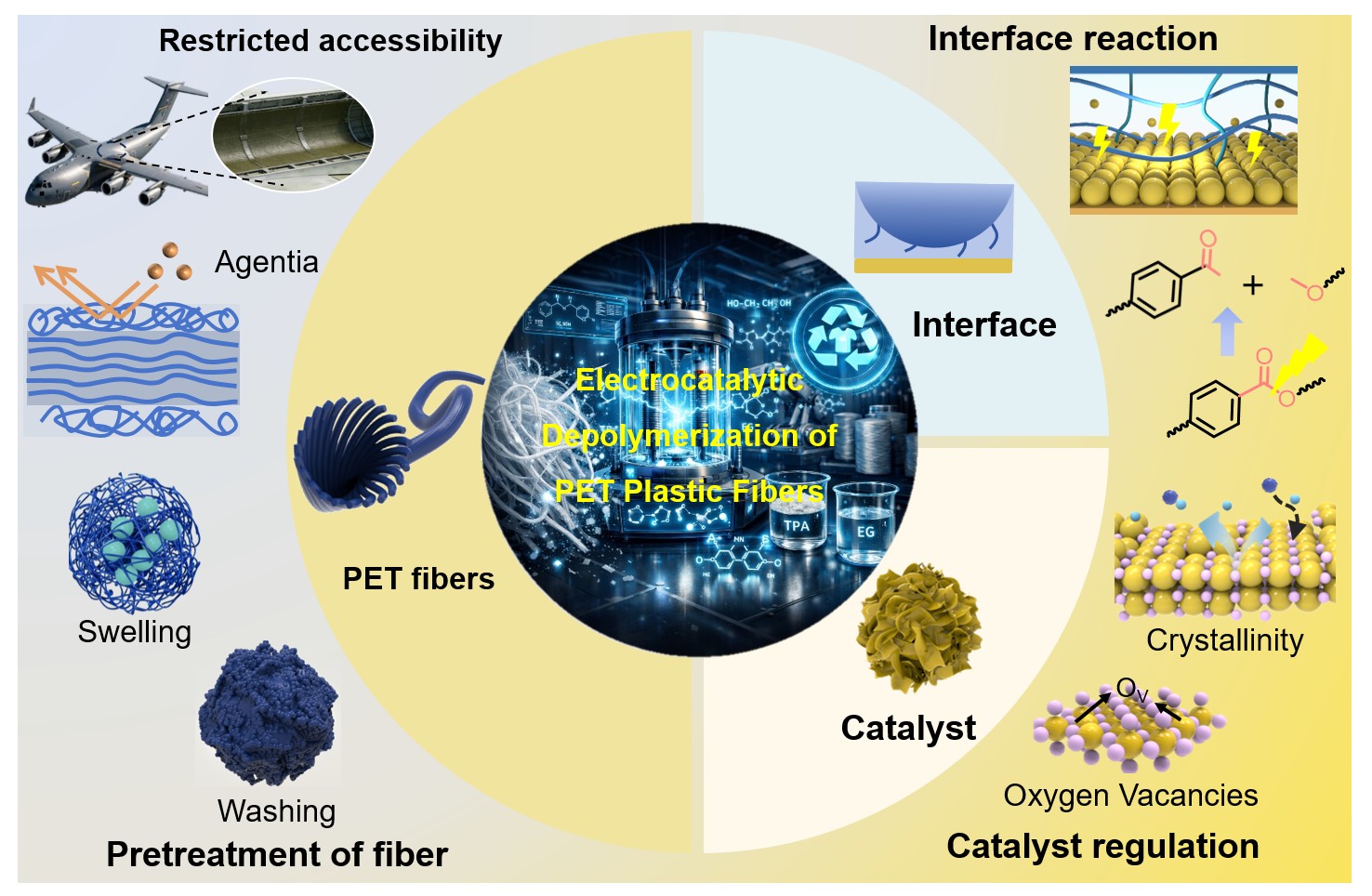
Poly (ethylene terephthalate) (PET) fibers constitute the largest share of global PET and are central to textiles and technical fabrics, yet high crystallinity, strong orientation, and complex finishing make them resistant to degradation and major sources of persistent microplastics. Conventional routes such as mechanical reprocessing, thermal depolymerization, hydrolysis, and alcoholysis were adapted from bulk PET but are inefficient for fibers due to limited accessibility, surface barriers, and poor selectivity toward high-purity monomers. This review adopts a fiber-centered perspective on electrocatalytic PET degradation that integrates structural, interfacial, and process considerations. It compares multiscale structural and chemical differences between fibers and bulk PET, and analyzes how pretreatments such as desizing, swelling, and surface activation condition fibers for electrochemical reactivity. It outlines fundamental principles of electrocatalytic depolymerization and classifies catalysts by structural descriptors including crystallinity, composition, and interfaces, supported by a consolidated dataset. Distinct from previous surveys, the review foregrounds fiber-specific interfaces and pretreatments and proposes a structure-centric framework for catalyst design. Highlights include transferable descriptors for cross-comparison and explicit coupling of pretreatment with catalyst selection. Looking ahead, priority is placed on scalable, continuous electrocatalytic platforms that link renewable electricity with circular textile recycling.
- Open Access
- Review
Electrocatalytic Depolymerization of PET Plastic Fibers for Circular Textiles
- Ruchuan Chen 1,†,
- Junfeng Li 1,†,
- Kean Zhu 1,†,
- Aoxiang Zhu 1,
- Weilin Xu 1,
- Hui Wang 2,*,
- Jun Wan 1,*
Author Information
Received: 04 Feb 2026 | Revised: 03 Apr 2026 | Accepted: 14 May 2026 | Published: 30 Jun 2026
Abstract
Graphical Abstract
Keywords
PET | plastic fiber | electrocatalytic degradation | fiber pretreatment | plastic recycling
References
- 1.
Fang, G.; Ma, X.; Hu, R.; et al. Horizontally Oriented 2D Skin Structures on Fiber Interface for Long-Life Flexible Energy Storage Devices. Chem. Eng. J. 2025, 509, 161557. https://doi.org/10.1016/j.cej.2025.161557.
- 2.
Yang, R.; Xu, G.; Tao, W.; et al. Recycled Polymer: Green Roads for Polyester Plastics. Green Carbon 2024, 2, 1–11. https://doi.org/10.1016/j.greenca.2024.01.004.
- 3.
Ma, X.; Wu, Z.; Tian, H.; et al. Durable Coaxial Fiber-Based Underwater Strain Sensor with Reversible Dry-Wet Transition. Infomat 2025, 7, e70030. https://doi.org/10.1002/inf2.70030.
- 4.
Liu, Y.-J.; Zhou, J.; Li, Y.; et al. State-of-the-Art Advances in Biotechnology for Polyethylene Terephthalate Bio-Depolymerization. Green Carbon 2025, 3, 303–319. https://doi.org/10.1016/j.greenca.2025.02.003.
- 5.
Huang, J.; Tian, H.; Zhang, H.; et al. Engineering Materials and Structural Paradigms for Mid-Infrared Thermal Management. Mater. Today Energy 2025, 52, 101944. https://doi.org/10.1016/j.mtener.2025.101944.
- 6.
Yang, X.; Li, C.; Song, H.; et al. CeO2/CoNiP Heterojunction as Excellent OER Electrocatalysts in Alkaline Seawater Effectively Suppresses Chloride Corrosion and Cobalt Leaching. ACS Sustain. Chem. Eng. 2025, 13, 13561–13572. https://doi.org/10.1021/acssuschemeng.5c05804.
- 7.
Cai, J.; Wu, Z.; Wang, S.; et al. Exploring Advanced Microwave Strategy for the Synthesis of Two‑Dimensional Energy Materials. Appl. Phys. Rev. 2024, 11, 021407. https://doi.org/10.1063/5.0231081.
- 8.
Jiang, H.; Li, J.; Xiao, Z.; et al. The Rapid Production of Multiple Transition Metal Carbides via Microwave Combustion under Ambient Conditions. Nanoscale 2020, 12, 16245–16252. https://doi.org/10.1039/D0NR05223J.
- 9.
Gandionco, K.A.; Kim, J.; Bekaert, L.; et al. Single‑Atom Catalysts for the Electrochemical Reduction of Carbon Dioxide into Hydrocarbons and Oxygenates. Carbon Energy 2024, 6, e410. https://doi.org/10.1002/cey2.410.
- 10.
Kim, M.; Joung, S.; Lee, S.; et al. Recent Advances in Ni-Based Electrocatalysts for Low-Energy Hydrogen Production via Alternative Pathways to Water Electrolysis. Energy Mater. 2025, 5, 500015. https://doi.org/10.20517/energymater.2024.244.
- 11.
Feng, Y.; Wang, M.; Zhang, H.; et al. Engineering Electrocatalytic Structures Through Molten Salt-Mediated Mechanistic Control. EcoEnergy 2025, 3, e70022. https://doi.org/10.1002/ece2.70022.
- 12.
Li, Q.; Fang, G.; Wu, Z.; et al. Advanced Microwave Strategies Facilitate Structural Engineering for Efficient Electrocatalysis. ChemSusChem 2024, 17, e202301874. https://doi.org/10.1002/cssc.202301874.
- 13.
Zhang, D.; Pan, W.; Sharma, A.; et al. Over 14% Unassisted Water Splitting Driven by Immersed Perovskite/Si Tandem Photoanode with Ni-Based Catalysts. Mater. Today Energy 2025, 48, 101809. https://doi.org/10.1016/j.mtener.2025.101809.
- 14.
Wang, K.; Wang, G.; Liu, Y.; et al. Regulation of Electrocatalytic Properties of High Entropy Alloy Electrocatalysts for the Oxygen Evolution Reaction. J. Mater. Chem. A 2024, 12, 29311–29334. https://doi.org/10.1039/D4TA04984E.
- 15.
Li, Y.; Li, T.; Zhang, T.; et al. Artificial Skin Sensation for Neuroprosthetic Hands. FlexMat 2025, 2, 458–474. https://doi.org/10.1002/flm2.70019.
- 16.
Ma, Y.; Qin, C.; Lei, Y.; et al. Tissue-Seeking Dyes for in Vivo Applications. Smart Mol. 2024, 2, e20240029. https://doi.org/10.1002/smo.20240029.
- 17.
Zhang, S.; Gong, J.; Rong, Z.; et al. Blade Coating Large-Area 3D/1D Perovskite Heterojunction Films for Effective Synaptic Memristors. Int. J. Min. Met. Mater. 2025, 32, 498–503. https://doi.org/10.1007/s12613-025-3327-z.
- 18.
Wang, K.; Liang, J.; Li, Z.; et al. Design of Experiments with the Support of Machine Learning for Process Parameter Optimization of All-Small-Molecule Organic Solar Cells. FlexMat 2024, 1, 234–247. https://doi.org/10.1002/flm2.34.
- 19.
Lin, Y.; Huang, Y.; Wang, T.; et al. Bioinspired Flexible Photonic Sensing Chips for Wearable Multiparameter Monitoring. FlexMat 2025, 2, 365–389. https://doi.org/10.1002/flm2.70007.
- 20.
Zhang, R.; Kong, X.; Ren, R.; et al. Recent Advances in Copper-Based Catalysts for Electrochemical Carbon Dioxide Reduction to C2+ Products. Carbon Neutralization 2025, 4, e70041. https://doi.org/10.1002/cnl2.70041.
- 21.
Ren, Y.; Yu, F.; Li, X.-G.; et al. Soft–Hard Interface Design in Super-Elastic Conductive Polymer Hydrogel Containing Prussian Blue Analogues to Enable Highly Efficient Electrochemical Deionization. Mater. Horiz. 2023, 10, 3548–3558. https://doi.org/10.1039/D2MH01149B.
- 22.
Wang, J.; Li, M.; Gao, H.; et al. Photoresponsive Tetracoordinate Arylboron Smart Molecules: Strategies for Molecular Design and Photoresponse Mechanisms. Smart Mol. 2024, 2, e20240041. https://doi.org/10.1002/smo.20240041.
- 23.
Li, J.; Jiang, H.; Zhou, Q.; et al. Best Available Technology Options for the Mitigation of Environmental Impacts in Waste Plastics. Carbon Neutrality 2024, 3, 29. https://doi.org/10.1007/s43979-024-00102-x.
- 24.
Liu, N.; Liu, D.; Zhan, Y.; et al. From Innovation to Integration: The Evolving Role of Carbon Capture and Storage in Global Decarbonization. cScience 2025, 1, e70008. https://doi.org/10.1002/csc3.70008.
- 25.
Qinyun, X.; Keli, Y.; Laodong, G.; et al. Diatom Biorefinery: Comprehensive Resource Utilization and Economic Feasibility for Sustainable Development. Sustain. Eng. Novit 2025, 1, 3. https://doi.org/10.53941/sen.2025.100003.
- 26.
Fan, M.; Tian, H.; Wu, Z.; et al. Microwave Shock Synthesis of Porous 2D Non-Layered Transition Metal Carbides for Efficient Hydrogen Evolution. SusMat 2025, 5, e252. https://doi.org/10.1002/sus2.252.
- 27.
Du, M.; Chen, Y.; Mai, M.; et al. Understanding and Modulating the Horizontal Orientations and Short‑Range Charge Transfer Excited States for High‑Performance Narrowband Emitters. FlexMat 2024, 1, 46–53. https://doi.org/10.1002/flm2.15.
- 28.
Huang, J.; Clark, A.H.; Hales, N.; et al. Spectroscopic Investigations of Complex Electronic Interactions by Elemental Doping and Material Compositing of Cobalt Oxide for Enhanced Oxygen Evolution Reaction Activity. Adv. Funct. Mater. 2024, 34, 2405384. https://doi.org/10.1002/adfm.202405384.
- 29.
Li, H.; Chen, C.; Ye, Z.; et al. Purely Organic Room Temperature Phosphorescent Materials toward Organic Light-Emitting Diodes. FlexMat 2024, 1, 173–192. https://doi.org/10.1002/flm2.23.
- 30.
Liu, Q.; Zhu, Z.; Zhang, H.; et al. Advanced Warming Textiles for Personalized Thermal Management through Radiative, Insulating, and Electrothermal Strategies. Mater. Today Energy 2026, 56, 102192. https://doi.org/10.1016/j.mtener.2026.102192.
- 31.
Xu, R.; Zhu, Z.; Zhang, H.; et al. Synergistic Material-Structure Engineering for Mid-Infrared Thermal Management in Textiles. Small 2025, 21, 2509257. https://doi.org/10.1002/smll.202509257.
- 32.
Wang, X.; Liu, T.; Sun, F.; et al. Highly Tough, Crack-Resistant and Self-Healable Piezo-Ionic Skin Enabled by Dynamic Hard Domains with Mechanosensitive Ionic Channel. Smart Mol. 2024, 2, e20240008. https://doi.org/10.1002/smo.20240008.
- 33.
Ruiying, F.; Lianchao, W.; Xutian, Y.; et al. Defects-Engineered Metal-Organic Frameworks for Supercapacitor Platform. Sustain. Eng. Novit 2025, 1, 2. https://doi.org/10.53941/sen.2025.100002.
- 34.
Chen, J.; Chu, L. AB Epoxy Encapsulation-Induced Transparency in Perovskite Films. Sci. China Mater. 2026, 69, 570–574. https://doi.org/10.1007/s40843-025-3552-2.
- 35.
Takai, L.; Kinoshita, Y.; Takahashi, N.; et al. n-Type Carbon Nanotube Inks for High-Yield Printing of Ultrabroadband Soft Photo-Imager Thin Sheets. FlexMat 2025, 2, 115–125. https://doi.org/10.1002/flm2.41.
- 36.
Kuanhong, C.; Guangshu, Y.; Mingxuan, L.; et al. Organoselenium Catalyzed Reaction: Sustainable Chemistry from Laboratory to Industry. Sustain. Eng. Novit 2025, 1, 1. https://doi.org/10.53941/sen.2025.100001.
- 37.
Yang, J.; Cui, M.; Deng, J.; et al. Mild and Efficient Stripping of Blended Cotton-Polyester Fabrics Based on an Extended Acetolysis System. Carbon Neutrality 2025, 4, 40. https://doi.org/10.1007/s43979-025-00154-7.
- 38.
Chauhan, M.; Budania, Y.; Modi, A.; et al. Trifunctional Nature of Heteroatom (B, N, S, O)-Doped Waste Diesel Soot: Turning Pollutants into Potential Energy Catalysts for HER, OER, and ORR. Carbon Neutralization 2025, 4, e195. https://doi.org/10.1002/cnl2.195.
- 39.
Liu, L.; Gan, M.; Fan, X.; et al. Ultrasound-Assisted Capture of CO2 from Flue Gas Using Steel Slag Leachate and Synthesis of Vaterite-Type CaCO3. cScience 2025, 1, e70006. https://doi.org/10.1002/csc3.70006.
- 40.
Tu, X.; Liu, X.; Zhang, Y.; et al. Advances in Sn-Based Oxide Catalysts for the Electroreduction of CO2 to Formate. Green Carbon 2024, 2, 131–148. https://doi.org/10.1016/j.greenca.2024.03.006.
- 41.
Quílez-Bermejo, J.; Herranz, J. A Review on Electrochemical CO2-to-CH4 Conversion for a Sustainable Energy Future: From Electrocatalysts to Electrolyzers. J. Mater. Chem. A 2025, 13, 41555–41579. https://doi.org/10.1039/D5TA03854E.
- 42.
Gao, Z.; Xie, H.; Yang, X.; et al. Electric Vehicle Lifecycle Carbon Emission Reduction: A Review. Carbon Neutralization 2023, 2, 528–550. https://doi.org/10.1002/cnl2.81.
- 43.
Mao, H.; Zhang, S.; Liu, J.; et al. Bimetallic Ions Modified 2-Methylimidazolium Functionalized Polypyrrole/Graphene Oxide for the Improved Supercapacitor. FlexMat 2024, 1, 302–310. https://doi.org/10.1002/flm2.32.
- 44.
Li, J.; Orbell, W.; Li, X.; et al. Resolving the Activity–Selectivity Trade-Off in NH3 Oxidation with an Intermetallic-Oxide Dual-Site Catalyst. Adv. Funct. Mater. 2026, 36, e30020. https://doi.org/10.1002/adfm.202530020.
- 45.
Meskher, H.; Woldu, A.R.; Chu, P.K.; et al. Sustainability Assessment of Seawater Splitting: Prospects, Challenges, and Future Directions. EcoEnergy 2024, 2, 630–651. https://doi.org/10.1002/ece2.68.
- 46.
Fan, C.; Pan, F.; Ma, S.; et al. Hydrogen Direct Reduction: History and Pathways for Cost Reduction. cScience 2025, 1, e70003. https://doi.org/10.1002/csc3.70003.
- 47.
Li, W.; Xu, Y.; Wang, G.; et al. Sustainable Carbon-Based Catalyst Materials Derived from Lignocellulosic Biomass for Energy Storage and Conversion: Atomic Modulation and Properties Improvement. Carbon Energy 2025, 7, e708. https://doi.org/10.1002/cey2.708.
- 48.
Wan, J.; Fang, G.; Mi, S.; et al. Metastable 2D Amorphous Nb2O5 for Aqueous Supercapacitor Energy Storage. Chem. Eng. J. 2024, 488, 150912. https://doi.org/10.1016/j.cej.2024.150912.
- 49.
Baig, M.M.; Khan, S.A.; Ahmad, H.; et al. 3D Printing of Hydrogels for Flexible Micro‑Supercapacitors. FlexMat 2024, 1, 79–99. https://doi.org/10.1002/flm2.14.
- 50.
Qin, S.; Dai, J.; Tian, H.; et al. 3D Printing Driving Innovations in Extreme Low‑Temperature Energy Storage. Virtual Phys. Prototyp. 2025, 20, e2459798. https://doi.org/10.1080/17452759.2025.2459798.
- 51.
Hu, R.; Wei, L.; Xian, J.; et al. Microwave Shock Process for Rapid Synthesis of 2D Porous La0.2Sr0.8CoO3 Perovskite as an Efficient Oxygen Evolution Reaction Catalyst. Acta Phys. Chim. Sin. 2023, 39, 2212025. https://doi.org/10.3866/pku.Whxb202212025.
- 52.
Feng, Y.; Dai, J.; Wang, M.; et al. Unraveling Metastable Perovskite Oxides: Insights from Structural Engineering to Synthesis Paradigms. Microstructures 2025, 5, 2025068. https://doi.org/10.20517/microstructures.2024.115.
- 53.
Li, Z.; Wang, S.; Yin, Y.; et al. Electrooxidation of Ethylene Glycol to Glycolic Acid with Pt-Ni(OH)2 Catalysts: High Efficiency and Selectivity for PET Plastics Upgrading. Chem. Asian J. 2025, 20, e202401843. https://doi.org/10.1002/asia.202401843.
- 54.
Li, Y.; Yi, H.; Li, M.; et al. Synchronous Degradation and Decolorization of Colored Poly(ethylene terephthalate) Fabrics for the Synthesis of High Purity Terephthalic Acid. J. Cleaner Prod. 2022, 366, 132985. https://doi.org/10.1016/j.jclepro.2022.132985.
- 55.
Wang, D.; Xu, H.; Tan, F.; et al. Boosting Simultaneous Proton Transfer and Oxygen‑Related Radical Species Generation for H2O2 Photosynthesis by Cationic Polarization of Covalent Organic Polymers. Chem. Eng. J. 2025, 524, 169225. https://doi.org/10.1016/j.cej.2025.169225.
- 56.
Su, Y.; Zhang, Y.; Feng, W.; et al. Monocarboxylic Acid Structural Analogues Facilitate in Situ Composite of Functional Complexes for Aqueous Batteries. Angew. Chem. Int. Ed. 2025, 64, e202502752. https://doi.org/10.1002/anie.202502752.
- 57.
Chang, C.-W.; Ting, Y.-C.; Yen, F.-Y.; et al. High Performance Anion Exchange Membrane Water Electrolysis Driven by Atomic Scale Synergy of Non‑Precious High Entropy Catalysts. Energy Mater. 2025, 5, 500042. https://doi.org/10.20517/energymater.2025.05.
- 58.
Wu, X.; Chen, M.; Li, S.; et al. Sea Urchin-Like La-Doped MnO2 for Electrocatalytic Oxidation Degradation of Sulfonamide in Water. Energy Mater. 2025, 5, 500089. https://doi.org/10.20517/energymater.2025.103.
- 59.
Yang, X.; Zhang, Y.; Sun, P.; et al. A Review on Renewable Energy: Conversion and Utilization of Biomass. Smart Mol. 2024, 2, e20240019. https://doi.org/10.1002/smo.20240019.
- 60.
Liu, Y.; Ma, J.; Yang, Y.; et al. Smart Chiral Liquid Crystal Elastomers: Design, Properties and Application. Smart Mol. 2024, 2, e20230025. https://doi.org/10.1002/smo.20230025.
- 61.
Hu, K.; Li, B.; Tian, Z.; et al. Multiscale Simulation in Fuel Cell and Electrolyzer Systems: A Review of Methods, Applications, and Future Prospects. Sustain. Eng. Novit 2025, 1, 5. https://doi.org/10.53941/sen.2025.100005.
- 62.
Liu, Y.; Liu, K.; Wang, P.; et al. Electrocatalytic Upcycling of Nitrogenous Wastes into Green Ammonia: Advances and Perspectives on Materials Innovation. Carbon Neutrality 2023, 2, 14. https://doi.org/10.1007/s43979-023-00055-7.
- 63.
Han, Y.; Wang, J.; Liu, Y.; et al. Stability Challenges and Opportunities of NiFe-Based Electrocatalysts for Oxygen Evolution Reaction in Alkaline Media. Carbon Neutralization 2024, 3, 172–198. https://doi.org/10.1002/cnl2.110.
- 64.
Huijie, Z.; Wenjiang, Z.; Shunyu, G.; et al. Multimodal Intelligence in Chemical Discovery: Integrating Interpretable ML, Autonomous Robotics, and Edge Computing. Sustain. Eng. Novit 2025, 1, 4. https://doi.org/10.53941/sen.2025.100004.
- 65.
Rabiee, H.; Yan, P.; Wang, H.; et al. Electrochemical CO2 Reduction Integrated with Membrane/Adsorption-Based CO2 Capture in Gas-Diffusion Electrodes and Electrolytes. EcoEnergy 2024, 2, 3–21. https://doi.org/10.1002/ece2.23.
- 66.
Yu, L.; Yiwen, Y.; Rui, W.; et al. Computational Studies for Aqueous Zinc-Ion Secondary Batteries. Sustain. Eng. Novit 2025, 1, 6. https://doi.org/10.53941/sen.2025.100006.
- 67.
Zhao, Z.; Yao, X.; Zhang, L.; et al. Electrocatalytic Dehalogenation in the Applications of Organic Synthesis and Environmental Degradation. EcoEnergy 2024, 2, 83–113. https://doi.org/10.1002/ece2.28.
- 68.
Chen, B.; Feng, M.; Chen, Y.; et al. Performing Electrocatalytic CO2 Reduction Reactions at a High Pressure. Carbon Neutrality 2024, 3, 31. https://doi.org/10.1007/s43979-024-00106-7.
- 69.
Liu, K.; Nawaz, M.A.; Liao, G. Progress and Future Challenges in Designing High‑Performance Ni/CeO2 Catalysts for CO2 Methanation: A Critical Review. Carbon Neutralization 2025, 4, e190. https://doi.org/10.1002/cnl2.190.
- 70.
Birat, J.-P.; Fick, G. Recent Advances in Life Cycle Assessment and Other Sustainability Metrics. cScience 2025, 1, e70007. https://doi.org/10.1002/csc3.70007.
- 71.
McTernan, C.T.; Davies, J.A.; Nitschke, J.R. Beyond Platonic: How to Build Metal–Organic Polyhedra Capable of Binding Low‑Symmetry, Information-Rich Molecular Cargoes. Chem. Rev. 2022, 122, 10393–10437. https://doi.org/10.1021/acs.chemrev.1c00763.
- 72.
Zhai, Z.; Li, D.; Lu, X.; et al. Heteroatom‑Induced Tensile Strain in Copper Lattice Boosts CO2 Electroreduction toward Multi-Carbon Products. Carbon Energy 2024, 6, e648. https://doi.org/10.1002/cey2.648.
- 73.
Zhang, C.; Gu, Y.; Jiang, Q.; et al. Exploration of Gas-Dependent Self-Adaptive Reconstruction Behavior of Cu2O for Electrochemical CO2 Conversion to Multi‑Carbon Products. Nano Micro Lett. 2024, 17, 66. https://doi.org/10.1007/s40820-024-01568-1.
- 74.
Lv, Z.; Jia, D.; Wei, J.; et al. Oxygen Atom-Driven COOH Formation Pathway on FeP/Cu2O Heterostructure for Highly Selective Photoelectrochemical Reduction of CO2 to CO. Electrochim. Acta 2026, 552, 148242. https://doi.org/10.1016/j.electacta.2026.148242.
- 75.
Zhang, T.; Fan, H.J. Grafted Superstructure Renders Catalyst Stability in Alkaline Water Oxidation. cScience 2025, 1, e70000. https://doi.org/10.1002/csc3.70000.
- 76.
Tian, Y.; Chen, R.; Liu, X.; et al. Highly Stabilized and Selective Ammonia Electro-Oxidation over CuNi Metallic Glass Nanoarray. Carbon Energy 2025, 7, e667. https://doi.org/10.1002/cey2.667.
- 77.
Gu, Z.; Zhu, J.; Xue, Z.; et al. Challenges and Strategies for CO2 Electroreduction to C2+ Products under Acidic Conditions. Green Carbon 2025, in press. https://doi.org/10.1016/j.greenca.2025.07.002.
- 78.
Dai, J.; Xian, J.; Liu, K.; et al. Unconventional Metastable Cubic 2D LaMnO3 for Efficient Alkaline Seawater Oxygen Evolution. Chin. J. Catal. 2025, 74, 228–239. https://doi.org/10.1016/S1872-2067(25)64667-5.
- 79.
Chen, C.; Jin, H.; Wang, P.; et al. Local Reaction Environment in Electrocatalysis. Chem. Soc. Rev. 2024, 53, 2022–2055. https://doi.org/10.1039/D3CS00669G.
- 80.
Noh, K.J.; Park, B.J.; Wang, Y.; et al. Tailoring Local Structures of Atomically Dispersed Copper Sites for Highly Selective CO2 Electroreduction. Carbon Energy 2024, 6, e419. https://doi.org/10.1002/cey2.419.
- 81.
Fan, M.; Guo, J.; Fang, G.; et al. Microwave-Pulse Assisted Synthesis of Tunable Ternary‑Doped 2D Molybdenum Carbide for Efficient Hydrogen Evolution. Chem. Synth. 2024, 4, 36. https://doi.org/10.20517/cs.2023.72.
- 82.
Wu, Z.; Xian, J.; Dai, J.; et al. Microwave-Pulse Synthesis of Tunable 2D Porous Nickel‑Enriched LaMnxNi1₋xO3 Solid Solution for Efficient Electrocatalytic Urea Oxidation. J. Mater. Chem. A 2024, 12, 7047–7057. https://doi.org/10.1039/d4ta00235k.
- 83.
Zhang, H.; Qi, M.; Wang, Y. NiNC Catalysts in CO2-to-CO Electrolysis. Nano Micro Lett. 2024, 17, 94. https://doi.org/10.1007/s40820-024-01595-y.
- 84.
Hu, X.; Jiang, M.; Li, S. Synergy and Stability: The Rise of High‑Entropy Single-Atom Catalysts. Adv. Mater. 2026, 38, e22135. https://doi.org/10.1002/adma.202522135.
- 85.
Chen, Z.; Han, N.; Wei, W.; et al. Dual Doping: An Emerging Strategy to Construct Efficient Metal Catalysts for Water Electrolysis. EcoEnergy 2024, 2, 114–140. https://doi.org/10.1002/ece2.29.
- 86.
Wang, S.; Zhang, M.; Mu, X.; et al. Atomically Dispersed Multi‑Site Catalysts: Bifunctional Oxygen Electrocatalysts Boost Flexible Zinc–Air Battery Performance. Energy Environ. Sci. 2024, 17, 4847–4870. https://doi.org/10.1039/D4EE01656D.
- 87.
Shan, L.; Liu, Y.; Chen, Y.; et al. High-Density Iron–Nickel Dual Sites in Carbon Aerogels as Effective Alkaline Water/Seawater Oxidation Electrocatalysts. ACS Sustainable Chem. Eng. 2025, 13, 311–320. https://doi.org/10.1021/acssuschemeng.4c07297.
- 88.
Wu, B.; Harrath, K.; Sendeku, M.G.; et al. Electrochemical Evolution of a Metal Oxyhydroxide Surface on Two-Dimensional Layered Metal Phosphorus Trisulfides Enables the Oxidation of Amine to Nitrile. Carbon Energy 2025, 7, e672. https://doi.org/10.1002/cey2.672.
- 89.
Dai, J.; Wang, M.; Tian, H.; et al. Microwave Shock-Driven Thermal Engineering of Unconventional Cubic 2D LaMnO3 for Efficient Oxygen Evolution. J. Mater. Chem. A 2025, 13, 31002–31012. https://doi.org/10.1039/D5TA01034A.
- 90.
Choe, S.; Kim, N.; Jang, Y.J. Perspective on the Interfacial Engineering for Electrocatalytic N2 to NH3 Conversion from Catalysts to Systems. EcoEnergy 2023, 1, 3–15. https://doi.org/10.1002/ece2.10.
- 91.
Jiang, H.; Xian, J.; Hu, R.; et al. Microwave Discharge for Rapid Introduction of Bimetallic-Synergistic Configuration to Conductive Catecholate toward Long-Term Supercapacitor. Chem. Eng. J. 2023, 455, 140804. https://doi.org/10.1016/j.cej.2022.140804.
- 92.
Zhao, Q.; Zhao, B.; Long, X.; et al. Interfacial Electronic Modulation of Dual-Monodispersed Pt–Ni3S2 as Efficacious Bi‑Functional Electrocatalysts for Concurrent H2 Evolution and Methanol Selective Oxidation. Nano Micro Lett. 2024, 16, 80. https://doi.org/10.1007/s40820-023-01282-4.
- 93.
Faridi, S.; Razzaq, S.; Singh, D.; et al. Trends in Competing Oxygen and Chlorine Evolution Reactions over Electrochemically Formed Single-Atom Centers of MXenes. J. Mater. Chem. A 2025, 13, 16481–16490. https://doi.org/10.1039/D5TA02220G.
- 94.
Mei, Z.; Zhou, Y.; Lv, W.; et al. Recent Progress in Electrocatalytic Urea Synthesis under Ambient Conditions. ACS Sustain. Chem. Eng. 2022, 10, 12477–12496. https://doi.org/10.1021/acssuschemeng.2c03681.
- 95.
Kohan, E.; Khoshnavazi, R.; Hosseini, M.G.; et al. A Review on Instability Factors of Mono- and Divalent Metal Ion Batteries: From Fundamentals to Approaches. J. Mater. Chem. A 2024, 12, 30190–30248. https://doi.org/10.1039/D4TA05386A.
- 96.
Chen, Y.; Jia, C.; Zhou, C.; et al. Electrocatalytic Polyester Waste Upcycling via Lattice Oxygen Redox Activation. Angew. Chem. Int. Ed. 2025, 64, e202513447. https://doi.org/10.1002/anie.202513447.
- 97.
Qi, L.; Jiang, J.; Sun, Y.; et al. Ultra-Efficient Electrooxidation of Ethylene Glycol Enabled by Pd-Loaded Fe-Doped Nb2O5 with Abundant Oxygen Vacancies. Chem. Eng. J. 2023, 475, 146050. https://doi.org/10.1016/j.cej.2023.146050.
- 98.
Li, Z.; Yang, Z.; Wang, S.; et al. Medium Entropy Metal Oxide Induced OH Species Targeted Transfer Strategy for Efficient Polyethylene Terephthalate Plastic Recycling. Chem. Eng. J. 2024, 479, 147611. https://doi.org/10.1016/j.cej.2023.147611.
- 99.
Mari, E.; Tsai, P.; Eswaran, M.; et al. Efficient Electro-Catalytic Oxidation of Ethylene Glycol Using Flower-Like Graphitic Carbon Nitride/Iron Oxide/Palladium Nanocomposite for Fuel Cell Application. Fuel 2020, 280, 118646. https://doi.org/10.1016/j.fuel.2020.118646.
- 100.
Wang, J.; Li, X.; Zhang, T.; et al. Electro-Reforming Polyethylene Terephthalate Plastic to Co-Produce Valued Chemicals and Green Hydrogen. J. Phys. Chem. Lett. 2022, 13, 622–627. https://doi.org/10.1021/acs.jpclett.1c03658.
- 101.
Aladeemy, S.A.; AlRijraji, T.R.; Amer, M.S.; et al. Electrooxidation of Ethylene Glycol Coupled with Hydrogen Production on Porous NiO/Ni@NF Nanosheet Electrocatalysts. Catal. Sci. Technol. 2025, 15, 2571–2583. https://doi.org/10.1039/D4CY01450B.
- 102.
Arjona, N.; Espinosa‑Magaña, F.; Bañuelos, J.A.; et al. Manganese Oxides (Mn3O4 & α‑MnO2) as Co-Catalysts in Pd‑Based Nanomaterials for the Ethylene Glycol Electro-Oxidation. ChemElectroChem 2022, 9, e202200015. https://doi.org/10.1002/celc.202200015.
- 103.
Sultan, M.A.; Hassan, H.B.; Tammam, R.H. Stimulation of Ethylene Glycol Electrooxidation on Electrodeposited Ni–PbO2–GN Nanocomposite in Alkaline Medium. J. Appl. Electrochem. 2023, 53, 463–486. https://doi.org/10.1007/s10800-022-01792-w.
- 104.
Leiva‑Leroy, C.; Koul, A.; Nkou, F.B.S.; et al. From Heat to Electrons: Bridging Heterogeneous Liquid‑Phase Thermal and Electrocatalytic Oxidation of Ethylene Glycol over Co3O4. Angew. Chem. Int. Ed. 2026, 65, e19188. https://doi.org/10.1002/anie.202519188.
- 105.
Wang, H.; Yang, B.; Smith, R.L., Jr.; et al. Electro-Reconstructed Transition Metal Electrodes for Coupled-Upgrading of Nitrate Pollution and Waste Poly(Ethylene Terephthalate) Plastics. Adv. Funct. Mater. 2025, 35, 2425333. https://doi.org/10.1002/adfm.202425333.
- 106.
Mais, L.; Melis, N.; Vacca, A.; et al. Electrochemical Removal of PET and PE Microplastics for Wastewater Treatment. Environ. Sci. Water Res. Technol. 2024, 10, 399–407. https://doi.org/10.1039/D3EW00582H.
- 107.
Sun, L.; Lv, H.; Xiao, J.; et al. Enzymatic Mesoporous Metal Nanocavities for Concurrent Electrocatalysis of Nitrate to Ammonia Coupled with Polyethylene Terephthalate Upcycling. Adv. Mater. 2024, 36, 2402767. https://doi.org/10.1002/adma.202402767.
- 108.
Xin, L.; Zhang, Z.; Qi, J.; et al. Electrocatalytic Oxidation of Ethylene Glycol (EG) on Supported Pt and Au Catalysts in Alkaline Media: Reaction Pathway Investigation in Three-Electrode Cell and Fuel Cell Reactors. Appl. Catal. B 2012, 125, 85–94. https://doi.org/10.1016/j.apcatb.2012.05.024.
- 109.
Ma, Y.; Guo, X.; Yuan, W.; et al. Paired Electrochemical Synthesis of Glycolic Acid and Ammonia from Polyester and Nitrate Sewage. Chem Catal. 2025, 5, 101336. https://doi.org/10.1016/j.checat.2025.101336.
- 110.
Kang, S.; Yuan, W.; Guo, X.; et al. Concurrent Production of Glycolic Acid via Anode Valorization of Plastic Paired with Cathode Upcycling of Biomass Derivative. Angew. Chem. Int. Ed. 2025, 64, e202504993. https://doi.org/10.1002/anie.202504993.
- 111.
Han, S.; Sun, L.; Fan, D.; et al. Pulsed Electrosynthesis of Glycolic Acid through Polyethylene Terephthalate Upcycling over a Mesoporous PdCu Catalyst. Nat. Commun. 2025, 16, 3426. https://doi.org/10.1038/s41467-025-58813-3.
- 112.
Wang, S.; Li, S.; Li, Y.; et al. Electronic State Reconfiguration of NiMoCox Boosts Electrocatalytic Upcycling of Polyethylene Terephthalate Plastic Wastes for Simultaneous Production of Formate and Green Hydrogen. Chem. Eng. J. 2025, 515, 163901. https://doi.org/10.1016/j.cej.2025.163901.
- 113.
Si, D.; Xiong, B.; Chen, L.; et al. Highly Selective and Efficient Electrocatalytic Synthesis of Glycolic Acid in Coupling with Hydrogen Evolution. Chem Catal. 2021, 1, 941–955. https://doi.org/10.1016/j.checat.2021.08.001.
- 114.
Chen, J.; Zhang, F.; Kuang, M.; et al. Unveiling Synergy of Strain and Ligand Effects in Metallic Aerogel for Electrocatalytic Polyethylene Terephthalate Upcycling. Proc. Natl. Acad. Sci. USA 2024, 121, e2318853121. https://doi.org/10.1073/pnas.2318853121.
- 115.
Selvaraj, V.; Vinoba, M.; Alagar, M. Electrocatalytic Oxidation of Ethylene Glycol on Pt and Pt–Ru Nanoparticles Modified Multi‑Walled Carbon Nanotubes. J. Colloid Interface Sci. 2008, 322, 537–544. https://doi.org/10.1016/j.jcis.2008.02.069.
- 116.
Cheng, J.; Tu, Y.; Xiang, Y.; et al. Anti-Poisoning of CO and Carbonyl Species over Pd Catalysts during the Electrooxidation of Ethylene Glycol to Glycolic Acid at Elevated Current Density. Chem. Sci. 2025, 16, 4303–4310. https://doi.org/10.1039/D4SC08579E.
- 117.
Ma, H.-Z.; He, S.-H.; Zhang, Y.; et al. Selective Electrocatalytic Oxidation of Ethylene Glycol into Glycolic Acid at Coin‑Group Electrodes: An Investigation on Catalytic Activity and Selectivity. ACS Sustain. Chem. Eng. 2024, 12, 12249–12259. https://doi.org/10.1021/acssuschemeng.4c04928.
- 118.
Guo, H.; Kang, J.; Du, Y.; et al. N-Coordinated Pd‑Rh Synergy for Highly Selective Ethylene Glycol Oxidation and Efficient Hydrogen Evolution. Green Chem. 2025, 27, 7242–7253. https://doi.org/10.1039/d5gc00784d.
- 119.
Li, W.; Bao, Q.; Ma, F.; et al. Metal-Support Interaction and Tip-Enhanced Electric Field Effect Co-Enhancing Oxygen Species Adsorption/Enrichment for Efficient Electrooxidation of Plastic Waste Derived Alcohol into Glycolic Acid. Appl. Catal. B Environ. 2025, 374, 125375. https://doi.org/10.1016/j.apcatb.2025.125375.
- 120.
Wang, Z.; Li, J.; Zhang, Q.; et al. Facilitating Formate Selectivity via Optimizing eg* Band Broadening in NiMn Hydroxides for Ethylene Glycol Electro-Oxidation. Angew. Chem. Int. Ed. 2024, 63, e202411517. https://doi.org/10.1002/anie.202411517.
- 121.
Lu, X.; Guo, Y.; Fu, H.; et al. Electrochemical Upcycling Strategy for Polyethylene Terephthalate Plastic Coupled with Efficient Hydrogen Production. Chem. Eng. J. 2025, 506, 159810. https://doi.org/10.1016/j.cej.2025.159810.
- 122.
Fang, Z.; Du, X.; Qian, K.; et al. Interfacial Effects in Ni(OH)2/MnO@Ni Aerogel Heterostructures Promote Highly Efficient Electrooxidation of Ethylene Glycol to Formate and Hydrogen. Int. J. Hydrogen Energy 2024, 74, 39–48. https://doi.org/10.1016/j.ijhydene.2024.06.140.
- 123.
Ma, Y.; Ge, H.; Zhang, Y.; et al. Selective Electrooxidation of Ethylene Glycol to Formate with Hydrogen Cogeneration in Ni3S2 Nanodomains on NiFeMn-LDH Nanosheet Arrays. ACS Sustain. Chem. Eng. 2025, 13, 5601–5612. https://doi.org/10.1021/acssuschemeng.4c10750.
- 124.
Li, Y.; Liu, X.; Wang, K.; et al. Oxygen Vacancy Assisted Ru-Ni(OH)2 for Efficient Ethylene Glycol Electrooxidation Reaction. Inorg. Chem. Front. 2024, 11, 6889–6897. https://doi.org/10.1039/d4qi01372g.
- 125.
Fan, J.; Xu, B.; Cheng, C.; et al. Pd-Doped CoNi-Based Bifunctional Electrodes for Upcycling of PET Plastic with Ultra-Long Stability. Appl. Catal. B Environ. 2025, 367, 125076. https://doi.org/10.1016/j.apcatb.2025.125076.
- 126.
Wang, N.; Li, X.; Hu, M.-K.; et al. Ordered Macroporous Superstructure of Bifunctional Cobalt Phosphide with Heteroatomic Modification for Paired Hydrogen Production and Polyethylene Terephthalate Plastic Recycling. Appl. Catal. B 2022, 316, 121667. https://doi.org/10.1016/j.apcatb.2022.121667.
- 127.
Xia, T.; Chen, Z.; Dong, C.; et al. Yeast Inherited Phosphide/Bio‑Carbon for Controllable Polyethylene Terephthalate Upcycling. Adv. Funct. Mater. 2025, 35, 2503193. https://doi.org/10.1002/adfm.202503193.
- 128.
Zhou, H.; Ren, Y.; Li, Z.; et al. Electrocatalytic Upcycling of Polyethylene Terephthalate to Commodity Chemicals and H2 Fuel. Nat. Commun. 2021, 12, 4679. https://doi.org/10.1038/s41467-021-25048-x.
- 129.
Yu, Z.; Xu, J.; Amorim, I.; et al. Easy Preparation of Multifunctional Ternary PdNiP/C Catalysts toward Enhanced Small Organic Molecule Electro-Oxidation and Hydrogen Evolution Reactions. J. Energy Chem. 2021, 58, 256–263. https://doi.org/10.1016/j.jechem.2020.10.016.
- 130.
Zhang, J.; Zhang, X.; Shi, C.; et al. Plasma-Constructed Co2P-Ni2P Heterointerface for Electro-Upcycling of Polyethylene Terephthalate Plastic to Co-Produce Hydrogen and Formate. Small 2024, 20, 2406767. https://doi.org/10.1002/smll.202406767.
- 131.
Chang, J.; Wang, L.; Wu, D.; et al. Concurrent Electrocatalytic Hydrogen Evolution and Polyethylene Terephthalate Plastics Reforming by Self-Supported Amorphous Cobalt Iron Phosphide Electrode. J. Colloid Interface Sci. 2024, 655, 555–564. https://doi.org/10.1016/j.jcis.2023.11.044.
- 132.
Ghosh, S.; Mondal, B.; Roy, S.; et al. Alcohol Oxidation with High Efficiency and Selectivity by Nickel Phosphide Phases. J. Mater. Chem. A 2022, 10, 8238–8244. https://doi.org/10.1039/D2TA00863G.
- 133.
Ma, G.; Yang, N.; Xue, Y.; et al. Ethylene Glycol Electrochemical Reforming Using Ruthenium Nanoparticle‑Decorated Nickel Phosphide Ultrathin Nanosheets. ACS Appl. Mater. Interfaces 2021, 13, 42763–42772. https://doi.org/10.1021/acsami.1c10971.
- 134.
Yue, S.; Zhao, Z.; Liu, Y.; et al. Dual-Site Synergistic Electrocatalysis Enables Highly Selective Upcycling of Real-World Plastic Waste to Glycolic Acid. Adv. Funct. Mater. 2025, 35, 2509766. https://doi.org/10.1002/adfm.202509766.
- 135.
Ma, Y.; Li, L.; Tang, J.; et al. Electrochemical PET Recycling to Formate through Ethylene Glycol Oxidation on Ni-Co-S Nanosheet Arrays. J. Mater. Chem. A 2024, 12, 33917–33925. https://doi.org/10.1039/d4ta07156e.
- 136.
Li, J.; Li, L.; Ma, X.; et al. Selective Ethylene Glycol Oxidation to Formate on Nickel Selenide with Simultaneous Evolution of Hydrogen. Adv. Sci. 2023, 10, 2300841. https://doi.org/10.1002/advs.202300841.
- 137.
Behera, S.; Dinda, S.; Saha, R.; et al. Quantitative Electrocatalytic Upcycling of Polyethylene Terephthalate Plastic and Its Oligomer with a Cobalt‑Based One-Dimensional Coordination Polymer Having Open Metal Sites along with Coproduction of Hydrogen. ACS Catal. 2023, 13, 469–474. https://doi.org/10.1021/acscatal.2c05270.
- 138.
Li, M.; Xia, T.; Wang, M.; et al. Biocarbon-Confined Bimetallic FeCo Metal-Organic Framework Orthogonal Nanosheet Arrays for Industry-Level Ethylene Glycol Oxidation. Chin. J. Struct. Chem. 2025, 44, 100627. https://doi.org/10.1016/j.cjsc.2025.100627.
- 139.
Das, S.; Zhang, T.; Clarkson, G.; et al. Selective Electrocatalytic Production of Formic Acid from Plastic Waste Using a Nickel Metal‑Organic Framework Constructed from a Biomass-Derived Ligand. ChemSusChem 2025, 18, e202402319. https://doi.org/10.1002/cssc.202402319.
- 140.
Guo, Z.; Liu, M.; Ga, L.; et al. Terbium-Doped Cobalt-Based Metal-Organic Frameworks for Electrocatalytic Hydrogen Production and Polyethylene Terephthalate Plastic Upcycling. Chem. Eng. J. 2024, 496, 154062. https://doi.org/10.1016/j.cej.2024.154062.
- 141.
Gangadharan, P.G.; Bharti, A.; Sengupta, S.; et al. Enhancing the Degradation of Polystyrene and Polyethylene Terephthalate Microplastics in Water Using Electrochemical Treatment at Neutral pH. J. Environ. Manag. 2025, 394, 127401. https://doi.org/10.1016/j.jenvman.2025.127401.
- 142.
Pham, P.H.; Barlow, S.; Marder, S.R.; et al. Electricity-Driven Recycling of Ester Plastics Using One-Electron Electro-Organocatalysis. Chem Catal. 2023, 3, 100675. https://doi.org/10.1016/j.checat.2023.100675.
- 143.
Chen, R.; Zhang, Z.; Deng, Y.; et al. Electrochemical Degradation of PET Microplastics and Its Mechanism. Ind. Eng. Chem. Res. 2025, 64, 7915–7929. https://doi.org/10.1021/acs.iecr.5c00311.
- 144.
Mohanty, D.; Kuan, W.-F. Recent Advances in Carbon‑Based Electrocatalysts for Rechargeable Li-CO2 Batteries: A Review. Mater. Today Energy 2025, 54, 102095. https://doi.org/10.1016/j.mtener.2025.102095.
- 145.
Wang, K.; Yun, S.; Sun, M.; et al. Strengthening Heterogeneous Strain in FeCoNiMo-Based High-Entropy Alloys for Advanced Energy Conversion. Mater. Today Energy 2025, 48, 101762. https://doi.org/10.1016/j.mtener.2024.101762.
- 146.
Jin, J.; Wang, X.; Hu, Y.; et al. Precisely Control Relationship between Sulfur Vacancy and H Absorption for Boosting Hydrogen Evolution Reaction. Nano Micro Lett. 2024, 16, 63. https://doi.org/10.1007/s40820-023-01291-3.
- 147.
Adli, N.M.; Zhang, H.; Mukherjee, S.; et al. Review—Ammonia Oxidation Electrocatalysis for Hydrogen Generation and Fuel Cells. J. Electrochem. Soc. 2018, 165, J3130. https://doi.org/10.1149/2.0191815jes.
- 148.
Qiu, H.; Jian, J.; Huang, J.; et al. A High-Entropy Carbonate Hydroxide as a High-Efficient Tri-Functional Electrocatalyst for OER/ORR/MOR. Mater. Today Energy 2025, 49, 101847. https://doi.org/10.1016/j.mtener.2025.101847.
- 149.
Castañeda‑Morales, E.; Peralta-Cruz, J.O.; Ruiz-Zepeda, F.; et al. Electrochemical Reduction of NO3⁻ to NH3 Using Defect‑Rich TiO2 Support Loaded with CuNi Catalysts: Differential Electrochemical Mass Spectrometry Insights. Mater. Today Energy 2024, 41, 101525. https://doi.org/10.1016/j.mtener.2024.101525.
- 150.
Gao, X.; Dai, S.; Teng, Y.; et al. Ultra-Efficient and Cost-Effective Platinum Nanomembrane Electrocatalyst for Sustainable Hydrogen Production. Nano Micro Lett. 2024, 16, 108. https://doi.org/10.1007/s40820-024-01324-5.
- 151.
Zhang, Y.; Jiang, Y.; Abdukayum, A.; et al. Recent Advances in Selenide-Based Electrocatalysts for Hydrogen/Oxygen Evolution Reaction: From Mechanism and Synthesis to Application. Mater. Today Energy 2024, 44, 101641. https://doi.org/10.1016/j.mtener.2024.101641.
- 152.
Zhou, P.; Li, W.; Lan, J.; et al. Electroredox Carbene Organocatalysis with Iodide as Promoter. Nat. Commun. 2022, 13, 3827. https://doi.org/10.1038/s41467-022-31453-7.
- 153.
Zhu, C.; Ang, N.W.; Meyer, T.H.; et al. Organic Electrochemistry: Molecular Syntheses with Potential. ACS Cent. Sci. 2021, 7, 415–431. https://doi.org/10.1021/acscentsci.0c01532.
- 154.
Yan, M.; Kawamata, Y.; Baran, P.S. Synthetic Organic Electrochemical Methods Since 2000: On the Verge of a Renaissance. Chem. Rev. 2017, 117, 13230–13319. https://doi.org/10.1021/acs.chemrev.7b00397.
- 155.
Francke, R.; Little, R.D. Redox Catalysis in Organic Electrosynthesis: Basic Principles and Recent Developments. Chem. Soc. Rev. 2014, 43, 2492–2521. https://doi.org/10.1039/C3CS60464K.
- 156.
Tamirat, A.G.; Guan, X.; Liu, J.; et al. Redox Mediators as Charge Agents for Changing Electrochemical Reactions. Chem. Soc. Rev. 2020, 49, 7454–7478. https://doi.org/10.1039/D0CS00489H.
- 157.
Karim, A.V.; Nidheesh, P.V.; Oturan, M.A. Boron-Doped Diamond Electrodes for the Mineralization of Organic Pollutants in the Real Wastewater. Curr. Opin. Electrochem. 2021, 30, 100855. https://doi.org/10.1016/j.coelec.2021.100855.
- 158.
Clematis, D.; Panizza, M. Application of Boron-Doped Diamond Electrodes for Electrochemical Oxidation of Real Wastewaters. Curr. Opin. Electrochem. 2021, 30, 100844. https://doi.org/10.1016/j.coelec.2021.100844.
- 159.
Bejan, D.; Guinea, E.; Bunce, N.J. On the Nature of the Hydroxyl Radicals Produced at Boron-Doped Diamond and Ebonex® Anodes. Electrochim. Acta 2012, 69, 275–281. https://doi.org/10.1016/j.electacta.2012.02.097.
- 160.
Sun, Y.; Xue, Z.; Liu, Q.; et al. Modulating Electronic Structure of Metal-Organic Frameworks by Introducing Atomically Dispersed Ru for Efficient Hydrogen Evolution. Nat. Commun. 2021, 12, 1369. https://doi.org/10.1038/s41467-021-21595-5.
- 161.
Liao, P.-Q.; Shen, J.-Q.; Zhang, J.-P. Metal–Organic Frameworks for Electrocatalysis. Coord. Chem. Rev. 2018, 373, 22–48. https://doi.org/10.1016/j.ccr.2017.09.001.
- 162.
Wei, Y.-S.; Zhang, M.; Zou, R.; et al. Metal–Organic Framework‑Based Catalysts with Single Metal Sites. Chem. Rev. 2020, 120, 12089–12174. https://doi.org/10.1021/acs.chemrev.9b00757.
- 163.
Wei, L.; Dai, J.; Qin, S.; et al. Two-Dimensional Materials for High-Current-Density Seawater Electrolysis. Green Chem. 2025, 27, 8755–8776. https://doi.org/10.1039/D5GC01687H.
- 164.
Tian, H.; Zhang, H.; Zhu, Z.; et al. Near-Unity Solar Reflectance and Mid‑Infrared Transparency via Microwave-Engineered 2D Y2O3 for Passive Radiative Cooling. J. Mater. Chem. A 2025, 13, 39330–39339. https://doi.org/10.1039/D5TA05882A.
- 165.
Cheng, S.; Zhang, H.; Zhu, Z.; et al. Opaque, Transparent, and Colored Low-Emissivity Materials for Mid‑Infrared Thermal Management. J. Mater. Chem. A 2025, 13, 38585–38608. https://doi.org/10.1039/D5TA05910K.
- 166.
Wang, M.; Wang, Y.; Liu, J.; et al. Integration of Advanced Biotechnology for Green Carbon. Green Carbon 2024, 2, 164–175. https://doi.org/10.1016/j.greenca.2024.02.006.
- 167.
Wang, R.; He, M.; Zhang, Z.; et al. Photodynamic Therapy Promotes Hypoxia‑Activated Nitrogen Mustard Drug Release. Smart Mol. 2024, 2, e20240010. https://doi.org/10.1002/smo.20240010.

This work is licensed under a Creative Commons Attribution 4.0 International License.

 Suite 4002 Level 4, 447 Collins Street, Melbourne, Victoria 3000, Australia
 General Inquiries: info@sciltp.com