
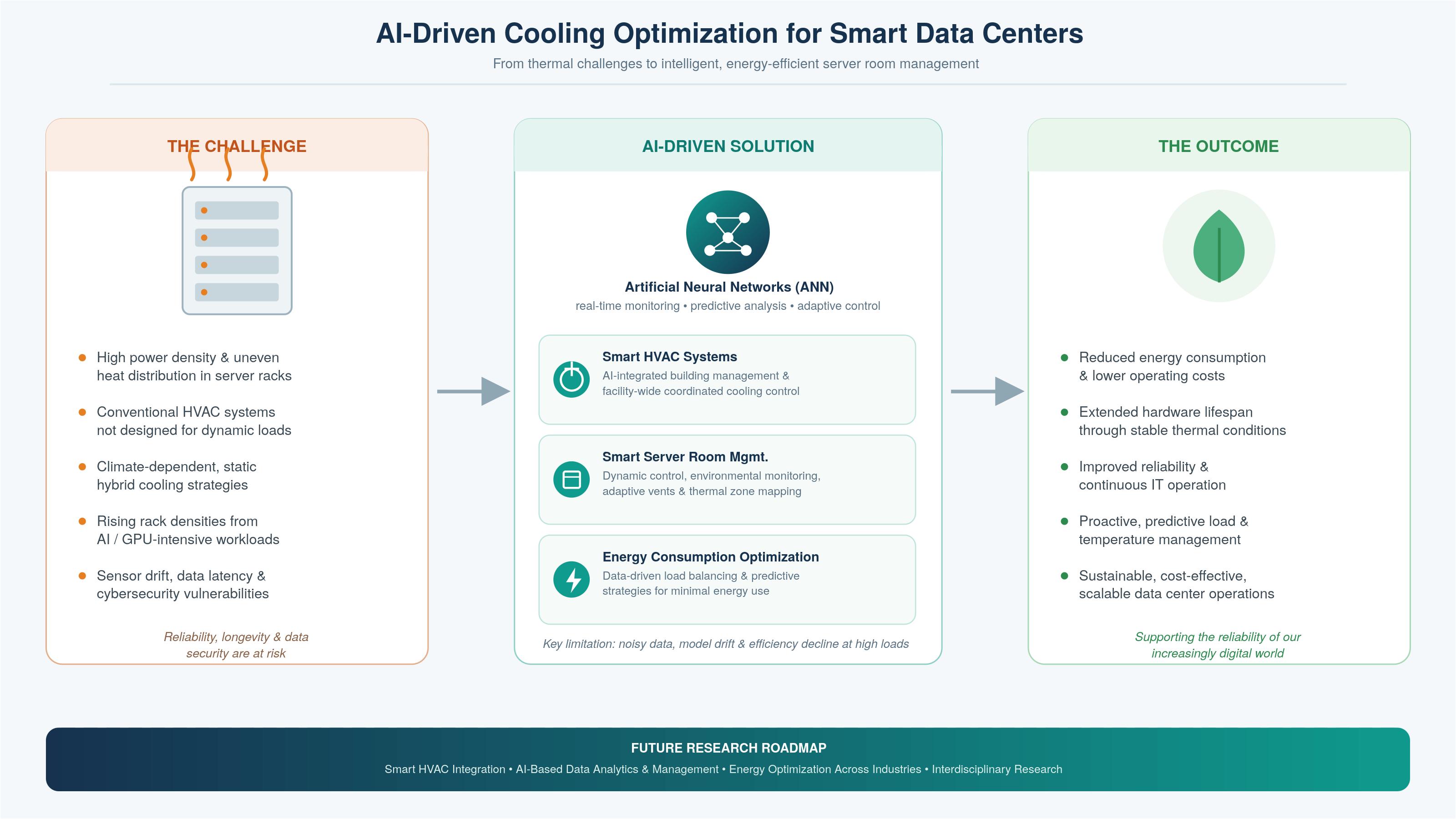
The global shift to digital technologies has spurred a surge in data centers, intensifying server room cooling challenges. Effective cooling ensures optimal IT equipment operation, reliability, longevity, and data security, requiring stable, efficient environments for critical operations. Traditional HVAC systems fall short for data centers, prompting specialized advancements, hybrid cooling integrations, and optimization techniques. Artificial Intelligence (AI), like Artificial Neural Networks (ANN), revolutionizes server room cooling by training hardware and systems for minimal energy use. This study reviews recent advances in smart data center cooling via AI-driven HVAC, dynamic control, environmental monitoring, adaptive vents, thermal mapping, and data-driven strategies. AI integrates with building management systems for facility-wide coordination, enhancing efficiency. Key AI capabilities include real-time monitoring, predictive analysis, and adaptive responses to dynamic conditions, yielding higher cooling efficiency, reduced energy consumption, extended hardware life, and improved reliability. These enable sustainable, cost-effective operations essential for our digital era. Results highlight AI’s role in temperature and load prediction, enabling proactive management. Various ANN techniques, detailed here, balance loads and temperatures, optimizing server room performance through intelligent control. The future research roadmap for cooling data centers concludes in the development of smart HVAC systems, data analytics, and AI-based management strategies, energy consumption optimization, interdisciplinary research, and adaptive environment and load regulation.
- Open Access
- Review
Utilizing Artificial Intelligence Techniques for Cooling Optimization and Energy Management in Smart Data Centers
Author Information
Received: 06 Aug 2025 | Revised: 15 Jul 2026 | Accepted: 23 Jul 2026 | Published: 14 Aug 2026
Abstract
Graphical Abstract
Keywords
AI-driven data center cooling | artificial neural networks HVAC | smart data center thermal management | predictive cooling optimization | energy-efficient server room cooling | machine learning building management systems
References
- 1.
Montagud-Montalvá, C.; Navarro-Peris, E.; Gómez-Navarro, T.; et al. Recovery of waste heat from data centres for decarbonisation of university campuses in a Mediterranean climate. Energy Convers. Manag. 2023, 290, 117212. https://doi.org/10.1016/J.ENCONMAN.2023.117212.
- 2.
Zhang, H.; Shao, S.; Xu, H.; et al. Integrated system of mechanical refrigeration and thermosyphon for free cooling of data centers. Appl. Therm. Eng. 2015, 75, 185–192. https://doi.org/10.1016/J.APPLTHERMALENG.2014.09.060.
- 3.
Opalic, S.M.; Goodwin, M.; Jiao, L.; et al. ANN modelling of CO2 refrigerant cooling system COP in a smart warehouse. J. Clean. Prod. 2020, 260, 120887. https://doi.org/10.1016/J.JCLEPRO.2020.120887.
- 4.
Zhao, J.; Liu, X. A hybrid method of dynamic cooling and heating load forecasting for office buildings based on artificial intelligence and regression analysis. Energy Build. 2018, 174, 293–308. https://doi.org/10.1016/J.ENBUILD.2018.06.050.
- 5.
Lee, D.; Ooka, R.; Matsuda, Y.; et al. Experimental analysis of artificial intelligence-based model predictive control for thermal energy storage under different cooling load conditions. Sustain. Cities Soc. 2022, 79, 103700. https://doi.org/10.1016/J.SCS.2022.103700.
- 6.
Selvam, S., Kalaivanan, C., Jain, R.; et al. Artificial Intelligence Based Cooling System for Managing the Energy Efficiency Keywords: Recurrent Neural Network, Thermal efficiency, Smart buildings, HVAC system. J. Contemp. Issues Bus. Gov. 2021, 27, 1649–1659.
- 7.
Hosoz, M.; Ertunc, H.M.; Bulgurcu, H. Performance prediction of a cooling tower using artificial neural network. Energy Convers. Manag. 2007, 48, 1349–1359. https://doi.org/10.1016/J.ENCONMAN.2006.06.024.
- 8.
Yigit, K.S.; Ertunc, H.M. Prediction of the air temperature and humidity at the outlet of a cooling coil using neural networks. Int. Commun. Heat Mass Transf. 2006, 33, 898–907. https://doi.org/10.1016/J.ICHEATMASSTRANSFER.2006.04.003.
- 9.
Li, A.; Xiao, F.; Zhang, C.; et al. Attention-based interpretable neural network for building cooling load prediction. Appl. Energy 2021, 299, 117238. https://doi.org/10.1016/j.apenergy.2021.117238.
- 10.
Hou, Z.; Lian, Z.; Yao, Y.; et al. Cooling-load prediction by the combination of rough set theory and an artificial neural-network based on data-fusion technique. Appl. Energy 2006, 83, 1033–1046. https://doi.org/10.1016/J.APENERGY.2005.08.006.
- 11.
Kamel, E.; Sheikh, S.; Huang, X. Data-driven predictive models for residential building energy use based on the segregation of heating and cooling days. Energy 2020, 206, 118045. https://doi.org/10.1016/J.ENERGY.2020.118045.
- 12.
Peng, Y.; Rysanek, A.; Nagy, Z.; et al. Using Machine Learning Techniques for Occupancy-prediction-based Cooling Control in Office Buildings. Appl. Energy 2018, 211, 1343–1358.
- 13.
Sha, H.; Moujahed, M.; Qi, D. Machine learning-based cooling load prediction and optimal control for mechanical ventilative cooling in high-rise buildings. Energy Build. 2021, 242, 110980. https://doi.org/10.1016/j.enbuild.2021.110980.
- 14.
Ma, Y. Model Predictive Control for the Operation of Building Cooling Systems. 2010. Available online: https://escholarship.org/uc/item/2hz3g57z (accessed on 6 June 2024).
- 15.
Zabala, L.; Febres, J.; Sterling, R.; et al. Virtual testbed for model predictive control development in district cooling systems. Renew. Sustain. Energy Rev. 2020, 129, 109920. https://doi.org/10.1016/j.rser.2020.109920.
- 16.
Xu, Z.Y.; Wang, R.Z. Simulation of solar cooling system based on variable effect LiBr-water absorption chiller. Renew Energy 2017, 113, 907–914. https://doi.org/10.1016/J.RENENE.2017.06.069.
- 17.
Ramakrishnan, B.; Alissa, H.; Manousakis, I.; et al. CPU Overclocking: A Performance Assessment of Air, Cold Plates, and Two-Phase Immersion Cooling. IEEE Trans. Compon. Packag. Manuf. Technol. 2021, 11, 1703–1715. https://doi.org/10.1109/TCPMT.2021.3106026.
- 18.
ACM Digital Library; Sigarch. Proceedings of the Conference on High Performance Computing Networking, Storage and Analysis; ACM: New York, NY, USA, 2009.
- 19.
Liang, S.; Yang, Z.; Jin, F.; et al. Data Centers Job Scheduling with Deep Reinforcement Learning. In Advances in Knowledge Discovery and Data Mining; Lecture Notes in Computer Science (Including Subseries Lecture Notes in Artificial Intelligence and Lecture Notes in Bioinformatics), Springer: Cham, Switzerland, 2020; pp. 906–917. https://doi.org/10.1007/978-3-030-47436-2_68.
- 20.
Wei, W.; Gu, H.; Wang, K.; et al. Multi-dimensional Resource Allocation in Distributed Data Centers using Deep Reinforcement Learning. IEEE Trans. Netw. Serv. Manag. 2022, 20, 1817–1829. https://doi.org/10.1109/TNSM.2022.3213575.
- 21.
Gebreyesus, Y.; Dalton, D.; Nixon, S.; et al. Machine Learning for Data Center Optimizations: Feature Selection Using Shapley Additive exPlanation (SHAP). Future Internet 2023, 15, 88. https://doi.org/10.3390/fi15030088.
- 22.
Fernández-Cerero, D.; Troyano, J.A.; Jakóbik, A.; et al. Machine learning regression to boost scheduling performance in hyper-scale cloud-computing data centres. J. King Saud Univ. Comput. Inf. Sci. 2022, 34, 3191–3203. https://doi.org/10.1016/J.JKSUCI.2022.04.008.
- 23.
Nie, L.; Jiang, D.; Guo, L.; et al. Traffic Matrix Prediction and Estimation Based on Deep Learning for Data Center Networks. In Proceedings of the 2016 IEEE Globecom Workshops (GC Wkshps), Washington, DC, USA, 4–8 December 2016.
- 24.
Levy, M.; Raviv, D.; Baker, J. Data Center Predictions using MATLAB Machine Learning Toolbox. In Proceedings of the 2019 IEEE 9th Annual Computing and Communication Workshop and Conference (CCWC), Las Vegas, NV, USA, 7–9 January 2019.
- 25.
Guo, L.; Wu, J.; Hsieh, I.M.; et al. Advanced Single-phase Passive Immersion Cooling Solution with Natural Convection for Outdoor Edge Servers. In Proceedings of the 2021 20th IEEE Intersociety Conference on Thermal and Thermomechanical Phenomena in Electronic Systems (iTherm), San Diego, CA, USA, 1–4 June 2021; pp. 417–422. https://doi.org/10.1109/ITherm51669.2021.9503238.
- 26.
Wang, Y.; Zheng, W.; Shi, G.; et al. Experimental research on the influence of a novel passive cooling system on the data center temperature distribution. Energy Build. 2023, 292, 113135. https://doi.org/10.1016/J.ENBUILD.2023.113135.
- 27.
Fragkos, G.; Lebien, S.; Tsiropoulou, E.E. Artificial intelligent multi-access edge computing servers management. IEEE Access 2020, 8, 171292–171304. https://doi.org/10.1109/ACCESS.2020.3025047.
- 28.
Prevost, J.; Nagothu, K.; Kelley, B.; et al. Prediction of Cloud Data Center Networks Loads Using Stochastic and Neural Models. In Proceedings of the 2011 6th International Conference on System of Systems Engineering (SoSE), Albuquerque, NM, USA, 27–30 June 2011; pp. 276–281. https://doi.org/10.1109/SYSOSE.2011.5966610.
- 29.
Liu, N.; Lin, X.; Wang, Y. Data center power management for regulation service using neural network-based power prediction. In Proceedings of the 2017 18th International Symposium on Quality Electronic Design (ISQED), Santa Clara, CA, USA, 14–15 March 2017; pp. 367–372. https://doi.org/10.1109/ISQED.2017.7918343.
- 30.
Cao, X.; Zhong, Y.; Zhou, Y.; et al. Interactive temporal recurrent convolution network for traffic prediction in data centers. IEEE Access 2017, 6, 5276–5289. https://doi.org/10.1109/ACCESS.2017.2787696.
- 31.
Perepelkin, D.; Ivanchikova, M. Research of Neural Network Architectures for Solving Adaptive Routing Problems in Multiprovider Networks of Distributed Data Centers. In Proceedings of the 2020 9th Mediterranean Conference on Embedded Computing (MECO), Budva, Montenegro, 8–11 June 2020.
- 32.
Yu, X.; Wang, Y.; Miao, J.; et al. A data-center FPGA acceleration platform for convolutional neural networks. In Proceedings of the 29th International Conference on Field-Programmable Logic and Applications (FPL 2019), Barcelona, Spain, 8–13 September 2019; Institute of Electrical and Electronics Engineers Inc.: New York, NY, USA, 2019; pp. 151–158. https://doi.org/10.1109/FPL.2019.00032.
- 33.
Xiao, J.; Sun, L.; Liu, C.; et al. Optimizations and investigations for transfer learning of iteratively pruned neural network equalizers for data center networking. Opt. Express 2022, 30, 36358. https://doi.org/10.1364/oe.468716.
- 34.
Zhou, X.; Wang, R.; Wen, Y.; et al. Joint IT-Facility Optimization for Green Data Centers via Deep Reinforcement Learning. IEEE Netw. 2021, 35, 255–262. https://doi.org/10.1109/MNET.011.2100101.
- 35.
Li, Y.; Wen, Y.; Tao, D.; et al. Transforming Cooling Optimization for Green Data Center via Deep Reinforcement Learning. IEEE Trans. Cybern. 2020, 50, 2002–2013. https://doi.org/10.1109/TCYB.2019.2927410.
- 36.
Moore, J.; Chase, J.S. Weatherman: Automated, Online, and Predictive Thermal Mapping and Management for Data Centers. In Proceedings of the 2006 IEEE International Conference on Autonomic Computing, Dublin, Ireland, 12–16 June 2006.
- 37.
Haruna, A.A.; Jung, L.T.; Arputharaj, V.; et al. Incentive-Scheduling Algorithms to Provide Green Computational Data Center. SN Comput. Sci. 2021, 2, 252. https://doi.org/10.1007/s42979-021-00633-5.
- 38.
Chou, J.S.; Bui, D.K. Modeling heating and cooling loads by artificial intelligence for energy-efficient building design. Energy Build. 2014, 82, 437–446. https://doi.org/10.1016/J.ENBUILD.2014.07.036.
- 39.
Wang, L.; Von Laszewski, G.; Huang, F.; et al. Task scheduling with ANN-based temperature prediction in a data center: A simulation-based study. Eng. Comput. 2011, 27, 381–391. https://doi.org/10.1007/s00366-011-0211-4.
- 40.
Chen, J.; Tan, R.; Wang, Y.; et al. A high-fidelity temperature distribution forecasting system for data centers. In Proceedings of the Real-Time Systems Symposium, San Juan, PR, USA, 4–7 December 2012; pp. 215–224. https://doi.org/10.1109/RTSS.2012.73.
- 41.
Matsuda, Y.; Ooka, R.; Ikeda, S. The development of cloud-based building automation system and creating predictive models of HVAC system with machine learning. In Proceedings of the 2021 29th Mediterranean Conference on Control and Automation (MED), Puglia, Italy, 22–25 June 2021; Institute of Electrical and Electronics Engineers Inc.: New York, NY, USA, 2021; pp. 955–960. https://doi.org/10.1109/MED51440.2021.9480357.
- 42.
Mirhoseininejad, S.; García, F.M.; Badawy, G.; et al. ALTM: Adaptive learning-based thermal model for temperature predictions in data centers. In Proceedings of the 2019 IEEE Sustainability through ICT Summit (StICT), Montreal, QC, Canada, 18–19 June 2019.
- 43.
Gao, J. Machine Learning Applications for Data Center Optimization. Available online: https://static.googleusercontent.com/media/research.google.com/zh-CN//pubs/archive/42542.pdf (accessed on 10 August 2026).
- 44.
Khalaj, A.H.; Scherer, T.; Siriwardana, J.; et al. Multi-objective efficiency enhancement using workload spreading in an operational data center. Appl. Energy 2015, 138, 432–444. https://doi.org/10.1016/j.apenergy.2014.10.083.
- 45.
Damasio, H.T.; Oyamada, M.S. A Predictive Actuator for IoT-based Air Conditioner Unit. In Proceedings of the 2020 X Brazilian Symposium on Computing Systems Engineering (SBESC), Florianopolis, Brazil, 24–27 November 2020.
- 46.
Yumang, A.N.; Paglinawan, C.C.; Sejera, M.M.; et al. ZigBee Based Monitoring of Temperature and Humidity of Server Rooms using Thermal Imaging. In Proceedings of the 6th IEEE International Conference on Control System, Computing and Engineering (ICCSCE 2016), Penang, Malaysia, 25–27 November 2016; pp. 452–454.
- 47.
Asfahan, H.M.; Sajjad, U.; Sultan, M.; et al. Artificial intelligence for the prediction of the thermal performance of evaporative cooling systems. Energies 2021, 14, 3946. https://doi.org/10.3390/en14133946.
- 48.
Tuli, S.; Gill, S.; Casale, G.; et al. New trends and ideas iThermoFog: IoT-Fog based Automatic Thermal Profile Creation for Cloud Data Centers using Artificial Intelligence Techniques. Internet Technol. Lett. 2020, 3, e198.
- 49.
Wang, Y.; Zhang, Y.; Nörtershäuser, D.; et al. Model and data driven transient thermal system modelings for contained data centers. Energy Build. 2022, 258, 111790. https://doi.org/10.1016/J.ENBUILD.2021.111790.
- 50.
Manaserh, Y.M.; Tradat, M.I.; Bani-Hani, D.; et al. Machine learning assisted development of IT equipment compact models for data centers energy planning. Appl. Energy 2022, 305, 117846. https://doi.org/10.1016/j.apenergy.2021.117846.
- 51.
Kumar, R.; Khatri, S.K.; Diván, M.J. Effect of Cooling Systems on the Energy Efficiency of Data Centers: Machine Learning Optimisation. In Proceedings of the 2020 International Conference on Computational Performance Evaluation (ComPE), Shillong, India, 2–4 July 2020; pp. 596–600. https://doi.org/10.1109/COMPE49325.2020.9200088.
- 52.
Choi, Y.J.; Park, B.R.; Hyun, J.Y.; et al. Development of an adaptive artificial neural network model and optimal control algorithm for a data center cyber–physical system. Build. Environ. 2022, 210, 108704. https://doi.org/10.1016/j.buildenv.2021.108704.
- 53.
Pérez, J.; Pérez, S.; Moya, J.M.; et al. Thermal Prediction for Immersion Cooling Data Centers Based on Recurrent Neural Networks. In Intelligent Data Engineering and Automated Learning—IDEAL 2018; Lecture Notes in Computer Science (including subseries Lecture Notes in Artificial Intelligence and Lecture Notes in Bioinformatics); Springer: Cham, Switzerland, 2018; pp. 491–498. https://doi.org/10.1007/978-3-030-03493-1_51.
- 54.
Chung, M.H.; Yang, Y.K.; Lee, K.H.; et al. Application of artificial neural networks for determining energy-efficient operating set-points of the VRF cooling system. Build. Environ. 2017, 125, 77–87. https://doi.org/10.1016/J.BUILDENV.2017.08.044.
- 55.
Li, L.; Liang, C.-J.M.; Liu, J.; et al. ThermoCast: A Cyber-Physical Forecasting Model for Data Centers. In Proceedings of the 17th ACM SIGKDD International Conference on Knowledge Discovery and Data Mining, San Diego, CA, USA, 21–24 August 2011; pp. 1370–1378.
- 56.
Song, M.; Chen, K.; Wang, J. Numerical Study on the Optimized Control of CRACs in a Data Center Based on a Fast Temperature-Predicting Model. J. Energy Eng. 2017, 143, 04017041. https://doi.org/10.1061/(ASCE)EY.1943-7897.0000460.
- 57.
Liu, Y.; Van Le, D.; Tan, R. A data-assisted first-principle approach to modeling server outlet temperature in air free-cooled data centers. Future Gener. Comput. Syst. 2022, 129, 225–235. https://doi.org/10.1016/j.future.2021.12.003.
- 58.
Chen, M.; Zhang, Z.; Deng, Q.; et al. Optimization of underfloor air distribution systems for data centers based on orthogonal test method: A case study. Build. Environ. 2023, 232, 110071. https://doi.org/10.1016/j.buildenv.2023.110071.
- 59.
Zhou, R. et al., A Holistic and Optimal Approach for Data Center Cooling Management. In Proceedings of the 2011 American Control Conference, San Francisco, CA, USA, 29 June 2011–1 July 2011. https://doi.org/10.1109/ACC.2011.5991575.
- 60.
MirhoseiniNejad, S.M.; Badawy, G.; Down, D.G. Holistic thermal-aware workload management and infrastructure control for heterogeneous data centers using machine learning. Future Gener. Comput. Syst. 2021, 118, 208–218. https://doi.org/10.1016/j.future.2021.01.007.
- 61.
Mousavi, A.; Vyatkin, V.; Berezovskaya, Y.; et al. Cyber-physical Design of Data Centers Cooling Systems Automation. In Proceedings of the 2015 IEEE Trustcom/BigDataSE/ISPA, Helsinki, Finland, 20–22 August 2015.
- 62.
Lazic, N.; Boutilier, C.; Lu, T.; et al. Data Center Cooling Using Model-Predictive Control. In Proceedings of the Advances in Neural Information Processing Systems 31 (NeurIPS 2018), Montreal, QC, Canada, 2–8 December 2018; pp. 3818–3827.
- 63.
Asgari, S.; MirhoseiniNejad, S.M.; Moazamigoodarzi, H.; et al. A gray-box model for real-time transient temperature predictions in data centers. Appl. Therm. Eng. 2021, 185, 116319. https://doi.org/10.1016/j.applthermaleng.2020.116319.
- 64.
Hnayno, M.; Chehade, A.; Klaba, H.; et al. Experimental investigation of an autonomous liquid-cooled uninterruptible power supply (UPS). Energy Rep. 2023, 9, 5775–5787. https://doi.org/10.1016/J.EGYR.2023.05.010.
- 65.
Grishina, A.; Chinnici, M.; Kor, A.L.; et al. A machine learning solution for data center thermal characteristics analysis. Energies 2020, 13, 4378. https://doi.org/10.3390/en13174378.
- 66.
Athavale, J.; Yoda, M.; Joshi, Y. Artificial Neural Network Based Prediction of Temperature and Flow Profile in Data Centers. In Proceedings of the 2018 17th IEEE Intersociety Conference on Thermal and Thermomechanical Phenomena in Electronic Systems (ITherm 2018), San Diego, CA, USA, 29 May–1 June 2018; pp. 871–880. https://doi.org/10.1109/ITHERM.2018.8419607
- 67.
Song, Z.; Murray, B.T.; Sammakia, B. Airflow and temperature distribution optimization in data centers using artificial neural networks. Int. J. Heat Mass Transf. 2013, 64, 80–90. https://doi.org/10.1016/J.IJHEATMASSTRANSFER.2013.04.017.
- 68.
Lucchese, R.; Johansson, A. Coldspot: A Thermal Supervisor Aimed at Server Rooms Implementing a Raised Plenum Cooling Setup. In Proceedings of the 2019 American Control Conference (ACC), Philadelphia, PA, USA, 10–12 July 2019; pp. 5870–5877.
- 69.
Fang, Q.; Li, Z.; Wang, Y.; et al. A neural-network enhanced modeling method for real-time evaluation of the temperature distribution in a data center. Neural Comput. Appl. 2019, 31, 8379–8391. https://doi.org/10.1007/s00521-019-04508-y.
- 70.
Asgari, S.; Moazamigoodarzi, H.; Tsai, P.J.; et al. Hybrid Surrogate Model for Online Temperature and Pressure Predictions in Data Centers. Future Gener. Comput. Syst. 2021, 114, 531–547.
- 71.
Ghosh, R.; Joshi, Y. Rapid temperature predictions in data centers using multi-parameter proper orthogonal decomposition. Numer. Heat Transf. Part A Appl. 2014, 66, 41–63. https://doi.org/10.1080/10407782.2013.869090.
- 72.
Zhou, R.; Wang, Z.; Mcreynolds, A.; et al. Optimization and Control of Cooling Microgrids for Data Centers. In Proceedings of the 13th InterSociety Conference on Thermal and Thermomechanical Phenomena in Electronic Systems, San Diego, CA, USA, 30 May–1 June 2012.
- 73.
Antal, M.; Cioara, T.; Anghel, I.; et al. Reuse of data center waste heat in nearby neighborhoods: A neural networks-based prediction model. Energies 2019, 12, 814. https://doi.org/10.3390/en12050814.
- 74.
Shoukourian, H.; Wilde, T.; Labrenz, D.; et al. Using machine learning for data center cooling infrastructure efficiency prediction. In Proceedings of the 2017 IEEE 31st International Parallel and Distributed Processing Symposium Workshops (IPDPSW 2017), Orlando, FL, USA, 29 May–2 June 2017; Institute of Electrical and Electronics Engineers Inc.: New York, NY, USA, 2017; pp. 954–963. https://doi.org/10.1109/IPDPSW.2017.25.
- 75.
Liang, B.; Wu, D.; Wu, P.; et al. An energy-aware resource deployment algorithm for cloud data centers based on dynamic hybrid machine learning. Knowl. Based Syst. 2021, 222, 107020. https://doi.org/10.1016/j.knosys.2021.107020.
- 76.
Patel, Y.S.; Jaiswal, R.; Misra, R. Deep learning-based multivariate resource utilization prediction for hotspots and coldspots mitigation in green cloud data centers. J. Supercomput. 2022, 78, 5806–5855. https://doi.org/10.1007/s11227-021-04107-6.
- 77.
Zhou, X.; Wang, K.; Jia, W.; et al. Reinforcement Learning-Based Adaptive Resource Management of Differentiated Services in Geo-Distributed Data Centers. In Proceedings of the 2017 IEEE/ACM 25th International Symposium on Quality of Service (IWQoS), Vilanova i la Geltrú, Spain, 14–16 June 2017; pp. 1–6.
- 78.
Shaw, R.; Howley, E.; Barrett, E. An Advanced Reinforcement Learning Approach for Energy-Aware Virtual Machine Consolidation in Cloud Data Centers. In Proceedings of the 2017 12th International Conference for Internet Technology and Secured Transactions (ICITST), Cambridge, UK, 11–14 December 2017.
- 79.
Sharma, M.; Garg, R. An artificial neural network based approach for energy efficient task scheduling in cloud data centers. Sustain. Comput. Inform. Syst. 2020, 26, 100373. https://doi.org/10.1016/j.suscom.2020.100373.
- 80.
Berral, J.L.; Gavaldà, R.; Torres, J. Power-Aware Multi-Data Center management using machine learning. In Proceedings of the 2013 42nd International Conference on Parallel Processing, Lyon, France, 1–4 October 2013; Institute of Electrical and Electronics Engineers Inc.: New York, NY, USA, 2013; pp. 858–867. https://doi.org/10.1109/ICPP.2013.102.
- 81.
Farahnakian, F.; Liljeberg, P.; Plosila, J. Energy-efficient virtual machines consolidation in cloud data centers using reinforcement learning. In Proceedings of the 2014 22nd Euromicro International Conference on Parallel, Distributed, and Network-Based Processing (PDP 2014), Turin, Italy, 12–14 February 2014; pp. 500–507. https://doi.org/10.1109/PDP.2014.109.
- 82.
Tarutani, Y. et al. Temperature distribution prediction in data centers for decreasing power consumption by machine learning. In Proceedings of the IEEE 7th International Conference on Cloud Computing Technology and Science (CloudCom 2015), Vancouver, BC, Canada, 30 November–3 December 2015; Institute of Electrical and Electronics Engineers Inc.: New York, NY, USA, 2016; pp. 635–642. https://doi.org/10.1109/CloudCom.2015.49.
- 83.
Wang, T.; Xia, Y.; Muppala, J.; et al. Achieving Energy Efficiency in Data Centers Using an Artificial Intelligence Abstraction Model. IEEE Trans. Cloud Comput. 2015, 6, 612–624. https://doi.org/10.1109/tcc.2015.2511720.
- 84.
Simon, V.S.; Siddarth, A.; Agonafer, D. Artificial Neural Network Based Prediction of Control Strategies for Multiple Air-Cooling Units in a Raised-floor Data Center. In Proceedings of the 19th IEEE Intersociety Conference on Thermal and Thermomechanical Phenomena in Electronic Systems (ITherm), Orlando, FL, USA, 21–23 July 2020.
- 85.
Shao, W.; Chen, Q.; He, K.; et al. Operation Optimization of Liquid Cooling Systems in Data Centers by the Heat Current Method and Artificial Neural Network. J. Therm. Sci. 2020, 29, 1063–1075. https://doi.org/10.1007/s11630-020-1283-5.
- 86.
Guo, C.; Luo, F.; Cai, Z.; et al. Integrated energy systems of data centers and smart grids: State-of-the-art and future opportunities. Appl. Energy 2021, 301, 117474. https://doi.org/10.1016/J.APENERGY.2021.117474.
- 87.
Kang, I.; Lee, K.H.; Lee, J.H.; et al. Artificial neural network-based control of a variable refrigerant flow system in the cooling season. Energies 2018, 11, 1643. https://doiorg/10.3390/en11071643.
- 88.
Athavale, J.; Yoda, M.; Joshi, Y. Genetic algorithm based cooling energy optimization of data centers. Int. J. Numer. Methods Heat Fluid Flow 2020, 31, 3148–3168. https://doi.org/10.1108/HFF-01-2020-0036.
- 89.
Ran, Y.; Hu, H.; Zhou, X.; et al. DeepEE: Joint optimization of job scheduling and cooling control for data center energy efficiency using deep reinforcement learning. In Proceedings of the International Conference on Distributed Computing Systems, Dallas, TX, USA, 7–10 July 2019; Institute of Electrical and Electronics Engineers Inc.: New York, NY, USA, 2019, pp. 645–655. https://doi.org/10.1109/ICDCS.2019.00070.


This work is licensed under a Creative Commons Attribution 4.0 International License.

 Suite 4002 Level 4, 447 Collins Street, Melbourne, Victoria 3000, Australia
 General Inquiries: info@sciltp.com