
Intracellular pathogens that escape into the cytosol challenge classical immune defenses. Host cells counteract this threat through ubiquitin-mediated recognition and elimination. Recent work by Ghosh et al. highlights VCP/p97, a host AAA ATPase, as a cytosolic effector that translates ubiquitin recognition into mechanical disruption of bacterial integrity. In this perspective, we discuss a previously unrecognized strategy for broad-spectrum pathogen control by mechanical force generation, expanding on our current views on ubiquitin-mediated immunity.
- Open Access
- Perspective
VCP/p97 Mediated Bacteriolysis: A Ubiquitin-Powered Mechanical Arm of Cell-Autonomous Immunity
Author Information
Received: 02 Apr 2026 | Revised: 07 May 2026 | Accepted: 11 May 2026 | Published: 20 May 2026
Abstract
Keywords
cell-autonomous immunity | AAA-ATPase | VCP/p97 | ubiquitin | proteasome | immune effectors | bacteriolysis
References
- 1.
Ghosh, S.; Roy, S.; Baid, N.; et al. Host AAA-ATPase VCP/p97 lyses ubiquitinated intracellular bacteria as an innate antimicrobial defence. Nat. Microbiol. 2025, 10, 1099–1114. https://doi.org/10.1038/s41564-025-01984-y.
- 2.
Jia, J.; Poolsup, S.; Salinas, J.E. Cellular homeostatic responses to lysosomal damage. Trends Cell Biol. 2025, 35, 761–772. https://doi.org/10.1016/j.tcb.2025.02.007.
- 3.
Boyle, K.B.; Ellison, C.J.; Elliott, P.R.; et al. TECPR1 conjugates LC3 to damaged endomembranes upon detection of sphingomyelin exposure. EMBO J. 2023, 42, e113012. https://doi.org/10.15252/embj.2022113012.
- 4.
Ellison, C.J.; Kukulski, W.; Boyle, K.B.; et al. Transbilayer Movement of Sphingomyelin Precedes Catastrophic Breakage of Enterobacteria-Containing Vacuoles. Curr. Biol. 2020, 30, 2974–2983e6. https://doi.org/10.1016/j.cub.2020.05.083.
- 5.
Weng, I.C.; Chen, H.L.; Lo, T.H.; et al. Cytosolic galectin-3 and -8 regulate antibacterial autophagy through differential recognition of host glycans on damaged phagosomes. Glycobiology 2018, 28, 392–405. https://doi.org/10.1093/glycob/cwy017.
- 6.
Shenoy, A.R.; Kim, B.H.; Choi, H.P.; et al. Emerging themes in IFN-gamma-induced macrophage immunity by the p47 and p65 GTPase families. Immunobiology 2008, 212, 771–784. https://doi.org/10.1016/j.imbio.2007.09.018.
- 7.
Wandel, M.P.; Kim, B.-H.; Park, E.-S.; et al. Guanylate-binding proteins convert cytosolic bacteria into caspase-4 signaling platforms. Nat. Immunol. 2020, 21, 880–891. https://doi.org/10.1038/s41590-020-0697-2.
- 8.
Feng, S.; Enosi Tuipulotu, D.; Pandey, A.; et al. Pathogen-selective killing by guanylate-binding proteins as a molecular mechanism leading to inflammasome signaling. Nat. Commun. 2022, 13, 4395. https://doi.org/10.1038/s41467-022-32127-0.
- 9.
Gaudet, R.G.; Zhu, S.; Halder, A.; et al. A human apolipoprotein L with detergent-like activity kills intracellular pathogens. Science 2021, 373, eabf8113. https://doi.org/10.1126/science.abf8113.
- 10.
Goldberg, K.; Lobov, A.; Antonello, P.; et al. Cell-autonomous innate immunity by proteasome-derived defence peptides. Nature 2025, 639, 1032–1041. https://doi.org/10.1038/s41586-025-08615-w.
- 11.
Wandel, M.P.; Pathe, C.; Werner, E.I.; et al. GBPs Inhibit Motility of Shigella flexneri but Are Targeted for Degradation by the Bacterial Ubiquitin Ligase IpaH9.8. Cell Host Microbe 2017, 22, 507–518.e5. https://doi.org/10.1016/j.chom.2017.09.007.
- 12.
Cao, S.; Jiao, Y.; Jiang, W.; et al. Subversion of GBP-mediated host defense by E3 ligases acquired during Yersinia pestis evolution. Nat. Commun. 2022, 13, 4526. https://doi.org/10.1038/s41467-022-32218-y.
- 13.
Deol, K.K.; Lorenz, S.; Strieter, E.R. Enzymatic Logic of Ubiquitin Chain Assembly. Front. Physiol. 2019, 10, 835. https://doi.org/10.3389/fphys.2019.00835.
- 14.
Franco, L.H.; Nair, V.R.; Scharn, C.R.; et al. The Ubiquitin Ligase Smurf1 Functions in Selective Autophagy of Mycobacterium tuberculosis and Anti-tuberculous Host Defense. Cell Host Microbe 2017, 22, 421–423. https://doi.org/10.1016/j.chom.2017.08.005.
- 15.
Manzanillo, P.S.; Ayres, J.S.; Watson, R.O.; et al. The ubiquitin ligase parkin mediates resistance to intracellular pathogens. Nature 2013, 501, 512–516. https://doi.org/10.1038/nature12566.
- 16.
Polajnar, M.; Dietz, M.S.; Heilemann, M.; et al. Expanding the host cell ubiquitylation machinery targeting cytosolic Salmonella. EMBO Rep. 2017, 18, 1572–1585. https://doi.org/10.15252/embr.201643851.
- 17.
Huett, A.; Heath, R.J.; Begun, J.; et al. The LRR and RING domain protein LRSAM1 is an E3 ligase crucial for ubiquitin-dependent autophagy of intracellular Salmonella Typhimurium. Cell Host Microbe 2012, 12, 778–790. https://doi.org/10.1016/j.chom.2012.10.019.
- 18.
Otten, E.G.; Werner, E.; Crespillo-Casado, A.; et al. Ubiquitylation of lipopolysaccharide by RNF213 during bacterial infection. Nature 2021, 594, 111–116. https://doi.org/10.1038/s41586-021-03566-4.
- 19.
Crespillo-Casado, A.; Pothukuchi, P.; Naydenova, K.; et al. Recognition of phylogenetically diverse pathogens through enzymatically amplified recruitment of RNF213. EMBO Rep. 2024, 25, 4979–5005. https://doi.org/10.1038/s44319-024-00280-w.
- 20.
Bhutda, S.; Ghosh, S.; Sinha, A.R.; et al. Differential Ubiquitination as an Effective Strategy Employed by the Blood-Brain Barrier for Prevention of Bacterial Transcytosis. J. Bacteriol. 2022, 204, e0045621. https://doi.org/10.1128/JB.00456-21.
- 21.
Apte, S.; Bhutda, S.; Ghosh, S.; et al. An innate pathogen sensing strategy involving ubiquitination of bacterial surface proteins. Sci. Adv. 2023, 9, eade1851. https://doi.org/10.1126/sciadv.ade1851.
- 22.
Ye, Y.; Meyer, H.H.; Rapoport, T.A. The AAA ATPase Cdc48/p97 and its partners transport proteins from the ER into the cytosol. Nature 2001, 414, 652–656. https://doi.org/10.1038/414652a.
- 23.
Tanaka, A.; Cleland, M.M.; Xu, S.; et al. Proteasome and p97 mediate mitophagy and degradation of mitofusins induced by Parkin. J. Cell Biol. 2010, 191, 1367–1380. https://doi.org/10.1083/jcb.201007013.
- 24.
Kaneko, Y.; Shimoda, K.; Ayala, R.; et al. p97 and p47 function in membrane tethering in cooperation with FTCD during mitotic Golgi reassembly. EMBO J. 2021, 40, e105853. https://doi.org/10.15252/embj.2020105853.
- 25.
Hetzer, M.; Meyer, H.H.; Walther, T.C.; et al. Distinct AAA-ATPase p97 complexes function in discrete steps of nuclear assembly. Nat. Cell Biol. 2001, 3, 1086–1091. https://doi.org/10.1038/ncb1201-1086.
- 26.
Verma, R.; Oania, R.S.; Kolawa, N.J.; et al. Cdc48/p97 promotes degradation of aberrant nascent polypeptides bound to the ribosome. Elife 2013, 2, e00308. https://doi.org/10.7554/eLife.00308.
- 27.
Wrobel, L.; Hill, S.M.; Ashkenazi, A.; et al. VCP/p97 modulates PtdIns3P production and autophagy initiation. Autophagy 2021, 17, 1052–1053. https://doi.org/10.1080/15548627.2021.1898742.
- 28.
Papadopoulos, C.; Kirchner, P.; Bug, M.; et al. VCP/p97 cooperates with YOD1, UBXD1 and PLAA to drive clearance of ruptured lysosomes by autophagy. EMBO J. 2017, 36, 135–150. https://doi.org/10.15252/embj.201695148.
- 29.
Hanzelmann, P.; Schindelin, H. The Interplay of Cofactor Interactions and Post-translational Modifications in the Regulation of the AAA+ ATPase p97. Front. Mol. Biosci. 2017, 4, 21. https://doi.org/10.3389/fmolb.2017.00021.
- 30.
Zhang, X.; Gui, L.; Zhang, X.; et al. Altered cofactor regulation with disease-associated p97/VCP mutations. Proc. Natl. Acad. Sci. USA 2015, 112, E1705–E1714. https://doi.org/10.1073/pnas.1418820112.
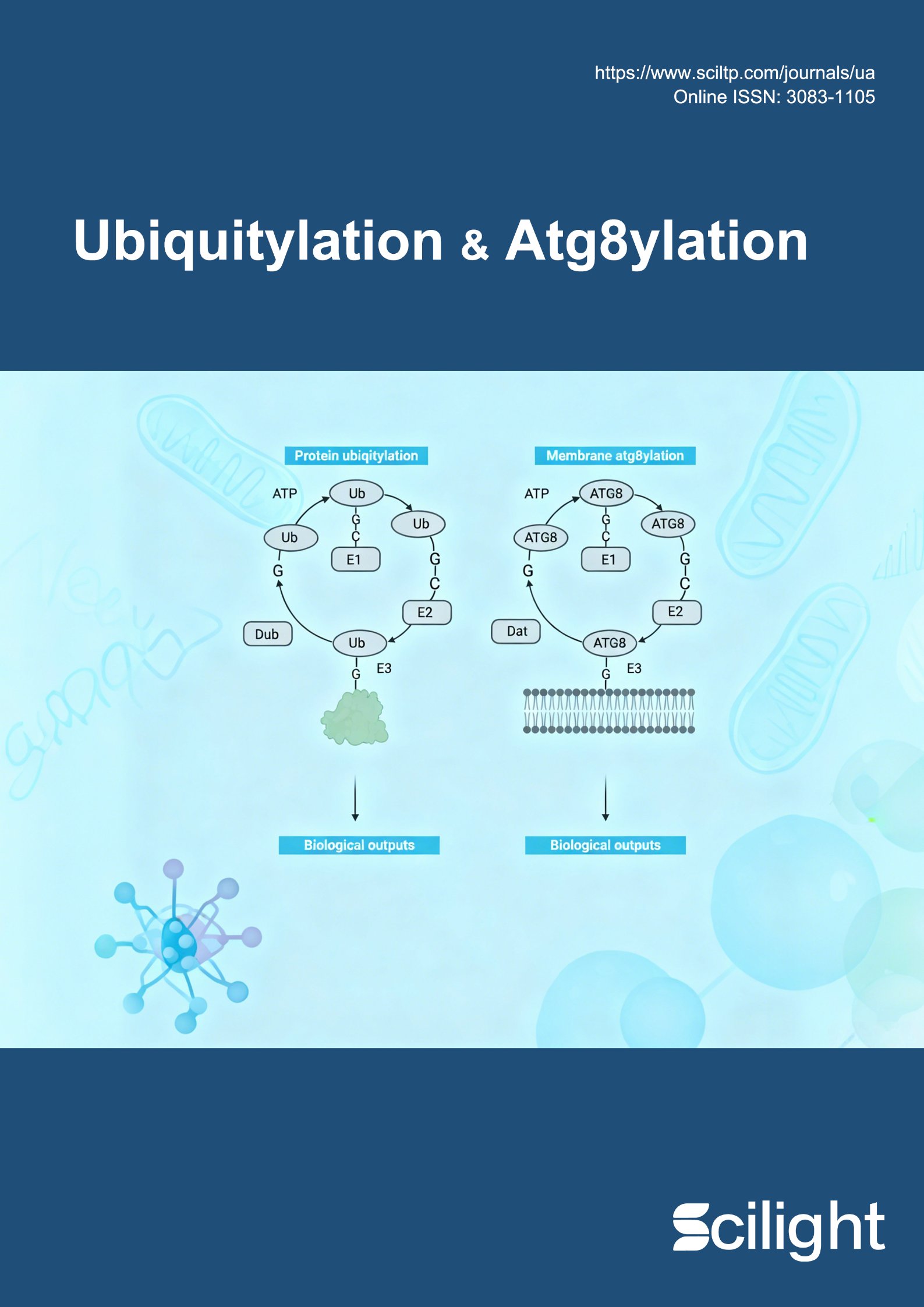
How to Cite
Ghosh, S.; Banerjee, A. VCP/p97 Mediated Bacteriolysis: A Ubiquitin-Powered Mechanical Arm of Cell-Autonomous Immunity. Ubiquitylation & Atg8ylation 2026, 1 (1), 4. https://doi.org/10.53941/ua.2026.100004.
RIS
BibTex
Copyright & License

Copyright (c) 2026 by the authors.
This work is licensed under a Creative Commons Attribution 4.0 International License.
Article Metrics
403
Article Views
0
Citations
Contents
References

 Suite 4002 Level 4, 447 Collins Street, Melbourne, Victoria 3000, Australia
 General Inquiries: info@sciltp.com