
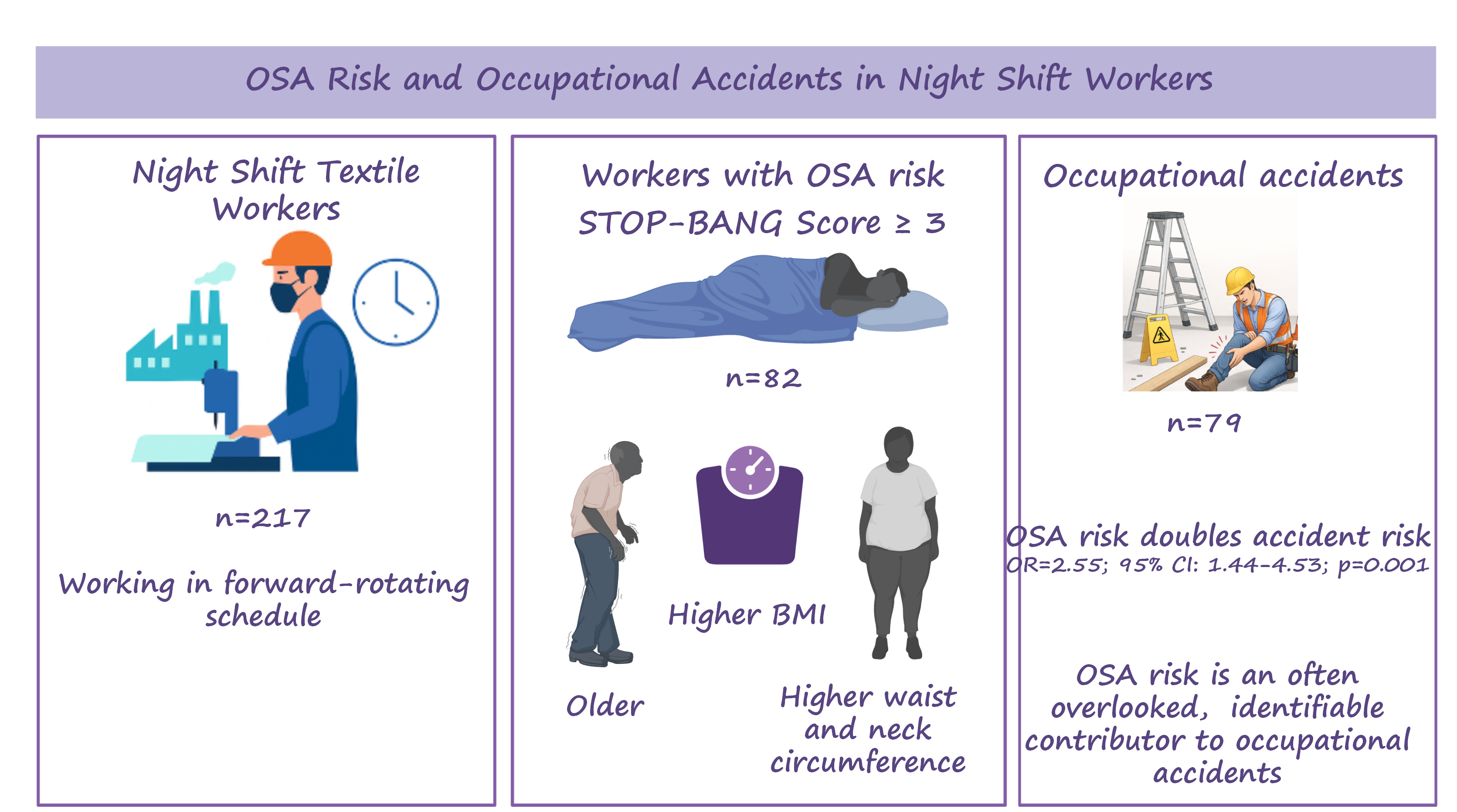
Obstructive Sleep Apnea (OSA) represents a critical yet often underdiagnosed contributor to occupational morbidity, given its established links to impaired vigilance, neurocognitive dysfunction, and accident proneness. This cross-sectional study evaluated the prevalence of OSA risk and its relationship with occupational accidents among rotating shift workers. Between April and June 2024, 217 textile workers underwent assessment using the STOP-BANG questionnaire (score ≥3 indicating OSA risk) alongside the Epworth Sleepiness Scale, Pittsburgh Sleep Quality Index, and Insomnia Severity Index. Compared with their counterparts, those at risk were older, had higher body mass index, larger neck and waist circumferences, longer employment duration, more comorbidities, and higher daytime sleepiness scores (ESS: 4 [0–11] vs. 5 [0–16]; p = 0.007), while subjective sleep time and sleep quality indices were comparable. In total, 36.4% of workers reported an occupational accident in the past year. Accident prevalence was higher in those with OSA risk (50.0% vs. 28.1%), and OSA risk remained an independent predictor of accidents (adjusted OR = 2.55; 95% CI: 1.44–4.53; p = 0.001) in the fully adjusted model. These findings highlight OSA as a prevalent, underrecognized determinant of occupational safety among shift workers. Integrating systematic OSA screening into workplace health surveillance and implementing targeted preventive measures could mitigate accident risk, improve productivity, and contribute to a closer alignment between sleep medicine and occupational health practice.
- Open Access
- Article
Association of Obstructive Sleep Apnea Risk with Occupational Accidents in Rotating Night Shift Textile Workers
Author Information
Received: 28 November 2025 | Revised: 17 January 2026 | Accepted: 21 January 2026 | Published: 03 February 2026
Abstract
Graphical Abstract
Keywords
obstructive sleep apnea | occupational accident | daytime sleepiness | sleep apnea screening | STOP-BANG
References
- 1.
American Academy of Sleep Medicine. The International Classification of Sleep Disorders—Third Edition (ICSD-3); AASM: Darien, IL, USA, 2014.
- 2.
Tregear, S.; Reston, J.T.; Schoelles, K.; et al. Obstructive sleep apnea and risk of motor vehicle crash: Systematic review and meta-analysis. J. Clin. Sleep Med. 2009, 5, 573–581.
- 3.
Garbarino, S.; Guglielmi, O.; Sanna, A.; et al. Risk of occupational accidents in workers with obstructive sleep apnea: Systematic review and meta-analysis. Sleep 2016, 39, 1211–1218.
- 4.
Harrington, J.M. Health effects of shift work and extended hours of work. Occup. Environ. Med. 2001, 58, 68–72.
- 5.
International Labour Organization. Guide to Developing Balanced Working-Time Arrangements; ILO: Geneva, Switzerland, 2012.
- 6.
Wagstaff, A.S.; Lie, J.A.S. Shift and night work and long working hours—A systematic review of safety implications. Scand. J. Work Environ. Health 2011, 37, 173–185.
- 7.
Folkard, S.; Tucker, P. Shift work, safety and productivity. Occup. Med. 2003, 53, 95–101.
- 8.
Yang, C.C.; Lee, K.W.; Watanabe, K.; et al. The association between shift work and possible obstructive sleep apnea: A systematic review and meta-analysis. Int. Arch. Occup. Environ. Health 2021, 94, 1763–1772. https://doi.org/10.1007/s00420-021-01675-1.
- 9.
Malicki, M.; Karuga, F.F.; Szmyd, B.; et al. Obstructive Sleep Apnea, Circadian Clock Disruption, and Metabolic Consequences. Metabolites 2023, 13, 60.
- 10.
International Labour Office. Investigation of Occupational Accidents and Diseases: A Practical Guide for Labour Inspectors; ILO: Geneva, Switzerland, 2014.
- 11.
Chung, F.; Abdullah, H.R.; Liao, P. STOP-Bang questionnaire: A practical approach to screen for obstructive sleep apnea. Chest 2016, 149, 631–638.
- 12.
Johns, M.W. A new method for measuring daytime sleepiness: The Epworth Sleepiness Scale. Sleep 1991, 14, 540–545.
- 13.
İzci, B.; Ardıç, S.; Fırat, H.; et al. Reliability and validity studies of the Turkish version of the Epworth Sleepiness Scale. Sleep Breath. 2008, 12, 161–168.
- 14.
Buysse, D.J.; Reynolds, C.F.; Monk, T.H.; et al. The Pittsburgh Sleep Quality Index. Psychiatry Res. 1989, 28, 193–213.
- 15.
Ağargün, M.Y.; Kara, H.; Anlar, O. Pittsburgh Uyku Kalitesi İndeksi’nin geçerliği ve güvenirliği. Türk Psikiyatr. Derg. 1996, 7, 107–115.
- 16.
Morin, C.M.; Belleville, G.; Bélanger, L.; et al. The Insomnia Severity Index: Psychometric indicators to detect insomnia cases and evaluate treatment response. Sleep 2011, 34, 601–608.
- 17.
Boysan, M.; Güleç, M.; Beşiroğlu, L.; et al. Turkish version of the Insomnia Severity Index. Anadolu Psikiyatr. Derg. 2010, 11, 248–252.
- 18.
Senaratna, C.V.; Perret, J.L.; Lodge, C.J.; et al. Prevalence of obstructive sleep apnea in the general population. Sleep Med. Rev. 2017, 34, 70–81.
- 19.
Boersma, G.J.; Mijnster, T.; Vantyghem, P.; et al. Shift work is associated with extensively disordered sleep, especially when working nights. Front. Psychiatry 2023, 14, 1233640.
- 20.
Reis, C.; Staats, R.; Pellegrino, P.; et al. The prevalence of excessive sleepiness is higher in shift workers than in patients with obstructive sleep apnea. J. Sleep Res. 2020, 29, e13073.
- 21.
Sweetman, A.; Lack, L.; McEvoy, R.D.; et al. Bi-directional relationships between co-morbid insomnia and sleep apnea (COMISA). Sleep Med. Rev. 2021, 60, 101519.
- 22.
Zhang, Y.; Ren, R.; Lei, F.; et al. Worldwide and regional prevalence rates of co-occurrence of insomnia and obstructive sleep apnea: Systematic review and meta-analysis. Sleep Med. Rev. 2019, 45, 1–17.
- 23.
Ghahramani, F.; Ahmadi, M.; Alizadeh, H. Sleep Apnea and Occupational Accidents: A Systematic Review and Meta-Analysis. J. Sleep Res. 2018, 27, e12503.
- 24.
Taşbakan, M.S.; Ekren, P.K.; Uysal, F.E.; et al. Evaluation of traffic accident risk in in-city bus drivers: The use of Berlin Questionnaire. Turk. Thorac. J. 2018, 19, 73–76.
- 25.
Beebe, D.W. Neurobehavioral effects of obstructive sleep apnea: An overview and heuristic model. Curr. Opin. Pulm. Med. 2005, 11, 494–500.
- 26.
Jackson, M.L.; Howard, M.E.; Barnes, M. Cognition and daytime functioning in sleep-related breathing disorders. Prog. Brain Res. 2011, 190, 53–68.
- 27.
Garbarino, S.; Scoditti, E.; Lanteri, P.; et al. Obstructive sleep apnea with or without excessive daytime sleepiness: Clinical and experimental data-driven phenotyping. Front. Neurol. 2018, 9, 505.
- 28.
Bianchi, M.T.; Williams, K.L.; McKinney, S.; et al. The subjective–objective mismatch in sleep perception in insomnia and sleep apnea. J. Sleep Res. 2013, 22, 557–568.
- 29.
Morrone, E.; D’Artavilla Lupo, N.; Trentin, R.; et al. Microsleep as a marker of sleepiness in obstructive sleep apnea patients. J. Sleep Res. 2020, 29, e12882.
- 30.
Behrens, T.; Burek, K.; Pallapies, D.; et al. Decreased psychomotor vigilance of female shift workers after working night shifts. PLoS ONE 2019, 14, e0219087.
- 31.
Burek, K.; Rabstein, S.; Kantermann, T.; et al. Night work, chronotype and cortisol at awakening in female hospital employees. Sci. Rep. 2022, 12, 6525.
- 32.
Uehli, K.; Mehta, A.J.; Miedinger, D.; et al. Sleep problems and work injuries: A systematic review and meta-analysis. Sleep Med. Rev. 2014, 18, 61–73. https://doi.org/10.1016/j.smrv.2013.01.004.
- 33.
Chou, K.T.; Tsai, Y.L.; Yeh, W.Y.; et al. Risk of work-related injury in workers with obstructive sleep apnea: A systematic review and meta-analysis. J. Sleep Res. 2022, 31, e13446. https://doi.org/10.1111/jsr.13446.


This work is licensed under a Creative Commons Attribution 4.0 International License.
