
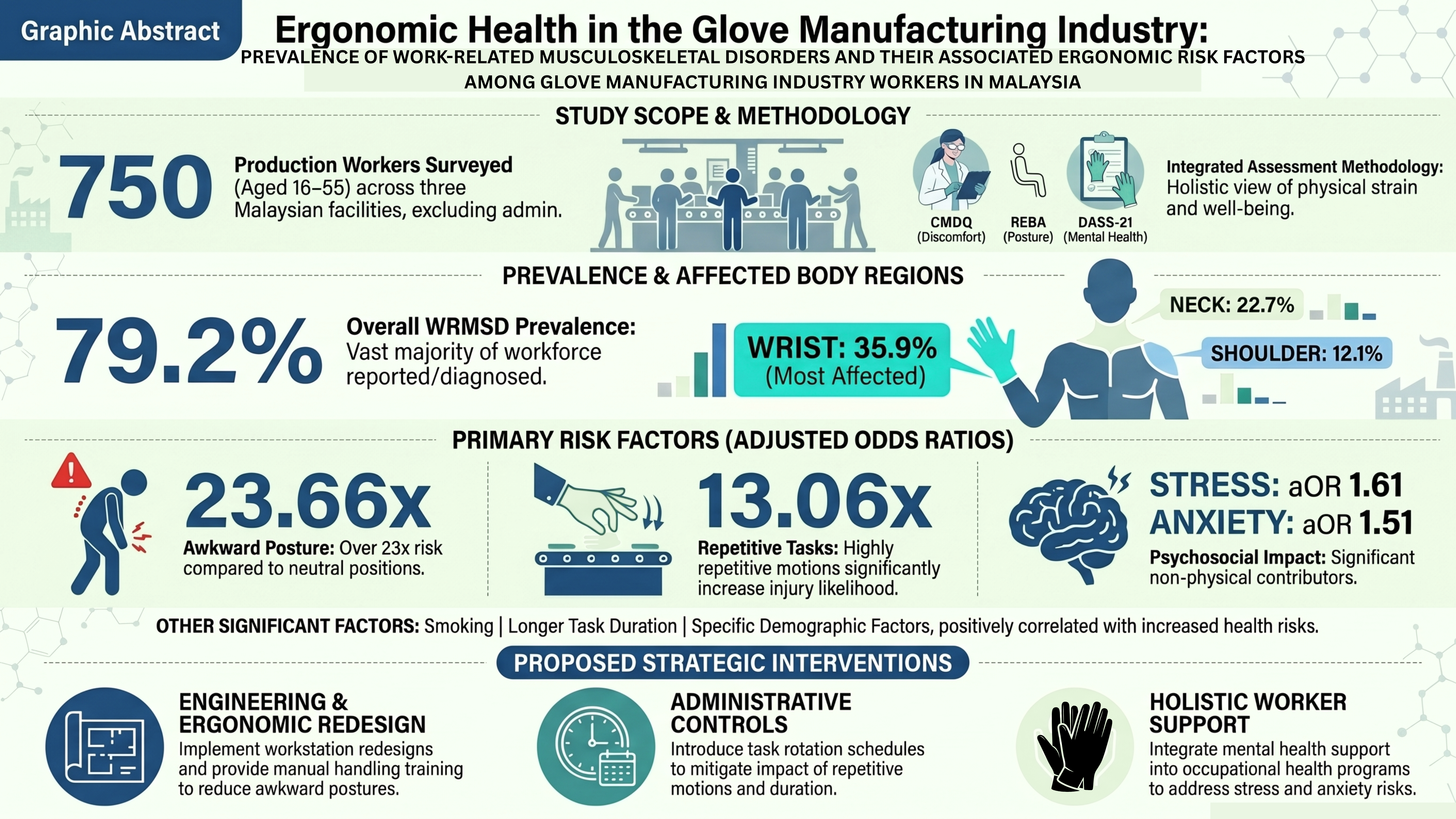
Introduction: Work-related musculoskeletal disorders (WRMSD) are a significant occupational health concern in the glove manufacturing sector. Despite its prominence, WRMSD prevalence in this sector remains unexplored. This study aims to determine the prevalence and associated risk factors of WRMSD among glove manufacturing workers in Malaysia. Method: A cross-sectional study used secondary data from three glove manufacturing facilities between 30 January and 30 June 2024. 750 production workers (aged 16–55) in similar job roles were included. Workers who had administrative roles or relevant medical histories were excluded. Secondary data included Cornell Musculoskeletal Discomfort Questionnaire (CMDQ), Depression, Anxiety, and Stress Scale–21 Items (DASS-21), medical records, and Rapid Entire Body Assessment (REBA) to assess musculoskeletal discomfort, mental health, WRMSD diagnosis, and ergonomic risk with posture, respectively. The primary outcome was WRMSD with independent variables including ergonomic postures, risk levels, overtime, absenteeism, age, gender, duration of employment, task repetition, and mental health status. Data was analysed using SPSS v.28, employing descriptive statistics, chi-square tests, and logistic regression. Result: The prevalence of WRMSD was 79.2%, with the wrist (35.9%), neck (22.7%), and shoulder (12.1%) being the most affected regions. Significant associated factors included smoking (aOR = 1.34,95% CI [1.21–1.64]), Awkward posture (aOR = 23.66,95% CI [14.28–38.94]), Repetitive Posture (aOR = 13.06,95% CI [12.03–14.11]), task duration (aOR=1.08,95% CI [1.01–1.15]), stress (aOR = 1.61, 95% CI [1.10–2.35]) and anxiety (aOR 1.51, 95% CI [1.42–1.88]). Conclusion: The study highlights a high prevalence of WRMSD in Malaysia’s glove manufacturing industry. Findings emphasize the need for integrated preventive measures including manual handling training, workstation redesign, task rotation, and mental health support to protect worker’s well-being and sustain industry productivity. The results provide a foundation for policy and workplace interventions, with future research recommended to explore causal relationships and evaluate the effectiveness of ergonomic interventions.
- Open Access
- Article
Prevalence of Work-Related Musculoskeletal Disorders and Their Associated Ergonomic Risk Factors among Glove Manufacturing Industry Workers in Malaysia †
- Anantha Kumar Rajendran 1,2,‡,
- Rama Krishna Supramanian 2,*,‡ and
- Menaka Dharshinii Selvaraj 3,‡
Author Information
Received: 20 March 2026 | Revised: 05 April 2026 | Accepted: 15 April 2026 | Published: 30 April 2026
Abstract
Graphical Abstract
Keywords
References
- 1.
Department of Statistics Malaysia (DOSM). Manufacturing Statistics. Available online: https://open.dosm.gov.my/dashboard/manufacturing-statistics (accessed on 24 January 2025).
- 2.
International Labour Organization (ILO). Decent Work Challenges and Opportunities in Malaysia’s Rubber Glove Supply Chain. Available online: https://www.ilo.org/publications/decent-work-challenges-and-opportunities-malaysia%E2%80%99s-rubber-glove-supply (accessed on 28 March 2023).
- 3.
Department of Occupational Safety and Health (DOSH). Guidelines for Manual Handling at Workplace, 2nd ed.; DOSH: Putrajaya, Malaysia, 2018.
- 4.
Department of Occupational Safety and Health (DOSH). Guidelines on Ergonomic Risk Assessment at Workplace; DOSH, Ministry of Human Resources: Putrajaya, Malaysia, 2017.
- 5.
World Health Organization (WHO). Preventing Musculoskeletal Disorders in the Workplace; WHO: Geneva, Switzerland, 2003. Available online: https://www.who.int/publications/i/item/preventing-musculoskeletal-disorders-in-the-workplace (accessed on 5 April 2025).
- 6.
Md Zein, R.; Rohani, J.M.; Abidin, N.Z.; et al. Financial Impact and Causes of Chronic MSD Cases in Malaysia Based on SOCSO Claims Record. In Advances in Human Factors and Ergonomics in Manufacturing; Springer: Cham, Switzerland, 2019; pp. 43–53.
- 7.
Department of Occupational Safety and Health (DOSH). Occupational Diseases and Poisoning Statistics. Available online: https://intranet.dosh.gov.my/osh-info-2/occupational-health/398-statistics-socso (accessed on 5 April 2025).
- 8.
Department of Statistics Malaysia (DOSM). Available online: https://www.dosm.gov.my/portal-main/release-content/big-data-analytics-national-occupational-injury-and-disease-statistics (accessed on 5 January 2025).
- 9.
Ali, N.F.; Roslan, A.N.N. Ergonomic Risk Factors and Prevalence of Work-Related Musculoskeletal Disorders among Solvent Manufacturing Workers in Shah Alam, Selangor. Malays. J. Med. Health Sci. 2024, 20, 99–105.
- 10.
Jacquier‑Bret, J.; Gorce, P. Work-Related Musculoskeletal Disorder Prevalence by Body Area among Nurses in Asia: Systematic Review and Meta-Analysis. Int. J. Environ. Res. Public Health 2025, 22, 652.
- 11.
Yusof, A.; Nurul Shahida, M.S. Prevalence of Musculoskeletal Discomfort among Workers in a Medical Manufacturing Facility. Int. J. Automot. Mech. Eng. 2021, 18, 8687–8694.
- 12.
Shafie, S.; Mohd Tamrin, S.B.; Yee Guan, N.; et al. Development of a Comprehensive Human Factor and Ergonomics Checklist for Workplace Inspections Using a Macro Ergonomics Approach. In Physical Ergonomics and Human Factors; Springer: Cham, Switzerland, 2023.
- 13.
Koirala, R.; Maharjan, K. Cognitive Ergonomics on Employee Wellbeing: A Literature Review. J. Econ. Concerns 2022, 13, 93–106.
- 14.
Tengku Sabri, T.A.; Isa, S.N.I.; Kamalruzaman, N.S.A.; et al. Relationship between Musculoskeletal Disorders and Psychological Distress among Health Sciences Undergraduate Students in Selangor. Malays. J. Public Health Med. 2023, 23, 57–64.
- 15.
Jayan, A. Major Processes in the Glove Manufacturing Industry Involving Manual Operations and Workforce Demand. Unpublished report, Malaysia, 2024.
- 16.
Poh, G.K.X.; Chew, I.M.L.; Tan, J. Life Cycle Optimization for Synthetic Rubber Glove Manufacturing. Chem. Eng. Technol. 2019, 42, 1771–1779.
- 17.
Demissie, B.; Bayih, E.T.; Demmelash, A.A. A Systematic Review of Work-Related Musculoskeletal Disorders and Risk Factors among Computer Users. Heliyon 2024, 10, e25075.
- 18.
Loh, P.Y.; Choi, J.; Lin, Y. Impact of Task Variation and Microbreaks on Muscle Fatigue at Seated and Standing Postures. Work 2023, 76, 1039–1045.
- 19.
Beltran Martinez, K.; Nazarahari, M.; Rouhani, H. Breaking the Fatigue Cycle: Investigating the Effect of Work‑Rest Schedules on Muscle Fatigue in Material Handling Jobs. Sensors 2023, 23, 9670.
- 20.
Krishnan, K.S.; Raju, G.; Shawkataly, O. Prevalence of Work-Related Musculoskeletal Disorders: Psychological and Physical Risk Factors. Int. J. Environ. Res. Public Health 2021, 18, 9361.
- 21.
Jia, N.; Zhang, M.; Zhang, H.; et al. Prevalence and Risk Factors Analysis for Low Back Pain among Occupational Groups in Key Industries of China. BMC Public Health 2022, 22, 1493.
- 22.
Lim, M.C.; Awang Lukman, K.; Giloi, N.; et al. Landscaping Work: Work-Related Musculoskeletal Problems and Ergonomic Risk Factors. Risk Manag. Healthc. Policy 2021, 14, 3411–3421.
- 23.
Lim, M.C.; Lukman, K.A.; Giloi, N.; et al. Prevalence of Upper Limb Musculoskeletal Disorders and Its Associated Risk Factors among Janitorial Workers: A Cross‑Sectional Study. Ann. Med. Surg. 2022, 73, 103201.
- 24.
Yongu, W.T.; Iorvaa, T.; Burbwa, S.N.; et al. Correlation between Job Satisfaction and Musculoskeletal Disorders among Academic Staff of Universities in Benue State: A Theoretical Narrative. Educ. Res. Rev. 2024, 19, 135–142.
- 25.
Jeffree, M.S.; Rahim AA, A.; Daud DM, A.; et al. Predictors of Musculoskeletal Disorders among Special Education Teachers in Sabah, Malaysia. Heliyon 2024, 10, e30873.
- 26.
Isusi, I.; Corra, A.; Durán, J.; et al. Work-Related Musculoskeletal Disorders: Prevalence, Costs and Demographics in the EU (European Risk Observatory); Publications Office of the European Union: Luxembourg, 2020.
- 27.
Nimje, S.; Dhatrak, S.; Nandi, S. Comparative Study of Work-Related Musculoskeletal Disorders among Mechanized and Manual Stone Miners. J. Datta Meghe Inst. Med. Sci. Univ. 2020, 15, 287–292.
- 28.
Fleiss, J.L.; Levin, B.; Paik, M.C. Statistical Methods for Rates and Proportions; Wiley: New York, NY, USA, 2003.
- 29.
Lwanga, S.K.; Lemeshow, S. Sample Size Determination in Health Studies: A Practical Manual; World Health Organization: Geneva, Switzerland, 1991; pp. 1–30.
- 30.
Pourhoseingholi, M.A.; Vahedi, M.; Rahimzadeh, M. Sample Size Calculation in Medical Studies. Gastroenterol. Hepatol. Bed Bench 2013, 6, 14–17.
- 31.
Serdar, C.C.; Cihan, M.; Yücel, D.; et al. Sample Size, Power and Effect Size Revisited: Simplified and Practical Approaches in Pre-Clinical, Clinical and Laboratory Studies. Biochem. Med. 2021, 31, 27–53.
- 32.
Yii, Y.Z.; Pillai, S.; Ramalingam, V.; et al. Prevalence of Work-Related Musculoskeletal Disorders (WRMSD) and the Associated Risk Factors among Malaysian Physiotherapists: A Cross-Sectional Study. J. Phys. Educ. Sport 2022, 22, 2636–2641.
- 33.
Duchesne, E.; Dufresne, S.S.; Dumont, N.A. Impact of Inflammation and Anti‑Inflammatory Modalities on Skeletal Muscle Healing: From Fundamental Research to the Clinic. Phys. Ther. 2017, 97, 807–817.
- 34.
Bezzina, A.; Austin, E.; Nguyen, H.; et al. Workplace Psychosocial Factors and Their Association with Musculoskeletal Disorders: A Systematic Review of Longitudinal Studies. Workplace Health Saf. 2023, 71, 578–588.
- 35.
Das, B. Work-Related Musculoskeletal Disorders in Agriculture: Ergonomics Risk Assessment and Its Prevention among Indian Farmers. Work 2023, 76, 225–241.
- 36.
O’Donnell, A.-M.; Little, C. Orthopedics and Trauma of the Limbs. In Fitness for Work: The Medical Aspects, 5th ed.; Palmer, K.T., Brown, I., Hobson, J., Eds.; Oxford University Press: Oxford, UK, 2013; pp. 233–267.
- 37.
Koop, M.A.; Lutke Schipholt, I.J.; Scholten-Peeters, G.G.M.; et al. Identifying the Most Important Confounders When Assessing the Association between Low-Grade Systemic Inflammation and Musculoskeletal Pain: A Modified Delphi Study. Pain Med. 2021, 22, 2661–2669.
- 38.
Schwartz, A.H.; Albin, T.J.; Gerberich, S.G. Intra-Rater and Inter-Rater Reliability of the Rapid Entire Body Assessment (REBA) Tool. Int. J. Ind. Ergon. 2019, 71, 111–116.
- 39.
Astete-Cornejo, J.M.; Asencios-Hidalgo, J.R. Validation of the Cornell Musculoskeletal Discomfort Questionnaires in Textile Workers in Peru. Rev. Bras. Med. Trab. 2023, 21, e1007.
- 40.
Thiyagarajan, A.; James, T.G.; Marzo, R.R. Psychometric Properties of the 21-Item Depression, Anxiety, and Stress Scale (DASS-21) among Malaysians during COVID-19: A Methodological Study. Humanit. Soc. Sci. Commun. 2022, 9, 220.
- 41.
Greenland, S. Modeling and Variable Selection in Epidemiologic Analysis. Am. J. Public Health 1989, 79, 340–349.
- 42.
Groenwold, R.H.H.; Klungel, O.H.; Altman, D.G.; et al. Adjustment for Continuous Confounders: An Example of How to Prevent Residual Confounding. Can. Med. Assoc. J. 2013, 185, 401–406.
- 43.
Zulkiflee, E.N.D.; Puteh, F.; Ahmad, J. Generation Y Youth Involvement in 3D Industries: A Preliminary Evidence from Malaysia. Int. J. Acad. Res. Bus. Soc. Sci. 2022, 12, 2672–2696.
- 44.
Kumar, K. Malaysians Shun “3D” Jobs Because of Social Stigma, Not Low Wages, Employers Say. Available online: https://www.malaymail.com/news/malaysia/2016/02/17/malaysians-shun-3d-jobs-because-of-social-stigma-not-low-wages-employers-sa/1062173 (accessed on 15 April 2025).
- 45.
Rusbadrol, N. An Empirical Evidence of Employee Loyalty in the Private Sector. Int. J. Bus. Technol. Manag. 2024, 6, 254–261.
- 46.
Department of Statistics Malaysia (DOSM). Available online: https://www.dosm.gov.my/portal-main/release-content/big-data-analytics-national-occupational-accident-and-disease-statistics-2021 (accessed on 3 February 2025).
- 47.
Department of Statistics Malaysia (DOSM). Statistics on Women Empowerment in Selected Domains, Malaysia, 2024. Available online: https://www.dosm.gov.my/portal-main/release-content/statistics-on-women-empowerment-in-selected-domains-malaysia-2024 (accessed on 3 February 2025).
- 48.
Firouz, A. Reframing Narratives on Women and Development in Malaysia; Khazanah Research Institute: Kuala Lumpur, Malaysia, 2024.
- 49.
Ramachandran, J. 700,000 out of Work but “3D Jobs” Go a-Begging. Free Malaysia Today. Available online: https://www.freemalaysiatoday.com/category/nation/2022/03/01/700000-out-of-work-but-3d-jobs-go-a-begging (accessed on 3 February 2025).
- 50.
Khatri, R.B.; Assefa, Y. Access to Health Services among Culturally and Linguistically Diverse Populations in the Australian Universal Health Care System: Issues and Challenges. BMC Public Health 2022, 22, 880.
- 51.
Kumar, M.; Beri, R.; Arora, A.S.; et al. Symptom‑Based Analysis for Carpal Tunnel Syndrome in Assembly Line Workers Using ANOVA with Orthogonal Array. Appl. Mech. Mater. 2011, 110–116, 1701–1705.
- 52.
Yusof, A.; Mohd Shalahim, N.S. Investigation of Ergonomic Risk Factors among Male Workers in a Medical Manufacturing Company in Northern Malaysia. Malays. J. Public Health Med. 2020, 20, 167–175.
- 53.
Gül, T.; Gül, S.S. The Incidence of Musculoskeletal System Occupational Diseases among Tuberculosis Laboratory Workers. Eur. Res. J. 2017, 3, 174–179.
- 54.
Muniandy, R.K.; Mudin, K.; Yeap, B.T.; et al. Increased Incidence and Aetiological Factors of Back Pain among Universiti Malaysia Sabah Staff and Undergraduates During the COVID-19 Lockdown Period. Med. J. Malaysia 2022, 77, 185–188.
- 55.
Institute for Public Health (IKU), National Institutes of Health (NIH) Malaysia. Global Adult Tobacco Survey (GATS) Malaysia 2023: Factsheet; Ministry of Health Malaysia: Kuala Lumpur, Malaysia, 2024. Available online: https://iku.nih.gov.my/images/gats2023/gats-factsheet1-2023.pdf (accessed on 5 February 2025).
- 56.
Sheth, A.; Pagdhune, A.; Viramgami, A. Prevalence of Work‑Related Musculoskeletal Disorders (WRMSDs) and Its Association with Modifiable Risk Factors in Metropolitan Bus Transit Drivers: A Cross‑Sectional Comparison. J. Fam. Med. Prim. Care 2023, 12, 1673–1678.
- 57.
Altundaş Hatman, E.; Öngel, F.S.; Yavuz, M.E.; et al. Work‑Related Diseases and Risk Factors Associated with Work‑Related Musculoskeletal Disorders among Unionized Metal Industry Workers: A Cross-Sectional Study. Int. J. Occup. Saf. Ergon. 2024, 30, 110–120.
- 58.
Friedman, A.S. Smoking to Cope: Addictive Behavior as a Response to Mental Distress. J. Health Econ. 2020, 72, 102323.
- 59.
Chowdhury, R.; Shah, D.; Payal, A. Healthy Worker Effect Phenomenon: Revisited with Emphasis on Statistical Methods—A Review. Indian J. Occup. Environ. Med. 2017, 21, 2–8.
- 60.
Soares, C.O.; Pereira, B.F.; Gomes, M.V.P.; et al. Preventive Factors Against Work-Related Musculoskeletal Disorders: Narrative Review. Rev. Bras. Med. Trab. 2019, 17, 415–430.
- 61.
Shah, K.; Maruthur, M.; Phillips, W.; et al. Ergonomic and Psychosocial Risk Factors Associated with Work-Related Musculoskeletal Disorders in Mohs Histotechs. Arch. Dermatol. Res. 2023, 315, 917–923.
- 62.
Acquah, A.A.; D’Souza, C.; Martin, B.J.; et al. Comparison of Ergonomic Risk Factors and Work-Related Musculoskeletal Disorders among Dismantlers and Burners of Electronic Waste in Agbogbloshie, Accra, Ghana. In Proceedings of the Human Factors and Ergonomics Society 65th International Annual Meeting, Baltimore, MA USA, 3–8 October 2021.
- 63.
Tan, D.; Balaraman, T. Working Posture and Musculoskeletal Pain among Restaurant Chefs. Indian J. Physiother. Occup. Ther. 2020, 14, 45–50.
- 64.
National Research Council; Institute of Medicine. Musculoskeletal Disorders and the Workplace; National Academies Press: Washington, DC, USA, 2001.
- 65.
Burgess-Limerick, R. Participatory Ergonomics: Evidence and Implementation Lessons. Appl. Ergon. 2018, 68, 289–293.
- 66.
Kang, D.M.; Kim, Y.K.; Kim, J.E. Job Stress and Musculoskeletal Diseases. J. Korean Med. Assoc. 2011, 54, 851–858.
- 67.
Khan, H.; Ghani, L.; Kousar, A.; et al. Association of Work‑Related Musculoskeletal Disorders with Depression, Anxiety and Stress among Farmers. Insights J. Health Rehabil. 2025, 3, 657–664.
- 68.
Sic, A.; Bogicevic, M.; Brezic, N.; et al. Chronic Stress and Headaches: The Role of the HPA Axis and Autonomic Nervous System. Biomedicines 2025, 13, 463.
- 69.
Larsson, K.; Ekblom, Ö.; Kallings, L.V.; et al. Job Demand-Control-Support Model as Related to Objectively Measured Physical Activity and Sedentary Time in Working Women and Men. Int. J. Environ. Res. Public Health 2019, 16, 3370.
- 70.
Nurhanisah, M.H.; Sulaiman, R.; Manami, K.; et al. A Survey on Musculoskeletal Pain and Discomfort among Industrial Workers. Malays. J. Public Health Med. 2023, 23, 235–244.
- 71.
Mazur, B.; Mazur-Małek, M. Evaluating the Effectiveness of a Worksite Wellness Program. Int. J. Contemp. Manag. 2017, 4, 77–89.
- 72.
Greggi, C.; Visconti, V.V.; Albanese, M.; et al. Work‑Related Musculoskeletal Disorders: A Systematic Review and Meta-Analysis. J. Clin. Med. 2024, 13, 3964.
- 73.
Hita-Gutiérrez, M.; Gómez-Galán, M.; Díaz-Pérez, M.; et al. An Overview of REBA Method Applications in the World. Int. J. Environ. Res. Public Health 2020, 17, 2635.
- 74.
Hazra, A. Using the Confidence Interval Confidently. J. Thorac. Dis. 2017, 9, 4124–4129.
- 75.
Kahlert, J.; Gribsholt, S.B.; Gammelager, H.; et al. Control of Confounding in the Analysis Phase—An Overview for Clinicians. Clin. Epidemiol. 2017, 9, 195–204.
- 76.
Baldwin, J.R.; Pingault, J.-B.; Schoeler, T.; et al. Protecting Against Researcher Bias in Secondary Data Analysis: Challenges and Potential Solutions. Eur. J. Epidemiol. 2022, 37, 1–10.


This work is licensed under a Creative Commons Attribution 4.0 International License.
