
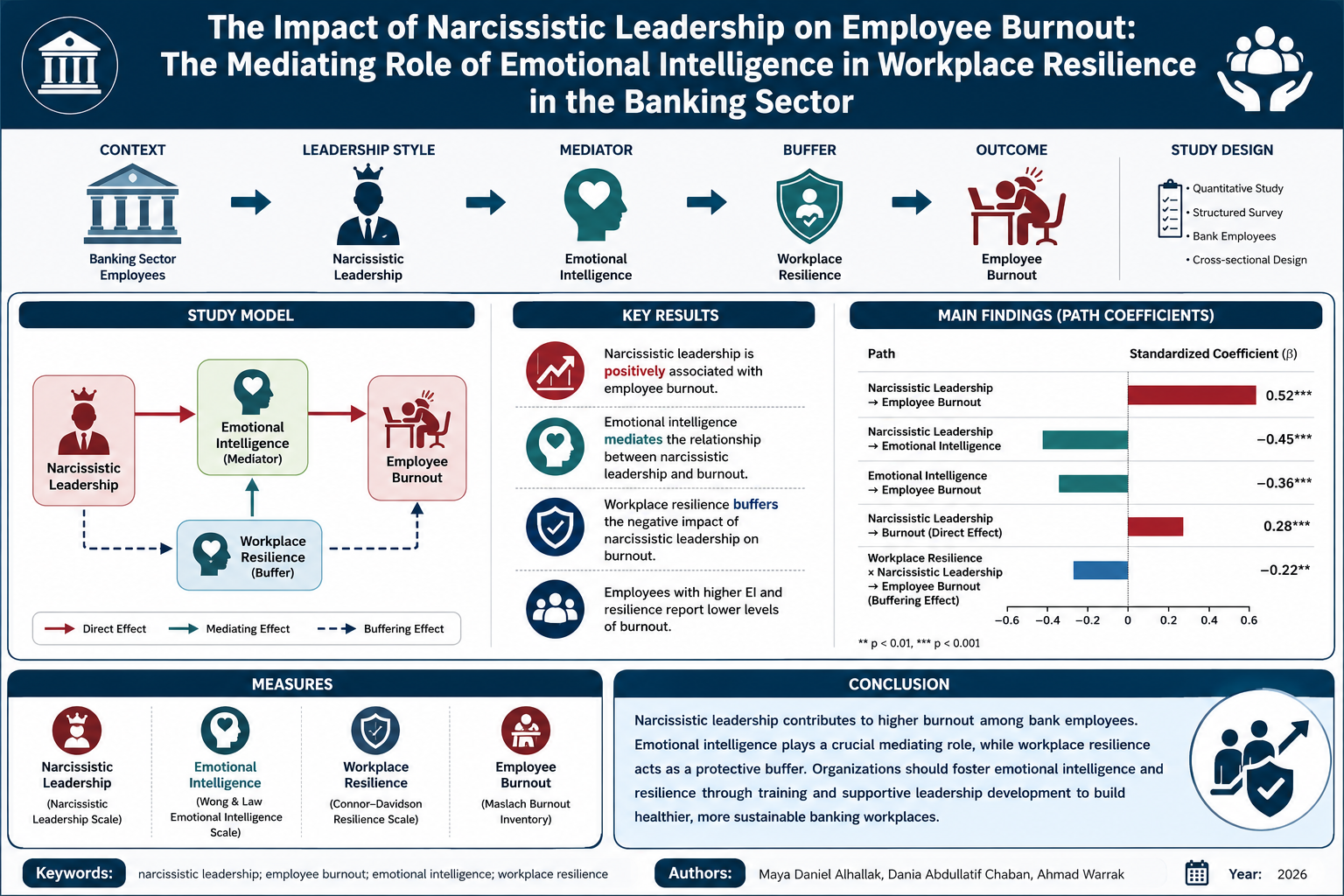
In contemporary organizational environments, leadership style plays a critical role in shaping employee well-being and performance. Narcissistic leaders often exhibit manipulative, self-centered, and emotionally detached behaviors, which can contribute to a toxic work atmosphere and lead to heightened stress and burnout among employees. This study investigates the relationship between narcissistic leadership and employee burnout, focusing specifically on the banking sector. Through the lens of workplace resilience, the research explores how emotional intelligence mediates this relationship among bank employees. A quantitative approach was used, collecting data from employees through structured surveys measuring perceived narcissism in leadership, levels of burnout, emotional intelligence, and resilience. We observed a significant positive correlation between narcissistic leadership and employee burnout. However, emotional intelligence was found to play a mediating role, helping individuals better manage the emotional toll of difficult leadership dynamics. Moreover, workplace resilience emerged as a buffering factor, reducing the intensity of burnout symptoms. The findings underscore the importance of fostering emotional intelligence and resilience in employees as protective mechanisms against toxic leadership styles. Organizations are encouraged to invest in leadership development and emotional competency training to create healthier and more sustainable work environments.
- Open Access
- Article
The Impact of Narcissistic Leadership on Employee Burnout: The Mediating Role of Emotional Intelligence in Workplace Resilience in the Banking Sector
- Maya Daniel Alhallak,
- Dania Abdullatif Chaban and
- Ahmad Warrak *
Author Information
Received: 08 December 2025 | Revised: 10 April 2026 | Accepted: 23 April 2026 | Published: 10 June 2026
Abstract
Graphical Abstract
References
- 1.
Mayer, J.D.; Salovey, P. What Is Emotional Intelligence? In Emotional Development and Emotional Intelligence: Implications for Educators; Salovey, P., Sluyter, D., Eds.; Basic Books: New York, NY, USA, 1997; pp. 3–31.
- 2.
Sarrionandia, A.; Ramos-Díaz, E.; Fernández-Lasarte, O. Resilience as a Mediator of Emotional Intelligence and Perceived Stress: A Cross-Country Study. Front. Psychol. 2018, 9, 2653.
- 3.
Vilca‑Pareja, V.; Luque Ruiz de Somocurcio, A.; Delgado‑Morales, R.; et al. Emotional Intelligence, Resilience, and Self‑Esteem as Predictors of Satisfaction with Life in University Students. Int. J. Environ. Res. Public Health 2022, 19, 16548.
- 4.
Chatterjee, A.; Hambrick, D.C. Itʼs All about Me: Narcissistic Chief Executive Officers and Their Effects on Company Strategy and Performance. Adm. Sci. Q. 2007, 52, 351–386.
- 5.
Grijalva, E.; Harms, P.D. Narcissism: An Integrative Synthesis and Dominance Complementarity Model. Acad. Manag. Perspect. 2014, 28, 108–127.
- 6.
OʼBoyle, E.H.; Forsyth, D.R.; Banks, G.C.; et al. A Meta-Analysis of the Dark Triad and Work Behavior: A Social Exchange Perspective. J. Appl. Psychol. 2012, 97, 557–579.
- 7.
Asrar-ul-Haq, M.; Anjum, T. Impact of Narcissistic Leadership on Employee Work Outcomes in Banking Sector of Pakistan. Future Bus. 2020, 6, 34.
- 8.
Başar, U. A Multilevel Study of Relationships between Leaders’ Dark Triad and Employee Burnout: Mediating Role of Perceived Dark Leadership. J. Bus. Res.-Turk 2020, 12, 2407–2423. https://doi.org/10.20491/isarder.2020.983.
- 9.
Nevicka, B.; De Hoogh, A.H.B.; Den Hartog, D.N.; et al. Narcissistic Leaders and Their Victims: Followers Low on Self-Esteem and Low on Core Self-Evaluations Suffer Most. Front. Psychol. 2018, 9, 422. https://doi.org/10.3389/fpsyg.2018.00422.
- 10.
Labrague, L.J. Abusive Supervision and Its Relationship with Nursing Workforce and Patient Safety Outcomes: A Systematic Review. West. J. Nurs. Res. 2024, 46, 52–63.
- 11.
Gong, Z.; Chen, Y.; Wang, Y. The Influence of Emotional Intelligence on Job Burnout and Job Performance: Mediating Effect of Psychological Capital. Front. Psychol. 2019, 10, 2707.
- 12.
Goleman, D. Working with Emotional Intelligence; Bantam Books: Milwaukee, WI, USA, 2006.
- 13.
Miao, Z.; Han, Z.; Zhang, T.; et al. A Systems Approach to a Spatio‑Temporal Understanding of the Drought Stress Response in Maize. Sci. Rep. 2017, 7, 6590.
- 14.
Li, J.; Tong, Y. Does Narcissistic Leadership Enhance Employee Resilience? A Moderated Mediation Model of Goal-Directed Energy and Psychological Availability. Leadersh. Organ. Dev. J. 2021, 42, 819–836. https://doi.org/10.1108/LODJ-11-2020-0521.
- 15.
Galanis, P.; Vraka, I.; Fragkou, D.; et al. Nurses’ Burnout and Associated Risk Factors during the COVID-19 Pandemic: A Systematic Review and Meta-Analysis. J. Adv. Nurs. 2021;77, 3286–302. https://doi.org/10.1111/jan.14839.
- 16.
Hobfoll, S.E. Conservation of Resources: A New Attempt at Conceptualizing Stress. Am. Psychol. 1989, 44, 513–524.
- 17.
Bakker, A.B.; Demerouti, E. Job Demands–Resources Theory: Taking Stock and Looking Forward. J. Occup. Health Psychol. 2017, 22, 273–285.
- 18.
Toker, S.; Biron, M. Job Burnout and Depression: Unraveling Their Temporal Relationship and Considering the Role of Physical Activity. J. Appl. Psychol. 2012, 97, 699–710.
- 19.
Youssef, C.M.; Luthans, F. Positive Organizational Behavior in the Workplace: The Impact of Hope, Optimism, and Resilience. J. Manag. 2007, 33, 774–800.
- 20.
Ames, D.R.; Rose, P.; Anderson, C.P. The NPI‑16 as a Short Measure of Narcissism. J. Res. Pers. 2006, 40, 440–450.
- 21.
Wong, C.S.; Law, K.S. The Effects of Leader and Follower Emotional Intelligence on Performance and Attitude: An Exploratory Study. Leadersh. Q. 2002, 13, 243–274.
- 22.
Connor, K.M.; Davidson, J.R.T. Development of a New Resilience Scale: The Connor‑Davidson Resilience Scale (CD‑RISC). Depress. Anxiety 2003, 18, 76–82.
- 23.
Maslach, C.; Jackson, S.E. The Measurement of Experienced Burnout. J. Organ. Behav. 1981, 2, 99–113.
- 24.
Baron, R.M.; Kenny, D.A. The Moderator–Mediator Variable Distinction in Social Psychological Research: Conceptual, Strategic, and Statistical Considerations. J. Pers. Soc. Psychol. 1986, 51, 1173–1182.
- 25.
Rosenthal, S.A.; Pittinsky, T.L. Narcissistic Leadership. Leadersh. Q. 2006, 17, 617–633.
- 26.
American Psychiatric Association. Diagnostic and Statistical Manual of Mental Disorders, 5th ed.; American Psychiatric Association: Washington, DC, USA, 2022. https://doi.org/10.1176/appi.books.9780890425787.
- 27.
Judge, T.A.; Bono, J.E.; Ilies, R.; et al. Personality and Leadership: A Qualitative and Quantitative Review. J. Appl. Psychol. 2002, 87, 765–780.
- 28.
Blau, P.M. Exchange and Power in Social Life; John Wiley & Sons: New York, NY, USA, 1964.
- 29.
Maccoby, M. Narcissistic Leaders: The Incredible Pros, the Inevitable Cons. Harv. Bus. Rev. 2000, 78, 68–78.
- 30.
Maslach, C.; Schaufeli, W.B.; Leiter, M.P. Job Burnout. Annu. Rev. Psychol. 2001, 52, 397–422.
- 31.
Skakon, J.; Nielsen, K.; Borg, V.; et al. Are Leaders’ Well‑Being, Behaviours and Style Associated with the Affective Well‑Being of Their Employees? A Systematic Review of Three Decades of Research. Work Stress 2010, 24, 107–139.
- 32.
Mayer, J.D.; Salovey, P.; Caruso, D.R. Emotional Intelligence: Theory, Findings, and Implications. Psychol. Inq. 2004, 15, 197–215.
- 33.
Goleman, D. Emotional Intelligence: Why It Can Matter More than IQ; Bantam Books: Milwaukee, WI, USA, 1995.
- 34.
Jackson, D.; Firtko, A.; Edenborough, M. Personal Resilience as a Strategy for Surviving and Thriving in the Face of Workplace Adversity: A Literature Review. J. Adv. Nurs. 2007, 60, 1–9.
- 35.
Hair, J.F.; Black, W.C.; Babin, B.J.; et al. Multivariate Data Analysis, 7th ed.; Prentice Hall: Upper Saddle River, NJ, USA, 2010.


This work is licensed under a Creative Commons Attribution 4.0 International License.
