
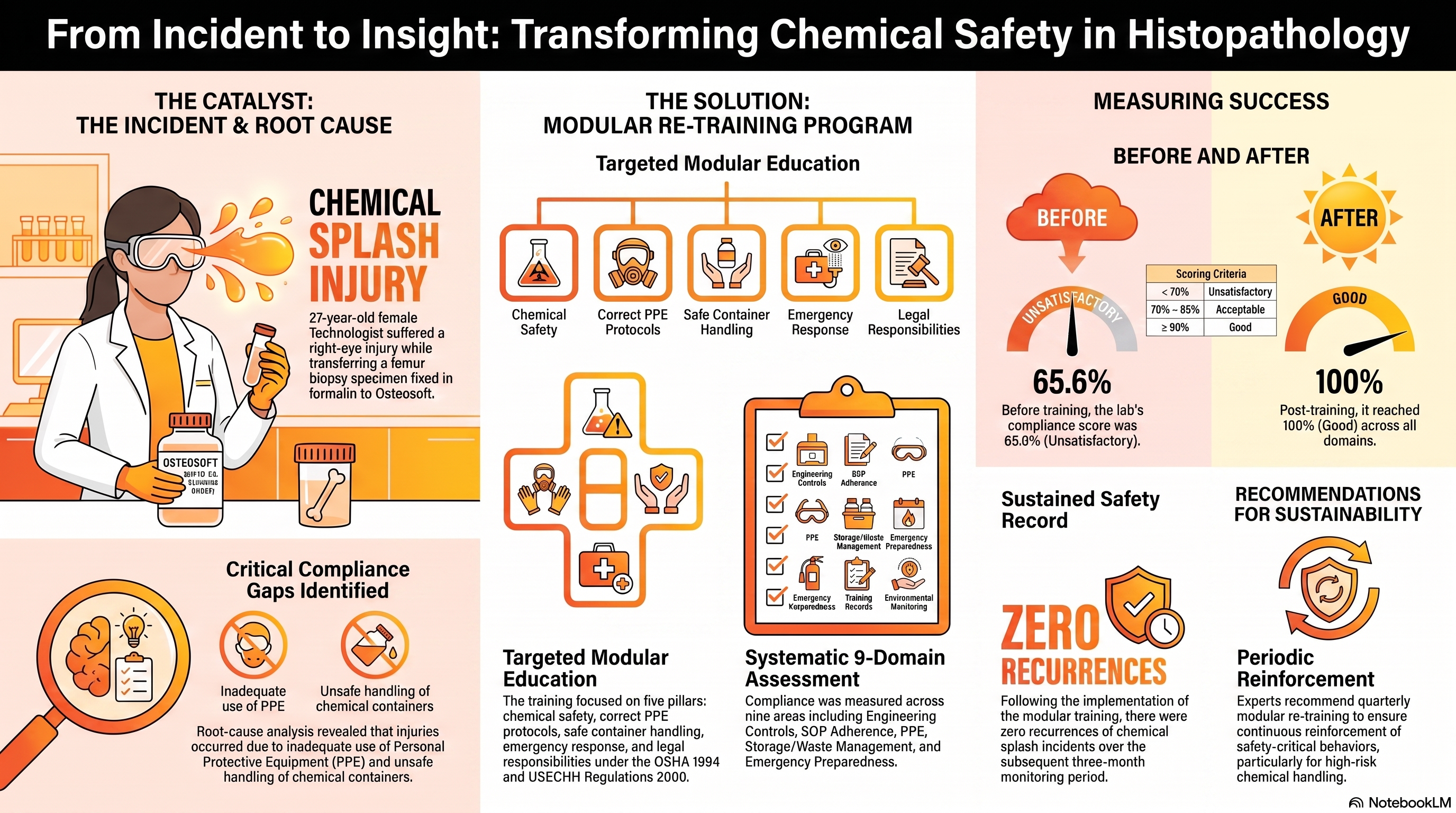
Chemical splash injuries are a preventable occupational hazard in histopathology laboratories. Despite regulatory frameworks, including the Occupational Safety and Health Act 1994 and Use and Standard of Chemicals Hazardous to Health (USECHH) Regulations 2000, compliance gaps persist. This study evaluated the impact of a modular re-training program combined with a structured chemical safety assessment on laboratory safety practices in a Category I hospital in Kuching, Sarawak, Malaysia. The study was prompted by a chemical splash injury to the right eye of a 27-year-old female Medical Laboratory Technologist while handling a femur bone-marrow biopsy specimen fixed in formalin and transferred to Osteosoft (an alkaline decalcifying agent, corrosive—GHS05, pH 7.0–7.3). Root-cause analysis identified inadequate personal protective equipment (PPE) use and unsafe container handling. Methodology: A modular re-training program was implemented, focusing on chemical safety, correct PPE use, safe container handling, emergency response, and legal responsibilities by adapting the Lean Six Sigma DMAIC framework. A nine-domain chemical safety checklist, adapted from institutional resources, assessed documentation, engineering controls, adherence to Safe Work Procedures (SWP), PPE, handling, storage/waste management, emergency preparedness, training/monitoring, and legal compliance. Each item was scored 0–2 (0 = non-compliant; 1 = partial; 2 = fully compliant), with total compliance categorized as <70% = Unsatisfactory, 70–89% = Acceptable, ≥90% = Good. Results: Post-training, overall compliance improved from 65.6% (Unsatisfactory) to 100% (Good). Staff achieved full PPE compliance, improved adherence to SWP, enhanced hazard awareness, and no recurrence of incidents over three months. Discussion: The modular re-training reinforced safe practices through focused, repetitive instruction, while assessment scores enabled objective monitoring and accountability. It is recommended that to implement periodic (e.g., quarterly) modular re-training for all histopathology staff focusing on high-risk chemicals, PPE requirements, safe container handling, and emergency response. This ensures continuous reinforcement of safety-critical behaviours. Conclusion: Combining modular re-training with systematic safety assessment strengthened compliance, fostered a culture of safety, and supported sustained safe chemical handling practices.
- Open Access
- Article
From Incident to Insight: Impact of a Modular Re-Training Approach in a Histopathology Laboratory of a Category I Hospital in Kuching, Sarawak, Malaysia †
- Anantha Kumar Rajendran 1, 2, *, ‡,
- Lau Fui Yin 1, ‡,
- Roszita Binti Ibrahim 2, ‡,
- Azimatun Noor Aizuddin 2, ‡,
- Wong Khung Ying 1, ‡ and
- Menaka Dharshinii Selvaraj 3, ‡
Author Information
Received: 20 March 2026 | Revised: 21 April 2026 | Accepted: 13 May 2026 | Published: 08 July 2026
Abstract
Graphical Abstract
Keywords
laboratory safety | chemical exposure | training | regulatory | lean | six sigma
References
- 1.
Campbell, O.B.L. Occupational Exposure to Hazards among Medical Laboratory Scientists at a Hospital Clinical Laboratory in Kingston, Jamaica. Discov. Public Health 2026, 23, 165.
- 2.
Baliga, M.S.; Dʼsouza, R.T.; Madathil, L.P.; et al. Chemicals in Medical Laboratory and Its Impact on Healthcare Workers and Biotic Factors: Analysis through the Prism of Environmental Bioethics. Laboratories 2025, 2, 14.
- 3.
Yahyaei, E.; Majlesi, B.; Pourbakhshi, Y.; et al. Occupational Exposure and Risk Assessment of Formaldehyde in the Pathology Departments of Hospitals. Asian Pac. J. Cancer Prev. 2020, 21, 1303–1309.
- 4.
Department of Occupational Safety and Health (DOSH). A Manual of Recommended Practice on Assessment of the Health Risk from the Use of Chemicals Hazardous to Health at Workplace, 3rd ed.; Department of Occupational Safety and Health: Putrajaya, Malaysia, 2017.
- 5.
Yon, H. The Compliance Status of Chemical Management among Industries in Malaysia: The USECHH after 20 Years. J. Energy Saf. Technol. 2022, 5, 7–20.
- 6.
Badea, D.O.; Darabont, D.C.; Ivan, I.; et al. Workersʼ Exposure to Chemical Risk in Small and Medium Sized Enterprises: Assessment Methodology and Field Study. Sustainability 2024, 16, 6308.
- 7.
Malta, G.; Matera, S.; Plescia, F.; et al. Occupational Accidents and the Use of PPE: A Global Meta-Analysis. Front. Public Health 2024, 12, 1368991.
- 8.
Paredes, W.M. Laboratory Lapses: Investigating Common Issues and Violations in Chemistry Laboratory Courses among Future Science Educators. Int. J. Arts Sci. Educ. 2025, 6, 175–193.
- 9.
Aliyo, A.; Edin, A. Assessment of Safety Requirements and Their Practices among Teaching Laboratories of Health Institutes. Microbiol. Insights 2023, 16, 11786361231174414.
- 10.
Carbonell, C.; Adegbulugbe, A.; Cheung, W.; et al. Barriers and Challenges to Implementing a Quality Improvement Program: Political and Administrative Challenges. JCO Glob. Oncol. 2024, 10, e2300455.
- 11.
Backhouse, A.; Ogunlayi, F. Quality Improvement into Practice. BMJ 2020, 368, m865.
- 12.
Fadhel, R.; Alqurs, A. Enhancing Occupational Health and Safety through Strategic Leadership: The Mediating Role of Total Quality Management in Hodeida Hospitals, Yemen. Risk Manag. Healthc. Policy 2025, 18, 823–842.
- 13.
Slil, E.; Iyiola, K.; Alzubi, A.; et al. Impact of Safety Leadership and Employee Morale on Safety Performance: The Moderating Role of Harmonious Safety Passion. Buildings 2025, 15, 186.
- 14.
Elendu, C.; Amaechi, D.C.; Okatta, A.U.; et al. The Impact of Simulation Based Training in Medical Education: A Review. Medicine 2024, 103, e38813.
- 15.
Herjuna, S.A.S.; Marhaeni, V.F.; Alvira, M.; et al. Impact of Training and Development Programs on Employee Performance in the Manufacturing Sector. Acta Psychol. 2024, 3, 140–151.
- 16.
Naughton, E.; Moran, R.; Kharub, M.; et al. A Structured Model for Continuous Improvement Methodology Deployment and Sustainment: A Case Study. Heliyon 2024, 10, e40034.
- 17.
Hariyani, D.; Hariyani, P.; Mishra, S.; et al. A Review of the Structured Framework for Sustainability Audits in Manufacturing Organizations. Green Technol. Sustain. 2025, 3, 100170.
- 18.
Li, J.; Wu, J.; Rong, X.; et al. The Novel Hazard Control and Accident Prevention System for Sustainable Chemical Lab Management. Sustainability 2025, 17, 8015.
- 19.
Mansur dos Reis, M.E.D.; de Abreu, M.F.; Neto, O.O.B.; et al. DMAIC in Improving Patient Care Processes: Challenges and Facilitators in Context of Healthcare. IFAC PapersOnLine 2022, 55, 215–220.
- 20.
Mittal, A.; Gupta, P.; Kumar, V.; et al. The Performance Improvement Analysis Using Six Sigma DMAIC Methodology: A Case Study on Indian Manufacturing Company. Heliyon 2023, 9, e14625.
- 21.
Mishra, P.; Sharma, R.K. A Hybrid Framework Based on SIPOC and Six Sigma DMAIC for Improving Process Dimensions in Supply Chain Network. Int. J. Qual. Reliab. Manag. 2014, 31, 522–546.
- 22.
Alara, O.R.; Osakwe, K.A. Sustainable Workplace Safety: Evidence Informed Priorities for Urgent Cross Sector Action. Glob. Health J. 2026, 10, 7–18.
- 23.
Zito, M.; Emanuel, F.; Bertola, L.; et al. Passion and Flow at Work for the Reduction of Exhaustion at Work in Nursing Staff. SAGE Open 2022, 12, 21582440221095009.
- 24.
Chance, E.A.; Florence, D.; Abdoul, I.S. The Effectiveness of Checklists and Error Reporting Systems in Enhancing Patient Safety and Reducing Medical Errors in Hospital Settings: A Narrative Review. Int. J. Nurs. Sci. 2024, 11, 387–398.
- 25.
Al-Zain, Y.; Al-Fandi, L.; Arafeh, M.; et al. Implementing Lean Six Sigma in a Kuwaiti Private Hospital. Int. J. Health Care Qual. Assur. 2019, 32, 431–446.
- 26.
Ibrahim, R.; Ho Han Ching, N.; Salahudin, S.A. Lean Healthcare: Perception and Assessment; Penerbit UKM: Bangi, Malaysia, 2022.
- 27.
George, M.L. Lean Six Sigma for Service; McGraw-Hill: New York, NY, USA, 2003.
- 28.
de Koning, H.; Verver, J.P.S.; van den Heuvel, J.; et al. Lean Six Sigma in Healthcare. J. Healthc. Qual. 2006, 28, 4–11.
- 29.
Hossain, M.A. Data-Driven Decision Making: Enhancing Quality Management Practices through Optimized MIS Frameworks. Innovatech Eng. J. 2024, 1, 117–135.
- 30.
Bošnjak, I.; Bošnjak, M. Lean System Management in Hospitals. Athens J. Health Med. Sci. 2020, 7, 127–144.
- 31.
Ren Jye, A.K.; Agos Lokman, F.Z. Lean Healthcare: Factors Influencing Sustainability of Sarawak General Hospital. J. Pharm. Negat. Results 2022, 13, 10344–10356.
- 32.
Muhamad Nasharudin, N.A.; Jiakai, L.; Suhaimi, N.A. A Sequential Mediation Model Linking Workplace Environment and Work Well-Being via Job Resources and Burnout among Trainers in Malaysiaʼs Ministry of Health Training Institutes. Discov. Psychol. 2026, 6, 47.

This work is licensed under a Creative Commons Attribution 4.0 International License.
