
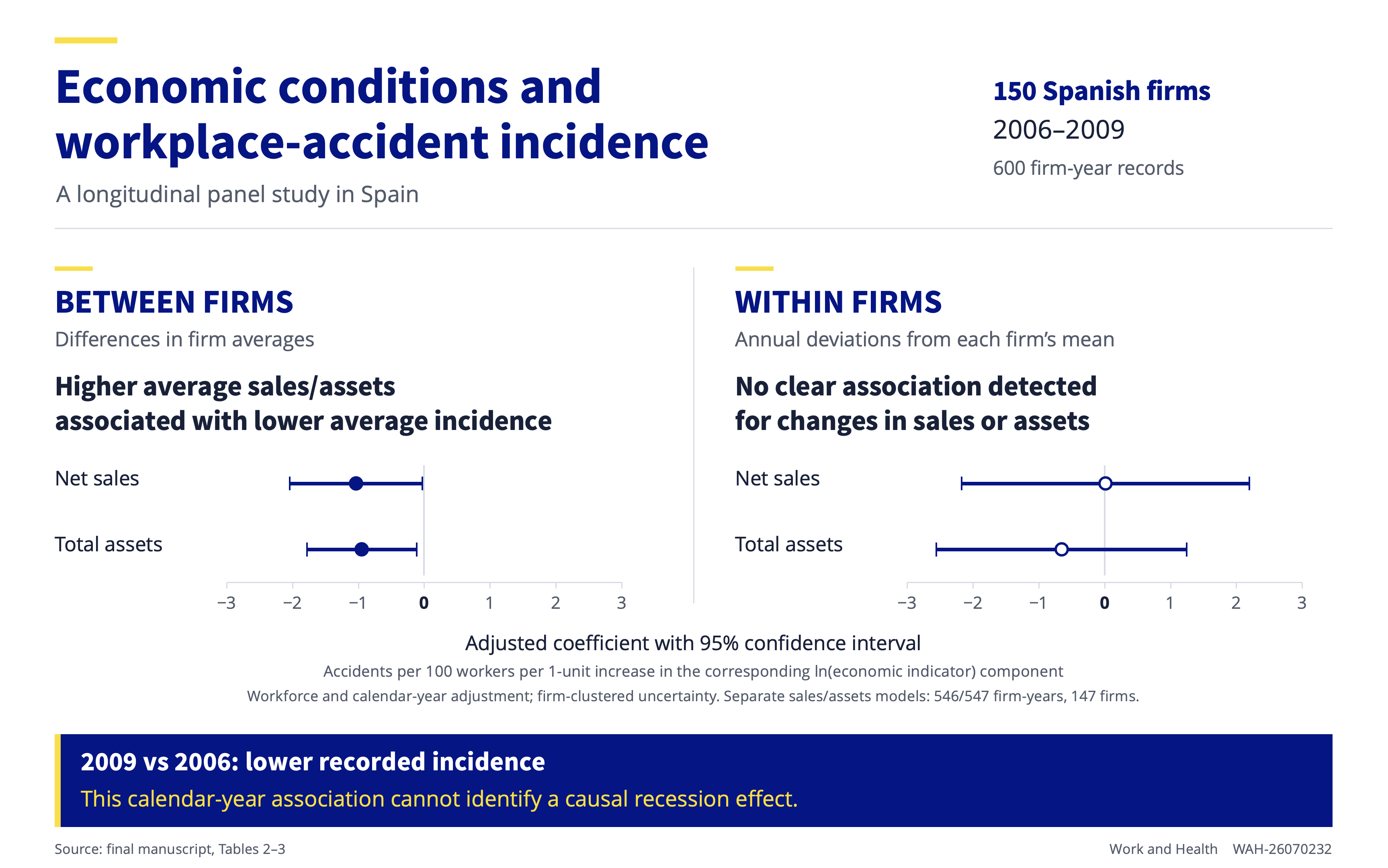
Workplace-accident statistics can change during economic downturns because firms alter employment, activity, work organization, and reporting, yet firm-level evidence often conflates differences between firms with changes occurring within the same firm. This longitudinal study examined associations of net sales and total assets with recorded workplace-accident incidence in 150 Spanish firms observed annually from 2006 to 2009. The balanced firm-year structure was analyzed using firm and calendar-year fixed effects with standard errors clustered by firm. Adjusted within-between decompositions distinguished within-firm changes from between-firm differences. The archived sample included firms that obtained OHSAS 18001 certification at different times and a non-certified comparison group; certification was therefore treated as a time-varying contextual characteristic rather than a uniform sample attribute. Higher average sales and assets characterized firms with lower average accident incidence, but changes in either economic measure within a firm were not associated with corresponding changes in incidence after accounting for workforce and common calendar-year conditions. Recorded incidence was lower in 2009 than in 2006, although this calendar-year contrast cannot identify a causal recession effect. Results were consistent across alternative outcome definitions, complete-sample restrictions, sector-specific time trends, outlier checks, first-difference models, and alternative outcome transformations. The findings show why between-firm and within-firm evidence should be separated when interpreting occupational-injury patterns during macroeconomic disruption. The longitudinal estimates therefore do not support the hypothesis that improvements in firm economic conditions were associated with reductions in accident incidence within firms.
- Open Access
- Article
Between-Firm and Within-Firm Economic Conditions and Workplace-Accident Incidence in Spain, 2006–2009: A Longitudinal Panel Study
- Agustín Sánchez-Toledo Ledesma 1,*,
- Natalia Fernández Laviada 2,
- María Inmaculada Martín Alix 3,
- Juan José Agún González 4,
- Raúl Aguilar Elena 4
Author Information
Received: 23 Jul 2026 | Revised: 27 Aug 2026 | Accepted: 01 Sep 2026 | Published: 10 Sep 2026
Abstract
Graphical Abstract
Keywords
occupational accidents | economic cycle | panel data | firm fixed effects | OHSAS 18001 | Spain
References
- 1.
Robson, L.S.; Clarke, J.A.; Cullen, K.; et al. The Effectiveness of Occupational Health and Safety Management System Interventions: A Systematic Review. Saf. Sci. 2007, 45, 329–353. https://doi.org/10.1016/j.ssci.2006.07.003.
- 2.
Madsen, C.U.; Kirkegaard, M.L.; Dyreborg, J.; et al. Making Occupational Health and Safety Management Systems ‘Work’: A Realist Review of the OHSAS 18001 Standard. Saf. Sci. 2020, 129, 104843. https://doi.org/10.1016/j.ssci.2020.104843.
- 3.
Heras-Saizarbitoria, I.; Boiral, O.; Arana, G.; et al. OHSAS 18001 Certification and Work Accidents: Shedding Light on the Connection. J. Saf. Res. 2019, 68, 33–40. https://doi.org/10.1016/j.jsr.2018.11.003.
- 4.
Abad, J.; Lafuente, E.; Vilajosana, J. An Assessment of the OHSAS 18001 Certification Process: Objective Drivers and Consequences on Safety Performance and Labour Productivity. Saf. Sci. 2013, 60, 47–56. https://doi.org/10.1016/j.ssci.2013.06.011.
- 5.
McLeod, C.B.; Macpherson, R.A. Evaluating the Effectiveness of an Occupational Health and Safety Management System Certification Program on Firm Work Injury Rates in Alberta, Canada. Am. J. Ind. Med. 2025, 68, 175–183. https://doi.org/10.1002/ajim.23690.
- 6.
Macpherson, R.A.; McLeod, C.B. Does Having a Certified Occupational Health and Safety Management System Lead to a Greater Injury Rate Reduction? An Evaluation of the Certificate of Recognition Program in Ontario, Canada. J. Saf. Res. 2026, 97, 1–8. https://doi.org/10.1016/j.jsr.2026.01.017.
- 7.
Viswanathan, K.; Johnson, M.S.; Toffel, M.W. Do Safety Management System Standards Indicate Safer Operations? Evidence from the OHSAS 18001 Occupational Health and Safety Standard. Saf. Sci. 2024, 171, 106383. https://doi.org/10.1016/j.ssci.2023.106383.
- 8.
Joo, I.; Baek, K. The Consequences of ISO 45001: Preliminary Analysis of Cases in Korea. J. Occup. Health 2024, 66, uiad007. https://doi.org/10.1093/joccuh/uiad007.
- 9.
Dyreborg, J.; Thorsen, S.V.; Madsen, C.U.; et al. Effectiveness of OHSAS 18001 in Reducing Accidents at Work: A Follow-up Study of 13,102 Workplaces. Saf. Sci. 2024, 177, 106573. https://doi.org/10.1016/j.ssci.2024.106573.
- 10.
Ledic Neto, J.; Moro, A.R.P.; Ensslin, S.R. Occupational Health and Safety Management Systems: A Systemic Approach. Rev. Bras. De Cineantropometria Desempenho Hum. 2024, 26, e91514. https://doi.org/10.1590/1980-0037.2024v26e91514.
- 11.
Sedano de la Fuente, V.; Camino López, M.A.; Fontaneda González, I.; et al. The Impact of the Economic Crisis on Occupational Injuries. J. Saf. Res. 2014, 48, 77–85. https://doi.org/10.1016/j.jsr.2013.12.007.
- 12.
Fernández-Muñiz, B.; Montes-Peón, J.M.; Vázquez-Ordás, C.J. Occupational Accidents and the Economic Cycle in Spain 1994–2014. Saf. Sci. 2018, 106, 273–284. https://doi.org/10.1016/j.ssci.2016.02.029.
- 13.
Asfaw, A.; Pana-Cryan, R.; Rosa, R. The Business Cycle and the Incidence of Workplace Injuries: Evidence from the U.S.A. J. Saf. Res. 2011, 42, 1–8. https://doi.org/10.1016/j.jsr.2010.10.008.
- 14.
Chang, D.S.; Chen, Y.; Tsai, Y.C. How Injury Incidence Is Associated with Business Cycles? Empirical Evidence from Taiwan. Saf. Sci. 2018, 110, 235–248. https://doi.org/10.1016/j.ssci.2018.08.014.
- 15.
Jenke, T.; Oosthuizen, J.; Cattani, M. An Investigation of the Influence of Economic Cycles on Safety Performance in Western Australia. Saf. Sci. 2021, 138, 105230. https://doi.org/10.1016/j.ssci.2021.105230.
- 16.
Boone, J.; van Ours, J.C.; Wuellrich, J.P.; et al. Recessions Are Bad for Workplace Safety. J. Health Econ. 2011, 30, 764–773. https://doi.org/10.1016/j.jhealeco.2011.05.013.
- 17.
Anyfantis, I.; Boustras, G.; Karageorgiou, A. Maintaining Occupational Safety and Health Levels during the Financial Crisis—A Conceptual Model. Saf. Sci. 2018, 106, 246–254. https://doi.org/10.1016/j.ssci.2016.02.014.
- 18.
Canaveras Perea, R.M.; Tejada Ponce, Á.; Sánchez González, M.P. How to Prevent 3 Million Deaths Worldwide: A Systematic Review of Occupational Accident Research—A Factor- and Cost-Based Approach. Eur. J. Public Health 2025, 35, 91–100. https://doi.org/10.1093/eurpub/ckae197.
- 19.
Murrell-Blanco, M. The Relationship between the Economic Cycle and Work Accidents in the United States: A Time Series Analysis. Tec Empres. 2023, 17, 1–17. https://doi.org/10.18845/te.v17i1.6433.
- 20.
Cabrera-Flores, J. The Relationship between Work Accident Rates and Economic Activity: Evidence from Peru (2016–2021). Tec Empres. 2023, 17, 20–32. https://doi.org/10.18845/te.v17i3.6847.
- 21.
Li, C.; Wang, X.; Wei, C.; et al. Analysis of the Correlation between Occupational Accidents and Economic Factors in China. Int. J. Environ. Res. Public Health 2021, 18, 10781. https://doi.org/10.3390/ijerph182010781.
- 22.
Fernández-Muñiz, B.; Montes-Peón, J.M.; Vázquez-Ordás, C.J. Relation between Occupational Safety Management and Firm Performance. Saf. Sci. 2009, 47, 980–991. https://doi.org/10.1016/j.ssci.2008.10.022.
- 23.
Forteza, F.J.; Carretero-Gómez, J.M.; Sesé, A. Occupational Risks, Accidents on Sites and Economic Performance of Construction Firms. Saf. Sci. 2017, 94, 61–76. https://doi.org/10.1016/j.ssci.2017.01.003.
- 24.
Argilés-Bosch, J.M.; Martí, J.; Monllau, T.; et al. Empirical Analysis of the Incidence of Accidents in the Workplace on Firms’ Financial Performance. Saf. Sci. 2014, 70, 123–132. https://doi.org/10.1016/j.ssci.2014.05.012.
- 25.
Estudillo, B.; Carretero-Gómez, J.M.; Forteza, F.J. The Impact of Occupational Accidents on Economic Performance: Evidence from the Construction. Saf. Sci. 2024, 177, 106571. https://doi.org/10.1016/j.ssci.2024.106571.
- 26.
Bautista-Bernal, I.; Quintana-García, C.; Marchante-Lara, M. Safety Culture, Safety Performance and Financial Performance: A Longitudinal Study. Saf. Sci. 2024, 172, 106409. https://doi.org/10.1016/j.ssci.2023.106409.
- 27.
International Labour Organization. Guidelines on Occupational Safety and Health Management Systems: ILO-OSH 2001; International Labour Office: Geneva, Switzerland, 2001.
- 28.
ISO 45001:2018; Occupational Health and Safety Management Systems—Requirements with Guidance for Use. International Organization for Standardization: Geneva, Switzerland, 2018.
- 29.
Arocena, P.; Núñez, I. An Empirical Analysis of the Effectiveness of Occupational Health and Safety Management Systems in SMEs. Int. Small Bus. J. 2010, 28, 398–419. https://doi.org/10.1177/0266242610363521.
- 30.
Ghahramani, A.; Salminen, S. Evaluating Effectiveness of OHSAS 18001 on Safety Performance in Manufacturing Companies in Iran. Saf. Sci. 2019, 112, 206–212. https://doi.org/10.1016/j.ssci.2018.10.021.
- 31.
Madsen, C.U.; Thorsen, S.V.; Hasle, P.; et al. Differences in Occupational Health and Safety Efforts between Adopters and Non-Adopters of Certified Occupational Health and Safety Management Systems. Saf. Sci. 2022, 152, 105794. https://doi.org/10.1016/j.ssci.2022.105794.
- 32.
von Elm, E.; Altman, D.G.; Egger, M.; et al. The Strengthening the Reporting of Observational Studies in Epidemiology (STROBE) Statement: Guidelines for Reporting Observational Studies. PLoS Med. 2007, 4, e296. https://doi.org/10.1371/journal.pmed.0040296.
- 33.
Eurostat NACE Rev. 2—Statistical Classification of Economic Activities in the European Community. Available online: https://eur-lex.europa.eu/legal-content/EN/ALL/?uri=CELEX:32006R1893 (accessed on 14 August 2026).


This work is licensed under a Creative Commons Attribution 4.0 International License.
