
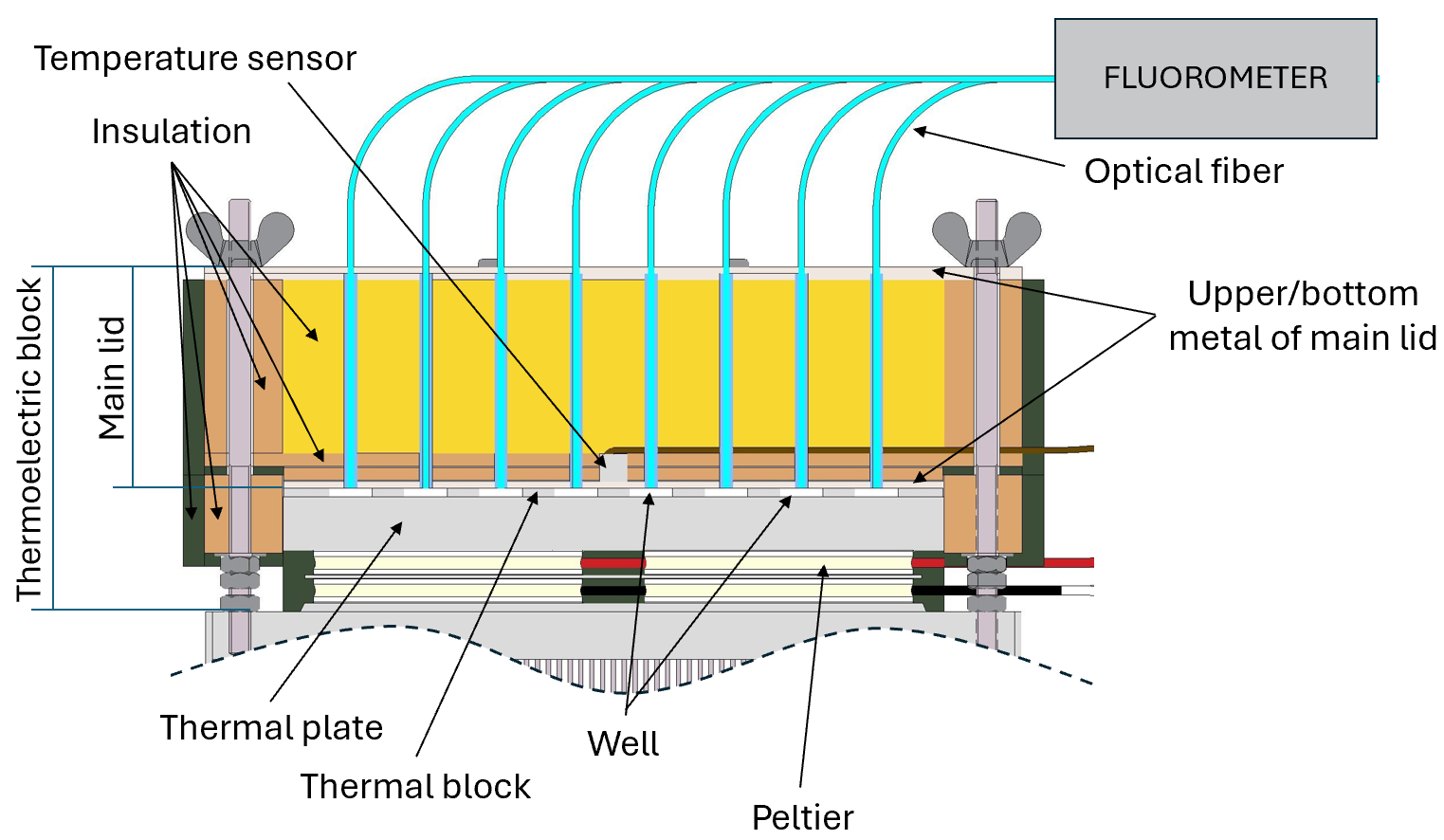
Assessing freezing tolerance in photosynthetic tissues is essential for understanding plant adaptation to extreme environments such as Antarctica and the Arctic. This study presents a new portable thermoelectric device capable of applying controlled thermal cycles and measuring photosynthetic efficiency (Fv/Fm) in situ by means of coupling with a commercial fluorometer. The device, designed for remote field studies, offers significant improvements in portability, precision, and analytical capacity compared to previous systems. It was tested in both Antarctic and Arctic environments, covering a wide taxonomic diversity including algae, lichens, bryophytes, and tracheophytes, and revealing differential patterns of freezing tolerance across groups. To explore these differences, the experimental approach included (1) nucleation temperature; (2) the maintainability of Fv/Fm after a freeze-thaw cycle at different temperatures, durations, and temperature vs. time change ramps; and (3) the time-course of Fv/Fm during a freeze-thaw cycle, i.e., allowing for impact vs. recovery assessment. The results show that many species tolerate subzero temperatures by maintaining photosystem II functionality even after ice formation, with tolerance varying among taxonomic groups. Antarctic lichens exhibited exceptional resistance, while vascular plants showed greater sensitivity. The device demonstrated high thermal homogeneity, reliability, and efficiency, making it a versatile tool for ecophysiological studies of photosynthetic organisms subjected to extreme conditions.
- Open Access
- Article
Assessing Freezing Tolerance in Antarctic and Arctic Plants, Lichens and Algae by Using an Innovative Freeze-Inducing and Monitoring System
- Francesc Castanyer-Mallol 1, *,
- Miren I. Arzac 2,
- León A. Bravo 3, 4,
- Marc Carriquí 1,
- Neus Cubo-Ribas 1,
- Beatriz Fernández-Marín 2, 5,
- Jeroni Galmés 1,
- José I. García-Plazaola 2,
- Javier Gulias 1,
- Miquel Ribas-Carbó 1,
- Javier Martínez-Abaigar 6,
- Encarnación Núñez-Olivera 6,
- Luis G. Quintanilla 7,
- Jorge Gago 1
Author Information
Received: 05 May 2025 | Revised: 16 Jul 2025 | Accepted: 16 Jul 2025 | Published: 04 Aug 2025
Abstract
Graphical Abstract
Keywords
Antarctic plants | Arctic plants | cryothermocycler | Fv/Fm recovery | Fv/Fm maintaining | freezing test | freezing tolerance | innovative device | nucleation temperature
References
- 1.Adhikari L, Baral R, Paudel D, Min D, Makaju SO, Poudel HP, & Missaoui AM. (2022). Cold stress in plants: Strategies to improve cold tolerance in forage species. Plant Stress, 4, 100081. https://doi.org/10.1016/J.STRESS.2022.100081.
- 2.Andrzejowska A, Hájek J, Puhovkin A, Harańczyk H, & Barták M. (2024). Freezing temperature effects on photosystem II in Antarctic lichens evaluated by chlorophyll fluorescence. Journal of Plant Physiology, 294, 154192. https://doi.org/10.1016/j.jplph.2024.154192.
- 3.Angel R, Conrad R, Dvorsky M, Kopecky M, Kotilínek M, Hiiesalu I, & Doležal J. (2016). The Root-Associated Microbial Community of the World’s Highest Growing Vascular Plants. Microbial Ecology, 72(2), 394–406. https://doi.org/10.1007/s00248-016-0779-8.
- 4.Arnold PA, Briceño VF, Gowland KM, Catling AA, Bravo LA, & Nicotra AB. (2021). A high-throughput method for measuring critical thermal limits of leaves by chlorophyll imaging fluorescence. Functional Plant Biology, 48(6), 634–646. https://doi.org/10.1071/FP20344.
- 5.Arzac Garmendia MI, Miranda González de Apodaca J, De los Ríos A, Castanyer Mallol F, García Plazaola JI, & Fernández Marín B. (2024). The outstanding capacity of Prasiola antarctica to thrive in contrasting harsh environments relies on the constitutive protection of thylakoids and on morphological plasticity. The Plant Journal, 119(1), 65–83. https://doi.org/10.1111/tpj.16742.
- 6.Becker S, Walter B, & Bischof K. (2009). Freezing tolerance and photosynthetic performance of polar seaweeds at low temperatures. Botanica Marina, 52(6), 609–616. https://doi.org/10.1515/BOT.2009.079.
- 7.Birkeland S, Slotte T, Krag Brysting A, Gustafsson AL S, Rhoden Hvidsten T, Brochmann C, & Nowak MD. (2022). What can cold-induced transcriptomes of Arctic Brassicaceae tell us about the evolution of cold tolerance? Molecular Ecology, 31(16), 4271–4285. https://doi.org/10.1111/mec.16581.
- 8.Bravo LA, & Griffith M. (2005). Characterization of antifreeze activity in Antarctic plants. Journal of Experimental Botany, 56(414), 1189–1196. https://doi.org/10.1093/jxb/eri112.
- 9.Bravo LA, Ulloa N, Zuñiga GE, Casanova A, Corcuera LJ, & Alberdi M. (2001). Cold resistance in Antarctic angiosperms. Physiologia Plantarum, 111, 55–65. https://doi.org/10.1034/j.1399-3054.2001.1110108.x.
- 10.Bravo LA, Bascuñán-Godoy L, Pérez-Torres E, & Corcuera LJ. (2009). Cold Hardiness in Antarctic Vascular Plants. In Plant cold hardiness: From the laboratory to the field. (Gusta LV, Wisniewski ME, Tanino KK, Eds.) (p. 317). CABI.
- 11.Chaudhary S, Devi P, Bhardwaj A, Jha UC, Sharma KD, Prasad PV, & Nayyar H. (2020). Identification and Characterization of Contrasting Genotypes/Cultivars for Developing Heat Tolerance in Agricultural Crops: Current Status and Prospects. Frontiers in Plant Science, 11, 587264. https://doi.org/10.3389/fpls.2020.587264.
- 12.Clemente‐Moreno MJ, Omranian N, Sáez P, Figueroa CM, Del‐Saz N, Elso M, & Gago J. (2019). Cytochrome respiration pathway and sulphur metabolism sustain stress tolerance to low temperature in the Antarctic species Colobanthus quitensis. New Phytologist, 225(2), 754–768. https://doi.org/10.1111/nph.16167.
- 13.Clemente‐Moreno MJ, Omranian N, Sáez PL, Figueroa CM, Del‐Saz N, Elso M, & Gago J. (2020). Low-temperature tolerance of the Antarctic species Deschampsia antarctica: A complex metabolic response associated with nutrient remobilization. Plant Cell and Environment, 43(6), 1376–1393. https://doi.org/10.1111/pce.13737.
- 14.Danzey LM, Briceño VF, Cook AM, Nicotra AB, Peyre G, Rossetto M, & Leigh A. (2024). Environmental and Biogeographic Drivers behind Alpine Plant Thermal Tolerance and Genetic Variation. Plants, 13(9), 1271. https://doi.org/10.3390/plants13091271.
- 15.De Mendiburu F. (2021). agricolae: Statistical procedures for agricultural research. R package version 1.3-5. https://CRAN.R-project.org/package=agricolae.
- 16.Dolezal J, Dvorsky M, Kopecky M, Liancourt P, Hiiesalu I, Macek M, & Schweingruber F. (2016). Vegetation dynamics at the upper elevational limit of vascular plants in Himalaya. Scientific Reports, 6, 24881. https://doi.org/10.1038/srep24881.
- 17.Eidesen PB, Brysting AK, Hagen KR, Hjelle SS, Reveret A, Tjessem IV, & Volden IK. (2024). Ecological and evolutionary consequences of ploidy-driven trait variation: Insights from Saxifraga oppositifolia L. Arctic Science, 11, 1–26. https://doi.org/10.1139/as-2024-0020.
- 18.Fernández‐Marín B, Gulías J, Figueroa CM, Iñiguez C, Clemente‐Moreno MJ, Nunes‐Nesi A, & Gago J. (2020). How do vascular plants perform photosynthesis in extreme environments? An integrative ecophysiological and biochemical story. Plant Journal, 101(4), 979–1000. https://doi.org/10.1111/tpj.14694.
- 19.Flexas J, Fernie AR, Usadel B, Alonso-Forn D, Ardiles V, Ball MC, & Gago J. (2025). What can we learn from the ecophysiology of plants inhabiting extreme environments? from ‘sherplants’ to ‘shercrops’. Journal of Experimental Botany, Eraf236. https://doi.org/10.1093/jxb/eraf236
- 20.Fox J, & Weisberg S. (2019). Car: Companion to applied regression. R package version 3.0-10. https://CRAN.R-project.org/package=car.
- 21.GBIF. (2025a, April 17). GBIF Backbone taxonomy: Deschampsia antarctica É. Desv. Checklist dataset. https://www.gbif.org/species/4144844.
- 22.GBIF. (2025b, April 17). GBIF Backbone taxonomy: Colobanthus quitensis (Kunth) Bartl. Checklist dataset. https://www.gbif.org/species/5588218.
- 23.Geange SR, Arnold PA, Catling AA, Coast O, Cook AM, Gowland KM, & Nicotra AB. (2021). The thermal tolerance of photosynthetic tissues: a global systematic review and agenda for future research. New Phytologist, 229, 2497–2513. https://doi.org/10.1111/nph.17052.
- 24.Graves S, Piepho HP, Selzer L, & Dorai-Raj S. (2019). multcompView: Visualizations of paired comparisons. R package version 0.1-8. https://CRAN.R-project.org/package=multcompView.
- 25.Harris RJ, Bryant C, Coleman MA, Leigh A, Briceño VF, Arnold PA, & Nicotra AB. (2023). A novel and high-throughput approach to assess photosynthetic thermal tolerance of kelp using chlorophyll α fluorometry. Journal of Phycology, 59(1), 179–192. https://doi.org/10.1111/jpy.13296.
- 26.Hothorn T, Bretz F, & Westfall P. (2008). multcomp: Simultaneous inference in general parametric models. R package version 1.4-25. https://CRAN.R-project.org/package=multcomp.
- 27.John UP, Polotnianka RM, Sivakumaran KA, Chew O, Mackin L, Kuiper MJ, & Spangenberg GC. (2009). Ice recrystallization inhibition proteins (IRIPs) and freeze tolerance in the cryophilic Antarctic hair grass Deschampsia antarctica E. Desv. Plant, Cell and Environment, 32(4), 336–348. https://doi.org/10.1111/j.1365-3040.2009.01925.x.
- 28.Junttila O, & Robberecht R. (1993). The Influence of Season and Phenology on Freezing Tolerance in Silene acaulis L., a Subarctic and Arctic Cushion Plant of Circumpolar Distribution. Annals of Botany, 71, 423–426. https://doi.org/10.1006/anbo.1993.1054.
- 29.Juurakko CL, diCenzo GC, & Walker VK. (2021). Cold acclimation and prospects for cold-resilient crops. Plant Stress, 2, 100028. https://doi.org/10.1016/j.stress.2021.100028.
- 30.Körner C. (2011). Coldest places on earth with angiosperm plant life. Alpine Botany, 121(1), 11–22. https://doi.org/10.1007/s00035-011-0089-1
- 31.Körner C. (2021). Climatic stress. In Alpine plant life (pp. 175–201). Springer. https://doi.org/10.1007/978-3-030-59538-8_8.
- 32.Körner C, & Alsos IG. (2009). Freezing resistance in high arctic plant species of Svalbard in mid-summer. Bauhinia, 21, pp. 25–32. https://www.researchgate.net/publication/242389283.
- 33.Lange OL, & Kappen L. (1972). Photosynthesis of Lichens from Antarctica. In Antarctic terrestrial biology (Llano GA. Ed.) (pp. 83–96). American Geophysical Union.
- 34.Larcher W. (2000). Temperature stress and survival ability of mediterranean sclerophyllous plants. Plant Biosystems, 134(3), 279–295. https://doi.org/10.1080/11263500012331350455.
- 35.Lenth RV. (2023). emmeans: Estimated marginal means, aka least-squares means. R package version 1.8.9. https://CRAN.R-project.org/package=emmeans.
- 36.Li H, Wang Z, Yu Y, Gao W, Zhu J, Zhang H, & Liu Y. (2024). Enhancing cold tolerance in tobacco through endophytic symbiosis with Piriformospora indica. Frontiers in Plant Science, 15, 1459882. https://doi.org/10.3389/FPLS.2024.1459882.
- 37.López D, Larama G, Sáez PL, & Bravo LA. (2023). Transcriptome Analysis of Diurnal and Nocturnal-Warmed Plants, the Molecular Mechanism Underlying Cold Deacclimation Response in Deschampsia antarctica. International Journal of Molecular Sciences, 24(13). https://doi.org/10.3390/ijms241311211.
- 38.López D, Sanhueza C, Salvo-Garrido H, Bascunan-Godoy L, & Bravo LA. (2023). How Does Diurnal and Nocturnal Warming Affect the Freezing Resistance of Antarctic Vascular Plants? Plants, 12(4). https://doi.org/10.3390/plants12040806.
- 39.López‐Pozo M, Flexas J, Gulías J, Carriquí M, Nadal M, Perera‐Castro AV, & Fernández‐Marín B. (2019). A field portable method for the semi-quantitative estimation of dehydration tolerance of photosynthetic tissues across distantly related land plants. Physiologia Plantarum, 167(4), 540–555. https://doi.org/10.1111/ppl.12890.
- 40.Maxwell K, & Johnson GN. (2000). Chlorophyll fluorescence—a practical guide. Journal of Experimental Botany, 51(345), 669–668. https://doi.org/10.1093/jxb/51.345.659.
- 41.Norman PA, Huner GÖ, & Fathey S. (1998). Energy balance and acclimation to light and cold. Trends in Plant Science, 3(6), 224–230. https://doi.org/10.1016/S1360-1385(98)01248-5.
- 42.Ouellet F. (2007). Cold Acclimation and Freezing Tolerance in Plants. In Encyclopedia of life sciences. Wiley. https://doi.org/10.1002/9780470015902.a0020093.
- 43.Paulsen G. (2002). Application of Physiology in Wheat Breeding. Crop Science, 42(6), 2228–2229. https://doi.org/10.2135/cropsci2002.2228.
- 44.Pearce RS. (2001). Plant freezing and damage. In Annals of botany (pp. 417–424). Academic Press. https://doi.org/10.1006/anbo.2000.1352.
- 45.Peat HJ, Clarke A, & Convey P. (2007). Diversity and biogeography of the Antarctic flora. Journal of Biogeography, 34(1), 132–146. https://doi.org/10.1111/j.1365-2699.2006.01565.x.
- 46.Perera-Castro AV, Brito P, & González-Rodríguez AM. (2018). Changes in thermic limits and acclimation assessment for an alpine plant by chlorophyll fluorescence analysis: Fv/Fm vs. Rfd’. Photosynthetica, 56, 527–536. https://doi.org/10.1007/s11099-017-0691-6.
- 47.Perera-Castro AV, Flexas J, González-Rodríguez ÁM, & Fernández-Marín B. (2021). Photosynthesis on the edge: photoinhibition, desiccation and freezing tolerance of Antarctic bryophytes. Photosynthesis Research, 149, 135–153. https://doi.org/10.1007/s11120-020-00785-0.
- 48.Petruccelli R, Bartolini G, Ganino T, Zelasco S, Lombardo L, Perri E, & Bernardi R. (2022). Cold Stress, Freezing Adaptation, Varietal Susceptibility of Olea europaea L.: A Review. Plants, 11(10), 1367. https://doi.org/10.3390/plants11101367.
- 49.Pinheiro J, Bates D, DebRoy S, Sarkar D, & R Core Team. (2023). nlme: Linear and nonlinear mixed effects models. R package version 3.1-162. https://CRAN.R-project.org/package=nlme.
- 50.Ralser M, Stegner M, & Neuner G. (2024). When water turns to ice: Control of ice volume and freezing dynamics as important aspects of cold acclimation. Environmental and Experimental Botany, 227, 105957. https://doi.org/10.1016/j.envexpbot.2024.105957.
- 51.Robberecht R, & Junttila O. (1992). The Freezing Response of an Arctic Cushion Plant, Saxifraga caespitosa L.: Acclimation, Freezing Tolerance and Ice Nucleation. Annals of Botany, 70(2), 129–135. https://doi.org/10.1093/oxfordjournals.aob.a088449.
- 52.Sakai A, & Larcher W. (1987). Frost Survival of Plants, Responses and Adaptation to Freezing Stress (Durham WDB, Athens FG, Würzburg OLL, Oak Ridge JSO, Merburg HR, Eds.). Springer-Verlag. https://archive.org/details/frostsurvivalofoO000saka
- 53.Sierra-Almeida A, Cavieres LA, & Bravo LA. (2018). Warmer temperatures affect the in situ freezing resistance of the antarctic vascular plants. Frontiers in Plant Science, 9, 1456. https://doi.org/10.3389/fpls.2018.01456.
- 54.Stange R. (2018). Spitsbergen-Svalbard. In The complete guidebook around the arctic archipelago (4th ed.). Rolf.
- 55.Thalhammer A, & Hincha DK. (2014). A mechanistic model of COR15 protein function in plant freezing tolerance: Integration of structural and functional characteristics. Plant Signaling and Behavior, 9(12), e977722–e977723. https://doi.org/10.4161/15592324.2014.977722.
- 56.Wang C, Zhang M, Zhou J, Gao X, Zhu S, Yuan L, & Hou J. (2022). Transcriptome analysis and differential gene expression profiling of wucai (Brassica campestris L.) in response to cold stress. BMC Genomics, 23(1), 137. https://doi.org/10.1186/s12864-022-08311-3.
- 57.Wanner LA, & Junttila O. (1999). Cold-Induced Freezing Tolerance in Arabidopsis. Plant Physiology, 120, 391–399. https://doi.org/10.1104/pp.120.2.391.
- 58.Wienckel C, & tom Dieck I. (1990). Temperature requirements for growth and survival of macroalgae from Antarctica and southern Chile. Marine Ecology Progress Series, 59, 157–170. http://www.jstor.org/stable/24837833.
- 59.Wójcik-Jagła M, & Rapacz M. (2023). Freezing tolerance and tolerance to de-acclimation of European accessions of winter and facultative barley. Scientific Reports, 13(1), 19931. https://doi.org/10.1038/s41598-023-47318-y.
How to Cite
Castanyer-Mallol, F., Arzac, M. I., Bravo, L. A., Carriquí, M., Cubo-Ribas, N., Fernández-Marín, B., Galmés, J., García-Plazaola, J. I., Gulias, J., Ribas-Carbó, M., Martínez-Abaigar, J., Núñez-Olivera, E., Quintanilla, L. G., & Gago, J. (2025). Assessing Freezing Tolerance in Antarctic and Arctic Plants, Lichens and Algae by Using an Innovative Freeze-Inducing and Monitoring System. Plant Ecophysiology, 1(2), 1. https://doi.org/10.53941/plantecophys.2025.100010
RIS
BibTex
Copyright & License

Copyright (c) 2025 by the authors.
This work is licensed under a Creative Commons Attribution 4.0 International License.
Article Metrics
374
Article Views
2
Citations
Contents
References
