
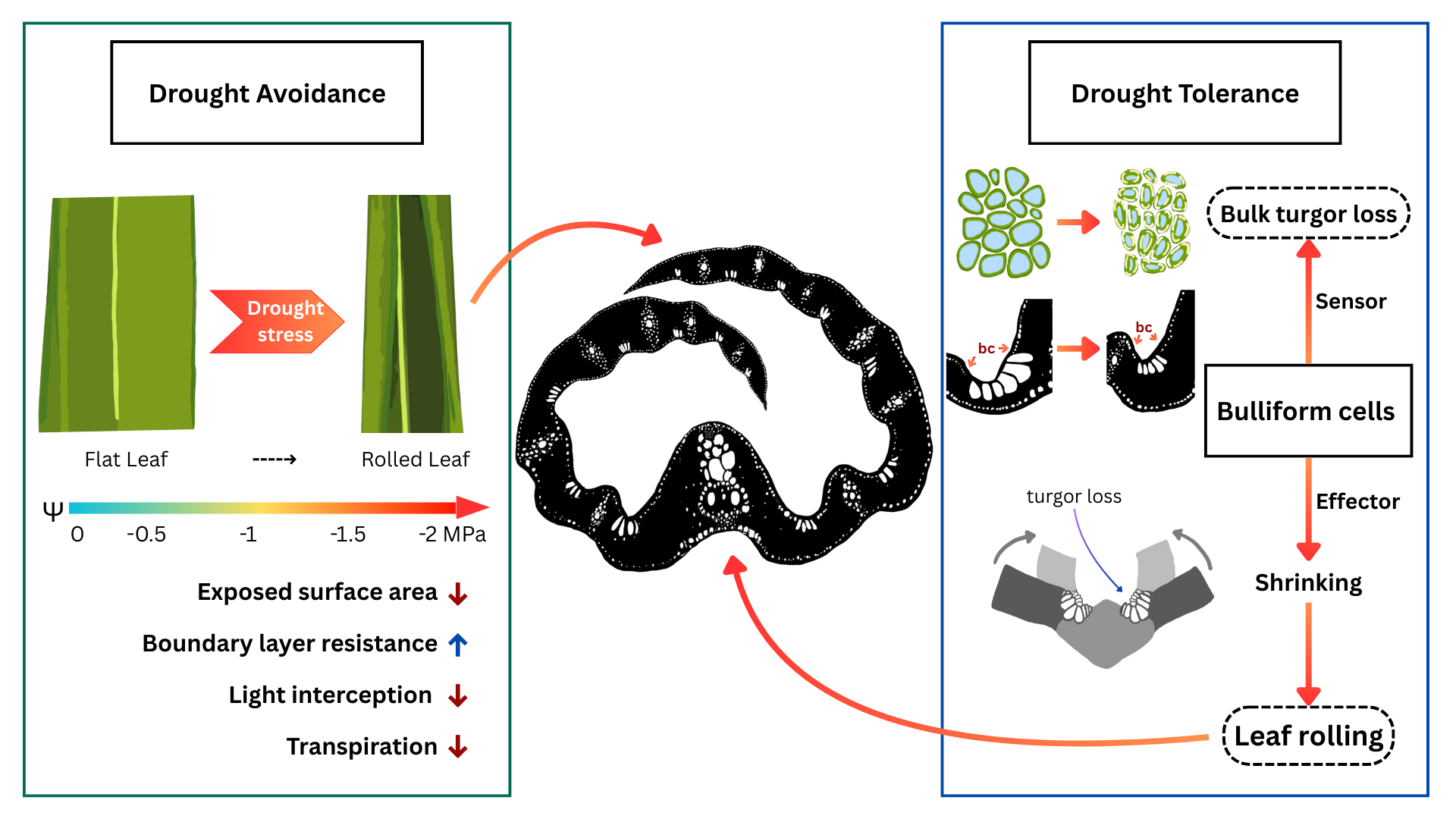
Leaf rolling is a distinct morphological response to drought stress observed in grasses, including major cereal crops such as rice, wheat, and maize. While parameters associated with leaf rolling are often proposed as potential criteria for screening and selecting drought-tolerant genotypes, their efficacy and reliability as definitive indicators of drought tolerance remain subjects of ongoing debate. In this review, we first summarize common patterns of leaf rolling and provide a critical overview of quantification methods, ranging from subjective visual scoring and simple indices like the leaf rolling index to objective morpho-geometric measurements, advanced image analysis techniques, and integrated or remote sensing approaches. We also summarize the significant inter- and intraspecific variations observed. Subsequently, we delve into the physiological mechanisms linking leaf rolling to both avoidance and tolerance. Recent evidence suggests a tight temporal correlation between the initiation of visible rolling and critical physiological thresholds, such as the bulk leaf turgor loss point and substantial stomatal closure. This supports the hypothesis that bulliform cells might act not only as the effectors executing the rolling movement but also as highly sensitive physiological sensors monitoring internal water status. Furthermore, the initiation phase of rolling—potentially governed by the sensory function of bulliform cells—may provide novel insights into physiological tolerance, even if the extent of rolling remains an equivocal trait for breeding selection. Finally, potential future research directions stemming from this analysis are also discussed.
- Open Access
- Review
Does Leaf Rolling Serve as a Phenotype Index for Drought Tolerance in Grasses? A Review
Author Information
Received: 23 Apr 2025 | Revised: 14 Jul 2025 | Accepted: 18 Aug 2025 | Published: 21 Aug 2025
Abstract
Graphical Abstract
References
- 1.Ali Z, Merrium S, Habib-ur-Rahman M, Hakeem S, Saddique MAB, & Sher MA. (2022). Wetting mechanism and morphological adaptation; leaf rolling enhancing atmospheric water acquisition in wheat crop—A review. Environmental Science and Pollution Research, 29(21), 30967–30985. https://doi.org/10.1007/s11356-022-18846-3.
- 2.Al-Salman Y, Cano FJ, Pan L, Koller F, Piñeiro J, Jordan D, & Ghannoum O. (2023). Anatomical drivers of stomatal conductance in sorghum lines with different leaf widths grown under different temperatures. Plant, Cell & Environment, 46(7), 2142–2158. https://doi.org/10.1111/pce.14592.
- 3.Amal B-A, Said M, Abdelaziz B, Mouhammed M, Nasser EN, & Keltoum EB. (2020). Relationship between leaf rolling and some physiological parameters in durum wheat under water stress. African Journal of Agricultural Research, 16(7), 1061–1068. https://doi.org/10.5897/AJAR2020.14939.
- 4.Asner GP, Scurlock JMO, & Hicke JA. (2003). Global synthesis of leaf area index observations: Implications for ecological and remote sensing studies. Global Ecology and Biogeography, 12(3), 191–205. https://doi.org/10.1046/j.1466-822X.2003.00026.x.
- 5.Baird AS, Taylor SH, Pasquet Kok J, Vuong C, Zhang Y, Watcharamongkol T, Scoffoni C, Edwards EJ, Christin PA, Osborne CP, & Sack L. (2021). Developmental and biophysical determinants of grass leaf size worldwide. Nature, 592(7853), 242–247. https://doi.org/10.1038/s41586-021-03370-0.
- 6.Baret F, Madec S, Irfan K, Lopez J, Comar A, Hemmerlé M, Dutartre D, Praud S, & Tixier MH. (2018). Leaf-rolling in maize crops: From leaf scoring to canopy-level measurements for phenotyping. Journal of Experimental Botany, 69(10), 2705–2716. https://doi.org/10.1093/jxb/ery071.
- 7.Berger K, Machwitz M, Kycko M, Kefauver SC, Van Wittenberghe S, Gerhards M, Verrelst J, Atzberger C, Van Der Tol C, Damm A, Rascher U, Herrmann I, Paz VS, Fahrner S, Pieruschka R, Prikaziuk E, Buchaillot Ma L, Halabuk A, Celesti M, Schlerf M; et al. (2022). Multi-sensor spectral synergies for crop stress detection and monitoring in the optical domain: A review. Remote Sensing of Environment, 280, 113198. https://doi.org/10.1016/j.rse.2022.113198.
- 8.Berni J, Zarco Tejada PJ, Suarez L, & Fereres E. (2009). Thermal and Narrowband Multispectral Remote Sensing for Vegetation Monitoring From an Unmanned Aerial Vehicle. IEEE Transactions on Geoscience and Remote Sensing, 47(3), 722–738. https://doi.org/10.1109/TGRS.2008.2010457.
- 9.Blum A. (2009). Effective use of water (EUW) and not water-use efficiency (WUE) is the target of crop yield improvement under drought stress. Field Crops Research, 112(2–3), 119–123. https://doi.org/10.1016/j.fcr.2009.03.009.
- 10.Cal AJ, Sanciangco M, Rebolledo MC, Luquet D, Torres RO, McNally KL, & Henry A. (2019). Leaf morphology, rather than plant water status, underlies genetic variation of rice leaf rolling under drought. Plant, Cell & Environment, 42(5), 1532–1544. https://doi.org/10.1111/pce.13514.
- 11.Cardoso JA, Pineda M, Jiménez JDL C, Vergara MF, & Rao IM. (2015). Contrasting strategies to cope with drought conditions by two tropical forage C4 grasses. AoB Plants, 7, plv107. https://doi.org/10.1093/aobpla/plv107.
- 12.Corlett JE, Jones HG, Massacci A, & Masojidek J. (1994). Water deficit, leaf rolling and susceptibility to photoinhibition in field grown sorghum. Physiologia Plantarum, 92(3), 423–430. https://doi.org/10.1111/j.1399-3054.1994.tb08831.x.
- 13.Desta BT, Feleke G, Eshetu S, Batu W, Meseret A, Zemede A, & Worku W. (2025). Screening drought-tolerant durum wheat genotypes using morphophysiological traits. Agronomy Journal, 117(3), e70061. https://doi.org/10.1002/agj2.70061.
- 14.Dingkuhn M, Cruz R, O’Toole J, & Dörffling K. (1989). Net photosynthesis, water use efficiency, leaf water potential and leaf rolling as affected by water deficit in tropical upland rice. Australian Journal of Agricultural Research, 40(6), 1171. https://doi.org/10.1071/AR9891171.
- 15.Khaipho-Burch M. Down-to-earth drought resistance. (2024). Nature Plants, 10(4), 525–526. https://doi.org/10.1038/s41477-024-01686-z.
- 16.Du J, Zhai CM, & Wang QP. (2013). Recognition of plant leaf image based on fractal dimension features. Neurocomputing, 116, 150–156. https://doi.org/10.1016/j.neucom.2012.03.028.
- 17.Easlon HM, & Bloom AJ. (2014). Easy Leaf Area: Automated digital image analysis for rapid and accurate measurement of leaf area. Applications in Plant Sciences, 2(7), 1400033. https://doi.org/10.3732/apps.1400033.
- 18.Efisue AA. (2006). Studies of drought tolerance in interspecific progenies of oryza glaberrima (steud) and o. Sativa (l) and an appraisal of the use of male gametocides in rice hybridisation. University of KwaZulu-Natal.
- 19.Fang Y, & Xiong L. (2015). General mechanisms of drought response and their application in drought resistance improvement in plants. Cellular and Molecular Life Sciences, 72(4), 673–689. https://doi.org/10.1007/s00018-014-1767-0.
- 20.Fernandez D, & Castrillo M. (1999). Maize leaf rolling initiation. Photosynthetica, 37, 493–497. https://doi.org/10.1023/A:1007124214141.
- 21.Fernandez GC. (1992). Effective selection criteria for assessing plant stress tolerance. In Proceedings of the International Symposium on Adaptation of Vegetable and Other Food Crops in Temperature and Water Stress (Kuo, C.G., Ed), 1992 Tainan: AVRDC Publication, Taiwan, China, 13–18 August 1992; pp. 257–270.
- 22.Gao L, Yang G, Li Y, Fan N, Li H, Zhang M, Xu R, Zhang M, Zhao A, Ni Z, & Zhang Y. (2019). Fine mapping and candidate gene analysis of a QTL associated with leaf rolling index on chromosome 4 of maize (Zea mays L.). Theoretical and Applied Genetics, 132(11), 3047–3062. https://doi.org/10.1007/s00122-019-03405-1.
- 23.Garrigues S, Lacaze R, Baret F, Morisette JT, Weiss M, Nickeson JE, Fernandes R, Plummer S, Shabanov NV, Myneni RB, Knyazikhin Y, & Yang W. (2008). Validation and intercomparison of global Leaf Area Index products derived from remote sensing data. Journal of Geophysical Research: Biogeosciences, 113(G2), 2007JG000635. https://doi.org/10.1029/2007JG000635.
- 24.Gwo C-Y, Wei C-H, & Li Y. (2013). Rotary matching of edge features for leaf recognition. Computers and Electronics in Agriculture, 91, 124–134. https://doi.org/10.1016/j.compag.2012.12.005.
- 25.Hay JO, Moulia B, Lane B, Freeling M, & Silk WK. (2000). Biomechanical analysis of the Rolled (RLD) leaf phenotype of maize. American Journal of Botany, 87(5), 625–633. https://doi.org/10.2307/2656848.
- 26.Hsiao TC, O’Toole JC, Yambao EB, & Turner NC. (1984). Influence of osmotic adjustment on leaf rolling and tissue death in rice (Oryza sativa L.). Plant Physiology, 75(2), 338–341. https://doi.org/10.1104/pp.75.2.338.
- 27.Hu N, Lu C, Yao K, & Zou J. (2009). Simulation on distribution of photosynthetically active radiation in canopy and optimum leaf rolling index in rice with rolling leaves. Rice Science, 16(3), 217–225. https://doi.org/10.1016/S1672-6308(08)60082-7.
- 28.Huang H, Kang J, Chen J, Ding R, Lu H, Wu S, & Kang S. (2024). A new 3D vision-based leaf rolling index (LRI) and its application as a stable indicator of cotton drought stress. Agricultural Water Management, 306, 109174. https://doi.org/10.1016/j.agwat.2024.109174.
- 29.Jardine EC, Thomas GH, & Osborne CP. (2021). Traits explain sorting of C4 grasses along a global precipitation gradient. Ecology and Evolution, 11(6), 2669–2680. https://doi.org/10.1002/ece3.7223.
- 30.Jiang Z, Tu H, Bai B, Yang C, Zhao B, Guo Z, Liu Q, Zhao H, Yang W, Xiong L, & Zhang J. (2021). Combining UAV-RGB high-throughput field phenotyping and genome-wide association study to reveal genetic variation of rice germplasms in dynamic response to drought stress. New Phytologist, 232(1), 440–455. https://doi.org/10.1111/nph.17580.
- 31.Kadioglu A, & Terzi R. (2007). A Dehydration avoidance mechanism: Leaf rolling. Botanical Review, 73(4), 290–302. https://doi.org/10.1663/0006-8101(2007)73[290:ADAMLR]2.0.CO;2.
- 32.Kadioglu A, Terzi R, Saruhan N, & Saglam A. (2012). Current advances in the investigation of leaf rolling caused by biotic and abiotic stress factors. Plant Science, 182, 42–48. https://doi.org/10.1016/j.plantsci.2011.01.013.
- 33.Kang S, & Huang H. (2023). Method for determining the degree of crop leaf curling. State Intellectual Property Office of the People’s Republic of China, CN115937151A.
- 34.King MJ, Vincent JFV, & Harris W. (1996). Curling and folding of leaves of monocotyledons—A strategy for structural stiffness. New Zealand Journal of Botany, 34(3), 411–416. https://doi.org/10.1080/0028825X.1996.10410704.
- 35.Kooyers N. (2015). The evolution of drought escape and avoidance in natural herbaceous populations. Plant Science, 234, 155–162. https://doi.org/10.1016/j.plantsci.2015.02.012.
- 36.Kumar S, Dwivedi S, Singh S, Jha S, Lekshmy S, Elanchezhian R, Singh O, & Bhatt B. (2014). Identification of drought tolerant rice genotypes by analysing drought tolerance indices and morpho-physiological traits. SABRAO Journal of Breeding & Genetics, 46(2), 217–230.
- 37.Lafitte R, Blum A, & Atlin G. (2003). Using secondary traits to help identify drought-tolerant genotypes. In Breeding Rice for Drought-Prone Environments (pp.37–48), International Rice Research Institute.
- 38.Latif A, Ying S, Cuixia P, & Ali N. (2023). Rice curled its leaves either adaxially or abaxially to combat drought stress. Rice Science, 30(5), 405–416. https://doi.org/10.1016/j.rsci.2023.04.002.
- 39.Li L, Shi ZY, Li L, Shen GZ, Wang XQ, An LS, & Zhang JL. (2010). Overexpression of ACL1 (abaxially curled leaf 1) Increased Bulliform Cells and Induced Abaxial Curling of Leaf Blades in Rice. Molecular Plant, 3(5), 807–817. https://doi.org/10.1093/mp/ssq022.
- 40.Li P, Ma B, Palta JA, Ding T, Cheng Z, & Xiong Y. (2022). Distinct contributions of drought avoidance and drought tolerance to yield improvement in dryland wheat cropping. Journal of Agronomy and Crop Science, 208(3), 265–282. https://doi.org/10.1111/jac.12574.
- 41.Li W, Zhang M, Gan P, Qiao L, Yang S, Miao H, Wang G, Zhang M, Liu W, Li H, Shi C, & Chen K. (2017). CLD 1 / SRL 1 modulates leaf rolling by affecting cell wall formation, epidermis integrity and water homeostasis in rice. The Plant Journal, 92(5), 904–923. https://doi.org/10.1111/tpj.13728.
- 42.Liu Z, Jia L, Mao Y, & He Y. (2010). Classification and quantification of leaf curvature. Journal of Experimental Botany, 61(10), 2757–2767. https://doi.org/10.1093/jxb/erq111.
- 43.Lu Y, Hao Z, Xie C, Crossa J, Araus J-L, Gao S, Vivek BS, Magorokosho C, Mugo S, Makumbi D, Taba S, Pan G, Li X, Rong T, Zhang S, & Xu Y. (2011). Large-scale screening for maize drought resistance using multiple selection criteria evaluated under water-stressed and well-watered environments. Field Crops Research, 124(1), 37–45. https://doi.org/10.1016/j.fcr.2011.06.003.
- 44.Mader A, Langer M, Knippers J, & Speck O. (2020). Learning from plant movements triggered by bulliform cells: The biomimetic cellular actuator. Journal of The Royal Society Interface, 17(169), 20200358. https://doi.org/10.1098/rsif.2020.0358.
- 45.Matschi S, Vasquez MF, Bourgault R, Steinbach P, Chamness J, Kaczmar N, Gore MA, Molina I, & Smith LG. (2020). Structure-function analysis of the maize bulliform cell cuticle and its potential role in dehydration and leaf rolling. Plant Direct, 4(10), e00282. https://doi.org/10.1002/pld3.282.
- 46.Matthews RB, Azam-Ali SN, & Peacock JM. (1990). Response of four sorghum lines to mid-season drought. II. Leaf characteristics. Field Crops Research, 25(3–4), 297–308. https://doi.org/10.1016/0378-4290(90)90011-Y.
- 47.Nar H, Saglam A, Terzi R, Várkonyi Z, & Kadioglu A. (2009). Leaf rolling and photosystem II efficiency in Ctenanthe setosa exposed to drought stress. Photosynthetica, 47(3), 429–436. https://doi.org/10.1007/s11099-009-0066-8.
- 48.O’Toole JC, & Cruz RT. (1980). Response of leaf water potential, stomatal resistance, and leaf rolling to water stress. Plant Physiology, 65(3), 428–432. https://doi.org/10.1104/pp.65.3.428.
- 49.O’Toole JC, Cruz RT, & Singh TN. (1979). Leaf rolling and transpiration. Plant Science Letters, 16(1), 111–114. https://doi.org/10.1016/0304-4211(79)90015-4.
- 50.Peleg Z, Fahima T, Krugman T, Abbo S, Yakir D, Korol AB, & Saranga Y. (2009). Genomic dissection of drought resistance in durum wheat × wild emmer wheat recombinant inbreed line population. Plant, Cell & Environment, 32(7), 758–779. https://doi.org/10.1111/j.1365-3040.2009.01956.x.
- 51.Perez-Sanz F, Navarro PJ, & Egea-Cortines M. (2017). Plant phenomics: An overview of image acquisition technologies and image data analysis algorithms. GigaScience, 6(11), gix092. https://doi.org/10.1093/gigascience/gix092.
- 52.Puglielli G, Gratani L, & Varone L. (2017). Leaf rolling as indicator of water stress in Cistus incanus from different provenances. BioRxiv, 131508.
- 53.Redmann RE. (1985). Adaptation of grasses to water stress-leaf rolling and stomate distribution. Annals of the Missouri Botanical Garden, 72(4), 833. https://doi.org/10.2307/2399225.
- 54.Saglam A, Kadioglu A, Demiralay M, & Terzi R. (2014). Leaf Rolling Reduces Photosynthetic Loss in Maize Under Severe Drought. Acta Botanica Croatica, 73(2), 315–332. https://doi.org/10.2478/botcro-2014-0012.
- 55.Saruhan N, Saglam A, & Kadioglu A. (2012). Salicylic acid pretreatment induces drought tolerance and delays leaf rolling by inducing antioxidant systems in maize genotypes. Acta Physiologiae Plantarum, 34(1), 97–106. https://doi.org/10.1007/s11738-011-0808-7.
- 56.Shao Y. (2005). Fine mapping of an incom-plete recessive gene for leaf rolling in rice (Oryza sativa L.). Chinese Science Bulletin, 50(21), 2466. https://doi.org/10.1360/982005-999.
- 57.Singh S, Singh TN, & Chauhan JS. (2011). Living with limited water, part II: Dynamics of leaf rolling, leaf water homeostasis and water economy by hybrid rice. Journal of Crop Improvement, 25(4), 435–457. https://doi.org/10.1080/15427528.2011.583559.
- 58.Sirault XRR. (2007). Leaf rolling in wheat. Australian National University.
- 59.Sirault XRR, Condon AG, Wood JT, Farquhar GD, & Rebetzke GJ. (2015). “Rolled-upness”: Phenotyping leaf rolling in cereals using computer vision and functional data analysis approaches. Plant Methods, 11(1), 52. https://doi.org/10.1186/s13007-015-0095-1.
- 60.Tardieu F, Simonneau T, & Muller B. (2018). The physiological basis of drought tolerance in crop plants: A scenario-dependent probabilistic approach. Annual Review of Plant Biology, 69(1), 733–759. https://doi.org/10.1146/annurev-arplant-042817-040218.
- 61.Toon A, Crisp MD, Gamage H, Mant J, Morris DC, Schmidt S, & Cook LG. (2015). Key innovation or adaptive change? A test of leaf traits using Triodiinae in Australia. Scientific Reports, 5(1), 12398. https://doi.org/10.1038/srep12398.
- 62.Vadez V, Grondin A, Chenu K, Henry A, Laplaze L, Millet EJ, & Carminati A. (2024). Crop traits and production under drought. Nature Reviews Earth & Environment, 5(3), 211–225. https://doi.org/10.1038/s43017-023-00514-w.
- 63.Verulkar SB, & Verma SK. (2014). Screening protocols in breeding for drought tolerance in rice. Agricultural Research, 3(1), 32–40. https://doi.org/10.1007/s40003-014-0094-x.
- 64.Wang X, Huang J, Peng S, & Xiong D. (2023). Leaf rolling precedes stomatal closure in rice (Oryza sativa) under drought conditions. Journal of Experimental Botany, 74(21), 6650–6661. https://doi.org/10.1093/jxb/erad316.
- 65.Wang Y, Jing X, Gao Y, Han X, Zhao C, & Pan W. (2024). Leaf rolling detection in maize under complex environments using an improved deep learning method. Plant Molecular Biology, 114(5), 92. https://doi.org/10.1007/s11103-024-01491-4.
- 66.Wu S, Tian L, Guo S, Lei H, Zhao X, Hao X, Li S, Xie Z, Hu W, Huang L, Tan Y, Long X, & Li D. (2025). OsLC1, a transaldolase, regulates cell patterning and leaf morphology through modulation of secondary metabolism. Plant Biotechnology Journal, pbi.70004. https://doi.org/10.1111/pbi.70004.
- 67.Xu Y, Kong W, Wang F, Wang J, Tao Y, Li W, Chen Z, Fan F, Jiang Y, Zhu Q, & Yang J. (2021). Heterodimer formed by ROC8 and ROC5 modulates leaf rolling in rice. Plant Biotechnology Journal, 19(12), 2662–2672. https://doi.org/10.1111/pbi.13690.
- 68.Zhang GH, Xu Q, Zhu XD, Qian Q, & Xue HW. (2009). SHALLOT-LIKE1 Is a KANADI transcription factor that modulates rice leaf rolling by regulating leaf abaxial cell development. The Plant Cell, 21(3), 719–735. https://doi.org/10.1105/tpc.108.061457.
- 69.Zhang G, Hou X, Wang L, Xu J, Chen J, Fu X, Shen N, Nian J, Jiang Z, Hu J, Zhu L, Rao Y, Shi Y, Ren D, Dong G, Gao Z, Guo L, Qian Q, & Luan S. (2021). PHOTO-SENSITIVE LEAF ROLLING 1 encodes a polygalacturonase that modifies cell wall structure and drought tolerance in rice. New Phytologist, 229(2), 890–901. https://doi.org/10.1111/nph.16899.
- 70.Zhang J, Wu S, Jiang L, Wang J, Zhang X, Guo X, Wu C, & Wan J. (2015). A detailed analysis of the leaf rolling mutant sll2 reveals complex nature in regulation of bulliform cell development in rice (Oryza sativa L.). Plant Biology, 17(2), 437–448. https://doi.org/10.1111/plb.12255.
- 71.Zou L, Sun X, Zhang Z, Liu P, Wu J, Tian C, Qiu J, & Lu T. (2011). Leaf rolling controlled by the homeodomain leucine zipper class IV gene Roc5 in rice. Plant Physiology, 156(3), 1589–1602. https://doi.org/10.1104/pp.111.176016.
- 72.Zou L, Zhang Z, Qi D, Peng M, & Lu T. (2014). Cytological mechanisms of leaf rolling in rice. Crop Science, 54(1), 198–209. https://doi.org/10.2135/cropsci2013.03.0199.

How to Cite
Chandarak, N., Wang, X., Liu, S., & Xiong, D. (2025). Does Leaf Rolling Serve as a Phenotype Index for Drought Tolerance in Grasses? A Review. Plant Ecophysiology, 1(2), 3. https://doi.org/10.53941/plantecophys.2025.100012
RIS
BibTex
Copyright & License

Copyright (c) 2025 by the authors.
This work is licensed under a Creative Commons Attribution 4.0 International License.
Article Metrics
751
Article Views
4
Citations
Contents
References
