
Stomata patterning, leaf structure, gas exchange, and ultimately species biogeography are inherently connected and have been observed to differ in plants by photosynthetic type. Patterns distinguishing C3 and C4 plants across scales are elucidated well in the literature. However, how trait shifts occur along the C3 to C4 evolutionary continuum are less clear. This review focuses on the role of C2 species as C3-C4 evolutionary intermediates that help to transition important traits from typical C3 to C4 phenotypes across scales. We show that the C2 phenotype is remarkably diverse and not always intermediate between C3 and C4 phenotypes. We highlight that studies of C2 species in the literature commonly lump C3-C4 evolutionary intermediates, stable state C2 species, and C3 × C4 hybrid species together and we argue that these different C2 types should be distinguished, when possible, and researched independently to help explain the broad diversity of C2 phenotypes and their global biogeography.
- Open Access
- Review
C2 Photosynthesis across Scales
Author Information
Received: 11 Aug 2025 | Revised: 10 Oct 2025 | Accepted: 11 Oct 2025 | Published: 24 Oct 2025
Abstract
Graphical Abstract
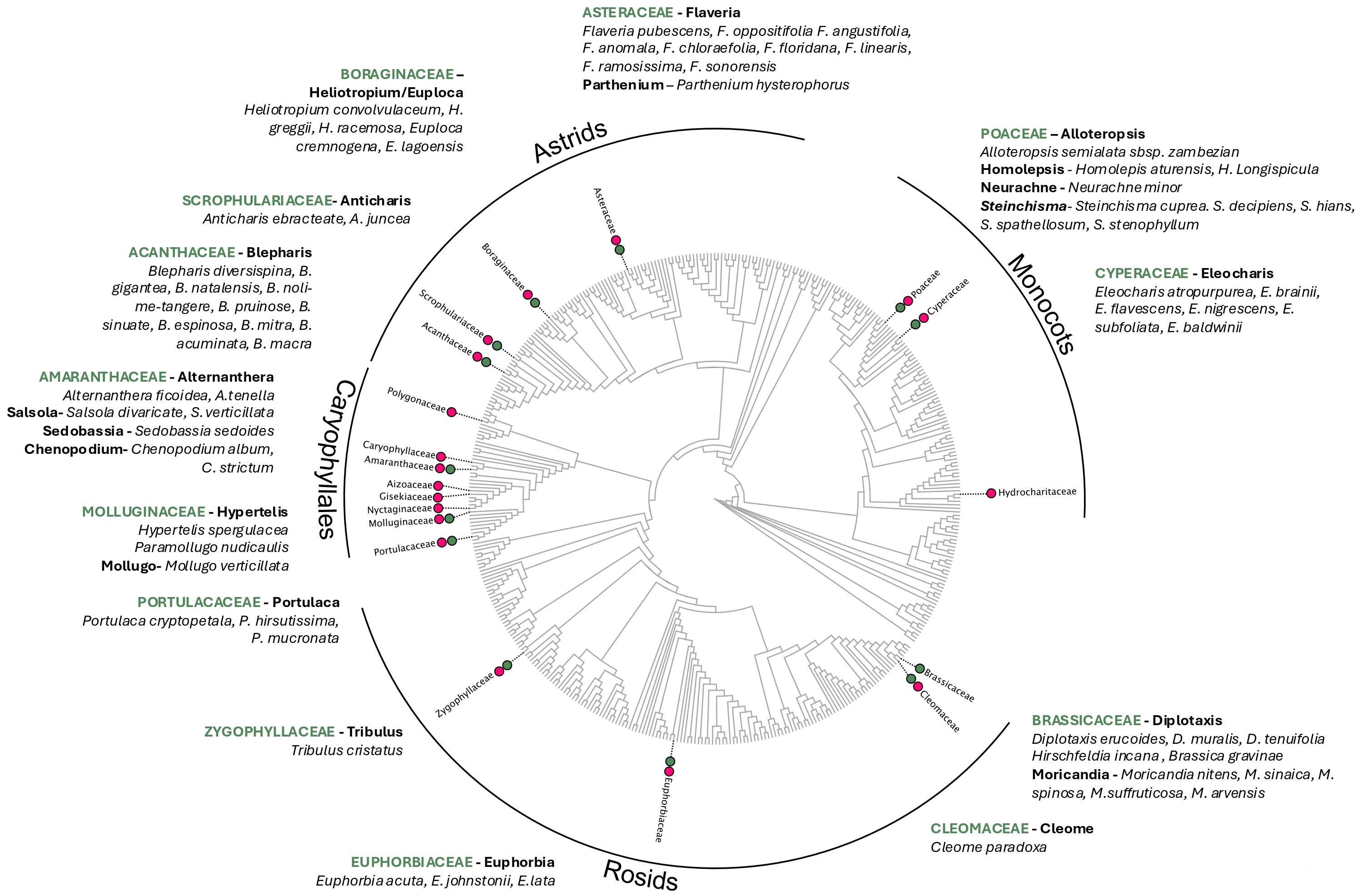
Keywords
biogeography | C2 photosynthesis | C3-C4 intermediate | C4 photosynthesis evolution | carbon concentrating mechanism | gas exchange | leaf anatomy | stomata
References
- 1.
Adachi S, Stata M, Martin DG, Cheng S, Liu HG, Zhu XG, & Sage RF. (2023). The evolution of C4 photosynthesis in Flaveria (Asteraceae): Insights from the Flaveria linearis complex. Plant Physiology, 191, 233–251.
- 2.
Alvarenga JP, Stata M, Sage RF, Patel R, das Chagas Mendonca AM, Della Torre F, Liu H, Cheng S, Weake S, Watanabe EJ, Lage Viana P, de Castro Arruda IA, Ludwig M, Delfino Barbosa JPRA, & Sage TL. (2025). Evolutionary diversification of C2 photosynthesis in the grass genus Homolepis (Arthropogoninae). Annals of Botany, 135, 769–788.
- 3.
Baillie AL, & Fleming AJ. (2020). The developmental relationship between stomata and mesophyll airspace. New Phytologist, 225, 1120–1126.
- 4.
Bianconi ME, Sotelo G, Curran EV, Milenkovic V, Samaritani E, Dunning LT, Bertolino LT, Osborne CP, & Christin PA. (2022). Upregulation of C4 characteristics does not consistently improve photosynthetic performance in intraspecific hybrids of a grass. Plant, Cell and Environment, 45, 1398–1411.
- 5.
Bräutigam A, & Gowik U. (2016). Photorespiration connects C3 and C4 photosynthesis. Journal of Experimental Botany, 67, 2953–2962.
- 6.
Busch FA, Sage RF, & Farquhar GD. (2018). Plants increase CO2 uptake by assimilating nitrogen via the photorespiratory pathway. Nature Plants, 4, 46–54.
- 7.
Caemmerer, S. (1992). Carbon isotope discrimination in C3-C4 intermediates. Plant, Cell & Environment, 15, 1063–1072.
- 8.
Chamberlain S. (2023). rgbif: Interface to the global biodiversity information facility API. (Version 3.0.0) [R package]. https://CRAN.R-project.org/package=rgbif.
- 9.
Christin PA, Sage TL, Edwards EJ, Ogburn RM, Khoshravesh R, & Sage RF. (2011). Complex evolutionary transitions and the significance of C3–C4 intermediate forms of photosynthesis in Molluginaceae. Evolution 65, 643–660.
- 10.
Christin PA, Osborne CP, Chatelet DS, Columbus JT, Besnard G, Hodkinson TR, Garrison LM, Vorontsova MS, & Edwards EJ. (2013). Anatomical enablers and the evolution of C4 photosynthesis in grasses. Proceedings of the National Academy of Sciences, 110, 1381–1386.
- 11.
Cowan IR. (1982). Regulation of water use in relation to carbon gain in higher plants. In Physiological Plant Ecology, Encyclopedia of Plant Physiology (Lange OL, Nobel PS, Osmond CB, & Ziegler H, Eds. pp. 589–613). Springer.
- 12.
Conklin PA, Strable J, Li S, & Scanlon MJ. (2019). On the mechanisms of development in monocot and eudicot leaves. New Phytologist, 221, 706–724.
- 13.
Dai Z, Ku MS, & Edwards GE. (1993). C4 photosynthesis (the CO2-concentrating mechanism and photorespiration). Plant Physiology, 103, 83–90.
- 14.
Dengler NG, Dengler RE, Donnelly PM, & Hattersley PW. (1994). Quantitative leaf anatomy of C3 and C4 grasses (Poaceae): Bundle sheath and mesophyll surface area relationships. Annals of Botany, 73, 241–255.
- 15.
Dunning LT, Lundgren MR, Moreno-Villena JJ, Namaganda M, Edwards EJ, Nosil P, Osborne CP, & Christin PA. (2017). Introgression and repeated co-option facilitated the recurrent emergence of C4 photosynthesis among close relatives. Evolution, 71, 1541–1555.
- 16.
Dunning LT, Moreno-Villena JJ, Lundgren MR, Dionora J, Salazar P, Adams C, Nyirenda F, Olofsson JK, Mapaura A, Grundy IM, & Kayombo CJ. (2019). Key changes in gene expression identified for different stages of C4 evolution in Alloteropsis semialata. Journal of Experimental Botany, 70, 3255–3268.
- 17.
Duval-Jouve J. (1875). Histotaxie des feuilles des Graminees. Annales des Science Naturelles Botanical Series, 61, 227–346.
- 18.
Edwards GE, & Ku MS. (1987). Biochemistry of C3–C4 intermediates. In Photosynthesis (pp. 275–325). Academic Press.
- 19.
Edwards EJ, Still CJ, & Donoghue MJ. (2007). The relevance of phylogeny to studies of global change. Trends in Ecology and Evolution, 22, 243–249.
- 20.
Edwards EJ, & Still CJ. (2008). Climate, phylogeny and the ecological distribution of C4 grasses. Ecology Letters, 11, 266–276.
- 21.
Eisenhut M, Roell MS, & Weber AP. (2019). Mechanistic understanding of photorespiration paves the way to a new green revolution. New Phytologist, 223, 1762–1769.
- 22.
Evans JR. (2021). Mesophyll conductance: Walls, membranes and spatial complexity. New Phytologist, 229, 1864–1876.
- 23.
Fick SE, & Hijmans RJ. (2017). WorldClim 2: New 1km spatial resolution climate surfaces for global land areas. International Journal of Climatology, 37, 4302–4315.
- 24.Fiorin L, Brodribb TJ, & Anfodillo T. (2016). Transport efficiency through uniformity: Organization of veins and stomata in angiosperm leaves. New Phytologist, 209, 216–227.
- 25.
Global Invasive Species Database. (2024, November 21). Species Profile: Parthenium hysterophorus. http://www.iucngisd.org/gisd/speciesname/Parthenium+hysterophorus.
- 26.Global Biodiversity Information Facility (GBIF). (2022, March 30). Biodiversity Data Use. https://docs.gbif.org/course-data-use/en/biodiversity-data-use.en.pdf.
- 27.Gao J, Chen J, Lei Y, Wang Q, Zou J, Ning Z, Tan X, Yang F, & Yang W. (2023). Functional consequences of light intensity on soybean leaf hydraulic conductance: Coordinated variations in leaf venation architecture and mesophyll structure. Environmental and Experimental Botany, 210, 105301.
- 28.
Griffiths H, Weller G, Toy LF, & Dennis RJ. (2013). You’re so vein: Bundle sheath physiology, phylogeny and evolution in C3 and C4 plants. Plant, Cell and Environment, 36, 249–261.
- 29.
Haberlandt G. (1884). Physiologische Pflanzenanatomie. Engelmann.
- 30.
Harrison EL, Arce Cubas L, Gray JE, & Hepworth C. (2020). The influence of stomatal morphology and distribution on photosynthetic gas exchange. The Plant Journal, 101, 768–779.
- 31.
Hattersley PW. (1984). Characterization of C4 type leaf anatomy in grasses (Poaceae). Mesophyll: Bundle sheath area ratios. Annals of Botany, 53, 163–180.
- 32.Heckmann D, Schulze S, Denton A, Gowik U, Westhoff P, Weber AP, & Lercher MJ. (2013). Predicting C4 photosynthesis evolution: Modular, individually adaptive steps on a Mount Fuji fitness landscape. Cell, 153, 1579–1588.
- 33.Hijmans RJ, Barbosa M, Ghosh A, & Mandel A. (2024). Geodata: Download geographic data. (Version 0.6-2) [R package]. https://CRAN.R-project.org/package=geodata.
- 34.Hijmans RJ. (2023). Terra: Spatial data analysis. (Version 1.7-65) [R package]. https://CRAN.R-project.org/package=terra.
- 35.
Holaday AS, & Chollet R. (1984). Photosynthetic/photorespiratory characteristics of C3-C4 intermediate species. Photosynthesis Research, 5, 307–323.
- 36.
Huxman TE, & Monson RK. (2003). Stomatal responses of C3, C3-C4 and C4 Flaveria species to light and intercellular CO2 concentration: Implications for the evolution of stomatal behaviour. Plant, Cell and Environment, 26, 313–322.
- 37.
Irakiza R, Makokha DW, Malombe I, Bourgeois TL, Chitiki AK, & Rodenburg J. (2021). Composition of weed communities in seasonally flooded rice environments in East Africa is determined by altitude. South African Journal of Botany, 140, 143–152.
- 38.
Israel WK, Watson-Lazowski A, Chen ZH, & Ghannoum O. (2022). High intrinsic water use efficiency is underpinned by high stomatal aperture and guard cell potassium flux in C3 and C4 grasses grown at glacial CO2 and low light. Journal of Experimental Botany, 73, 1546–1565.
- 39.
Kadereit G, Bohley K, Lauterbach M, Tefarikis DT, & Kadereit JW. (2017). C3–C4 intermediates may be of hybrid origin–a reminder. New Phytologist 215, 70–76.
- 40.
Kennedy RA, Eastburn JL, & Jensen KG. (1980). C3-C4 photosynthesis in the genus Mollugo: Structure, physiology and evolution of intermediate characteristics. American Journal of Botany, 67, 1207–1217.
- 41.
Khoshravesh R, Stinson CR, Stata M, Busch FA, Sage RF, Ludwig M, & Sage TL. (2016). C3–C4 intermediacy in grasses: Organelle enrichment and distribution, glycine decarboxylase expression, and the rise of C2 photosynthesis. Journal of Experimental Botany, 67, 3065–3078.
- 42.
Khoshravesh R, Stata M, Busch FA, Saladié M, Castelli JM, Dakin N, Hattersley PW, Macfarlane TD, Sage RF, Ludwig M, & Sage TL. (2020). The evolutionary origin of C4 photosynthesis in the grass subtribe Neurachninae. Plant Physiology, 182, 566–583.
- 43.
Lauterbach M, Zimmer R, Alexa AC, Adachi S, Sage R, Sage T, MacFarlane T, Ludwig M, & Kadereit G. (2019). Variation in leaf anatomical traits relates to the evolution of C4 photosynthesis in Tribuloideae (Zygophyllaceae). Perspectives in Plant Ecology, Evolution and Systematics, 39, 125463.
- 44.
Lawson T, & Blatt MR. (2014). Stomatal size, speed, and responsiveness impact on photosynthesis and water use efficiency. Plant Physiology, 164, 1556–1570.
- 45.Leegood RC. (2007). A welcome diversion from photorespiration. Nature Biotechnology, 25, 539–540.
- 46.Leegood RC, Lea PJ, Adcock MD, & Häusler RE. (1995). The regulation and control of photorespiration. Journal of Experimental Botany 46, 1397–1414.
- 47.
Lehmeier C, Pajor R, Lundgren MR, Mathers A, Sloan J, Bauch M, Mitchell A, Bellasio C, Green A, Bouyer D, & Schnittger A. (2017). Cell density and airspace patterning in the leaf can be manipulated to increase leaf photosynthetic capacity. The Plant Journal, 92, 981–994.
- 48.
Leung A, Patel R, Chirachon V, Stata M, Macfarlane TD, Ludwig M, Busch FA, Sage TL, & Sage RF. (2024). Tribulus (Zygophyllaceae) as a case study for the evolution of C2 and C4 photosynthesis. Plant, Cell and Environment, 47, 3541–3560.
- 49.
Lundgren MR, & Fleming AJ. (2020). Cellular perspectives for improving mesophyll conductance. The Plant Journal, 101, 845–857.
- 50.
Lundgren MR, Osborne CP, & Christin PA. (2014). Deconstructing Kranz anatomy to understand C4 evolution. Journal of Experimental Botany, 65, 3357–3369.
- 51.
Lundgren MR, Besnard G, Ripley BS, Lehmann CE, Chatelet DS, Kynast RG, Namaganda M, Vorontsova MS, Hall RC, Elia J, & Christin PA. (2015). Photosynthetic innovation broadens the niche within a single species. Ecology Letters 18, 1021-1029.
- 52.
Lundgren MR, Christin PA, Escobar EG, Ripley BS, Besnard G, Long CM, Hattersley PW, Ellis RP, Leegood RC, & Osborne CP. (2016). Evolutionary implications of C3–C4 intermediates in the grass Alloteropsis semialata. Plant, Cell and Environment, 39, 1874–1885.
- 53.
Lundgren MR, & Christin PA. (2017). Despite phylogenetic effects, C3–C4 lineages bridge the ecological gap to C4 photosynthesis. Journal of Experimental Botany, 68, 241–254.
- 54.
Lundgren MR, Dunning LT, Olofsson JK, Moreno-Villena JJ, Bouvier JW, Sage TL, Khoshravesh R, Sultmanis S, Stata M, Ripley BS, Vorontsova MS, Besnard G, Adams C, Cuff N, Mapaura A, Bianconi ME, Long CM, Christin PA, & Osborne CP. (2019a). C4 anatomy can evolve via a single developmental change. Ecology Letters, 22, 302–312.
- 55.
Lundgren MR, Mathers A, Baillie AL, Dunn J, Wilson MJ, Hunt L, & Fleming AJ. (2019b). Mesophyll porosity is modulated by the presence of functional stomata. Nature Communications, 10, 2825.
- 56.
Lyu MJ, Tang Q, Wang Y, Essemine J, Chen F, Ni X, Chen G, & Zhu XG. (2023). Evolution of gene regulatory network of C4 photosynthesis in the genus Flaveria reveals the evolutionary status of C3-C4 intermediate species. Plant Communications, 4(1), 100426.
- 57.
Mallmann J, Heckmann D, Bräutigam A, Lercher MJ, Weber AP, Westhoff P, & Gowik U. (2014). The role of photorespiration during the evolution of C4 photosynthesis in the genus Flaveria. eLife, 3, e02478.
- 58.Massicotte P, & South A. (2023). rnaturalearth: World map data from natural earth. (Version 1.0.1) [R package]. https://CRAN.R-project.org/package=rnaturalearth.
- 59.McAusland L, Vialet-Chabrand S, Davey P, Baker NR, Brendel O, & Lawson T. (2016). Effects of kinetics of light-induced stomatal responses on photosynthesis and water-use efficiency. New Phytologist, 211, 1209–1220.
- 60.
McKown AD, & Dengler NG. (2007). Key innovations in the evolution of Kranz anatomy and C4 vein pattern in Flaveria (Asteraceae). American Journal of Botany, 94, 382–399.
- 61.
McKown AD, & Dengler NG. (2009). Shifts in leaf vein density through accelerated vein formation in C4 Flaveria (Asteraceae). Annals of Botany, 104, 1085–1098.
- 62.
McVetty PBE, Austin RB, & Morgan CL. (1989). A comparison of the growth, photosynthesis, stomatal conductance and water use efficiency of Moricandia and Brassica species. Annals of Botany, 64(1), 87–94.
- 63.
Monson RK, Edwards GE, & Ku MS. (1984). C3-C4 intermediate photosynthesis in plants. Bioscience, 34, 563–574.
- 64.
Monson RK, Teeri JA, Ku MSB, Gurevitch J, Mets LJ, & Dudley S. (1988). Carbon-isotope discrimination by leaves of Flaveria species exhibiting different amounts of C3-and C4-cycle co-function. Planta, 174, 145–151.
- 65.
Monson RK. (1989). The relative contributions of reduced photorespiration, and improved water-and nitrogen-use efficiencies, to the advantages of C3−C4 intermediate photosynthesis in Flaveria. Oecologia 80, 215–221.
- 66.
Muhaidat R, Sage RF, & Dengler NG. (2007). Diversity of Kranz anatomy and biochemistry in C4 eudicots. American Journal of Botany, 94, 362–381.
- 67.
Muhaidat R, Sage TL, Frohlich MW, Dengler NG, & Sage RF. (2011). Characterization of C3–C4 intermediate species in the genus Heliotropium L. (Boraginaceae): Anatomy, ultrastructure and enzyme activity. Plant, Cell and Environment, 34, 1723–1736.
- 68.
Ogle K. (2003). Implications of interveinal distance for quantum yield in C4 grasses: A modeling and meta-analysis. Oecologia, 136(4), 532–542.
- 69.
O’Leary MH. (1981). Carbon isotope fractionation in plants. Phytochemistry, 20, 553–567.
- 70.
Osborne CP, & Sack L. (2012). Evolution of C4 plants: A new hypothesis for an interaction of CO2 and water relations mediated by plant hydraulics. Philosophical Transactions of the Royal Society B: Biological Sciences, 367, 583–600.
- 71.
Paradis E, & Schliep K. (2019). Ape 5.0: An environment for modern phylogenetics and evolutionary analyses in R. Bioinformatics, 35, 526–528.
- 72.
Pereira L, Bianconi ME, Osborne CP, Christin PA, & Dunning LT. (2023). Alloteropsis semialata as a study system for C4 evolution in grasses. Annals of Botany, 132, 365–382.
- 73.
Pigliucci M. (2001). Phenotypic Plasticity: Beyond Nature and Nurture. John Hopkins University Press.
- 74.
Rajendrudu G, Prasad JS, & Das VR. (1986). C3-C4 Intermediate species in Alternanthera (Amaranthaceae) leaf anatomy, CO2 compensation point, net CO2 exchange and activities of photosynthetic enzymes. Plant Physiology, 80, 409–414.
- 75.
Raven JA, & Ramsden HJ. (1988). Similarity of stomatal index in the C4 plant Salsola kali L. in material collected in 1843 and in 1987: Relevance to changes in atmospheric CO2 content. Transactions of the Botanical Society of Edinburgh, 45, 223–233.
- 76.
Roth-Nebelsick A, Uhl D, Mosbrugger V, & Kerp H. (2001). Evolution and function of leaf venation architecture: A review. Annals of Botany, 87(5), 553–566.
- 77.
Rudall PJ, Chen ED, & Cullen E. (2017). Evolution and development of monocot stomata. American Journal of Botany, 104, 1122–1141.
- 78.
Sage RF, Khoshravesh R, & Sage TL. (2014). From proto-Kranz to C4 Kranz: Building the bridge to C4 photosynthesis. Journal of Experimental Botany 65, 3341–3356.
- 79.
Sage RF, & McKown AD. (2006). Is C4 photosynthesis less phenotypically plastic than C3 photosynthesis? Journal of Experimental Botany, 57, 303–317.
- 80.
Sage RF. (2004). The evolution of C4 photosynthesis. New Phytologist, 161, 341–370.
- 81.
Sage RF, Christin PA, & Edwards EJ. (2011). The C4 plant lineages of planet Earth. Journal of Experimental Botany, 62, 3155-3169.
- 82.
Sage TL, Sage RF, Vogan PJ, Rahman B, Johnson DC, Oakley JC, & Heckel MA. (2011). The occurrence of C2 photosynthesis in Euphorbia subgenus Chamaesyce (Euphorbiaceae). Journal of Experimental Botany, 62, 3183–3195.
- 83.
Sanchez-Del Pino I, Motley TJ, & Borsch T. (2012). Molecular phylogenetics of Alternanthera (Gomphrenoideae, Amaranthaceae): Resolving a complex taxonomic history caused by different interpretations of morphological characters in a lineage with C4 and C3–C4 intermediate species. Botanical Journal of the Linnean Society, 169, 493–517.
- 84.
Schlüter U, Bräutigam A, Gowik U, Melzer M, Christin PA, Kurz S, Mettler-Altmann T, & Weber AP. (2017). Photosynthesis in C3–C4 intermediate Moricandia species. Journal of Experimental Botany, 68, 191–206.
- 85.
Schlüter U, Bouvier JW, Guerreiro R, Malisic M, Kontny C, Westhoff P, Stich B, & Weber AP. (2023). Brassicaceae display variation in efficiency of photorespiratory carbon-recapturing mechanisms. Journal of Experimental Botany, 74, 6631–6649.
- 86.
Shabbir A, Bajwa AA, Mao R, Kezar S, Dorji S, & Adkins SW. (2024). Biology of Invasive Plants 6. Parthenium hysterophorus L. Invasive Plant Science and Management, 17, 129–156.
- 87.
Siadjeu C, Lauterbach M, & Kadereit G. (2021). Insights into regulation of C2 and C4 photosynthesis in Amaranthaceae/Chenopodiaceae using RNA-Seq. International Journal of Molecular Sciences, 22, 12120.
- 88.
Stata M. (2023). The Evolution of C4 Photosynthesis in Blepharis (Acanthaceae): Multiple Transitions, Diverse Intermediate States, and Divergent Routes to a Convergent Phenotype. Doctoral Dissertation. University of Toronto.
- 89.
Stata M, Lyu MJ, Liu H, Cheng S, Zhu XG, Sage TL, & Sage RF. (2025). How evolution repeatedly builds complexity: A case study with C4 photosynthesis in Blepharis (Acanthaceae). New Phytologist.
- 90.
Taylor G, Garassino F, Aarts MG, & Harbinson J. (2023). Improving C3 photosynthesis by exploiting natural genetic variation: Hirschfeldia incana as a model species. Food and Energy Security, 12(1), e420.
- 91.
Taylor SH, Hulme SP, Rees M, Ripley BS, Woodward FI, & Osborne CP. (2010). Ecophysiological traits in C3 and C4 grasses: A phylogenetically controlled screening experiment. New Phytologist, 185, 780–791.
- 92.
Taylor SH, Ripley BS, Woodward FI, & Osborne CP. (2011). Drought limitation of photosynthesis differs between C3 and C4 grass species in a comparative experiment. Plant, Cell and Environment, 34, 65–75.
- 93.
Taylor SH, Franks PJ, Hulme SP, Spriggs E, Christin PA, Edwards EJ, Woodward FI, & Osborne CP. (2012). Photosynthetic pathway and ecological adaptation explain stomatal trait diversity amongst grasses. New Phytologist, 193, 387–396.
- 94.
Tanigawa K, Yuchen Q, Katsuhama N, Sakoda K, Wakabayashi Y, Tanaka Y, Sage R, Lawson T, & Yamori W. (2024). C4 monocots and C4 dicots exhibit rapid photosynthetic induction response in contrast to C3 plants. Physiologia Plantarum, 176, e14431.
- 95.
Terashima I, Hanba YT, Tholen D, & Niinemets Ü. (2011). Leaf functional anatomy in relation to photosynthesis. Plant Physiology, 155, 108–116.
- 96.
Timm S, & Bauwe H. (2013). The variety of photorespiratory phenotypes—Employing the current status for future research directions on photorespiration. Plant Biology, 15, 737–747.
- 97.
Tolbert NE. (1980). Photorespiration. In Metabolism and Respiration (Davies DD, Ed., pp. 487–523). Academic Press.
- 98.
Ubierna N, Holloway-Phillips MM, & Farquhar GD. (2018a). Using stable carbon isotopes to study C3 and C4 photosynthesis: Models and calculations. In Photosynthesis: Methods and Protocols (pp. 155–196). Springer New York.
- 99.
Ubierna N, Holloway-Phillips MM, & Farquhar GD. (2018b). Evidence from photosynthetic characteristics for the hybrid origin of Diplotaxis muralis from a C3-C4 intermediate and a C3 species. Plant Biology, 8, 253–259.
- 100.
Ueno O, Kawano Y, Wakayama M, & Takeda T. (2006). Leaf vascular systems in C3 and C4 grasses: A two-dimensional analysis. Annals of Botany, 97, 611–621.
- 101.
Ueno, O. (2011). Structural and biochemical characterization of the C3–C4 intermediate Brassica gravinae and relatives, with particular reference to cellular distribution of Rubisco. Journal of Experimental Botany, 62(15), 5347–5355.
- 102.
Vogan PJ, Frohlich MW, & Sage RF. (2007). The functional significance of C3–C4 intermediate traits in Heliotropium L. (Boraginaceae): Gas exchange perspectives. Plant, Cell and Environment, 30, 1337–1345.
- 103.
Voznesenskaya EV, Franceschi VR, Kiirats O, Freitag H, & Edwards GE. (2001). Kranz anatomy is not essential for terrestrial C4 plant photosynthesis. Nature, 414, 543–546.
- 104.
Voznesenskaya EV, Koteyeva NK, Chuong SDX, Ivanova AN, Barroca J, Craven LA, & Edwards GE. (2007). Physiological, anatomical and biochemical characterisation of photosynthetic types in genus Cleome (Cleomaceae). Functional Plant Biology, 34, 247.
- 105.
Voznesenskaya EV, Koteyeva NK, Akhani H, Roalson EH, & Edwards GE. (2013). Structural and physiological analyses in Salsoleae (Chenopodiaceae) indicate multiple transitions among C3, intermediate, and C4 photosynthesis. Journal of Experimental Botany, 64, 3583–3604.
- 106.
Voznesenskaya EV, Koteyeva NK, Edwards GE, & Ocampo G. (2017). Unique photosynthetic phenotypes in Portulaca (Portulacaceae): C3-C4 intermediates and NAD-ME C4 species with Pilosoid-type Kranz anatomy. Journal of Experimental Botany, 68, 225-239.
- 107.
Walsh CA, Bräutigam A, Roberts MR, & Lundgren MR. (2023). Evolutionary implications of C2 photosynthesis: How complex biochemical trade-offs may limit C4 evolution. Journal of Experimental Botany, 74, 707–722.
- 108.
Wang Y, Wang Y, Tang Y, & Zhu XG. (2022). Stomata conductance as a goalkeeper for increased photosynthetic efficiency. Current Opinion in Plant Biology, 70, 102310.
- 109.
Way DA. (2012). What lies between: The evolution of stomatal traits on the road to C4 photosynthesis. New Phytologist, 193, 291–293.
- 110.
Yorimitsu Y, Kadosono A, Hatakeyama Y, Yabiku T, & Ueno O. (2019). Transition from C3 to proto-Kranz to C3–C4 intermediate type in the genus Chenopodium (Chenopodiaceae). Journal of Plant Research, 132, 839–855.
- 111.
Yu G, Smith DK, Zhu H, Guan Y, & Lam TTY. (2017). ggtree: An R package for visualization and annotation of phylogenetic trees with their covariates and other associated data. Methods in Ecology and Evolution, 8, 28–36.
- 112.
Zhao WL, Siddiq Z, Fu PL, Zhang JL, & Cao KF. (2017). Stable stomatal number per minor vein length indicates the coordination between leaf water supply and demand in three leguminous species. Scientific Reports, 7, 2211.
- 113.
Zhao YY, Lyu MA, Miao F, Chen G, & Zhu XG. (2022). The evolution of stomatal traits along the trajectory toward C4 photosynthesis. Plant Physiology, 190, 441–458.
- 114.
Zhou Y, & Osborne CP. (2024). Stomatal dynamics in Alloteropsis semialata arise from the evolving interplay between photosynthetic physiology, stomatal size and biochemistry. Plant, Cell and Environment, 47, 4586–4598.
- 115.
Zuntini AR, Carruthers T, Maurin O, Bailey PC, Leempoel K, Brewer GE, & Knapp S. (2024). Phylogenomics and the rise of the angiosperms. Nature, 629, 843–850.

This work is licensed under a Creative Commons Attribution 4.0 International License.

 Suite 4002 Level 4, 447 Collins Street, Melbourne, Victoria 3000, Australia
 General Inquiries: info@sciltp.com