
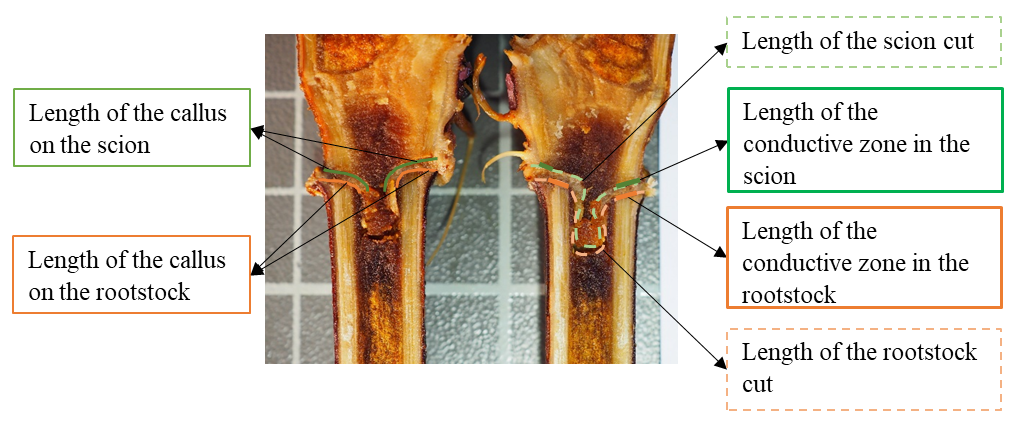
Evaluating graft quality in grapevine grafted plants is challenging because structural differences at the graft union are mostly internal. Conventional nursery assessments rely on external inspection, which provides limited information on vascular reconnection. This study applied two complementary approaches to characterise graft union quality: histological observations of callus and vascular development, and hydraulic conductance measurements. Trials were conducted in 2020 and 2021 with Tempranillo grafted onto 110 Richter. Five bench grafting methods were tested: omega with completely aligned cambium (OM-CA), omega with partially aligned cambium (OM-PA), V-shape (V), full cleft (FC), and hand-made whip and tongue (WTh). Histological analysis based on phenotyping of graft union vascular development were done at two time points, after the callusing phase and after field rooting, and hydraulic conductance was measured in one-year-old potted plants using a gravimetric flow–pressure method. Omega grafts, despite shorter contact surfaces, generally produced higher callus and a greater proportion of plants with complete vascular connection. OM-CA reached the most advanced vascular developmental categories, whereas V and WTh remained in intermediate stages and FC showed variable results. Hydraulic conductance did not differ among methods, although OM-CA displayed the highest and most uniform values. These results indicated that grafting efficiency depended more on cambial alignment and tissue differentiation than on the length of cambium surface. Combining scalable histological and hydraulic measurements offered a practical framework to assess graft quality in nursery trials and complemented advanced imaging approaches.
- Open Access
- Article
Evaluation of Grafting Method and Scion—Rootstock Alignment Effects on Anatomical Development and Hydraulic Properties of Grapevine (Vitis vinifera L.) Graft Unions
- Ana Villa-Llop 1, 2, 3, *,
- Sara Crespo-Martínez 2, 3,
- Maite Loidi 3,
- Ana Pina 4, 5,
- Patricia Irisarri 4, 5,
- Luis Gonzaga Santesteban 2, 3
Author Information
Received: 20 Oct 2025 | Revised: 05 Mar 2026 | Accepted: 07 Mar 2026 | Published: 13 Mar 2026
Abstract
Graphical Abstract
Keywords
callus formation | cambium | conductance | nursery propagation
References
- 1.
Bahar E, Korkutal I, Carbonneau A, & Akcay G. (2010). Using magnetic resonance imaging technique (MRI) to investigate graft connection and its relation to reddening discoloration in grape leaves. Journal of Food, Agriculture and Environment, 8, 293–297.
- 2.
Battiston E, Falsini S, Giovannelli A, Schiff S, Tani C, Panaiia R, Papini A, Di Marco S, & Mugnai L. (2022). Xylem anatomy and hydraulic traits in Vitis grafted cuttings in view of their impact on the young grapevine decline. Frontiers in Plant Science, 13. https://doi.org/10.3389/fpls.2022.1006835.
- 3.
Camboué M, Janoueix A, Spilmont A-S, Mathieu G, Ollat N, Santesteban LG, & Cookson S. (2025). Visualising xylem vessels connections formed one year after grafting using different techniques. OENO One, 59(3), 3. https://doi.org/10.20870/oeno-one.2025.59.3.9148.
- 4.
Carrere C, Spilmont A-S, Loupit G, Beutin P, Stessels C, Ollat N, & Cookson S-J. (2022). Evaluation of criteria to assist the selection of good quality grafted grapevines prior to their commercialisation. OENO One, 56(2), 2. https://doi.org/10.20870/oeno-one.2022.56.2.4792.
- 5.
De Herralde, F, del Mar Alsina M, Aranda X, Savé R, & Biel C. (2006). Effects of rootstock and irrigation regime on hydraulic architecture of Vitis vinifera L. cv. Tempranillo. OENO One, 40(3), 3. https://doi.org/10.20870/oeno-one.2006.40.3.868.
- 6.
Irisarri P, Zhebentyayeva T, Errea P, & Pina A. (2019). Inheritance of self- and graft-incompatibility traits in an F 1 apricot progeny. PLoS ONE, 14(5), 1–14. https://doi.org/10.1371/journal.pone.0216371.
- 7.
Janoueix A, Spilmont A-S, Moisy C, Mathieu G, Cordelières F, Teillon J, Gonzaga Santesteban L, Villa-Llop A, Crespo S, Marín D, & Cookson SJ. (2024). Imaging xylem connections between the scion and rootstock of grafted grapevine with X-ray microtomography. Acta Horticulturae, 1390, 103–108. https://doi.org/10.17660/ActaHortic.2024.1390.13.
- 8.
Korkutal İ, Bahar E, & Ozdemir AG. (2018). Determining the internal connection ratios by MRI and their effects on grafted rooted vine growing features of cvs. Merlot and Syrah. Erwerbs-Obstbau, 60(1), 61–69. https://doi.org/10.1007/s10341-018-0404-8.
- 9.
Loupit G, Valls Fonayet J, Tran J, Garcia V, Hummel I, Petriacq P, Gallusci P, Berger M, Franc C, de Revel G, Ollat N, & Cookson SJ. (2025). Graft union formation involves interactions among bud signals, carbon availability, dormancy release, wound responses and non-self-communication in grapevine. The Plant Journal, 122(5), e70244. https://doi.org/10.1111/tpj.70244.
- 10.
Marín D, Mayor B, Santesteban LG, Miranda C, Urrestarazu J, Abad FJ, Savé R, Aranda X, de Herralde F. (2019). The grapevine nursery sector in Spain/ A szőlőiskola-szektor Spanyolországban. In Phytoremediation of Soil Contaminated with Cadmium (pp. 109–119). Doktoranduszok Országos Szövetsége, Akadémiai Kiadó.
- 11.
Marín D, Abad FJ, Torres-Ruiz JM, & Santesteban LG. (2020). The vascular connections in grafted plants under examination. XIIIth International Terroir Congress. https://www.researchgate.net/publication/346336075_The_vascular_connections_in_grafted_plants_under_examination.
- 12.
Marín D, Santesteban LG, Dayer S, Villa-Llop A, Abad FJ, Gambetta GA, Torres-Ruiz JM, & Torres N. (2022). Connection matters: Exploring the implications of scion–rootstock alignment in grafted grapevines. Australian Journal of Grape and Wine Research, 28(4), 561–571. https://doi.org/10.1111/ajgw.12559.
- 13.
Mary S, Laveau C, Lecomte P, Birebent M, & Roby J-P. (2017). Impact of grafting type on Esca foliar symptoms. OENO One, 51(2), 221–230. https://doi.org/10.20870/oeno-one.2016.50.4.1408.
- 14.
Melnyk CW. (2017). Plant grafting: Insights into tissue regeneration. Regeneration, 4(1), 3–14. https://doi.org/10.1002/reg2.71.
- 15.
Melnyk CW, Gabel A, Hardcastle TJ, Robinson S, Miyashima S, Grosse I, & Meyerowitz EM. (2018). Transcriptome dynamics at Arabidopsis graft junctions reveal an intertissue recognition mechanism that activates vascular regeneration. Proceedings of the National Academy of Sciences, 115(10), E2447–E2456. https://doi.org/10.1073/pnas.1718263115.
- 16.
Melnyk CW, & Meyerowitz EM. (2015). Plant grafting. Current Biology, 25(5), R183–R188. https://doi.org/10.1016/j.cub.2015.01.029.
- 17.
Mendiburu F. (2021). Agricolae: Statistical Procedures for Agricultural Research (Version 1.3-5) [Computer software]. https://CRAN.R-project.org/package=agricolae.
- 18.
Milien M, Renault-Spilmont A-S, Cookson SJ, Sarrazin A, & Verdeil J-L. (2012). Visualization of the 3D structure of the graft union of grapevine using X-ray tomography. Scientia Horticulturae, 144, 130–140. https://doi.org/10.1016/j.scienta.2012.06.045.
- 19.
Mudge K, Janick J, Scofield S, & Goldschmidt EE. (2009). A History of grafting. In Janick J., (Ed.) Horticultural Reviews (1st ed., pp. 437–493). Wiley. https://doi.org/10.1002/9780470593776.ch9.
- 20.
Ollat N, Bordenave L, Tandonnet JP, Boursiquot JM, & Marguerit E. (2016). Grapevine rootstocks: Origins and perspectives. Acta Horticulturae, 1136, 11–22. https://doi.org/10.17660/ActaHortic.2016.1136.2.
- 21.
Pina A, Cookson SJ, Calatayud A, Trinchera A, & Errea P. (2017). Physiological and molecular mechanisms underlying graft compatibility. Vegetable Grafting: Principles and Practices, 132–154. https://doi.org/10.1079/9781780648972.0132.
- 22.
Pina A, & Errea P. (2005). A review of new advances in mechanism of graft compatibility–incompatibility. Scientia Horticulturae, 106(1), 1–11. https://doi.org/10.1016/j.scienta.2005.04.003.
- 23.
RStudio Team. (2021). RStudio: Integrated development for R [Computer software]. RStudio. http://www.rstudio.com/.
- 24.
Santarosa E, Souza PVD, de Araujo Mariath JE, & Lourosa GV. (2016). Physiological interaction between rootstock-scion: Effects on xylem vessels in Cabernet Sauvignon and Merlot grapevines. American Journal of Enology and Viticulture, 67(1), 65–76. https://doi.org/10.5344/ajev.2015.15003.
- 25.
Santesteban LG, Miranda C, & Royo JB. (2010). Vegetative growth, reproductive development and vineyard balance. In Methodologies and Results in Grapevine Research (pp. 45–56). Springer. https://doi.org/10.1007/978-90-481-9283-0_4.
- 26.
Soar CJ, Dry PR, & Loveys BR. (2006). Scion photosynthesis and leaf gas exchange in Vitis vinifera L. cv. Shiraz: Mediation of rootstock effects via xylem sap ABA. Australian Journal of Grape and Wine Research, 12(2), 82–96. https://doi.org/10.1111/j.1755-0238.2006.tb00047.x.
- 27.
Spilmont A-S, Carrere C, Hmedi Y, & Mathieu G. (2021). X-Ray tomography: A promising tool to assess the selection of good quality grafted vines prior to their commercialization. Internet Journal of Viticulture and Enology, 8.
- 28.
Stamp JA. (2001). The contribution of imperfections in nursery stock to the decline of young vines in California. Phytopathologia Mediterranea, 40, 369–375. https://doi.org/10.14601/Phytopathol_Mediterr-1640.
- 29.
Tandonnet JP, Cookson SJ, Vivin P, & Ollat N. (2010). Scion genotype controls biomass allocation and root development in grafted grapevine. Australian Journal of Grape and Wine Research, 16(2), 290-300. https://doi.org/10.1111/j.1755-0238.2009.00090.x.
- 30.
Tedesco S, Irisarri P, Teixeira Santos M, Fevereiro P, Pina A, & Kragler F. (2023). Early detection of grapevine graft incompatibility: Insights into translocated and virus-induced incompatibility. Scientia Horticulturae, 318, 112087. https://doi.org/10.1016/j.scienta.2023.112087.
- 31.
Torres-Ruiz JM, Sperry JS, & Fernández JE. (2012). Improving xylem hydraulic conductivity measurements by correcting the error caused by passive water uptake. Physiologia Plantarum, 146(2), 129–135. https://doi.org/10.1111/j.1399-3054.2012.01619.x.
- 32.
Venturas MD, Sperry JS, & Hacke UG. (2017). Plant xylem hydraulics: What we understand, current research, and future challenges. Journal of Integrative Plant Biology, 59(6), 356–389. https://doi.org/10.1111/jipb.12534.
- 33.
Villa-Llop A, Torres N, Loidi M, Velaz M, Galar-Martínez M, Crespo-Martínez S, & Santesteban LG. (2025). Does omega-type graft compromise vine performance? Evaluation of five bench grafting methods across nursery, vineyard establishment, and first productive years. Scientia Horticulturae, 350, 114346. https://doi.org/10.1016/j.scienta.2025.114346.
- 34.
Waite H, Whitelaw-Weckert M, & Torley P. (2015). Grapevine propagation: Principles and methods for the production of high-quality grapevine planting material. New Zealand Journal of Crop and Horticultural Science, 43(2), 144–161. https://doi.org/10.1080/01140671.2014.978340.


This work is licensed under a Creative Commons Attribution 4.0 International License.

 Suite 4002 Level 4, 447 Collins Street, Melbourne, Victoria 3000, Australia
 General Inquiries: info@sciltp.com