
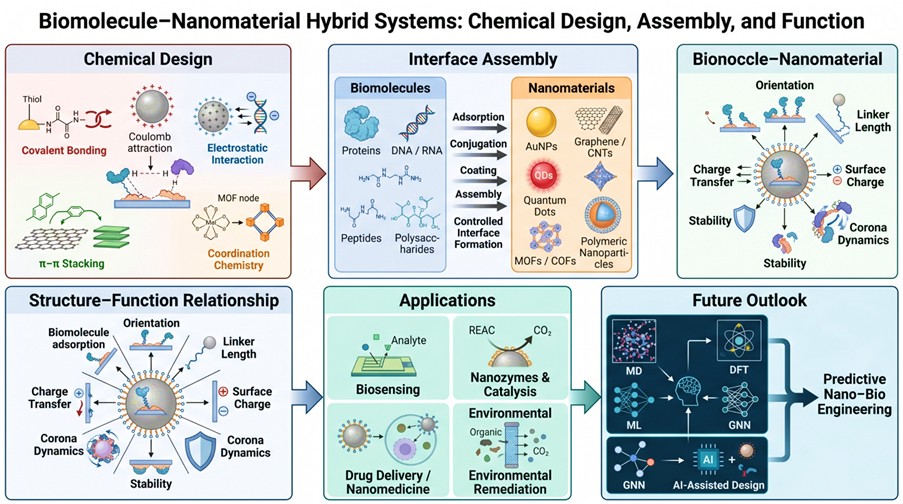
The interface of biomolecular and nanomaterials has emerged as one of the most appealing areas of focus of research in nanochemistry, materials science and biotechnology. The review gives a detailed overview of the key principles that can regulate the form and behaviour of interfaces between biomolecules and nanomaterials with particular attention to chemical design, assembly, and structure-function relations. The major interaction mechanisms, such as covalent bonding, electrostatic interaction, π–π stacking, hydrogen bonding, and metal ligand coordination, are discussed, where they can play a role in the stability as well as functionality of the interface. Different types of biomolecules (proteins, nucleic acids, peptides and polysaccharides) are studied, and the key nanomaterial platforms are met (metal nanoparticles, carbon-based nanomaterials, semiconductor quantum dots and metal-organic frameworks). The review also addresses interface engineering strategies based on functionalizing surfaces, bio-templating, self-assembling, and stimulus-responsive design. Such complex methods of characterization to investigate nano-bio interfaces and explain their structural and electronic characteristics are also mentioned. Notably, the interface structure/functional performance spectrum of the application is studied in biosensing and nanozyme catalysis, as well as targeted drug delivery and environmental or energy technologies. Lastly, the issues of the complexity of interface, stability, reproducibility, and scalability are considered, and an outlook of the issues in the future is provided with a focus on the role of computational modelling and artificial intelligence to support rational design of the next generation biomolecule-nanomaterial systems.
- Open Access
- Review
Biomolecule-Nanomaterial Hybrid Systems: Chemical Design, Assembly, and Function
- Sandhya Savita 1,
- Sanmatee Bai 1,
- Archana Markam 2,
- Ashish Singh 1,
- Pallab Bhandari 1,
- Sunil Kumar Singh 1,
- Suryabhan Singh 1,
- Ashish Kumar Singh 1,
- Uday Pratap Azad 1,*,
- Bijnaneswar Mondal 1,*,
- Bharat Lal Sahu 1,*
Author Information
Received: 15 Apr 2026 | Revised: 03 Aug 2026 | Accepted: 11 Aug 2026 | Published: 20 Aug 2026
Abstract
Graphical Abstract
Keywords
biomolecule | nanomaterials | biosensing | biointerfaces | self-assembly | interfaces
References
- 1.
Rodríguez-Quijada, C.; Sánchez-Purrà, M.; de Puig, H.; et al. Physical properties of biomolecules at the nanomaterial interface. J. Phys. Chem. B 2018, 122, 2827–2840.
- 2.
Bobo, D.; Robinson, K.J.; Islam, J.; et al. Nanoparticle-Based Medicines: A Review of FDA-Approved Materials and Clinical Trials to Date. Pharm. Res. 2016, 33, 2373–2387.
- 3.
Anselmo, A.C.; Mitragotri, S. Nanoparticles in the Clinic. Bioeng. Transl. Med. 2016, 1, 10–29.
- 4.
Bekdemir, A.; Stellacci, F. A Centrifugation-Based Physicochemical Characterization Method for the Interaction Between Proteins and Nanoparticles. Nat. Commun. 2016, 7, 13121.
- 5.
Willner, I.; Willner, B. Biomolecule-based nanomaterials and nanostructures. Nano Lett. 2010, 10, 3805–3815.
- 6.
Willner, I.; Basnar, B.; Willner, B. Nanoparticle–Enzyme Hybrid Systems for Nanobiotechnology Applications. FEBS J. 2007, 274, 302–309.
- 7.
Freeman, R.; Finder, T.; Willner, I. Multiplexed Analysis of Hg²⁺ and Ag⁺ Ions by DNA-Based Sensors. Angew. Chem. Int. Ed. 2009, 48, 7818–7821.
- 8.
Freeman, R.; Gill, R.; Shweky, I.; et al. Biosensing and Probing of Intracellular Metabolic Pathways by NADH-Sensitive Quantum Dots. Angew. Chem. Int. Ed. 2009, 48, 309–313.
- 9.
Zhao, H.; Wang, Y.; Bao, L.; et al. Engineering nano–bio interfaces from nanomaterials to nanomedicines. Acc. Mater. Res. 2022, 3, 812–829.
- 10.
Ren, J.; Andrikopoulos, N.; Velonia, K.; et al. Chemical and Biophysical Signatures of the Protein Corona in Nanomedicine. J. Am. Chem. Soc. 2022, 144, 9184–9205.
- 11.
Liu, J.; Guo, M.; Chen, C. Nano-Bio Interactions: A Major Principle in the Dynamic Biological Processes of Nano-Assemblies. Adv. Drug Deliv. Rev. 2022, 186, 114318.
- 12.
Bondarenko, O.; Mortimer, M.; Kahru, A.; et al. Nanotoxicology and Nanomedicine: The Yin and Yang of Nano-Bio Interactions for the New Decade. Nano Today 2021, 39, 101184.
- 13.
Pulido-Reyes, G.; Leganés, F.; Fernández-Piñas, F.; et al. Bio-nano interface and environment: A critical review. Environ. Toxicol. Chem. 2017, 36, 3181–3193.
- 14.
Kuruvilla, J.; Farinha, A.P.; Bayat, N.; et al. Surface proteomics on nanoparticles: A step to simplify the rapid prototyping of nanoparticles. Nanoscale Horiz. 2017, 2, 55–64.
- 15.
Yue, Y.; Li, X.; Sigg, L.; et al. Interaction of silver nanoparticles with algae and fish cells: A side by side comparison. J. Nanobiotechnol. 2017, 15, 16.
- 16.
Hayashi, Y.; Miclaus, T.; Murugadoss, S.; et al. Female versus male biological identities of nanoparticles determine the interaction with immune cells in fish. Environ. Sci. Nano 2017, 4, 895–906.
- 17.
Yang, Y.-S.S.; Atukorale, P.U.; Moynihan, K.D.; et al. High-throughput quantitation of inorganic nanoparticle biodistribution at the single-cell level using mass cytometry. Nat. Commun. 2017, 8, 14069.
- 18.
Ma, J.; Yang, S.; Yang, Z.; et al. Functional nanomaterials for advanced bioelectrode interfaces: Recent advances in disease detection and metabolic monitoring. Sensors 2025, 25, 4412.
- 19.
Irimes, M.B.; Pusta, A.; Cernat, A.; et al. Multiplexed electrochemical sensing devices for chronic diseases diagnosis and monitoring. TrAC Trends Anal. Chem. 2024, 172, 117560.
- 20.
Han, Q.; Wang, H.; Wang, J. Multi-Mode/Signal Biosensors: Electrochemical Integrated Sensing Techniques. Adv. Funct. Mater. 2024, 34, 2403122.
- 21.
Keles, G.; Sifa Ataman, E.; Taskin, S.B.; et al. Nanostructured Metal Oxide-Based Electrochemical Biosensors in Medical Diagnosis. Biosensors 2024, 14, 238.
- 22.
Fabbri, R.; Scida, A.; Saracino, E.; et al. Graphene oxide electrodes enable electrical stimulation of distinct calcium signalling in brain astrocytes. Nat. Nanotechnol. 2024, 19, 1344–1353.
- 23.
Song, J.; Chen, H.; Sun, Y.; et al. Layered MXene Films via Self-Assembly. Small 2024, 20, e2406855.
- 24.
Jawad, M.S.; Rahman, W.U.; Khan, M.; et al. Nanomaterial assembly pathways: Comparative insights into self-assembly and directed assembly techniques. Next Mater. 2026, 10, 101422.
- 25.
Karachevtsev, V.A.; Stepanian, S.G. Biomolecules and their complexes with nanostructures. Low Temp. Phys. 2021, 47, 179–180. https://doi.org/10.1063/10.0003517.
- 26.
Miao, H.; Chen, K.; Yu, H.; et al. DNA-directed assembly of graphene homostructures. J. Appl. Phys. 2025, 138, 044303.
- 27.
Kuznetsova, V.; Kadar, A.; Gaenko, A.; et al. Graph property relationships for complex chiral nanodendrimers. ACS Nano 2025, 19, 6095-6106.
- 28.
Bhaskar, S.; Wang, W.; Lee, H.; et al. Photonic crystal grating resonance and interfaces for health diagnostic technologies. Chem. Rev. 2025, 125, 6435–6540.
- 29.
Yeo, E.L.L.; Cheah, J.U.J.; Neo, D.J.H.; et al. Exploiting the Protein Corona around Gold Nanorods for Low-Dose Combined Photothermal and Photodynamic Therapy. J. Mater. Chem. B 2017, 5, 254–268.
- 30.
Chan, K.P.; Gao, Y.; Goh, J.X.; et al. Exploiting the Protein Corona from Cell Lysate on DNA Functionalized Gold Nanoparticles for Enhanced mRNA Translation. ACS Appl. Mater. Interfaces 2017, 9, 10408–10417.
- 31.
Ozboyaci, M.; Kokh, D.B.; Corni, S.; et al. Modeling and Simulation of Protein–Surface Interactions: Achievements and Challenges. Q. Rev. Biophys. 2016, 49, e4. https://doi.org/10.1017/S0033583515000256.
- 32.
Gao, Q.; Liu, S.; Guo, Z.; et al. Nanozyme-biological interfaces: A review on mechanisms and applications from natural biomolecular corona to artificial surface modifications. ACS Appl. Nano Mater. 2025, 8, 22070–22085.
- 33.
Wu, G.; Li, S.; Luo, L.; et al. Exploring Single-Atom Nanozymes toward Environmental Pollutants: Monitoring and Control. Nano Micro Lett. 2025, 17, 238.
- 34.
Ma, L.; Liang, Z.; Hou, Y.; et al. Nanozymes and Their Potential Roles in the Origin of Life. Adv. Mater. 2025, 37, 2412211.
- 35.
Jia, X.; Wang, E.; Wang, J.; et al. Rational Design of Nanozymes for Engineered Cascade Catalytic Cancer Therapy. Chem. Rev. 2025, 125, 2908–2952.
- 36.
Yang, X.; Hu, Y.; Zhou, H.; et al. Specific Capture, Detection, and Killing of Enterococcus faecalisBased on Aptamer-Modified Peroxidase Mimetic Nanozymes. Chem. Eng. J. 2025, 511, 161848.
- 37.
Wu, Y.; Zhang, Y.; Han, J.; et al. Nanozyme-Based Biomimetic Intelligent Immune Organelles for the Treatment of Bladder-Metastasized Tumors. Adv. Mater. 2025, 37, e11181.
- 38.
Miller, M.A.; Medina, S. Life at the interface: Engineering bio-nanomaterials through interfacial molecular self-assembly. Wiley Interdiscip. Rev. Nanomed. Nanobiotechnol. 2024, 16, e1966. https://doi.org/10.1002/wnan.1966.
- 39.
Hou, S.; Bai, L.; Lu, D.; et al. Interfacial Colloidal Self-Assembly for Functional Materials. Acc. Chem. Res. 2023, 56, 740–751.
- 40.
Lawanprasert, A.; Sloand, J.N.; González Vargas, M.; et al. Deciphering the Mechanistic Basis for Perfluoroalkyl-Protein Interactions. ChemBioChem 2023, 24, e202300159. https://doi.org/10.1002/cbic.202300159.
- 41.
Ornithopoulou, E.; Åstrand, C.; Gustafsson, L.; et al. Self-assembly of RGD-functionalized recombinant spider silk protein into microspheres in physiological buffer and in the presence of hyaluronic acid. ACS Appl. Bio Mater. 2023, 6, 3696–3705.
- 42.
Dang, M.; Yang, C.; Jin, G.; et al. From biomolecular condensates to functional nanomaterials: LLPS-inspired frameworks for nanoscale hydrogels and adaptive materials. J. Nanobiotechnol. 2026, 24, 280.
- 43.
Pu, J.; Wu, S.; Chen, L. AFM multiparametric characterization of LLPS in plants. Trends Plant Sci. 2025, 30, 437–438.
- 44.
Arbiol Enguita, A.M.; Zöller, L.; Tomberg, T.; et al. Chemically Specific Coherent Raman Imaging of Liquid–Liquid Phase Separation and Its Sequelae. Anal. Chem. 2025, 97, 3242–3252.
- 45.
Qian, J.; Li, X.; Ruan, H.; et al. Design and development of drug delivery nanocarriers based on liquid–liquid phase separation: Improved stability, cell penetration and anti-cancer effect. Int. J. Biol. Macromol. 2025, 307, 142023.
- 46.
Wen, P.; Huang, H.; Zhang, R.; et al. Coacervate vesicles assembled by liquid–liquid phase separation improve delivery of biopharmaceuticals. Nat. Chem. 2025, 17, 279–288.
- 47.
Caselli, L.; Conti, L.; De Santis, I.; et al. Small-angle X-ray and neutron scattering applied to lipid-based nanoparticles: Recent advancements across different length scales. Adv. Colloid Interface Sci. 2024, 327, 103156.
- 48.
Yang, H.; Yao, L.; Wang, Y.; et al. Advancing cell surface modification in mammalian cells with synthetic molecules. Chem. Sci. 2023, 14, 13325–13345.
- 49.
Zhang, F.L.; Hou, Y.; Zhu, M.H.; et al. Death Pathways of Cancer Cells Modulated by Surface Molecule Density on Gold Nanorods. Adv. Sci. 2021, 8, 2102666.
- 50.
Tiwari, V.K.; Jaiswal, M.K.; Rajkhowa, S.; et al. Bioorthogonal Click Chemistry: Invention to Applications in Living Systems. In Click Chemistry; Springer Nature: Singapore 2024; pp. 175–203.
- 51.
Swierczewski, M.; Bürgi, T. Langmuir and Langmuir–Blodgett Films of Gold and Silver Nanoparticles. Langmuir 2023, 39, 2135–2151.
- 52.
Pinals, R.L. On Protein Corona Formation: Understanding Nano-Bio Interactions Toward Engineering Optical Nanomaterials. Ph.D. Thesis, in Chemical Engineering, University of California, Berkeley, CA, USA, 2021.
- 53.
Baimanov, D.; Wang, J.; Liu, Y.; et al. Identification of Cell Receptors Responsible for Recognition and Binding of Lipid Nanoparticles. J. Am. Chem. Soc. 2025, 147, 7604–7616.
- 54.
Balashev, K., Interfacial Interactions of Nanoparticles and Molecular Nanostructures with Model Membrane Systems: Mechanisms, Methods, and Applications. Membranes 2026, 16, 134. https://doi.org/10.3390/membranes16040134.
- 55.
Guo, P.; Wang, Y.; Cui, H.; et al. Nano-bio-interface: Unleashing the potential of noble nanometals. Small Sci. 2024, 4, 2300227.
- 56.
Azharuddin, M.; Zhu, G.H.; Das, D.; et al. A repertoire of biomedical applications of noble metal nanoparticles. Chem. Commun. 2019, 55, 6964–6996.
- 57.
Wang, Z.; Tang, C.; Huang, M.; et al. One-Step Synthesis of Peptide–Gold Nanoclusters with Tunable Fluorescence and Enhanced Gene Delivery Efficiency. Langmuir 2022, 38, 14799–14807.
- 58.
Cao, C.; Yang, N.; Wang, X.; et al. Biomedicine meets nanozyme catalytic chemistry. Coord. Chem. Rev. 2023, 491, 215245.
- 59.
Chen, W.-Q.; Wu, W.-J.; Yu, Y.-Q.; et al. New Insights on the Size-Dependent Inhibition of Enzymes by Gold Nanoparticles. Langmuir 2023, 39, 9595–9603.
- 60.
Ramezani Farani, M.; Zandi, A.; Shojaeian, F.; et al. Biomimetic carbon-based nanomaterials: From design strategies to next-generation biosensing and theranostic applications. Small 2025, 21, e02711.
- 61.
Farani, M.R.; Zare, I.; Mirshafiei, M.; et al. Graphene oxide-engineered chitosan nanoparticles: Synthesis, properties, and antibacterial activity for tissue engineering and regenerative medicine. Chem. Eng. J. 2025, 483, 160852.
- 62.
Jabbari, F.; Farani, M.R.; Abednejad, A.; et al. Chitosan Nanoparticles in Tissue Engineering and Regenerative Medicine. In Fundamentals and Biomedical Applications of Chitosan Nanoparticles; Elsevier: Amsterdam, The Netherlands, 2025; pp. 497–526.
- 63.
Banazadeh, M.; Ilaghi, M.; Abadi, B.; et al. Chitosan Nanoparticles-Hydrogel Composites for Biomedical Applications. In Fundamentals and Biomedical Applications of Chitosan Nanoparticles; Elsevier: Amsterdam, The Netherlands, 2025; pp. 633–678.
- 64.
Kang, N.; Hwang, J.; Jeong, D.; et al. Ligand Interrelation Analysis via Graph Theory Predicts Macrophage Response. Adv. Mater. 2025, 37, 2414356.
- 65.
Yang, B.; Wang, R.; Li, W.; et al. On-Origami Molecular Crowding Control of G-Quadruplex DNAzymes. Small Methods 2025, 9, 2401401.
- 66.
Gou, Q.; Lu, L.; Lin, S.; et al. Multifunctional Chitosan–Covalent Bonded Multi-Walled Carbon Nanotubes Composite Binder for Enhanced Electrochemical Performances of Lithium–Sulfur Batteries. Macromol. Rapid Commun. 2025, 46, 2500155.
- 67.
Li, T.; Sun, M.; Zhou, Q.; et al. Endogenous Enzyme-Powered DNA Nanomotor Operating in Living Cells for microRNA Imaging. Anal. Chem. 2023, 95, 15025–15032.
- 68.
Freeman, R.; Finder, T.; Gill, R.; et al. Probing Protein Kinase (CK2) and Alkaline Phosphatase with CdSe/ZnS Quantum Dots. Nano Lett. 2010, 10, 2192–2196.
- 69.
Lo, P.K.; Karam, P.; Aldaye, F.A.; et al. Loading and selective release of cargo in DNA nanotubes with longitudinal variation. Nat. Chem. 2010, 2, 319–328.
- 70.
Gu, H.; Chao, J.; Xiao, S.-J.; et al. A proximity-based programmable DNA nanoscale assembly line. Nature 2010, 465, 202–205.
- 71.
Yehezkeli, O.; Yan, Y.-M.; Baravik, I.; et al. Integrated oligoaniline-cross-linked composites of Au nanoparticles/glucose oxidase electrodes: A generic paradigm for electrically contacted enzyme systems. Chem. Eur. J. 2009, 15, 2674–2679.
- 72.
Freeman, R.; Li, Y.; Tel-Vered, R.; et al. Self-assembly of supramolecular aptamer structures for optical or electrochemical sensing. Analyst 2009, 134, 653–656.
- 73.
Andersen, E.S.; Dong, M.; Nielsen, M.M.; et al. Self-Assembly of a Nanoscale DNA Box with a Controllable Lid. Nature 2009, 459, 73–76.
- 74.
Sharma, J.; Chhabra, R.; Cheng, A.; et al. Control of Self-Assembly of DNA Tubules Through Sequence Design. Science 2009, 323, 112–116.
- 75.
Yang, Q.; Ren, W.J.; Yu, X.H.; et al. Arachin amyloid-like fibrils and chitosan composite coatings with antimicrobial and antioxidant activities for effective preservation of perishable fruits. Int. J. Biol. Macromol. 2025, 308, 142704.
- 76.
Feng, N.; Zhang, J.; Tian, J.; et al. Preserving fruit freshness with amyloid-like protein coatings. Nat. Commun. 2025, 16, 5060.
- 77.
Liu, G.; Liu, R.; Fu, C.; et al. Protein/polysaccharide composite nanocoating based on amyloid-like aggregation for fresh-cut fruits preservation. Chem. Eng. J. 2025, 519, 165048.
- 78.
Marshall, K.E.; Mengham, K.; Spink, M.C.; et al. Correlative cryo-soft X-ray tomography and cryo-structured illumination microscopy reveal changes to lysosomes in amyloid-β-treated neurons. Structure 2024, 32, 585–593.
- 79.
Ding, L.; Bing, L.; Peil, A.; et al. DNA-directed assembly of photonic nanomaterials for diagnostic and therapeutic applications. Adv. Mater. 2025, 37, 2500086. https://doi.org/10.1002/adma.202500086.
- 80.
Zhang, T.-K.; Yi, Z.-Q.; Huang, Y.-Q.; et al. Natural biomolecules for cell-interface engineering. Chem. Sci. 2025, 16, 3019–3044.
- 81.
Zhang, T.-K.; Geng, W.; Huang, Y.-Q.; et al. Specific recognition to create nanofunctionalized cells for precise functions. Coord. Chem. Rev. 2024, 498, 215471.
- 82.
Gao, M.; Wang, H.; Zhang, Y.; et al. Unveiling Trends: Nanoscale Materials Shaping Emerging Biomedical Applications. ACS Nano 2024, 18, 16325–16342.
- 83.
Yang, H.; Xiong, Z.; Heng, X.; et al. Click-Chemistry-Mediated Cell Membrane Glycopolymer Engineering to Potentiate Dendritic Cell Vaccines. Angew. Chem. Int. Ed. 2024, 63, e202315782.
- 84.
Niu, Y.; Xue, D.; Dai, X.; et al. Sustainable power generation from sewage with engineered microorganisms as electrocatalysts. Nat. Sustain. 2024, 7, 1182–1189.
- 85.
Zhou, W.; Zhang, W.; Geng, W.; et al. External Electrons Directly Stimulate Escherichia coli for Enhancing Biological Hydrogen Production. ACS Nano 2024, 18, 10840–10849.
- 86.
Li, Z.; Xue, L.; Yang, J.; et al. Metal–Organic Framework-Based Nanoplatforms for Biomedical Applications. Adv. Sci. 2024, 11, 2305126.
- 87.
Wei, X.; Wang, Y.; Liu, Y.; et al. Biomimetic design strategies for biomedical applications. Matter 2024, 7, 826–854.
- 88.
Ma, B.; Bianco, A. Regulation of biological processes by intrinsically chiral engineered materials. Nat. Rev. Mater. 2023, 8, 403–413.
- 89.
Li, J.; Chen, C.; Xia, T. Understanding Nanomaterial–Liver Interactions to Facilitate the Development of Safer Nanoapplications. Adv. Mater. 2022, 34, 2106456.
- 90.
Liu, J.M.; Wang, A.Z.; Liu, S.H.; et al. A Titanium Nitride Nanozyme for pH-Responsive and Irradiation-Enhanced Cascade Catalytic Tumor Therapy. Angew. Chem. Int. Ed. 2021, 60, 25328–25338.
- 91.
Ni, B.; González-Rubio, G.; Van Gordon, K., et al. Seed-Mediated Growth and Advanced Characterization of Chiral Gold Nanorods. Adv. Mater. 2024, 36, 2412473.
- 92.
Li, B.; Yu, S.; Feng, R.; et al. Dual-Mode Gold Nanocluster-Based Nanoprobe Platform for Two-Photon Fluorescence Imaging and Fluorescence Lifetime Imaging of Intracellular Endogenous miRNA. Anal. Chem. 2023, 95, 14925–14933.
- 93.
Habeeb, H.; Vengateswaran, H.T.; Tripathi, A.K.; et al. Enhancing biomedical imaging: the role of nanoparticle-based contrast agents. Biomed. Microdevices 2024, 26, 42.
- 94.
Li, H.; Zhang, Y.; Ding, J.; et al. Synthesis of Carbon Quantum Dots for Application of Alleviating Amyloid-β Mediated Neurotoxicity. Colloids Surf. B 2022, 212, 112373.
- 95.
Huang, H.; Liu, R.; Yang, J.; et al. Gold Nanoparticles: Construction for Drug Delivery and Application in Cancer Immunotherapy. Pharmaceutics 2023, 15, 1868.
- 96.
Li, Q.; Li, Y.; Xu, P.; et al. One-Step Fabrication Bioinspired Flexible Hierarchical Micro–Nano Structures with Different Morphologies. ACS Appl. Mater. Interfaces 2023, 15, 43016–43025.
- 97.
Kumar, N.; Samal, P.P.; Mahapatra, A.; et al. Deciphering pressure induced nanoarchitectonics in a monolayer of heterocoronene-based discotics at air–water and air–solid interfaces. Soft Matter 2023, 19, 1513–1522.
- 98.
Sánchez-Purrà, M.; Carré-Camps, M.; de Puig, H.; et al. SERS-Based Sandwich Immunoassays for Multiplexed Detection of Zika and Dengue Viral Biomarkers. ACS Infect. Dis. 2017, 3, 767–776.
- 99.
Wilhelm, S.; Tavares, A.J.; Dai, Q.; et al. Analysis of nanoparticle delivery to tumours. Nat. Rev. Mater. 2016, 1, 16014.
- 100.
Liu, C.; Liang, L.; Yu, Y.; et al. Multiple Recognition-Powered Abiotic Bimetallic Oxide Nanozyme-Based Colorimetric Platform for the Selective Detection of Allergen β-Lactoglobulin. Food Chem. 2025, 468, 142400.
- 101.
Bhaskar, S.; Liu, L.; Liu, W.; et al. Photonic crystal band edge coupled enhanced fluorescence from magneto-plasmonic cryosoret nano-assemblies for ultra-sensitive detection. APL Mater. 2025, 13, 041103.
- 102.
Bhaskar, S.; Liu, L.; Liu, W.; et al. Photonic-crystal-enhanced fluorescence: Template-free gold cryosoret nanoassembly steering, dequenching, and augmenting the quenched emission from radiating dipoles. MRS Bull. 2025, 50, 585–598.
- 103.
Bhaskar, S.; Liu, W.; Shepherd, S.; et al. Integrated metallo-dielectric 3D hotspots from high refractive index nanodiamond-plasmonic gold cryosoret nano-assemblies for photonic crystal enhanced fluorescence. Adv. Funct. Mater. 2025, 36, e12295.
- 104.
Jia, B.; Yao, Y.; Xu, Y.; et al. Multi-Functional Copper-Based Nanoenzyme System with Antioxidant and Ferroptosis Inhibition for Traumatic Brain Injury. Chem. Eng. J. 2025, 515, 163592.
- 105.
Kim, K.; Min, S.; Thangam, R.; et al. Dynamic hierarchical ligand anisotropy for competing macrophage regulation in vivo. Bioact. Mater. 2025, 47, 121–135.
- 106.
Miller, M.A.; Medina, S. Synthetic Colonic Mucus Enables the Development of Modular Microbiome Organoids. Adv. Funct. Mater. 2024, 34, 2402514.
- 107.
Kim, I.; Elliott, J.C.; Lawanprasert, A.; et al. Real-Time, In Situ Imaging of Macrophages via Phase-Change Peptide Nanoemulsions. Small 2023, 19, 2301673.
- 108.
Tawakey, S.H.; Mansour, M.; Soltan, A.; et al. Early detection of hypo/hyperglycemia using a microneedle electrode array-based biosensor for glucose ultrasensitive monitoring in interstitial fluid. Lab Chip 2024, 24, 3958–3972.
- 109.
Wang, X.; Xu, M.; Yang, H.; et al. Ultraflexible Neural Electrodes Enabled Synchronized Long-Term Dopamine Detection and Wideband Chronic Recording Deep in Brain. ACS Nano 2024, 18, 34272–34287.
- 110.
Du, X.; Yang, L.; Shi, X.; et al. Ultrathin Bioelectrode Array with Improved Electrochemical Performance for Electrophysiological Sensing and Modulation. ACS Nano 2024, 18, 34971–34985.
- 111.
Kirtane, A.R.; Bi, J.; Rajesh, N.U.; et al. Radioprotection of healthy tissue via nanoparticle-delivered mRNA encoding for a damage-suppressor protein found in tardigrades. Nat. Biomed. Eng. 2025, 9, 1240–1253.
- 112.
Garg, T.; Arora, S.; Pahwa, R. Cellulose and its derivatives: Structure, modification, and application in controlled drug delivery. Future J. Pharm. Sci. 2025, 11, 76.
- 113.
Donthi, M.R.; Munnangi, S.R.; Krishna, K.V.; et al. Nanoemulgel: A Novel Nano Carrier as a Tool for Topical Drug Delivery. Pharmaceutics 2023, 15, 164.
- 114.
Zhao, H.; Xu, J.B.; Wang, Y.Q.; et al. A Photosensitizer Discretely Loaded Nanoaggregate with Robust Photodynamic Effect for Local Treatment Triggers Systemic Antitumor Responses. ACS Nano 2022, 16, 3070–3080.
- 115.
Zhao, H.; Xu, J.B.; Feng, C.; et al. Tailoring Aggregation Extent of Photosensitizers to Boost Phototherapy Potency for Eliciting Systemic Antitumor Immunity. Adv. Mater. 2022, 34, 2106390.
- 116.
Li, Y.; Feng, H.; Yang, H.; et al. A Self-Priming Pyroptosis-Inducing Agent for Activating Anticancer Immunity. Adv. Healthcare Mater. 2025, 14, 2500610.
- 117.
Ma, J.; Wu, Y.; Zou, H.; et al. Acid-Responsive Aggregation of Gold Nanoparticles for the Photothermal Treatment of Bacterial Infections. ACS Infect. Dis. 2023, 9, 2538–2547.
- 118.
de Puig, H.; Carré-Camps, M.; Bosch, I. Effect of the Protein Corona on Antibody–Antigen Binding in Nanoparticle Sandwich Immunoassays. Bioconjugate Chem. 2017, 28, 230–238.
- 119.
Picchietti, S.; Bernini, C.; Stocchi, V.; et al. Engineered nanoparticles of titanium dioxide (TiO2): Uptake and biological effects in a sea bass cell line. Fish Shellfish Immunol. 2017, 63, 53–67.
- 120.
Shen, Z.; Liang, Q.; Chang, Q.; et al. Topological Hydrogels for Long-Term Brain Signal Monitoring, Neuromodulation, and Stroke Treatment. Adv. Mater. 2024, 36, e2310365.
- 121.
Fu, F.; Liu, C.; Jiang, Z.; et al. Polymeric silk fibroin hydrogel as a conductive and multifunctional adhesive for durable skin and epidermal electronics. Smart Med. 2024, 3, e20240027.
- 122.
Mitrano, D.M.; Nowack, B. The need for a life-cycle-based aging paradigm for nanomaterials: Importance of real-world test systems to identify realistic particle transformations. Nanotechnology 2017, 28, 072001.
- 123.
Berry, T.D.; Filley, T.R.; Clavijo, A.P.; et al. Degradation and microbial uptake of C60 fullerols in contrasting agricultural soils. Environ. Sci. Technol. 2017, 51, 1387–1394.
- 124.
Martín-de-Lucía, I.; Campos-Mañas, M.C.; Agüera, A.; et al. Reverse Trojan-horse effect decreased wastewater toxicity in the presence of inorganic nanoparticles. Environ. Sci. Nano 2017, 4, 1273–1282.
- 125.
Elfiky, A.A.; Ibrahim, I.M.; Elghareib, A.M.; et al. Simulation of gold nanoparticle movement through normal and cancer cell membranes. Comput. Biol. Med. 2023, 164, 107363.

This work is licensed under a Creative Commons Attribution 4.0 International License.

 Suite 4002 Level 4, 447 Collins Street, Melbourne, Victoria 3000, Australia
 General Inquiries: info@sciltp.com