
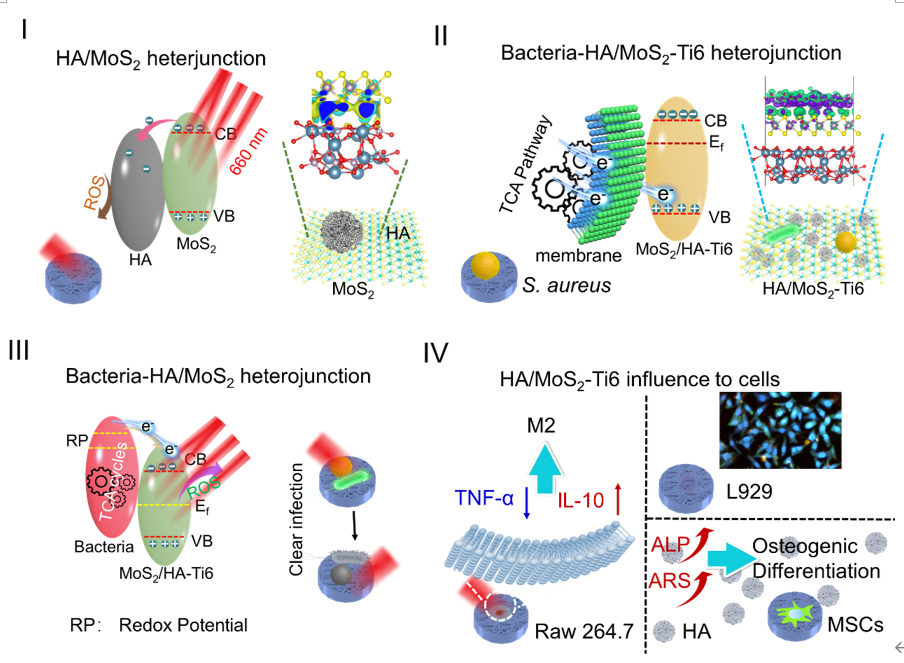
Photodynamic therapy can be used to clear bacterial infections. However, light disinfection primarily relies on reactive oxygen species (ROS), which are nonselective, leading to undesired damage to normal cells. Therefore, developing a photosensitizer that can selectively kill bacteria and protect normal cells is highly desirable based on the structural difference between normal cells and bacteria. In this study, a bacterial redox potential-boosted photocatalytic concept is proposed. Here, we designed a selectively bacteria-killing photosensitizer, hydroxyapatite/MoS2 coating in Ti6 implant (HA/MoS2-Ti6), which could accept the electrons from bacteria due to the potential difference between HA/MoS2 and the bacterial outer membrane. Then it further boosted the separation of electrons and holes of HA/MoS2 produced by 660 nm light irradiation, which enhanced the photocatalytic activity of HA/MoS2-Ti6. Density functional theory calculation further demonstrated the complete electron transfer circulation between HA/MoS2-Ti6 and the bacterial outer membrane. The produced ROS and changed electrons transfer pathway altered bacterial membrane potential and intracellular ROS, leading to bacterial death (92.99 ± 0.84% against Staphylococcus aureus and 94.70 ± 3.60% against Escherichia coli). Meanwhile, HA/MoS2-Ti6 has great biocompatibility with Raw 264.7, L929, and MC3T3-E1 with/without light irradiation. HA/MoS2-Ti6 can also enhance MC3T3-E1 into osteoblasts due to the osteoinduction of HA. HA/MoS2-Ti6 induced macrophages to differentiate into M2 under light irradiation. The strategy-based nano-bio interface offered a new platform to clear microbes and enhance cell differentiation simultaneously.
- Open Access
- Article
Bacteria-Powered Photodynamic Amplification on Nano-Bio Interface for Selective Pathogen Killing and Tissue Regeneration
- Jieni Fu 1, 2, 3,
- Chaofeng Wang 1,
- Congyang Mao 2,
- Hui Jiang 3,
- Jie Shen 4,
- Zhaoyang Li 3,
- Yanqin Liang 3,
- Shengli Zhu 3,
- Zhenduo Cui 3,
- Xiangmei Liu 1, 2, *
Author Information
Received: 29 Jun 2025 | Revised: 04 Jul 2025 | Accepted: 14 Jul 2025 | Published: 22 Jul 2025
Abstract
Graphical Abstract
References
- 1.Lewis, K.; Lee, R.E.; Brötz-Oesterhelt, R.H.; et al. Sophisticated natural products as antibiotics. Nature 2024, 632, 39–49.
- 2.Peng, X.; Gan, Y.; Yang, L.; et al. Biofunctional lipid nanoparticles for precision treatment and prophylaxis of bacterial infections. Sci. Adv. 2024, 10, eadk9754.
- 3.Rossiter, S.E.; Fletcher, M.H.; et al. Natural products as platforms to overcome antibiotic resistance. Chem. Rev. 2017, 117, 12415–12474.
- 4.Fu, J.; Li, Y.; Zhang, Y.; et al. An engineered pseudo-macrophage for rapid treatment of bacteria-infected osteomyelitis via microwave-excited anti-infection and immunoregulation. Adv. Mater. 2021, 33, e2102926.
- 5.Blackmon, S.; Avendano, E.E.; Nirmala, N.; et al. Socioeconomic status and the risk for colonisation or infection with priority bacterial pathogens: A global evidence map. Lancet Microbe 2025, 6, 100993.
- 6.Liu, C.; Kong, D.; Hsu, P.; et al. Rapid water disinfection using vertically aligned MoS2 nanofilms and visible light. Nat. Nanotechnol. 2016, 11, 1098–1104.
- 7.Gao, Y.; Wang, J.; Hu, D.; et al. Bacteria-targeted supramolecular photosensitizer delivery vehicles for photodynamic ablation against biofilms. Macromol. Rapid Commun. 2019, 40, e1800763.
- 8.Ray, P.C.; Khan, S.A.; Singh, A.K.; et al. Nanomaterials for targeted detection and photothermal killing of bacteria. Chem. Soc. Rev. 2012, 41, 3193–3209.
- 9.Green, J.; Paget, M.S. Bacterial redox sensors. Nat. Rev. Microbiol. 2004, 2, 954–966.
- 10.Liu, D.F.; Li, W.W. Potential-dependent extracellular electron transfer pathways of exoelectrogens. Curr. Opin. Chem. Biol. 2020, 59, 140–146.
- 11.Sporer, A.J.; Kahl, L.J.; et al. Redox-based regulation of bacterial development and behavior. Annu. Rev. Biochem. 2017, 86, 777–797.
- 12.Nel, A.E.; Mädler, L.; Velegol, D.; et al. Understanding biophysicochemical interactions at the nano–bio interface. Nat. Mater. 2009, 8, 543–557.
- 13.Baldus Ilona, B.; Gräter, F. Mechanical Force Can Fine-Tune Redox Potentials of Disulfide Bonds. Biophys. J. 2012, 102, 622–629.
- 14.Li, J.; Jiang, M.; Zhou, H.; et al. Vanadium dioxide nanocoating induces tumor cell death through mitochondrial electron transport chain interruption. Glob. Chall. 2019, 3, 1800058.
- 15.Sakimoto, K.K.; Wong, A.B.; Yang, P. Self-photosensitization of nonphotosynthetic bacteria for solar-to-chemical production. Science 2016, 351, 74–76.
- 16.King, P.; Brown, K.; Harris, D. Light-driven dinitrogen reduction catalyzed by a CdS:nitrogenase MoFe protein biohybrid. Science 2016, 352, 448–450.
- 17.Guo, J.; Suástegui, M.; Sakimoto, K.K.; et al. Light-driven fine chemical production in yeast biohybrids. Science 2018, 362, 813–816.
- 18.Liu, C.; Colón, B.C.; Ziesack, M.; et al. Water splitting–biosynthetic system with CO2 reduction efficiencies exceeding photosynthesis. Science 2016, 352, 1210–1213.
- 19.Zhang, H.; Liu, H.; Tian, Z.; et al. Bacteria photosensitized by intracellular gold nanoclusters for solar fuel production. Nat. Nanotechnol. 2018, 13, 900–905.
- 20.Li, X.; Zhu, H. Two-dimensional MoS2: Properties, preparation, and applications. J. Materiomics 2015, 1, 33–44.
- 21.Hendi, A.H.; Osman, A.M.; Khan, I.; et al. Visible light-driven photoelectrocatalytic water splitting using Z-scheme Ag-decorated MoS2/RGO/NiWO4 heterostructure. ACS Omega 2020, 5, 31644–31656.
- 22.Fu, J.; Liu, X.; Liu, X.; et al. Photoelectric-responsive extracellular matrix for bone engineering. ACS Nano 2019, 13, 13581–13594.
- 23.Fu, J.; Zhu, W.; Liu, X.; et al. Self-activating anti-infection implant. Nat. Commun. 2021, 12, 6907.
- 24.Kresse, G.; Furthmüller, J. Efficiency of ab-initio total energy calculations for metals and semiconductors using a plane-wave basis set. Comput. Mater. Sci. 1996, 6, 15–50.
- 25.Blöchl, P.E. Projector augmented-wave method. Phys. Rev. B 1994, 50, 17953–17979.
- 26.Perdew, J.P.; Chevary, J.A.; Vosko, S.H.; et al. Atoms, molecules, solids, and surfaces: Applications of the generalized gradient approximation for exchange and correlation. Phys. Rev. B 1992, 46, 6671–6687.
- 27.Grimme, S.; Antony, J.; Ehrlich, S.; et al. A consistent and accurate ab initio parametrization of density functional dispersion correction (DFT-D) for the 94 elements H-Pu. Chem. Phys. 2010, 132, 154104.
- 28.Li, S.; Liu, Y.; Zhao, X.; et al. Sandwich-like heterostructures of MoS2/graphene with enlarged interlayer spacing and enhanced hydrophilicity as high-performance cathodes for aqueous zinc-ion batteries. Adv. Mater. 2021, 33, e2007480.
- 29.Kottegoda, N.; Sandaruwan, C.; Priyadarshana, G.; et al. Urea-hydroxyapatite nanohybrids for slow release of nitrogen. ACS Nano 2017, 11, 1214–1221.
- 30.Bayer, B.C.; Kaindl, R.; Monazam, M.R.A.; et al. Atomic-scale in situ observations of crystallization and restructuring processes in two-dimensional MoS2 films. ACS Nano 2018, 12, 8758–8769.
- 31.Yang, C.T.; Li, K.Y.; Meng, F.Q.; et al. ROS-induced HepG2 cell death from hyperthermia using magnetic hydroxyapatite nanoparticles. Nanotechnology 2018, 29, 375101.
- 32.Liang, Z.; Xue, Y.; Wang, X.; et al. Co doped MoS2 as cocatalyst considerably improved photocatalytic hydrogen evolution of g-C3N4 in an alkalescent environment. Chem. Eng. J. 2021, 421, 130016.
- 33.Umezawa, N.; Shuxin, O.; Ye, J. Theoretical study of high photocatalytic performance of Ag3PO4. Phys. Rev. B 2011, 83, 035202.
- 34.Li, Y.; Liu, X.; Tan, L.; et al. Rapid sterilization and accelerated wound healing using Zn2+ and graphene oxide modified g-C3N4 under dual light irradiation. Adv. Funct. Mater. 2018, 28, 1800299.
- 35.Zhu, Y.; Liu, X.; Wu, J.; et al. Regulation of macrophage polarization through surface topography design to facilitate implant-to-bone osteointegration. Sci. Adv. 2021, 7, eabf6654.
- 36.Nosaka, Y.; Nosaka, A.Y. Generation and detection of reactive oxygen species in photocatalysis. Chem. Rev. 2017, 117, 11302–11336.
- 37.Bagramyan, K.; Galstyan, A.; Trchounian, A. Redox potential is a determinant in the Escherichia coli anaerobic fermentative growth and survival: Effects of impermeable oxidant. Bioelectrochemistry 2000, 51, 151–156.
- 38.Nothling, M.D.; Cao, H.; McKenzie, T.G.; et al. Bacterial redox potential powers controlled radical polymerization. J. Am. Chem. Soc. 2021, 143, 286–293.
- 39.Shi, L.; Dong, H.; Reguera, G.; et al. Extracellular electron transfer mechanisms between microorganisms and minerals. Nat. Rev. Microbiol. 2016, 14, 651–662.
- 40.Li, Y.; Liu, X.; Tan, L.; et al. Eradicating multidrug-resistant bacteria rapidly using a multi functional g—C3N4@Bi2S3 nanorod heterojunction with or without antibiotics. Adv. Funct. Mater. 2019, 29, 1900946.
- 41.Fang, X.; Kalathil, S.; Divitini, G.; et al. A three-dimensional hybrid electrode with electroactive microbes for efficient electrogenesis and chemical synthesis. Proc. Nat. Acad. Sci. USA 2020, 117, 5074–5080.
- 42.Courtney, C.M.; Goodman, S.M.; Nagy, T.A.; et al. Potentiating antibiotics in drug-resistant clinical isolates via stimuli-activated superoxide generation. Sci. Adv. 2017, 3, e1701776.
- 43.Lin, W.; Kirschvink, J.L.; Paterson, G.A.; et al. On the origin of microbial magnetoreception. Natl. Sci. Rev. 2020, 7, 472–479.
- 44.Martinière, A.; Gibrat, R.; Sentenac, H.; et al. Uncovering pH at both sides of the root plasma membrane interface using noninvasive imaging. Proc. Nat. Acad. Sci. USA 2018, 115, 6488.
- 45.Kzhyshkowska, J.; Gudima, A.; Riabov, V.; et al. Macrophage responses to implants: Prospects for personalized medicine. J. Leukoc. Biol. 2015, 98, 953–962.
- 46.Fu, J.; Liu, X.; Cui, Z.; et al. Probiotic-based nanoparticles for targeted microbiota modulation and immune restoration in bacterial pneumonia. Natl. Sci. Rev. 2023, 10, nwac221.
- 47.Li, Y.; Liu, X.; Cui, Z.; et al. Inflammation and microbiota regulation potentiate pneumonia therapy by biomimetic bacteria and macrophage membrane nanosystem. Research 2023, 6, 0096.
How to Cite
Fu, J.; Wang, C.; Mao, C.; Jiang, H.; Shen, J.; Li, Z.; Liang, Y.; Zhu, S.; Cui, Z.; Liu, X. Bacteria-Powered Photodynamic Amplification on Nano-Bio Interface for Selective Pathogen Killing and Tissue Regeneration. Advanced Antibacterial Materials 2026, 1 (1), 1–15. https://doi.org/10.53941/aam.2026.100001.
RIS
BibTex
Copyright & License

Copyright (c) 2025 by the authors.
This work is licensed under a Creative Commons Attribution 4.0 International License.
Article Metrics
250
Article Views
0
Citations
Contents
References

 Suite 4002 Level 4, 447 Collins Street, Melbourne, Victoria 3000, Australia
 General Inquiries: info@sciltp.com