
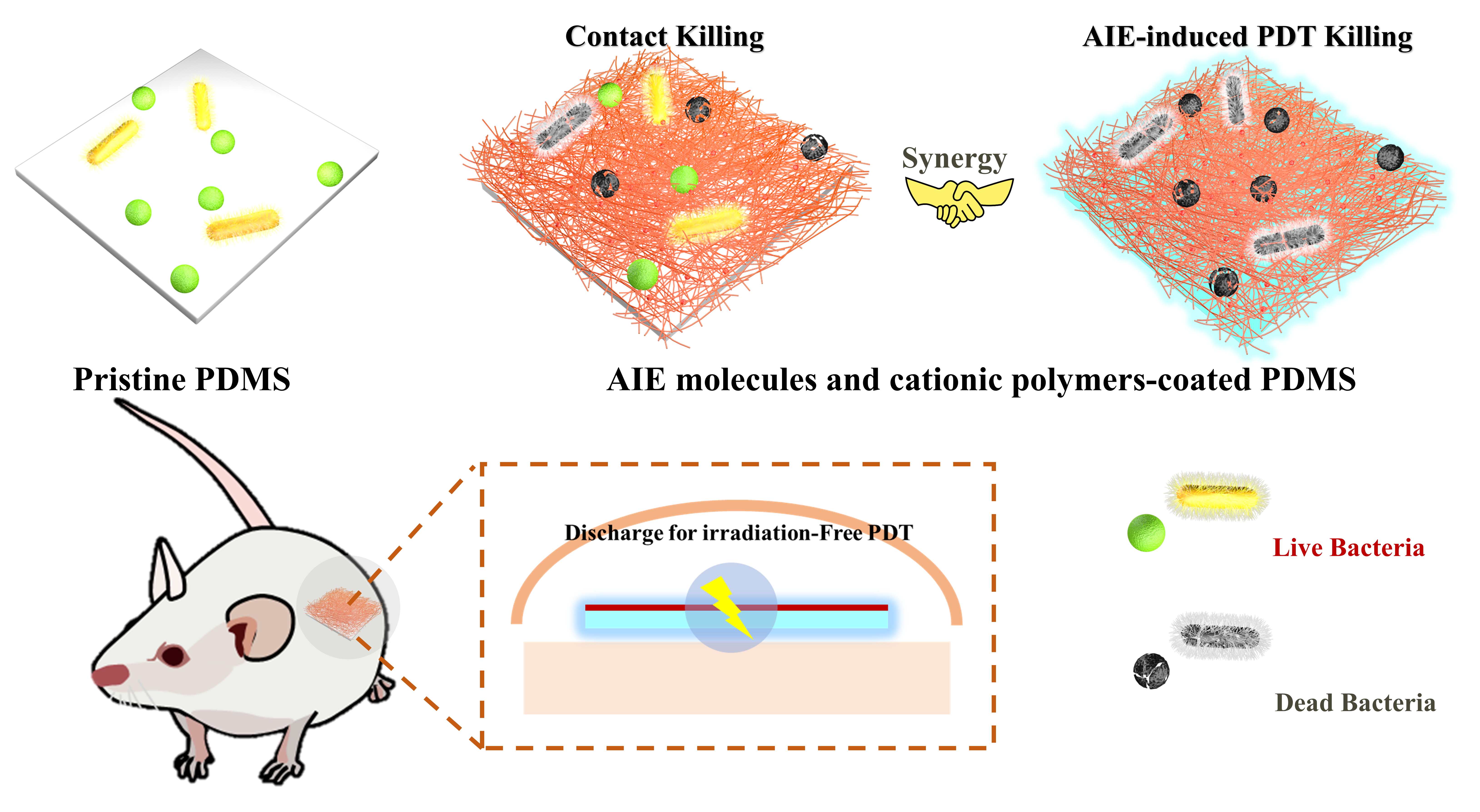
Photodynamic therapy (PDT) has emerged as a pivotal strategy for mitigating the risk of implant-associated infections (IAIs) due to its minimally invasive nature and the reduced emergence of multidrug-resistant (MDR) bacterial strains. However, the limited tissue penetration depth of visible light fundamentally constrains the therapeutic efficacy of PDT in deep-seated infections. Herein, we engineered a self-luminescent polydimethylsiloxane (PDMS) composite (PDMS-S) by integrating persistent luminescence material (Sr2MgSi2O7: Eu2+, Dy3+). Simultaneously, we encapsulated an aggregation-induced emission luminogen (AIEgen; TTVP) with exceptional photosensitizing efficiency within a hybrid polymeric network of phytic acid (PA) and carboxymethyl chitosan (CMCS). The resulting PA-CMCS-TTVP (PA-CT) aggregates are conveniently deposited onto PDMS-S surfaces. The intrinsic luminescence of PDMS-S enabled the PA-CT coating to generate sustained reactive oxygen species (ROS), resulting in long-term effective PDT. This work significantly expands the biomedical applications of PDT and provides a transformative strategy for deep-tissue infections.
- Open Access
- Article
Construction of AIE Molecule-Embedded Long-Persistent Luminescence Coating for Self-Activated Photodynamic Antibacterial Performance
- Weizhe Li 1,
- Li Xiang 1,
- Gnanasekar Sathishkumar 1,*,
- Xiaodong He 1,
- Yunjie Xiang 1,
- Kun Xu 1,
- Xi Rao 1,
- En-Tang Kang 2,*,
- Liqun Xu 1,*
Author Information
Received: 03 Oct 2025 | Revised: 11 Nov 2025 | Accepted: 25 Nov 2025 | Published: 11 Dec 2025
Abstract
Graphical Abstract
Keywords
phytic acid | carboxymethyl chitosan | antibacterial coating | self-illumination | AIE
References
- 1.
Fu, J.; Wang, C.; Mao, C.; et al. Bacteria-Powered Photodynamic Amplification on Nano-Bio Interface for Selective Pathogen Killing and Tissue Regeneration. Adv. Antibact. Mater. 2025. Available online: https://www.sciltp.com/journals/aam/articles/2507000989 (accessed on 3 November 2025).
- 2.
Rooney, L.J.; Marshall, A.; Tunney, M.M.; et al. Phenylboronic Acid-Modified Polyethyleneimine: A Glycan-Targeting Anti-Biofilm Polymer for Inhibiting Bacterial Adhesion to Mucin and Enhancing Antibiotic Efficacy. ACS Appl. Mater. Interfaces 2025, 17, 19276–19285.
- 3.
Zhang, X.; Wang, Y.; Yang, C.; et al. Cu-Bearing Antibacterial Stainless Steel Potentiates Antibiotic Sensitivity to Combat Methicillin-resistant Staphylococcus aureus. Adv. Antibact. Mater. 2025. Available online: https://www.sciltp.com/journals/aam/articles/2509001365 (accessed on 3 November 2025).
- 4.
Ziegelmeyer, T.; de Sousa, K.M.; Liao, T.-Y.; et al. Multifunctional micro/nano-textured titanium with bactericidal, osteogenic, angiogenic and anti-inflammatory properties: Insights from in vitro and in vivo studies. Mater. Today Bio 2025, 32, 101710.
- 5.
Tan, L.; Li, J.; Liu, X.; et al. Rapid biofilm eradication on bone implants using red phosphorus and near-infrared light. Adv. Mater. 2018, 30, 1801808.
- 6.
Jiang, F.; Wang, J.; Ren, Z.; et al. Targeted light-induced immunomodulatory strategy for implant-associated infections via reversing biofilm-mediated immunosuppression. ACS Nano 2024, 18, 6990–7010.
- 7.
Wang, J.; Wang, L.; Pan, J.; et al. Magneto-based synergetic therapy for implant-associated infections via biofilm disruption and innate immunity regulation. Adv. Sci. 2021, 8, 2004010.
- 8.
Chen, X.; Zhou, J.; Qian, Y.; et al. Antibacterial coatings on orthopedic implants. Mater. Today Bio 2023, 19, 100586.
- 9.
Gnanasekar, S.; Kasi, G.; He, X.; et al. Recent advances in engineered polymeric materials for efficient photodynamic inactivation of bacterial pathogens. Bioact. Mater. 2023, 21, 157–174.
- 10.
Li, L.; Wang, Y.; Huang, T.; et al. Cationic porphyrin-based nanoparticles for photodynamic inactivation and identification of bacteria strains. Biomater. Sci. 2022, 10, 3006–3016.
- 11.
Xia, F.W.; Guo, B.W.; Zhao, Y.; et al. Type I photosensitizer targeting glycans: Overcoming biofilm resistance by inhibiting the two-component system, quorum sensing, and multidrug efflux. Adv. Mater. 2023, 35, 2309797.
- 12.
Tsay, J.M.; Trzoss, M.; Shi, L.; et al. Singlet oxygen production by peptide-coated quantum dot—photosensitizer conjugates. J. Am. Chem. Soc. 2007, 129, 6865–6871.
- 13.
Shen, Y.; Shuhendler, A.J.; Ye, D.; et al. Two-photon excitation nanoparticles for photodynamic therapy. Chem. Soc. Rev. 2016, 45, 6725–6741.
- 14.
Zhan, Q.; Qian, J.; Liang, H.; et al. Using 915 nm laser excited Tm3+/Er3+/Ho3+-doped NaYbF4 upconversion nanoparticles for in vitro and deeper in vivo bioimaging without overheating irradiation. ACS Nano 2011, 5, 3744–3757.
- 15.
Kabe, R.; Adachi, C. Organic long persistent luminescence. Nature 2017, 550, 384–387.
- 16.
Hu, L.; Wang, P.; Zhao, M.; et al. Near-infrared rechargeable “optical battery” implant for irradiation-free photodynamic therapy. Biomaterials 2018, 163, 154–162.
- 17.
He, X.; Wu, H.; Xu, K.; et al. Biomimetic Engineering of Robust Gradient Antibacterial Coatings using Hollow Nanoframes of Prussian Blue Analogues. Adv. Mater. 2025, 37, 2501174.
- 18.
Jiang, Y.; He, X.; Xiang, L.; et al. Phytic Acid-Polypeptide Network-Promoted Deposition of Photoactive Agents for the Construction of Synergistic Bactericidal Coatings. ACS Appl. Mater. Interfaces 2025, 17, 36260–36272.
- 19.
Li, W.; Xiang, L.; Liu, Y.; et al. Construction of natural AIEgens-embedded chitosan network coatings with synergistic antibacterial effects. Surf. Coat. Technol. 2025, 498, 131814.
- 20.
Wang, D.; Su, H.; Kwok, R.T.; et al. Rational design of a water-soluble NIR AIEgen, and its application in ultrafast wash-free cellular imaging and photodynamic cancer cell ablation. Chem. Sci. 2018, 9, 3685–3693.
- 21.
Sampaio, D.; Souza, N.; Santos, J.; et al. Translucent and persistent luminescent SrAl2O4: Eu2+ Dy3+ ceramics. Ceram. Int. 2016, 42, 4306–4312.
- 22.
Li, S.; Zhang, J.; He, J.; et al. Functional PDMS elastomers: Bulk composites, surface engineering, and precision fabrication. Adv. Sci. 2023, 10, 2304506.
- 23.
Kim, G.; Jin, S. Hydrochannel-containing hydrophobic polymers by inverse emulsion polymerization for moisture-driven actuators. ACS Appl. Mater. Interfaces 2020, 12, 55223–55230.
- 24.
Meng, J.; Yang, G.; Liu, L.; et al. Cell adhesive spectra along surface wettability gradient from superhydrophilicity to superhydrophobicity. Sci. China Chem. 2017, 60, 614–620.
- 25.
Li, H.; Long, M.; Su, H.; et al. Carboxymethyl chitosan assembled piezoelectric biosensor for rapid and label-free quantification of immunoglobulin Y. Carbohydr. Polym. 2022, 290, 119482.
- 26.
Liang, D.; Tang, J.; Sun, Q.; et al. Achieving ultra-low latent heat of water evaporation in capillary water by regulating hydrophilic groups and pore structure of cellulose/chitosan gel. Carbohydr. Polym. 2025, 353, 123302.
- 27.
Christy, A.A.; Kvalheim, O.M.; Velapoldi, R.A. Quantitative analysis in diffuse reflectance spectrometry: A modified Kubelka-Munk equation. Vib. Spectrosc. 1995, 9, 19–27.
- 28.
Wang, W.-Y.; Chiou, J.-C.; Chen, W.-X.; et al. Biosafety evaluation and quantitative determination of poly (hexamethylene biguanide)(PHMB) coated on cellulosic fabrics by Kubelka–Munk equation. Cellulose 2021, 28, 6651–6661.
- 29.
Jia, L.; Zhou, Z.; Li, X.; et al. A multifunctional ROS cascade nanoplatform enables common prosperity of O2 and H2O2 for magnetic targeting and fluorescence imaging-guided photodynamic/chemodynamic therapy. Chem. Eng. J. 2025, 506, 160178.
- 30.
Chatterjee, A.; Sharma, A.K.; Purkayastha, P. Development of a carbon dot and methylene blue NIR-emitting FLIM-FRET pair in niosomes for controlled ROS generation. Nanoscale 2022, 14, 6570–6584.
- 31.
D’Errico, G.; Vitiello, G.; De Tommaso, G.; et al. Electron Spin Resonance (ESR) for the study of Reactive Oxygen Species (ROS) on the isolated frog skin (Pelophylax bergeri): A non-invasive method for environmental monitoring. Environ. Res. 2018, 165, 11–18.
- 32.
Yu, Y.; Wu, S.; Zhang, L.; et al. Cationization to boost both type I and type II ROS generation for photodynamic therapy. Biomaterials 2022, 280, 121255.
- 33.
Huang, G.; Li, Y.; Qin, Z.; et al. Hybridization of carboxymethyl chitosan with MOFs to construct recyclable, long-acting and intelligent antibacterial agent carrier. Carbohydr. Polym. 2020, 233, 115848.
- 34.
Zhang, M.; Yang, M.; Woo, M.W.; et al. High-mechanical strength carboxymethyl chitosan-based hydrogel film for antibacterial wound dressing. Carbohydr. Polym. 2021, 256, 117590.
- 35.
Andreica, B.-I.; Mititelu-Tartau, L.; Rosca, I.; et al. Biocompatible hydrogels based on quaternary ammonium salts of chitosan with high antimicrobial activity as biocidal agents for disinfection. Carbohydr. Polym. 2024, 342, 122389.
- 36.
Peng, G.; Hu, J.; Guo, J.; et al. Injectable exosome-loaded quaternized chitosan/oxidized sodium alginate hydrogel with self-healing, bioadhesive, and antibacterial properties for treating combined radiation-wound injury. Chem. Eng. J. 2024, 494, 152933.
- 37.
Wu, J.; Shen, P.; Qin, X.; et al. Self-supply of H2O2 and O2 by a composite nanogenerator for chemodynamic therapy/hypoxia improvement and rapid therapy of biofilm-infected wounds. Chem. Eng. J. 2023, 459, 141507.
- 38.
Yan, L.X.; Chen, L.J.; Zhao, X.; et al. pH switchable nanoplatform for in vivo persistent luminescence imaging and precise photothermal therapy of bacterial infection. Adv. Funct. Mater. 2020, 30, 1909042.
- 39.
Bauer, S.; Schmuki, P.; Von Der Mark, K.; et al. Engineering biocompatible implant surfaces: Part I: Materials and surfaces. Prog. Mater. Sci. 2013, 58, 261–326.
- 40.
Yue, P.; Chen, B.; Lv, X.; et al. Biocompatible composite microspheres of chitin/ordered mesoporous carbon CMK3 for bilirubin adsorption and cell microcarrier culture. Macromol. Biosci. 2022, 22, 2100412.

This work is licensed under a Creative Commons Attribution 4.0 International License.

 Suite 4002 Level 4, 447 Collins Street, Melbourne, Victoria 3000, Australia
 General Inquiries: info@sciltp.com