
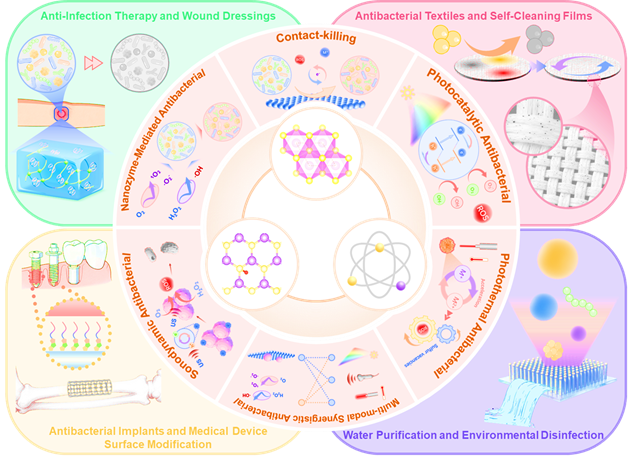
Molybdenum disulfide (MoS2), a prototypical two-dimensional layered material, has recently attracted considerable attention in antibacterial research owing to its unique structure, exceptional photoelectrochemical properties, and abundant surface active sites. In this review, we provide a comprehensive overview of the structural, physicochemical, and nanoscale characteristics of MoS2 and its composites, with an emphasis on their multifaceted antibacterial mechanisms, including direct contact-mediated membrane disruption, photocatalytic generation of reactive oxygen species (ROS), photothermal effects, nanozyme-like catalysis, sonodynamic activity, and multimodal synergistic strategies. By systematically comparing these mechanisms, we highlight advances in applications ranging from infection control and wound dressings to antibacterial fibers, self-cleaning films, implantable medical devices, water purification, and environmental disinfection. The review also addresses biosafety considerations and explores strategies for the development of multifunctional composites, mechanistic studies, sustainable design, technological optimization, and clinical translation. Overall, MoS2-based materials exhibit broad-spectrum, efficient antibacterial activity, recyclability, and environmental compatibility, establishing a foundation for the rational design of next-generation antimicrobial materials.
- Open Access
- Review
Multifunctional Molybdenum Disulfide-Based Composites for Antibacterial Applications: Mechanisms, Biosafety, and Future Perspectives
- Huiyan Xu 1,
- Jian Zhang 2,
- Zhirong Liu 3,
- Lihan Cai 1,
- Aizhu Wang 1,
- Longhua Ding 1,
- Jianfang Li 4,*,
- Yuanwei Sun 5,*,
- Hong Liu 6,
- Xin Yu 1,*
Author Information
Received: 17 Nov 2025 | Revised: 08 Dec 2025 | Accepted: 15 Dec 2025 | Published: 19 Dec 2025
Abstract
Graphical Abstract
Keywords
MoS2 | antibacterial activity | photocatalysis | nanozyme catalysis | multifunctional composites
References
- 1.
Van Boeckel, T.P.; Pires, J.; Silvester, R.; et al. Global trends in antimicrobial resistance in animals in low- and middle-income countries. Science 2019, 365, eaaw1944.
- 2.
Li, B.; Jiang, L.; Johnson, T.; et al. Global health risks lurking in livestock resistome. Sci. Adv. 2025, 11, eadt8073.
- 3.
Antimicrobial resistance: A silent pandemic. Nat. Commun. 2024, 15, 6198.
- 4.
Uberoi, A.; McCready-Vangi, A.; Grice, E.A. The wound microbiota: Microbial mechanisms of impaired wound healing and infection. Nat. Rev. Microbiol. 2024, 22, 507–521.
- 5.
Singh, B.; Bhat, A.; Ravi, K. Antibiotics Misuse and Antimicrobial Resistance Development in Agriculture: A Global Challenge. Environ. Health 2024, 2, 618–622.
- 6.
Miller, W.R.; Arias, C.A.; ESKAPE pathogens: Antimicrobial resistance; epidemiology, clinical impact and therapeutics. Nat. Rev. Microbiol. 2024, 22, 598–616.
- 7.
Chowdhury, T.; Sadler, E.C.; Kempa, T.J. Progress and Prospects in Transition-Metal Dichalcogenide Research beyond 2D. Chem. Rev. 2020, 120, 12563–12591.
- 8.
Choi, W.; Choudhary, N.; Han, G.H.; et al. Recent development of two-dimensional transition metal dichalcogenides and their applications. Mater. Today 2017, 20, 116–130.
- 9.
Gupta, S.; Zhang, J.-J.; Lei, J.; et al. Two-Dimensional Transition Metal Dichalcogenides: A Theory and Simulation Perspective. Chem. Rev. 2025, 125, 786–834.
- 10.
Huang, H.; Feng, W.; Chen, Y.; Two-dimensional biomaterials: Material science, biological effect and biomedical engineering applications. Chem. Soc. Rev. 2021, 50, 11381–11485.
- 11.
Hu, T.; Yang, Y.; Wang, T.; et al. Structural Engineering of Layered Nanomaterials for Biomedical Applications. Chem. Rev. 2025, 125, 8764–8834.
- 12.
Lee, H.P.; Gaharwar, A.K. Light-Responsive Inorganic Biomaterials for Biomedical Applications. Adv. Sci. 2020, 7, 2000863.
- 13.
Han, D.L.; Ma, M.X.; Han, Y.J.; et al. Eco-friendly Hybrids of Carbon Quantum Dots Modified MoS2 for Rapid Microbial Inactivation by Strengthened Photocatalysis. ACS Sustainable Chem. Eng. 2020, 8, 534–542.
- 14.
Afra, F.G.; Hamidinezhad, H.; Mozafari, H. Antibacterial activity of two-dimensional MoS2 Nanostructures: Effects of reaction time and temperature on morphology. Mater. Chem. Phys. 2025, 343, 130945.
- 15.
Pandit, S.; Karunakaran, S.; Boda, S.K.; et al. High Antibacterial Activity of Functionalized Chemically Exfoliated MoS2. ACS Appl. Mater. Interfaces 2016, 8, 31567–31573.
- 16.
Zhang, M.; Wang, K.; Zeng, S.; et al. Visible light-induced antibacterial effect of MoS2: Effect of the synthesis methods. Chem. Eng. J. 2021, 411, 128517.
- 17.
Mutalik, C.; Krisnawati, D.I.; Patil, S.B.; et al. Phase-Dependent MoS2 Nanoflowers for Light-Driven Antibacterial Application. ACS Sustainable Chem. Eng. 2021, 9, 7904–7912.
- 18.
Roy, S.; Mondal, A.; Yadav, V.; et al. Mechanistic Insight into the Antibacterial Activity of Chitosan Exfoliated MoS2 Nanosheets: Membrane Damage, Metabolic Inactivation, and Oxidative Stress. ACS Appl. Bio Mater. 2019, 2, 2738–2755.
- 19.
Shen, J.; Liu, J.; Fan, X.; et al. Unveiling the antibacterial strategies and mechanisms of MoS2: A comprehensive analysis and future directions. Biomater. Sci. 2024, 12, 596–620.
- 20.
Wang, P.; Wang, H.; Zhao, X.; et al. Antibacterial activity and cytotoxicity of novel silkworm-like nisin@PEGylated MoS2. Colloid. Surface. B 2019, 183, 110491.
- 21.
Mutalik, C.; Okoro, G.; Chou, H.L.; et al. Phase-Dependent 1T/2H-MoS2 Nanosheets for Effective Photothermal Killing of Bacteria. ACS Sustain. Chem. Eng. 2022, 10, 8949–8957.
- 22.
Jin, Y.; Zhang, X.; Zhao, X.; et al. Two-Dimensional Biomaterials Applied as Functional Bio-Platforms and Devices: Revolutionizing Biomedical Applications. Small 2025, 21, 2502929.
- 23.
Lv, R.; Robinson, J.A.; Schaak, R.E.; et al. Transition Metal Dichalcogenides and Beyond: Synthesis, Properties, and Applications of Single- and Few-Layer Nanosheets. Acc. Chem. Res. 2015, 48, 56–64.
- 24.
Shang, S.-L.; Lindwall, G.; Wang, Y.; et al. Lateral Versus Vertical Growth of Two-Dimensional Layered Transition-Metal Dichalcogenides: Thermodynamic Insight into MoS2. Nano Lett. 2016, 16, 5742–5750.
- 25.
Yin, X.; Tang, C.S.; Zheng, Y.; et al. Recent developments in 2D transition metal dichalcogenides: Phase transition and applications of the (quasi-)metallic phases. Chem. Soc. Rev. 2021, 50, 10087–10115.
- 26.
Addou, R.; McDonnell, S.; Barrera, D.; et al. Impurities and Electronic Property Variations of Natural MoS2 Crystal Surfaces. ACS Nano 2015, 9, 9124–9133.
- 27.
Yazyev, O.V.; Kis, A. MoS2 and semiconductors in the flatland. Mater. Today 2015, 18, 20–30.
- 28.
Chen, Y.; Huang, S.; Ji, X.; et al. Tuning Electronic Structure of Single Layer MoS2 through Defect and Interface Engineering. ACS Nano 2018, 12, 2569–2579.
- 29.
Xie, J.; Zhang, H.; Li, S.; et al. Defect-Rich MoS2 Ultrathin Nanosheets with Additional Active Edge Sites for Enhanced Electrocatalytic Hydrogen Evolution. Adv. Mater. 2013, 25, 5807–5813.
- 30.
Cai, L.; He, J.F.; Liu, Q.H.; et al. Vacancy-Induced Ferromagnetism of MoS2 Nanosheets. J. Am. Chem. Soc. 2015, 137, 2622–2627.
- 31.
Yu, Y.F.; Nam, G.H.; He, Q.Y.; et al. High phase-purity 1T′-MoS2- and 1T′-MoSe2- layered crystals. Nat. Chem. 2018, 10, 638–643.
- 32.
Toh, R.J.; Sofer, Z.; Luxa, J.; et al. 3R phase of MoS2 and WS2 outperforms the corresponding 2H phase for hydrogen evolution. Chem. Commun. 2017, 53, 3054–3057.
- 33.
Fang, Y.Q.; Pan, J.; He, J.Q.; et al. Structure Re-determination and Superconductivity Observation of Bulk 1T MoS2. Angew. Chem. Int. Edit. 2018, 57, 1232–1235.
- 34.
Lukowski, M.A.; Daniel, A.S.; Meng, F.; et al. Enhanced Hydrogen Evolution Catalysis from Chemically Exfoliated Metallic MoS2 Nanosheets. J. Am. Chem. Soc. 2013, 135, 10274–10277.
- 35.
Zeng, M.; Liu, J.; Zhou, L.; et al. Bandgap tuning of two-dimensional materials by sphere diameter engineering. Nat. Mater. 2020, 19, 528–533.
- 36.
He, Z.; Que, W.; Molybdenum disulfide nanomaterials: Structures; properties, synthesis and recent progress on hydrogen evolution reaction. Appl. Mater. Today 2016, 3, 23–56.
- 37.
Zhu, X.; Li, D.; Zhang, R.; et al. Probing quantum confinement effects on the excitonic property and electronic band structures of MoS2. Appl. Surf. Sci. 2020, 519, 146262.
- 38.
Mak, K.F.; Lee, C.; Hone, J.; et al. Atomically Thin MoS2: A New Direct-Gap Semiconductor. Phys. Rev. Lett. 2010, 105, 136805.
- 39.
Das, S.; Wang, Y.; Dai, Y.; et al. Ultrafast transient sub-bandgap absorption of monolayer MoS2. Light Sci. Appl. 2021, 10, 27.
- 40.
Teja, Y.N.; Sakar, M. Comprehensive Insights into the Family of Atomically Thin 2D-Materials for Diverse Photocatalytic Applications. Small 2023, 19, 2303980.
- 41.
Kim, J.S.; Kim, J.; Zhao, J.; et al. Electrical Transport Properties of Polymorphic MoS2. ACS Nano 2016, 10, 7500–7506.
- 42.
Cheng, Z.; He, S.; Han, X.; et al. Improving electron mobility in MoS2 field-effect transistors by optimizing the interface contact and enhancing the channel conductance through local structural phase transition. J. Mater. Chem. C 2024, 12, 2794–2802.
- 43.
Zhou, Y.; Yang, P.; Zu, H.; et al. Electronic structures and magnetic properties of MoS2 nanostructures: Atomic defects, nanoholes, nanodots and antidots. Phys. Chem. Chem. Phys. 2013, 15, 10385–10394.
- 44.
Shinde, S.M.; Dhakal, K.P.; Chen, X.; et al. Stacking-controllable interlayer coupling and symmetric configuration of multilayered MoS2. NPG Asia Mater. 2018, 10, e468.
- 45.
Kuc, A.; Zibouche, N.; Heine, T. Influence of quantum confinement on the electronic structure of the transition metal sulfide TS2. Phys. Rev. B 2011, 83, 245213.
- 46.
Afanasiev, P.; Lorentz, C. Oxidation of Nanodispersed MoS2 in Ambient Air: The Products and the Mechanistic Steps. J. Phys. Chem. C 2019, 123, 7486–7494.
- 47.
Zhou, H.; Xie, Z.; Liu, Y.; et al. Recent advances in molybdenum disulfide-based advanced oxidation processes. Environ. Funct. Mater. 2022, 1, 1–9.
- 48.
Wang, Z.; Mi, B. Environmental Applications of 2D Molybdenum Disulfide (MoS2) Nanosheets. Environ. Sci. Technol. 2017, 51, 8229–8244.
- 49.
Liu, Y.; Wang, H.; Yuan, X.; et al. Roles of sulfur-edge sites, metal-edge sites, terrace sites, and defects in metal sulfides for photocatalysis. Chem Catal. 2021, 1, 44–68.
- 50.
Li, Z.; Meng, X.; Zhang, Z. Recent development on MoS2-based photocatalysis: A review. J. Photoch. Photobio. C 2018, 35, 39–55.
- 51.
Li, C.; Cao, Q.; Wang, F.; et al. Engineering graphene and TMDs based van der Waals heterostructures for photovoltaic and photoelectrochemical solar energy conversion. Chem. Soc. Rev. 2018, 47, 4981–5037.
- 52.
Roxlo, C.B.; Daage, M.; Ruppert, A.F.; et al. Optical absorption and catalytic activity of molybdenum sulfide edge surfaces. J. Catal. 1986, 100, 176–184.
- 53.
Daage, M.; Chianelli, R.R. Structure-Function Relations in Molybdenum Sulfide Catalysts: The “Rim-Edge” Model. J. Catal. 1994, 149, 414–427.
- 54.
Yang, H.; Fairbridge, C.; Ring, Z. Adsorption of Dibenzothiophene Derivatives over a MoS2 NanoclusterA Density Functional Theory Study of Structure−Reactivity Relations. Energy Fuels 2003, 17, 387–398.
- 55.
Pandit, S.; Karunakaran, S.; Boda, S.K.; et al. High Antibacterial Activity of Functionalized Chemically Exfoliated MoS2. ACS Appl. Mater. Interfaces 2016, 8, 31567–31573.
- 56.
Zhang, Y.; Li, H.; Zhang, X.; et al. Enhanced adsorption and photocatalytic Cr(VI) reduction and sterilization of defective MoS2/PVP. J. Colloid Interf. Sci. 2023, 630, 742–753.
- 57.
Ali, S.R.; De, M.M. Defect-Engineered Functionalized MoS2 Quantum Dots with Enhanced Antibacterial Activity. ACS Appl. Nano Mater. 2023, 6, 2193–2202.
- 58.
Chen, H.H.; Hu, X.; Hou, B.Y.; et al. Cu-Intercalated MoS2 Nanosheets with Enhanced Antibacterial Activity for Treatment of Bacterial Keratitis. Small 2025, 21, 2410643.
- 59.
Tang, M.M.; Ma, R.; Ding, Y.; et al. Tailored regulation of ferroptosis in periodontitis using thermosensitive ionic liquid hydrogel based on galangin/L-cysteine-decorated MoS2 nanoflowers. J. Control. Release 2025, 384, 113928.
- 60.
Cao, Y.M.; Zheng, M.; Li, Y.F.; et al. Smart Textiles Based on MoS2 Hollow Nanospheres for Personal Thermal Management. ACS Appl. Mater. Interfaces 2021, 13, 48988–48996.
- 61.
Wang, J.; Wang, Y.; Ren, W.Y.; et al. “Nano Killers” Activation by permonosulfate enables efficient anaerobic microorganisms disinfection. J. Hazard. Mater. 2022, 440, 129742.
- 62.
Fu, J.N.; Zhu, W.D.; Liu, X.M.; et al. Self-activating anti-infection implant. Nat. Commun. 2021, 12, 6907.
- 63.
Shi, T.L.; Hou, X.; Guo, S.Q.; et al. Nanohole-boosted electron transport between nanomaterials and bacteria as a concept for nano-bio interactions. Nat. Commun. 2021, 12, 493.
- 64.
Karunakaran, S.; Pandit, S.; Basu, B.; et al. Simultaneous Exfoliation and Functionalization of 2H-MoS2 by Thiolated Surfactants: Applications in Enhanced Antibacterial Activity. J. Am. Chem. Soc. 2018, 140, 12634–12644.
- 65.
Wang, L.W.; Tang, X.W.; Yang, Z.W.; et al. Regulation of functional groups enable the metal-free PDINH/GO advisable antibacterial photocatalytic therapy. Chem. Eng. J. 2023, 451, 139007.
- 66.
Zhao, X.; Wang, S.M.; Wang, J.Y.; et al. Construction of a thiophene-based conjugated polymer/TP-PCN S-scheme to enhance visible-light-driven photocatalytic activity: Promotion of wound healing in super-resistant bacterial infections. J. Hazard. Mater. 2025, 488, 137429.
- 67.
Yu, X.; Li, C.C.; Zhang, J.; et al. Recent progress on Sn3O4 nanomaterials for photocatalytic applications. Int. J. Miner. Metall. Mater. 2024, 31, 231–244.
- 68.
Wang, L.W.; Liu, L.; You, Z.; et al. Surface amorphization oxygen vacancy-rich porous Sn3Ox nanosheets for boosted photoelectrocatalytic bacterial inactivation. Rare Met. 2023, 42, 1508–1515.
- 69.
Rao, S.S.; Lu, Z.W.; Xie, J.; et al. Atomic Zn-N4 Site-Regulated Donor-Acceptor Catalyst for Boosting Photocatalytic Bactericidal Activity. Nano Lett. 2024, 24, 15598–15606.
- 70.
Yang, R.Q.; Song, G.X.; Wang, L.W.; et al. Full Solar-Spectrum-Driven Antibacterial Therapy over Hierarchical Sn3O4/PDINH with Enhanced Photocatalytic Activity. Small 2021, 17, 2102744.
- 71.
Wang, L.W.; Zhang, X.; Yu, X.; et al. An All-Organic Semiconductor C3N4/PDINH Heterostructure with Advanced Antibacterial Photocatalytic Therapy Activity. Adv. Mater. 2019, 31, 1901965.
- 72.
Xiao, K.M.; Wang, T.Q.; Sun, M.Z.; et al. Photocatalytic Bacterial Inactivation by a Rape Pollen-MoS2 Biohybrid Catalyst: Synergetic Effects and Inactivation Mechanisms. Environ. Sci. Technol. 2020, 54, 537–549.
- 73.
Liu, C.; Kong, D.S.; Hsu, P.C.; et al. Rapid water disinfection using vertically aligned MoS2 nanofilms and visible light. Nat. Nanotechnol. 2016, 11, 1098–1104.
- 74.
Yang, Z.X.; Chen, C.H.; Li, B.; et al. A core-shell 2D- MoS2@MOF heterostructure for rapid therapy of bacteria-infected wounds by enhanced photocatalysis. Chem. Eng. J. 2023, 451, 139127.
- 75.
Li, Y.N.; Han, Y.J.; Li, H.X.; et al. Modification of a rod-shaped Bi-MOF with MoS2 nanosheets to form a p-n heterojunction for enhanced antimicrobial activity. Appl. Surf. Sci. 2024, 654, 159434.
- 76.
Zhou, P.Y.; Cheng, S.Y.; Li, Q.; et al. Multifunctional MoS2@AuNSs nanoflakes as SERS and photothermal tags for single-cell bacterial detection and in-situ inactivation. Chem. Eng. J. 2023, 471, 144514.
- 77.
Liu, Y.J.; Zhang, H.H.; He, M.Y.; et al. Quaternized chitosan templated MoS2 nanohybrids for photothermal-enhanced synergistic antibacterial therapy. Int. J. Biol. Macromol. 2025, 298, 139525.
- 78.
Lu, Y.P.; Kang, W.Q.; Yu, Y.; et al. Antibacterial and antioxidant bifunctional hydrogel based on hyaluronic acid complex MoS2-dithiothreitol nanozyme for treatment of infected wounds. Regen. Biomater. 2024, 11, rbae025.
- 79.
Li, J.; Li, J.; Chen, Y.L.; et al. Molybdenum Disulfide-Supported Cuprous Oxide Nanocomposite for Near-Infrared-I Light-Responsive Synergistic Antibacterial Therapy. ACS Nano 2024, 18, 16184–16198.
- 80.
Li, H.; Gong, M.H.; Xiao, J.Y.; et al. Photothermally activated multifunctional MoS2 bactericidal nanoplatform for combined chemo/photothermal/photodynamic triple-mode therapy of bacterial and biofilm infections. Chem. Eng. J. 2022, 429, 132600.
- 81.
Yang, Z.W.; Wang, L.W.; Zhang, X.Y.; et al. Nitrogen Vacancy Modulation of Tungsten Nitride Peroxidase-Mimetic Activity for Bacterial Infection Therapy. ACS Nano 2024, 18, 24469–24483.
- 82.
Wang, L.W.; Yang, Z.W.; Song, G.X.; et al. Construction of S-N-C bond for boosting bacteria-killing by synergistic effect of photocatalysis and nanozyme. Appl. Catal. B-Environ. Energy 2023, 325, 122345.
- 83.
Yang, Z.W.; Zhang, X.Y.; Wang, L.W.; et al. Defect-Engineered CoFe Layered Double Hydroxide Quantum Dots: Oxygen Vacancy-Driven Boost in Peroxidase-Mimic Catalysis for Multiplex Biomarker Sensing. ACS Mater. Lett. 2025, 7, 1777–1785.
- 84.
Wang, L.W.; Zhang, X.D.; You, Z.; et al. A Molybdenum Disulfide Nanozyme with Charge-Enhanced Activity for Ultrasound-Mediated Cascade-Catalytic Tumor Ferroptosis. Angew. Chem. Int. Edit. 2023, 62, e202217448.
- 85.
Zhang, J.; Han, D.; Wang, Y.H.; et al. Synergy between nanozymes and natural enzymes on the hybrid MoS2 nanosheets/graphite microfiber for enhanced voltammetric determination of hydrogen peroxide. Microchim. Acta 2020, 187, 321.
- 86.
Ding, L.; Wang, L.; Zhang, J.; et al. Nanozymes regulated by nitrogen element: Mechanism, design, and application. Adv. Powder Mater. 2024, 3, 100191.
- 87.
Cao, F.F.; Zhang, L.; Wang, H.; et al. Defect-Rich Adhesive Nanozymes as Efficient Antibiotics for Enhanced Bacterial Inhibition. Angew. Chem. Int. Edit. 2019, 58, 16236–16242.
- 88.
Wang, L.W.; Gao, F.N.; Wang, A.Z.; et al. Defect-Rich Adhesive Molybdenum Disulfide/rGO Vertical Heterostructures with Enhanced Nanozyme Activity for Smart Bacterial Killing Application. Adv. Mater. 2020, 32, 2005423.
- 89.
Wang, G.T.; Wang, T.; Dang, Y.; et al. Insights into the antibacterial mechanism of MoS2/CoS2 heterostructure nanozymes with double enzyme-like activities for MRSA-infected wound therapy. Chem. Eng. J. 2023, 461, 141959.
- 90.
Zhao, H.A.; Zhong, T.; Huang, W.B.; et al. Designing multi-functional MoS2/rGO piezocatalysts based on bacteria-catalyst topological interactions and electron pump effects for efficient water disinfection. J. Clean. Prod. 2024, 461, 142597.
- 91.
Wang, C.; Sun, W.; Xiang, Y.; et al. Ultrasound-Activated Piezoelectric MoS2Enhances Sonodynamic for Bacterial Killing. Small Sci. 2023, 3, 2300022.
- 92.
Chen, X.X.; Xu, H.W.; Liu, C.; et al. Synthesis and characterization of Vs-B/ MoS2 with double defects for efficient piezocatalytic antibiotic degradation and bacterial disinfection. Chem. Eng. J. 2024, 498, 155591.
- 93.
Chou, T.M.; Chan, S.W.; Lin, Y.J.; et al. A highly efficient Au- MoS2 nanocatalyst for tunable piezocatalytic and photocatalytic water disinfection. Nano Energy 2019, 57, 14–21.
- 94.
Feng, X.B.; Lei, J.; Ma, L.; et al. Ultrasonic Interfacial Engineering of MoS2-Modified Zn Single-Atom Catalysts for Efficient Osteomyelitis Sonodynamic Ion Therapy. Small 2022, 18, 2105775.
- 95.
Zheng, G.Q.; Tang, Z.M.; Peng, F. Ultrasound-activated inorganic nanomaterials to generate ROS for antibacterial applications. Biomater. Sci. 2025, 13, 2628–2641.
- 96.
Cao, F.F.; Ju, E.G.; Zhang, Y.; et al. An Efficient and Benign Antimicrobial Depot Based on Silver-Infused MoS2. ACS Nano 2017, 11, 4651–4659.
- 97.
Tang, Y.A.; Qin, Z.; Zhong, Y.H.; et al. Bioinspired MoS2 Nanosheet-Modified Carbon Fibers for Synergetic Bacterial Elimination and Wound Disinfection. Adv. Healthc. Mater. 2023, 12, 2202270.
- 98.
Liu, W.L.; Ye, J.C.; Wang, Y.L.; et al. Multimodal Antibacterial E-Skin Patch Driven by Oxidative Stress for Real-Time Wound-Status Monitoring and Integrated Treatment of Chronic Wounds. Adv. Funct. Mater. 2025, 35, 2424698.
- 99.
Yin, W.Y.; Yu, J.; Lv, F.T.; et al. Functionalized Nano-MoS2 with Peroxidase Catalytic and Near-Infrared Photothermal Activities for Safe and Synergetic Wound Antibacterial Applications. ACS Nano 2016, 10, 11000–11011.
- 100.
Wang, T.; Zhang, X.; Mei, L.; et al. A two-step gas/liquid strategy for the production of N-doped defect-rich transition metal dichalcogenide nanosheets and their antibacterial applications. Nanoscale 2020, 12, 8415–8424.
- 101.
Sahoo, J.; Sahoo, S.; Subramaniam, Y.; et al. Photo-Controlled Gating of Selective Bacterial Membrane Interaction and Enhanced Antibacterial Activity for Wound Healing. Angew. Chem. Int. Edit. 2024, 63, e202314804.
- 102.
Jin, W.H.; Song, P.; Wu, Y.J.; et al. Biofilm Microenvironment-Mediated MoS2 Nanoplatform with Its Photothermal/Photodynamic Synergistic Antibacterial Molecular Mechanism and Wound Healing Study. ACS Biomater. Sci. Eng. 2022, 8, 4274–4288.
- 103.
Li, Y.; Fu, R.Z.; Duan, Z.G.; et al. Construction of multifunctional hydrogel based on the tannic acid-metal coating decorated MoS2 dual nanozyme for bacteria-infected wound healing. Bioact. Mater. 2022, 9, 461–474.
- 104.
Wang, P.L.; Wu, J.W.; Xiao, X.L.; et al. Engineering Injectable Coassembled Hydrogel by Photothermal Driven Chitosan-Stabilized MoS2 Nanosheets for Infected Wound Healing. ACS Nano 2024, 18, 26961–26974.
- 105.
Qiu, L.B.; Duan, L.; Lin, H.Y.; et al. Multifunctional and Sprayable 2D MoS2/Silk Sericin Bio-Nanocomposite Dressings with Enhanced Photothermal Effect for Infected Wound Healing. Adv. Fiber Mater. 2024, 6, 1074–1091.
- 106.
Jia, X.Y.; He, K.T.; Cai, L.; et al. Coaxially fabricated electrospinning near-infrared light-responsive nanofibrous membranes for combating drug-resistant bacteria. J. Hazard. Mater. 2025, 492, 138106.
- 107.
Pi, S.; Liu, C.; Zhang, J.X.; et al. Durable Rapid Self-Disinfection, Reusable Protective Clothing Based on the Ag-Pd@MoS2 Nanozyme with Enhanced Triple-Mode Synergistic Antibacterial Effect. ACS Appl. Mater. Interfaces 2023, 15, 18032–18044.
- 108.
Huang, X.L.; Liu, Y.; Zhao, Y.C.; et al. Antibiofouling polyethersulfone ultrafiltration membranes functionalized with MoS2 nanosheets and self-cleaning with hydrogen peroxide. J. Environ. Chem. Eng. 2023, 11, 111571.
- 109.
Li, M.; Li, L.Q.; Su, K.; et al. Highly Effective and Noninvasive Near-Infrared Eradication of a Staphylococcus aureus Biofilm on Implants by a Photoresponsive Coating within 20 Min. Adv. Sci. 2019, 6, 1900599.
- 110.
Yuan, Z.; Tao, B.L.; He, Y.; et al. Biocompatible MoS2/PDA-RGD coating on titanium implant with antibacterial property via intrinsic ROS-independent oxidative stress and NIR irradiation. Biomaterials 2019, 217, 119290.
- 111.
Yan, H.L.; Liu, L.Z.; Wang, R.; et al. Binary composite MoS2/TiO2 nanotube arrays as a recyclable and efficient photocatalyst for solar water disinfection. Chem. Eng. J. 2020, 401, 126052.
- 112.
Wu, T.; Liu, B.; Liu, C.; et al. Solar-driven efficient heterogeneous subminute water disinfection nanosystem assembled with fingerprint MoS2. Nat. Water 2023, 1, 462–470.
- 113.
Luo, B.C.; Li, X.Y.; Liu, P.; et al. Self-assembled NIR-responsive MoS2@quaternized chitosan/nanocellulose composite paper for recyclable antibacteria. J. Hazard. Mater. 2022, 434, 128896.
- 114.
Lu, Y.-W.; Wang, C.; Joshi, N.; et al. MoS2 nanoflowers-activated peroxydisulfate oxidation for rapid and efficient water disinfection. Water Cycle 2022, 3, 44–49.
- 115.
Xu, C.Y.; Ou, C.L.; Li, J.Q.; et al. Magnetically Recoverable Multifunctional MoS2 Composite Nanosheets for Water Disinfection and Purification with High Efficiency. ACS Appl. Nano Mater. 2024, 7, 12980–12992.
- 116.
Appel, J.H.; Li, D.O.; Podlevsky, J.D.; et al. Low Cytotoxicity and Genotoxicity of Two-Dimensional MoS2 and WS2. ACS Biomater. Sci. Eng. 2016, 2, 361–367.
- 117.
Zou, W.; Ma, S.; Ma, H.W.; et al. Componential and molecular-weight-dependent effects of natural organic matter on the colloidal behavior, transformation, and toxicity of MoS2 nanoflakes. J. Hazard. Mater. 2023, 459, 132186.
- 118.
Zhang, L.; He, X.; Zhou, Q.X.; et al. Fabrication of 1T-MoS2 nanosheets and the high-efficiency removal of toxic metals in aquatic systems: Performance and mechanisms. Chem. Eng. J. 2020, 386, 123996.
- 119.
Chng, E.L.K.; Sofer, Z.; Pumera, M. MoS2 exhibits stronger toxicity with increased exfoliation. Nanoscale 2014, 6, 14412–14418.
- 120.
Wang, Q.; Li, R.; Zhang, X.; et al. Chlorination treatment actuated structural reconstitution and aggravated toxicity of molybdenum disulfide nanosheets to freshwater algae. J. Hazard. Mater. 2025, 491, 137919.
- 121.
Arefi-Oskoui, S.; Khataee, A.; Ucun, O.K.; et al. Toxicity evaluation of bulk and nanosheet MoS2 catalysts using battery bioassays. Chemosphere 2021, 268, 128822.
- 122.
Chen, W.; Qi, W.; Lu, W.; et al. Direct Assessment of the Toxicity of Molybdenum Disulfide Atomically Thin Film and Microparticles via Cytotoxicity and Patch Testing. Small 2018, 14, 1702600.
- 123.
Cc, S.; Anusri, A.; Levna, C.; et al. MoS2 nanoparticles induce behavioral alteration and oxidative stress mediated cellular toxicity in the social insect Oecophylla smaragdina (Asian weaver ant). J. Hazard. Mater. 2020, 385, 121624.
- 124.
Zou, W.; Chang, Y.; Zhang, X.; et al. MoS2 Nanosheets at Low Doses Induced Cardiotoxicity in Developing Zebrafish via Ferroptosis: Influence of Lateral Size and Surface Modification. Environ. Sci. Technol. 2024, 58, 22539–22552.
- 125.
Sun, K.; White, J.C.; He, E.; et al. Surface Defects Regulate the in Vivo Bioenergetic Response of Earthworm Eisenia fetida Coelomocytes to Molybdenum Disulfide Nanosheets. ACS Nano 2023, 17, 2639–2652.
- 126.
Wu, G.; Huang, Y.; Li, J.; et al. Chronic level of exposures to low-dosed MoS2 nanomaterials exhibits more toxic effects in HaCaT keratinocytes. Ecotoxicol. Environ. Saf. 2022, 242, 113848.
- 127.
Lin, H.; Ji, D.K.; Lucherelli, M.A.; et al. Comparative Effects of Graphene and Molybdenum Disulfide on Human Macrophage Toxicity. Small 2020, 16, 2002194.
- 128.
Liu, S.; Shen, Z.; Wu, B.; et al. Cytotoxicity and Efflux Pump Inhibition Induced by Molybdenum Disulfide and Boron Nitride Nanomaterials with Sheetlike Structure. Environ. Sci. Technol. 2017, 51, 10834–10842.
- 129.
Hao, J.; Song, G.; Liu, T.; et al. In Vivo Long-Term Biodistribution, Excretion, and Toxicology of PEGylated Transition-Metal Dichalcogenides MS2 (M = Mo, W, Ti) Nanosheets. Adv. Sci. 2017, 4, 1600160.

This work is licensed under a Creative Commons Attribution 4.0 International License.

 Suite 4002 Level 4, 447 Collins Street, Melbourne, Victoria 3000, Australia
 General Inquiries: info@sciltp.com