
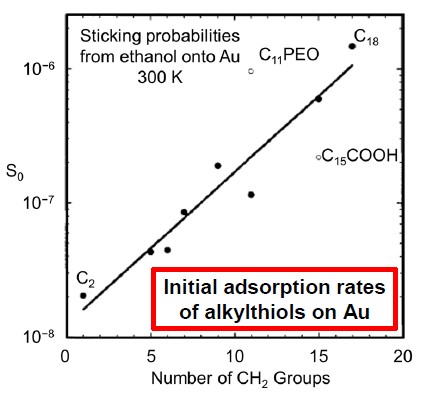
The recent surge in basic research studying liquid-phase surface reactions for catalytic biomass conversions and electrocatalytic reactions for energy storage and utilization highlights the importance of characterizing adsorbates at the liquid / solid interface and their surface chemical reactions. The design of new, more active, and selective catalysts for these reactions is vital. Typical catalytic reactions include multiple elementary steps involving many surface-bound intermediates and transition states. The energetics of these intermediates and transition states are crucial, as they determine the rate and selectivity of the catalysts. These energies are also essential to build accurate microkinetic models that predict activity and selectivity under different conditions and the few rate-controlling species whose energies can be tuned to make a better catalyst. Therefore, the ability to identify the adsorbed intermediates in catalytic reaction mechanisms and to predict the energies of these surface intermediates and their transition states for formation and further reaction are of critical importance. This is true for reactions at solid surfaces both in the gas phase and in liquids. We review here methods for studying adsorbates on solid surfaces in the liquid phase, their coverages, the rates of their formation and further surface reactions, the internal energies of these adsorbates, the activation free energies for their formation, and methods for estimating the effects of solvent choice and of interfacial electric fields on these adsorbate internal energies.
- Open Access
- Review
Methods for Characterizing Adsorption on Solid Surfaces in Liquids
Author Information
Received: 13 May 2026 | Revised: 25 Jun 2026 | Accepted: 25 Jun 2026 | Published: 30 Jun 2026
Abstract
Graphical Abstract
Keywords
adsorption at liquid/solid interfaces | solvent effects | adsorption kinetics | adsorbate energies | heterogeneous catalysis | electrocatalysis
References
- 1.
Ertl, G. Reactions at Surfaces: From Atoms to Complexity (Nobel Lecture). Angew. Chemie. Int. Ed. 2008, 47, 2–14.
- 2.
Dumesic, J.A.; Huber, G.W.; et al. Microkinetics. In Handbook of Heterogeneous Catalysis, 2nd ed.; Ertl, G., Knözinger, H.; Schüth, F., et al, Eds.; Wiley-VCH Gmbh: Weinheim, Germany, 2008; pp. 1445–1462.
- 3.
Campbell, C.T. The Degree of Rate Control: A Powerful Tool for Catalysis Research. ACS Catal. 2017, 7, 2770–2779.
- 4.
Norskov, J.K.; Bligaard, T.; Rossmeisl, J.; et al. Towards the computational design of solid catalysts. Nat. Chem. 2009, 1, 37–46.
- 5.
Nørskov, J.K.; Abild-Pedersen, F.; Studt, F.; et al. Density functional theory in surface chemistry and catalysis. Proc. Natl. Acad. Sci. USA 2011, 108, 937–943.
- 6.
Zaera, F. Probing Liquid/Solid Interfaces at the Molecular Level. Chem. Rev. 2012, 112, 2920–2986.
- 7.
Auer, A.; Eder, B.; Giessibl, F.J. Electrochemical AFM/STM with a qPlus sensor: A versatile tool to study solid-liquid interfaces. J. Chem. Phys. 2023, 159, 174201.
- 8.
Pastor, E.; Lian, Z.; Xia, L.; et al. Complementary probes for the electrochemical interface. Nat. Rev. Chem. 2024, 8, 159–178.
- 9.
Johannsmann, D.; Reviakine, I. Quartz crystal microbalance with dissipation monitoring for studying soft matter at interfaces. Nat. Rev. Methods Primers 2024, 4, 63.
- 10.
Brummel, O.; Lykhach, Y.; Ralaiarisoa, M.; et al. A Versatile Approach to Electrochemical In Situ Ambient-Pressure X-ray Photoelectron Spectroscopy: Application to a Complex Model Catalyst. J. Phys. Chem. Lett. 2022, 13, 11015–11022.
- 11.
Starr, D.E.; Favaro, M.; Abdi, F.F.; et al. Combined soft and hard X-ray ambient pressure photoelectron spectroscopy studies of semiconductor/electrolyte interfaces. J. Electron Spectrosc. Relat. Phenom. 2017, 221, 106–115.
- 12.
Stoerzinger, K.A.; Hong, W.T.; Crumlin, E.J.; et al. Insights into Electrochemical Reactions from Ambient Pressure Photoelectron Spectroscopy. Acc. Chem. Res. 2015, 48, 2976–2983.
- 13.
Yang, Y.; Feijóo, J.; Briega-Martos, V.; et al. Operando methods: A new era of electrochemistry. Curr. Opin. Electrochem. 2023, 42, 101403.
- 14.
Zang, Y.J.; Shi, S.C.; Liu, J.; et al. Direct Probing the Electrical Double Layer at Graphite/Nafion Interface via Depth Profiling APXPS. J. Am. Chem. Soc. 2025, 147, 33366–33371.
- 15.
Gileadi, E.; Rubin, B.R.; Bockris, J.O.M. Electrosorption of Ethylene on Platinum as a Function of Potential Concentration and Temperature. J. Phys. Chem. 1965, 69, 3335–3345.
- 16.
Gileadi, E. Electrosorption of Uncharged Molecules on Solid Electrodes. J. Electroanal. Chem. 1966, 11, 137–151.
- 17.
Gileadi, E.; Duic, L.; Bockris, J.O. A Comparison of Radiotracer and Electrochemical Methods for Measurement of Electrosorption of Organic Molecules. Electrochim. Acta 1968, 13, 1915–1935.
- 18.
Heiland, W.; Gileadi, E.; Bockris, J.O. Kineitc and Thermodynamic Aspects of Electrosorption of Benzene on Platinim Electrodes. J. Phys. Chem. 1966, 70, 1207–1216.
- 19.
Corrigan, D.S.; Krauskopf, E.K.; Rice, L.M.; et al. Adsorption of Acetic-Acid at Platinum and Gold Electrodes—A Combined Infrared Spectroscopic And Radiotracer Study. J. Phys. Chem. 1988, 92, 1596–1601.
- 20.
Chia, V.K.F.; Soriaga, M.P.; Hubbard, A.T. The Adsorption, Orientation and Electrochemical Oxidation of Hydroquinone At Smooth Platinum-Electrodes—The Effect Of Electrode Potential. J. Electroanal. Chem. 1984, 167, 97–106.
- 21.
Soriaga, M.P.; White, J.H.; Hubbard, A.T. Orientation of Aromatic-Compounds Adsorbed on Platinum-Electrodes—The Effect of Temperature. J. Phys. Chem. 1983, 87, 3048–3054.
- 22.
Soriaga, M.P.; Hubbard, A.T. Determination of The Orientation of Adsorbed Molecules at Solid-Liquid Interfaces by Thin-Layer Electrochemistry—Aromatic-Compounds at Platinum-Electrodes. J. Am. Chem. Soc. 1982, 104, 2735–2742.
- 23.
Jung, L.S.; Campbell, C.T.; Chinowsky, T.M.; et al. Quantitative Interpretation of the Response of Surface Plasmon Resonance Sensors to Adsorbed Films. Langmuir 1998, 14, 5636–5648.
- 24.
Jung, L.S.; Campbell, C.T. Sticking probabilities in adsorption from liquid solutions: Alkylthiols on gold. Phys. Rev. Lett. 2000, 84, 5164–5167.
- 25.
Jung, L.S.; Campbell, C.T. Sticking probabilities in adsorption of alkanethiols from liquid ethanol solution onto gold. J. Phys. Chem. B 2000, 104, 11168–11178.
- 26.
Jung, L.S.; Nelson, K.E.; Stayton, P.S.; et al. Binding and dissociation kinetics of wild-type and mutant streptavidins on mixed biotin-containing alkylthiolate monolayers. Langmuir 2000, 16, 9421–9432.
- 27.
Shumaker-Parry, J.S.; Campbell, C.T. Quantitative methods for spatially resolved adsorption/desorption measurements in real time by surface plasmon resonance microscopy. Anal. Chem. 2004, 76, 907–917.
- 28.
Campbell, C.T.; Kim, G. SPR microscopy and its applications to high-throughput analyses of biomolecular binding events and their kinetics. Biomaterials 2007, 28, 2380–2392.
- 29.
Hartung, T.; Baltruschat, H. Differential Electrochemical Mass-Spectrometry Using Smooth Electrodes—Adsorption And H/D-Exchange Reactions of Benzene on pt. Langmuir 1990, 6, 953–957.
- 30.
Baltruschat, H. Differential electrochemical mass spectrometry. J. Am. Soc. Mass Spectrom. 2004, 15, 1693–1706.
- 31.
Bakshi, H.B.; Lucky, C.; Chen, H.S.; et al. Electrocatalytic Scission of Unactivated C(sp3)-C(sp3) Bonds through Real-Time Manipulation of Surface-Bound Intermediates. J. Am. Chem. Soc. 2023, 145, 13742–13749.
- 32.
Lucky, C.; Fuller, L.; Schreier, M. Determining the potential-dependent identity of methane adsorbates at Pt electrodes using EC-MS. Catal. Sci. Technol. 2024, 14, 353–361.
- 33.
Huang, J.H.; Scott, S.B.; Chorkendorff, I.; et al. Online Electrochemistry-Mass Spectrometry Evaluation of the Acidic Oxygen Evolution Reaction at Supported Catalysts. Acs Catal. 2021, 11, 12745–12753.
- 34.
Krempl, K.; Hochfilzer, D.; Scott, S.B.; et al. Dynamic Interfacial Reaction Rates from Electrochemistry-Mass Spectrometry. Anal. Chem. 2021, 93, 7022–7028.
- 35.
Trimarco, D.B.; Scott, S.B.; Thilsted, A.H.; et al. Enabling real-time detection of electrochemical desorption phenomena with sub-monolayer sensitivity. Electrochim. Acta 2018, 268, 520–530.
- 36.
Winiwarter, A.; Boyd, M.J.; Scott, S.B.; et al. CO as a Probe Molecule to Study Surface Adsorbates during Electrochemical Oxidation of Propene. Chemelectrochem 2021, 8, 250–256.
- 37.
Bhadouria, A.; Heil, J.N.; Parab, D.E.; et al. Propane Activation on Pt Electrodes at Room Temperature: Quantification of Adsorbate Identity and Coverage. Angew. Chem. Int. Ed. 2025, 64, e202421613.
- 38.
McCrum, I.T.; Janik, M.J. Deconvoluting Cyclic Voltammograms To Accurately Calculate Pt Electrochemically Active Surface Area. J. Phys. Chem. C 2017, 121, 6237–6245.
- 39.
Singh, N.; Sanyal, U.; Fulton, J.L.; et al. Quantifying adsorption of organic molecules on platinum in aqueous phase by hydrogen site blocking and in situ X-ray absorption spectroscopy. ACS Catal. 2019, 9, 6869–6881.
- 40.
Akinola, J.; Barth, I.; Goldsmith, B.R.; et al. Adsorption Energies of Oxygenated Aromatics and Organics on Rhodium and Platinum in Aqueous Phase. ACS Catal. 2020, 10, 4929–4941.
- 41.
Koga, O.; Watanabe, Y.; Tanizaki, M.; et al. Specific adsorption of anions on a copper (100) single crystal electrode studied by charge displacement by CO adsorption and infrared spectroscopy. Electrochim. Acta 2001, 46, 3083–3090.
- 42.
Bain, C.D.; Troughton, E.B.; Tao, Y.T.; et al. Formation of Monolayer Films by The Spontaneous Assembly of Organic Thiols From Solution Onto Gold. J. Am. Chem. Soc. 1989, 111, 321–335.
- 43.
Ravi, V.; Binz, J.M.; Rioux, R.M. Thermodynamic Profiles at the Solvated Inorganic-Organic Interface: The Case of Gold-Thiolate Monolayers. Nano Lett. 2013, 13, 4442–4448.
- 44.
Campbell, C.T.; Sellers, J.R.V. The Entropies of Adsorbed Molecules. J. Am. Chem. Soc. 2012, 134, 18109–18115.
- 45.
Campbell, C.T.; Sprowl, L.H.; Arnadottir, L. Equilibrium Constants and Rate Constants for Adsorbates: Two-Dimensional (2D) Ideal Gas, 2D Ideal Lattice Gas, and Ideal Hindered Translator Models. J. Phys. Chem. C 2016, 120, 10283–10297.
- 46.
Singh, N.; Campbell, C.T. A Simple Bond-Additivity Model Explains Large Decreases in Heats of Adsorption in Solvents Versus Gas Phase: A Case Study with Phenol on Pt(111) in Water. ACS Catal. 2019, 9, 8116–8127.
- 47.
Goobes, R.; Goobes, G.; Shaw, W.J.; et al. Thermodynamic roles of basic amino acids in statherin recognition of hydroxyapatite. Biochemistry 2007, 46, 4725–4733.
- 48.
Crowe, M.C.; Campbell, C.T. Adsorption Microcalorimetry: Recent Advances in Instrumentation and Application. Annu. Rev. Anal. Chem. 2011, 4, 41–58.
- 49.
Song, Y.; Sanyal, U.; Pangotra, D.; et al. Hydrogenation of benzaldehyde via electrocatalysis and thermal catalysis on carbon-supported metals. J. Catal. 2018, 359, 68–75.
- 50.
Broomhead, W.T.; Flaherty, D.W. Microcalorimetric quantification of hydrogen adsorption thermodynamics in water-solvated systems on Pt/C. Faraday Discuss. 2026. https://doi.org/10.1039/D5FD00170F Available online: https://pubs.rsc.org/en/content/articlelanding/2026/fd/d5fd00170f/unauth (accessed on 30 May 2026).
- 51.
Schuster, R. Electrochemical microcalorimetry at single electrodes. Curr. Opin. Electrochem. 2017, 1, 88–94.
- 52.
Etzel, K.D.; Bickel, K.R.; Schuster, R. Heat Effects upon Electrochemical Copper Deposition on Polycrystalline Gold. Chemphyschem 2010, 11, 1416–1424.
- 53.
Bickel, K.R.; Etzel, K.D.; Halka, V.; et al. Microcalorimetric determination of heat changes caused by overpotential upon electrochemical Ag bulk deposition. Electrochim. Acta 2013, 112, 801–812.
- 54.
Gottfried, J.M.; Schuster, R. Surface Microcalorimetry. In Surface and Interface Science; Wandelt, K., Ed.; Wiley-VCH: Weinheim, Germany, 2014.
- 55.
Frittmann, S.; Halka, V.; Schuster, R. Identification of Non-Faradaic Processes by Measurement of the Electrochemical Peltier Heat during the Silver Underpotential Deposition on Au(111). Angew. Chem. Int. Ed. 2016, 55, 4688–4691.
- 56.
Schönig, M.; Frittmann, S.; Schuster, R. Identification of Electrochemically Adsorbed Species via Electrochemical Microcalorimetry: Sulfate Adsorption on Au(111). Chemphyschem 2022, 23, e202200227.
- 57.
Walker, T.W.; Chew, A.K.; Li, H.X.; et al. Universal kinetic solvent effects in acid-catalyzed reactions of biomass-derived oxygenates. Energy Environ. Sci. 2018, 11, 617–628.
- 58.
Mellmer, M.A.; Sener, C.; Gallo, J.M.R.; et al. Solvent Effects in Acid-Catalyzed Biomass Conversion Reactions. Angew. Chem. Int. Ed. 2014, 53, 11872–11875.
- 59.
Mellmer, M.A.; Sanpitakseree, C.; Demir, B.; et al. Solvent-enabled control of reactivity for liquid-phase reactions of biomass-derived compounds. Nat. Catal. 2018, 1, 199–207.
- 60.
Gonzo, E.E.; Boudart, M. Catalytic-Hydrogenation of Cyclohexene: 3. Gas-Phase and Liquid-Phase Reaction On Supported Palladium. J. Catal. 1978, 52, 462–471.
- 61.
Madon, R.J.; Oconnell, J.P.; Boudart, M. Catalytic-Hydrogenation of Cyclohexene: 2. Liquid-Phase Reaction on Supported Platinum in A Gradientless Slurry Reactor. Aiche J. 1978, 24, 904–911.
- 62.
Segal, E.; Madon, R.J.; Boudart, M. Catalytic-Hydrogenation of Cyclohexene: 1. Vapor-Phase Reaction on Supported Platinum. J. Catal. 1978, 52, 45–49.
- 63.
Chen, F.; Shetty, M.; Wang, M.; et al. Differences in Mechanism and Rate of Zeolite-Catalyzed Cyclohexanol Dehydration in Apolar and Aqueous Phase. ACS Catal. 2021, 11, 2879–2888.
- 64.
He, J.Y.; Liu, M.J.; Huang, K.F.; et al. Production of levoglucosenone and 5-hydroxymethylfurfural from cellulose in polar aprotic solvent-water mixtures. Green Chem. 2017, 19, 3642–3653.
- 65.
Qi, L.; Alamillo, R.; Elliott, W.A.; et al. Operando Solid-State NMR Observation of Solvent-Mediated Adsorption-Reaction of Carbohydrates in Zeolites. ACS Catal. 2017, 7, 3489c3500.
- 66.
Iyemperumal, S.K.; Deskins, N.A. Evaluating Solvent Effects at the Aqueous/Pt(111) Interface. Chemphyschem 2017, 18, 2171–2190.
- 67.
Singh, N.; Sanyal, U.; Ruehl, G.; et al. Aqueous phase catalytic and electrocatalytic hydrogenation of phenol and benzaldehyde over platinum group metals. J. Catal. 2020, 382, 372–384.
- 68.
Xie, T.J.; Bodenschatz, C.J.; Getman, R.B. Insights into the roles of water on the aqueous phase reforming of glycerol. React. Chem. Eng. 2019, 4, 383–392.
- 69.
Cortright, R.D.; Dumesic, J.A. Kinetics of heterogeneous catalytic reactions: Analysis of reaction schemes. Adv. Catal. 2001, 46, 161–264.
- 70.
Dumesic, J.A. Analyses of Reaction Schemes Using De Donder relations. J. Catal. 1999, 185, 496.
- 71.
Gokhale, A.A.; Dumesic, J.A.; Mavrikakis, M. On the mechanism of low-temperature water gas shift reaction on copper. J. Am. Chem. Soc. 2008, 130, 1402–1414.
- 72.
Grabow, L.C.; Gokhale, A.A.; Evans, S.T.; et al. Mechanism of the water gas shift reaction on Pt: First principles, experiments, and microkinetic modeling. J. Phys. Chem. C 2008, 112, 4608–4617.
- 73.
Kandoi, S.; Greeley, J.; Sanchez-Castillo, M.A.; et al. Prediction of experimental methanol decomposition rates on platinum from first principles. Top. Catal. 2006, 37, 17–28.
- 74.
Motagamwala, A.H.; Dumesic, J.A. Analysis of reaction schemes using maximum rates of constituent steps. Proc. Natl. Acad. Sci. USA 2016, 113, E2879–E2888.
- 75.
Grabow, L.C.; Mavrikakis, M. Mechanism of Methanol Synthesis on Cu through CO2 and CO Hydrogenation. ACS Catal. 2011, 1, 365–384.
- 76.
Motagamwala, A.H.; Dumesic, J.A. Chemical kinetics for generalized two-step reaction schemes. J. Catal. 2021, 404, 850–863.
- 77.
Norskov, J.K.; Bligaard, T.; Logadottir, A.; et al. Universality in heterogeneous catalysis. J. Catal. 2002, 209, 275–278.
- 78.
Ovesen, C.V.; Stoltze, P.; Norskov, J.K.; et al. A Kinetic Model of the Water-Gas Shift Reaction. J. Catal. 1992, 134, 445–468.
- 79.
Ovesen, C.V.; Clausen, B.S.; Hammershoi, B.S.; et al. Microkinetic analysis of the water-gas shift reaction under industrial conditions. J. Catal. 1996, 158, 170–180.
- 80.
Medford, A.J.; Vojvodic, A.; Hummelshoj, J.S.; et al. From the Sabatier principle to a predictive theory of transition-metal heterogeneous catalysis. J. Catal. 2015, 328, 36–42.
- 81.
Moses, P.G.; Grabow, L.C.; Fernandez, E.M.; Hinnemann, B.; Topsoe, H.; Knudsen, K.G.; Norskov, J.K. Trends in Hydrodesulfurization Catalysis Based on Realistic Surface Models. Catal. Lett. 2014, 144, 1425–1432.
- 82.
Vojvodic, A.; Norskov, J.K. New design paradigm for heterogeneous catalysts. Natl. Sci. Rev. 2015, 2, 140–143.
- 83.
Mhadeshwar, A.B.; Vlachos, D.G. Microkinetic modeling for water-promoted CO oxidation, water-gas shift, and preferential oxidation of CO on pt. J. Phys. Chem. B 2004, 108, 15246–15258.
- 84.
Meskine, H.; Matera, S.; Scheffler, M.; et al. Examination of the concept of degree of rate control by first-principles kinetic Monte Carlo simulations. Surf. Sci. 2009, 603, 1724–1730.
- 85.
Reuter, K.; Frenkel, D.; Scheffler, M. The steady state of heterogeneous catalysis, studied by first-principles statistical mechanics. Phys. Rev. Lett. 2004, 93, 116105.
- 86.
Linic, S.; Barteau, M.A. Construction of a reaction coordinate and a microkinetic model for ethylene epoxidation on silver from DFT calculations and surface science experiments. J. Catal. 2003, 214, 200–212.
- 87.
Campbell, C.T.; Mao, Z.T. Analysis and prediction of reaction kinetics using the degree of rate control. J. Catal. 2021, 404, 647–660.
- 88.
Mao, Z.T.; Campbell, C.T. Kinetic Isotope Effects: Interpretation and Prediction Using Degrees of Rate Control. ACS Catal. 2020, 10, 4181–4192.
- 89.
Dix, S.T.; Scott, J.K.; Getman, R.B.; et al. Using degrees of rate control to improve selective n-butane oxidation over model MOF-encapsulated catalysts: Sterically-constrained Ag3Pd(111). Faraday Discuss. 2016, 188, 21–38.
- 90.
Wolcott, C.A.; Medford, A.J.; Studt, F.; et al. Degree of Rate Control Approach to Computational Catalyst Screening. J. Catal. 2015, 330, 197–207.
- 91.
Stegelmann, C.; Schiødt, N.C.; Campbell, C.T.; et al. Microkinetic modeling of ethylene oxidation over silver. J. Catal. 2004, 221, 630–649.
- 92.
Campbell, C.T. Micro- and Macro-Kinetics: Their Relationship in Heterogeneous Catalysis. Top. Catal. 1994, 1, 353–366.
- 93.
Bockris, J.O.M.; Jeng, K.T. In-situ studies of adsorption of organic compounds on platinum electrodes. J. Electroanal. Chem. 1992, 330, 541–581.
- 94.
Kristoffersen, H.H.; Shea, J.-E.; Metiu, H. Catechol and HCl Adsorption on TiO2(110) in Vacuum and at the Water–TiO2 Interface. J. Phys. Chem. Lett. 2015, 6, 2277–2281.
- 95.
Song, W.; Martsinovich, N.; Heckl, W.M.; et al. Born-haber cycle for monolayer self-assembly at the liquid-solid interface: Assessing the enthalpic driving force. J. Am. Chem. Soc. 2013, 135, 14854–14862.
- 96.
Yoon, Y.; Rousseau, R.; Weber, R.S.; et al. First-Principles Study of Phenol Hydrogenation on Pt and Ni Catalysts in Aqueous Phase. J. Am. Chem. Soc. 2014, 136, 10287–10298.
- 97.
Akinola, J.; Campbell, C.T.; Singh, N. Effects of Solvents on Adsorption Energies: A General Bond-Additivity Model. J. Phys. Chem. C 2021, 125, 24371–24380.
- 98.
Akinola, J.; Singh, N. Temperature dependence of aqueous-phase phenol adsorption on Pt and Rh. J. Appl. Electrochem. 2021, 51, 37–50.
- 99.
Magnussen, O.M.; Gross, A. Toward an Atomic-Scale Understanding of Electrochemical Interface Structure and Dynamics. J. Am. Chem. Soc. 2019, 141, 4777–4790.
- 100.
Singh, N.; Lee, M.S.; Akhade, S.A.; et al. Impact of pH on Aqueous-Phase Phenol Hydrogenation Catalyzed by Carbon-Supported Pt and Rh. ACS Catal. 2019, 9, 1120–1128.
- 101.
Saleheen, M.; Heyden, A. Liquid-Phase Modeling in Heterogeneous Catalysis. ACS Catal. 2018, 8, 2188–2194.
- 102.
Zhang, X.H.; Sewell, T.E.; Glatz, B.; et al. On the water structure at hydrophobic interfaces and the roles of water on transition-metal catalyzed reactions: A short review. Catal. Today 2017, 285, 57–64.
- 103.
Zhang, X.H.; DeFever, R.S.; Sarupria, S.; et al. Free Energies of Catalytic Species Adsorbed to Pt(111) Surfaces under Liquid Solvent Calculated Using Classical and Quantum Approaches. J. Chem. Inf. Model. 2019, 59, 2190–2198.
- 104.
Granda-Marulanda, L.P.; Builes, S.; Koper, M.T.M.; et al. Influence of Van der Waals Interactions on the Solvation Energies of Adsorbates at Pt-Based Electrocatalysts. Chemphyschem 2019, 20, 2968–2972. https://doi.org/10.1002/cphc.201900512.
- 105.
Gray, C.M.; Saravanan, K.; Wang, G.F.; et al. Quantifying solvation energies at solid/liquid interfaces using continuum solvation methods. Mol. Simul. 2017, 43, 420–427.
- 106.
Clabaut, P.; Schweitzer, B.; Götz, A.W.; et al. Solvation Free Energies and Adsorption Energies at the Metal/Water Interface from Hybrid Quantum-Mechanical/Molecular Mechanics Simulations. J. Chem. Theory Comput. 2020, 16, 6539–6549.
- 107.
Gu, G.H.; Schweitzer, B.; Michel, C.; et al. Group Additivity for Aqueous Phase Thermochemical Properties of Alcohols on Pt(111). J. Phys. Chem. C 2017, 121, 21510–21519.
- 108.
Klamt, A.; Schuurmann, G. Cosmo–A New Approach to Dielectric Screening in Solvents with Explicit Expressions for The Screening Energy and Its Gradient. J. Chem. Soc. Perkin Trans. 1993, 2, 799–805.
- 109.
Schweitzer, B.; Steinmann, S.N.; Michel, C. Can microsolvation effects be estimated from vacuum computations? A case-study of alcohol decomposition at the H2O/Pt(111) interface. Phys. Chem. Chem. Phys. 2019, 21, 5368–5377.
- 110.
Yuk, S.F.; Lee, M.S.; Akhade, S.A.; et al. First-principle investigation on catalytic hydrogenation of benzaldehyde over Pt-group metals. Catal. Today 2022, 388, 208–215.
- 111.
Zhang, X.H.; Savara, A.; Getman, R.B. A Method for Obtaining Liquid-Solid Adsorption Rates from Molecular Dynamics Simulations: Applied to Methanol on Pt(111) in H2O. J. Chem. Theory Comput. 2020, 16, 2680–2691.
- 112.
Zare, M.; Solomon, R.V.; Yang, W.Q.; et al. Theoretical Investigation of Solvent Effects on the Hydrodeoxygenation of Propionic Acid over a Ni(111) Catalyst Model. J. Phys. Chem. C 2020, 124, 16488–16500.
- 113.
Fiorentin, M.R.; Bianchi, M.G.; Christiansen, M.A.H.; et al. Methodological Frameworks for Computational Electrocatalysis: From Theory to Practice. Small Methods 2026, 10, e01542.
- 114.
Chukwu, K.C.; Arnadóttir, L. Effects of co-adsorbed water on different bond cleavages involved in acetic acid decomposition on Pt(111). Surf. Sci. 2025, 756, 122721.
- 115.
Hanselman, S.; Koper, M.T.M.; Calle-Vallejo, F. Using micro-solvation and generalized coordination numbers to estimate the solvation energies of adsorbed hydroxyl on metal nanoparticles. Phys. Chem. Chem. Phys. 2023, 25, 3211–3219.
- 116.
Heenen, H.H.; Gauthier, J.A.; Kristoffersen, H.H.; et al. Solvation at metal/water interfaces: An ab initio molecular dynamics benchmark of common computational approaches. J. Chem. Phys. 2020, 152, 144703.
- 117.
Baricuatro, J.H.; Kwon, S.; Kim, Y.G.; et al. Operando Electrochemical Spectroscopy for CO on Cu(100) at pH 1 to 13: Validation of Grand Canonical Potential Predictions. ACS Catal. 2021, 11, 3173–3181.
- 118.
Hussain, J.; Jónsson, H.; Skúlason, E. Calculations of Product Selectivity in Electrochemical CO2 Reduction. Acs Catal. 2018, 8, 5240–5249.
- 119.
Skúlason, E.; Bligaard, T.; Gudmundsdóttir, S.; et al. A theoretical evaluation of possible transition metal electro-catalysts for N2 reduction. Phys. Chem. Chem. Phys. 2012, 14, 1235–1245.
- 120.
Barth, I.; Akinola, J.; Lee, J.; et al. Explaining the structure sensitivity of Pt and Rh for aqueous-phase hydrogenation of phenol. J. Chem. Phys. 2022, 156, 104703.
- 121.
Baghdady, E.A.; Medlin, J.W.; Schwartz, D.K. Tuning formate surface coverage with cosolvents for liquid-phase catalytic transfer hydrogenation. Catal. Sci. Technol. 2025, 15, 3354–3362.
- 122.
Rumptz, J.R.; Campbell, C.T. Adhesion Energies of Solvent Films to Pt(111) and Ni(111) Surfaces by Adsorption Calorimetry. ACS Catal. 2019, 9, 11819–11825.
- 123.
Rumptz, J.R.; Campbell, C.T. Adhesion Energies of Liquid Hydrocarbon Solvents onto Pt(111), MgO(100), Graphene, and TiO2(110) from Temperature-Programmed Desorption Energies. J. Phys. Chem. C 2021, 125, 27931–27937.
- 124.
Mallat, T.; Baiker, A. Catalyst potential measurement: A valuable tool for understanding and controlling liquid phase redox reactions. Top. Catal. 1999, 8, 115–124.
- 125.
Adams, J.S.; Kromer, M.L.; Rodríguez-López, J.; Flaherty, D.W. Unifying Concepts in Electro- and Thermocatalysis toward Hydrogen Peroxide Production. J. Am. Chem. Soc. 2021, 143, 7940–7957.
- 126.
Ryu, J.; Bregante, D.T.; Howland, W.C.; et al. Thermochemical aerobic oxidation catalysis in water can be analysed as two coupled electrochemical half-reactions. Nat. Catal. 2021, 4, 742–752.
- 127.
Wesley, T.S.; Román-Leshkov, Y.; Surendranath, Y. Spontaneous Electric Fields Play a Key Role in Thermochemical Catalysis at Metal-Liquid Interfaces. ACS Cent. Sci. 2021, 7, 1045–1055.
- 128.
Howland, W.C.; Gerken, J.B.; Stahl, S.S.; et al. Thermal Hydroquinone Oxidation on Co/N-doped Carbon Proceeds by a Band-Mediated Electrochemical Mechanism. J. Am. Chem. Soc. 2022, 144, 11253–11262.
- 129.
Fortunato, G.V.; Pizzutilo, E.; Katsounaros, I.; et al. Analysing the relationship between the fields of thermo- and electrocatalysis taking hydrogen peroxide as a case study. Nat. Commun. 2022, 13, 1973.
- 130.
Lodaya, K.M.; Tang, B.Y.; Bisbey, R.P.; et al. An electrochemical approach for designing thermochemical bimetallic nitrate hydrogenation catalysts. Nat. Catal. 2024, 7, 262–272.
- 131.
Westendorff, K.S.; Hülsey, M.J.; Wesley, T.S.; et al. Electrically driven proton transfer promotes Brønsted acid catalysis by orders of magnitude. Science 2024, 383, 757–763.
- 132.
Razdan, N.K.; Westendorff, K.S.; Surendranath, Y. Wireless potentiometry of thermochemical heterogeneous catalysis. Nat. Catal. 2025, 8, 315–327.
- 133.
Harraz, D.M.; Lodaya, K.M.; Tang, B.Y.; et al. Homogeneous-heterogeneous bifunctionality in Pd-catalyzed vinyl acetate synthesis. Science 2025, 388, eads7913.
- 134.
Campbell, C.T. Effects of Electric Fields on the Energies of Adsorbates on Metal Surfaces in Vacuum and in Liquids. ACS Catal. 2026, 16, 5294–5308.
- 135.
Sheng, W.C.; Zhuang, Z.B.; Gao, M.R.; et al. Correlating hydrogen oxidation and evolution activity on platinum at different pH with measured hydrogen binding energy. Nat. Commun. 2015, 6, 5848.
- 136.
McGregor, J.M.; Bender, J.T.; Petersen, A.S.; et al. Organic electrolyte cations promote non-aqueous CO2 reduction by mediating interfacial electric fields. Nat. Catal. 2025, 8, 79–91.

This work is licensed under a Creative Commons Attribution 4.0 International License.

 Suite 4002 Level 4, 447 Collins Street, Melbourne, Victoria 3000, Australia
 General Inquiries: info@sciltp.com