
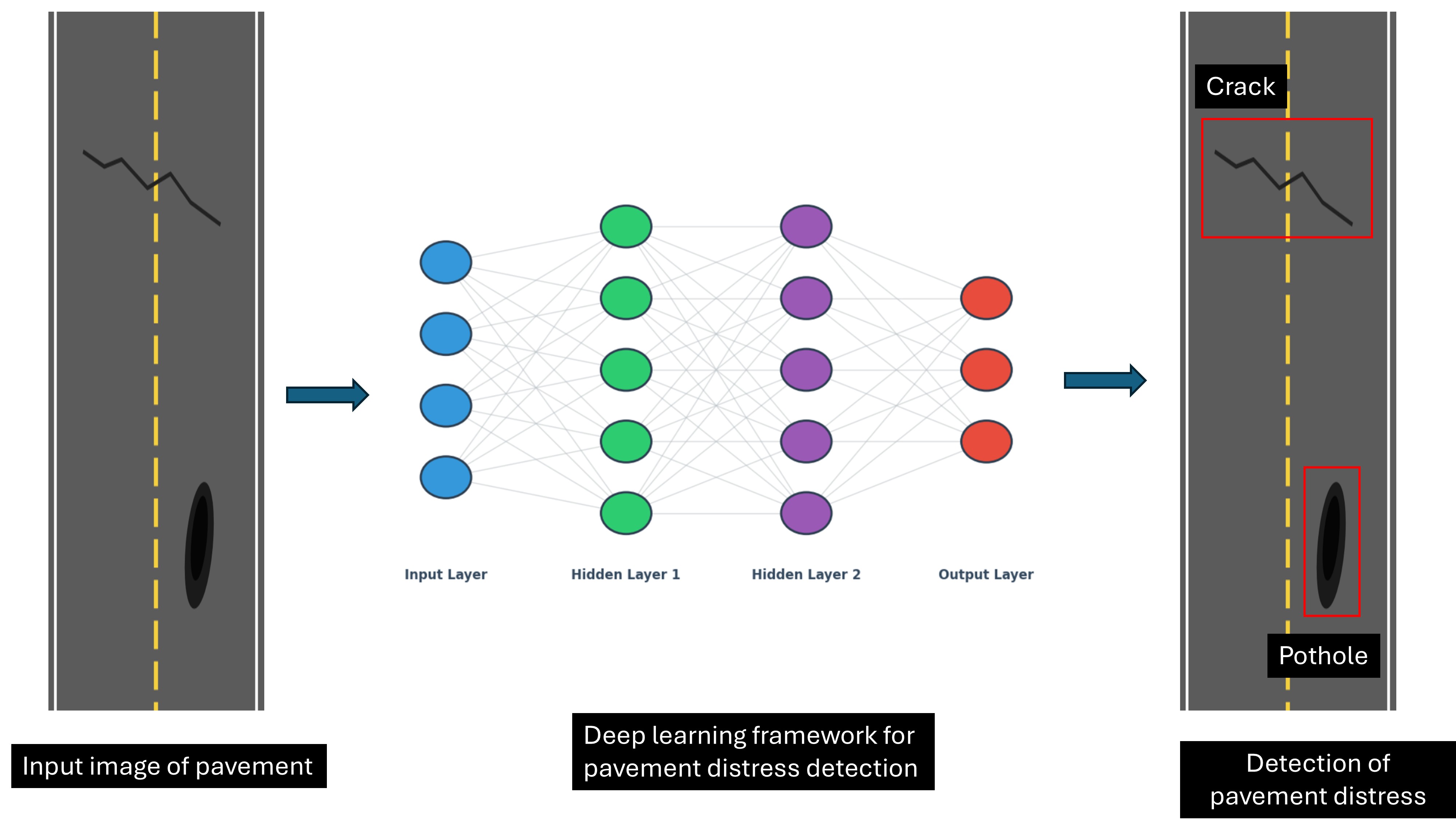
Pavements are essential elements of transportation networks and are instrumental to the growth and development of a country. To harness the full potential of this infrastructure, it is necessary to maintain it in proper structural and functional conditions. Conventional techniques, such as manual inspection can be used to determine the functional conditions of the pavement. However, these techniques have different shortcomings, including high monitoring costs, time consumption and requirement of traffic control during pavement surveying. These shortcomings can be mitigated by utilizing various Artificial Intelligence (AI) techniques such as machine learning and deep learning, for pavement surface inspection. This study aims to systematically review state-of-the-art deep learning techniques such as vision transformer model for pavement distress detection. This research contributes to the knowledge body by summarizing the application of vision transformer model for pavement distress detection. Moreover, this research provides a brief description of the application of other deep learning architectures including You Only Look Once (YOLO), and Convolutional Neural Networks (CNNs) for pavement distress detection. Deep learning techniques can autonomously detect various types of pavement distress including longitudinal and transverse cracks, rutting, faulting, patching, shoving, raveling and potholes from the pavement surface. The research was performed in three different steps namely: keyword selection, identification of databases, literature acquisition and summarizing the literature based on different deep learning models. The findings from the review indicate that YOLO and CNN were extensively employed by researchers, however in recent times, vision transformers gained popularity among researchers and pavement engineers. Overall, this study highlights the critical role played by different deep learning techniques in transforming pavement monitoring, leading to safer, more resilient, and sustainable transportation infrastructure.
- Open Access
- Review
Application of Deep Learning for Pavement Monitoring: Movement towards Autonomous Future
Author Information
Received: 07 Jun 2026 | Revised: 06 Aug 2026 | Accepted: 10 Aug 2026 | Published: 27 Aug 2026
Abstract
Graphical Abstract
Keywords
transformer | CNN | YOLO | pavement distress | deep learning
References
- 1.
Chatterjee, K.; Vivanco, D.; Yang, X.; et al. Enhancing Pavement Performance through Balanced Mix Design: A Comprehensive Field Study in Oklahoma. In Proceedings of the International Conference on Transportation and Development, Atlanta, GA, USA, 15–18 June 2024; pp. 511–522.
- 2.
Parajulee, K.; Chatterjee, K.; Li, J. Leveraging original equipment manufacturer vehicle sensor data for enhanced roadway safety. Int. J. Pavement Res. Technol. 2025, 1–18. https://doi.org/10.1007/s42947-025-00619-z.
- 3.
Ansari, F.; Chatterjee, K.; Li, J.Q.; et al. Multi-Object Pavement Surface Feature Detection with CNN and Transformer Deep Learning Architecture. In Proceedings of the Airfield and Highway Pavements, Glendale, AZ, USA, 8–11 June 2025; pp. 350–359.
- 4.
Chatterjee, K.; Li, J.Q.; Ansari, F.; et al. Hybrid LSTM-Transformer models for profiling highway–railway grade crossings. J. Transp. Eng. Part A Syst. 2026, 152, 04025138.
- 5.
Chatterjee, K.; Li, J.; Parajulee, K.; et al. Assessing Hangup Susceptibility of Highway-Railway Grade Crossings Leveraging CNN-Transformer Hybrid Model. In Proceedings of the International Conference on Transportation and Development, Detroit, MI, USA, 28 June–1 July 2026; pp. 579–590.
- 6.
Chatterjee, K.; Desai, M.; Li, J. Application of large language models in geotechnical engineering: A movement towards safe and sustainable future. Geotechnics 2026, 6, 38.
- 7.
Asteris, P.G. Computational intelligence: From nature and Aristotle to Meta-Heuristic algorithms. Bull. Comput. Intell. 2025, 1, 1–2. https://doi.org/10.53941/bci.2025.100001.
- 8.
Benzaamia, A.; Ghrici, M.; Rbouh, R.; et al. Prediction of chloride resistance level in concrete using optimized tree-based machine learning models. Bull. Comput. Intell. 2025, 1, 104–117.
- 9.
Khatti, J.; Kontoni, D.P.N. Assessment of bearing capacity of concrete piles in alluvial soils using bio and swarm-optimized artificial neural network models. Bull. Comput. Intell. 2025, 1, 53–75.
- 10.
Ansari, S.S.; Ansari, M.A.; Ibrahim, S.M. Explainable predictive modelling of sustainable slag-fly ash based geopolymer concrete with life cycle and carbon-neutrality assessment. Bull. Comput. Intell. 2026, 2, 54–82.
- 11.
Bardhan, A.; Kardani, N. An efficient meta-ensemble paradigm for modelling Poisson’s ratio and maximum horizontal stress in casing collapse hazard. Bull. Comput. Intell. 2026, 2, 146–163.
- 12.
Desai, M.; Chatterjee, K. Application of machine learning techniques for prediction of soil water characteristics curve: A state of the art review. preprints 2026, Epub ahead of print. https://doi.org/10.20944/preprints202602.0792.v1.
- 13.
Muhammed, A.M.; Omer, M.A.I.; Haider, R.S.; et al. Predicting the compressive strength of fly ash composite foam concrete using artificial neural networks and soft computing techniques. Bull. Comput. Intell. 2026, 2, 83–102.
- 14.
Iqbal, M.; Raheel, M.; Biswas, R. Hybrid artificial neural network models for predicting flexural strength of FRP-reinforced concrete beams. Bull. Comput. Intell. 2026, 2, 196–212.
- 15.
Subedi, A.; Subedi, S.; Adhikari, S.; et al. Explainable hybridized machine learning for prediction of compressive strength of fly-ash based geopolymer concrete. Bull. Comput. Intell. 2026, 2, 213–234.
- 16.
Yang, F.; Zhang, L.; Yu, S.; et al. Feature pyramid and hierarchical boosting network for pavement crack detection. IEEE Trans. Intell. Transp. Syst. 2020, 21, 1525–1535.
- 17.
Cano-Ortiz, S.; Iglesias, L.L.; del Árbol, P.M.R.; et al. An end-to-end computer vision system based on deep learning for pavement distress detection and quantification. Constr. Build. Mater. 2024, 416, 135036.
- 18.
Yu, H.; Deng, Y.; Guo, F. Real-time pavement surface crack detection based on lightweight semantic segmentation model. Transp. Geotech. 2024, 48, 101335.
- 19.
Guo, F.; Liu, J.; Xie, Q.; et al. A two-stage framework for pixel-level pavement surface crack detection. Eng. Appl. Artif. Intell. 2024, 133, 108312.
- 20.
Zhang, H.; Zhang, A.A.; Dong, Z.; et al. Robust semantic segmentation for automatic crack detection within pavement images using multi-mixing of global context and local image features. IEEE Trans. Intell. Transp. Syst. 2024, 25, 11282–11303.
- 21.
Wu, W.; Zhu, F.; Li, Z.; et al. Optimized deep learning model with integrated spectrum focus transformer for pavement distress recognition and classification. Sci. Rep. 2025, 15, 3803.
- 22.
Bochkovskiy, A.; Wang, C.Y.; Liao, H.Y.M. YOLOv4: Optimal speed and accuracy of object detection. arXiv 2020, arXiv:2004.10934.
- 23.
Luo, H.; Li, J.; Cai, L.; et al. STrans-YOLOX: Fusing Swin Transformer and YOLOX for automatic pavement crack detection. Appl. Sci. 2023, 13, 1999.
- 24.
Wang, S.; Cai, B.; Wang, W.; et al. Automated detection of pavement distress based on enhanced YOLOv8 and synthetic data with textured background modeling. Transp. Geotech. 2024, 48, 101304.
- 25.
Wu, P.; Wu, J.; Xie, L. Pavement distress detection based on improved feature fusion network. Measurement 2024, 236, 115119.
- 26.
Yang, X.; Li, J.Q.; Zhan, Y.; et al. Real-time automated deep learning based railroad trespassing violation detection and tracking at highway-rail grade crossing. Intell. Transp. Infrastruct. 2024, 3, liae003.
- 27.
Lv, Z.; Hao, Z.; Zhu, Y.; et al. A review on automated detection and identification algorithms for highway pavement distress. Appl. Sci. 2025, 15, 6112.
- 28.
Dosovitskiy, A.; Beyer, L.; Kolesnikov, A.; et al. An image is worth 16 × 16 words: Transformers for image recognition at scale. arXiv 2020, arXiv:2010.11929.
- 29.
Vaswani, A.; Shazeer, N.; Parmar, N.; et al. Attention Is All You Need. In Proceedings of the Advances in Neural Information Processing Systems 30 (NIPS 2017), Long Beach, CA, USA, 4–9 December 2017; pp. 5998–6008.
- 30.
Shamsabadi, E.A.; Xu, C.; Rao, A.S.; et al. Vision transformer-based autonomous crack detection on asphalt and concrete surfaces. Autom. Constr. 2022, 140, 104316.
- 31.
Tang, W.; Huang, S.; Zhang, X.; et al. Pict: A Slim Weakly Supervised Vision Transformer for Pavement Distress Classification. In Proceedings of the 30th ACM International Conference on Multimedia, Lisboa, Portugal, 10–14 October 2022; pp. 3076–3084.
- 32.
Xu, Z.; Guan, H.; Kang, J.; et al. Pavement crack detection from CCD images with a locally enhanced transformer network. Int. J. Appl. Earth Obs. Geoinf. 2022, 110, 102825.
- 33.
Xiao, S.; Shang, K.; Lin, K.; et al. Pavement crack detection with hybrid-window attentive vision transformers. Int. J. Appl. Earth Obs. Geoinf. 2023, 116, 103172.
- 34.
Guo, F.; Qian, Y.; Liu, J.; et al. Pavement crack detection based on transformer network. Autom. Constr. 2023, 145, 104646.
- 35.
Guo, F.; Liu, J.; Lv, C.; et al. A novel transformer-based network with attention mechanism for automatic pavement crack detection. Constr. Build. Mater. 2023, 391, 131852.
- 36.
Liu, H.; Yang, J.; Miao, X.; et al. CrackFormer network for pavement crack segmentation. IEEE Trans. Intell. Transp. Syst. 2023, 24, 9240–9252.
- 37.
Tong, Z.; Ma, T.; Zhang, W.; et al. Evidential transformer for pavement distress segmentation. Comput. Aided Civ. Infrastruct. Eng. 2023, 38, 2317–2338.
- 38.
Zhang, H.; Zhang, A.A.; He, A.; et al. Pixel-level detection of multiple pavement distresses and surface design features with ShuttleNetV2. Struct. Health Monit. 2024, 23, 1263–1279.
- 39.
Zim, A.H.; Iqbal, A.; Al-Huda, Z.; et al. EfficientCrackNet: A Lightweight Model for Crack Segmentation. In Proceedings of 2025 IEEE/CVF Winter Conference on Applications of Computer Vision (WACV), Tucson, AZ, USA, 26 February–6 March 2025; pp. 6279–6289.
- 40.
Kyem, B.A.; Asamoah, J.K.; Aboah, A. Context-CrackNet: A context-aware framework for precise segmentation of tiny cracks in pavement images. Constr. Build. Mater. 2025, 484, 141583.
- 41.
Fan, L.; Wang, D.; Wang, J.; et al. Pavement defect detection with deep learning: A comprehensive survey. IEEE Trans. Intell. Veh. 2024, 9, 4292–4311.
- 42.
Wang, C.; Liu, H.; An, X.; et al. SwinCrack: Pavement crack detection using convolutional swin-transformer network. Digit. Signal Process. 2024, 145, 104297.
- 43.
Chen, S.; Feng, Z.; Xiao, G.; et al. Pavement crack detection based on the improved Swin-Unet model. Buildings 2024, 14, 1442.
- 44.
Li, H.; Zhang, H.; Zhu, H.; et al. Automatic crack detection on concrete and asphalt surfaces using semantic segmentation network with hierarchical transformer. Eng. Struct. 2024, 307, 117903.
- 45.
Zhang, Z.; Song, W.; Zhuang, Y.; et al. Automated multi-type pavement distress segmentation and quantification using transformer networks for pavement condition index prediction. Appl. Sci. 2024, 14, 4709.
- 46.
Huang, W.Q.; Feng, L.; He, Y.L. LTPLN: Automatic pavement distress detection. PLoS ONE 2024, 19, e0309172.
- 47.
Elghaish, F.; Matarneh, S.; Abdellatef, E.; et al. Multi-layers deep learning model with feature selection for automated detection and classification of highway pavement cracks. Smart Sustain. Built Environ. 2025, 14, 511–535.
- 48.
Zhang, J.; Sun, S.; Song, W.; et al. Automated pavement distress detection based on convolutional neural network. IEEE Access 2024, 12, 105055–105068.
- 49.
Ali, L.; Jassmi, H.A.; Khan, W.; et al. Crack45K: Integration of vision transformer with tubularity flow field (TuFF) and sliding-window approach for crack-segmentation in pavement structures. Buildings 2023, 13, 55.
- 50.
Zheng, X.; Qian, S.; Wei, S.; et al. The combination of Transformer and You Only Look Once for automatic concrete pavement crack detection. Appl. Sci. 2023, 13, 9211.
- 51.
Owor, N.J.; Adu-Gyamfi, Y.; Aboah, A.; et al. PaveSAM—Segment anything for pavement distress. Road Mater. Pavement Des. 2025, 26, 593–617.
- 52.
Hu, Y.; Chen, N.; Hou, Y.; et al. Lightweight deep learning for real-time road distress detection on mobile devices. Nat. Commun. 2025, 16, 4212.
- 53.
Li, Y.; Liu, C.; Weng, Z.; et al. Aggregate-level 3D analysis of asphalt pavement deterioration using laser scanning and vision transformer. Autom. Constr. 2025, 178, 106380.
- 54.
Alshawabkeh, S.; Wu, L.; Dong, D.; et al. A hybrid approach for pavement crack detection using Mask R-CNN and Vision Transformer model. Comput. Mater. Contin. 2025, 82, 561–577.
- 55.
Zheng, L.; Xiao, J.; Wang, Y.; et al. Deep learning-based intelligent detection of pavement distress. Autom. Constr. 2024, 168, 105772.
- 56.
Zhang, S.; Bei, Z.; Ling, T.; et al. Research on high-precision recognition model for multi-scene asphalt pavement distresses based on deep learning. Sci. Rep. 2024, 14, 25416.
- 57.
Tao, Z.; Gong, H.; Liu, L.; et al. A weakly-supervised deep learning model for end-to-end detection of airfield pavement distress. Int. J. Transp. Sci. Technol. 2025, 17, 67–78.
- 58.
Liu, F.; Liu, J.; Wang, L.; et al. Multiple-type distress detection in asphalt concrete pavement using infrared thermography and deep learning. Autom. Constr. 2024, 161, 105355.
- 59.
Liu, Z.; Wu, W.; Gu, X.; et al. PaveDistress: A comprehensive dataset of pavement distresses detection. Data Brief 2024, 57, 111111.
- 60.
Zaman, F.; Xu, Z.; Hussain, A.; et al. Concrete and Pavement Cracks Detection Leveraging Vision Transformer (ViT) Model. In Proceedings of 2024 International Conference on Electrical and Information Technology (IEIT), Malang, Indonesia, 12–13 September 2024; pp. 90–95.
- 61.
Wang, S.; Chen, X.; Dong, Q. Detection of asphalt pavement cracks based on vision transformer improved YOLOv5. J. Transp. Eng. Part B Pavements 2023, 149, 04023004.
- 62.
Li, D.; Duan, Z.; Hu, X.; et al. Automated classification and detection of multiple pavement distress images based on deep learning. J. Traffic Transp. Eng. 2023, 10, 276–290.
- 63.
Lin, W.; Li, X.; Han, H.; et al. A novel approach for pavement distress detection and quantification using RGB-D camera and deep learning algorithm. Constr. Build. Mater. 2023, 407, 133593.
- 64.
Guan, S.; Liu, H.; Pourreza, H.R.; et al. Deep learning approaches in pavement distress identification: A review. arXiv 2023, arXiv:2308.00828.
- 65.
Gopalakrishnan, K. Deep learning in data-driven pavement image analysis and automated distress detection: A review. Data 2018, 3, 28.
- 66.
Chatterjee, K. Application of Large Language Models in Intelligent Transportation Systems: A Systematic Review. In Proceedings of International Conference on Transportation and Development, Detroit, MI, USA, 28 June–1 July 2026; pp. 565–572.


This work is licensed under a Creative Commons Attribution 4.0 International License.

 Suite 4002 Level 4, 447 Collins Street, Melbourne, Victoria 3000, Australia
 General Inquiries: info@sciltp.com