
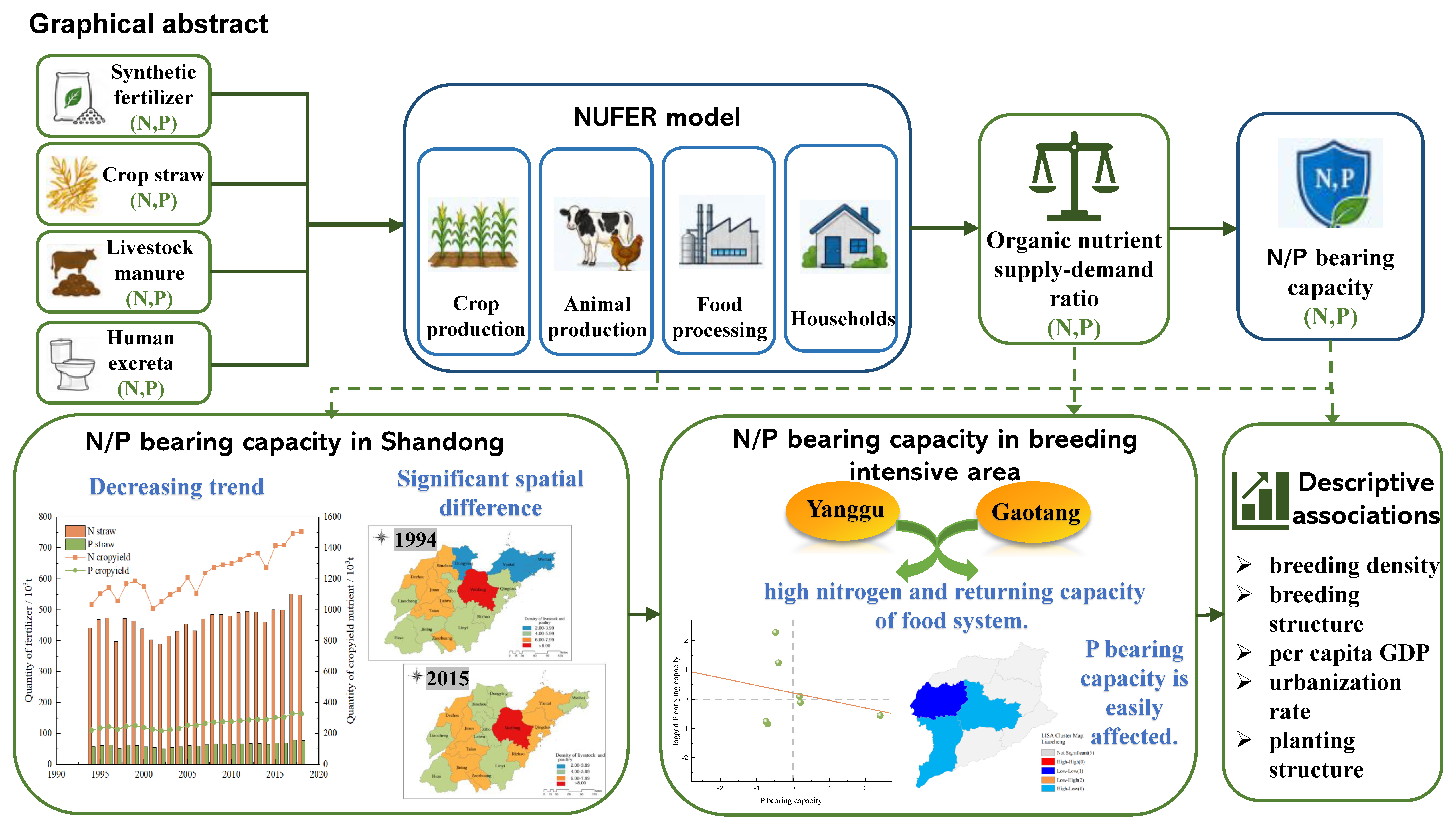
Recycling organic nutrient resources is important for reducing dependence on synthetic fertilizers and improving nutrient management in integrated crop–livestock food systems. Using the NUFER model, official statistics, published parameters, and field-survey data, this study quantified the temporal and spatial patterns of nitrogen (N) and phosphorus (P) bearing capacity in the agricultural food system of Shandong Province from 1994 to 2018 and at the county level in Liaocheng City in 2019. In this study, N/P bearing capacity refers exclusively to an operational organic nutrient supply–demand ratio rather than environmental bearing capacity. Results reveal a general downward trend in N/P bearing capacity, accompanied by significant spatial variations. The bearing capacity was positively correlated with livestock density and farming structure, whereas negatively correlated with per capita Gross Domestic Product (GDP) and urbanization rates, and exhibited a quadratic linear relationship with cropping structure. Detailed regional analysis indicates that the N bearing capacity in Dongchangfu District, Linqing City, and Guan County of Liaocheng’s food system fall below 1, indicating that the modeled potentially recyclable organic N supply was lower than the corresponding net crop-product N demand. In the other counties, the modeled organic N supply exceeded this demand on a theoretical mass basis. In Gaotang County, Chiping District, Dong’e County, and Yanggu County, P bearing capacity exceeded 1, reaching 3.16 in Yanggu County, indicating that potentially recyclable organic P exceeded crop-product P removal in quantitative terms. Moran’s I test showed no statistically significant overall spatial autocorrelation among the county-level units.
- Open Access
- Article
Nutrient Balance–Based Assessment of Nitrogen and Phosphorus Bearing Capacity in Shandong Farmlands
- Zhuoya Lv 1,
- Minglu Zhang 1,
- Qing Xu 1,
- Jiayi Li 1,
- Santanu Mukherjee 2,
- Yukai Wang 1,
- Mohammed Ali Alshehri 3,
- Salah F. Abou-Elwafa 4,
- Tao Zhang 1,*
Author Information
Received: 10 May 2026 | Revised: 03 Jul 2026 | Accepted: 09 Jul 2026 | Published: 04 Aug 2026
Abstract
Graphical Abstract
Keywords
nitrogen | phosphorus | food system | livestock density | spatial variation
References
- 1.
Wu, F.C.; Li, F.B.; Zhao, X.L.; et al. Meet the Challenges in the “Carbon Age”. Carbon Res. 2022, 1, 1. https://doi.org/10.1007/s44246-022-00001-9.
- 2.
Xu, Q.; Zhang, T.; Niu, Y.Q.; et al. A Comprehensive Review on Agricultural Waste Utilization through Sustainable Conversion Techniques, with a Focus on the Additives Effect on the Fate of Phosphorus and Toxic Elements during Composting Process. Sci. Total Environ. 2024, 942, 173567. https://doi.org/10.1016/j.scitotenv.2024.173567.
- 3.
Wu, H.J.; Wang, S.; Gao, L.M.; et al. Nutrient-Derived Environmental Impacts in Chinese Agriculture during 1978–2015. J. Environ. Manag. 2018, 217, 762–774. https://doi.org/10.1016/j.jenvman.2018.04.002.
- 4.
Zhang, T.; Xu, H.Y.; Li, H.H.; et al. Microwave Digestion-Assisted HFO/Biochar Adsorption to Recover Phosphorus from Swine Manure. Sci. Total Environ. 2018, 621, 1512–1526. https://doi.org/10.1016/j.scitotenv.2017.10.077.
- 5.
Lassaletta, L.; Billen, G.; Grizzetti, B.; et al. 50 Year Trends in Nitrogen Use Efficiency of World Cropping Systems: The Relationship between Yield and Nitrogen Input to Cropland. Environ. Res. Lett. 2014, 9, 105011. https://doi.org/10.1088/1748-9326/9/10/105011.
- 6.
Feng, W.Y.; Wang, T.; Zhu, Y.; et al. Chemical Composition, Sources, and Ecological Effect of Organic Phosphorus in Water Ecosystems: A Review. Carbon Res. 2023, 2, 12. https://doi.org/10.1007/s44246-023-00038-4.
- 7.
Zhang, T.; Li, P.; Fang, C.; et al. Phosphate Recovery from Animal Manure Wastewater by Struvite Crystallization and CO₂ Degasification Reactor. Ecol. Chem. Eng. S 2014, 21, 89–99. https://doi.org/10.2478/eces-2014-0008.
- 8.
You, L.; Ros, G.H.; Chen, Y.; et al. Optimized Agricultural Management Reduces Global Cropland Nitrogen Losses to Air and Water. Nat. Food 2024, 5, 995–1004. https://doi.org/10.1038/s43016-024-01076-w.
- 9.
Gong, C.; Wang, Y.; Tian, H.; et al. Uncertainties in Fertilizer-Induced Emissions of Soil Nitrogen Oxide and the Associated Impacts on Ground-Level Ozone and Methane. Atmos. Chem. Phys. 2025, 25, 17009–17025. https://doi.org/10.5194/acp-25-17009-2025.
- 10.
Bai, Z.H.; Ma, L.; Qin, W.; et al. Changes in Pig Production in China and Their Effects on Nitrogen and Phosphorus Use and Losses. Environ. Sci. Technol. 2014, 48, 12742–12749. https://doi.org/10.1021/es502160v.
- 11.
Dzvene, A.R.; Chiduza, C.; Mnkeni, P.N.S. Assessing Manure Availability and Utilization in Integrated Crop-Livestock System: Implications for Nitrogen Management in Rural Eastern Cape, South Africa. Discov. Agric. 2025, 3, 6. https://doi.org/10.1007/s44279-025-00165-z.
- 12.
Daatselaar, C.H.; Reijs, J.R.; Oenema, J.; et al. Variation in Nitrogen Use Efficiencies on Dutch Dairy Farms. J. Sci. Food Agric. 2015, 95, 3055–3058. https://doi.org/10.1002/jsfa.7250.
- 13.
Zhou, C.; Wang, J.; Xu, T.; et al. Manure Substitution for Chemical Nitrogen Enhances Soil Quality without Compromising Maize Yield: A Short-Term Field Experiment in Northeast China. Front. Plant Sci. 2025, 16, 1694608. https://doi.org/10.3389/fpls.2025.1694608.
- 14.
Ma, L.; Ma, W.Q.; Velthof, G.L.; et al. Modeling Nutrient Flows in the Food Chain of China. J. Environ. Qual. 2010, 39, 1279–1289. https://doi.org/10.2134/jeq2009.0403.
- 15.
Devault, M.; Woolf, D.; Lehmann, J. Nutrient Recycling Potential of Excreta for Global Crop and Grassland Production. Nat. Sustain. 2025, 8, 99–111. https://doi.org/10.1038/s41893-024-01467-8.
- 16.
Ma, Y.F.; Hou, Y.; Dong, P.; et al. Cooperation between Specialized Livestock and Crop Farms Can Reduce Environmental Footprints and Increase Net Profits in Livestock Production. J. Environ. Manag. 2022, 302, 113960. https://doi.org/10.1016/j.jenvman.2021.113960.
- 17.
Jin, X.P.; Bai, Z.H.; Oenema, O.; et al. Spatial Planning Needed to Drastically Reduce Nitrogen and Phosphorus Surpluses in China’s Agriculture. Environ. Sci. Technol. 2020, 54, 11894–11904. https://doi.org/10.1021/acs.est.0c00781.
- 18.
Hou, S.; Dang, H.; Huang, T.; et al. Targeting High Nutrient Efficiency to Reduce Fertilizer Input in Wheat Production of China. Field Crops Res. 2023, 292, 108809. https://doi.org/10.1016/j.fcr.2023.108809.
- 19.
Li, Q.; Zhang, J.; Zhang, J.; et al. Spatial and Temporal Distribution Characteristics and Prediction Analysis of Nitrogen and Phosphorus Surface Source Pollution in Shandong Province under Climate and Land Use Changes. Front. Ecol. Evol. 2023, 11, 1231394. https://doi.org/10.3389/fevo.2023.1231394.
- 20.
Wu, J.; Zhang, J.; Yi, W.; et al. Agri-Biomass Supply Chain Optimization in North China: Model Development and Application. Energy 2022, 239, 122374. https://doi.org/10.1016/j.energy.2021.122374.
- 21.
Meyer-Aurich, A.; Gandorfer, M.; Heißenhuber, A. Economic Analysis of Precision Farming Technologies at the Farm Level: Two German Case Studies. In Agricultural Systems: Economics, Technology and Diversity; Nova Science Publishers: Hauppage, NY, USA, 2008; pp. 67–76.
- 22.
Sharma, N.; Jaiswal, D.K.; Kumari, S.; et al. Genome-Wide Urea Response in Rice Genotypes Contrasting for Nitrogen Use Efficiency. Int. J. Mol. Sci. 2023, 24, 6080. https://doi.org/10.3390/ijms24076080.
- 23.
Zhang, F.S.; Cui, Z.L.; Fan, M.S.; et al. Integrated Soil–Crop System Management: Reducing Environmental Risk While Increasing Crop Productivity and Improving Nutrient Use Efficiency in China. J. Environ. Qual. 2011, 40, 1051–1057. https://doi.org/10.2134/jeq2010.0292.
- 24.
Ma, L.; Wang, F.H.; Zhang, W.F.; et al. Environmental Assessment of Management Options for Nutrient Flows in the Food Chain in China. Environ. Sci. Technol. 2013, 47, 7260–7268. https://doi.org/10.1021/es400456u.
- 25.
Huang, X.; Cheng, L.; Chien, H.; et al. Sustainability of Returning Wheat Straw to Field in Hebei, Shandong and Jiangsu Provinces: A Contingent Valuation Method. J. Clean. Prod. 2019, 213, 1290–1298. https://doi.org/10.1016/j.jclepro.2018.12.242.
- 26.
Zhai, J., Han, B., Li, H., Ren, W., Xue, B. Accounting for the nitrogen footprint of food production in Chinese provinces during 1998–2018. J. Clean. Prod. 2023, 389, 136011. https://doi.org/10.1016/j.jclepro.2023.136011
- 27.
National Bureau of Statistics of China. China Statistical Yearbook. 1995–2019. Available online: https://www.stats.gov.cn/sj/ndsj/ (accessed on 5 June 2026).
- 28.
Shandong Provincial Bureau of Statistics. Shandong Statistical Yearbook. 1995–2019. Available online: http://tjj.shandong.gov.cn/col/col6279/index.html (accessed on 5 June 2026).
- 29.
Gao, L.W.; Ma, L.; Zhang, W.F.; et al. Estimation of Nutrient Resource Quantity of Crop Straw and Its Utilization Situation in China. Trans. Chin. Soc. Agric. Eng. 2009, 25, 173–179.
- 30.
Herridge, D.F.; Peoples, M.B.; Boddey, R.M. Global Inputs of Biological Nitrogen Fixation in Agricultural Systems. Plant Soil 2008, 311, 1–18. https://doi.org/10.1007/s11104-008-9668-3.
- 31.
Liu, X.J.; Zhang, Y.; Han, W.X.; et al. Enhanced Nitrogen Deposition over China. Nature 2013, 494, 459–462. https://doi.org/10.1038/nature11917.
- 32.
Bai, Z.H.; Ma, L.; Jin, S.Q.; et al. Nitrogen, Phosphorus, and Potassium Flows through the Manure Management Chain in China. Environ. Sci. Technol. 2016, 50, 13409–13418. https://doi.org/10.1021/acs.est.6b03348.
- 33.
IPCC. 2006 IPCC Guidelines for National Greenhouse Gas Inventories. Volume 4: Agriculture, Forestry and Other Land Use. Chapter 10: Emissions from Livestock and Manure Management. 2006. Available online: https://www.ipcc-nggip.iges.or.jp/public/2006gl/pdf/4_Volume4/V4_10_Ch10_Livestock.pdf (accessed on 5 June 2026).
- 34.
Luo, B.; Liu, L.; Yung, D.H.Y.; et al. Effects of Enhancing Nitrogen Use Efficiency in Cropland and Livestock Systems on Agricultural Ammonia Emissions and Particulate Matter Air Quality in China. Atmos. Chem. Phys. 2025, 25, 10089–10108. https://doi.org/10.5194/acp-25-10089-2025.
- 35.
Zhang, Y.; Zhang, T.; Wang, Y.; et al. Crop Production and Phosphorus Legacy with Long-Term Phosphorus- and Nitrogen-Based Swine Manure Applications under Corn–Soybean Rotation. Agronomy 2021, 11, 1548. https://doi.org/10.3390/agronomy11081548.
- 36.
Zheng, L.; Zhang, Q.; Zhang, A.; et al. Spatiotemporal Characteristics of the Bearing Capacity of Cropland Based on Manure Nitrogen and Phosphorus Load in Mainland China. J. Clean. Prod. 2019, 233, 601–610. https://doi.org/10.1016/j.jclepro.2019.06.049.
- 37.
Wu, H.; Zhang, Y.; Yuan, Z.; et al. A Review of Phosphorus Management through the Food System: Identifying the Roadmap to Ecological Agriculture. J. Clean. Prod. 2016, 114, 45–54. https://doi.org/10.1016/j.jclepro.2015.07.073.
- 38.
Luo, Y.; Chen, D.; Wang, X. Assessment of Crop Residues and Corresponding Nutrients Return to Fields via Root, Stubble, and Straw in Southwest China. Sustainability 2023, 15, 15138. https://doi.org/10.3390/su152015138.
- 39.
Nieto-Cantero, J.; García-López, A.M.; Recena, R.; et al. Recycling Manure as Vermicompost: Assessing Phosphorus Fertilizer Efficiency and Effects on Soil Health Under Different Soil Management. J. Soil Sci. Plant Nutr. 2025, 25, 5046–5061. https://doi.org/10.1007/s42729-025-02446-4.
- 40.
Dzvene, A.R.; Chiduza, C.; Mnkeni, P.N.S. Evaluating Nitrogen and Phosphorus Dynamics Influenced by Animal Manure Biochar in Eutric Cambisol. J. Soil Sci. Plant Nutr. 2026, 26, 3682–3692. https://doi.org/10.1007/s42729-026-03092-0.
- 41.
Li, H.; Dai, M.; Dai, S.; et al. Current Status and Environment Impact of Direct Straw Return in China’s Cropland—A Review. Ecotoxicol. Environ. Saf. 2018, 159, 293–300. https://doi.org/10.1016/j.ecoenv.2018.05.014.
- 42.
Ditta, A.; Arshad, M.; Zahir, Z.A.; et al. Comparative Efficacy of Rock Phosphate Enriched Organic Fertilizer vs. Mineral Phosphatic Fertilizer for Nodulation, Growth and Yield of Lentil. Int. J. Agric. Biol. 2015, 17, 589–595. https://doi.org/10.17957/IJAB/17.3.14.954.
- 43.
Peng, L.; Dai, H.; Wu, Y.; et al. A Comprehensive Review of Phosphorus Recovery from Wastewater by Crystallization Processes. Chemosphere 2018, 197, 768–781. https://doi.org/10.1016/j.chemosphere.2018.01.098.
- 44.
Campos, J.L.; Crutchik, D.; Franchi, Ó.; et al. Nitrogen and Phosphorus Recovery from Anaerobically Pretreated Agro-Food Wastes: A Review. Front. Sustain. Food Syst. 2019, 2, 91. https://doi.org/10.3389/fsufs.2018.00091.
- 45.
Kuusemets, L.; Mander, Ü.; Escuer-Gatius, J.; et al. Interactions of Fertilisation and Crop Productivity in Soil Nitrogen Cycle Microbiome and Gas Emissions. SOIL 2025, 11, 1–15. https://doi.org/10.5194/soil-11-1-2025.
- 46.
Sabir, M.; Sultan, T.; Yaseen, M.; et al. Comparative Effect of Different Phosphatic Fertilizers on Growth of Rapeseed (Brassica napus L.) in Alkaline Calcareous Saline-Sodic Soils. Commun. Soil Sci. Plant Anal. 2021, 52, 2588–2596. https://doi.org/10.1080/00103624.2021.1953056.
- 47.
Lessmann, M.; Kros, H.; Walvoort, D.; et al. Uncertainties in Nitrogen Application from Manure and Synthetic Fertilizers and Ammonia Emissions from Agriculture in the Netherlands across Different Spatial Scales. Nutr. Cycl. Agroecosyst. 2025, 131, 141–164. https://doi.org/10.1007/s10705-025-10410-y.
- 48.
Zhang, J.; Hao, X.; Li, X.; et al. Evaluation and Regulation Strategy for Ecological Security in the Tarim River Basin Based on the Ecological Footprint. J. Clean. Prod. 2024, 435, 140488. https://doi.org/10.1016/j.jclepro.2023.140488.
- 49.
Xu, Y.; Ma, T.; Yuan, Z.; et al. Spatial Patterns in Pollution Discharges from Livestock and Poultry Farms and the Linkage between Manure Nutrient Load and the Carrying Capacity of Croplands in China. Sci. Total Environ. 2023, 901, 166006. https://doi.org/10.1016/j.scitotenv.2023.166006.
- 50.
Wang, M.; Ma, L.; Strokal, M.; et al. Hotspots for Nitrogen and Phosphorus Losses from Food Production in China: A County-Scale Analysis. Environ. Sci. Technol. 2018, 52, 5782–5791. https://doi.org/10.1021/acs.est.7b06138.
- 51.
Harder, R.; Wielemaker, R.; Larsen, T.A.; et al. Recycling Nutrients Contained in Human Excreta to Agriculture: Pathways, Processes, and Products. Crit. Rev. Environ. Sci. Technol. 2019, 49, 695–743. https://doi.org/10.1080/10643389.2018.1558889.
- 52.
Irankhahi, M.; Jozi, S.A.; Farshchi, P.; et al. Combination of GISFM and TOPSIS to Evaluation of Urban Environment Bearing Capacity (Case Study: Shemiran City, Iran). Int. J. Environ. Sci. Technol. 2017, 14, 1317–1332. https://doi.org/10.1007/s13762-017-1243-0.
- 53.
Li, X.; Zhu, T.; He, Y.; et al. Assessment of Eutrophication and Nitrogen and Phosphorus Bearing Capacity before and after Removing Pen Culture (2013–2018) in Lake Changhu, China. Environ. Sci. Pollut. Res. 2022, 29, 5674–5686. https://doi.org/10.1007/s11356-021-15908-w.
- 54.
Piri, M.; Sepehr, E.; Ghavidel, S.Z. Dosing of Leonardite/Struvite Compounds as Phosphorus Fertilizers Increased Biomass and Nutrient Uptake in a Calcareous Soil. J. Clean. Prod. 2023, 430, 139723. https://doi.org/10.1016/j.jclepro.2023.139723.
- 55.
Wang, S.; Shang, M.; Zhou, Y.; et al. Resources and Environmental Carrying Capacity Using RS and GIS. Pol. J. Environ. Stud. 2017, 26, 2793–2800. https://doi.org/10.15244/pjoes/70927.
- 56.
Yang, Y.X.; Wang, G.Y.; Pan, X.C. China Food Composition 2002. Available online: https://www.pumpress.com/shop/753.html (accessed on 5 June 2026).
- 57.
Yang, Y.X. China Food Composition Tables: Standard Edition, 6th ed.; Peking University Medical Press: Beijing, China, 2018. Available online: https://www.pumpress.com.cn/en-shop/5514.html (accessed on 5 June 2026).

This work is licensed under a Creative Commons Attribution 4.0 International License.
