
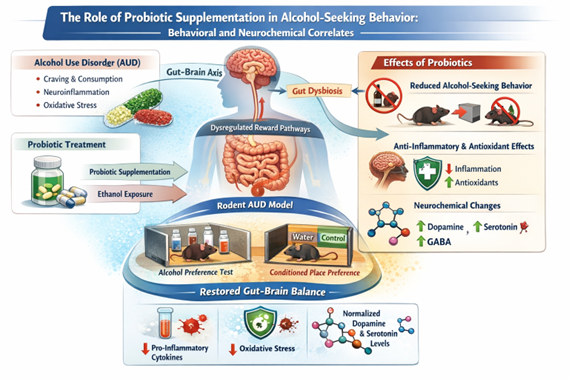
Background: Alcohol Use Disorder (AUD) is depicted by persistent craving and repeated administration, underpinned by neuroinflammation, oxidative stress, and dysregulation of reward pathways. Emerging evidence suggests a role for gut-brain communication of these processes, with gut dysbiosis exacerbating behavioral and neurochemical correlates of addiction. Purpose: This investigation aimed to evaluate the therapeutic efficacy of targeted probiotic supplementation in modulating alcohol-seeking behavior and its underlying neurobiological substrates. Study design: Preclinical controlled study. Methods: Using a pre-clinical rodent model of AUD, subjects were administered a specific multi-strain probiotic formulation alongside chronic intermittent ethanol exposure. Behavioral assays were employed to quantify alcohol preference and reward-motivated behaviour (using conditioned place preference). Parallel biochemical analyses assessed systemic and central anti-inflammatory markers and antioxidant capacity. Levels of serotonin, dopamine and metabolites were estimation in caudate and nucleus accumbens via high performance liquid chromatography. Results: Probiotic administration significantly reduced alcohol preference and attenuated conditioned place preference for ethanol-paired contexts compared to controls. These behavioral improvements correlated with robust anti-inflammatory and antioxidant effects, as evidenced by reduced pro-inflammatory cytokines and enhanced oxidative stress defense in both plasma and brain tissue. Critically, probiotic treatment normalized neurochemical dysregulation, increasing tonic GABAergic inhibition and restoring dopamine dynamics within the reward circuitry. Conclusion: These findings demonstrate that probiotic supplementation effectively reduces alcohol seeking behavior and reward-related behaviors by mitigating neuroinflammation, oxidative stress, and aberrant neurotransmission. The results highlight the gut-brain axis as a viable target for novel nutritional interventions in AUD and provide a mechanistic rationale for the adjunct use of probiotics in managing alcohol dependence.
- Open Access
- Article
The Role of Probiotic Supplementation in Alcohol-Seeking Behavior: Behavioral and Neurochemical Correlates
Author Information
Received: 21 Dec 2025 | Revised: 06 Apr 2026 | Accepted: 07 May 2026 | Published: 01 Jun 2026
Abstract
Graphical Abstract
Keywords
probiotic | alcohol use disorder | gut-brain axis | conditioned place preference | neuroinflammation | oxidative stress | dopamine
References
- 1.
Cui, X.; Liu, K.; Ji, Y.; et al. Global trends in the burden of alcohol use disorders in the working-age population from 1990 to 2021 and projections for the next 20 years. Front. Public Health 2025, 13, 1616343.
- 2.
Yang, W.; Singla, R.; Maheshwari, O.; et al. Alcohol Use Disorder: Neurobiology and Therapeutics. Biomedicines 2022, 10, 1192.
- 3.
Alorfi, N.M. Investigating Therapeutic Targets for Alcohol Use Disorder: Pharmacological View of ClinicalTrials.gov Data. Int. J. Gen. Med. 2025, 18, 3701–3712.
- 4.
Shukla, S.; Hsu, C.L. Alcohol Use Disorder and the Gut-Brain Axis: A Narrative Review of the Role of Gut Microbiota and Implications for Treatment. Microorganisms 2025, 13, 67.
- 5.
Pich, E.M.; Tarnanas, I.; Brigidi, P.; et al. Gut Microbiome-Liver-Brain axis in Alcohol Use Disorder. The role of gut dysbiosis and stress in alcohol-related cognitive impairment progression: Possible therapeutic approaches. Neurobiol. Stress 2025, 35, 100713.
- 6.
Dong, Y.; Buczynski, M.W.; Gregus, A.M. Alcohol use disorder-associated pain: Clinical and preclinical evidence. Alcohol 2025, 129, 14–40.
- 7.
Koutromanos, I.; Legaki, E.; Dovrolis, N.; et al. Integrating gut microbiome and neuroplasticity genomics in alcohol use disorder therapy. Hum. Genom. 2025, 19, 78.
- 8.
Erickson, E.K.; Grantham, E.K.; Warden, A.S.; et al. Neuroimmune signaling in alcohol use disorder. Pharmacol. Biochem. Behav. 2019, 177, 34–60.
- 9.
Tsermpini, E.E.; Plemenitaš Ilješ, A.; Dolžan, V. Alcohol-Induced Oxidative Stress and the Role of Antioxidants in Alcohol Use Disorder: A Systematic Review. Antioxidants 2022, 11, 1374.
- 10.
Avchalumov, Y.; Mandyam, C.D. Synaptic Plasticity and its Modulation by Alcohol. Brain Plast. 2020, 6, 103–111.
- 11.
Pisarello, M.J.L.; Marquez, A.; Chaia, A.P.; et al. Targeting gut health: Probiotics as promising therapeutics in alcohol-related liver disease management. AIMS Microbiol. 2025, 11, 410–435.
- 12.
Shukla, P.K.; Meena, A.S.; Rao, R. Prevention and mitigation of alcohol-induced neuroinflammation by Lactobacillus plantarum by an EGF receptor-dependent mechanism. Nutr. Neurosci. 2022, 25, 871–883.
- 13.
Hou, S.; Arce Soto, N.M.; Glover, E.J. Modeling Alcohol Consumption in Rodents Using Two-Bottle Choice Home Cage Drinking and Microstructural Analysis. J. Vis. Exp. 2024, 213, e67486. https://doi.org/10.3791/67486.
- 14.
Sklenarik, S.M.; Burrows, C.N.; Astur, R.S. Conditioned place preferences for virtual alcohol cues. Behav. Brain Res. 2023, 438, 114176.
- 15.
Hallihan, H.; Srimoragot, M.; Ma, J.; et al. Integrated behavioral interventions for adults with alcohol use disorder: A systematic review. Drug Alcohol Depend. 2024, 263, 111406.
- 16.
Vidya Bernhardt, G.; Shivappa, P.; Pinto, J.R.; et al. Probiotics-role in alleviating the impact of alcohol liver disease and alcohol deaddiction: A systematic review. Front. Nutr. 2024, 11, 1372755.
- 17.
Fuenzalida, C.; Dufeu, M.S.; Poniachik, J.; et al. Probiotics-Based Treatment as an Integral Approach for Alcohol Use Disorder in Alcoholic Liver Disease. Front. Pharmacol. 2021, 12, 729950.
- 18.
Bettocchi, S.; Comotti, A.; Elli, M.; et al. Probiotics and Fever Duration in Children With Upper Respiratory Tract Infections: A Randomized Clinical Trial. JAMA Netw. Open 2025, 8, e250669.
- 19.
Kwoji, I.D.; Aiyegoro, O.A.; Okpeku, M.; et al. Multi-Strain Probiotics: Synergy among Isolates Enhances Biological Activities. Biology 2021, 10, 322.
- 20.
Ikram, H.; Atique, I.; Moosa, U.M.; et al. Mitigation of addictive effects induced by lorazepam through concurrent administration of SSRI: Interplay of serotonin and dopamine in cAUDate and nucleus accumbens. Pak. J. Pharm. Sci. 2024, 37, 1043–1051.
- 21.
Wang, Y.; Kirpich, I.; Liu, Y.; et al. Lactobacillus rhamnosus GG treatment potentiates intestinal hypoxia-inducible factor, promotes intestinal integrity and ameliorates alcohol-induced liver injury. Am. J. Pathol. 2011, 179, 2866–2875.
- 22.
Haleem, D.J.; Naz, H.; Parveen, T.; et al. Serotonin and serotonin 1-A receptors in the failure of ethanol-treated rats to adapt to a repeated stress schedule. J. Stud. Alcohol 2002, 63, 389–396.
- 23.
Velten Mendes, M.; Lima, T.C.; Amormino, M.S.; et al. Predicted functional alterations in colonic microbiota metabolism underlie ethanol consumption and preference behavior in mice. Alcohol Clin. Exp. Res. 2025, 49, 2436–2450.
- 24.
Ikram, H.; Zakir, R.; Haleem, D.J. Memory enhancing and neuroprotective effects of apomorphine in a rat model of dementia. Metab. Brain Dis. 2024, 39, 1051–1063.
- 25.
Ikram, H.; Perveen, S.; Haleem, D.J. Dual role of dietary tryptophan on memory regulation in male albino wistar rats—Synergistic modulation of serotonergic signaling and kynurenine pathway. Nutr. Neurosci. 2026, 29, 356–370.
- 26.
Ikram, H.; Haleem, D.J. Regional neurochemical profile following coadministration of apomorphine and buspirone in an animal model of addiction. Pak. J. Pharm. Sci. 2025, 38, 2168–2175.
- 27.
Ikram, H.; Shahla, P.; Ali, S.; et al. Reduced 5-HT2C receptor responsiveness in rats after chronic midazolam treatment: Behavioral and neurochemical evidence in rats. Neurophysiology 2023, 55, 50–60. https://doi.org/10.1007/s11062-025-09954-0.
- 28.
Gupta, H.; Kim, S.H.; Kim, S.K.; et al. Beneficial Shifts in Gut Microbiota by Lacticaseibacillus rhamnosus R0011 and Lactobacillus helveticus R0052 in Alcoholic Hepatitis. Microorganisms 2022, 10, 1474.
- 29.
Li, Y.; Yao, Y.; Zhang, Z.; et al. Research status and development trends of probiotics in clinical applications. Front. Nutr. 2025, 12, 1650883.
- 30.
Winkler, G.A.; Grahame, N.J. Home cage voluntary alcohol consumption increases binge drinking without affecting abstinence-related depressive-like behaviors or operant responding in crossed high alcohol-preferring mice (cHAPs). Alcohol 2024, 116, 9–19.
- 31.
Pei, J.; Zhang, C.; Zhang, Q.; et al. Probiotics alleviate chronic ethanol exposure-induced anxiety-like behavior and hippocampal neuroinflammation in male mice through gut microbiota-derived extracellular vesicles. J. Nanobiotechnol. 2024, 22, 730.
- 32.
Robles-Vera, I.; Jarit-Cabanillas, A.; Brandi, P.; et al. Microbiota translocation following intestinal barrier disruption promotes Mincle-mediated training of myeloid progenitors in the bone marrow. Immunity 2025, 58, 381–396.e9.
- 33.
Escobar, A.P.; Bonansco, C.; Cruz, G.; et al. Central and Peripheral Inflammation: A Common Factor Causing Addictive and Neurological Disorders and Aging-Related Pathologies. Int. J. Mol. Sci. 2023, 24, 10083.
- 34.
Ahmadi-Khorram, M.; Hatami, A.; Asghari, P.; et al. Probiotics mitigate stress and inflammation in malnourished adults via gut microbiota modulation: A randomized controlled trial. Front. Nutr. 2025, 12, 1615607.
- 35.
Lee, C.; Kim, S.W.; Verma, R.; et al. Probiotic Consortium Confers Synergistic Anti-Inflammatory Effects in Inflammatory Disorders. Nutrients 2024, 16, 790.
- 36.
Lee, J.Y.; Jee, Y.M.; Yang, K.; et al. Alcohol-Induced Oxidative Stress and Gut-Liver-Brain Crosstalk: Expanding the Paradigm from ALD to MetALD. Antioxidants 2025, 14, 1196.
- 37.
Tsao, S.P.; Nurrahma, B.A.; Kumar, R.; et al. Probiotic Enhancement of Antioxidant Capacity and Alterations of Gut Microbiota Composition in 6-Hydroxydopamin-Induced Parkinson’s Disease Rats. Antioxidants 2021, 10, 1823.
- 38.
Weinstock, M. Role of Oxidative Stress and Neuroinflammation in the Etiology of Alzheimer’s Disease: Therapeutic Options. Antioxidants 2025, 14, 769.
- 39.
Gorlova, A.; Svirin, E.; Pavlov, D.; et al. Understanding the Role of Oxidative Stress, Neuroinflammation and Abnormal Myelination in Excessive Aggression Associated with Depression: Recent Input from Mechanistic Studies. Int. J. Mol. Sci. 2023, 24, 915.
- 40.
Garland, K.C.; Madden, G.J. A Pavlovian, conditioned-reinforcement approach to reducing impulsive choice. Behav. Process. 2025, 228, 105208.
- 41.
Mkrtchian, A.; Qiu, Z.; Abir, Y.; et al. Differential Associations of Dopamine and Serotonin With Reward and Punishment Processes in Humans: A Systematic Review and Meta-Analysis. JAMA Psychiatry 2025, 82, 818–829.
- 42.
Vecchio, L.M.; Sullivan, P.; Dunn, A.R.; et al. Enhanced tyrosine hydroxylase activity induces oxidative stress, causes accumulation of autotoxic catecholamine metabolites, and augments amphetamine effects in vivo. J. Neurochem. 2021, 158, 960–979.
- 43.
Shi, C.; Dong, J.; Hui, X.; et al. Production, Mechanisms, and Therapeutic Strategies of Tryptophan Metabolites in CNS Diseases. Mol. Neurobiol. 2025, 63, 226.

This work is licensed under a Creative Commons Attribution 4.0 International License.
