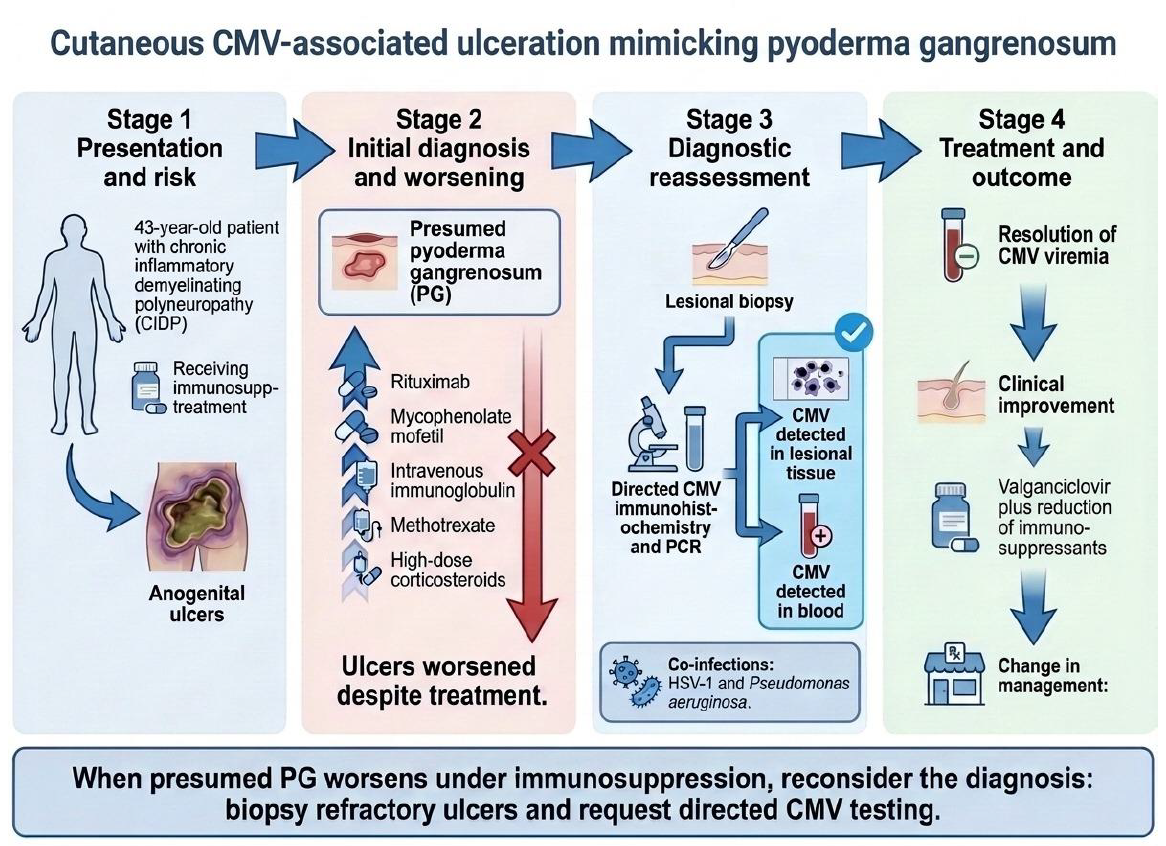
Cytomegalovirus (CMV) cutaneous ulceration is a rare but important mimic of inflammatory ulcerative dermatoses in immunocompromised patients. We report a case of a 43-year-old man with chronic inflammatory demyelinating polyneuropathy receiving rituximab, mycophenolate mofetil, and intravenous immunoglobulin who presented with progressive, painful anogenital ulcers initially diagnosed as pyoderma gangrenosum (PG). Despite escalating immunosuppression, including methotrexate and high-dose corticosteroids, the ulcers worsened. Multiple biopsies were performed over the disease course showing only nonspecific ulceration and were repeatedly negative for HSV; CMV was identified only when directed immunohistochemistry was applied to a repeat inpatient biopsy, revealing positive nuclear staining with nucleomegaly. CMV DNA was subsequently detected by PCR in both lesional tissue and blood (viral load 1099 IU/mL). HSV-1 was repeatedly detected from surface groin and oral specimens, although tissue-based HSV testing was negative; Pseudomonas aeruginosa was felt to represent colonization, contributing to diagnostic complexity. Ulceration was therefore best characterized as CMV-associated, with possible clinically significant CMV/HSV coinfection. Immunosuppression was reduced, and valganciclovir therapy was initiated, resulting in clinical improvement and resolution of viremia. This case highlights the importance of reconsidering the diagnosis in presumed PG that worsens with immunosuppression and emphasizes the need for early biopsy with directed viral testing. Recognition of CMV as an infectious mimic can prevent inappropriate escalation of immunosuppression and reduce morbidity in immunocompromised hosts.
- Open Access
- Case Report
Cutaneous Cytomegalovirus-Associated Ulceration Mimicking Pyoderma Gangrenosum in an Iatrogenically Immunosuppressed Patient: A Case Report
- Rachel A. Dorey * and
- Colton R. Jensen
Author Information
Received: 04 July 2026 | Revised: 28 October 2026 | Accepted: 02 November 2026 | Published: 12 November 2026
Abstract
Graphical Abstract
Keywords
cytomegalovirus | herpes simplex virus | pyoderma gangrenosum | immunosuppression | genital ulcer | valganciclovir
References
- 1.
Weenig, R.H.; Davis, M.D.P.; Dahl, P.R.; et al. Skin Ulcers Misdiagnosed as Pyoderma Gangrenosum. N. Engl. J. Med. 2002, 347, 1412–1418. https://doi.org/10.1056/nejmoa013383.
- 2.
Becker, S.L.; Badawi, A.H.; Thornton, C.; et al. Clinical Mimickers Misdiagnosed as Pyoderma Gangrenosum. Am. J. Clin. Dermatol. 2025, 26, 511–523. https://doi.org/10.1007/s40257-025-00941-z.
- 3.
Agrawal, S.; Hutson, S.D.; Johnson, E.F.; et al. Cytomegalovirus-induced cutaneous ulcers: A case series. JAAD Case Rep. 2025, 61, 123–128. https://doi.org/10.1016/j.jdcr.2025.04.016.
- 4.
Hartsough, E.M.; Nazarian, R.M.; Cornejo, K.M.; et al. Unusual isolated cytomegalovirus cutaneous infections: A subtle histopathologic diagnosis with review of the literature. J. Cutan. Pathol. 2024, 51, 565–571. https://doi.org/10.1111/cup.14608.
- 5.
Choi, Y.L.; Kim, J.A.; Jang, K.T.; et al. Characteristics of cutaneous cytomegalovirus infection in non-acquired immune deficiency syndrome, immunocompromised patients. Br. J. Dermatol. 2006, 155, 977–982. https://doi.org/10.1111/j.1365-2133.2006.07456.x.
- 6.
Fernández, S.; Grafia, I.; Peyrony, O.; et al. Clinical characteristics and outcomes of immunocompromised critically ill patients with cytomegalovirus end-organ disease: A multicenter retrospective cohort study. Crit. Care 2024, 28, 243. https://doi.org/10.1186/s13054-024-05029-4.
- 7.
Hayes, B.B.; Boyd, A.S. Cytomegalovirus-Induced Perineal Ulcerations in a Woman: Case Report and Review of the Literature. J. Toxicol. Cutan. Ocul. Toxicol. 2003, 22, 47–50. https://doi.org/10.1081/cus-120019329.
- 8.
Kaisar, M.O.; Kirwan, R.M.; Strutton, G.M.; et al. Cutaneous manifestations of cytomegalovirus disease in renal transplant recipients: A case series. Transpl. Infect. Dis. 2008, 10, 209–213. https://doi.org/10.1111/j.1399-3062.2007.00273.x.
- 9.
Tarkan, J.L.; Woo, S.B.; Pavlakis, M.; et al. Spotting the owl: Surreptitious cytomegalovirus disease in a renal transplant recipient. Clin. Transplant. 2008, 22, 391–395. https://doi.org/10.1111/j.1399-0012.2008.00793.x.
- 10.
Lima, R.B.; Santos, P.S.S.; Malafronte, P.; et al. Oral Manifestation of Cytomegalovirus Associated with Herpes Simplex Virus in Renal Transplant Recipient. Transplant. Proc. 2008, 40, 1378–1381. https://doi.org/10.1016/j.transproceed.2008.03.138.
- 11.
López-Pintor, R.M.; Hernández, G.; de Arriba, L.; et al. Oral Ulcers during the Course of Cytomegalovirus Infection in Renal Transplant Recipients. Transplant. Proc. 2009, 41, 2419–2421. https://doi.org/10.1016/j.transproceed.2009.06.053.
- 12.
Gouveia, A.I.; Borges-Costa, J.; Soares-Almeida, L.; et al. Herpes simplex virus and cytomegalovirus co-infection presenting as exuberant genital ulcer in a woman infected with human immunodeficiency virus. Clin. Exp. Dermatol. 2014, 39, 915–917. https://doi.org/10.1111/ced.12453.
- 13.
Guo, R.F.; Gebreab, F.H.; Tang, E.H.H.; et al. Cutaneous Ulcer as Leading Symptom of Systemic Cytomegalovirus Infection. Case Rep. Infect. Dis. 2015, 2015, 723962. https://doi.org/10.1155/2015/723962.
- 14.
Ezzatzadegan Jahromi, S.; Lotfi, Z.; Torabi-Nezhad, S.; et al. A potential role for cytomegalovirus in a facial ulcer in a renal transplant recipient. Transpl. Infect. Dis. 2016, 18, 457–460. https://doi.org/10.1111/tid.12536.
- 15.
Fasanya, A.A.; Pedersen, F.T.; Alhassan, S.; et al. Cytomegalovirus Cutaneous Infection in an Immunocompromised Patient. Cureus 2016, 8, e598. https://doi.org/10.7759/cureus.598.
- 16.
Masuda, Y.; Fujiwara, S.; Kunisada, M.; et al. Two cases of cytomegalovirus-related cutaneous ulcers indicating an ominous clinical prognosis. Eur. J. Dermatol. 2016, 26, 499–501. https://doi.org/10.1684/ejd.2016.2818.
- 17.
Ito, K.; Okuno, T.; Sawada, A.; et al. Recurrent Aphthous Stomatitis Caused by Cytomegalovirus, Herpes Simplex Virus, and Candida Species in a Kidney Transplant Recipient: A Case Report. Transplant. Proc. 2019, 51, 993–997. https://doi.org/10.1016/j.transproceed.2019.01.058.
- 18.
Hajihashemi, Z.; Bidari-Zerehpoosh, F.; Zahedi, K.; et al. Cytomegalovirus-induced cutaneous ulcer mimicking vasculitis in a patient with systemic lupus erythematosus: A case report and review of the literature. Lupus 2021, 30, 149–154. https://doi.org/10.1177/0961203320961473.
- 19.
Ferguson, J.; Mooney, K.; Saleem, A.; et al. Cutaneous cytomegalovirus—A case of disseminated cytomegalovirus presenting with extensive ulcerative skin lesions in a renal transplant recipient. Transpl. Infect. Dis. 2021, 23, e13582. https://doi.org/10.1111/tid.13582.
- 20.
Bhandari, G.; Tiwari, V.; Gupta, A.; et al. CMV presenting as a skin growth in renal transplant patient. Transpl. Infect. Dis. 2021, 23, e13590. https://doi.org/10.1111/tid.13590.
- 21.
Yu, H.C.; Liu, W.D.; Kuo, P.H.; et al. Cutaneous presentation of disseminated cytomegalovirus infection in a non-transplant patient with hematological malignancy: A case report. Medicine 2022, 101, e28721. https://doi.org/10.1097/md.0000000000028721.


This work is licensed under a Creative Commons Attribution 4.0 International License.