
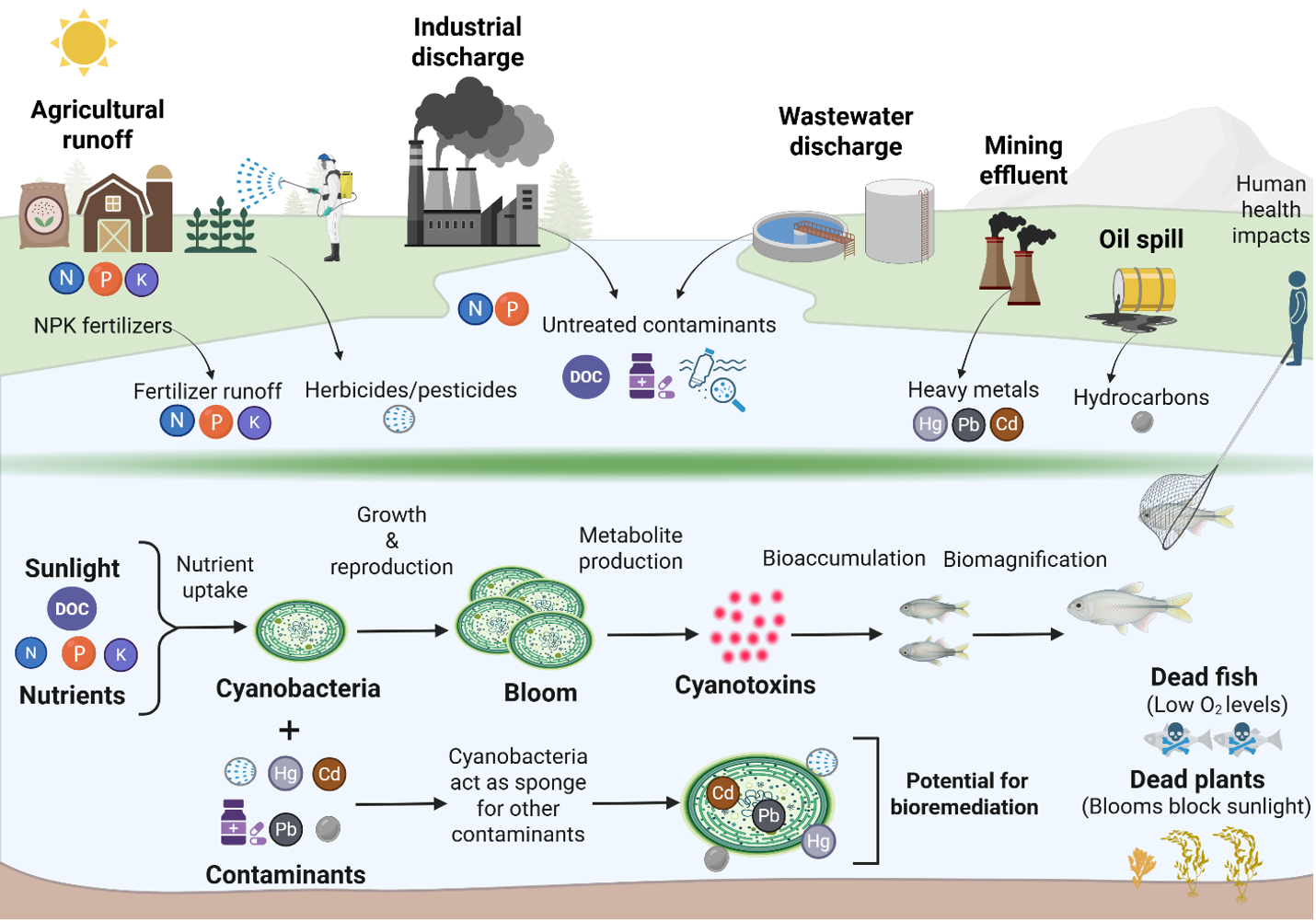
Cyanobacteria are highly effective microorganisms with strong potential for remediation of a wide range of contaminants, including heavy metals, pharmaceuticals and personal care products (PPCPs), synthetic dyes, polycyclic aromatic hydrocarbons (PAHs), per- and polyfluoroalkyl substances (PFAS), polychlorinated biphenyls (PCBs), and other organic pollutants, commonly found across aquatic environments. This review critically discusses cyanobacteria as natural absorbents (“sponges”) and examines related mechanisms of bioremediation: biosorption, bioaccumulation, and biodegradation, while exploring sustainable approaches for resource recovery and biomass valorization. Various bioreactor configurations have also been discussed for optimizing growth and pollutant removal efficiency. This review brings together current knowledge on cyanobacteria-based remediation and outlines key directions needed to move these approaches toward reliable, real-world implementation.
- Open Access
- Review
Cyanobacteria: Can They Serve as Natural Sponges for Environmental Contaminants?
- Anastasiia Bolshakova †,
- Gaurav Bhardwaj †,
- Khyati Joshi †,
- Ratul Kumar Das and
- Satinder Kaur Brar *
Author Information
Received: 11 March 2026 | Revised: 05 May 2026 | Accepted: 25 May 2026 | Published: 10 June 2026
Abstract
Graphical Abstract
Keywords
cyanobacteria | emerging contaminants | bioremediation | circular bioeconomy | bioreactor systems
References
- 1.
Saleem, A.; Anwar, S.; Saud, S.; et al. Cyanobacteria Diversity and Ecological Roles: Insights into Cyanobacterial Adaptations and Environmental Implications. J. Umm Al-Qura Univ. Appl. Sci. 2025. https://doi.org/10.1007/S43994-025-00261-2.
- 2.
Song, L.; Jia, Y.; Qin, B.; et al. Harmful Cyanobacterial Blooms: Biological Traits, Mechanisms, Risks, and Control Strategies. Annu. Rev. Environ. Resour. 2023, 48, 123–147. https://doi.org/10.1146/ANNUREV-ENVIRON-112320-081653.
- 3.
Chandra, S.; Bhattacharya, S.; Pandit, S.; et al. Cyanobacteria as an Eco-Friendly Bioresource for EPS Production with Crack Healing Capacity in Concrete. Biocatal. Agric. Biotechnol. 2023, 54, 102909. https://doi.org/10.1016/J.BCAB.2023.102909.
- 4.
Tan, Y.; Wang, Y.; Bing, X.; et al. Coupling Effect of Cyanobacterial Blooms with Migration and Transformation of Typical Pollutants in Lake or Reservoir: Enhanced or Decreased? Environ. Res. 2025, 267, 120734. https://doi.org/10.1016/J.ENVRES.2024.120734.
- 5.
Dudeja, C.; Masroor, S.; Mishra, V.; et al. Cyanobacteria-Based Bioremediation of Environmental Contaminants: Advances and Computational Insights. Discov. Agric. 2025, 3, 42. https://doi.org/10.1007/S44279-025-00193-9.
- 6.
Lourembam, J.; Haobam, B.; Singh, K.B.; et al. The Molecular Insights of Cyanobacterial Bioremediations of Heavy Metals: The Current and the Future Challenges. Front. Microbiol. 2024, 15, 1450992. https://doi.org/10.3389/FMICB.2024.1450992.
- 7.
Nikita; Singh, U.; Tiwari, G.L.; et al. Bioremediation of Heavy Metals Mediated by Cyanobacteria. In Biodegradation of Toxic and Hazardous Chemicals: Remediation and Resource Recovery; CRC Press: Boca Raton, FL, USA, 2024; pp. 135–147. https://doi.org/10.1201/9781003391487-9.
- 8.
Sarkhel, R.; Gupta, P.; Mandal, T. Bioremediation of Microplastics by Cyanobacteria. In Microplastics in the Terrestrial Environment: Pathways and Remediation Strategies; CRC Press: Boca Raton, FL, USA, 2024; pp. 316–330. https://doi.org/10.1201/9781032684574-17.
- 9.
Wu, P.; Luo, Y.; Hu, T.; et al. Sustainable Biodegradation of Triclosan and Sulfamethoxazole with Cyanobacteria: Resistance Mechanism and Metabolic Transformation. ACS EST Water 2025, 5, 943–952. https://doi.org/10.1021/ACSESTWATER.4C00975.
- 10.
Forouzandeh, A.; Schlosser, M.S.L.; Vernon, A.N.; et al. Mobilization of Genes Encoding Potential PFAS-Degradation Enzymes and Positive Selection in Cyanobacteria. bioRxiv 2025. https://doi.org/10.1101/2025.07.23.666183.
- 11.
Kumar, M.S.; Muralitharan, G.; Thajuddin, N. Screening of a Hypersaline Cyanobacterium, Phormidium tenue, for the Degradation of Aromatic Hydrocarbons: Naphthalene and Anthracene. Biotechnol. Lett. 2009, 31, 1863–1866. https://doi.org/10.1007/S10529-009-0085-3.
- 12.
Bhardwaj, G.; Abdulkadhim, M.; Joshi, K.; et al. Exposure Pathways, Systemic Distribution, and Health Implications of Micro- and Nanoplastics in Humans. Appl. Sci. 2025, 15, 8813. https://doi.org/10.3390/app15168813.
- 13.
Metcalf, J.S.; Codd, G.A. Co-Occurrence of Cyanobacteria and Cyanotoxins with Other Environmental Health Hazards: Impacts and Implications. Toxins 2020, 12, 629. https://doi.org/10.3390/TOXINS12100629.
- 14.
Li, X.; Luo, K.; Ren, J.; et al. Characterisation of Extracellular Polymeric Substances from Different Cyanobacterial Species and Their Influence on Biocalcification Processes. Environ. Chem. 2017, 14, 254–265. https://doi.org/10.1071/EN17068.
- 15.
Bhardwaj, G.; Wankhede, L.; Pulicharla, R.; et al. Microplastic-Associated Biofilms in Wastewater Treatment Plants: Mechanisms and Impacts. J. Water Process Eng. 2025, 72, 107582. https://doi.org/10.1016/j.jwpe.2025.107582.
- 16.
Sadettin, S.; Dönmez, G. Bioaccumulation of Reactive Dyes by Thermophilic Cyanobacteria. Process Biochem. 2006, 41, 836–841. https://doi.org/10.1016/J.PROCBIO.2005.10.031.
- 17.
Rakić, I.Z.; Kevrešan, Ž.S.; Kovač, R.; et al. Bioaccumulation and Biosorption Study of Heavy Metals Removal by Cyanobacteria Nostoc sp. Chem. Ind. Chem. Eng. Q. 2023, 29, 291–298. https://doi.org/10.2298/CICEQ220511002R.
- 18.
Sadettin, S.; Dönmez, G. Simultaneous Bioaccumulation of Reactive Dye and Chromium(VI) by Using Thermophil Phormidium sp. Enzyme Microb. Technol. 2007, 41, 175–180. https://doi.org/10.1016/J.ENZMICTEC.2006.12.015.
- 19.
Flores, E.; Herrero, A. Nitrogen Assimilation and Nitrogen Control in Cyanobacteria. Biochem. Soc. Trans. 2005, 33, 164–167. https://doi.org/10.1042/BST0330164.
- 20.
Cottingham, K.L.; Ewing, H.A.; Greer, M.L.; et al. Cyanobacteria as Biological Drivers of Lake Nitrogen and Phosphorus Cycling. Ecosphere 2015, 6, 1–19. https://doi.org/10.1890/ES14-00174.1.
- 21.
Anas, M.; Khattak, W.A.; Avci, M.A.; et al. Role of Cyanobacteria in Bioremediation and Environmental Restoration. In Cyanobacterial Blooms: Ecology, Evolution and Biogeochemical Impacts; Springer: Cham, Switzerland, 2026; pp. 421–446. https://doi.org/10.1007/978-3-032-06042-6_17.
- 22.
El-Bestawy, E.A.; El-Salam, A.Z.A.; Mansy, A.E.R.H. Potential Use of Environmental Cyanobacterial Species in Bioremediation of Lindane-Contaminated Effluents. Int. Biodeterior. Biodegrad. 2007, 59, 180–192. https://doi.org/10.1016/J.IBIOD.2006.12.005.
- 23.
Sultana, U.; Vanamala, P.; Zahoor Gul, M. Cyanobacteria for Bioremediation of Contaminated Soil. In Microbial and Biotechnological Interventions in Bioremediation and Phytoremediation; Springer: Cham, Switzerland, 2022; pp. 203–220. https://doi.org/10.1007/978-3-031-08830-8_9.
- 24.
Sarmah, P.; Rout, J. Role of Algae and Cyanobacteria in Bioremediation: Prospects in Polyethylene Biodegradation. In Advances in Cyanobacterial Biology; Academic Press: Cambridge, MA, USA, 2020; pp. 333–349. https://doi.org/10.1016/B978-0-12-819311-2.00022-X.
- 25.
Zhubanova, A.A.; Ernazarova, A.K.; Kaiyrmanova, G.K.; et al. Construction of Cyanobacterial-Bacterial Consortium on the Basis of Axenic Cyanobacterial Cultures and Heterotrophic Bacteria Cultures for Bioremediation of Oil-Contaminated Soils and Water Ponds. Russ. J. Plant Physiol. 2013, 60, 555–562. https://doi.org/10.1134/S1021443713040183.
- 26.
Rueda, E.; García-Galán, M.J.; Ortiz, A.; et al. Bioremediation of Agricultural Runoff and Biopolymers Production from Cyanobacteria Cultured in Demonstrative Full-Scale Photobioreactors. Process Saf. Environ. Prot. 2020, 139, 241–250. https://doi.org/10.1016/J.PSEP.2020.03.035.
- 27.
Papadopoulos, K.P.; Economou, C.N.; Tekerlekopoulou, A.G.; et al. A Cyanobacteria-Based Biofilm System for Advanced Brewery Wastewater Treatment. Appl. Sci. 2021, 11, 174. https://doi.org/10.3390/APP11010174.
- 28.
Kalita, N.; Baruah, P.P. Cyanobacteria as a Potent Platform for Heavy Metals Biosorption: Uptake, Responses and Removal Mechanisms. J. Hazard. Mater. Adv. 2023, 11, 100349. https://doi.org/10.1016/j.hazadv.2023.100349.
- 29.
Mangan, N.M.; Brenner, M.P. Systems Analysis of the CO2 Concentrating Mechanism in Cyanobacteria. eLife 2014, 3, e02043. https://doi.org/10.7554/eLife.02043.
- 30.
Stal, L.J. Nitrogen Fixation in Cyanobacteria. In Encyclopedia of Life Sciences; John Wiley & Sons, Ltd.: Hoboken, NJ, USA, 2015; pp. 1–9. https://doi.org/10.1002/9780470015902.a0021159.
- 31.
Zhang, Q.; Jia, L.; Chen, Y.; et al. Molecular Mechanisms of the Cyanobacterial Response to Different Phosphorus Sources. Sustainability 2024, 16, 5642. https://doi.org/10.3390/su16135642.
- 32.
Rangabhashiyam, S.; Balasubramanian, P. Characteristics, Performances, Equilibrium and Kinetic Modeling Aspects of Heavy Metal Removal Using Algae. Bioresour. Technol. Rep. 2019, 5, 261–279. https://doi.org/10.1016/j.biteb.2018.07.009.
- 33.
Touliabah, H.E.S.; El-Sheekh, M.M.; Ismail, M.M.; et al. A Review of Microalgae- and Cyanobacteria-Based Biodegradation of Organic Pollutants. Molecules 2022, 27, 1141. https://doi.org/10.3390/molecules27031141.
- 34.
Al-Amin, A.; Parvin, F.; Chakraborty, J.; et al. Cyanobacteria Mediated Heavy Metal Removal: A Review on Mechanism, Biosynthesis, and Removal Capability. Environ. Technol. Rev. 2021, 10, 44–57. https://doi.org/10.1080/21622515.2020.1869323.
- 35.
Bhardwaj, G.; Wankhede, L. Bioremediation of Microplastics in Wastewater Treatment Plants: A Sustainable Approach. ACS Symp. Ser. 2025, 1517, 237–258. https://doi.org/10.1021/bk-2025-1517.ch008.
- 36.
Kaur, R.; Gupta, S.; Tripathi, V.; et al. Microbiome Based Approaches for the Degradation of Polycyclic Aromatic Hydrocarbons (PAHs): A Current Perception. Chemosphere 2023, 341, 139951. https://doi.org/10.1016/j.chemosphere.2023.139951.
- 37.
Zhang, H.; Jiang, X.; Lu, L.; et al. Biodegradation of Polychlorinated Biphenyls (PCBs) by the Novel Identified Cyanobacterium Anabaena PD-1. PLoS ONE 2015, 10, e0131450. https://doi.org/10.1371/journal.pone.0131450.
- 38.
Castellanos-Estupiñan, M.A.; Carrillo-Botello, A.M.; Rozo-Granados, L.S.; et al. Removal of Nutrients and Pesticides from Agricultural Runoff Using Microalgae and Cyanobacteria. Water 2022, 14, 558. https://doi.org/10.3390/w14040558.
- 39.
Cruz, D.; Vasconcelos, V.; Pierre, G.; et al. Exopolysaccharides from Cyanobacteria: Strategies for Bioprocess Development. Appl. Sci. 2020, 10, 3763. https://doi.org/10.3390/app10113763.
- 40.
Chojnacka, K. Biosorption and Bioaccumulation—The Prospects for Practical Applications. Environ. Int. 2010, 36, 299–307. https://doi.org/10.1016/J.ENVINT.2009.12.001.
- 41.
Xia, L.; Zhao, Z.; Lang, Z.; et al. Exploring the Cumulative Selectivity of Polycyclic Aromatic Hydrocarbons in Phytoplankton, Water, and Sediment in Typical Urban Water Bodies. Water 2022, 14, 3145. https://doi.org/10.3390/W14193145.
- 42.
Stange, K.; Swackhamer, D.L. Factors Affecting Phytoplankton Species-Specific Differences in Accumulation of 40 Polychlorinated Biphenyls (PCBs). Environ. Toxicol. Chem. 1994, 13, 1849–1860. https://doi.org/10.1002/ETC.5620131117.
- 43.
Pan, M.; Lyu, T.; Zhan, L.; et al. Mitigating Antibiotic Pollution Using Cyanobacteria: Removal Efficiency, Pathways and Metabolism. Water Res. 2021, 190, 116735. https://doi.org/10.1016/J.WATRES.2020.116735.
- 44.
Ni, Y.; Lai, J.; Wan, J.; et al. Photosynthetic Responses and Accumulation of Mesotrione in Two Freshwater Algae. Environ. Sci. Process. Impacts 2014, 16, 2288–2294. https://doi.org/10.1039/C4EM00254G.
- 45.
Mona, S.; Kaushik, A.; Kaushik, C.P. Biosorption of Reactive Dye by Waste Biomass of Nostoc linckia. Ecol. Eng. 2011, 37, 1589–1594. https://doi.org/10.1016/J.ECOLENG.2011.04.005.
- 46.
Tiwari, B.; Sellamuthu, B.; Ouarda, Y.; et al. Review on Fate and Mechanism of Removal of Pharmaceutical Pollutants from Wastewater Using Biological Approach. Bioresour. Technol. 2017, 224, 1–12. https://doi.org/10.1016/J.BIORTECH.2016.11.042.
- 47.
Joshi, K.; Elshafie, A.; Magdouli, S.; et al. Biodegradation of Mixed Polycyclic Aromatic Hydrocarbons by Newly Isolated Priestia megaterium KS01 and Its Enzymatic Pathway Profiling. J. Environ. Chem. Eng. 2025, 13, 120131. https://doi.org/10.1016/J.JECE.2025.120131.
- 48.
Aldaby, E.S.E.; Mawad, A.M.M. Pyrene Biodegradation Capability of Two Different Microalgal Strains. Global NEST J. 2019, 21, 290–295. https://doi.org/10.30955/GNJ.002767.
- 49.
Márquez-Villa, J.M.; Rodríguez-Sierra, J.C.; Amtanus Chequer, N.; et al. Phenanthrene Degradation by Photosynthetic Bacterial Consortium Dominated by Fischerella sp. Life 2023, 13, 1108. https://doi.org/10.3390/LIFE13051108.
- 50.
Marchetto, F.; Roverso, M.; Righetti, D.; et al. Bioremediation of Per- and Poly-Fluoroalkyl Substances (PFAS) by Synechocystis sp. PCC 6803: A Chassis for a Synthetic Biology Approach. Life 2021, 11, 1300. https://doi.org/10.3390/LIFE11121300.
- 51.
Sarmah, P.; Rout, J. Efficient Biodegradation of Low-Density Polyethylene by Cyanobacteria Isolated from Submerged Polyethylene Surface in Domestic Sewage Water. Environ. Sci. Pollut. Res. 2018, 25, 33508–33520. https://doi.org/10.1007/s11356-018-3079-7.
- 52.
El-Sheekh, M.M.; Gharieb, M.M.; Abou-El-Souod, G.W. Biodegradation of Dyes by Some Green Algae and Cyanobacteria. Int. Biodeterior. Biodegrad. 2009, 63, 699–704. https://doi.org/10.1016/j.ibiod.2009.04.010.
- 53.
Parikh, A.; Madamwar, D. Textile Dye Decolorization Using Cyanobacteria. Biotechnol. Lett. 2005, 27, 323–326. https://doi.org/10.1007/s10529-005-0691-7.
- 54.
Joseph, V.; Joseph, A. Microalgae in Petrochemical Effluent: Growth and Biosorption of Total Dissolved Solids. Bull. Environ. Contam. Toxicol. 2001, 66, 522–527. https://doi.org/10.1007/s00128-001-0038-6.
- 55.
Dellamatrice, P.M.; Silva-Stenico, M.E.; de Moraes, L.A.B.; et al. Degradation of Textile Dyes by Cyanobacteria. Braz. J. Microbiol. 2017, 48, 25–31. https://doi.org/10.1016/J.BJM.2016.09.012.
- 56.
Seymour, J.R.; Amin, S.A.; Raina, J.B.; et al. Zooming in on the Phycosphere: The Ecological Interface for Phytoplankton–Bacteria Relationships. Nat. Microbiol. 2017, 2, 17065. https://doi.org/10.1038/nmicrobiol.2017.65.
- 57.
Briand, E.; Humbert, J.F.; Tambosco, K.; et al. Role of Bacteria in the Production and Degradation of Microcystis Cyanopeptides. Microbiologyopen 2016, 5, 469. https://doi.org/10.1002/MBO3.343.
- 58.
Fang, Y.; Lin, G.; Liu, Y.; et al. Removal of Sulfamethoxazole and Production of Cyanobacterial Lipid Promoted by the Construction of a Consortium Containing a Non-Toxic Cyanobacterium and Sewage Bacteria. J. Clean. Prod. 2024, 447, 141544. https://doi.org/10.1016/J.JCLEPRO.2024.141544.
- 59.
Zhao, L.; Lin, L.Z.; Zeng, Y.; et al. The Facilitating Role of Phycospheric Heterotrophic Bacteria in Cyanobacterial Phosphonate Availability and Microcystis Bloom Maintenance. Microbiome 2023, 11, 142. https://doi.org/10.1186/S40168-023-01582-2.
- 60.
Cai, H.; McLimans, C.J.; Jiang, H.; et al. Aerobic Anoxygenic Phototrophs Play Important Roles in Nutrient Cycling within Cyanobacterial Microcystis Bloom Microbiomes. Microbiome 2024, 12, 88. https://doi.org/10.1186/S40168-024-01801-4.
- 61.
Cai, H.; Jiang, H.; Krumholz, L.R.; et al. Bacterial Community Composition of Size-Fractioned Aggregates within the Phycosphere of Cyanobacterial Blooms in a Eutrophic Freshwater Lake. PLoS ONE 2014, 9, e102879. https://doi.org/10.1371/JOURNAL.PONE.0102879.
- 62.
Fang, Y.; Lin, G.; Liu, Y.; et al. Contaminant Removal Performance and Lipid Productivity of a Cyanobacteria-Bacteria Consortium Containing Exogenous Phytohormones during the Treatment of Antibiotic-Polluted Wastewater. Chemosphere 2024, 361, 142473. https://doi.org/10.1016/j.chemosphere.2024.142473.
- 63.
Fan, X.; Kong, L.; Wang, J.; et al. Surface-Programmed Microbiome Assembly in Phycosphere to Microplastics Contamination. Water Res. 2024, 262, 122064. https://doi.org/10.1016/J.WATRES.2024.122064.
- 64.
Chen, J.; Qin, B.; Han, Y.; et al. Sulfamethoxazole and Sulfaisoxazole Stress on Growth, Photosynthesis, Cell Structure and Oxidation System in Microcystis aeruginosa. Algal Res. 2025, 87, 103880. https://doi.org/10.1016/J.ALGAL.2024.103880.
- 65.
Xu, S.; Liu, Y.; Zhang, J.; et al. Proteomic Mechanisms for the Combined Stimulatory Effects of Glyphosate and Antibiotic Contaminants on Microcystis aeruginosa. Chemosphere 2021, 267, 129244. https://doi.org/10.1016/j.chemosphere.2020.129244.
- 66.
Liu, Y.; Chen, S.; Zhang, J.; et al. Growth, Microcystin-Production and Proteomic Responses of Microcystis aeruginosa under Long-Term Exposure to Amoxicillin. Water Res. 2016, 93, 141–152. https://doi.org/10.1016/j.watres.2016.01.060.
- 67.
Liu, Y.; Zhang, J.; Gao, B.; et al. Combined Effects of Two Antibiotic Contaminants on Microcystis aeruginosa. J. Hazard. Mater. 2014, 279, 148–155. https://doi.org/10.1016/j.jhazmat.2014.07.002.
- 68.
Liu, X.X.; Li, J.M.; Wang, R.B.; et al. Antibiotics Disrupt Bacteria–Phytoplankton Symbioses: Unveiling Ecological Risks in Aquatic Ecosystems. Oikos 2025, 2025, e11201. https://doi.org/10.1111/OIK.11201.
- 69.
Sánchez-Fortún, A.; Dʼors, A.; Fajardo, C.; et al. Influence of Contaminant-Spiked Polyethylene-Type Microplastics on the Growth and Primary Production of the Freshwater Phytoplankton Species Scenedesmus armatus and Microcystis aeruginosa. Environ. Exp. Bot. 2022, 203, 105061. https://doi.org/10.1016/J.ENVEXPBOT.2022.105061.
- 70.
Feng, L.J.; Sun, X.D.; Zhu, F.P.; et al. Nanoplastics Promote Microcystin Synthesis and Release from Cyanobacterial Microcystis aeruginosa. Environ. Sci. Technol. 2020, 54, 3386–3394. https://doi.org/10.1021/ACS.EST.9B06085.
- 71.
Gradíssimo, D.G.; Xavier, L.P.; Santos, A.V. Cyanobacterial Polyhydroxyalkanoates: A Sustainable Alternative in Circular Economy. Molecules 2020, 25, 4331. https://doi.org/10.3390/molecules25184331.
- 72.
Kasting, J.F. The Rise of Atmospheric Oxygen. Science 2001, 293, 819–820. https://doi.org/10.1126/science.1063811.
- 73.
Sundaram, T.; Rajendran, S.; Gnanasekaran, L.; et al. Bioengineering Strategies of Microalgae Biomass for Biofuel Production: Recent Advancement and Insight. Bioengineered 2023, 14, 2252228. https://doi.org/10.1080/21655979.2023.2252228.
- 74.
Chia, W.Y.; Ying Tang, D.Y.; Khoo, K.S.; et al. Natureʼs Fight against Plastic Pollution: Algae for Plastic Biodegradation and Bioplastics Production. Environ. Sci. Ecotechnol. 2020, 4, 100065. https://doi.org/10.1016/J.ESE.2020.100065.
- 75.
Kapahi, P.; Goyal, E.; Fayaz, T.; et al. Microalgae-Based Wastewater Treatment and Biomass Production for Different Applications. In Industrial and Biotechnological Applications of Algae; Springer: Singapore, 2025; pp. 1–20. https://doi.org/10.1007/978-981-96-1844-6_1.
- 76.
Wang, J.; Zhang, S.; Wei, C.; et al. Hydrothermal Carbonization of Heavy Metal-Contaminated Biomass: Migration, Transformation, and Ecological Stability Changes of Metals. Int. J. Mol. Sci. 2025, 26, 2551. https://doi.org/10.3390/IJMS26062551.
- 77.
Naaz, F.; Bhattacharya, A.; Pant, K.K.; et al. Impact of Heavy Metal Laden Algal Biomass on Hydrothermal Liquefaction and Biorefinery Approach. Process Saf. Environ. Prot. 2021, 145, 141–149. https://doi.org/10.1016/J.PSEP.2020.08.005.
- 78.
Guo, B.; Yang, B.; Su, Y.; et al. Screening and Optimization of Microalgae Biomass and Plastic Material Coprocessing by Hydrothermal Liquefaction. ACS EST Eng. 2022, 2, 65–77. https://doi.org/10.1021/ACSESTENGG.1C00261.
- 79.
Malik, H.A.; Shahid, R.; Rehman, O.; et al. Development of Algal Industry 4.0 for Efficient Cultivation, Resource Recovery, and Bioproducts Production. In Algae Biotechnology: Decarbonization, Resource Recovery, and Bioproducts; Elsevier: Amsterdam, The Netherlands, 2026; pp. 355–374. https://doi.org/10.1016/B978-0-443-34063-5.00014-3.
- 80.
Jurado-Flores, A.; Heredia-Martínez, L.G.; Torres-Cortes, G.; et al. Harnessing Microalgae and Cyanobacteria for Sustainable Agriculture: Mechanistic Insights and Applications as Biostimulants, Biofertilizers and Biocontrol Agents. Agriculture 2025, 15, 1842. https://doi.org/10.3390/agriculture15171842.
- 81.
Ciani, M.; Adessi, A. Cyanoremediation and Phyconanotechnology: Cyanobacteria for Metal Biosorption toward a Circular Economy. Front. Microbiol. 2023, 14, 1166612. https://doi.org/10.3389/fmicb.2023.1166612.
- 82.
Bellver, M.; Ruales, E.; Díez-Montero, R.; et al. Natural Pigments and Biogas Recovery from Cyanobacteria Grown in Treated Wastewater. Fate of Organic Microcontaminants. Water Res. 2025, 273, 123005. https://doi.org/10.1016/j.watres.2024.123005.
- 83.
Shahid, A.; Usman, M.; Atta, Z.; et al. Impact of Wastewater Cultivation on Pollutant Removal, Biomass Production, Metabolite Biosynthesis, and Carbon Dioxide Fixation of Newly Isolated Cyanobacteria in a Multiproduct Biorefinery Paradigm. Bioresour. Technol. 2021, 333, 125194. https://doi.org/10.1016/j.biortech.2021.125194.
- 84.
Samantaray, S.; Mallick, N. Production and Characterization of Poly-β-Hydroxybutyrate (PHB) Polymer from Aulosira fertilissima. J. Appl. Phycol. 2012, 24, 803–814. https://doi.org/10.1007/s10811-011-9699-7.
- 85.
Bhati, R.; Mallick, N. Poly(3-Hydroxybutyrate-Co-3-Hydroxyvalerate) Copolymer Production by the Diazotrophic Cyanobacterium Nostoc muscorum Agardh: Process Optimization and Polymer Characterization. Algal Res. 2015, 7, 78–85. https://doi.org/10.1016/j.algal.2014.12.003.
- 86.
Nishioka, M.; Nakai, K.; Miyake, M.; et al. Production of Poly-β-Hydroxybutyrate by Thermophilic Cyanobacterium, Synechococcus sp. MA19, under Phosphate-Limited Conditions. Biotechnol. Lett. 2001, 23, 1095–1099. https://doi.org/10.1023/A:1010551614648.
- 87.
Khetkorn, W.; Incharoensakdi, A.; Lindblad, P.; et al. Enhancement of Poly-3-Hydroxybutyrate Production in Synechocystis sp. PCC 6803 by Overexpression of Its Native Biosynthetic Genes. Bioresour. Technol. 2016, 214, 761–768. https://doi.org/10.1016/j.biortech.2016.05.014.
- 88.
Brick, M.B.; Hussein, M.H.; Mowafy, A.M.; et al. Significance of Siderophore-Producing Cyanobacteria on Enhancing Iron Uptake Potentiality of Maize Plants Grown under Iron-Deficiency. Microb. Cell Fact. 2025, 24, 3. https://doi.org/10.1186/s12934-024-02618-4.
- 89.
Ghotbi-Ravandi, A.A.; Shariatmadari, Z.; Riahi, H.; et al. Enhancement of Essential Oil Production and Expression of Some Menthol Biosynthesis-Related Genes in Mentha piperita Using Cyanobacteria. Iran. J. Biotechnol. 2023, 21, 96–107. https://doi.org/10.30498/ijb.2023.368377.3550.
- 90.
Hussain, A.; Shah, S.T.; Rahman, H.; et al. Effect of IAA on in Vitro Growth and Colonization of Nostoc in Plant Roots. Front. Plant Sci. 2015, 6, 46. https://doi.org/10.3389/fpls.2015.00046.
- 91.
Youssef, S.M.; El-Serafy, R.S.; Ghanem, K.Z.; et al. Foliar Spray or Soil Drench: Microalgae Application Impacts on Soil Microbiology, Morpho-Physiological and Biochemical Responses, Oil and Fatty Acid Profiles of Chia Plants under Alkaline Stress. Biology 2022, 11, 1844. https://doi.org/10.3390/biology11121844.
- 92.
Koreivienė, J.; Karosienė, J.; Kasperovičienė, J.; et al. EU Project of LIFE Programme ‘Algae Service for LIFE’ Develops Ecologically Sustainable Bioproducts from Freshwater Cyanobacteria and Macroalgae Biomass. Botanica 2019, 25, 176–185. https://doi.org/10.2478/botlit-2019-0019.
- 93.
Kuddus, M.; Singh, P.; Thomas, G.; et al. Recent Developments in Production and Biotechnological Applications of C-Phycocyanin. BioMed Res. Int. 2013, 2013, 742859. https://doi.org/10.1155/2013/742859.
- 94.
Arias, D.M.; García, J.; Uggetti, E. Production of Polymers by Cyanobacteria Grown in Wastewater: Current Status, Challenges and Future Perspectives. N. Biotechnol. 2020, 55, 46–57. https://doi.org/10.1016/j.nbt.2019.09.001.
- 95.
Drosg, B.; Fritz, I.; Gattermayr, F.; et al. Photo-Autotrophic Production of Poly(Hydroxyalkanoates) in Cyanobacteria. Chem. Biochem. Eng. Q. 2015, 29, 145–156. https://doi.org/10.15255/CABEQ.2014.2254.
- 96.
Rhu, D.H.; Lee, W.H.; Kim, J.Y.; et al. PHA Production from Waste. Water Sci. Technol. 2003, 48, 221–228. https://doi.org/10.2166/wst.2003.0472.
- 97.
Lee, S.Y.; Hong, S.H.; Park, S.J.; et al. Metabolic Flux Analysis on the Production of Poly(3-Hydroxybutyrate). In Biopolymers Online; John Wiley & Sons, Ltd.: Hoboken, NJ, USA, 2005. https://doi.org/10.1002/3527600035.bpol3a08.
- 98.
Fujita, Y.; Uesaka, K. Nitrogen Fixation in Cyanobacteria. In Cyanobacterial Physiology; Academic Press: Cambridge, MA, USA, 2022; pp. 29–45. https://doi.org/10.1016/B978-0-323-96106-6.00007-1.
- 99.
Iniesta-Pallarés, M.; Álvarez, C.; Gordillo-Cantón, F.M.; et al. Sustaining Rice Production through Biofertilization with N2-Fixing Cyanobacteria. Appl. Sci. 2021, 11, 4628. https://doi.org/10.3390/app11104628.
- 100.
Nishanth, S.; Kokila, V.; Prasanna, R. Metabolite Profiling of Plant Growth Promoting Cyanobacteria—Anabaena laxa and Calothrix elenkinii, Using Untargeted Metabolomics. 3 Biotech 2024, 14, 35. https://doi.org/10.1007/s13205-023-03902-7.
- 101.
Jithesh, M.N.; Shukla, P.S.; Kant, P.; et al. Physiological and Transcriptomics Analyses Reveal That Ascophyllum nodosum Extracts Induce Salinity Tolerance in Arabidopsis by Regulating the Expression of Stress Responsive Genes. J. Plant Growth Regul. 2019, 38, 463–478. https://doi.org/10.1007/s00344-018-9861-4.
- 102.
Cruz, C.G.; Rosa, A.P.C.; Costa, J.A.V. Identification of the Phytohormones Indole-3-Acetic Acid and trans-Zeatin in Microalgae. J. Chem. Technol. Biotechnol. 2023, 98, 1048–1056. https://doi.org/10.1002/jctb.7312.
- 103.
Renganathan, P.; Puente, E.O.R.; Sukhanova, N.V.; et al. Hydroponics with Microalgae and Cyanobacteria: Emerging Trends and Opportunities in Modern Agriculture. BioTech 2024, 13, 27. https://doi.org/10.3390/biotech13030027.
- 104.
Baltrėnas, P.; Misevičius, A. Biogas Production Experimental Research Using Algae. J. Environ. Health Sci. Eng. 2015, 13, 18. https://doi.org/10.1186/s40201-015-0169-z.
- 105.
Park, S.; Li, Y. Evaluation of Methane Production and Macronutrient Degradation in the Anaerobic Co-Digestion of Algae Biomass Residue and Lipid Waste. Bioresour. Technol. 2012, 111, 42–48. https://doi.org/10.1016/j.biortech.2012.01.160.
- 106.
Zarei, Z.; Malekshahi, P.; Morowvat, M.H.; et al. A Review of Bioreactor Configurations for Hydrogen Production by Cyanobacteria and Microalgae. Int. J. Hydrogen Energy 2024, 49, 472–495. https://doi.org/10.1016/J.IJHYDENE.2023.09.108.
- 107.
Davies, F.K.; Fricker, A.D.; Robins, M.M.; et al. Microbiota Associated with the Large-Scale Outdoor Cultivation of the Cyanobacterium Synechococcus sp. PCC 7002. Algal Res. 2021, 58, 102382. https://doi.org/10.1016/J.ALGAL.2021.102382.
- 108.
Takenaka, H.; Yamaguchi, Y. Commercial-Scale Culturing of Cyanobacteria: An Industrial Experience. In Cyanobacteria: An Economic Perspective; 2013; pp. 293–301. https://doi.org/10.1002/9781118402238.CH18.
- 109.
Arias, D.M.; Uggetti, E.; García, J. Assessing the Potential of Soil Cyanobacteria for Simultaneous Wastewater Treatment and Carbohydrate-Enriched Biomass Production. Algal Res. 2020, 51, 102042. https://doi.org/10.1016/J.ALGAL.2020.102042.
- 110.
Al-Homaidan, A.A.; Al-Abbad, A.F.; Al-Hazzani, A.A.; et al. Lead Removal by Spirulina platensis Biomass. Int. J. Phytoremediation 2016, 18, 184–189. https://doi.org/10.1080/15226514.2015.1073673.
- 111.
Johnson, T.J.; Katuwal, S.; Anderson, G.A.; et al. Photobioreactor Cultivation Strategies for Microalgae and Cyanobacteria. Biotechnol. Prog. 2018, 34, 811–827. https://doi.org/10.1002/BTPR.2628.
- 112.
Arias, D.M.; Uggetti, E.; García-Galán, M.J.; et al. Cultivation and Selection of Cyanobacteria in a Closed Photobioreactor Used for Secondary Effluent and Digestate Treatment. Sci. Total Environ. 2017, 587–588, 157–167. https://doi.org/10.1016/J.SCITOTENV.2017.02.097.
- 113.
Lan, S.; Wu, L.; Yang, H.; et al. A New Biofilm Based Microalgal Cultivation Approach on Shifting Sand Surface for Desert Cyanobacterium Microcoleus vaginatus. Bioresour. Technol. 2017, 238, 602–608. https://doi.org/10.1016/J.BIORTECH.2017.04.058.
- 114.
Milferstedt, K.; Kuo-Dahab, W.C.; Butler, C.S.; et al. The Importance of Filamentous Cyanobacteria in the Development of Oxygenic Photogranules. Sci. Rep. 2017, 7, 17944. https://doi.org/10.1038/s41598-017-16614-9.


This work is licensed under a Creative Commons Attribution 4.0 International License.
