
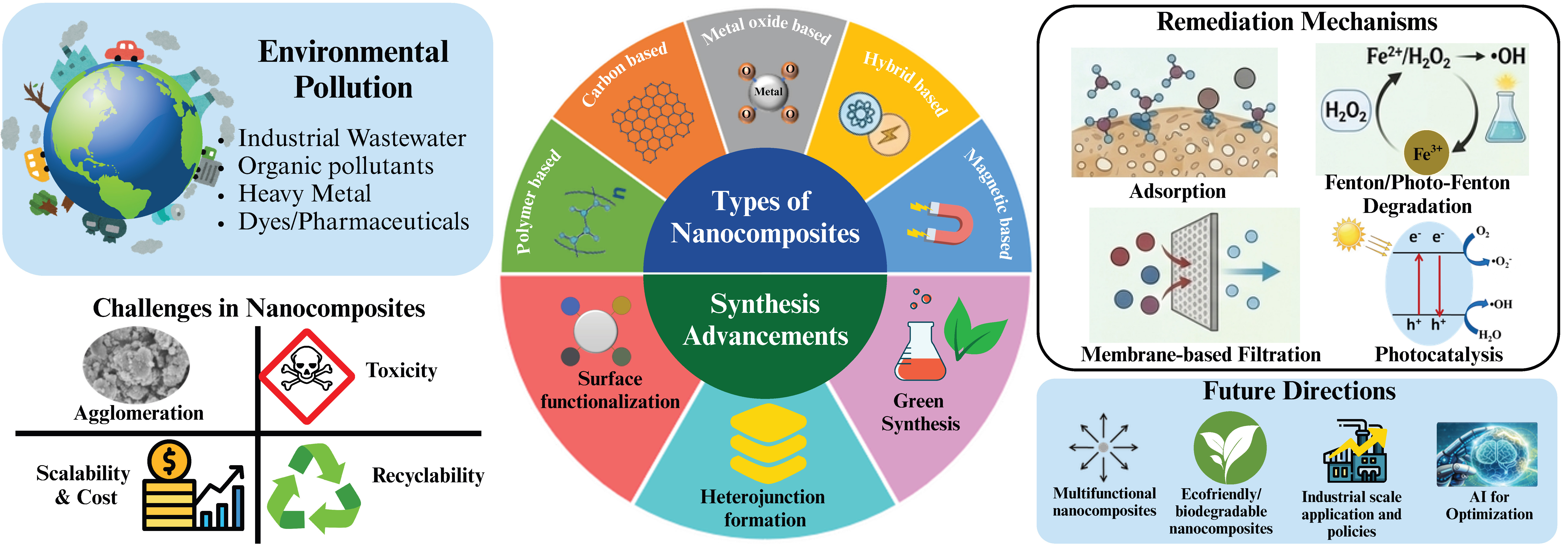
Nanocomposites have emerged as effective materials for environmental cleanup owing to their distinctive physicochemical features, elevated surface area, and increased reactivity. This review paper presents a comprehensive overview of nanocomposites used for environmental remediation, focusing on their synthesis, mechanisms, recent advancements, challenges, and future directions. The paper classifies nanocomposites into five primary types which are discussed in detail in this review. Each type offers distinct advantages in pollutant degradation and heavy metal removal through adsorption, photocatalysis, Fenton and Photo-Fenton reactions and membrane filtration. Notably, adsorption and photocatalytic mechanisms, including charge separation and ROS generation, are highlighted for their effectiveness in tackling contamination. Recent advancements in synthesis techniques emphasize green synthesis approaches, heterojunction formation, and surface functionalization to enhance performance. Despite the progress, challenges such as nanoparticle agglomeration, recyclability, toxicity, and environmental impacts persist. Addressing these limitations through innovative strategies is crucial for sustainable application. Future research should focus on developing multifunctional nanocomposites for integrated remediation, leveraging artificial intelligence for material optimization, and designing eco-friendly and biodegradable materials. By overcoming current challenges, nanocomposites hold significant potential to revolutionize environmental remediation strategies.
- Open Access
- Review
Next-Generation Nanocomposites for Environmental Remediation: Progress and Future Prospects
Author Information
Received: 09 Jun 2026 | Revised: 03 Aug 2026 | Accepted: 17 Aug 2026 | Published: 26 Aug 2026
Abstract
Graphical Abstract
Keywords
nanocomposites | environmental remediation | adsorption | photocatalysis | heavy metal removal | dye degradation | green synthesis
References
- 1.
Ukaogo, P.O.; Ewuzie, U.; Onwuka, C.V. Environmental Pollution: Causes, Effects, and the Remedies. In Microorganisms for Sustainable Environment and Health; Elsevier: Amsterdam, Netherlands, 2020; pp. 419–429.
- 2.
Shetty, S.S.; Deepthi, D.; Harshitha, S.; et al. Environmental Pollutants and Their Effects on Human Health. Heliyon 2023, 9, e19496. https://doi.org/10.1016/j.heliyon.2023.e19496.
- 3.
Zhang, P.; Yang, M.; Lan, J.; et al. Water Quality Degradation Due to Heavy Metal Contamination: Health Impacts and Eco-Friendly Approaches for Heavy Metal Remediation. Toxics 2023, 11, 828. https://doi.org/10.3390/toxics11100828.
- 4.
Singh, A.; Sharma, A.; Verma, R.K.; et al. Heavy Metal Contamination of Water and Their Toxic Effect on Living Organisms. In The Toxicity of Environmental Pollutants; IntechOpen: London, UK, 2022. https://doi.org/10.5772/intechopen.105075.
- 5.
Ali, N.M.; Khan, M.K.; Mazhar, B.; et al. Impact of Water Pollution on Waterborne Infections: Emphasizing Microbial Contamination and Associated Health Hazards in Humans. Discov. Water 2025, 5, 19. https://doi.org/10.1007/s43832-025-00198-x.
- 6.
Nuruzzaman, M.; Bahar, M.M.; Naidu, R. Diffuse Soil Pollution from Agriculture: Impacts and Remediation. Sci. Total Environ. 2025, 962, 178398. https://doi.org/10.1016/j.scitotenv.2025.178398.
- 7.
Shamshad, J.; Ur Rehman, R. Innovative Approaches to Sustainable Wastewater Treatment: A Comprehensive Exploration of Conventional and Emerging Technologies. Environ. Sci. Adv. 2025, 4, 189–222. https://doi.org/10.1039/d4va00136b.
- 8.
Omanović-Mikličanin, E.; Badnjević, A.; Kazlagić, A.; et al. Nanocomposites: A Brief Review. Health Technol. 2019, 10, 51–59. https://doi.org/10.1007/s12553-019-00380-x.
- 9.
Rostami, M.S.; Khodaei, M.M. Recent Advances in Chitosan-Based Nanocomposites for Adsorption and Removal of Heavy Metal Ions. Int. J. Biol. Macromol. 2024, 270, 132386. https://doi.org/10.1016/j.ijbiomac.2024.132386.
- 10.
Joshi, N.C.; Gururani, P. Advances of Graphene Oxide Based Nanocomposite Materials in the Treatment of Wastewater Containing Heavy Metal Ions and Dyes. Curr. Res. Green Sustain. Chem. 2022, 5, 100306. https://doi.org/10.1016/j.crgsc.2022.100306.
- 11.
Taghizadeh, M.; Asgharinezhad, A.A.; Pooladi, M.; et al. A Novel Magnetic Metal Organic Framework Nanocomposite for Extraction and Preconcentration of Heavy Metal Ions, and Its Optimization via Experimental Design Methodology. Microchim. Acta 2013, 180, 1073–1084. https://doi.org/10.1007/s00604-013-1010-y.
- 12.
Roushree, R.R.; Haimbodi, R. Recent Advances in ZnO-Based Nanocomposites for Amoxicillin Photocatalytic Degradation and Adsorption in Wastewater: A Review. J. Inorg. Organomet. Polym. Mater. 2025, 36, 26–63. https://doi.org/10.1007/s10904-025-03943-w.
- 13.
Alsheheri, S.Z. Nanocomposites Containing Titanium Dioxide for Environmental Remediation. Des. Monomers Polym. 2021, 24, 22–45. https://doi.org/10.1080/15685551.2021.1876322.
- 14.
Thambiliyagodage, C.; Liyanaarachchi, H.; Jayanetti, M.; et al. Persulfate Assisted Photocatalytic and Antibacterial Activity of TiO2–CuO Coupled with Graphene Oxide and Reduced Graphene Oxide. Sci. Rep. 2024, 14, 12505. https://doi.org/10.1038/s41598-024-63452-7.
- 15.
Rathod, P.P.; Bhosle, V.K.; Ubale, A.U.; et al. Ultrasonically Synthesized ZnO-GO Nanocomposite for Photocatalytic and Antibacterial Applications. Compos. Commun. 2025, 57, 102457. https://doi.org/10.1016/j.coco.2025.102457.
- 16.
Kumar, P. Nanocomposites-Enabled Membrane Technologies for Water Purification. In Nanocomposites for Sustainable Wastewater Treatment: Performance Evaluation and Future Perspective; Springer Nature: Singapore, 2025; pp. 93–103. https://doi.org/10.1007/978-981-95-1369-7_5.
- 17.
Sahu, A.; Dosi, R.; Kwiatkowski, C.; et al. Advanced Polymeric Nanocomposite Membranes for Water and Wastewater Treatment: A Comprehensive Review. Polymers 2023, 15, 540. https://doi.org/10.3390/polym15030540.
- 18.
Mohamed, E.F.; Mohamed, F.; El-Mekawy, A.; et al. Development of PVA/GO Nanocomposites Membranes for Air-Filtration and Purification. J. Inorg. Organomet. Polym. Mater. 2023, 33, 3389–3401. https://doi.org/10.1007/s10904-023-02762-1.
- 19.
Wei, Y.; Meng, H.; Wu, Q.; et al. TiO2-Based Photocatalytic Building Material for Air Purification in Sustainable and Low-Carbon Cities: A Review. Catalysts 2023, 13, 1466. https://doi.org/10.3390/catal13121466.
- 20.
Zeng, Y.; Song, W.; Wang, Y.; et al. The Utilization of Dye Wastewater in Enhancing Catalytic Activity of CeO2-TiO2 Mixed Oxide Catalyst for NO Reduction and Dichloromethane Oxidation. Chemosphere 2019, 235, 1146–1153. https://doi.org/10.1016/j.chemosphere.2019.07.031.
- 21.
Othman, F.E.C.; Yusof, N.; Ismail, A.F. Activated-Carbon Nanofibers/Graphene Nanocomposites and Their Adsorption Performance towards Carbon Dioxide. Chem. Eng. Technol. 2020, 43, 2023–2030. https://doi.org/10.1002/ceat.201900480.
- 22.
Sharma, P.; Krishnapriya, R.; Sharma, P.R.; et al. Recent Advances in Synthesis of Metal–Carbon Nanocomposites and Their Application in Catalytic Hydrogenation Reactions. In Advanced Heterogeneous Catalysts Volume 1: Applications at the Nano-Scale; American Chemical Society: Washington, DC, USA, 2020; pp. 403–458. https://doi.org/10.1021/bk-2020-1359.ch014.
- 23.
Galhano, J.; Capelo-Martinez, J.L.; Lorenzo, J.; et al. Advances in Antimicrobial Applications of Ag, Cu, and AgCu Nanoparticle-Doped Polymeric Composite Materials: A Comprehensive Review. ACS Nano 2025, 19, 31301–31330. https://doi.org/10.1021/acsnano.5c08822.
- 24.
Muhammed Shameem, M.; Sasikanth, S.M.; Annamalai, R.; et al. A Brief Review on Polymer Nanocomposites and Its Applications. Mater. Today Proc. 2021, 45, 2536–2539. https://doi.org/10.1016/j.matpr.2020.11.254.
- 25.
Pachaiappan, R.; Rajendran, S.; Show, P.L.; et al. Metal/Metal Oxide Nanocomposites for Bactericidal Effect: A Review. Chemosphere 2021, 272, 128607. https://doi.org/10.1016/j.chemosphere.2020.128607.
- 26.
Kinoti, I.K.; Karanja, E.M.; Nthiga, E.W.; et al. Review of Clay-Based Nanocomposites as Adsorbents for the Removal of Heavy Metals. J. Chem. 2022, 2022, 7504626. https://doi.org/10.1155/2022/7504626.
- 27.
Hazarika, B.; Ahmaruzzaman, M.; Santosh, M.S.; et al. Advances in Polymer-Based Nanocomposite Membranes for Water Remediation: Preparation Methods, Critical Issues and Mechanisms. J. Environ. Chem. Eng. 2023, 11, 111401. https://doi.org/10.1016/j.jece.2023.111401.
- 28.
Araújo, E.S.; Pereira, M.F.G.; da Silva, G.M.G.; et al. A Review on the Use of Metal Oxide-Based Nanocomposites for the Remediation of Organics-Contaminated Water via Photocatalysis: Fundamentals, Bibliometric Study and Recent Advances. Toxics 2023, 11, 658. https://doi.org/10.3390/toxics11080658.
- 29.
Fawzi Suleiman Khasawneh, O.; Palaniandy, P. Photocatalytic Degradation of Pharmaceuticals Using TiO2 Based Nanocomposite Catalyst-Review. Civ. Environ. Eng. Rep. 2019, 29, 1–33. https://doi.org/10.2478/ceer-2019-0021.
- 30.
Shaik, B.B.; Katari, N.K.; Raghupathi, J.K.; et al. Titanium Dioxide/Graphene-Based Nanocomposites as Photocatalyst for Environmental Applications: A Review. ChemistrySelect 2024, 9, e202403521. https://doi.org/10.1002/slct.202403521.
- 31.
Xin, Z.; He, Q.; Wang, S.; et al. Recent Progress in ZnO-Based Nanostructures for Photocatalytic Antimicrobial in Water Treatment: A Review. Appl. Sci. 2022, 12, 7910. https://doi.org/10.3390/app12157910.
- 32.
Altaf, S.; Soni, R.K.; Singhal, R.; et al. Cerium Oxide Nanoparticles: A Tiny Solution for Big Challenges. ChemistrySelect 2025, 10, e03512. https://doi.org/10.1002/slct.202503512.
- 33.
Kumar, P.; Thakur, N.; Kaur, J.; et al. Carbon-Based Nanocomposite for Environmental Catalysis. In Carbon-Based Nanocomposites for Sustainable Applications, Volume III: Biomedicine, Electronics, and Catalysis; Springer Nature: Cham, Switzerland, 2026; pp. 341–364. https://doi.org/10.1007/978-3-032-10637-7_14.
- 34.
Liu, X.; Ma, R.; Wang, X.; et al. Graphene Oxide-Based Materials for Efficient Removal of Heavy Metal Ions from Aqueous Solution: A Review. Environ. Pollut. 2019, 252, 62–73. https://doi.org/10.1016/j.envpol.2019.05.050.
- 35.
Kong, E.; Chau, J.; Lai, C.; et al. GO/TiO2-Related Nanocomposites as Photocatalysts for Pollutant Removal in Wastewater Treatment. Nanomaterials 2022, 12, 3536. https://doi.org/10.3390/nano12193536.
- 36.
Zhang, M. Lead and Cadmium Decontamination from Water Media by CNT/Starch/Fe3O4, as Reclaimable Magnetic Nanocomposite. Biomass Convers. Biorefinery 2024, 15, 8487–8500. https://doi.org/10.1007/s13399-024-05594-2.
- 37.
Chausali, N.; Saxena, J.; Prasad, R. Nanobiochar and Biochar Based Nanocomposites: Advances and Applications. J. Agric. Food Res. 2021, 5, 100191. https://doi.org/10.1016/j.jafr.2021.100191.
- 38.
Huang, Q.; Song, S.; Chen, Z.; et al. Biochar-Based Materials and Their Applications in Removal of Organic Contaminants from Wastewater: State-of-the-Art Review. Biochar 2019, 1, 45–73. https://doi.org/10.1007/s42773-019-00006-5.
- 39.
Biondi, M.; Borzacchiello, A.; Mayol, L.; et al. Nanoparticle-Integrated Hydrogels as Multifunctional Composite Materials for Biomedical Applications. Gels 2015, 1, 162–178. https://doi.org/10.3390/gels1020162.
- 40.
Losetty, V.; Lakkaboyana, S.K.; Chappidi, H.Y.; et al. Transformative Applications of Polymer-Based Metal Oxide Nanocomposites in Medicine, Industry, and Environmental Remediation: A Review. J. Inorg. Organomet. Polym. Mater. 2025, 36, 64–96. https://doi.org/10.1007/s10904-025-03707-6.
- 41.
Wang, J.; Zhuang, S. Removal of Various Pollutants from Water and Wastewater by Modified Chitosan Adsorbents. Crit. Rev. Environ. Sci. Technol. 2017, 47, 2331–2386. https://doi.org/10.1080/10643389.2017.1421845.
- 42.
Asghar, M.A.; Ahmed, F.; Qamar, A.R.; et al. Synthesis and Characterization of Chitosan/Zinc Oxide Nanocomposite for Enhanced Applications as Antibacterial, Antifungal and Aflatoxin B1 Adsorption. J. Clust. Sci. 2025, 36, 47. https://doi.org/10.1007/s10876-024-02760-4.
- 43.
Shoaie, N.; Daneshpour, M.; Azimzadeh, M.; et al. Electrochemical Sensors and Biosensors Based on the Use of Polyaniline and Its Nanocomposites: A Review on Recent Advances. Microchim. Acta 2019, 186, 465. https://doi.org/10.1007/s00604-019-3588-1.
- 44.
Hur, O.N.; Park, S.; Park, S.; et al. A Study on Fabrication of Polypyrrole@Lignin Composite and Electrical Sensing and Metal Ion Adsorption Capabilities. Mater. Chem. Phys. 2022, 285, 126166. https://doi.org/10.1016/j.matchemphys.2022.126166.
- 45.
Jangid, N.K.; Jadoun, S.; Yadav, A.; et al. Polyaniline-TiO2-Based Photocatalysts for Dyes Degradation. Polym. Bull. 2020, 78, 4743–4777. https://doi.org/10.1007/s00289-020-03318-w.
- 46.
Moghadam, M.T.; Lesage, G.; Mohammadi, T.; et al. Improved Antifouling Properties of TiO2/PVDF Nanocomposite Membranes in UV-Coupled Ultrafiltration. J. Appl. Polym. Sci. 2015, 132, 41731. https://doi.org/10.1002/app.41731.
- 47.
Woldeamanuel, M.M.; Mohapatra, S.; Senapati, S.; et al. Role of Magnetic Nanomaterials in Environmental Remediation. In Iron Oxide-Based Nanocomposites and Nanoenzymes: Fundamentals and Applications; Springer International Publishing: Cham, Switzerland, 2024; pp. 185–208. https://doi.org/10.1007/978-3-031-44599-6_11.
- 48.
Thangavel, S.; Raghavan, N.; Venugopal, G. Magnetically Separable Iron Oxide-Based Nanocomposite Photocatalytic Materials for Environmental Remediation. In Photocatalytic Functional Materials for Environmental Remediation; John Wiley & Sons Inc.: Hoboken, NJ, USA, 2019; pp. 243–265. https://doi.org/10.1002/9781119529941.ch8.
- 49.
Youssif, M.M.; Wojnicki, M. Efficacious Removal of Cd2+ and Pb2+ Ions from Wastewater Using a Novel Fe3O4/SiO2/PANI-SDBS Nanocomposite. Materials 2025, 18, 2083. https://doi.org/10.3390/ma18092083.
- 50.
Sharifi, M.J.; Nouralishahi, A.; Hallajisani, A. Fe3O4-Chitosan Nanocomposite as a Magnetic Biosorbent for Removal of Nickel and Cobalt Heavy Metals from Polluted Water. Int. J. Biol. Macromol. 2023, 248, 125984. https://doi.org/10.1016/j.ijbiomac.2023.125984.
- 51.
Donga, C.; Mishra, S.B.; Ndlovu, L.N.; et al. Magnetic Magnetite-Graphene Oxide (Fe3O4-GO) Nanocomposites for Removal of Dyes from Aqueous Solution. J. Inorg. Organomet. Polym. Mater. 2024, 34, 4192–4202. https://doi.org/10.1007/s10904-024-03077-5.
- 52.
Manchanda, A.; Hasan, Z.; Alamri, A.A.; et al. Multifunctional Magnetic Biochar Nanocomposite for Sustainable Water Treatment, Antimicrobial, Antioxidant, and Biocompatibility Investigations. ACS Omega 2026, 11, 11790–11807. https://doi.org/10.1021/acsomega.5c10487.
- 53.
Vignesh, J.; Ramesh, B.; Xavier, J.R. Recent Advances in Multifunctional Nanocomposites for High-Performance and Durable Concrete in Harsh Environments. Results Eng. 2026, 29, 108840. https://doi.org/10.1016/j.rineng.2025.108840.
- 54.
Zhou, Z.; Gao, J.; Zhang, G.; et al. Optimizing Graphene-TiO2 Interface Properties via Fermi Level Modulation for Photocatalytic Degradation of Volatile Organic Compounds. Ceram. Int. 2020, 46, 5887–5893. https://doi.org/10.1016/j.ceramint.2019.11.040.
- 55.
Zhou, X. Electrochemical Detection of Heavy Metal Ions in Water Using MWCNT/ZnO Nanocomposite. Int. J. Electrochem. Sci. 2024, 19, 100559. https://doi.org/10.1016/j.ijoes.2024.100559.
- 56.
Song, H.; Zhang, K.; Li, P.; et al. One-Step Construction of Silver–Polyaniline Nanocomposite Modified Multifunctional Sponges for Wastewater Remediation: Adsorption, Catalysis and Antimicrobial Applications. J. Mater. Chem. A 2024, 12, 6747–6767. https://doi.org/10.1039/d3ta07919h.
- 57.
Fadhel, S.R. Chitosan-NiFe2O4 Nanocomposite Synthesis for Effective Removal of Pb (II) and Zn (II) from Aqueous Solution. Results Eng. 2024, 24, 103293. https://doi.org/10.1016/j.rineng.2024.103293.
- 58.
Rahman, M.A. Nanocomposite Adsorbents for Heavy Metal and Dye Removal: Performance, Mechanisms, and Regeneration Challenges. Heat Transf. 2026, 55, 3076–3094. https://doi.org/10.1002/htj.70243.
- 59.
Akhtar, M.S.; Ali, S.; Zaman, W. Innovative Adsorbents for Pollutant Removal: Exploring the Latest Research and Applications. Molecules 2024, 29, 4317. https://doi.org/10.3390/molecules29184317.
- 60.
Rahdar, S.; Dehghan, A.; Davoudi, M.; et al. Functionalized Graphene Oxide for Cr (VI) Removal: A Systematic Review of Functional Groups, Mechanisms, and Environmental Implications. Results Eng. 2025, 28, 107385. https://doi.org/10.1016/j.rineng.2025.107385.
- 61.
Dambuza, A.; Mokolokolo, P.P.; Makhatha, M.E.; et al. Chitosan-Based Materials as Effective Materials to Remove Pollutants. Polymers 2025, 17, 2447. https://doi.org/10.3390/polym17182447.
- 62.
Ghaedi, S.; Rajabi, H.; Hadi Mosleh, M.; et al. MOF Biochar Composites for Environmental Protection and Pollution Control. Bioresour. Technol. 2025, 418, 131982. https://doi.org/10.1016/j.biortech.2024.131982.
- 63.
Isaeva, V.I.; Vedenyapina, M.D.; Kurmysheva, A.Y.; et al. Modern Carbon–Based Materials for Adsorptive Removal of Organic and Inorganic Pollutants from Water and Wastewater. Molecules 2021, 26, 6628. https://doi.org/10.3390/molecules26216628.
- 64.
Gumpu, M.B.; Veerapandian, M.; Krishnan, U.M.; et al. Simultaneous Electrochemical Detection of Cd(II), Pb(II), as(III) and Hg(II) Ions Using Ruthenium(II)-Textured Graphene Oxide Nanocomposite. Talanta 2017, 162, 574–582. https://doi.org/10.1016/j.talanta.2016.10.076.
- 65.
Chakravorty, A.; Roy, S. A Review of Photocatalysis, Basic Principles, Processes, and Materials. Sustain. Chem. Environ. 2024, 8, 100155. https://doi.org/10.1016/j.scenv.2024.100155.
- 66.
Chidhambaram, N.; Ravichandran, K. Fabrication of ZnO/G-C3N4 Nanocomposites for Enhanced Visible Light Driven Photocatalytic Activity. Mater. Res. Express 2017, 4, 075037. https://doi.org/10.1088/2053-1591/aa7abd.
- 67.
Mancuso, A.; Pipolo, A.; Iannece, P.; et al. Engineered G-C3N4/N-TiO2 Heterostructure for Enhanced Visible-Light Photocatalytic Degradation of Chloramphenicol: Mechanistic Insight and Ecotoxicological Assessment of the Treated Effluent. J. Environ. Chem. Eng. 2025, 13, 119711. https://doi.org/10.1016/j.jece.2025.119711.
- 68.
El Mchaouri, M.; Mallah, S.; Abouhajjoub, D.; et al. Engineering TiO2 Photocatalysts for Enhanced Visible-Light Activity in Wastewater Treatment Applications. Tetrahedron Green Chem 2025, 6, 100084. https://doi.org/10.1016/j.tgchem.2025.100084.
- 69.
Mohamed, M.M.; Ghanem, M.A.; Khairy, M.; et al. Zinc Oxide Incorporated Carbon Nanotubes or Graphene Oxide Nanohybrids for Enhanced Sonophotocatalytic Degradation of Methylene Blue Dye. Appl. Surf. Sci. 2019, 487, 539–549. https://doi.org/10.1016/j.apsusc.2019.05.135.
- 70.
Ameta, R.; Chohadia, A.K.; Jain, A.; et al. Fenton and Photo-Fenton Processes. In Advanced Oxidation Processes for Waste Water Treatment; Academic Press: Cambridge, MA, USA, 2018; pp. 49–87. https://doi.org/10.1016/b978-0-12-810499-6.00003-6.
- 71.
Eddy, D.R.; Permana, M.D.; Rahmawati, D.; et al. Critical Review on Iron Photoreduction (Fe3+ to Fe2+): Mechanisms, Applications, and Boosting Strategies. Mater. Today Sustain. 2026, 35, 101393. https://doi.org/10.1016/j.mtsust.2026.101393.
- 72.
Banerjee, S.; Benjwal, P.; Singh, M.; et al. Graphene Oxide (rGO)-Metal Oxide (TiO2/Fe3O4) Based Nanocomposites for the Removal of Methylene Blue. Appl. Surf. Sci. 2018, 439, 560–568. https://doi.org/10.1016/j.apsusc.2018.01.085.
- 73.
Moniz, S.J.; Shevlin, S.A.; An, X.; et al. Fe2O3–TiO2 Nanocomposites for Enhanced Charge Separation and Photocatalytic Activity. Chem.–A Eur. J. 2014, 20, 15571–15579. https://doi.org/10.1002/chem.201403489.
- 74.
Rehman, G.U.; Tahir, M.; Goh, P.S.; et al. Enhancing the Photodegradation of Phenol Using Fe3O4/SiO2 Binary Nanocomposite Mediated by Silane Agent. J. Phys. Chem. Solids 2021, 153, 110022. https://doi.org/10.1016/j.jpcs.2021.110022.
- 75.
Alp, E.; Eşgin, H.; Kazmanlı, M.K.R.A.; et al. Synergetic Activity Enhancement in 2D CuO-Fe2O3 Nanocomposites for the Photodegradation of Rhodamine B. Ceram. Int. 2019, 45, 9174–9178. https://doi.org/10.1016/j.ceramint.2019.01.258.
- 76.
Prajapati, H.; Prajapati, K.; Busupalli, B. Emerging Insights into Nanocomposite Membranes for Sustainable Wastewater Treatment Technologies. Next Mater. 2026, 12, 102248. https://doi.org/10.1016/j.nxmate.2026.102248.
- 77.
Yu, L.Y.; Shen, H.M.; Xu, Z.L. PVDF–TiO2 Composite Hollow Fiber Ultrafiltration Membranes Prepared by TiO2 Sol–Gel Method and Blending Method. J. Appl. Polym. Sci. 2009, 113, 1763–1772. https://doi.org/10.1002/app.29886.
- 78.
Spoială, A.; Ilie, C.I.; Ficai, D.; et al. Chitosan-Based Nanocomposite Polymeric Membranes for Water Purification—A Review. Materials 2021, 14, 2091. https://doi.org/10.3390/ma14092091.
- 79.
Vijayan, A.S.; Joseph, A.; Nair, B.G.; et al. MoS2/Ag-TiO2 Nanocomposite Incorporated PVDF Nanofiber: An Antibiofouling Membrane for Air Filtration Applications. J. Environ. Chem. Eng. 2025, 13, 120049. https://doi.org/10.1016/j.jece.2025.120049.
- 80.
Zhou, C.; Chen, Z.; Yuan, J.; et al. Magnetic-Field-Assisted Fabrication of Fe3O4-Enhanced Thin-Film Nanocomposite Polyamide Nanofiltration Membranes with Enhanced Separation Performance. Desalination 2025, 614, 119177. https://doi.org/10.1016/j.desal.2025.119177.
- 81.
Al-Tohamy, R.; Ali, S.S.; Li, F.; et al. A Critical Review on the Treatment of Dye-Containing Wastewater: Ecotoxicological and Health Concerns of Textile Dyes and Possible Remediation Approaches for Environmental Safety. Ecotoxicol. Environ. Saf. 2022, 231, 113160. https://doi.org/10.1016/j.ecoenv.2021.113160.
- 82.
Prabakaran, E.; Sambaza, S.; Pillay, K. TiO2-Based Nanocomposites for Photodegradation of Organic Dyes. In Green Methods for Wastewater Treatment; Springer: Cham, Switzerland, 2020; pp. 151–184. https://doi.org/10.1007/978-3-030-16427-0_7.
- 83.
Narayanaswamy, V.; Kumar, H.; Srivastava, C.; et al. Adsorption of Methylene Blue and Rhodamine B on Graphene Oxide-Fe3O4 Nanocomposite: Molecular Dynamics and Monte Carlo Simulations. Mater. Express 2020, 10, 314–324. https://doi.org/10.1166/mex.2020.1647.
- 84.
Yang, K.; Wang, H.; Zhou, S.; et al. Recent Advancements in Fe3O4-Based Magnetic Nanocomposites: Synthesis, Adsorption Mechanisms, Ink Pollutants and Environmental Applications. J. Mol. Struct. 2026, 1351, 144280. https://doi.org/10.1016/j.molstruc.2025.144280.
- 85.
Burelo, M.; Acosta, S.; Bedolla-Valdez, Z.I.; et al. Bio-Based Polymer Composites and Nanocomposites: A Sustainable Approach. Macromol 2026, 6, 24. https://doi.org/10.3390/macromol6020024.
- 86.
Shivom, S.; Neelratan, P.P.; Kumar, R.; et al. Design of Ag-Doped ZnO Nanoflakes for Efficient Photocatalytic Degradation of Active Pharmaceutical Ingredients (APIs) under Natural Sunlight Exposure. J. Environ. Chem. Eng. 2025, 13, 118592. https://doi.org/10.1016/j.jece.2025.118592.
- 87.
Bakry, A.M.; Alamier, W.M.; Abdallah, A.B.; et al. Enhanced Performance of Amine and Thiol Chemically Modified Graphene Oxide for Effective Removal of Hg(II), Pb(II), and Cr(VI) from Aqueous Solution. Appl. Water Sci. 2024, 14, 179. https://doi.org/10.1007/s13201-024-02234-y.
- 88.
Kothavale, V.P.; Sharma, A.; Dhavale, R.P.; et al. Carboxyl and Thiol-Functionalized Magnetic Nanoadsorbents for Efficient and Simultaneous Removal of Pb(II), Cd(II), and Ni(II) Heavy Metal Ions from Aqueous Solutions: Studies of Adsorption, Kinetics, and Isotherms. J. Phys. Chem. Solids 2023, 172, 111089. https://doi.org/10.1016/j.jpcs.2022.111089.
- 89.
Zhou, Q.; Li, J.; Wang, M.; et al. Iron-Based Magnetic Nanomaterials and Their Environmental Applications. Crit. Rev. Environ. Sci. Technol. 2016, 46, 783–826. https://doi.org/10.1080/10643389.2016.1160815.
- 90.
Song, H.; Liu, W.; Meng, F.; et al. Efficient Sequestration of Hexavalent Chromium by Graphene-Based Nanoscale Zero-Valent Iron Composite Coupled with Ultrasonic Pretreatment. Int. J. Environ. Res. Public Health 2021, 18, 5921. https://doi.org/10.3390/ijerph18115921.
- 91.
Ngainunsiami; Lalhmunsiama; Tiwari, D. Facile Synthesis of Novel Graphene-Based Magnetized Nanocomposite for the Simultaneous Elimination of Lead (II) and Chromium (VI) in Aqueous Medium: Insights of Interfacial Studies. Chem. Eng. Res. Des. 2025, 219, 67–78. https://doi.org/10.1016/j.cherd.2025.05.056.
- 92.
Abuzalat, O.; Wong, D.; Elsayed, M.A. Nano-Porous Composites of Activated Carbon–Metal Organic Frameworks (Fe-BDC@AC) for Rapid Removal of Cr (VI): Synthesis, Adsorption, Mechanism, and Kinetics Studies. J. Inorg. Organomet. Polym. Mater. 2022, 32, 1924–1934. https://doi.org/10.1007/s10904-022-02237-9.
- 93.
Mahmoud, G.A.; Sayed, A.; Abdel-raouf, M.E.S.; et al. Efficient Removal of Cr(<Scp>VI</Scp>) from Aqueous Solutions Using Chitosan/Na-Alginate Bio-Based Nanocomposite Hydrogel. J. Appl. Polym. Sci. 2023, 140, e53886. https://doi.org/10.1002/app.53886.
- 94.
Jafari Kang, A.; Baghdadi, M.; Pardakhti, A. Removal of Cadmium and Lead from Aqueous Solutions by Magnetic Acid-Treated Activated Carbon Nanocomposite. Desalination Water Treat. 2016, 57, 18782–18798. https://doi.org/10.1080/19443994.2015.1095123.
- 95.
Sodha, V.; Shahabuddin, S.; Gaur, R.; et al. Comprehensive Review on Zeolite-Based Nanocomposites for Treatment of Effluents from Wastewater. Nanomaterials 2022, 12, 3199. https://doi.org/10.3390/nano12183199.
- 96.
Musico, Y.L.F.; Santos, C.M.; Dalida, M.L.P.; et al. Improved Removal of Lead(Ii) from Water Using a Polymer-Based Graphene Oxide Nanocomposite. J. Mater. Chem. A 2013, 1, 3789. https://doi.org/10.1039/c3ta01616a.
- 97.
Wang, N.; Ouyang, X.K.; Yang, L.Y.; et al. Fabrication of a Magnetic Cellulose Nanocrystal/Metal–Organic Framework Composite for Removal of Pb(II) from Water. ACS Sustain. Chem. Eng. 2017, 5, 10447–10458. https://doi.org/10.1021/acssuschemeng.7b02472.
- 98.
Zeng, G.; Wan, J.; Huang, D.; et al. Precipitation, Adsorption and Rhizosphere Effect: The Mechanisms for Phosphate-Induced Pb Immobilization in Soils—A Review. J. Hazard. Mater. 2017, 339, 354–367. https://doi.org/10.1016/j.jhazmat.2017.05.038.
- 99.
Wang, L.; Hou, D.; Cao, Y.; et al. Remediation of Mercury Contaminated Soil, Water, and Air: A Review of Emerging Materials and Innovative Technologies. Environ. Int. 2020, 134, 105281. https://doi.org/10.1016/j.envint.2019.105281.
- 100.
Velikova, N.; Vueva, Y.; Ivanova, Y.; et al. Silica-Based Organic-Inorganic Hybrid Materials as Potential Adsorbents for Hg (Ii) Ions. J. Chem. Technol. Metall. 2013, 48, 577–584.
- 101.
Jitjaroendee, T.; Chanmungkalakul, S.; Ervithayasuporn, V.; et al. Silica-Based Materials for Mercury Detection and Removal: A Chelation-Free Solution. Chem.–Asian J. 2025, 20, e202401591. https://doi.org/10.1002/asia.202401591.
- 102.
Moskalenko, F.; Garcia-Garcia, A.; Navarrete, L.; et al. Fe2O3 and Fe2O3-Pd Nanohybrids for Arsenic Removal: Adsorption of as(III) and as(V) from Water and Mine Tailings. J. Hazard. Mater. Adv. 2026, 21, 101044. https://doi.org/10.1016/j.hazadv.2026.101044.
- 103.
Cuong, D.V.; Wu, P.C.; Chen, L.I.; et al. Active MnO2/Biochar Composite for Efficient as(III) Removal: Insight into the Mechanisms of Redox Transformation and Adsorption. Water Res. 2021, 188, 116495. https://doi.org/10.1016/j.watres.2020.116495.
- 104.
Rani, N.; Singh, P.; Kumar, S.; et al. Plant-Mediated Synthesis of Nanoparticles and Their Applications: A Review. Mater. Res. Bull. 2023, 163, 112233. https://doi.org/10.1016/j.materresbull.2023.112233.
- 105.
Ahmed, R.; Manik, K.H.; Islam, M.S.; et al. Green Synthesis Methods for Nanoparticles: Principles, Biological Routes, and Physicochemical Approaches toward Sustainable Nanotechnology. Next Mater. 2026, 11, 101929. https://doi.org/10.1016/j.nxmate.2026.101929.
- 106.
Fahim, M.; Shahzaib, A.; Nishat, N.; et al. Green Synthesis of Silver Nanoparticles: A Comprehensive Review of Methods, Influencing Factors, and Applications. JCIS Open 2024, 16, 100125. https://doi.org/10.1016/j.jciso.2024.100125.
- 107.
Gopalakrishnan, V.; Singaravelan, R. Enhanced Antidiabetic and Antioxidant Properties of Gold Nanoparticles Green Synthesized Using Blossom Extract of Azadirachta Indica: In Vitro Studies. Inorg. Chem. Commun. 2023, 158, 111609. https://doi.org/10.1016/j.inoche.2023.111609.
- 108.
Tanwar, S.N.; Parauha, Y.R.; There, Y.; et al. Plant-Based Biosynthesis of Metal and Metal Oxide Nanoparticles: An Update on Antimicrobial and Anticancer Activity. ChemBioEng Rev. 2024, 11, e202400012. https://doi.org/10.1002/cben.202400012.
- 109.
Ogbonna, C.; Kavaz, D. Green Synthesis of Hybrids of Zinc Oxide, Titanium Oxide, and Calcium Oxide Nanoparticles from Foeniculum Vulgare: An Assessment of Biological Activity. Chem. Eng. Commun. 2024, 211, 1072–1098. https://doi.org/10.1080/00986445.2024.2328584.
- 110.
Khan, R.; Ikram, A.; Arshad, M.T.; et al. Sustainable Synthesis of Iron Oxide Nanomaterials Using Abelmoschus Esculentus Mucilage: Current Status and Future Perspectives. Cogent Food Agric. 2026, 12, 2618285. https://doi.org/10.1080/23311932.2026.2618285.
- 111.
Cardoso, B.; Nobrega, G.; Afonso, I.S.S.; et al. Sustainable Green Synthesis of Metallic Nanoparticle Using Plants and Microorganisms: A Review of Biosynthesis Methods, Mechanisms, Toxicity, and Applications. J. Environ. Chem. Eng. 2025, 13, 116921. https://doi.org/10.1016/j.jece.2025.116921.
- 112.
Pan, J.; Qian, H.; Sun, Y.; et al. Microbially Synthesized Nanomaterials: Advances and Applications in Biomedicine. Precis. Med. Eng. 2025, 2, 100019. https://doi.org/10.1016/j.preme.2025.100019.
- 113.
Mohammed, A.H.; Mhammedsharif, R.M.; Jalil, P.J.; et al. Comparative Study on the Biosynthesis of Magnetite Nanoparticles Using Aspergillus Elegans Extract and Their Efficacy in Dye Degradation versus Commercial Magnetite Nanoparticles. Heliyon 2024, 10, e40747. https://doi.org/10.1016/j.heliyon.2024.e40747.
- 114.
Tuo, Y.; Liu, G.; Dong, B.; et al. Microbial Synthesis of Pd/Fe3O4, Au/Fe3O4 and PdAu/Fe3O4 Nanocomposites for Catalytic Reduction of Nitroaromatic Compounds. Sci. Rep. 2015, 5, 13515. https://doi.org/10.1038/srep13515.
- 115.
Rolim, W.R.; Lamilla, C.; Pieretti, J.C.; et al. Antibacterial Activity and Cytotoxicity of Silver Chloride/Silver Nanocomposite Synthesized by a Bacterium Isolated from Antarctic Soil. BioNanoScience 2019, 10, 136–148. https://doi.org/10.1007/s12668-019-00693-1.
- 116.
Khan, A.U.; Malik, N.; Khan, M.; et al. Fungi-Assisted Silver Nanoparticle Synthesis and Their Applications. Bioprocess Biosyst. Eng. 2017, 41, 1–20. https://doi.org/10.1007/s00449-017-1846-3.
- 117.
Alhassan, S. Biopolymer-Assisted Hydrothermal Synthesis of Manganese Cobalt Spinel Oxide (MnCo2O4) Using Cellulose and Chitosan for Enhanced Catalytic Performance. Polymers 2025, 17, 3138. https://doi.org/10.3390/polym17233138.
- 118.
Chopra, L.; Thakur, M.; Pirozzi, D.; et al. Green, Sustainable, and Multifunctional Biobased Hybrid Nanocomposites: Semiconducting Materials with Tunable Molecular Interfaces for Photocatalysis. Int. J. Mol. Sci. 2026, 27, 3236. https://doi.org/10.3390/ijms27073236.
- 119.
Ben Amor, I.; Hemmami, H.; Grara, N.; et al. Chitosan: A Green Approach to Metallic Nanoparticle/Nanocomposite Synthesis and Applications. Polymers 2024, 16, 2662. https://doi.org/10.3390/polym16182662.
- 120.
Sharma, B.; Soni, U.; Afonso, L.O.B.; et al. Nanomaterial Doping: Chemistry and Strategies for Agricultural Applications. ACS Agric. Sci. Technol. 2022, 2, 240–257. https://doi.org/10.1021/acsagscitech.1c00273.
- 121.
Basavarajappa, P.S.; Patil, S.B.; Ganganagappa, N.; et al. Recent Progress in Metal-Doped TiO2, Non-Metal Doped/Codoped TiO2 and TiO2 Nanostructured Hybrids for Enhanced Photocatalysis. Int. J. Hydrogen Energy 2020, 45, 7764–7778. https://doi.org/10.1016/j.ijhydene.2019.07.241.
- 122.
Sultana, M.; Mondal, A.; Islam, S.; et al. Strategic Development of Metal Doped TiO2 Photocatalysts for Enhanced Dye Degradation Activity under UV–Vis Irradiation: A Review. Curr. Res. Green Sustain. Chem. 2023, 7, 100383. https://doi.org/10.1016/j.crgsc.2023.100383.
- 123.
Acharya, R.; Pani, P. Visible Light Susceptible Doped TiO2 Photocatalytic Systems: An Overview. Mater. Today Proc. 2022, 67, 1276–1282. https://doi.org/10.1016/j.matpr.2022.09.037.
- 124.
Chakhtouna, H.; Benzeid, H.; Zari, N.; et al. Recent Progress on Ag/TiO2 Photocatalysts: Photocatalytic and Bactericidal Behaviors. Environ. Sci. Pollut. Res. 2021, 28, 44638–44666. https://doi.org/10.1007/s11356-021-14996-y.
- 125.
Kanakaraju, D.; anak Kutiang, F.D.; Lim, Y.C.; et al. Recent Progress of Ag/TiO2 Photocatalyst for Wastewater Treatment: Doping, Co-Doping, and Green Materials Functionalization. Appl. Mater. Today 2022, 27, 101500. https://doi.org/10.1016/j.apmt.2022.101500.
- 126.
Wang, Y.; Wang, X.; Antonietti, M. Polymeric Graphitic Carbon Nitride as a Heterogeneous Organocatalyst: From Photochemistry to Multipurpose Catalysis to Sustainable Chemistry. Angew. Chem. Int. Ed. 2011, 51, 68–89. https://doi.org/10.1002/anie.201101182.
- 127.
Ong, W.J.; Tan, L.L.; Ng, Y.H.; et al. Graphitic Carbon Nitride (G-C3N4)-Based Photocatalysts for Artificial Photosynthesis and Environmental Remediation: Are We a Step Closer to Achieving Sustainability? Chem. Rev. 2016, 116, 7159–7329. https://doi.org/10.1021/acs.chemrev.6b00075.
- 128.
Jiang, H.; Li, Y.; Wang, D.; et al. Recent Advances in Heteroatom Doped Graphitic Carbon Nitride (G-C3N4) and G-C3N4/Metal Oxide Composite Photocatalysts. Curr. Org. Chem. 2020, 24, 673–693. https://doi.org/10.2174/1385272824666200309151648.
- 129.
Dong, F.; Zhao, Z.; Xiong, T.; et al. In Situ Construction of G-C3N4/G-C3N4 Metal-Free Heterojunction for Enhanced Visible-Light Photocatalysis. ACS Appl. Mater. Interfaces 2013, 5, 11392–11401. https://doi.org/10.1021/am403653a.
- 130.
Zhang, J.; Chen, Y.; Wang, X. Two-Dimensional Covalent Carbon Nitride Nanosheets: Synthesis, Functionalization, and Applications. Energy Environ. Sci. 2015, 8, 3092–3108. https://doi.org/10.1039/c5ee01895a.
- 131.
Low, J.; Yu, J.; Jaroniec, M.; et al. Heterojunction Photocatalysts. Adv. Mater. 2017, 29, 1601694. https://doi.org/10.1002/adma.201601694.
- 132.
Fu, J.; Yu, J.; Jiang, C.; et al. G-C3N4-Based Heterostructured Photocatalysts. Adv. Energy Mater. 2017, 8, 1701503. https://doi.org/10.1002/aenm.201701503.
- 133.
Ma, D.; Shi, J.W.; Zou, Y.; et al. Highly Efficient Photocatalyst Based on a CdS Quantum Dots/ZnO Nanosheets 0D/2D Heterojunction for Hydrogen Evolution from Water Splitting. ACS Appl. Mater. Interfaces 2017, 9, 25377–25386. https://doi.org/10.1021/acsami.7b08407.
- 134.
Wieszczycka, K.; Staszak, K.; Woźniak-Budych, M.J.; et al. Surface Functionalization–the Way for Advanced Applications of Smart Materials. Coord. Chem. Rev. 2021, 436, 213846. https://doi.org/10.1016/j.ccr.2021.213846.
- 135.
Madadrang, C.J.; Kim, H.Y.; Gao, G.; et al. Adsorption Behavior of EDTA-Graphene Oxide for Pb (II) Removal. ACS Appl. Mater. Interfaces 2012, 4, 1186–1193. https://doi.org/10.1021/am201645g.
- 136.
Tang, N.; Liu, X.; Jia, M.R.; et al. Amine- and Thiol-Bifunctionalized Mesoporous Silica Material for Immobilization of Pb and Cd: Characterization, Efficiency, and Mechanism. Chemosphere 2022, 291, 132771. https://doi.org/10.1016/j.chemosphere.2021.132771.
- 137.
Mubarak, M.F.; Adaileh, A.; Ahmed, I.A.; et al. Eco-Friendly Alginate-Coated Nano Iron Oxide-Graphene Oxide Nanocomposite for High-Performance Adsorption and Photocatalytic Detoxification of Harmful Dyes in Wastewater Treatment. J. Clust. Sci. 2024, 36, 27. https://doi.org/10.1007/s10876-024-02740-8.
- 138.
Subramani, K.; Incharoensakdi, A. Physicochemical and Photocatalytic Properties of Biogenic ZnO and Its Chitosan Nanocomposites for UV-Protection and Antibacterial Activity on Coated Textiles. Int. J. Biol. Macromol. 2024, 263, 130391. https://doi.org/10.1016/j.ijbiomac.2024.130391.
- 139.
Zhang, N.; Zhang, Y.; Xu, Y.J. Recent Progress on Graphene-Based Photocatalysts: Current Status and Future Perspectives. Nanoscale 2012, 4, 5792. https://doi.org/10.1039/c2nr31480k.
- 140.
Hotze, E.M.; Phenrat, T.; Lowry, G.V. Nanoparticle Aggregation: Challenges to Understanding Transport and Reactivity in the Environment. J. Environ. Qual. 2010, 39, 1909–1924. https://doi.org/10.2134/jeq2009.0462.
- 141.
Petosa, A.R.; Jaisi, D.P.; Quevedo, I.R.; et al. Aggregation and Deposition of Engineered Nanomaterials in Aquatic Environments: Role of Physicochemical Interactions. Environ. Sci. Technol. 2010, 44, 6532–6549. https://doi.org/10.1021/es100598h.
- 142.
Kamath, S.V.; Mruthunjayappa, M.H.; Mondal, D.; et al. Nanocomposite-Based High-Performance Adsorptive Water Filters: Recent Advances, Limitations, Nanotoxicity and Environmental Implications. Environ. Sci. Nano 2022, 9, 2320–2341. https://doi.org/10.1039/d2en00155a.
- 143.
Corsi, I.; Bellingeri, A.; Eliso, M.C.; et al. Eco-Interactions of Engineered Nanomaterials in the Marine Environment: Towards an Eco-Design Framework. Nanomaterials 2021, 11, 1903. https://doi.org/10.3390/nano11081903.
- 144.
Turan, N.B.; Erkan, H.S.; Engin, G.O.; et al. Nanoparticles in the Aquatic Environment: Usage, Properties, Transformation and Toxicity—A Review. Process Saf. Environ. Prot. 2019, 130, 238–249. https://doi.org/10.1016/j.psep.2019.08.014.
- 145.
Bashir, I.; Lone, F.A.; Bhat, R.A.; et al. Concerns and Threats of Contamination on Aquatic Ecosystems. In Bioremediation and Biotechnology: Sustainable Approaches to Pollution Degradation; Springer International Publishing: Cham, Switzerland, 2020; pp. 1–26. https://doi.org/10.1007/978-3-030-35691-0_1.
- 146.
Tripathy, D.B.; Gupta, A. Nanocomposites as Sustainable Smart Materials: A Review. J. Reinf. Plast. Compos. 2024, 45, 2258–2283. https://doi.org/10.1177/07316844241233162.
- 147.
Martínez-Gómez, J. Functional Composite Nanomaterials: Synthesis Strategies, Structure–Property Relationships, and Emerging Applications. Processes 2026, 14, 1428. https://doi.org/10.3390/pr14091428.
- 148.
Naseer, A.; Younas, F.; Munir, R.; et al. Clay-Based Nanocomposite Materials Used in Treatment of Wastewater: Recent Advancements, Cost Investigation and Future Perspectives. Sep. Purif. Rev. 2024, 54, 149–166. https://doi.org/10.1080/15422119.2024.2369872.
- 149.
Huang, X.; Auffan, M.L.; Eckelman, M.J.; et al. Trends, Risks and Opportunities in Environmental Nanotechnology. Nat. Rev. Earth Environ. 2024, 5, 572–587. https://doi.org/10.1038/s43017-024-00567-5.
- 150.
Chigwada, A.D.; Tekere, M. Nanotechnology in Environmental Remediation: Transforming Pollution Control Across Diverse Matrices. Green Anal. Chem. 2026, 16, 100324. https://doi.org/10.1016/j.greeac.2026.100324.
- 151.
Sharma, S.; Sheoran, S.; Dang, K.D.; et al. Nanostructured Composites for Sustainable Wastewater Treatment: Synthesis, Structural Variability, and Environmental Remediation Applications. Water Sci. Eng. 2026, in press.
- 152.
Veena, C.G.; Chitra, D. Advanced Nanocomposites for Microplastic Remediation: A Critical Review of Materials, Mechanisms, and Scalability Challenges. RSC Adv. 2026, 16, 26711–26729. https://doi.org/10.1039/d6ra02233b.
- 153.
Rando, G.; Sfameni, S.; Galletta, M.; et al. Functional Nanohybrids and Nanocomposites Development for the Removal of Environmental Pollutants and Bioremediation. Molecules 2022, 27, 4856. https://doi.org/10.3390/molecules27154856.
- 154.
Wang, X.; Zhou, J.; Zhao, S.; et al. Synergistic Effect of Adsorption and Visible-Light Photocatalysis for Organic Pollutant Removal over BiVO4/Carbon Sphere Nanocomposites. Appl. Surf. Sci. 2018, 453, 394–404. https://doi.org/10.1016/j.apsusc.2018.05.073.
- 155.
Singh, M.K.; Palaniappan, S.K.; Arora, G.; et al. Recent Advances in Applications of Nanocomposites: A Brief Overview. Discov. Mater. 2026, 6, 58. https://doi.org/10.1007/s43939-025-00524-z.
- 156.
Singh, H.; Dhanu, A.S.; Joshi, A.S.; et al. Next-Generation Nanomaterials for Environmental Remediation: Smart Design, Hybrid Materials and Sustainable Use. Front. Chem. 2026, 14, 1772161. https://doi.org/10.3389/fchem.2026.1772161.


This work is licensed under a Creative Commons Attribution 4.0 International License.
