
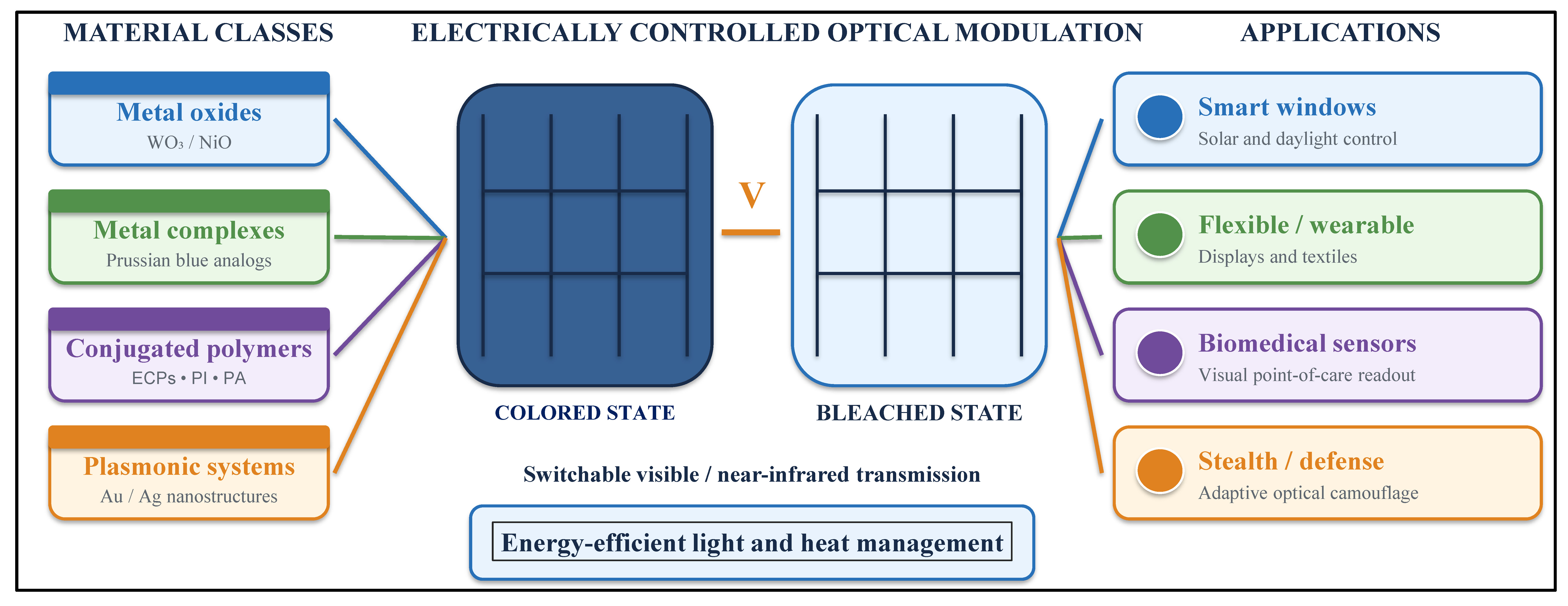
Electrochromic (EC) materials allow reversible and electrically controlled change of optical properties and are increasingly important in energy-efficient glazing, flexible electronics, sensing, and adaptive optics. This review critically examines recent advances in EC materials and devices with a focus on the relationships among materials selection, fabrication approach, switching mechanism, and device performance. Transition-metal oxides, metal complexes, conjugated polymers, and plasmonic metal/alloy systems are compared in terms of their optical contrast, coloration efficiency, response time, cycling stability, color tunability, and potential for large-scale manufacturing. Particular attention is paid to nanostructure engineering, compositional tuning, hybrid-device design, gel and solid electrolytes, and solution-processable approaches to large-area and flexible electrochromic devices. The opportunities and limitations of EC technologies are discussed in relation to the requirements of smart windows, flexible electronics, body-mounted sensors, and adaptive stealth systems. The key issues limiting the practical application of EC materials are the lack of long-term stability, electrolyte degradation, interfacial failure, limited multicolor tuning capability, high material costs in some systems, and scale-up challenges. Future directions of research and development will be determined by advances in materials chemistry, electrolyte and interfacial engineering, scalable fabrication approaches, accelerated lifetime testing under real-world conditions, and data-driven materials design. This review aims to provide an insight into the comparative advantages of different types of electrochromic materials and identify the directions for developing durable, high-performance, and cost-effective electrochromic devices, both at the materials level and device architecture.
- Open Access
- Review
Electrochromic Materials and Devices: Mechanisms, Emerging Technologies, and Applications
- Vishu Sharma 1,
- Shifa Altaf 1,
- Neha Mittal 1,
- Neeraj Ravi 1,
- Mahima Koushik 2,
- Rakesh Kumar Soni 1,*
Author Information
Received: 21 Aug 2026 | Revised: 10 Sep 2026 | Accepted: 14 Sep 2026 | Published: 29 Sep 2026
Abstract
Graphical Abstract
Keywords
electrochromic materials | electrochromic devices | smart windows | tungsten trioxide | prussian blue analogs | conjugated electrochromic polymers | plasmonic nanostructures | flexible electrochromic devices | coloration efficiency
References
- 1.
Granqvist, C.G.; Arvizu, M.A.; Bayrak Pehlivan, İ.; et al. Electrochromic materials and devices for energy efficiency and human comfort in buildings: A critical review. Electrochim. Acta 2018, 259, 1170–1182. https://doi.org/10.1016/j.electacta.2017.11.169.
- 2.
Syrrakou, E.; Papaefthimiou, S.; Yianoulis, P. Environmental assessment of electrochromic glazing production. Sol. Energy Mater. Sol. Cells 2005, 85, 205–240. https://doi.org/10.1016/j.solmat.2004.03.005.
- 3.
Mortimer, R.J. Electrochromic Materials. Annu. Rev. Mater. Res. 2011, 41, 241–268. https://doi.org/10.1146/annurev-matsci-062910-100344.
- 4.
Ahmed, T.; Mazumder, A.; Kuriakose, S.; et al. Materials, mechanisms, and emerging applications of electrochromic systems. Nanoscale 2025, 17, 18049–18076. https://doi.org/10.1039/d4nr02098g.
- 5.
Gu, C.; Jia, A.B.; Zhang, Y.M.; et al. Emerging Electrochromic Materials and Devices for Future Displays. Chem. Rev. 2022, 122, 14679–14721. https://doi.org/10.1021/acs.chemrev.1c01055.
- 6.
Carbas, B.B.; Yildiz, H.B. A review of dithieno [3,2-b:2′,3′-d]pyrrole-based electrochromic conjugated polymers. Eur. Polym. J. 2024, 204, 112700. https://doi.org/10.1016/j.eurpolymj.2023.112700.
- 7.
Chen, D.; Tong, Z.; Rao, Q.; et al. High-Performance Black Copolymers Enabling Full Spectrum Control in Electrochromic Devices. Nat. Commun. 2024, 15, 8457. https://doi.org/10.1038/s41467-024-52430-2.
- 8.
Liu, Q.; Yang, L.; Ling, W.; et al. Organic electrochromic energy storage materials and device design. Front. Chem. 2022, 10, 1001425. https://doi.org/10.3389/fchem.2022.1001425.
- 9.
Wu, W.; Lee, P.S. Flexible and stretchable electrochromic displays: Strategies, recent advances, and prospects. Soft Sci. 2024, 4, 29. https://doi.org/10.20517/ss.2024.21.
- 10.
Fan, Q.; Bai, Z.; Bao, B.; et al. Flexible electrochromic devices for wearable electronics. Wearable Electron. 2025, 2, 171–214. https://doi.org/10.1016/j.wees.2025.05.001.
- 11.
Yu, X.; Guo, P.; Chen, J.; et al. Recent advances in multifunctional electrochromic devices. Responsive Mater. 2024, 2, e20240013. https://doi.org/10.1002/rpm.20240013.
- 12.
Manjakkal, L.; Pereira, L.; Kumi Barimah, E.; et al. Multifunctional flexible and stretchable electrochromic energy storage devices. Prog. Mater. Sci. 2024, 142, 101244. https://doi.org/10.1016/j.pmatsci.2024.101244.
- 13.
Yaseen, M.; Khattak, M.A.K.; Khan, A.; et al. State-of-the-art electrochromic thin films devices, fabrication techniques and applications: A review. Nanocomposites 2024, 10, 1–40. https://doi.org/10.1080/20550324.2023.2291619.
- 14.
Neo, W.T.; Ye, Q.; Chua, S.J.; et al. Conjugated polymer-based electrochromics: Materials, device fabrication and application prospects. J. Mater. Chem. C 2016, 4, 7364–7376. https://doi.org/10.1039/c6tc01150k.
- 15.
Wu, C.; Chen, H.; Lin, K.; et al. Recent advances in electrochromic conjugated polymers prepared by direct (hetero) arylation polymerization. Synth. Met. 2024, 306, 117632. https://doi.org/10.1016/j.synthmet.2024.117632.
- 16.
Wang, Z.; You, L.; Pandit, V.; et al. Transparent Electrochromic Polymers with High Optical Contrast and Contrast Ratio. JACS Au 2024, 4, 2291–2299. https://doi.org/10.1021/jacsau.4c00254.
- 17.
Chen, D.; Chua, M.H.; He, Q.; et al. Multifunctional electrochromic materials and devices recent advances and future potential. Chem. Eng. J. 2025, 503, 157820. https://doi.org/10.1016/j.cej.2024.157820.
- 18.
Xu, L.; Zhang, L.; Liu, D.; et al. A Comprehensive Review of the Functionalized Integrated Application of Gel Polymer Electrolytes in Electrochromic Devices. Nano-Micro Lett. 2026, 18, 106. https://doi.org/10.1007/s40820-025-01909-8.
- 19.
Wang, J.; Wang, Z.; Zhang, M.; et al. Toward Next-Generation Smart Windows: An In-depth Analysis of Dual-Band Electrochromic Materials and Devices. Adv. Opt. Mater. 2024, 12, 2302344. https://doi.org/10.1002/adom.202302344.
- 20.
Qin, L.; Liu, Y.; Long, M.; et al. Advancements in dual-band electrochromic smart windows: Exploring single-component materials for sustainable building solutions. Ceram. Int. 2024, 50, 22174–22183. https://doi.org/10.1016/j.ceramint.2024.03.380.
- 21.
Sun, F.; Pal, R.; Eom, S.Y.; et al. Fast-switching dual-cathode electrochromic smart windows for year-round building energy savings. Nat. Commun. 2025, 16, 9569. https://doi.org/10.1038/s41467-025-64962-2.
- 22.
Ramanavicius, S.; Jagminas, A.; Ramanavicius, A. Advances in Molecularly Imprinted Polymers Based Affinity Sensors (Review). Polymers 2021, 13, 974. https://doi.org/10.3390/polym13060974.
- 23.
Ahmadian-Alam, L.; Jahangiri, F.; Mahdavi, H. Fabrication and assessment of an electrochromic and radar-absorbent dual device based on the new smart polythiophene-based/RGO/Fe3O4 ternary nanocomposite. Chem. Eng. J. 2021, 422, 130159. https://doi.org/10.1016/j.cej.2021.130159.
- 24.
Wang, H.; Barrett, M.; Duane, B.; et al. Materials and processing of polymer-based electrochromic devices. Mater. Sci. Eng. B 2018, 228, 167–174. https://doi.org/10.1016/j.mseb.2017.11.016.
- 25.
Chen, P.W.; Chang, C.T.; Ko, T.F.; et al. Fast response of complementary electrochromic device based on WO3/NiO electrodes. Sci. Rep. 2020, 10, 8430. https://doi.org/10.1038/s41598-020-65191-x.
- 26.
Zheng, J.Y.; Sun, Q.; Cui, J.; et al. Review on recent progress in WO3 -based electrochromic films: Preparation methods and performance enhancement strategies. Nanoscale 2023, 15, 63–79. https://doi.org/10.1039/d2nr04761f.
- 27.
Yao, Y.; Sang, D.; Zou, L.; et al. A Review on the Properties and Applications of WO3 Nanostructure−Based Optical and Electronic Devices. Nanomaterials 2021, 11, 2136. https://doi.org/10.3390/nano11082136.
- 28.
Gu, H.; Tan, M.; Wang, T.; et al. Boosting the electrochromic performance of P-doped WO3 films via electrodeposition for smart window applications. RSC Adv. 2024, 14, 10298–10303. https://doi.org/10.1039/d4ra00979g.
- 29.
Bai, J.; Zhang, Y.; Pan, Z.; et al. Optimization of electrochromic Mo doping WO3 films: A study on dual-phase stacked structures for energy-efficient smart windows. Electrochim. Acta 2024, 508, 145295. https://doi.org/10.1016/j.electacta.2024.145295.
- 30.
Song, K.; Cao, Z.; Weng, S.; et al. Extraordinarily fast response all-solid-state electrochromic devices. Sol. Energy Mater. Sol. Cells 2024, 278, 113193. https://doi.org/10.1016/j.solmat.2024.113193.
- 31.
Cheng, B.; Cao, Z.; Liao, L.; et al. Long-term stable quasi-solid-state complementary WO3 –NiO electrochromic devices with ultra-fast response. Mater. Today Chem. 2025, 43, 102471. https://doi.org/10.1016/j.mtchem.2024.102471.
- 32.
Fu, X.; Li, K.; Zhang, C.; et al. Homogeneous and Nanogranular Prussian Blue to Enable Long-Term-Stable Electrochromic Devices. ACS Appl. Mater. Interfaces 2024, 16, 17745–17756. https://doi.org/10.1021/acsami.3c17551.
- 33.
Liao, T.C.; Chen, W.H.; Liao, H.Y.; et al. Multicolor electrochromic thin films and devices based on the Prussian blue family nanoparticles. Sol. Energy Mater. Sol. Cells 2016, 145, 26–34. https://doi.org/10.1016/j.solmat.2015.08.004.
- 34.
Thai, L.H.; Nhi, L.T.T.; Giang, T.C.; et al. 3D printed multicolor Prussian blue-viologen hybrid electrochromic devices: Toward high contrast ratio and fast switching electrochromic devices. Appl. Mater. Today 2024, 40, 102369. https://doi.org/10.1016/j.apmt.2024.102369.
- 35.
Kim, Y.; Cha, S.; Kim, J.H.; et al. Electrochromic response and control of plasmonic metal nanoparticles. Nanoscale 2021, 13, 9541–9552. https://doi.org/10.1039/d1nr01055g.
- 36.
Liu, Y.; Huang, L.; Cao, S.; et al. Plasmonic-based electrochromic materials and devices. Nanophotonics 2024, 13, 155–172. https://doi.org/10.1515/nanoph-2023-0832.
- 37.
Ke, Y.; Wang, Z.; Xie, H.; et al. Long-Term Stable Complementary Electrochromic Device Based on WO3 Working Electrode and NiO-Pt Counter Electrode. Membranes 2023, 13, 601. https://doi.org/10.3390/membranes13060601.
- 38.
Eren, E.; Karaca, G.Y.; Koc, U.; et al. Electrochromic characteristics of radio frequency plasma sputtered WO3 thin films onto flexible polyethylene terephthalate substrates. Thin Solid Film. 2017, 634, 40–50. https://doi.org/10.1016/j.tsf.2017.05.009.
- 39.
Reyes-Gil, K.R.; Stephens, Z.D.; Stavila, V.; et al. Composite WO3/TiO2 Nanostructures for High Electrochromic Activity. ACS Appl. Mater. Interfaces 2015, 7, 2202–2213. https://doi.org/10.1021/am5050696.
- 40.
Ahmad, K.; Kim, H. Fabrication of Nickel-Doped Tungsten Trioxide Thin Film-Based Highly Stable Flexible Electrochromic Devices for Smart Window Applications. ACS Sustain. Chem. Eng. 2023, 11, 10746–10754. https://doi.org/10.1021/acssuschemeng.3c01483.
- 41.
Marciel, A.; Borges, J.; Pereira, L.; et al. Advancements in Electrochromic Technology for Multifunctional Flexible Devices. Materials 2025, 18, 2964. https://doi.org/10.3390/ma18132964.
- 42.
Tan, M.Y.; Thien, G.S.H.; Tan, K.B.; et al. Investigation of electrochromic performances of multicolor V2O5 devices fabricated at low processing temperature. Sci. Rep. 2025, 15, 1184. https://doi.org/10.1038/s41598-024-85014-7.
- 43.
Wang, J.; Guo, X.; Bian, C.; et al. Roadmap for electrochromic smart devices: From materials engineering and architectures design to multifunctional application. Prog. Mater. Sci. 2025, 153, 101461. https://doi.org/10.1016/j.pmatsci.2025.101461.
- 44.
Zhai, Y.; Zhu, Z.; Zhou, S.; et al. Recent advances in spectroelectrochemistry. Nanoscale 2018, 10, 3089–3111. https://doi.org/10.1039/c7nr07803j.
- 45.
Guo, J.; Liang, Y.; Zhang, S.; et al. Recent progress in improving strategies of metal oxide-based electrochromic smart window. Green Energy Resour. 2023, 1, 100007. https://doi.org/10.1016/j.gerr.2023.100007.
- 46.
Wang, Z.; Wang, X.; Cong, S.; et al. Towards full-colour tunability of inorganic electrochromic devices using ultracompact fabry-perot nanocavities. Nat. Commun. 2020, 11, 302. https://doi.org/10.1038/s41467-019-14194-y.
- 47.
Wang, S.M.; Hwang, J.; Kim, E. Polyoxometalates as promising materials for electrochromic devices. J. Mater. Chem. C 2019, 7, 7828–7850. https://doi.org/10.1039/c9tc01722d.
- 48.
Wang, Y.; Shen, G.; Tang, T.; et al. Construction of doped-rare earth (Ce, Eu, Sm, Gd) WO3 porous nanofilm for superior electrochromic and energy storage windows. Electrochim. Acta 2022, 412, 140099. https://doi.org/10.1016/j.electacta.2022.140099.
- 49.
Dallaev, R. Conductive Polymer Thin Films for Energy Storage and Conversion: Supercapacitors, Batteries, and Solar Cells. Polymers 2025, 17, 2346. https://doi.org/10.3390/polym17172346.
- 50.
Wang, S.; Cai, S.; Cai, W.; et al. Organic-inorganic hybrid electrochromic materials, polysilsesquioxanes containing triarylamine, changing color from colorless to blue. Sci. Rep. 2017, 7, 14627. https://doi.org/10.1038/s41598-017-15337-1.
- 51.
Ahlawat, N.; Bansal, L.; Sahu, B.; et al. A Viologen/α-MnO2 Inorganic/Organic Hybrid Assembly-Based Solid-State Electrochromic Device: Improved Performance and Multiwavelength Switching. ACS Appl. Electron. Mater. 2025, 7, 5712–5720. https://doi.org/10.1021/acsaelm.5c00782.
- 52.
Wu, Y.; Mishra, Y.K.; Xiong, J. Electrochromic materials: Scope for the cyclic decay mechanisms and performance stability optimisation strategies. Color. Technol. 2024, 140, 208–229. https://doi.org/10.1111/cote.12729.
- 53.
Kong, S.; Li, M.; Xiang, Y.; et al. Machine learning-guided investigation for a high-performance electrochromic device based on ammonium metatungstate-iron(II) chloride-heavy water electrochromic liquid. J. Mater. Chem. C 2023, 11, 12776–12784. https://doi.org/10.1039/d3tc02522e.
- 54.
Shu, Y.; Miao, N.; Li, R.; et al. Machine learning-enabled optoelectronic material discovery: A comprehensive review. J. Mater. Inform. 2025, 5, 36. https://doi.org/10.20517/jmi.2025.13.
- 55.
Zhu, M.; Xu, B.; He, T.; et al. Smart Electrochromic Devices for Wearables. Adv. Mater. Technol. 2025, 10, e01015. https://doi.org/10.1002/admt.202501015.
- 56.
Yu, J.; Wang, S.; Gao, L.; et al. Recent advances in flexible multifunctional electrochromic devices. Nanoscale 2025, 17, 6919–6937. https://doi.org/10.1039/d4nr04074k.
- 57.
Zhang, W.; Liu, G.; Zhang, Z.; et al. Flexographically Printed PEDOT:PSS Electrodes Enabling Stable Paper-Based Self-Powered Electrochromic Devices. ACS Appl. Polym. Mater. 2026, 8, 2030–2043. https://doi.org/10.1021/acsapm.5c04031.


This work is licensed under a Creative Commons Attribution 4.0 International License.

 Suite 4002 Level 4, 447 Collins Street, Melbourne, Victoria 3000, Australia
 General Inquiries: info@sciltp.com