
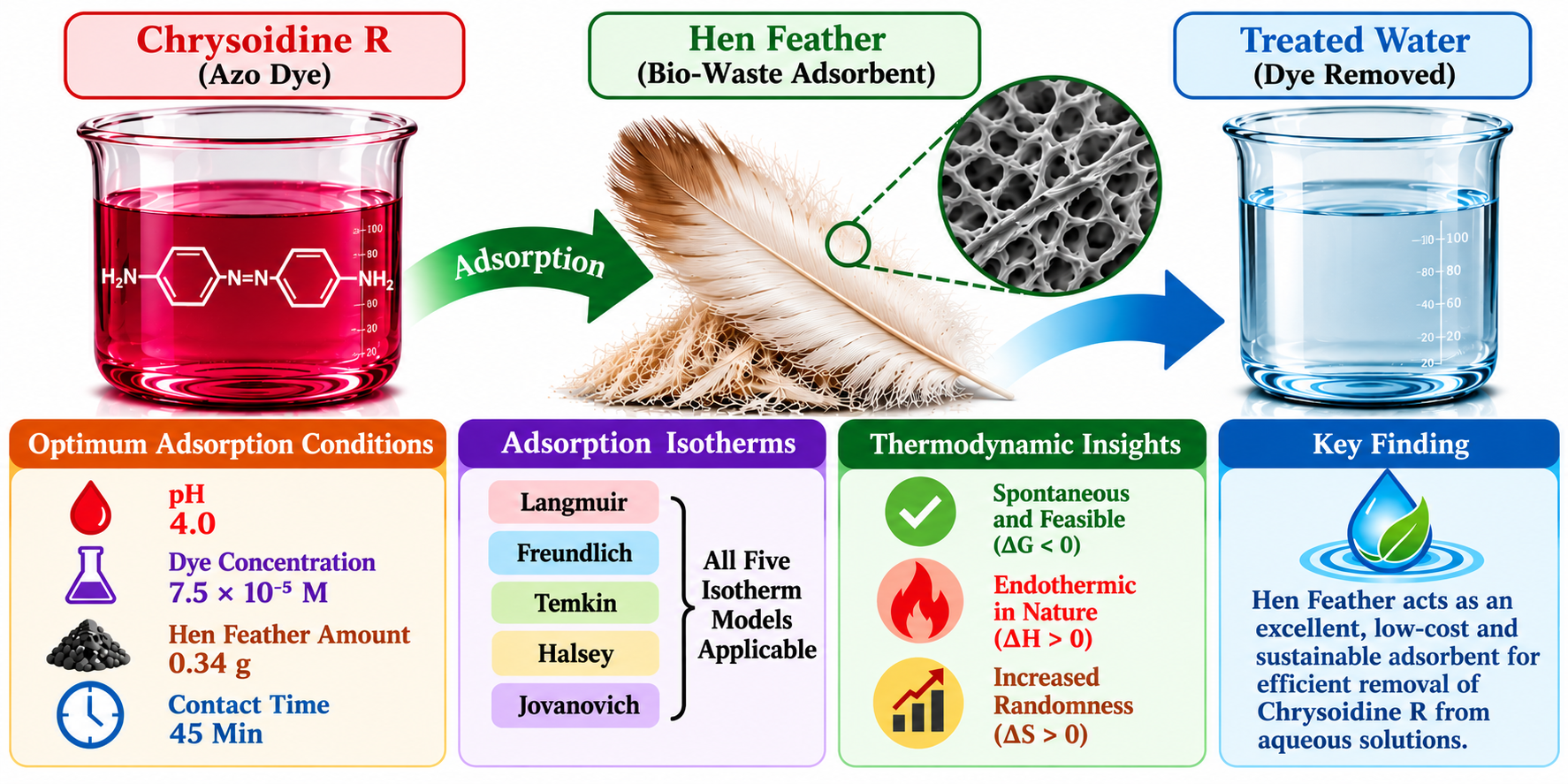
The paper focuses on the eradication of a hazardous azo dye Chrysoidine R from its aqueous solutions through adsorption over a biosorbent—Hen Feather. Chrysoidine R is a highly toxic dye, which poses severe health complications amongst humans. It can affect respiratory and gastrointestinal systems, may damage organs, produce dermatitis and even cause cancer. Hence, its removal from wastewater is highly desired and essential. Therefore, a bio waste material Hen Feather, which is available in huge quantity, is used as adsorbent to remove this dye from its aqueous solutions. Preliminary adsorption studies have been carried out and it is found that pH 4.0, dye concentration 7.5 × 10⁻⁵ M, Hen Feather amount 0.34 g and 30 min contact time result into maximum amount of dye removal. Total five well-known adsorption isotherm models namely, Langmuir, Freundlich, Temkin, Halsey and Jovanovich have been examined for the Chrysoidine R—Hen Feather system and interestingly all models have been found applicable in the present case. On the basis of Langmuir adsorption isotherm constant, various thermodynamic parameters like, change in Gibb’s free energy, change in enthalpy and change in entropy, were also evaluated and it is found that ongoing adsorption process is favorable, feasible, spontaneous and endothermic in nature. Thus, these studies indicate that Hen Feather acts as an excellent adsorber for the dye Chrysoidine R.
- Open Access
- Article
Hen Feather, an Efficient Biosorbent for the Adsorptive Removal of the Dye Chrysoidine R from Its Aqueous Solutions
Author Information
Received: 11 July 2026 | Revised: 22 September 2026 | Accepted: 29 September 2026 | Published: 26 October 2026
Abstract
Graphical Abstract
Keywords
References
- 1.
Arif, A. Water pollution and industries. Pure Appl. Biol. 2020, 9, 2214–2224. https://doi.org/10.19045/bspab.2020.90237.
- 2.
Lin, L.; Yang, H.; Xu, X. Effects of Water Pollution on Human Health and Disease Heterogeneity: A Review. Front. Environ. Sci. 2022, 10, 880246. https://doi.org/10.3389/fenvs.2022.880246.
- 3.
Singh, B.J.; Chakraborty, A.; Sehgal, R. A systematic review of industrial wastewater management: Evaluating challenges and enablers. J. Environ. Manage. 2023, 348, 119230. https://doi.org/10.1016/j.jenvman.2023.119230.
- 4.
Ferguson, D.W.; Male, J.W. The water pollution potential from demolition waste disposal. J. Environ. Sci. Health Part A Environ. Sci. Eng. 1980, 15, 545–559. https://doi.org/10.1080/10934528009374949.
- 5.
Vaiano, V.; De Marco, I. Removal of Azo Dyes from Wastewater through Heterogeneous Photocatalysis and Supercritical Water Oxidation. Separations 2023, 10, 230. https://doi.org/10.3390/separations10040230.
- 6.
Banerjee, P.; DasGupta, S.; De, S. Removal of dye from aqueous solution using a combination of advanced oxidation process and nanofiltration. J. Hazard. Mater. 2007, 140, 95–103. https://doi.org/10.1016/j.jhazmat.2006.06.075.
- 7.
Liu, L.; Chen, Z.; Zhang, J.; et al. Treatment of industrial dye wastewater and pharmaceutical residue wastewater by advanced oxidation processes and its combination with nanocatalysts: A review. J. Water Process Eng. 2021, 42, 102122. https://doi.org/10.1016/j.jwpe.2021.102122.
- 8.
Rai, H.S.; Bhattacharyya, M.S.; Singh, J.; et al. Removal of Dyes from the Effluent of Textile and Dyestuff Manufacturing Industry: A Review of Emerging Techniques with Reference to Biological Treatment. Crit. Rev. Environ. Sci. Technol. 2005, 35, 219–238. https://doi.org/10.1080/10643380590917932.
- 9.
Solayman, H.M.; Hossen, M.A.; Abd Aziz, A.; et al. Performance evaluation of dye wastewater treatment technologies: A review. J. Environ. Chem. Eng. 2023, 11, 109610. https://doi.org/10.1016/j.jece.2023.109610.
- 10.
Crini, G. Non-conventional low-cost adsorbents for dye removal: A review. Bioresour. Technol. 2006, 97, 1061–1085. https://doi.org/10.1016/j.biortech.2005.05.001.
- 11.
Li, T.; Wei, L.; Fang, Y.; et al. Risk identification of human health, ecotoxicity, and degradation products of azo dyes: Development of a priority control list. Environ. Pollut. 2025, 386, 127180. https://doi.org/10.1016/j.envpol.2025.127180.
- 12.
Khandare, R.V.; Govindwar, S.P. Phytoremediation of textile dyes and effluents: Current scenario and future prospects. Biotechnol. Adv. 2015, 33, 1697–1714. https://doi.org/10.1016/j.biotechadv.2015.09.003.
- 13.
Qamar, M.; Saquib, M.; Muneer, M. Titanium dioxide mediated photocatalytic degradation of two selected azo dye derivatives, Chrysoidine R and acid red 29 (Chromotrope 2R), in aqueous suspensions. Desalination 2005, 186, 255–271. https://doi.org/10.1016/j.desal.2005.05.021.
- 14.
Chung, K.T. Mutagenicity and carcinogenicity of aromatic amines metabolically produced from Azo Dyes. J. Environ. Sci. Health Part C 2000, 18, 51–74. https://doi.org/10.1080/10590500009373515.
- 15.
Ma, B.; Qiao, X.; Hou, X.; et al. Pure keratin membrane and fibers from chicken feather. Int. J. Biol. Macromol. 2016, 89, 614–621. https://doi.org/10.1016/j.ijbiomac.2016.04.039.
- 16.
Idris, A.; Vijayaraghavan, R.; Rana, U.A.; et al. Dissolution of feather keratin in ionic liquids. Green Chem. 2013, 15, 525–534. https://doi.org/10.1039/c2gc36556a.
- 17.
Khosa, M.A.; Ullah, A. In Situ modification, regeneration, and application of keratin biopolymer for arsenic removal. J. Hazard. Mater. 2014, 278, 360–371. https://doi.org/10.1016/j.jhazmat.2014.06.023.
- 18.
Gaur, B.; Mittal, J.; Shah, S.A.A.; et al. Sequestration of an Azo Dye by a Potential Biosorbent: Characterization of Biosorbent, Adsorption Isotherm and Adsorption Kinetic Studies. Molecules 2024, 29, 2387. https://doi.org/10.3390/molecules29102387.
- 19.
Gaur, B.; Mittal, J.; Hassan, H.; et al. Removal of hazardous Aniline Blue dye using a potential Biosorbent—Hen feather. J. Indian Chem. Soc. 2024, 101, 101322. https://doi.org/10.1016/j.jics.2024.101322.
- 20.
Mittal, A.; Mittal, J. Hen Feather: A Remarkable Adsorbent for Dye Removal. In Green Chemistry for Dyes Removal from Wastewater; Sharma, S.K., Ed.; Scrivener Publishing LLC: Beverly, MA, USA, 2015; pp. 409–457. https://doi.org/10.1002/9781118721001.ch11.
- 21.
Mittal, A.; Thakur, V.; Mittal, J.; et al. Process development for the removal of hazardous anionic azo dye Congo red from wastewater by using Hen Feather as potential adsorbent. Desalin. Water Treat. 2014, 52, 227–237. https://doi.org/10.1080/19443994.2013.785030.
- 22.
Mittal, A.; Thakur, V.; Gajbe, V. Adsorptive removal of toxic azo dye Amido Black 10B by Hen Feather. Environ. Sci. Pollut. Res. 2013, 20, 260–269. https://doi.org/10.1007/s11356-012-0843-y.
- 23.
Mittal, J.; Thakur, V.; Mittal, A. Batch removal of hazardous azo dye Bismark Brown R using waste material Hen Feather. Ecol. Eng. 2013, 60, 249–253. https://doi.org/10.1016/j.ecoleng.2013.07.025.
- 24.
Mittal, A.; Kurup, L.; Mittal, J. Freundlich and Langmuir adsorption isotherms and kinetics for the removal of Tartrazine from aqueous solutions using Hen Feathers. J. Hazard. Mater. 2007, 146, 243–248. https://doi.org/10.1016/j.jhazmat.2006.12.012.
- 25.
Mittal, A.; Mittal, J.; Kurup, L. Utilization of Hen Feathers for the adsorption of a hazardous dye, Indigo Carmine from its simulated effluent. J. Environ. Prot. Sci. 2007, 1, 92–100.
- 26.
Gupta, V.K.; Mittal, A.; Kurup, L.; et al. Adsorption of a hazardous dye, erythrosine, over Hen Feathers. J. Colloid Interface Sci. 2006, 304, 52–57. https://doi.org/10.1016/j.jcis.2006.08.032.
- 27.
Mittal, A. Adsorption kinetics of removal of a toxic dye, Malachite Green, from wastewater by using Hen Feathers. J. Hazard. Mater. 2006, 133, 196–202. https://doi.org/10.1016/j.jhazmat.2005.10.017.
- 28.
Mittal, A. Use of Hen Feathers as potential adsorbent for the removal of a hazardous dye, Brilliant Blue FCF, from wastewater. J. Hazard. Mater. 2006, 128, 233–239. https://doi.org/10.1016/j.jhazmat.2005.08.043.
- 29.
Malarvizhi, R.; Ho, Y.S. The influence of pH and the structure of the dye molecules on adsorption isotherm modeling using activated carbon. Desalination 2010, 264, 97–101. https://doi.org/10.1016/j.desal.2010.07.010.
- 30.
Mittal, A.; Gupta, V.K. Adsorptive removal and recovery of the azo dye Eriochrome Black T. Toxicol. Environ. Chem. 2010, 92, 1813–1823. https://doi.org/10.1080/02772248.2010.485998.
- 31.
de Farias Silva, C.E.; Villar da Gama, B.M.; da Silva Gonçalves, A.H.; et al. Basic-dye adsorption in albedo residue: Effect of pH, contact time, temperature, dye concentration, biomass dosage, rotation and ionic strength. J. King Saud Univ. Eng. Sci. 2020, 32, 351–359. https://doi.org/10.1016/j.jksues.2019.04.006.
- 32.
Kara, S.; Aydiner, C.; Demirbas, E.; et al. Modeling the effects of adsorbent dose and particle size on the adsorption of reactive textile dyes by fly ash. Desalination 2007, 212, 282–293. https://doi.org/10.1016/j.desal.2006.09.022.
- 33.
Gaur, B.; Mittal, J.; Hassan, H.; et al. Evaluation of ordered mesoporous carbon as a robust and efficient adsorbent for the removal of Metanil Yellow from aqueous solutions. C 2026, 12, 36. https://doi.org/10.3390/c12020036.
- 34.
Saadi, R.; Saadi, Z.; Fazaeli, R.; et al. Monolayer and multilayer adsorption isotherm models for sorption from aqueous media. Korean J. Chem. Eng. 2015, 32, 787–799. https://doi.org/10.1007/s11814-015-0053-7.
- 35.
Walsh, K.; Mayer, S.; Rehmann, D.; et al. Equilibrium data and its analysis with the Freundlich model in the adsorption of arsenic(V) on granular ferric hydroxide. Sep. Purif. Technol. 2020, 243, 116704. https://doi.org/10.1016/j.seppur.2020.116704.
- 36.
Gupta, V.K.; Jain, R.; Saleh, T.A.; et al. Equilibrium and Thermodynamic Studies on the Removal and Recovery of Safranine-T Dye from Industrial Effluents. Sep. Sci. Technol. 2011, 46, 839–846. https://doi.org/10.1080/01496395.2010.535591.
- 37.
Chu, K.H.; Bashiri, H.; Hashim, M.A.; et al. The Halsey isotherm for water contaminant adsorption is fake. Sep. Puri. Technol. 2023, 313, 123500. https://doi.org/10.1016/j.seppur.2023.123500.
- 38.
Misra, D.N. Jovanovich adsorption isotherm for heterogeneous surfaces. J. Colloid Interface Sci. 1973, 43, 85–88. https://doi.org/10.1016/0021-9797(73)90350-0.
- 39.
Ghosal, P.S.; Gupta, A.K. Determination of thermodynamic parameters from Langmuir isotherm constant-revisited. J. Mol. Liq. 2017, 225, 137–146. https://doi.org/10.1016/j.molliq.2016.11.058.
- 40.
Weber, T.W.; Chakravorti, R.K. Pore and solid diffusion models for fixed‐bed adsorbers. AIChE J. 1974, 20, 228–238. https://doi.org/10.1002/aic.690200204.


This work is licensed under a Creative Commons Attribution 4.0 International License.
