
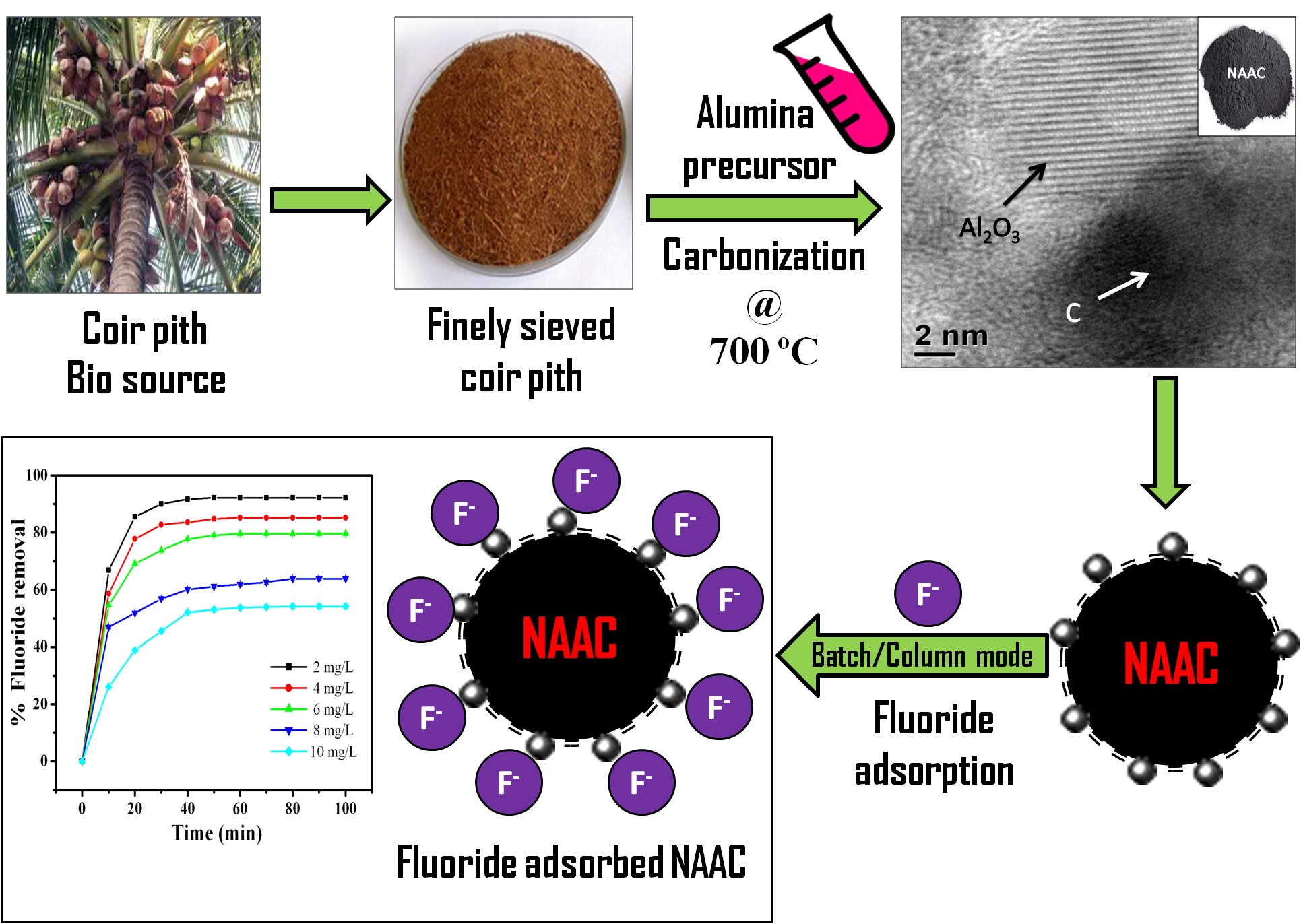
Fluoride contamination in surface and groundwater was a major environmental issue in various parts of the world. Fluorosis is caused by consumption of contaminated water; hence, it is essential to treat fluoride from contaminated water sources. This study involves the development of nano-alumina functionalized carbon composite adsorbent (NAAC) nanocomposite under controlled atmosphere for adsorption of fluoride from water. NAAC was synthesized using carbonization process at controlled nitrogen atmosphere. The X-ray diffraction (XRD), (High Resolution Transmission Electron Microscopy) HR-TEM coupled with (Energy Dispersive X-ray Spectroscopy) EDS and (Selected Area Electron Diffraction) SAED were used for characterization of the NAAC. Adsorption capacity of NAAC of fluoride was evaluated by batch and column mode using the fluoride spiked solution. The experiments performed to identify initial concentration of adsorbate and desorption studies. Adsorption data fitted to relevant Isotherm & Kinetic models. (Q0) of NAAC was found as 58.82 mg/g. Effects of flow rate, bed volume and different F- concentrations for the column experiments were find. (Bed-Depth-Service-Time) BDST model achieved by using data collected from experiments. As a result, the batch sorption was found to be more effective than the column sorption for removal. Therefore, study done the production of low-cost adsorbent fluoride removal from groundwater made by using NAAC is possible.
- Open Access
- Article
Nano-Alumina Functionalized Carbon Composite Adsorbent from Coir Pith Biomass for Fluoride Removal from Aqueous Solution
Author Information
Received: 22 Jan 2026 | Revised: 04 Jul 2026 | Accepted: 25 Aug 2026 | Published: 24 Sep 2026
Abstract
Graphical Abstract
Keywords
nano-alumina | activated carbon | nanocomposite | fluoride | batch | column mode
References
- 1.
Shaji, E.; Sarath, K.V.; Santosh, M.; et al. Fluoride contamination in groundwater: A global review of the status, processes, challenges, and remedial measures. Geosci. Front. 2024, 15, 101734.
- 2.
Khan, S.M.; Ravikumar, A. Role of Alkalinity for the Release of Fluoride in the Groundwater of Tiruchengode Taluk, Namakkal District, Tamilnadu, India. Chem. Sci. Trans. 2013, 2, S302–S308.
- 3.
Singaraja, C.; Chidambaram, S.; Anandhan, P.; et al. Geochemical evaluation of fluoride contamination of groundwater in the Thoothukudi District of Tamilnadu, India. Appl. Water Sci. 2014, 4, 241–250. https://doi.org/10.1007/s13201-014-0157-y.
- 4.
Duggal, V.; Sharma, S. Fluoride contamination in drinking water and associated health risk assessment in the Malwa Belt of Punjab, India. Environ. Adv. 2022, 8, 100242. https://doi.org/10.1016/j.envadv.2022.100242.
- 5.
Behera, B.; Kumar, N.; Moharana, M. Assessment of groundwater pollution due to fluoride concentration and water quality in and around Purulia district, West Bengal, India. J. Chem. Pharm. Res. 2014, 6, 384–392.
- 6.
Suriyaraj, S.P.; Vijayaraghavan, T.; Biji, P.; et al. Adsorption of fluoride from aqueous solution using different phases of microbially synthesized TiO2 nanoparticles. J. Environ. Chem. Eng. 2014, 2, 444–454. https://doi.org/10.1016/j.jece.2014.01.013.
- 7.
Suriyaraj, S.P.; Selvakumar, R. Advances in nanomaterial based approaches for enhanced fluoride and nitrate removal from contaminated water. RSC Adv. 2016, 6, 10565–10583. https://doi.org/10.1039/c5ra24789f.
- 8.
Kumar, R.; Chawla, J. Carbon-Based Materials for De-Fluoridation of Water: Current Status and Challenges; IntechOpen: London, UK, 2020. https://doi.org/10.5772/intechopen.90879.
- 9.
Daifullah, A.A.M.; Yakout, S.M.; Elreefy, S.A. Adsorption of fluoride in aqueous solutions using KMnO4-modified activated carbon derived from steam pyrolysis of rice straw. J. Hazard. Mater. 2007, 147, 633–643. https://doi.org/10.1016/j.jhazmat.2007.01.062.
- 10.
Al-Musawi, T.J.; McKay, G.; Kadhim, A.; et al. Activated carbon prepared from hazelnut shell waste and magnetized by Fe3O4 nanoparticles for highly efficient adsorption of fluoride. Biomass Convers. Biorefin. 2024, 14, 4687–4702.
- 11.
Bakhta, S.; Sadaoui, Z.; Bouazizi, N.; et al. Functional activated carbon: from synthesis to groundwater fluoride removal. RSC Adv. 2022, 12, 2332–2348. https://doi.org/10.1039/d1ra08209d.
- 12.
Tavallali, H.; Daneshyar, A. Cadmium selenide nanoparticles loaded on activated carbon and its efficient application for removal of fluoride from aqueous solution. Int. J. ChemTech Res. 2012, 4, 178–181.
- 13.
Guo, S.; Zheng, F.; Xu, J.; et al. Enhanced fluoride removal from drinking water by activated carbon supported Ce-Al oxides: performance and mechanism. RSC Adv. 2025, 15, 14363–14374. https://doi.org/10.1039/d5ra00397k.
- 14.
Yang, C.; Shen, C.; Zhang, N.; et al. Removing Fluoride from Water by Nanostructured Magnesia-Impregnated Activated Carbon. Colloids Interfaces 2025, 9, 22. https://doi.org/10.3390/colloids9020022.
- 15.
Sivasankar, V.; Murugesh, S.; Rajkumar, S.; et al. Cerium dispersed in carbon (CeDC) and its adsorption behavior: A first example of tailored adsorbent for fluoride removal from drinking water. Chem. Eng. J. 2013, 214, 45–54. https://doi.org/10.1016/j.cej.2012.10.023.
- 16.
Pei, S.; Hu, Y.; Huang, Y.; et al. Ultrasonically assisted synthesis of g-C3N4-activated carbon composite for enhanced defluoridation of water. Alex. Eng. J. 2024, 86, 399–404. https://doi.org/10.1016/j.aej.2023.11.084.
- 17.
Sathishkumar, M.; Binupriya, A.R.; Kavitha, D.; et al. Adsorption potential of maize cob carbon for 2,4-dichlorophenol removal from aqueous solutions: Equilibrium, kinetics and thermodynamics modeling. Chem. Eng. J. 2009, 147, 265–271. https://doi.org/10.1016/j.cej.2008.07.020.
- 18.
Maliyekkal, S.M.; Sharma, A.K.; Philip, L. Manganese-oxide-coated alumina: A promising sorbent for defluoridation of water. Water Res. 2006, 40, 3497–3506. https://doi.org/10.1016/j.watres.2006.08.007.
- 19.
Chai, L.; Wang, Y.; Zhao, N.; et al. Sulfate-doped Fe3O4/Al2O3 nanoparticles as a novel adsorbent for fluoride removal from drinking water. Water Res. 2013, 47, 4040–4049. https://doi.org/10.1016/j.watres.2013.02.057.
- 20.
Janardhana, C.; Rao, G.N.; Sathish, R.S.; et al. Study on defluoridation of drinking water using zirconium ion impregnated activated charcoals. Indian J. Chem. Technol. 2007, 14, 350–354.
- 21.
Langmuir, I. The adsorption of gases on plane surfaces of glass, mica and platinum. J. Am. Chem. Soc. 1918, 40, 1361–1403. https://doi.org/10.1021/ja02242a004.
- 22.
Freundlich, H.M.F. Über die adsorption in lösungen. Z. Phys. Chem. 1906, 57, 385–470.
- 23.
Li, Y.H.; Wang, S.; Cao, A.; et al. Adsorption of fluoride from water by amorphous alumina supported on carbon nanotubes. Chem. Phys. Lett. 2001, 350, 412–416. https://doi.org/10.1016/s0009-2614(01)01351-3.
- 24.
Gupta, A.K.; Deva, D.; Sharma, A.; et al. Adsorptive removal of fluoride by micro-nanohierarchal web of activated carbon fibers. Ind. Eng. Chem. Res. 2009, 48, 9697–9707. https://doi.org/10.1021/ie801688k.
- 25.
Alagumuthu, G.; Rajan, M. Equilibrium and kinetics of adsorption of fluoride onto zirconium impregnated cashew nut shell carbon. Chem. Eng. J. 2010, 158, 451–457. https://doi.org/10.1016/j.cej.2010.01.017.
- 26.
Kumar, E.; Bhatnagar, A.; Kumar, U.; et al. Defluoridation from aqueous solutions by nano-alumina: Characterization and sorption studies. J. Hazard. Mater. 2011, 186, 1042–1049. https://doi.org/10.1016/j.jhazmat.2010.11.102.
- 27.
Jing, C.; Cui, J.; Huang, Y.; et al. Fabrication, characterization, and application of a composite adsorbent for simultaneous removal of arsenic and fluoride. ACS Appl. Mater. Interfaces 2012, 4, 714–720. https://doi.org/10.1021/am2013322.
- 28.
Chen, N.; Zhang, Z.; Feng, C.; et al. Studies on fluoride adsorption of iron-impregnated granular ceramics from aqueous solution. Mater. Chem. Phys. 2011, 125, 293–298. https://doi.org/10.1016/j.matchemphys.2010.09.037.
- 29.
Zhang, T.; Li, Q.; Mei, Z.; et al. Adsorption of fluoride ions onto non-thermal plasma-modified CeO2/Al2O3 composites. Desalin. Water Treat. 2014, 52, 3367–3376. https://doi.org/10.1080/19443994.2013.800324.
- 30.
Zhao, X.; Zhang, L.; Xiong, P.; et al. A novel method for synthesis of Co–Al layered double hydroxides and their conversions to mesoporous CoAl2O4 nanostructures for applications in adsorption removal of fluoride ions. Microporous Mesoporous Mater. 2015, 201, 91–98. https://doi.org/10.1016/j.micromeso.2014.09.030.
- 31.
Ma, J.; Shen, Y.; Shen, C.; et al. Al-doping chitosan–Fe(III) hydrogel for the removal of fluoride from aqueous solutions. Chem. Eng. J. 2014, 248, 98–106. https://doi.org/10.1016/j.cej.2014.02.098.
- 32.
Gao, C.; Yu, X.Y.; Luo, T.; et al. Millimeter-sized Mg–Al-LDH nanoflake impregnated magnetic alginate beads (LDH-n-MABs): A novel bio-based sorbent for the removal of fluoride in water. J. Mater. Chem. A 2014, 2, 2119–2128. https://doi.org/10.1039/c3ta13526h.
- 33.
Lagergren, S. Zur theorie der sogenannten adsorption geloster stoffe. K. Sven. Vetenskapsakademiens Handl. 1898, 24, 1–39.
- 34.
Ho, Y.S.; McKay, G. Pseudo-second order model for sorption processes. Process Biochem. 1999, 34, 451–465. https://doi.org/10.1016/s0032-9592(98)00112-5.
- 35.
Kavitha, S.; Selvakumar, R.; Swaminathan, K. Polyvinyl Pyrrolidone K25 Modified Fungal Biomass as Biosorbent for As(V) Removal from Aqueous Solution. Sep. Sci. Technol. 2008, 43, 3902–3919. https://doi.org/10.1080/01496390802222590.
- 36.
Binupriya, A.R.; Sathishkumar, M.; Dhamodaran, K.; et al. Liquid-phase separation of reactive dye by wood-rotting fungus: A biotechnological approach. Biotechnol. J. 2007, 2, 1014–1025. https://doi.org/10.1002/biot.200600238.
- 37.
Ko, D.C.K.; Porter, J.F.; McKay, G. Optimised correlations for the fixed-bed adsorption of metal ions on bone char. Chem. Eng. Sci. 2000, 55, 5819–5829. https://doi.org/10.1016/s0009-2509(00)00416-4.
- 38.
Padmesh, T.V.N.; Vijayaraghavan, K.; Sekaran, G.; et al. Batch and column studies on biosorption of acid dyes on fresh water macro alga Azolla filiculoides. J. Hazard. Mater. 2005, 125, 121–129. https://doi.org/10.1016/j.jhazmat.2005.05.014.
- 39.
Deepa, K.K.; Sathishkumar, M.; Binupriya, A.R.; et al. Sorption of Cr(VI) from dilute solutions and wastewater by live and pretreated biomass of Aspergillus flavus. Chemosphere 2006, 62, 833–840. https://doi.org/10.1016/j.chemosphere.2005.04.087.
- 40.
Kamble, S.P.; Deshpande, G.; Barve, P.P.; et al. Adsorption of fluoride from aqueous solution by alumina of alkoxide nature: Batch and continuous operation. Desalination 2010, 264, 15–23. https://doi.org/10.1016/j.desal.2010.07.001.
- 41.
Vadivelan, V.; Kumar, K.V. Equilibrium, kinetics, mechanism, and process design for the sorption of methylene blue onto rice husk. J. Colloid Interface Sci. 2005, 286, 90–100. https://doi.org/10.1016/j.jcis.2005.01.007.
- 42.
Mondal, N.K.; Bhaumik, R.; Roy, P.; et al. Investigation on fixed bed column performance of fluoride adsorption by sugarcane charcoal. J. Environ. Biol. 2013, 34, 1059–1064.
- 43.
Aksu, Z.; Gönen, F. Biosorption of phenol by immobilized activated sludge in a continuous packed bed: prediction of breakthrough curves. Process Biochem. 2004, 39, 599–613. https://doi.org/10.1016/s0032-9592(03)00132-8.
- 44.
Hutchins, R.A. New method simplifies design of activated carbon systems. Chem. Eng. 1973, 80, 133–138.
- 45.
Selvakumar, R.; Kavitha, S.; Sathishkumar, M.; et al. Arsenic adsorption by polyvinyl pyrrolidone K25 coated cassava peel carbon from aqueous solution. J. Hazard. Mater. 2008, 153, 67–74. https://doi.org/10.1016/j.jhazmat.2007.08.020.
- 46.
Veressinina, Y.; Trapido, M.; Ahelik, V.; et al. Catalytic filtration for the improvement of drinking water quality. Proc. Est. Acad. Sci. Chem. 2000, 49, 168–179. https://doi.org/10.3176/chem.2000.3.04.


This work is licensed under a Creative Commons Attribution 4.0 International License.
