
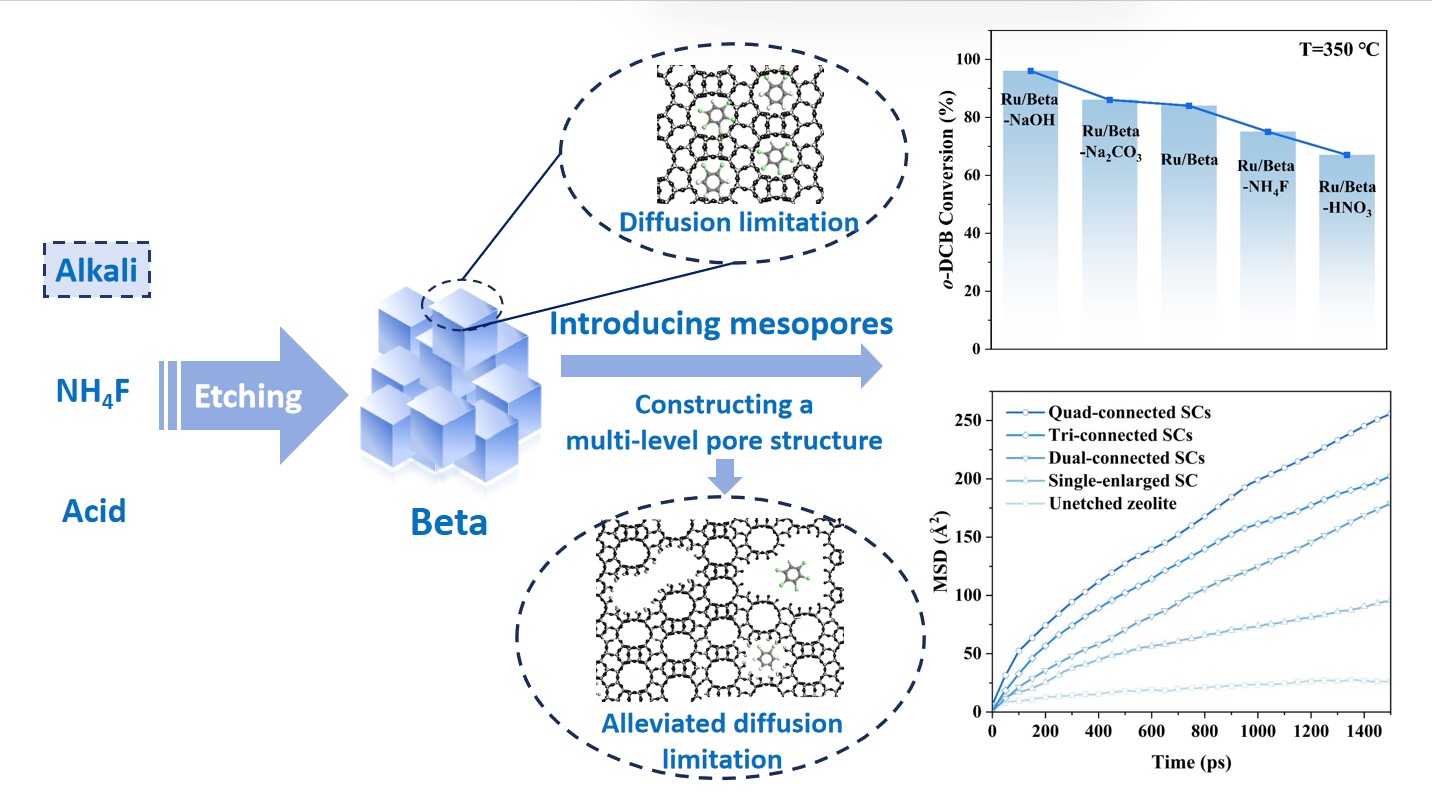
To resolve issues such as insufficient low-temperature activity and the formation of polychlorinated byproducts during the catalytic combustion of o-dichlorobenzene (o-DCB), Ru/Beta catalysts were treated with four etching strategies (NaOH, Na2CO3, NH4F, and HNO3) to modify their pore structure and surface chemistry, thereby elucidating the impact of these etching strategies on catalytic performance. The results indicate that the NaOH etching technique constructed a micro-mesoporous interconnected multi-level pore structure while preserving the integrity of the framework Al, significantly increasing the specific surface area and promoting the high dispersion of Ru species through the grafting effect of the framework Al. NH3-TPD and H2-TPR results show that the Ru/Beta-NaOH catalyst possesses both abundant acidic sites and strong redox capabilities. The acidic sites guide Cl species toward the HCl product, effectively suppressing the formation of Cl2 and polyhalogenated byproducts, while the strong redox ability accelerates the deep oxidation of o-DCB. Molecular dynamic simulations further indicate that the hierarchical pore structure effectively alleviates the diffusion limitation of polyhalogenated byproducts, enabling a facilitated reaction. Compared to the unetched Ru/Beta catalyst, the Ru/Beta-NaOH catalyst exhibits a 50 °C lower activation temperature, with a significant reduction in polychlorinated byproducts and improved stability. This catalyst achieves synergistic optimization of active sites and pore engineering, providing a theoretical basis for the development of catalysts for the efficient degradation of macromolecular chlorinated aromatics.
- Open Access
- Article
Modulating the Hierarchical Pore Structure and Surface Chemistry of Ru/Beta Catalyst by Alkaline Etching to Facilitate the o-Dichlorobenzene Oxidation
- Binglin Xin 1,
- Shuting Wei 1,
- Xiaonan Guo 1,
- Ying Wei 1, 2,
- Jingbo Jia 1, 2,
- Runduo Zhang 1, 2, *
Author Information
Received: 28 May 2026 | Revised: 13 Jul 2026 | Accepted: 15 Jul 2026 | Published: 30 Jul 2026
Abstract
Graphical Abstract
Keywords
o-dichlorobenzene oxidation | etching | Ru species | zeolites | hierarchical pores
References
- 1.
U.S. Environmental Protection Agency. Quality Criteria for Water; EPA 440/5-76-001; U.S. Environmental Protection Agency: Washington, DC, USA, 1976.
- 2.
Huang, H.; Dai, Q.G.; Wang, X.Y. Morphology Effect of Ru/CeO2 Catalysts for the Catalytic Combustion of Chlorobenzene. Appl. Catal. B Environ. 2014, 158–159, 96–105. https://doi.org/10.1016/j.apcatb.2014.01.062.
- 3.
Huang, B.B.; Lei, C.; Wei, C.H.; et al. Chlorinated Volatile Organic Compounds (Cl-VOCs) in Environment—Sources, Potential Human Health Impacts, and Current Remediation Technologies. Environ. Int. 2014, 71, 118–138. https://doi.org/10.1016/j.envint.2014.06.013.
- 4.
He, C.; Cheng, J.; Zhang, X.; et al. Recent Advances in the Catalytic Oxidation of Volatile Organic Compounds: A Review Based on Pollutant Sorts and Sources. Chem. Rev. 2019, 119, 4471–4568. https://doi.org/10.1021/acs.chemrev.8b00408.
- 5.
Lou, B.Z.; Shakoor, N.; Adeel, M.; et al. Catalytic Oxidation of Volatile Organic Compounds by Non-Noble Metal Catalyst: Current Advancement and Future Prospectives. J. Clean. Prod. 2022, 363, 132523. https://doi.org/10.1016/j.jclepro.2022.132523.
- 6.
Qiu, J.; Tang, M.H.; Peng, Y.Q.; et al. Simultaneous Removal of 1,2-Dichlorobenzene and Furan over Mn-Ce-Fe Oxide Catalyst: Catalytic Activity and Product Analysis. J. Rare Earths 2024, 42, 972–979. https://doi.org/10.1016/j.jre.2023.12.004.
- 7.
Wang, J.; Zhao, H.N.; Song, J.F.; et al. Structure-Activity Relationship of Manganese Oxide Catalysts for the Catalytic Oxidation of (Chloro)-VOCs. Catalysts 2019, 9, 726. https://doi.org/10.3390/catal9090726.
- 8.
Cano, M.; Guarín, F.; Aristizábal, B.; et al. Catalytic Activity and Stability of Pd/Co Catalysts in Simultaneous Selective Catalytic Reduction of NOx with Methane and Oxidation of o-Dichlorobenzene. Catal. Today 2017, 296, 105–117. https://doi.org/10.1016/j.cattod.2017.05.049.
- 9.
Babu, N.S.; Lingaiah, N.; Pasha, N.; et al. Influence of Particle Size and Nature of Pd Species on the Hydrodechlorination of Chloroaromatics: Studies on Pd/TiO2 Catalysts in Chlorobenzene Conversion. Catal. Today 2009, 141, 120–124. https://doi.org/10.1016/j.cattod.2008.03.018.
- 10.
Chen, J.; Wang, C.Q.; Lv, X.L.; et al. Pt/CeO2 Coated with Polyoxometallate Chainmail to Regulate Oxidation of Chlorobenzene without Hazardous By-Products. J. Hazard. Mater. 2023, 441, 129925. https://doi.org/10.1016/j.jhazmat.2022.129925.
- 11.
Liu, X.L.; Chen, L.; Zhu, T.Y.; et al. Catalytic Oxidation of Chlorobenzene over Noble Metals (Pd, Pt, Ru, Rh) and the Distributions of Polychlorinated By-Products. J. Hazard. Mater. 2019, 363, 90–98. https://doi.org/10.1016/j.jhazmat.2018.09.074.
- 12.
Liu, Y.P.; Li, S.Y.; Lu, X.Q.; et al. Insights into the Sintering Resistance of RuO2/TiO2-SiO2 in the Deacon Process: Role of SiO2. Catal. Sci. Technol. 2021, 11, 5460–5466. https://doi.org/10.1039/D1CY01023A.
- 13.
Dai, Q.G.; Bai, S.X.; Wang, X.Y.; et al. Catalytic Combustion of Chlorobenzene over Ru-Doped Ceria Catalysts: Mechanism Study. Appl. Catal. B Environ. 2013, 129, 580–588. https://doi.org/10.1016/j.apcatb.2012.10.006.
- 14.
Taralunga, M.; Mijoin, J.; Magnoux, P. Catalytic Destruction of 1,2-Dichlorobenzene over Zeolites. Catal. Commun. 2006, 7, 115–121. https://doi.org/10.1016/j.catcom.2005.09.006.
- 15.
Li, Y.Q.; Lv, B.S.; Li, N.; et al. Inhibiting the Production of Polychlorinated Organic Pollutants in the Hydrolysis Oxidation Process of 1,2-Dichlorobenzene. Atmosphere 2025, 16, 750. https://doi.org/10.3390/atmos16060750.
- 16.
Wei, S.T.; Guo, X.N.; Kang, B.; et al. Synergistic Catalysis of Acidity, Redox Properties, and Diffusion Limitation in Ru-Based Zeolites for Efficiently Catalytic Combustion of o-Dichlorobenzene. J. Environ. Sci. 2026, in press. https://doi.org/10.1016/j.jes.2026.03.056.
- 17.
Yu, H.; Guo, D.L.; Hao, W.F.; et al. A Selective Alkaline Etching Strategy to Prepare Hierarchical Beta Molecular Sieves for the Hydrodeoxygenation of Phenol. Fuel 2023, 334, 126577. https://doi.org/10.1016/j.fuel.2022.126577.
- 18.
Přech, J.; Bozhilov, K.N.; Fallah, J.E.; et al. Fluoride Etching Opens the Structure and Strengthens the Active Sites of the Layered ZSM-5 Zeolite. Microporous Mesoporous Mater. 2019, 280, 297–305. https://doi.org/10.1016/j.micromeso.2019.02.023.
- 19.
Zou, S.B.; Zhang, M.Y.; Mo, S.P.; et al. Catalytic Performance of Toluene Combustion over Pt Nanoparticles Supported on Pore-Modified Macro-Meso-Microporous Zeolite Foam. Nanomaterials 2020, 10, 30. https://doi.org/10.3390/nano10010030.
- 20.
Modhera, B.; Chakraborty, M.; Parikh, P.A.; et al. Synthesis of Nano-Crystalline Zeolite β: Effects of Crystallization Parameters. Cryst. Res. Technol. 2009, 44, 379–385. https://doi.org/10.1002/crat.200800474.
- 21.
Lago, C.D.; Decolatti, H.P.; Tonutti, L.G.; et al. Gas Phase Glycerol Dehydration over H-ZSM-5 Zeolite Modified by Alkaline Treatment with Na2CO3. J. Catal. 2018, 366, 16–27. https://doi.org/10.1016/j.jcat.2018.07.036.
- 22.
Babić, V.; Koneti, S.; Moldovan, S.; et al. Preparation of Hierarchical SSZ-13 by NH4F Etching. Microporous Mesoporous Mater. 2021, 314, 110863. https://doi.org/10.1016/j.micromeso.2020.110863.
- 23.
Cheng, W.T.; Liu, Y.L.; Wu, L.; et al. RuO2/IrO2 Nanoparticles Decorated TiO2 Nanotube Arrays for Improved Activity towards Chlorine Evolution Reaction. Catal. Today 2022, 400, 26–34. https://doi.org/10.1016/j.cattod.2022.04.004.
- 24.
Xu, W.X.; Liu, Y.D.; Shi, Y.; et al. Oxidative Reconstructed Ru-Based Nanoclusters Forming Heterostructures with Lanthanide Oxides for Acidic Water Oxidation. J. Colloid Interface Sci. 2025, 679, 958–965. https://doi.org/10.1016/j.jcis.2024.10.015.
- 25.
Wu, J.J.; Yan, Z.Y.; Shi, J.Y.; et al. Microwave Catalytic Degradation of Tetracycline Using Van Modified Fe-MOF: Regulation of Defect Engineering and Its Performance under Microwave Irradiation. J. Mater. Chem. A 2025, 13, 24084–24101. https://doi.org/10.1039/d5ta02433a.
- 26.
Luo, J.J.; Shan, F.X.; Yang, S.H.; et al. Boosting the Catalytic Behavior and Stability of a Gold Catalyst with Structure Regulated by Ceria. RSC Adv. 2022, 12, 1384–1392. https://doi.org/10.1039/d1ra07686h.
- 27.
Wang, Z.J.; Zhang, R.X.; Wang, J.G.; et al. Hierarchical Zeolites Obtained by Alkaline Treatment for Enhanced n-Pentane Catalytic Cracking. Fuel 2022, 313, 122669. https://doi.org/10.1016/j.fuel.2021.122669.
- 28.
Mihályi, R.M.; Kollár, M.; Király, P.; et al. Effect of Extra-Framework Al Formed by Successive Steaming and Acid Leaching of Zeolite MCM-22 on Its Structure and Catalytic Performance. Appl. Catal. A Gen. 2012, 417–418, 76–86. https://doi.org/10.1016/j.apcata.2011.12.029.
- 29.
Li, D.Q.; Wang, L.; Lu, Y.Q.; et al. New Insights into the Catalytic Mechanism of VOCs Abatement over Pt/Beta with Active Sites Regulated by Zeolite Acidity. Appl. Catal. B Environ. 2023, 334, 122811. https://doi.org/10.1016/j.apcatb.2023.122811.
- 30.
Zheng, Y.F.; Han, R.; Wang, Y.C.; et al. High-Temperature Shock-Resistant Zeolite-Confined Ru Subnanometric Species Boosts Highly Catalytic Oxidation of Dichloromethane. Appl. Catal. B Environ. 2024, 355, 124195. https://doi.org/10.1016/j.apcatb.2024.124195.
- 31.
Zhang, Q.; Gao, S.Q.; Yu, J.H. Metal Sites in Zeolites: Synthesis, Characterization, and Catalysis. Chem. Rev. 2022, 123, 6039–6106. https://doi.org/10.1021/acs.chemrev.2c00315.
- 32.
Yang, J.Q.; He, Y.; He, J.; et al. Enhanced Catalytic Performance through in Situ Encapsulation of Ultrafine Ru Clusters within a High-Aluminum Zeolite. ACS Catal. 2022, 12, 1847–1856. https://doi.org/10.1021/acscatal.1c05012.
- 33.
Liu, R.S.; Fan, B.H.; Zhi, Y.C.; et al. Dynamic Evolution of Aluminum Coordination Environments in Mordenite Zeolite and Their Role in the Dimethyl Ether (DME) Carbonylation Reaction. Angew. Chem. Int. Ed. 2022, 61, e202210658. https://doi.org/10.1002/anie.202210658.
- 34.
Zhang, T.; Qiu, F.; Li, J.H. Design and Synthesis of Core-Shell Structured meso-Cu-SSZ-13@Mesoporous Aluminosilicate Catalyst for SCR of NOx with NH3: Enhancement of Activity, Hydrothermal Stability, and Propene Poisoning Resistance. Appl. Catal. B Environ. 2016, 195, 48–58. https://doi.org/10.1016/j.apcatb.2016.04.058.
- 35.
Chen, Z.; Fan, C.; Pang, L.; et al. The Influence of Phosphorus on the Catalytic Properties, Durability, Sulfur Resistance and Kinetics of Cu-SSZ-13 for NOx Reduction by NH3-SCR. Appl. Catal. B Environ. 2018, 237, 116–127. https://doi.org/10.1016/j.apcatb.2018.05.075.
- 36.
Yu, D.; Wang, P.; Li, X.J.; et al. Study on the Role of Fe Species and Acid Sites in NH3-SCR over the Fe-Based Zeolites. Fuel 2023, 336, 126759. https://doi.org/10.1016/j.fuel.2022.126759.
- 37.
Wang, Y.; Chen, Y.; Zhang, L.; et al. Total Catalytic Oxidation of Chlorinated Aromatics over Bimetallic Pt-Ru Supported on Hierarchical HZSM-5 Zeolite. Microporous Mesoporous Mater. 2020, 308, 110538. https://doi.org/10.1016/j.micromeso.2020.110538.
- 38.
Wang, Y.; Wang, X.Q.; Gong, J.; et al. Improved Chlorobenzene Oxidation over Fe-Mn Oxide by Ni Doping: The Effect of Oxidative Ability and Surface Acidity. Appl. Catal. A Gen. 2022, 644, 118809. https://doi.org/10.1016/j.apcata.2022.118809.
- 39.
Cheng, L.; Yin, K.; Yang, Z.W.; et al. Synergistic Effects of Lattice Defects and Acid Sites in ZrMnOx Catalysts on Efficient Chlorobenzene Catalytic Oxidation: Enhanced Oxidation Activity and Chlorine Resistance. New J. Chem. 2025, 49, 11627–11639. https://doi.org/10.1039/D5NJ01794G.
- 40.
Zhang, Y.; Huang, Q.; Liu, X.; et al. Manganese-Based Catalysts for the Catalytic Oxidation of Chlorinated Volatile Organic Compounds (CVOCs): Critical Properties, Deactivation Mechanisms, and Design Strategies. J. Mater. Chem. A 2025, 13, 20234–20267. https://doi.org/10.1039/D5TA02122G.
- 41.
Dong, C.L.; Wang, H.T.; Du, H.C.; et al. Ru/HZSM-5 as an Efficient and Recyclable Catalyst for Reductive Amination of Furfural to Furfurylamine. Mol. Catal. 2020, 482, 110755. https://doi.org/10.1016/j.mcat.2019.110755.
- 42.
Serrano, D.P.; Escola, J.M.; Briones, L.; et al. Hydroreforming of the Oils from LDPE Thermal Cracking over Ni-Ru and Ru Supported over Hierarchical Beta Zeolite. Fuel 2015, 144, 287–294. https://doi.org/10.1016/j.fuel.2014.12.040.
- 43.
Hu, P.P.; Amghouz, Z.; Huang, Z.W.; et al. Surface-Confined Atomic Silver Centers Catalyzing Formaldehyde Oxidation. Environ. Sci. Technol. 2015, 49, 2384–2390. https://doi.org/10.1021/es504570n.
- 44.
Xie, Y.J.; Wang, S.M.; Jin, P.; et al. Hierarchical ZSM-5 Zeolite Supported RuOx Catalysts via Organic Mesoporous Porogens for Catalytic Oxidation of Vinyl Chloride. Surf. Interfaces 2024, 45, 103885. https://doi.org/10.1016/j.surfin.2024.103885.
- 45.
Li, J.H.; Xiao, G.F.; Guo, Z.Y.; et al. ZSM-5-Supported V-Cu Bimetallic Oxide Catalyst for Remarkable Catalytic Oxidation of Toluene in Coal-Fired Flue Gas. Chem. Eng. J. 2021, 419, 129675. https://doi.org/10.1016/j.cej.2021.129675.
- 46.
Wang, Y.; Deng, W.; Wang, Y.F.; et al. A Comparative Study of the Catalytic Oxidation of Chlorobenzene and Toluene over Ce-Mn Oxides. Mol. Catal. 2018, 459, 61–70. https://doi.org/10.1016/j.mcat.2018.08.022.
- 47.
Zhou, X.X.; Chen, H.R.; Zhang, G.B.; et al. Cu/Mn Co-Loaded Hierarchically Porous Zeolite Beta: A Highly Efficient Synergetic Catalyst for Soot Oxidation. J. Mater. Chem. A 2015, 3, 9745–9753. https://doi.org/10.1039/C5TA00094G.
- 48.
Xie, X.W.; Xiao, F.; Zhan, S.H.; et al. Deep Oxidation of Chlorinated VOCs by Efficient Catalytic Peroxide Activation over Nanoconfined Co@NCNT Catalysts. Environ. Sci. Technol. 2024, 58, 1625–1635. https://doi.org/10.1021/acs.est.3c08329.
- 49.
Sun, W.; Gong, B.W.; Pan, J.; et al. Catalytic Combustion of CVOCs over CrxTi1-x Oxide Catalysts. J. Catal. 2020, 391, 132–144. https://doi.org/10.1016/j.jcat.2020.08.007.
- 50.
Dong, R.T.; Ma, Y.F.; Liu, Y.; et al. Insight into Catalytic Performance of Chlorobenzene over Phosphate-Modified MnCeOx Catalysts and Suppression Mechanism of Polychlorinated Byproducts. Environ. Chem. Ecotoxicol. 2026, 8, 729–737. https://doi.org/10.1016/j.enceco.2025.12.020.


This work is licensed under a Creative Commons Attribution 4.0 International License.
