
- The adaptability and sustainability of environment and life under threat
- Inclusive Green Growth as an integral component of achieving Sustainable Development Goals
- Systematic bibliometric analysis with focus on the Triple Bottom Line
- Importance of pluralism and inclusiveness for the harmonious development of economy, environment and society
- Open Access
- Review
Inclusive Green Growth as a Policy Framework for Operationalizing Sustainable Development Goals through the Triple Bottom Line
- Moslem Ansarinasab 1, * and
- M. Santosh 2, 3, 4
Author Information
Received: 26 September 2025 | Revised: 22 October 2025 | Accepted: 26 October 2025 | Published: 04 November 2025
Highlights
Abstract
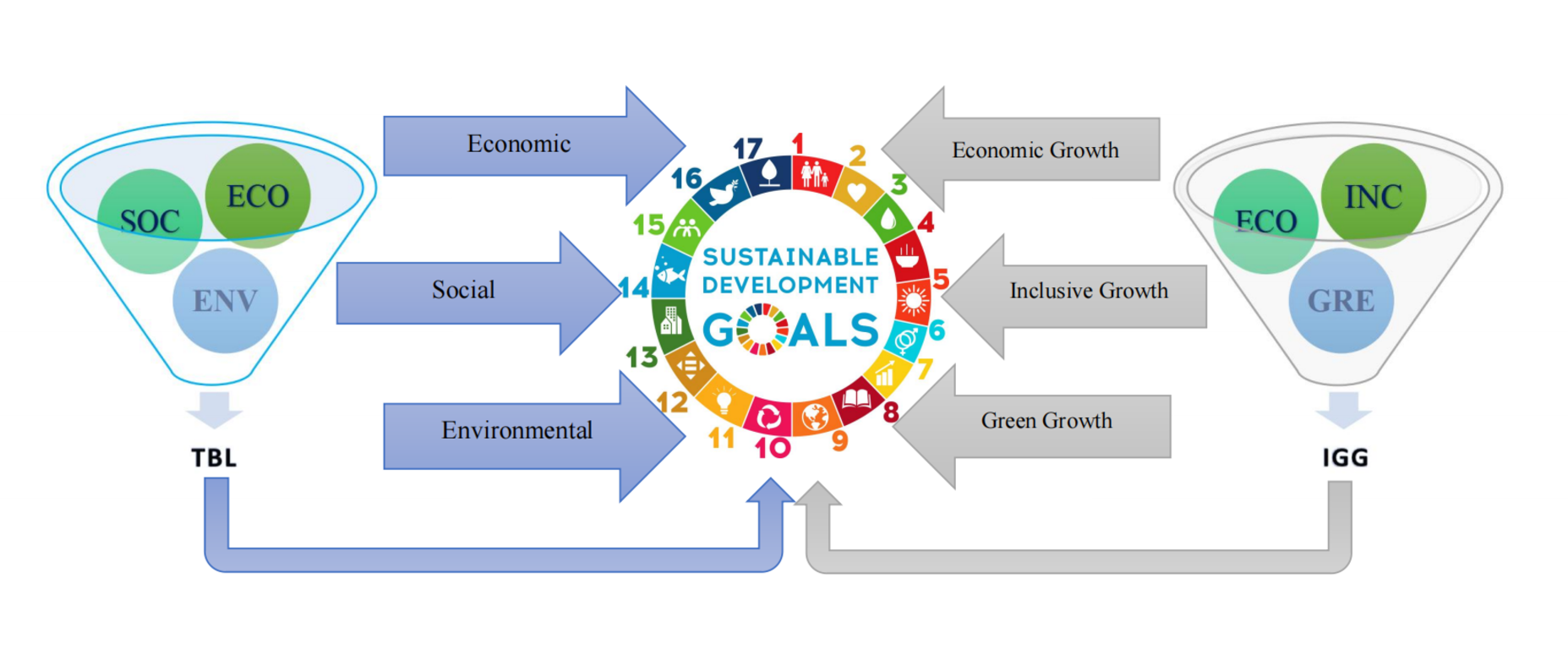
Inclusive Green Growth (IGG) provides a comprehensive framework for achieving the Sustainable Development Goals (SDGs) in the form of a triple bottom line (TBL) of economic, environmental and social dimensions. This paper systematically reviews 58 peer-reviewed articles to highlight the role of IGG in achieving the SDGs and identifies gaps in existing research. The findings from this study show that IGG strengthens economic dimensions, especially SDG 8 (decent work and economic growth), SDG 9 (industry, innovation and infrastructure), and environmental dimensions, especially SDG 13 (climate action). However, IGG still fails to address social dimensions such as inclusion, governance and equity, and the imbalance in this area is very evident. The bibliometric results show that China leads IGG research on the SDGs; however, interregional and interdisciplinary collaborations remain insufficient. Therefore, attention to governance mechanisms, social inclusion, and strengthening pluralism are essential for balancing the three fundamental pillars of sustainable development. Thus, the present study not only outlines a comprehensive framework for IGG and highlights research gaps in this area, but also proposes a roadmap for enhancing the role of IGG in achieving sustainable and equitable global development.
Graphical Abstract
Keywords
earth system | Inclusive Green Growth (IGG) | Triple Bottom Line (TBL) | Sustainable Development Goals (SDGs) | bibliometric analysis
References
- 1.Santosh, M.; Groves, D.I.; Yang, C.X. Habitable planet to sustainable civilization: Global climate change with related clean energy transition reliant on declining critical metal resources. Gondwana Res. 2024, 130, 220–233.
- 2.Groves, D.I.; Santosh, M.; Müller, D. Is Net Zero 2050/2060 a sensible forward-looking pathway for human civilization? A geological long-term perspective. Gondwana Res. 2025, in press. https://doi.org/10.1016/j.gr.2025.04.006.
- 3.Khan, I. The Energy Trilemma: An overview of balancing security, sustainability, and affordability. Habitable Planet 2025, 1, 56–68.
- 4.Munasinghe, M. Sustainability in the Twenty-First Century: Applying Sustainomics to Implement the Sustainable Development Goals; Cambridge University Press: Cambridge, UK, 2019.
- 5.Rammelt, C.F.; Gupta, J. Inclusive is not an adjective, it transforms development: A post-growth interpretation of Inclusive Development. Environ. Sci. Policy 2021, 124, 144–155.
- 6.Borel-Saladin, J.M.; Turok, I.N. The green economy: Incremental change or transformation? Environ. Policy Gov. 2013, 23, 209–220.
- 7.Verma, S.; Kandpal, D. Green economy and sustainable development: A macroeconomic perspective. In Environmental Sustainability and Economy; Elsevier: Amsterdam, The Netherlands, 2021; pp. 325–343.
- 8.Ren, S.; Li, L.; Han, Y.; et al. The emerging driving force of inclusive green growth: Does digital economy agglomeration work? Bus. Strategy Environ. 2022, 31, 1656–1678.
- 9.Xin, C.; Fan, S.; Mbanyele, W.; et al. Towards inclusive green growth: Does digital economy matter? Environ. Sci. Pollut. Res. 2023, 30, 70348–70370.
- 10.Song, Y.; Huang, H.; Li, Y.; et al. Towards inclusive green growth in China: Synergistic roles and mechanisms of new infrastructure construction. J. Environ. Manag. 2024, 353, 120281.
- 11.Li, Y.; Zhang, J.; Lyu, Y. Toward inclusive green growth for sustainable development: A new perspective of labor market distortion. Bus. Strategy Environ. 2023, 32, 3927–3950.
- 12.Ofori, I.K.; Gbolonyo, E.Y.; Ojong, N. Towards Inclusive Green Growth in Africa: Critical energy efficiency synergies and governance thresholds. J. Clean. Prod. 2022, 369, 132917.
- 13.Ofori, I.K.; Gbolonyo, E.Y.; Ojong, N. Foreign direct investment and inclusive green growth in Africa: Energy efficiency contingencies and thresholds. Energy Econ. 2023, 117, 106414.
- 14.Zhu, S.; Ye, A. Does foreign direct investment improve inclusive green growth? Empirical evidence from China. Economies 2018, 6, 44.
- 15.Ouyang, Z.; Song, C.; Zheng, H.; et al. Using gross ecosystem product (GEP) to value nature in decision making. Proc. Natl. Acad. Sci. USA 2020, 117, 14593–14601.
- 16.Mandle, L.; Ouyang, Z.; Salzman, J.; et al. (Eds.). Green Growth that Works: Natural Capital Policy and Finance Mechanisms around the World; Island Press: Washington, DC, USA, 2019; pp. 177–194.
- 17.He, Q.; Du, J. The impact of urban land misallocation on inclusive green growth efficiency: Evidence from China. Environ. Sci. Pollut. Res. 2022, 29, 3575–3586.
- 18.Schoneveld, G.; Zoomers, A. Natural resource privatisation in Sub-Saharan Africa and the challenges for inclusive green growth. Int. Dev. Plan. Rev. 2015, 37, 95–118.
- 19.Shobande, O.A.; Ogbeifun, L.; Tiwari, A.K. Carbon neutrality: Synergy for energy transition, circular economy and inclusive green growth. J. Environ. Manag. 2025, 374, 124114.
- 20.Kedir, A.M. Environment and climate change in Africa in an era of sustainable development goals. In From Millennium Development Goals to Sustainable Development Goals; Routledge: London, UK, 2017; pp. 152–166.
- 21.Fan, S.; Huang, H.; Mbanyele, W.; et al. Inclusive green growth for sustainable development of cities in China: Spatiotemporal differences and influencing factors. Environ. Sci. Pollut. Res. 2023, 30, 11025–11045.
- 22.Wu, Y.; Zhou, X. Research on the efficiency of China’s fiscal expenditure structure under the goal of inclusive green growth. Sustainability 2021, 13, 9725.
- 23.Yu, T.; Zhang, Y.; Jia, S.; et al. Spatio-temporal evolution and drivers of coupling coordination between digital infrastructure and inclusive green growth: Evidence from the Yangtze River economic belt. J. Environ. Manag. 2025, 376, 124416.
- 24.Sun, H.; Mao, W.; Dang, Y.; et al. What inhibits regional inclusive green growth? Empirical evidence from China. Environ. Sci. Pollut. Res. 2022, 29, 39790–39806.
- 25.Munasinghe, M. COVID-19 and sustainable development. Int. J. Sustain. Dev. 2020, 23, 1–24.
- 26.Sifa, S.F.; Sultana, R.; Bodrud-Doza, M. Climate Change and COVID-19: Crisis Within Crises for Eradication of Poverty in Bangladesh. In COVID-19: Environmental Sustainability and Sustainable Development Goals; Singapore: Springer, 2021; pp. 169–188.
- 27.Singh, P.; Yadav, N. Climate-Health-Sustainability Nexus; Springer Nature: Cham, Switzerland, 2024.
- 28.Acheampong, A.O. Foreign direct investment and inclusive green growth in Africa: Energy efficiency contingencies and thresholds: Comment. Energy Econ. 2023, 126, 107019.
- 29.Ben Lahouel, B.; Taleb, L.; Managi, S.; et al. Inclusive green growth in OECD countries: What are the impacts of stringent environmental and employment regulations? Environ. Econ. Policy Stud. 2023, 1–29. https://doi.org/10.1007/s10018-023-00362-4.
- 30.Bowen, A. Chapter 15 Green growth. In Handbook of Sustainable Development; Edward Elgar Publishing: Cheltenham Glos, UK, 2014; pp. 237–251.
- 31.Burkolter, P.; Perch, L. Greening growth in the south: Practice, policies and new frontiers. S. Afr. J. Int. Aff. 2014, 21, 235–259.
- 32.Cao, J. The dynamic coupling nexus among inclusive green growth: A case study in Anhui province, China. Environ. Sci. Pollut. Res. 2022, 29, 49194–49213.
- 33.Chenguel, M.B.; Mansour, N. Green finance: Between commitment and illusion. Compet. Rev. Int. Bus. J. 2024, 34, 179–192.
- 34.Chu, Y.; Du, Y.; Yang, Y. The impact of digital trade on inclusive green growth—Evidence from China’s experience. Front. Environ. Sci. 2025, 13, 1559586.
- 35.Dinda, S. Creating natural resource base for green growth in India. Int. J. Green Econ. 2016, 10, 1–14.
- 36.Dong, Y.; Xu, Q. How does digital economy achieve inclusive economic growth with efficiency, equity and green? International evidence. Manag. Environ. Qual. Int. J. 2025, 36, 1283–1303.
- 37.Fan, S.; Balezentis, T.; Mbanyele, W.; et al. Unlocking Informatization’s Potential: The Impact of Smart City Initiatives on Inclusive Green Growth. Sustain. Dev. 2025, 33, 6050–6070.
- 38.Iftikhar, H.; Ullah, A.; Pinglu, C. From regional integrated development toward sustainable future: Evaluating the Belt and Road Initiative’s spillover impact between tourism, Fintech and inclusive green growth. Clean Technol. Environ. Policy 2025, 27, 1427–1454.
- 39.Li, L.; Ren, S.; Gao, Z. Green through finance: The impact of monetary policy uncertainty on inclusive green growth. Environ. Sci. Pollut. Res. 2023, 30, 99913–99929.
- 40.Li, M.; Zhang, Y.; Fan, Z.; et al. Evaluation and research on the level of inclusive green growth in Asia-Pacific region. Sustainability 2021, 13, 7482.
- 41.Ma, R.; Liu, H.; Li, Z.; et al. Promoting sustainable development: Revisiting digital economy agglomeration and inclusive green growth through two-tier stochastic frontier model. J. Environ. Manag. 2024, 355, 120491.
- 42.Ofori, I.K.; Figari, F. Economic globalisation and inclusive green growth in Africa: Contingencies and policy-relevant thresholds of governance. Sustain. Dev. 2023, 31, 452–482.
- 43.Ofori, I.K.; Figari, F.; Ojong, N. Towards sustainability: The relationship between foreign direct investment, economic freedom and inclusive green growth. J. Clean. Prod. 2023, 406, 137020.
- 44.Peng, R.; Zeng, B. Digital financial inclusion and inclusive green growth: Evidence from China’s green growth initiatives. Int. J. Financ. Stud. 2024, 13, 2.
- 45.Ren, Y.; He, X.; Jiang, Q.; et al. Advancing high-quality development in China: Unraveling the dynamics, disparities, and determinants of inclusive green growth at the prefecture level. Ecol. Indic. 2024, 169, 112898.
- 46.Shobande, O.A.; Tiwari, A.K.; Ogbeifun, L. Quantifying the role of the energy transition in alleviating marginalisation and advancing inclusive green growth. J. Environ. Manag. 2025, 390, 126241.
- 47.Wang, J.; Ou, G.; Huang, J.; et al. Does China’s high-speed rail operation promote inclusive green growth? A service-based network perspective. Res. Transp. Bus. Manag. 2025, 62, 101455.
- 48.Wang, Q.; Chen, X. Can new quality productive forces promote inclusive green growth: Evidence from China. Front. Environ. Sci. 2024, 12, 1499756.
- 49.Wu, W.; Lin, X. Digital inclusive finance for green transformation: Insight from green innovation, industrial upgrading, and employment quality. J. Innov. Knowl. 2025, 10, 1–7.
- 50.Wu, Y.; Song, L.; Zhou, X. Can Adjust the Fiscal Expenditure Structure Promote Inclusive Green Growth? Empirical Evidence from China. Rev. Dev. Econ. 2025, 29, 1712–1733.
- 51.Xu, A.; Dai, Y.; Hu, Z.; et al. Can green finance policy promote inclusive green growth?-Based on the quasi-natural experiment of China’s green finance reform and innovation pilot zone. Int. Rev. Econ. Financ. 2025, 100, 104090.
- 52.Xu, Y.; Li, L.; Xiang, S. Performance evaluation of inclusive green growth in China: Dynamic evolution, regional differences, and spatial correlation. PLoS ONE 2024, 19, e0305338.
- 53.Yang, X.; Wang, H.; Yan, T.; et al. The road to inclusive green growth in China: Exploring the impact of digital-real economy integration on carbon emission efficiency. J. Environ. Manag. 2024, 370, 122989.
- 54.Chen, L.; Wang, Y.; Yan, Y.; et al. Coupling and coordination development, spatiotemporal evolution, and driving factors of China’s digital countryside and inclusive green growth in rural areas. Sustainability 2024, 16, 5583.
- 55.Chen, M.; Zhang, T.; Chu, Q.; et al. Convergence analysis of inclusive green growth in China based on the spatial correlation network. Sustainability 2023, 15, 12344.
- 56.Fan, S.; Huang, H.; Mbanyele, W.; et al. A step toward inclusive green growth: Can digital finance be the main engine? Environ. Sci. Pollut. Res. 2023, 30, 96075–96097.
- 57.Guan, Y.; Wang, H.; Guan, R.; et al. Measuring inclusive green total factor productivity from urban level in China. Front. Environ. Sci. 2022, 10, 966246.
- 58.Qian, J.; Ji, R. Impact of energy-biased technological progress on inclusive green growth. Sustainability 2022, 14, 16151.
- 59.Wang, H.; Li, W.; Xiao, H.; et al. Horizontal ecological compensation and urban inclusive green growth: Evidence from China. Front. Public Health 2024, 12, 1415309.
- 60.Wang, D.; Hou, Y.; Li, X.; et al. Developing a functional index to dynamically examine the spatio-temporal disparities of China’s inclusive green growth. Ecol. Indic. 2022, 139, 108861.
- 61.Kousar, S.; Ahmed, F.; Abid, A.; et al. Inclusive wealth as a measurement of sustainable future: Bibliometric analysis for past, present and future research agenda in biodiversity accounting and sustainable development. Int. J. Clim. Change Strateg. Manag. 2025. https://doi.org/10.1108/IJCCSM-03-2025-0064.
How to Cite
Ansarinasab, M.; Santosh, M. Inclusive Green Growth as a Policy Framework for Operationalizing Sustainable Development Goals through the Triple Bottom Line. Earth Systems, Resources, and Sustainability 2026, 1 (1), 1–17. https://doi.org/10.53941/esrs.2026.100001.
RIS
BibTex
Copyright & License

Copyright (c) 2025 by the authors.
This work is licensed under a Creative Commons Attribution 4.0 International License.
Contents
References
