
- Proposes a comprehensive GeoAI framework integrating ethics, skills, and governance.
- Addresses gaps in standardization, transparency, privacy, bias, and accountability.
- Emphasizes collaboration among academia, industry, and policymakers to align with the SDGs.
- Promotes a scalable, responsible, and ethically grounded GeoAI ecosystem for sustainability.
- Open Access
- Article
Towards Responsible GeoAI Frameworks for Ethical Governance and Global Sustainability
- Saied Pirasteh 1,2,*,
- Zaffar Sadiq Mohamed-Ghouse 3,
- Lokendra Chauhan 4,
- Georg Gartner 5,
- Mahdieh Shirmohammadi 1 and
- Nasim Khonsari 6
Author Information
Received: 11 October 2025 | Revised: 27 October 2025 | Accepted: 30 October 2025 | Published: 18 November 2025
Highlights
Abstract
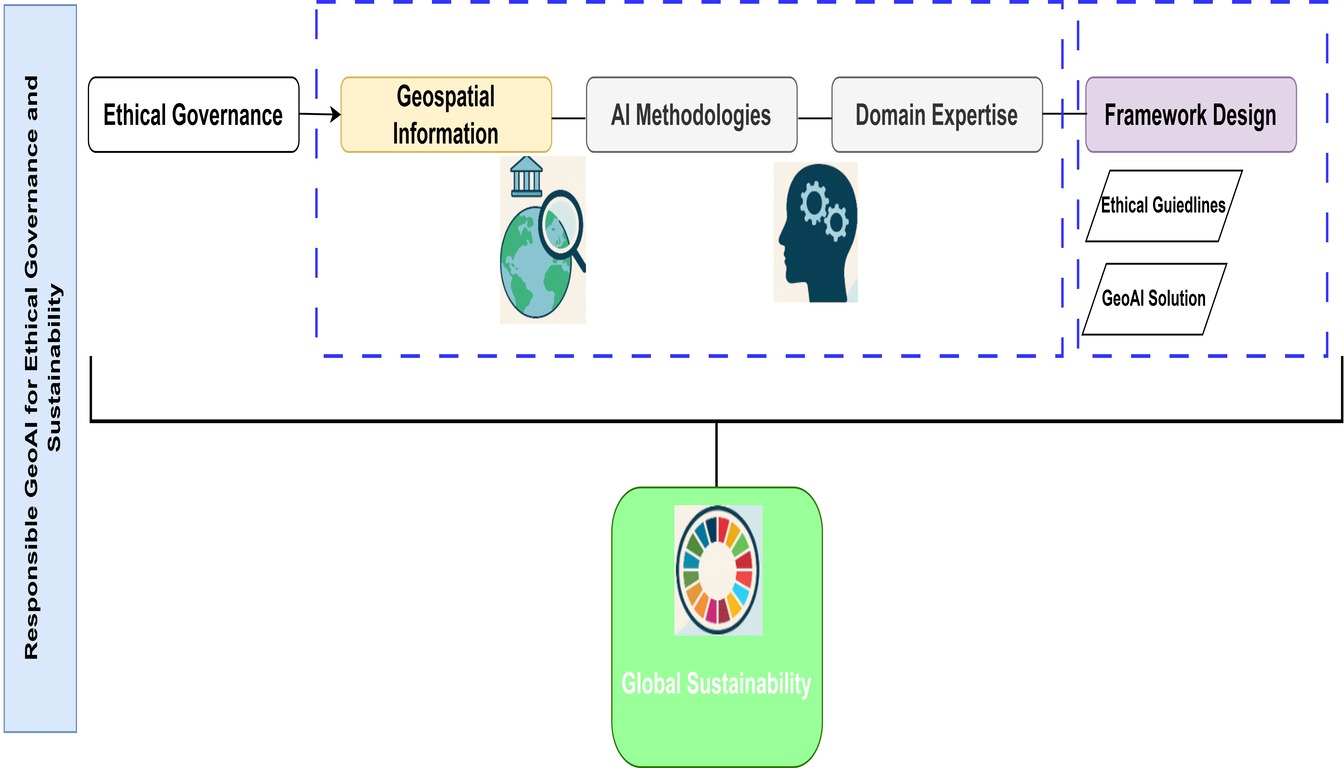
Geospatial Artificial Intelligence (GeoAI) is revolutionizing academia and industry by integrating advanced AI methodologies with geospatial sciences to enable smarter analysis, prediction, and decision-making. However, the global adoption of GeoAI faces critical challenges, including the lack of standardization, transparency, bias control, accountability, fairness, privacy protection, ethical oversight, and equitable collaboration. This study proposes an enhanced comprehensive framework and ethical guidelines to address these gaps and promote responsible GeoAI practices. The proposed frameworks emphasize the importance of ethical governance, interoperability, inclusivity, and reproducibility in GeoAI-driven systems. The proposed GeoAI framework integrates geospatial science, artificial intelligence, and domain expertise through a structured, multi-stage process including benchmarking, expert consultation, framework structuring, and iterative validation. We incorporated ethical guidelines and skill competencies to ensure transparency, fairness, privacy, and alignment with global standards, as outlined in the UN-GGIM. This approach enables the development of a scalable, responsible, and collaborative GeoAI ecosystem for sustainable decision-making. Findings underscore the need to stay current with technological and methodological advancements to enhance geospatial methods and services. Moreover, fostering collaboration among academic, industrial, and policy stakeholders is vital to ensuring that GeoAI initiatives align with and support the United Nations Sustainable Development Goals (SDGs). Ultimately, this work advocates for a transparent, fair, and ethically grounded GeoAI ecosystem that advances scientific innovation and contributes to sustainable global progress.
Graphical Abstract
Keywords
GeoAI | ethical frameworks | SDGs | transparency and fairness | ecosystem
References
- 1.
Asadikia, A.; Rajabifard, A.; Kalantari, M. Systematic prioritisation of SDGs: Machine learning approach. World Dev. 2021, 140, 105269. https://doi.org/10.1016/j.worlddev.2020.105269
- 2.
Metze, T.; Rojas-Padilla, E. Visualizing greener cities. Nat. Sustain. 2024, 7, 377–378. https://doi.org/10.1038/s41893-024-01277-y
- 3.
Yang, C.; Clarke, K.; Shekhar, S.; et al. Big Spatiotemporal Data Analytics: A research and innovation frontier. Int. J. Geogr. Info. Sci. 2019, 34, 1075–1088. https://doi.org/10.1080/13658816.2019.1698743
- 4.
Ceballos Cantu, J.P.; Jobst, M.; Gartner, G. Understanding relevance in maps through the use of knowledge graphs. Int. J. Cartogr. 2023, 9, 466–487.
- 5.
Fairbairn, D.; Gartner, G.; Peterson, M. Engagement, communication and context: The success of the human-map nexus. Int. J. Cartogr. 2023, 1–21.
- 6.
Zhang, F.; Li, S.; Ma, L.; et al. Limitation and challenges of image quality measurement. Proc. SPIE 2010, 7744, 774402. https://doi.org/10.1117/12.863083
- 7.
Cheng, H.-W. Challenges and limitations of ChatGPT and artificial intelligence for scientific research: A Perspective from organic materials. Artif. Intell. 2023, 4, 401–405. https://doi.org/10.3390/ai4020021
- 8.
Hassani, H.; Silva, M.S. The role of ChatGPT in data science: How AI-assisted conversational interfaces are revolutionizing the field. Big Data Cogn. Comput. 2023, 7, 62. https://doi.org/10.3390/bdcc7020062
- 9.
Pirasteh, S.; Shamsipour, G.; Liu, G.; et al. Cloud-based geospatial platform in support of sustainable development goals 2030: How to be prepared for earthquake disasters? In Proceedings of the XXIV ISPRS Congress, Nice, France, 14–20 June 2020; pp. 1705–1708. https://doi.org/10.5194/isprs-archives-XLIII-B3-2020-1705-2020
- 10.
Zhang, Y.; Wei, C.; He, Z.; et al. GeoGPT: An assistant for understanding and processing geospatial tasks. Int. J. Appl. Earth Obs. Geoinf. 2024, 131, 103976. https://doi.org/10.1016/j.jag.2024.103976
- 11.
Micheli, M.; Gevaert, C.M.; Carman, M.; et al. AI ethics and data governance in the geospatial domain of digital earth. Big Data Soc. 2022, 9, 205395172211387. https://doi.org/10.1177/20539517221138767
- 12.
Lokendra, C.P.S.; Shekhar, S. GeoAI – Accelerating a virtuous cycle between AI and Geo. In Proceedings of the 2021 Thirteenth International Conference on Contemporary Computing (IC3-2021); Association for Computing Machinery: New York, NY, USA, 2021; pp. 355–370. https://doi.org/10.1145/3474124.3474179
- 13.
Scott, G.; Rajabifard, A. Sustainable development and geospatial information: A strategic framework for integrating a global policy agenda into national geospatial capabilities. Geo-spat. Inf. Sci. 2017, 20, 59–76. https://doi.org/10.1080/10095020.2017.1325594
- 14.
Scott, G.; Rajabifard, A. SDGs Roadmap: Sustainable Development Goals Connectivity Dilemma, 1st ed.; CRC Press: Boca Raton, FL, USA, 2019; p. 11; ISBN 9780429290626.
- 15.
Jiang, H.; van Genderen, J.; Mazzetti, P.; et al. Current status and future directions of geoportals. Int. J. Digit. Earth 2020, 13, 1093–1114.
- 16.
United Nations-Global Geospatial Information Management (UNGGIM). Future Trends in Geospatial Information Management: The Five to Ten Year Vision, 2nd ed.; UN-GGIM: New York, NY, USA, 2015; pp. 1–44.
- 17.
Coetzee, S.; Iv ´anov´ a, I.; Mitasova, H.; et al. Open geospatial software and data: A review of the current state and a perspective into the future. ISPRS Int. J. Geo-Inf. 2020, 9, 90. https://doi.org/10.3390/ijgi9020090
- 18.
Peng, G.; Downs, R.R.; Lacagnina, C.; et al. Call to action for global access to and harmonization of quality information of individual earth science datasets. Data Sci. J. 2021, 20, 19. https://doi.org/10.5334/dsj-2021-019
- 19.
Wu, W.; Huang, T.; Gong, K. Ethical principles and governance technology development of AI in China. Engineering 2020, 6, 302–309.
- 20.
Gonz´ alez, A.; Bonnin, C.; O’Mahony, E.; et al. Challenges and prospects of integrating GIS education in development studies in a global south context. J. Geogr. 2021, 120, 12–22.
- 21.
Owers, C.J.; Lucas, R.M.; Clewley, D.; et al. Living Earth: Implementing national standardised land cover classification systems for Earth Observation in support of sustainable development. Big Earth Data 2021, 5, 368–390.
- 22.
UNESCO. Recommendation on the Ethics of Artificial Intelligence. UNESCO: Paris, France, 2021. Available online: https://unesdoc.unesco.org/ark:/48223/pf0000380455 (accessed 3 November 2022).
- 23.
Altan, O.; Dowman, I. The changing world under the corona virus threat—from human needs to SDGs and what next? Geospat. Inf. Sci. 2021, 24, 50–57.
- 24.
Marguerite, M.; Nyhan, A.; Cryan, J.F. Embed impact on SDGs in research assessments. Nature 2023, 621, 258. https://doi.org/10.1038/d41586-023-02860-7
- 25.
Calzati, S.; van Loenen, B. An ethics assessment list for geoinformation ecosystems: Revisiting the integrated geospatial information framework of the United Nations. Int. J. Digit. Earth 2023, 16, 1418–1438.
- 26.
Gartner, G.; Ignateva, O.; Zhunis, B.; et al. Conceptualizing and validating the trustworthiness of maps through an empirical study on the influence of cultural background on map design perception. ISPRS Int. J. Geo-Inf. 2024, 13. 39. https://doi.org/10.3390/ijgi13020039
- 27.
Floridi, L.; Cowls, J. A unified framework of five principles for AI in society. In Machine Learning and the City: Applications in Architecture and Urban Design; Wiley: Hoboken, NJ, USA, 2022; pp. 535–545.
- 28.
Choi, Y. GeoAI: Integration of artificial intelligence, machine learning, and deep learning with GIS. Appl. Sci. 2023, 13, 3895.
- 29.
Chun, Y.; Kwan, M.P.; Griffith, D.A. Uncertainty and context in GIScience and geography: Challenges in the era of geospatial big data. Int J. Geogr. Inf. Sci. 2019, 33, 1131–1134.
- 30.
Janowicz, K.; Gao, S.; McKenzie, G.; et al. GeoAI: Spatially explicit artificial intelligence techniques for geographic knowledge discovery and beyond. Int J. Geogr. Inf. Sci. 2020, 34, 625–636.
- 31.
Nelson, T.A.; Goodchild, M.F.; Wright, D.J. Accelerating ethics, empathy, and equity in geographic information science. Proc. Natl. Acad. Sci. USA 2022, 119, e2119967119.
- 32.
Roy, A.; Sen, S. Geospatial technologies in ethical AI decisionmaking under uncertainty: An integrative ethical framework. In World Conference on Information Systems for Business Management, September 2024; Springer Nature: Singapore, 2024; pp. 41–49.
- 33.
Cao, G. Deep learning of big geospatial data: Challenges and opportunities. In New Thinking in GIScience; Springer: Singapore, 2022; pp. 159–169.
- 34.
Samek, W.; Wiegand, T.; M¨ uller, K.R. Explainable artificial intelligence: Understanding, visualizing and interpreting deep learning models, arXiv 2017, arXiv:1708.08296
- 35.
Koldasbayeva, D.; Tregubova, P.; Gasanov, M.; et al. Challenges in data-driven geospatial modeling for environmental research and practice. Nat. Commun. 2024, 15, 10700. https://doi.org/10.1038/s41467-024-55240-8
- 36.
Hassija, V.; Chamola, V.; Mahapatra, A.; et al. Interpreting black-box models: A review on explainable artificial intelligence. Cogn. Comput. 2024, 16, 45–74.
- 37.
Leslie, D. Understanding artificial intelligence ethics and safety, arXiv 2019, arXiv:1906.05684
- 38.
Sun, C.; Ippel, L.; Dekker, A.; et al. A systematic review on privacypreserving distributed data mining. Data Sci. 2021, 4, 121–150.
- 39.
Hewage, U.H.W.A.; Sinha, R.; Naeem, M.A. Privacy-preserving data (stream) mining techniques and their impact on data mining accuracy: A systematic literature review. Artif. Intell. Rev. 2023, 56, 10427–10464.
- 40.
Jobin, A.; Ienca, M.; Vayena, E. The global landscape of AI ethics guidelines. Nat. Mach. Intell. 2019, 1, 389–399.
- 41.
OECD (Organisation for Economic Cooperation and Development). OECD Framework for the Classification of AI systems; OECD Publishing: Paris, France, 2022.
- 42.
UNESCO. Recommendation on the Ethics of Artificial Intelligence; United Nations Educational, Scientific and Cultural Organization: Paris, France, 2022.
- 43.
Dixon, B. GeoAI, and geospatial framework for integrated placebased approach. In Interdisciplinary Environmental Solutions: Using Geospatial Technologies for Bridging Disciplines, Scale and Data; Springer Nature: Cham, Switzerland, 2025; pp. 445–486.
- 44.
Ghamisi, P.; Yu, W.; Marinoni, A.; et al. Responsible AI for earth observation, arXiv 2024, arXiv:2405.20868
- 45.
Crampton, J. The ethics of GIS. Cartogr. Geogr. Inf. Syst. 1995, 22, 84–89.
- 46.
Breunig, M.; Bradley, P.E.; Jahn, M.; et al. Geospatial data management research: Progress and future directions. ISPRS Int. J. Geo-Info. 2020, 9, 95.
- 47.
European Commission. Communication from the Commission: Artificial Intelligence for Europe. 237; European Commission Publication Office: Luxemburg, 2018.
How to Cite
Pirasteh, S.; Mohamed-Ghouse, Z. S.; Chauhan, L.; Gartner, G.; Shirmohammadi, M.; Khonsari, N. Towards Responsible GeoAI Frameworks for Ethical Governance and Global Sustainability. Earth Systems, Resources, and Sustainability 2026, 1 (1), 18–31. https://doi.org/10.53941/esrs.2026.100002.
RIS
BibTex
Copyright & License

Copyright (c) 2025 by the authors.
This work is licensed under a Creative Commons Attribution 4.0 International License.
Contents
References
