
- Hydro-meteorological processes responsible for the genesis and circulation pattern of the Cyclone Nisarga were evaluated using stable isotopes and geospatial data.
- Distinctly depleted and widely variable stable isotopic signature was observed during the cyclone.
- Isotopic characteristics and atmospheric processes were compared between the tropical cyclones and the Indian Summer Monsoon.
- Elevated sea surface temperature and anthropogenic forcings are the key factors responsible the frequent occurrence of tropical cyclones.
- Open Access
- Article
Stable Isotopic and Geospatial Approach for Evaluating the Frequent Occurrence of Cyclonic Events Over the Arabian Sea
- Md. Arzoo Ansari,
- Jacob Noble * and
- Archana Deodhar
Author Information
Received: 14 October 2025 | Revised: 10 November 2025 | Accepted: 11 November 2025 | Published: 20 November 2025
Highlights
Abstract
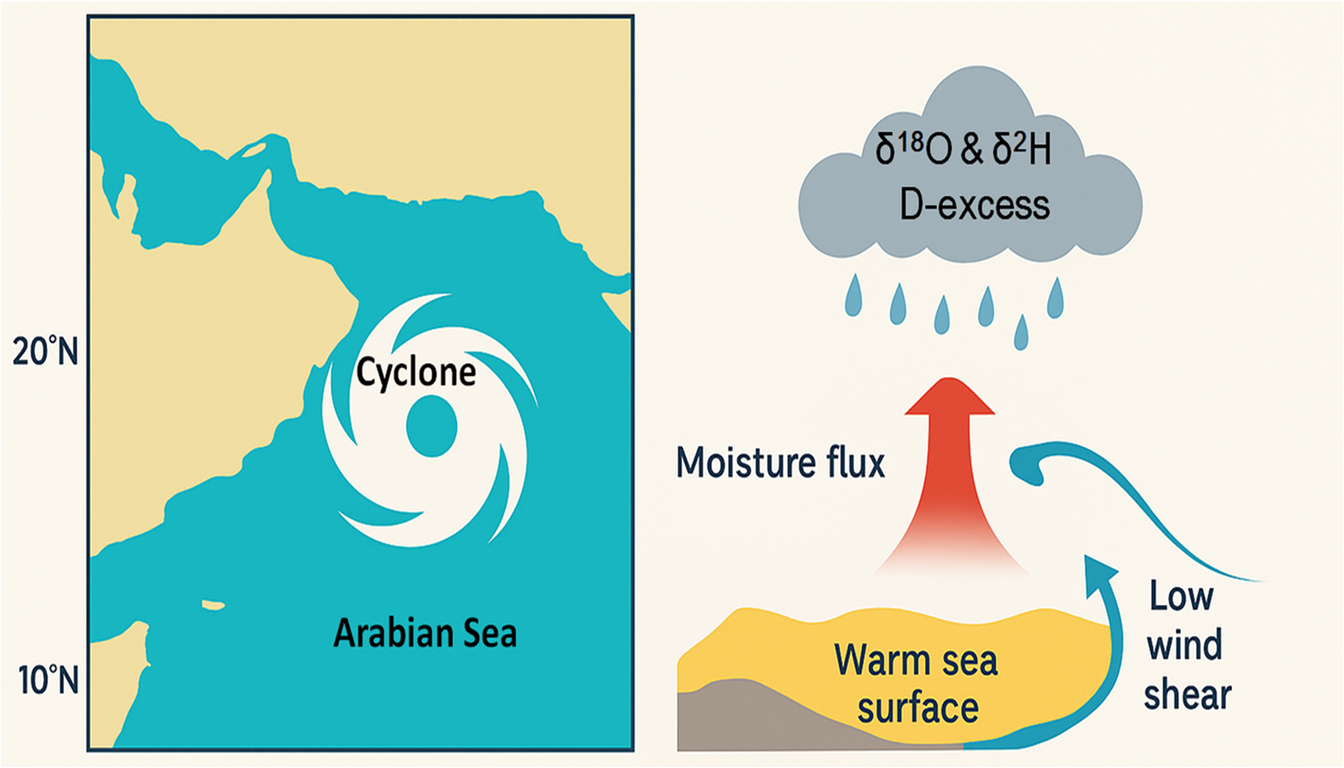
The frequency of cyclonic events has increased over the Arabian Sea in the recent past due to the influence of climate change on the Indian Ocean. This study integrates environmental isotopic tracers (δ18O and δ2H) and geospatial data to investigate the occurrence of Cyclone Nisarga during June, 2020, which impacted the Mumbai city, India. High frequency precipitation samples collected during the cyclone exhibited distinctly depleted and widely variable isotopic signatures (δ18O: −15.9‰ to −0.2‰; δ2H: −114.8‰ to 7.5‰; D-excess: 5.7‰ to 15.1‰), compared to the Indian Summer Monsoon (ISM), that is more enriched and having lower variability. These differences are attributed to the dynamic nature of moisture, isotopic fractionation due to organized convective condition and vapour recycling along the trajectory of the Cyclone Nisarga. The structural development and intensification of the cyclone were further examined using Sea Surface Temperature (SST), Outgoing Longwave Radiation (OLR), and wind circulation patterns derived from the HYSPLIT backward trajectory modelling. The elevated SST values and anthropogenic forcing are found to be the key factors responsible for the frequent cyclone genesis and its intensification over the Arabian Sea. The extremely low OLR values and distinct wind patterns are observed during the Cyclone Nisarga. Difference in wind dynamics and clouds patterns between tropical cyclones and the ISM highlight the unique atmospheric and hydro-meteorological processes responsible for the formation of the cyclone. The study offers valuable insights into the mechanisms of extreme rainfall events, aiding in improved forecasting, disaster mitigation, and climate resilience planning in the region.
Graphical Abstract
Keywords
stable isotopes | cyclone | extreme events | Arabian Sea | sea surface temperature
References
- 1.
Bhatia, K.T.; Vecchi, G.A.; Knutson, T.R.; et al. Recent increases in tropical cyclone intensification rates. Nat. Commun. 2019, 10, 635. https://doi.org/10.1038/s41467-019-08471-z
- 2.
Wu, D.; Ju, X.; Sun, J.; et al. Escalation of tropical cyclone impacts on the northwestern Bay of Bengal over the past decade. Clim. Dyn. 2024, 62, 5645–5662. https://doi.org/10.1007/s00382-024-07252-9
- 3.
Defforge, C.L.; Merlis, T.M. Observed warming trend in sea surface temperature at tropical cyclone genesis. Geophys. Res. Lett. 2017, 44, 1034–1040. https://doi.org/10.1002/2016GL071045
- 4.
Xu, M.; Wang, X.; Sun, L.; et al. Composited sea surface responses to tropical cyclones in the Bay of Bengal during 2003–2020. Mar. Environ. Res. 2024, 202, 106779. https://doi.org/10.1016/j.marenvres.2024.106779
- 5.
Gray, W.M. Global view of the origin of tropical disturbances and storms. Mon. Weather Rev. 1968, 96, 669–700.
- 6.
Evan, A.T.; Camargo, S.J. A climatology of Arabian Sea cyclonic storms. J. Clim. 2011, 24, 140–158.
- 7.
Sobel, A.H.; Wing, A.A.; Camargo, S.J.; et al. Tropical cyclone frequency. Earth’s Future 2021, 9, e2021EF002275. https://doi.org/10.1029/2021EF002275
- 8.
Singh, V.K.; Roxy, M.K. A review of ocean–atmosphere interactions during tropical cyclones in the North Indian Ocean. Earth-Sci. Rev. 2022, 226, 103967. https://doi.org/10.1016/j.earscirev.2022.103967
- 9.
Li, Z.; Yu, W.; Li, T.; et al. Bimodal character of cyclone climatology in Bay of Bengal modulated by monsoon seasonal cycle. J. Clim. 2013, 26, 1033-1046.
- 10.
Singh, O.P.; Kahn, A.; Rahman, S. Has the frequency of intense tropical cyclones increased in the North Indian Ocean? Curr. Sci. 2001, 80, 575–580.
- 11.
Vinodhkumar, B.; Busireddy, N.K.R.; Ankur, K.; et al. On occurrence of rapid intensification and rainfall changes in tropical cyclones over the North Indian Ocean. Int. J. Climatol. 2021, 42, 714–726. https://doi.org/10.1002/joc.7268
- 12.
Cheng, L.; Abraham, J.; Hausfather, Z.; et al. How fast are the oceans warming? Science 2019, 363, 128–129. https://doi.org/10.1126/science.aav7619
- 13.
WMO. Tropical Cyclone Operational Plan for the Bay of Bengal and Arabian Sea WMO/TD-84. World Meteorological Organization, 2015. https://www.wmo.int/pages/prog/www/tcp/documents/TCP-21Edition2015 final.pdf
- 14.
Kruk, M.C. Tropical cyclones, North Indian Ocean. Bull. Am. Meteorol. Soc. 2016, 97, 114–115.
- 15.
Murakami, H.; Vecchi, G.A.; Underwood, S. Increasing frequency of extremely severe cyclonic storms over the Arabian Sea. Nat. Clim. Change 2017, 7, 885–889. https://doi.org/10.1038/s41558-017-0008-6
- 16.
Roxy, M.K.; Ritika, K.; Terray, P.; et al. The curious case of Indian Ocean Warming. J. Clim. 2014, 27, 8501–8509. https://doi.org/10.1175/JCLI-D-14-00471.1
- 17.
Ansari, M.A.; Noble, J.; Deodhar, A.; et al. Atmospheric factors controlling the stable isotopes (δ18O and δ18O) of the Indian summer monsoon precipitation in a drying region of Eastern India. J. Hydrol. 2020, 584, 124636. https://doi.org/10.1016/j.jhydrol.2020.124636
- 18.
Sun, C.; Tian, L.; Shanahan, T.M.; et al. Isotopic variability in tropical cyclone precipitation is controlled by Rayleigh distillation and cloud microphysics. Commun. Earth Environ. 2022, 3, 50.
- 19.
Murillo, R.S.; Herrera, D.A.; Farrick, K.K.; et al. Stable isotope tempestology of tropical cyclones across the North Atlantic and Eastern Pacific Ocean basins. Ann. N. Y. Acad. Sci. 2024, 1543, 145-165. https://doi.org/10.1111/nyas.15274
- 20.
Lekshmy, P.R.; Chirsty, A.A.; Krishnadas, S.; et al. Anomalous oceanic moisture supply conceals expected stable water isotopic depletion during monsoon extreme rain events in Kerala, India. Sci. Total Environ. 2025, 988, 179758. https://doi.org/10.1016/j.scitotenv.2025.179758
- 21.
Kumar, B.; Rai, S.P.; Kumar, U.S.; et al. Isotopic characteristics of Indian precipitation. Water Resour. Res. 2010, 46, W12548. https://doi.org/10.1029/2009WR008532
- 22.
Aggarwal, P.K.; Romatschke, U.; Araguas-Araguas, L.; et al. Proportions of convective and stratiform precipitation revealed in water isotope ratios. Nat. Geosci. 2016, 9, 624. https://doi.org/10.1038/NGEO2739
- 23.
Chakraborty, S.; Sinha, N.; Chattopadhyay, R.; et al. Atmospheric controls on the precipitation isotopes over the Andaman Islands, Bay of Bengal. Sci. Rep. 2016, 6, 19555. https://doi.org/10.1038/srep19555
- 24.
Ansari, M.A.; Mohokar, H.V.; Deodhar, A.; et al. Distribution of environmental tritium in rivers, groundwater, mine water, and precipitation in Goa, India. J. Environ. Radioact. 2018, 189, 120–126. https://doi.org/10.1016/j.jenvrad.2018.04.004
- 25.
Fousiya, A.A.; Aravind, G.H.; Achyutan, H.; et al. Modulation of the precipitation isotopes by the dynamic and thermodynamic variables of the atmosphere in southern parts of India. Water Resour. Res. 2022, 58, e2021WR030855. https://doi.org/10.1029/2021WR030855
- 26.
Datye, A.; Chakraborty, S.; Chattopadhyay, R.; et al. Precipitation isotopes response to the atmospheric processes over the mainland and the island region in the Northern Indian Ocean: Implications to the paleo-monsoon study. Mausam 2023, 74, 503–512. https://doi.org/10.54302/mausam.v74i2.5998
- 27.
He, X.; Kang, S.; Wang, S.; et al. Effect of below-cloud evaporation on stable isotopes in precipitation revealed by 12-year observation in the Tanggulu Mountains, Central Tibetan Plateau. J. Hydrol. 2025, 663, 134300. https://doi.org/10.1016/j.jhydrol.2025.134300
- 28.
Rozanski, K.; Araguas, L.; Gonfiantini, R. Isotopic patterns in modern global precipitation. In Climate Change in Continental Isotopic Records; Swart, P.K., et al., Eds.; Geophys. Monogr. Ser.; American Geophysical Union: Washington, DC, USA, 1993; Volume 78, pp. 1–36.
- 29.
Guo, X.; Tian, L.; Wen, R.; et al. Controls of precipitation δ18O on the Northwestern Tibetan Plateau: A case study at Nagari station. Atmos. Res. 2017, 189, 141–151. https://doi.org/10.1016/j.atmosres.2017.02.004
- 30.
Noble, J.; Ansari, M.A. Isotope hydrology and geophysical techniques for reviving a part of the drought prone areas of Vidarbha, Maharashtra, India. J. Hydrol. 2019, 570, 495–507. https://doi.org/10.1016/j.jhydrol.2019.01.020
- 31.
Ansari, M.A.; Noble, J.; Deodhar, A.; et al. Stable isotopic (δ18O and δ2H) and geospatial approach for evaluating extreme rainfall events. Glob. Planet. Change 2020, 194, 103299. https://doi.org/10.1016/j.gloplacha.2020.103299
- 32.
Ansari, M.A.; Noble, J.; Kumar, U.S.; et al. Assessing the groundwater recharge processes in intensively irrigated regions: An approach combining isotope hydrology and machine learning. Geosci. Front. 2025, 16, 102105. https://doi.org/10.1016/j.gsf.2025.102105
- 33.
Zwart, C.; Munksgaard, N.C.; Kurita, N.; et al. Stable isotopic signature of Australian monsoon controlled by regional convection. Quat. Sci. Rev. 2016, 151, 228–235.
- 34.
He, S.; Goodkin, N.F.; Jackisch, D.; et al. Continuous real-time analysis of the isotopic composition of precipitation during tropical rain events: Insight into tropical convection. Hydrol. Process. 2018, 32, 1531–1545. https://doi.org/10.1002/hyp.11520
- 35.
Li, Y.; Zhao, C.; Deng, Q.; et al. Isotopic analysis of precipitation during rainstorm and typhoon events from the warm season in the southeastern coast of China. J. Hydrol. Reg. Stud. 2025, 61, 102749. https://doi.org/10.1016/j.ejrh.2025.102749
- 36.
Murillo, R.S.; Quesada, A.M.D.; Hernandez, G.E.; et al. Deciphering key processes controlling rainfall isotopic variability during extreme tropical cyclones. Nat. Commun. 2019, 10, 4321. https://doi.org/10.1038/s41467-019-12062-3
- 37.
Xu, T.; Sun, X.; Hong, H.; et al. Stable isotope ratios of typhoon rains in Fuzhou, Southeast China, during 2013–2017. J. Hydrol. 2019, 570, 445–453. https://doi.org/10.1016/j.jhydrol.2019.01.017
- 38.
Kim, T.; Choo, S.; Moon, J.; et al. Contribution of tropical cyclones to abnormal sea surface temperature warming in the yellow sea in December 2004. Dyn. Atmos. Oceans 2017, 80, 97–109.
- 39.
Cao, X.; Wu, R.; Wang, P.; et al. Impact of Arctic Sea ice anomalies on tropical cyclogenesis over the eastern North Pacific: Role of Northern Atlantic Sea Surface temperature anomalies. Atmos. Res. 2025, 315, 107844. https://doi.org/10.1016/j.atmosres.2024.107844
- 40.
Palm´en, E.H. On the formation and structure of tropical cyclones. Geophysica 1948, 3, 26–38.
- 41.
Tory, K.J.; Dare, R.A. Sea surface temperature thresholds for tropical cyclone formation. J. Clim. 2015, 28, 8171–8183.
- 42.
Arora, K.; Dash, P. Towards dependence of tropical cyclone intensity on sea surface temperature and its response in a warming world. Climate 2016, 4, 30. https://doi.org/10.3390/cli4020030
- 43.
McTaggart-Cowan, R.; Galarneau, T.J.; Bosart, L.F.; et al. A global climatology of baroclinically influenced tropical cyclogenesis. Mon. Weather Rev. 2013, 141, 1963–1989. https://doi.org/10.1175/MWRD-12-00186.1
- 44.
Malkus, J.S. Cloud patterns over tropical oceans. Science 1963, 141, 767–778.
- 45.
Evans, J.L.; Waters, J.J. Simulated relationships between sea surface temperature and tropical convection in climate models and their implications for tropical cyclone activity. J. Clim. 2012, 25, 7884–7895. https://doi.org/10.1175/JCLI-D-11-00392.1
- 46.
Sandeep, S.F.; Stordal, J. Use of OLR data in detecting precipitation extremes in the tropics. Remote Sens. Lett. 2013, 4, 570–578. https://doi.org/10.1080/2150704X.2013.769284
- 47.
Groning, M.; Lutz, H.O.; Roller-Lutz, Z.; et al. A simple rain collector preventing water re-evaporation dedicated for δ18O and δ2H analysis of cumulative precipitation samples. J. Hydrol. 2012, 448–449, 195–200.
- 48.
Epstein, M.; Mayeda, T. Variation of δ18O content in waters from natural sources. Geochim. Cosmochim. Acta 1953, 4, 213–224.
- 49.
Craig, H. Isotopic variations in meteoric waters. Science 1961, 133, 1702–1703.
- 50.
Clark, I.; Fritz, P. Environmental Isotopes in Hydrogeology; Lewis Publishers: New York, NY, USA, 1997.
- 51.
Liebmann, B.; Smith, C.A. Description of a complete (interpolated) outgoing longwave radiation dataset. Bull. Am. Meteorol. Soc. 1996, 77, 1275–1277.
- 52.
Draxler, R.R.; Rolph, G.D. HYSPLIT (Hybrid Single-Particle Lagrangian Integrated Trajectory) Model Access via NOAA ARL READY Website. NOAA Air Resources Laboratory: Silver Spring, MD, USA, 2014. https://ready.arl.noaa.gov/HYSPLIT.php (accessed on 15 September 2025)
- 53.
Blondi, R.; Ho, S.; Randel, W.; Tropical cyclone cloud-top height and vertical temperature structure detection using GPS radio occultation measurement. J. Geophys. Res. Atmos. 2013, 118, 5247–5259.
- 54.
Gedzelman, S.; Lawrence, J.; Gamache, J.; et al. Probing hurricanes with stable isotopes of rain and water vapor. Mon. Weather Rev. 2003, 131, 1112–1127.
- 55.
Fudeyasu, H.; Ichiyanagi, K.; Sugimoto, A.; et al. Isotope ratios of precipitation and water vapor observed in typhoon Shanshan. J. Geophys. Res. 2008, 113, D12113. https://doi.org/10.1029/2007JD009313
- 56.
Lawrence, J.R.; Gedzelman, S.D.; Black, M.; et al. Stable isotopes of precipitation collected at 3 km elevation in Hurricane Olivia (1994). J. Atmos. Chem. 2002, 41, 67–82.
- 57.
Dansgaard, W. Stable isotopes in precipitation. Tellus 1964, XVI, 436–446.
- 58.
Zhou, J.; Li, T. A tentative study of the relationship between annual δ18O & δD variations of precipitation and atmospheric circulations: A case from Southwest China. Quat. Int. 2018, 479, 117–127. https://doi.org/10.1016/j.quaint.2017.05.038
- 59.
Pfahl, S.; Sodemann, H. What controls deuterium excess in global precipitation? Clim. Past 2014, 10, 771–781. https://doi.org/10.5194/cp-10-771-2014
- 60.
Liu, F.; Tian, L.; Cai, Z.; et al. What caused the lag between oxygen-18 and deuterium excess in atmospheric vapour and precipitation during the earlier summer season in Southwest China? J. Hydrol. 2024, 644, 132087. https://doi.org/10.1016/j.jhydrol.2024.132087
- 61.
Xia, Z. Quantifying the fingerprint of oceanic moisture source conditions in deuterium and 17O excess parameters of precipitation. Geophys. Res. Lett. 2023, 50, e2022GL101901. https://doi.org/10.1029/2022GL101901
- 62.
Benetti, M.; Reverdin, G.; Pierre, C.; et al. Deuterium excess in marine water vapor: Dependency on relative humidity and surface wind speed during evaporation. J. Geophys. Res. Atmos. 2014, 119, 584–593. https://doi.org/10.1002/2013JD020535
- 63.
Rahul, P.; Prasanna, K.; Ghosh, P.; et al. Stable isotopes in water vapor and rainwater over the Indian sector of the southern ocean and estimation of fraction of recycled moisture. Sci. Rep. 2018, 8, 7552. https://doi.org/10.1038/s41598-018-25522-5
- 64.
Balagizi, C.M.; Marcellin, M.K.; Cuoco, E.; et al. Influence of moisture source dynamics and weather patterns on stable isotope ratios of precipitation in Central-Eastern Africa. Sci. Total Environ. 2018, 628-629, 1058–1078. https://doi.org/10.1016/j.scitotenv.2018.01.284
- 65.
Pang, H.X.; He, Y.Q.; Zhang, Z.L.; et al. The origin of summer monsoon rainfall at New Delhi by deuterium excess. Hydrol. Earth Syst. Sci. 2004, 8, 115–118.
- 66.
Hollins, S.E.; Hughes, C.E.; Crawford, J.; et al. Rainfall isotope variations over the Australian continent—implications for hydrology and isoscape applications. Sci. Total Environ. 2018, 645, 630–645. https://doi.org/10.1016/j.scitotenv.2018.07.082
- 67.
Kumar, U.S.; Ansari, M.A. Environmental protection: Managing fresh water resources. In Encyclopedia of Nuclear Energy; Greenspan, E., Ed.; Elsevier: Netherland, 2021; Volume 4, pp. 465–484. https://doi.org/10.1016/B978-0-12-819725-7.00064-7
- 68.
Good, S.P.; Mallia, D.V.; Lin, J.C.; et al. Stable isotope analysis of precipitation samples obtained via crowdsourcing reveals the spatiotemporal evolution of superstorm sandy. PLoS ONE 2014, 9, e91117.
- 69.
Munksgaard, N.C.; Zwart, C.; Kurita, N.; et al. Stable isotope anatomy of tropical cyclone Ita, North-Eastern Australia, April 2014. PLoS ONE 2015, 10, e0119728. https://doi.org/10.1371/journal.pone.0119728
- 70.
Kutty, G.; Gohil, K. The role of mid-level vortex in the intensification and weakening of tropical cyclones. J. Earth Syst. Sci. 2017, 126, 94. https://doi.org/10.1007/s1240-017-0879-y
- 71.
Kotal, S.D.; Kundu, P.K.; Bhowmik, S.K.R. An analysis of sea surface temperature and maximum potential intensity of tropical cyclone over the bay of Bengal between 1981 and 2000. Meteorol. Appl. 2009, 16, 169–177. https://doi.org/10.1002/met.96
- 72.
Rafiq, L.; Blaschke, T.; Tajbar, S. Arabian sea cyclone: Structure analysis using satellite data. Adv. Space Res. 2015, 56, 2235–2247.
- 73.
Knutson, T.; Tuleya, R.; Shen, W.; et al. Impact of CO2-induced warming on hurricane intensities as simulated in a hurricane model with ocean coupling. J. Clim. 2001, 14, 2458–2468.
- 74.
Lau, K.M.; Wu, H.T.; Bony, S. The role of large-scale atmospheric circulation in the relationship between tropical convection and sea surface temperature. J. Clim. 1997, 10, 381–392.
- 75.
Munksgaard, N.C.; Wurster, C.M.; Bass, A.; et al. Extreme short-term stable isotope variability revealed by continuous rainwater analysis. Hydrol. Process. 2012, 26, 3630–3634. https://doi.org/10.1002/hyp.9505
- 76.
Ansari, M.A.; Noble, J.; Deodhar, A.; et al. Isotope hydrogeochemical models for assessing the hydrological processes in a part of the largest continental flood basalts province of India. Geosci. Front. 2022, 13, 101336. https://doi.org/10.1016/j.gsf.2021.101336

How to Cite
Ansari, Md. A.; Noble, J.; Deodhar, A. Stable Isotopic and Geospatial Approach for Evaluating the Frequent Occurrence of Cyclonic Events Over the Arabian Sea. Earth Systems, Resources, and Sustainability 2026, 1 (1), 32–43. https://doi.org/10.53941/esrs.2026.100003.
RIS
BibTex
Copyright & License

Copyright (c) 2025 by the authors.
This work is licensed under a Creative Commons Attribution 4.0 International License.
Contents
References
