
- Volcanoes and hydrothermal systems provide valuable insights into Earth’s magmatic processes.
- Climate change and changing weather patterns exert significant control over feedback response between endogenous and exogenous forces.
- Call for integrated perspective for advancing next-generation volcanic monitoring and hazard mitigation strategies.
- Open Access
- Review
Volcanic Hazards in an Evolving Earth: Monitoring Magmatic Systems, External Forcing and Beyond
- Sambit Sahoo * and
- Bhaskar Kundu
Author Information
Received: 17 October 2025 | Revised: 12 November 2025 | Accepted: 19 November 2025 | Published: 24 November 2025
Highlights
Abstract
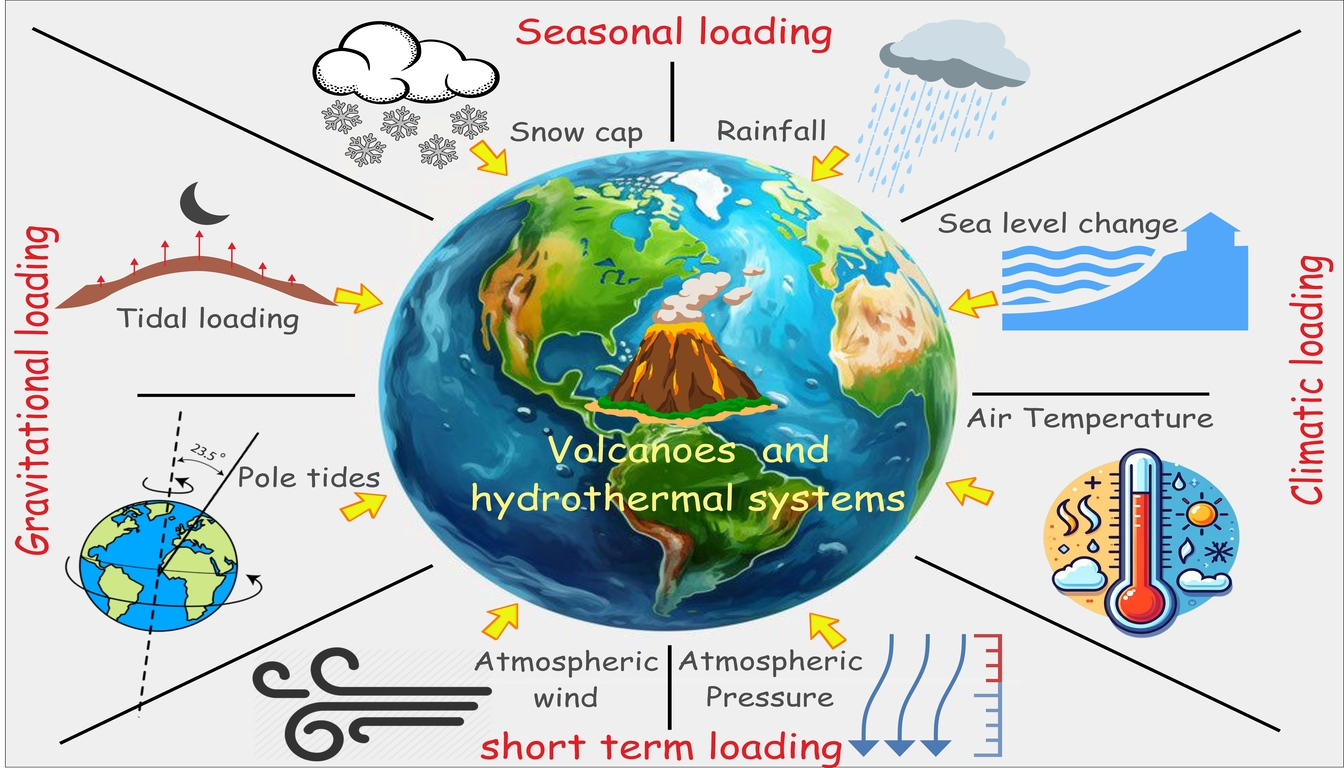
The Earth has evolved dynamically since its formation about 4.5 billion years ago, driven by continuous internal and surface processes. Magmatic systems, driven by Earth’s internal heat engine, have evolved from widespread primordial magmatism during early crustal formation to complex, localized activities associated with plate tectonics, mantle plumes, and subduction zones. Volcanoes and hydrothermal systems provide valuable insights into Earth’s magmatic processes, which often result in crustal deformations due to the injection, accumulation, and movement of magmatic fluids. Depending on complex physical conditions, these processes can be further influenced by various external and dynamic factors. Exogenous processes do not affect the general trend of magmatic inflation and the rate of increase in magma injection or accumulation, but rather modulate the driving factors. The interplay between endogenous forces (such as magmatic activity) and exogenous factors (such as tectonic stresses or atmospheric phenomena) complicates the understanding and prediction of hazards. The hazards associated with magmatic systems have increased worldwide as communities increasingly settle near these systems to capitalise on their economic and environmental benefits while also disrupting the natural processes through artificial impact. Such regions include the Cascades, the Nordic countries, the Southern Alps, Southeast Asia, and numerous volcanic islands. Under the current scenario of climate change and changing weather patterns, this further complicates the intricate feedback response between endogenous and exogenous forces. This review offers a novel synthesis of the interplay between endogenous and exogenous processes governing magmatic systems, highlighting how external forces modulate volcanic and hydrothermal activity across spatial and temporal scales. We propose a conceptual framework linking external stress perturbations with internal magma dynamics, emphasizing feedback mechanisms during different stages of the eruption cycle. By integrating multi-source geophysical, geodetic, and climatic observations, the study identifies knowledge gaps in understanding how natural forcing affects magmatic inflation, deformation, and eruption forecasting. Under the current scenario of global climate change and increasing anthropogenic impacts, such an integrated perspective is essential for advancing next-generation volcanic monitoring and hazard mitigation strategies.
Graphical Abstract
Keywords
magmatic systems | volcanic hazards | climate change | volcano monitoring | caldera dynamics | fluid flow | triggering and modulation
References
- 1.
Caricchi, L.; Townsend, M.; Chaillou, E.; et al. Volcanic eruptions and their impact on human settlements: A review of key processes and implications. J. Volcanol. Geotherm. Res. 2021, 417, 107–128. https://doi.org/10.1038/s43017-021-00174-8
- 2.
Townsend, M.; Huber, C. A critical magma chamber size for volcanic eruptions. Geology 2020, 48, 431–435. https://doi.org/10.1130/G47045
- 3.
Lejeune, A.M.; Richet, P. Rheology of crystal-bearing silicate melts: An experimental study at high temperatures and pressures. J. Geophys. Res. Solid Earth 1995, 100, 4215–4229. https://doi.org/10.1029/94JB02986
- 4.
Glasby, G.P.; Kasahara, J. Influence of tidal effects on the periodicity of earthquake activity in diverse geological settings with particular emphasis on submarine hydrothermal systems. Earth Sci. Rev. 2001, 52, 261–297. https://doi.org/10.1016/S0012-8252(00)00031-3
- 5.
Gregg, P.M.; Le M´evel, H.; Zhan, Y.; et al. Stress triggering of the 2005 eruption of Sierra Negra volcano, Gal´apagos. Geophys. Res. Lett. 2018, 45, 13288–13296. https://doi.org/10.1029/2018GL080393
- 6.
Loughlin, S.C.; Sparks, R.S.J.; Brown, S.K.; et al. Global Volcanic Hazards and Risk; Cambridge University Press: Cambridge, London, UK, 2015. https://doi.org/10.1017/CBO9781316276273
- 7.
Wilcock, W.S.; Tolstoy, M.; Waldhauser, F.; et al. Seismic constraints on caldera dynamics from the 2015 Axial Seamount eruption. Science 2016, 354, 1395–1399. https://doi.org/10.1126/science.aah5563
- 8.
Petrosino, S.; Cusano, P.; Madonia, P. Tidal and hydrological periodicities of seismicity reveal new risk scenarios at Campi Flegrei caldera. Sci. Rep. 2018, 8, 31760. https://doi.org/10.1038/s41598-018-31760-4
- 9.
Niu, J.; Song, T.R.A. Response of repetitive very-long-period seismic signals at Aso Volcano to periodic loading. Geophys. Res. Lett. 2021, 48, e2021GL092728. https://doi.org/10.1029/2021GL092728
- 10.
Dumont, S.; Petrosino, S.; Neves, M.C. On the link between global volcanic activity and global mean sea level. Front. Earth Sci. 2022, 10, 845511. https://doi.org/10.3389/feart.2022.845511
- 11.
Farquharson, J.I.; Amelung, F. Extreme rainfall triggered the 2018 rift eruption at K¯ilauea Volcano. Nature 2020, 580, 491–495. https://doi.org/10.1038/s41586-020-2172-5
- 12.
Sottili, G.; Lambert, S.; Palladino, D.M. Tides and volcanoes: A historical perspective. Front. Earth Sci. 2021, 9, 777548. https://doi.org/10.3389/feart.2021.777548
- 13.
Auker, M.R.; Sparks, R.S.J.; Siebert, L.; et al. A statistical analysis of the global historical volcanic fatalities record. J. Appl. Volcanol. 2013, 2, 2. https://doi.org/10.1186/2191-5040-2-2
- 14.
Pyle, D.M.; Barclay, J. Historical records of volcanic eruptions deserve more attention. Nat. Rev. Earth Environ. 2020, 1, 183–184. https://doi.org/10.1038/s43017-020-0044-z
- 15.
Segall, P. Earthquake and Volcano Deformation; Princeton University Press: Princeton, NJ, USA, 2010. https://doi.org/10.1515/9781400833856
- 16.
Venzke, E.; Sennert, S.K.; Wunderman, R. Reports from the Smithsonian’s Global Volcanism Network, February 2008. Bull. Volcanol. 2009, 71, 113–115. https://doi.org/10.1007/s00445-008-0221-2
- 17.
Ryan, M.P. Mechanics and three-dimensional internal structure of active magmatic systems: K¯ılauea Volcano. J. Geophys. Res. Solid Earth 1988, 93, 4213–4248. https://doi.org/10.1029/JB093iB05p04213
- 18.
Taisne, B.; Tait, S. Effect of solidification on a propagating dike. J. Geophys. Res. Solid Earth 2011, 116, B01206. https://doi.org/10.1029/2009JB007058
- 19.
Annen, C.; Blundy, J.D.; Sparks, R.S.J. The genesis of intermediate and silicic magmas in deep crustal hot zones. J. Petrol. 2006, 47, 505–539. https://doi.org/10.1093/petrology/egi084
- 20.
Fialko, Y.; Khazan, Y.; Simons, M. Deformation due to a pressurized horizontal circular crack in an elastic half-space. Geophys. J. Int. 2001, 146, 181–190. https://doi.org/10.1046/j.1365-246X.2001.00452.x
- 21.
Cimarelli, C.; Costa, A.; Mueller, S.; et al. Rheology of magmas with bimodal crystal size and shape distributions: Insights from analog experiments. Geochem. Geophys. Geosyst. 2011, 12, Q07012. https://doi.org/10.1029/2011GC003606
- 22.
Cashman, K.V.; Sparks, R.S.J. How volcanoes work: A 25-year perspective. Geol. Soc. Am. Bull. 2013, 125, 664–690. https://doi.org/10.1130/B30720.1
- 23.
Neuberg, J.W.; Tuffen, H.; Collier, L.; et al. The trigger mechanism of low-frequency earthquakes on Montserrat. J. Volcanol. Geotherm. Res. 2006, 153, 37–50. https://doi.org/10.1016/j.jvolgeores.2005.08.008
- 24.
Rivalta, E.; Dahm, T. Acceleration of buoyancy-driven fractures and magmatic dikes beneath the free surface. Geophys. J. Int. 2006, 166, 1424–1439. https://doi.org/10.1111/j.1365-246X.2006.02962.x
- 25.
Gonnermann, H.M.; Manga, M. The fluid mechanics inside a volcano. Annu. Rev. Fluid Mech. 2007, 39, 321–356. https://doi.org/10.1146/annurev.fluid.39.050905.110207
- 26.
Jellinek, A.M.; DePaolo, D.J. A model for the origin of large silicic magma chambers: Precursors of caldera-forming eruptions. Bull. Volcanol. 2003, 65, 363–381. https://doi.org/10.1007/s00445-003-0277-y
- 27.
Sahoo, S.; Senapati, B.; Panda, D.; et al. Tidal triggering of micro-seismicity associated with caldera dynamics in the Juan de Fuca ridge. J. Volcanol. Geotherm. Res. 2021, 417, 107319. https://doi.org/10.1016/j.jvolgeores.2021.107319
- 28.
Sparks, R.S.J.; Pinkerton, H.; Macdonald, R. The transport of xenoliths in magmas. Earth Planet. Sci. Lett. 1977, 35, 234–238. https://doi.org/10.1016/0012-821X%2877%2990126-1
- 29.
Thomas, M.E.; Neuberg, J. What makes a volcano tick—A first explanation of deep multiple seismic sources in ascending magma. Geology 2012, 40, 351–354. https://doi.org/10.1130/G32868.1
- 30.
McNutt, S.R.; Beavan, R.J. Eruptions of Pavlof volcano and their possible modulation by ocean load and tectonic stresses. J. Geophys. Res. Solid Earth 1987, 92, 11509–11523. https://doi.org/10.1029/JB092iB11p11509
- 31.
Sahoo, S.; Kundu, B.; Petrosino, S.; et al. Feedback responses between endogenous and exogenous processes at Campi Flegrei caldera dynamics, Italy. Bull. Volcanol. 2024, 86, 22. https://doi.org/10.1007/s00445-024-01719-7
- 32.
Jaupart, C.; All `egre, C.J. Gas content, eruption rate and instabilities of eruption regime in silicic volcanoes. Earth Planet. Sci. Lett. 1991, 102, 413–429. https://doi.org/10.1016/0012-821X(91)90032-D
- 33.
Levy, S.; Bohnenstiehl, D.R.; Sprinkle, P.; et al. Mechanics of fault reactivation before, during, and after the 2015 eruption of Axial Seamount. Geology 2018, 46, 447–450. https://doi.org/10.1130/G39978.1
- 34.
Acocella, V.; Di Lorenzo, R.; Newhall, C.; et al. An overview of recent (1988 to 2014) caldera unrest: Knowledge and perspectives. Rev. Geophys. 2015, 53, 896–955. https://doi.org/10.1002/2015RG000492
- 35.
Denlinger, R.P.; Hoblitt, R.P. Cyclic eruptive behavior of silicic volcanoes. Geology 1999, 27, 459–462. https://doi.org/10.1130/0091-7613(1999)027<0459:CEBOSV>2.3.CO;2
- 36.
Sturkell, E.; Einarsson, P.; Sigmundsson, F.; et al. Volcano geodesy and magma dynamics in Iceland. J. Volcanol. Geotherm. Res. 2006, 150, 14–34. https://doi.org/10.1016/j.jvolgeores.2005.07.010
- 37.
Sahoo, S.; Tiwari, D.K.; Panda, D.; et al. Eruption cycles of Mount Etna triggered by seasonal climatic rainfall. J. Geodyn. 2022, 149, 101896. https://doi.org/10.1016/j.jog.2021.101896
- 38.
Hainzl, S.; Kraft, T.; Wassermann, J.; et al. Evidence for rainfalltriggered earthquake activity. Geophys. Res. Lett. 2006, 33, L19303. https://doi.org/10.1029/2006GL027642
- 39.
Mason, B.G.; Pyle, D.M.; Dade, W.B.; et al. Seasonality of volcanic eruptions. J. Geophys. Res. Solid Earth 2004, 109, B04204. https://doi.org/10.1029/2002JB002293
- 40.
Sigmundsson, F.; Hooper, A.; Hreinsd´ ottir, S.; et al. Segmented lateral dyke growth in a rifting event at B´ arðarbunga volcanic system, Iceland. Nature 2015, 517, 191–195. https://doi.org/10.1038/nature14111
- 41.
Chiodini, G.; Caliro, S.; Avino, R.; et al. Hydrothermal pressuretemperature control on CO2 emissions and seismicity at Campi Flegrei (Italy). J. Volcanol. Geotherm. Res. 2021, 414, 107245. https://doi.org/10.1016/j.jvolgeores.2021.107245
- 42.
Lambert, S.; Sottili, G. Is there an influence of the pole tide on volcanism? Insights from Mount Etna recent activity. Geophys. Res. Lett. 2019, 46, 13730–13736. https://doi.org/10.1029/2019GL085525
- 43.
Cochran, E.S.; Vidale, J.E.; Tanaka, S. Earth tides can trigger shallow thrust fault earthquakes. Science 2004, 306, 1164–1166. https://doi.org/10.1126/science.1103961
- 44.
Lockner, D.A.; Beeler, N.M. Premonitory slip and tidal triggering of earthquakes. J. Geophys. Res. Solid Earth 1999, 104, 20133–20151. https://doi.org/10.1029/1999JB900205
- 45.
Senapati, B.; Kundu, B.; Jin, S. Seismicity modulation by external stress perturbations in plate boundary vs. stable plate interior. Geosci. Front. 2022, 13, 101352. https://doi.org/10.1016/j.gsf.2021.101352
- 46.
Emter, D. Tidal triggering of earthquakes and volcanic events. In Tidal Phenomena; Springer: Berlin, Germany, 1997; pp 293–309. https://doi.org/10.1007/BFb0011468
- 47.
Marshall, L.R.; Maters, E.C.; Schmidt, A.; et al. Volcanic effects on climate: Recent advances and future avenues. Bull. Volcanol. 2022, 84, 54. https://doi.org/10.1007/s00445-022-01559-3
- 48.
Rampino, M.R.; Self, S.; Fairbridge, R.W. Can rapid climatic change cause volcanic eruptions? Science 1979, 206, 826–829. https://doi.org/10.1126/science.206.4420.826
- 49.
Jull, M.; McKenzie, D. The effect of deglaciation on mantle melting beneath Iceland. J. Geophys. Res. Solid Earth 1996, 101, 21815–21828. https://doi.org/10.1029/96JB01308
- 50.
Glazner, A.F.; Manley, C.R.; Marron, J.S.; et al. Fire or ice: Anticorrelation of volcanism and glaciation in California over the past 800,000 years. Geophys. Res. Lett. 1999, 26, 1759–1762. https://doi.org/10.1029/1999GL900333
- 51.
McGuire, W.J.; Howarth, R.J.; Firth, C.R.; et al. Correlation between rate of sea-level change and frequency of explosive volcanism in the Mediterranean. Nature 1997, 389, 473–476. http://dx.doi.org/10.1038/38998
- 52.
Watt, S.F.; Pyle, D.M.; Mather, T.A. The volcanic response to deglaciation: Evidence from glaciated arcs and a reassessment of global eruption records. Earth-Sci. Rev. 2013, 122, 77–102. https://doi.org/10.1016/j.earscirev.2013.03.007
- 53.
Moran, S.C.; Zimbelman, D.R.; Malone, S.D. A model for the magmatic–hydrothermal system at Mount Rainier, Washington, from seismic and geochemical observations. Bull. Volcanol. 2000, 61, 425–436. http://dx.doi.org/10.1007/PL00008909
- 54.
Hurst, T.; Smith, W. A Monte Carlo methodology for modelling ashfall hazards. J. Volcanol. Geotherm. Res. 2004, 138, 393–403. http://dx.doi.org/10.1016/j.jvolgeores.2004.08.001
- 55.
Fedotov, S.A.; Zharinov, N.A. On the eruptions, deformation, and seismicity of Klyuchevskoy Volcano, Kamchatka in 1986–2005 and the mechanisms of its activity. J. Volcanol. Seismol. 2007, 1, 71–97. https://doi.org/10.1134/S0742046307020017
- 56.
Eibl, E.P.; Bean, C.J.; Einarsson, B.; et al. Seismic ground vibrations give advanced early-warning of subglacial floods. Nat. Commun. 2020, 11, 2504. https://doi.org/10.1038/s41467-020-15744-5
- 57.
Hurwitz, S.; Lowenstern, J.B. Dynamics of the Yellowstone hydrothermal system. Rev. Geophys. 2014, 52, 375–411. https://doi.org/10.1002/2014RG000452
- 58.
Satow, C.; Gudmundsson, A.; Gertisser, R.; et al. Eruptive activity of the Santorini Volcano controlled by sea-level rise and fall. Nat. Geosci. 2021, 14, 586–592. https://doi.org/10.1038/s41561-021-00783-4
- 59.
Gahalaut, K.; Gahalaut, V.K.; Kayal, J.R. Poroelastic relaxation and aftershocks of the 2001 Bhuj earthquake, India. Tectonophysics 2008, 460, 76–82. https://doi.org/10.1016/j.tecto.2008.07.004
- 60.
Kundu, B.; Legrand, D.; Gahalaut, K.; et al. The 2005 volcanotectonic earthquake swarm in the Andaman Sea: Triggered by the 2004 great Sumatra–Andaman earthquake. Tectonics 2012, 31, TC5009. https://doi.org/10.1029/2012TC003138
- 61.
Obara, K.; Kato, A. Connecting slow earthquakes to huge earthquakes. Science 2016, 353, 253–257. https://doi.org/10.1126/science.aaf1512
- 62.
Parisio, F.; Vilarrasa, V.; Wang, W.; et al. The risks of long-term reinjection in supercritical geothermal systems. Nat. Commun. 2019, 10, 12146. https://doi.org/10.1038/s41467-019-12146-0
- 63.
Schultz, R.; Skoumal, R.J.; Brudzinski, M.R.; et al. Hydraulic fracturing-induced seismicity. Rev. Geophys. 2020, 58, e2019RG000695. https://doi.org/10.1029/2019RG000695
- 64.
Panda, D.; Kundu, B.; Gahalaut, V.K.; et al. Seasonal modulation of deep slow-slip and earthquakes on the Main Himalayan Thrust. Nat. Commun. 2018, 9, 1–8. https://doi.org/10.1038/s41467-018-06371-2
- 65.
Schulz, W.H.; Kean, J.W.; Wang, G.; et al. Landslide movement in southwest Colorado triggered by atmospheric tides. Nat. Geosci. 2009, 2, 863–866. https://doi.org/10.1038/ngeo659
- 66.
Matthews, A.J.; Barclay, J.; Johnstone, J.E. The fast response of volcano-seismic activity to intense precipitation: Triggering of primary volcanic activity by rainfall at Soufri `ere Hills Volcano, Montserrat. J. Volcanol. Geotherm. Res. 2009, 184, 405–415. https://doi.org/10.1016/j.jvolgeores.2009.05.010
- 67.
Yamasato, H.; Kitagawa, S.; Komiya, M. Effect of rainfall on dacitic lava dome collapse at Unzen volcano, Japan. Pap. Meteorol. Geophys. 1998, 48, 73–78. https://doi.org/10.2467/mripapers.48.73
- 68.
Violette, S.; De Marsily, G.; Carbonnel, J.P.; et al. Can rainfall trigger volcanic eruptions? A mechanical stress model of “Piton de la Fournaise,” Reunion Island. Terra Nova 2001, 13, 18–24. https://doi.org/10.1046/j.1365-3121.2001.00297.x
- 69.
Lesparre, N.; Boudin, F.; Champollion, C.; et al. New insights on fractures deformation from tiltmeter data measured inside the Fontaine de Vaucluse karst system. Geophys. J. Int. 2017, 208, 1389–1402. https://doi.org/10.1093/gji/ggw446
- 70.
Banks, N.G.; Carvajal, C.; Mora, H.; et al. Deformation monitoring at Nevado del Ruiz, Colombia — October 1985–March 1988. J. Volcanol. Geotherm. Res. 1990, 41, 269–295. https://doi.org/10.1016/0377-0273(90)90092-T
- 71.
Keir, D.; Ebinger, C.J.; Stuart, G.W.; et al. Strain accommodation by magmatism and faulting as rifting proceeds to breakup: Seismicity of the northern Ethiopian rift. J. Geophys. Res. Solid Earth 2006, 111, B05403. https://doi.org/10.1029/2005JB003748
- 72.
Husen, S.; Taylor, R.; Smith, R.B.; et al. Changes in geyser eruption behavior and remotely triggered seismicity in Yellowstone National Park produced by the 2002 M 7.9 Denali earthquake. Geology 2004, 32, 537–540. https://doi.org/10.1130/G20381.1
- 73.
Ogiso, M.; Matsubayashi, H.; Yamamoto, T. Descent of tremor source locations before the 2014 phreatic eruption of Ontake volcano, Japan. Earth Planets Space 2015, 67, 1–12. https://doi.org/10.1186/s40623-015-0376-y
- 74.
Lowrie, W. A Student’s Guide to Geophysical Equations; Cambridge University Press: Cambridge, London, UK, 2011.
- 75.
Matsumoto, K.; Sato, T.; Takanezawa, T.; et al. GOTIC2: A program for computation of oceanic tidal loading effect. J. Geod. Soc. Jpn. 2001, 47, 243–248. https://doi.org/10.11311/jgeography.110.247
- 76.
Sahoo, S.; Senapati, B.; Panda, D.; et al. Tidal triggering of seismic swarm associated with hydrothermal circulation at Blanco Ridge transform fault zone, NE Pacific. Phys. Earth Planet. Inter. 2024, 356, 107259. https://doi.org/10.1016/j.pepi.2024.107259
- 77.
Bhatnagar, T.; Tolstoy, M.; Waldhauser, F. Influence of fortnightly tides on earthquake triggering at the East Pacific Rise at 9◦50′N. J. Geophys. Res. Solid Earth 2016, 121, 1262–1279. https://doi.org/10.1002/2015JB012365
- 78.
Varga, P.; Grafarend, E. Influence of tidal forces on triggering of seismic events. In Geodynamics and Earth Tides Observations; Springer: Cham, Switzerland, 2019; pp 55–63. http://dx.doi.org/10.1007/978-3-319-96277-1 6
- 79.
Agnew, D. SPOTL: Some Programs for Ocean-Tide Loading. SIO Technical Report; Scripps Institution of Oceanography, University of California: La Jolla, CA, USA, 2012.
- 80.
Ray, R.D. A global ocean tide model from TOPEX/POSEIDON altimetry: GOT99.2. NASA Tech. Memo.; Goddard Space Flight Center: Greenbelt, MD, USA, 1999.
- 81.
Mogi, K. Relations between the eruptions of various volcanoes and the deformations of the ground surfaces around them. Bull. Earthquake Res. Inst. 1958, 36, 99–134.
- 82.
Okada, Y. Surface deformation due to shear and tensile faults in a half-space. Bull. Seismol. Soc. Am. 1985, 75, 1135–1154. https://doi.org/10.1785/BSSA0750041135
- 83.
Dzurisin, D.; Lisowski, M. Analytical volcano deformation source models. In Volcano Deformation: Geodetic Monitoring Techniques; Springer: Berlin, Germany, 2007; pp 279–304. http://dx.doi.org/10.1007/978-3-540-49302-0 8
- 84.
Battaglia, M.; Cervelli, P.F.; Murray, J.R. dMODELS: A MATLAB software package for modeling crustal deformation near active faults and volcanic centers. J. Volcanol. Geotherm. Res. 2013, 254, 1–4. https://doi.org/10.1016/j.jvolgeores.2012.12.018
- 85.
Dvorak, J.J.; Dzurisin, D. Volcano geodesy: The search for magma reservoirs and the formation of eruptive vents. Rev. Geophys. 1997, 35, 343–384. https://doi.org/10.1029/97RG00070
- 86.
Wicks, C.; Thatcher, W.; Dzurisin, D. Migration of fluids beneath Yellowstone caldera inferred from satellite radar interferometry. Science 1998, 282, 458–462. https://doi.org/10.1126/science.282.5388.458
- 87.
Ziv, A.; Rubin, A.M. Static stress transfer and earthquake triggering: No lower threshold in sight? J. Geophys. Res. 2000, 105, 13631–13642. https://doi.org/10.1029/2000jb900081
- 88.Scholz, C.H.; Tan, Y.J.; Albino, F. The mechanism of tidal triggering of earthquakes at mid-ocean ridges. Nat. Commun. 2019, 10, 2526. https://doi.org/10.1038/s41467-019-10308-5
- 89.71
- 90.
Saikia, B.J.; Parthasarathy, G.; Borah, R.R. High-Ppressure polymorphs of olivine and silica in kamargaon (L6) chondrite: Laser micro-raman and XRD studies. J. Earth Syst. Sci. 2022, 131, 38. https://doi.org/10.1007/s12040-021-01803-y
- 91.
Saikia, B.J.; Parthasarathy, G.; Chalapathi Rao, N.V.; et al. High shock pressure metamorphism induced transformations of olivine and feldspar in natun balijan l4 chondrite. J. Geol. Soc. India 2022, 98, 731–739. https://doi.org/10.1007/s12594-022-2061-7
- 92.
Saikia, B.J.; Basak, S.; Borah, R.R.; et al. Spectroscopic investigations and mineral chemistry of dunite from the sargur supracrustals (3 Ga) greenstone belt. J. Geol. Soc. India 2022, 98, 1505–1512. https://doi.org/10.1007/s12594-022-2205-9
- 93.
Saikia, B.J.; Parthasarathy, G.; Chalapathi Rao, N.V.; et al. Mineral chemistry of Mahadevpur H4/5 chondrite. Curr. Sci. 2024, 126, 574–582. https://doi.org/10.18520/cs/v126/i5/574-582
- 94.
Pommier, C.J.S.; Denton, M.B.; Downs, R.T. Raman spectroscopic study of spodumene through the pressure-induced phase change from C2/c to P21/c. J. Raman Spectrosc. 2003, 34, 769–775. https://doi.org/10.1002/jrs.1051
- 95.
Saikia, B.J.; Parthasarathy, G. FTIR characterization of kaolinite from Assam and Meghalaya, Northeastern India. J. Mod. Phys. 2010, 1,
206–210. https://doi.org/10.4236/jmp.2010.14031 - 96.
Farmer, V.C. The Infrared Spectra of Minerals; Mineralogical Society: London, UK, 1974.
- 97.
Madejova, J.; Komadel, P. Baseline studies of the clay minerals society source clays: Infrared methods. Clays Clay Miner. 2001, 49, 410–432. https://doi.org/10.1346/CCMN.2001.0490508

How to Cite
Sahoo, S.; Kundu, B. Volcanic Hazards in an Evolving Earth: Monitoring Magmatic Systems, External Forcing and Beyond. Earth Systems, Resources, and Sustainability 2026, 1 (1), 44–71. https://doi.org/10.53941/esrs.2026.100004.
RIS
BibTex
Copyright & License

Copyright (c) 2025 by the authors.
This work is licensed under a Creative Commons Attribution 4.0 International License.
Contents
References
