
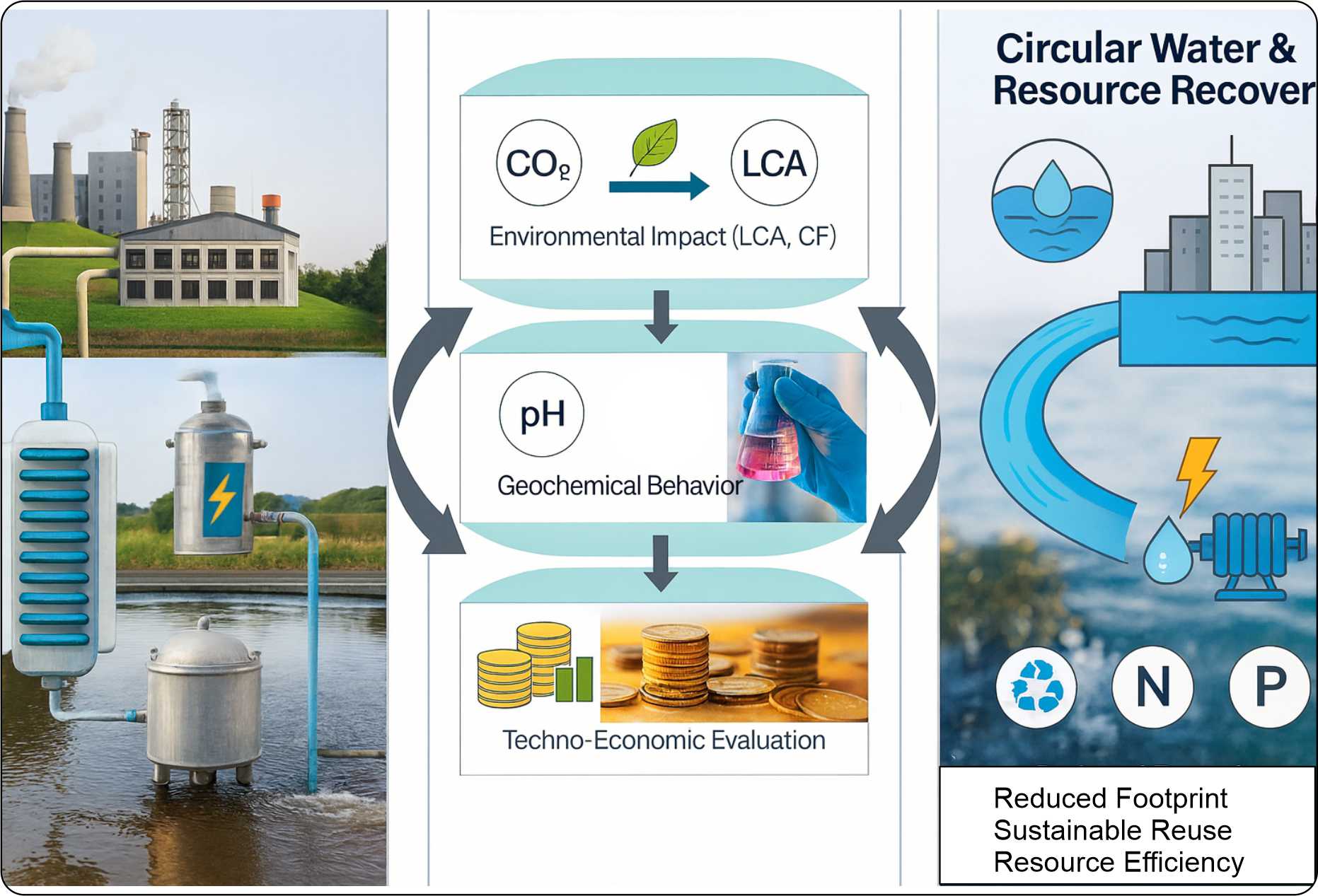
- Provides an integrated sustainability assessment of advanced wastewater treatment technologies using life cycle, geochemical, and techno-economic perspectives.
- Identifies energy-recovery and water-reuse-oriented systems as the most eco-efficient options with reduced greenhouse gas emissions.
- Emphasizes the need for quantitative, circular-economy-based evaluation frameworks to guide climateresilient wastewater management strategies.
- Open Access
- Article
Integrative Sustainability Assessment of Advanced Wastewater Treatment Technologies: Environmental Impact, Geochemical Insights, and Techno-Economic Evaluation for Circular Water Management
- Veeramalai Gopal 1,*,
- Rajaram Kalaivanan 2 and
- Subramanian Muthusamy 3
Author Information
Received: 05 November 2025 | Revised: 15 December 2025 | Accepted: 03 January 2026 | Published: 27 January 2026
Highlights
Abstract
Rapid advancements in wastewater treatment technologies are essential for achieving sustainability goals related to circular water use, carbon neutrality, and resource efficiency. This review provides an integrative assessment of key advanced treatment systems including membrane filtration, advanced oxidation processes, and anaerobic digestion by examining their environmental performance, geochemical implications, and techno-economic feasibility. Findings from life cycle assessment (LCA), carbon footprint evaluations, and cost–benefit analyses identify technologies with high eco-efficiency and reduced greenhouse gas emissions, particularly those enabling energy recovery and enhanced water reuse. The synthesis demonstrates that combining environmental indicators with geochemical insights supports the development of sustainable treatment pathways. Overall, the review highlights the need for integrated evaluation frameworks that link technological function with environmental and economic outcomes, guiding future wastewater treatment under circularity and climate-resilient frameworks.
Graphical Abstract
Keywords
wastewater treatment technologies | environmental sustainability | life cycle assessment (LCA) | carbon footprint | techno-economic analysis | resource recovery
References
- 1.
Pattison, J.E.; Cooke, P. Groundwater: Sinking cities, urbanisation, global drying, population growth. J. Popul. Sustain. 2024, 8, 77–104. https://doi.org/10.3197/JPS.63799977346492
- 2.
Khan, M. Impact of urbanization on water resources of Pakistan: A review. NUST J. Eng. Sci. 2019, 12, 1–8.
- 3.
Obaideen, K.; Shehata, N.; Sayed, E.T.; et al. The role of wastewater treatment in achieving sustainable development goals (SDGs) and sustainability guideline. Energy Nexus 2022, 7, 100112. https://doi.org/10.1016/j.nexus.2022.100112
- 4.
Silva, J.A. Wastewater treatment and reuse for sustainable water resources management: A systematic literature review. Sustainability 2023, 15, 10940. https://doi.org/10.3390/su151410940
- 5.
Baloch, M.Y.J.; Zhang, W.; Sultana, T.; et al. Utilization of sewage sludge to manage saline–alkali soil and increase crop production: Is it safe or not? Environ. Technol. Innov. 2023, 32, 103266. https://doi.org/10.1016/j.eti.2023.103266
- 6.
Gao, H.; Scherson, Y.D.;Wells, G.F. Towards energy neutral wastewater treatment: Methodology and state of the art. Environ. Sci. Process. Impacts 2014, 16, 1223–1246.
- 7.
Guo, Q.; Qi, F.; Mu, R.; et al. Advances in sustainable wastewater treatment: Microalgal–bacterial consortia process, greenhouse gas reduction and energy recovery technologies. Water Environ. J. 2023, 37, 192–205. https://doi.org/10.1111/wej.12839
- 8.
Chai, J.; Zhang, W.; Zhao, K.; et al. Multi-biological risk in groundwater–surface water system under landfill stress: Driven by bacterial size and biological toxicity. J. Hydrol. 2024, 636, 131282. https://doi.org/10.1016/j.jhydrol.2024.131282
- 9.
Soo, A.; Kim, J.; Shon, H.K. Technologies for the wastewater circular economy–A review Desalin. Water Treat. 2024, 317, 100205. https://doi.org/10.1016/j.dwt.2024.100205
- 10.
Cairone, S.; Hasan, S.W.; Choo, K.H.; et al. Revolutionizing wastewater treatment toward circular economy and carbon neutrality goals: Pioneering sustainable and efficient solutions for automation and advanced process control with smart and cuttingedge technologies. J. Water Process Eng. 2024, 63, 105486. https://doi.org/10.1016/j.jwpe.2024.105486
- 11.
Jat Baloch, M.Y.; Zhang, W.; Zhang, D.; et al. Evolution mechanism of arsenic enrichment in groundwater and associated health risks in southern Punjab, Pakistan. Int. J. Environ. Res. Public Health 2022, 19, 13325. https://doi.org/10.3390/ijerph192013325
- 12.
Tarpani, R.R.Z.; Azapagic, A. Life cycle sustainability assessment of advanced treatment techniques for urban wastewater reuse and sewage sludge resource recovery. Sci. Total Environ. 2023, 869, 161771. https://doi.org/10.1016/j.scitotenv.2023.161771
- 13.
Rodriguez-Garcia, G.; Molinos-Senante, M.; Hospido, A.; et al. Environmental and economic profile of six typologies of wastewater treatment plants. Water Res. 2011, 45, 5997–6010. https://doi.org/10.1016/j.watres.2011.08.053
- 14.
Islam, F.S. Advanced wastewater treatment technologies in addressing future water scarcity through resource recovery and reuse. J. Eng. Res. Rep. 2025, 27, 370–398. https://doi.org/10.9734/jerr/2025/v27i51513
- 15.
Sha, C.; Shen, S.; Zhang, J.; et al. A review of strategies and technologies for sustainable decentralized wastewater treatment. Water 2024, 16, 3003. https://doi.org/10.3390/w16203003
- 16.
Krystynik, P. Advanced oxidation processes (AOPs)–Utilization of hydroxyl radical and singlet oxygen. In Reactive Oxygen Species; IntechOpen: London, UK, 2021.
- 17.
Agrawal, S.; Chohadia, A.K.; Sherry, P.; et al. A review on wastewater treatment containing organic pollutants using advance oxidation processes. Int. J. Sci. Res. Sci. Technol. 2023, 10, 50–75. https://doi.org/10.32628/IJSRST2310014
- 18.
Silva, J.A. Advanced oxidation process in the sustainable treatment of refractory wastewater: A systematic literature review. Sustainability 2025, 17, 3439. https://doi.org/10.3390/su17083439
- 19.
Pandis, P.K.; Kalogirou, C.; Kanellou, E.; et al. Key points of advanced oxidation processes (AOPs) for wastewater, organic pollutants and pharmaceutical waste treatment: A mini review. Chem. Eng. 2022, 6, 8. https://doi.org/10.3390/chemengineering6010008
- 20.
Satyam, S.; Patra, S. The evolving landscape of advanced oxidation processes in wastewater treatment: Challenges and recent innovations. Processes 2025, 13, 987. https://doi.org/10.3390/pr13040987
- 21.
Abd El-Ghaffar, M.A.; Tieama, H.A. A review of membranes classifications, configurations, surface modifications, characteristics and its applications in water purification. Chem. Biomol. Eng. 2017, 2, 57–82. https://doi.org/10.11648/j.cbe.20170202.11
- 22.
Martinez-Huitle, C.A.; Ferro, S. Electrochemical oxidation of organic pollutants for the wastewater treatment: Direct and indirect processes. Chem. Soc. Rev. 2006, 35, 1324–1340. https://doi.org/10.1039/B517632H
- 23.
Błaszczyk, W.; Siatecka, A.; Tlusto˘s, P.; et al. Occurrence and dissipation mechanisms of organic contaminants during sewage sludge anaerobic digestion: A critical review. Sci. Total Environ. 2024, 945, 173517. https://doi.org/10.1016/j.scitotenv.2024.173517
- 24.
Loganathan, P.; Kandasamy, J.; Ratnaweera, H.; et al. Treatment trends and hybrid methods for the removal of poly- and perfluoroalkyl substances from water—A review. Appl. Sci. 2024, 14, 2574. https://doi.org/10.3390/app14062574
- 25.
Alardhi, S.M.; Ali, N.S.; Saady, N.M.C.; et al. Separation techniques in different configurations of hybrid systems via synergetic adsorption and membrane processes for water treatment: A review. J. Ind. Eng. Chem. 2024, 130, 91–104. https://doi.org/10.1016/j.jiec.2023.09.051
- 26.
Yu, S.; Deng, S.; Zhou, A.; et al. Life cycle assessment of energy consumption and GHG emission for sewage sludge treatment and disposal: A review. Front. Energy Res. 2023, 11, 1123972. https://doi.org/10.3389/fenrg.2023.1123972
- 27.
Yadav, G.; Mishra, A.; Ghosh, P.; et al. Technical, economic and environmental feasibility of resource recovery technologies from wastewater. Sci. Total Environ. 2021, 796, 149022. https://doi.org/10.1016/j.scitotenv.2021.149022
- 28.
Nath, S. Electrochemical wastewater treatment technologies through life cycle assessment: A review. ChemBioEng Rev. 2024, 11, e202400016. https://doi.org/10.1002/cben.202400016
- 29.
Starkl, M.; Brunner, N.; Das, S.; et al. Sustainability assessment for wastewater treatment systems in developing countries. Water 2022, 14, 241. https://doi.org/10.3390/w14020241
- 30.
Rashid, S.S.; Harun, S.N.; Hanafiah, M.M.; et al. Life cycle assessment and its application in wastewater treatment: A brief overview. Processes 2023, 11, 208. https://doi.org/10.3390/pr11010208
- 31.
Yilmaz, M.; Guven, H.; Ozgun, H.; et al. The application of life cycle assessment (LCA) to anaerobic technologies for the treatment of municipal wastewater: A review. Process Saf. Environ. Prot. 2024, 182, 357–370. https://doi.org/10.1016/j.psep.2023.11.078
- 32.
Tsangas, M.; Papamichael, I.; Banti, D.; et al. LCA of municipal wastewater treatment. Chemosphere 2023, 341, 139952. https://doi.org/10.1016/j.chemosphere.2023.139952
- 33.
Rahman, T.U.; Roy, H.; Islam, M.R.; et al. The advancement in membrane bioreactor (MBR) technology toward sustainable industrial wastewater management. Membranes 2023, 13, 181. https://doi.org/10.3390/membranes13020181
- 34.
Guerra-Rodrıguez, S.; Cuesta, S.; Perez, J.; et al. Life cycle assessment of sulfate radical based-AOPs for wastewater disinfection. Chem. Eng. J. 2023, 474, 145427. https://doi.org/10.1016/j.cej.2023.145427
- 35.
Martinez-Arce, A.; O’Flaherty, V.; Styles, D. State-of-the-art in assessing the environmental performance of anaerobic digestion biorefineries. Resour. Conserv. Recycl. 2024, 207, 107660. https://doi.org/10.1016/j.resconrec.2024.107660
- 36.
He, X.; Li, Z.; Xing, C.; et al. Carbon footprint of a conventional wastewater treatment plant: An analysis of water–energy nexus from life cycle perspective for emission reduction. J. Clean. Prod. 2023, 429, 139562. https://doi.org/10.1016/j.jclepro.2023.139562
- 37.
Nguyen, T.K.L.; Ngo, H.H.; Guo, W.S.; et al. A critical review on life cycle assessment and plant-wide models towards emission control strategies for greenhouse gas from wastewater treatment plants. J. Environ. Manag. 2020, 264, 110440. https://doi.org/10.1016/j.jenvman.2020.110440
- 38.
Massara, T.M.; Malamis, S.; Guisasola, A.; et al. A review on nitrous oxide (N2O) emissions during biological nutrient removal from municipal wastewater and sludge reject water. Sci. Total Environ. 2017, 596, 106–123. https://doi.org/10.1016/j.scitotenv.2017.03.191
- 39.
Mofatto, P.M.B.; Cosenza, A.; Di Trapani, D.; et al. Carbon footprint reduction by coupling intermittent aeration with submerged MBR: A pilot plant study. J. Environ. Chem. Eng. 2024, 12, 113115. https://doi.org/10.1016/j.jece.2024.113115
- 40.
Evangelisti, S.; Lettieri, P.; Borello, D.; Clift, R. Life cycle assessment of energy from waste via anaerobic digestion: A UK case study. Waste Manag. 2014, 34, 226–237. https://doi.org/10.1016/j.wasman.2013.09.013
- 41.
Borkovi´c, A.; Dragi´c, D.; Pilipovi´c, S.; et al. Application of solar energy in water treatment. In Proceedings of the First International Conference FUTURE-BME 2024 (Forging the Future: Pioneering Approaches in Business, Management and Economics Engineering to Overcome Emerging Global Challenges), Novi Sad, Serbia, 30–31 October 2024; p. 61.
- 42.
Lima, D.; Li, L.; Appleby, G. A review of renewable energy technologies in municipal wastewater treatment plants (WWTPs). Energies 2024, 17, 6084. https://doi.org/10.3390/en17236084
- 43.
Wu, Z.; Duan, H.; Li, K.; Ye, L. A comprehensive carbon footprint analysis of different wastewater treatment plant configurations. Environ. Res. 2022, 214, 113818. https://doi.org/10.1016/j.envres.2022.113818
- 44.
Hvala, N.; Vre˘cko, D.; Cerar, P.; et al. Energy cost optimisation in a wastewater treatment plant by balancing on-site electricity generation with plant demand. Water 2025, 17, 1170. https://doi.org/10.3390/w17081170
- 45.
Buller, L.S.; Sganzerla, W.G.; Berni, M.D.; et al. Design and technoeconomic analysis of a hybrid system for energy supply in a wastewater treatment plant: A decentralized energy strategy. J. Environ. Manag. 2022, 305, 114389. https://doi.org/10.1016/j.jenvman.2021.114389
- 46.
Maktabifard, M.; Zaborowska, E.; Makinia, J. Achieving energy neutrality in wastewater treatment plants through energy savings and enhancing renewable energy production. Rev. Environ. Sci. Biotechnol. 2018, 17, 655–689. https://doi.org/10.1007/s11157-018-9478-x
- 47.
Legg, S. IPCC, 2021: Climate change 2021—The physical science basis. Interaction 2021, 49, 44–45. https://search.informit.org/doi/10.3316/informit.315096509383738
- 48.
S´anchez-Montes, I.; Santos, G.O.; Dos Santos, A.J.; et al. Toxicological aspect of water treated by chlorine-based advanced oxidation processes: A review. Sci. Total Environ. 2023, 878, 163047. https://doi.org/10.1016/j.scitotenv.2023.163047
- 49.
Wu, T. Byproduct formation in heterogeneous catalytic ozonation processes. Environ. Sci. Adv. 2023, 2, 558–569. https://doi.org/10.1039/D2VA00216G
- 50.
Abdelrahman, A.M.; Ozgun, H.; Dereli, R.K.; et al. Anaerobic membrane bioreactors for sludge digestion: Current status and future perspectives. Crit. Rev. Environ. Sci. Technol. 2021, 51, 2119–2157. https://doi.org/10.1080/10643389.2020.1780879
- 51.
Viotti, P.; Tatti, F.; Bongirolami, S.; et al. Life cycle assessment methodology applied to a wastewater treatment plant. Water 2024, 16, 1177. https://doi.org/10.3390/w16081177
- 52.
Saadatinavaz, F.; Alomari, M.A.; Ali, M.; Saikaly, P.E. Striking a balance: Decentralized and centralized wastewater treatment systems for advancing sustainable development goal 6. Adv. Energy Sustain. Res. 2024, 5, 2400097. https://doi.org/10.1002/aesr.202400097
- 53.
Ahmad, K. Feasibility of adsorption as a process for large-scale adoption across industries for wastewater treatment: Research gaps and economic assessment. J. Clean. Prod. 2023, 388, 136014. https://doi.org/10.1016/j.jclepro.2023.136014
- 54.
Ni, L.; Wang, P.; Westerhoff, P.; et al. Mechanisms and strategies of advanced oxidation processes for membrane fouling control in MBRs: Membrane–foulant removal versus mixed-liquor improvement. Environ. Sci. Technol. 2024, 58, 11213–11235. https://doi.org/10.1021/acs.est.4c02659
- 55.
Ryu, T.Y.; Won, J.; Jung, H.; Im, H. A critical review on advanced membrane bioreactors for wastewater treatment: Fouling reduction and energy demand. J. Korean Soc. Environ. Eng. 2024, 46, 629–647. https://doi.org/10.4491/KSEE.2024.46.10.629
- 56.
Akrami, E.; Khalilarya, S.; Rocco, M.V. Techno-economic evaluation of a novel bio-energy system integrated with carbon capture and utilization technology in greenhouses. J. Taiwan Inst. Chem. Eng. 2023, 148, 104729. https://doi.org/10.1016/j.jtice.2023.104729
- 57.
Lessmann, M.; Kanellopoulos, A.; Kros, J.; et al. Maximizing agricultural reuse of recycled nutrients: A spatially explicit assessment of environmental consequences and costs. J. Environ. Manag. 2023, 332, 117378. https://doi.org/10.1016/j.jenvman.2023.117378
- 58.
Smol, M. Circular economy in wastewater treatment plant—Water, energy and raw materials recovery. Energies 2023, 16, 3911. https://doi.org/10.3390/en16093911
- 59.
Ghimire, U.; Sarpong, G.; Gude, V.G. Transitioning wastewater treatment plants toward circular economy and energy sustainability. ACS Omega 2021, 6, 11794–11803. https://doi.org/10.1021/acsomega.0c05827
- 60.
United Nations (UN). Transforming Our World: The 2030 Agenda for Sustainable Development; Resolution adopted by the General Assembly on 25 September 2015; UN: New York, NY, USA, 2015; pp. 1–13. https://wedocs.unep.org/handle/20.500.11822/9824
- 61.
Capodaglio, A.G.; Callegari, A. Energy and resources recovery from excess sewage sludge: A holistic analysis of opportunities and strategies. Resour. Conserv. Recycl. Adv. 2023, 19, 200184. https://doi.org/10.1016/j.rcradv.2023.200184
- 62.
Michael, I.; Rizzo, L.; McArdell, C.S.; et al. Urban wastewater treatment plants as hotspots for the release of antibiotics in the environment: A review. Water Res. 2013, 47, 957–995. https://doi.org/10.1016/j.watres.2012.11.027
- 63.
Carroll, P.; Kellow, A. The OECD: A Decade of Transformation: 2011–2021; Walter de Gruyter GmbH & Co. KG: Berlin, Germany, 2021.
- 64.
Rodriguez-Morales, A.J.; Cardona-Ospina, J.A.; Guti´errez-Ocampo, E.; et al. Clinical, laboratory and imaging features of COVID-19: A systematic review and meta-analysis. Travel Med. Infect. Dis. 2020, 34, 101623. https://doi.org/10.1016/j.tmaid.2020.101623
- 65.
Yuan, X.; He, P.; Zhu, Q.; et al. Adversarial examples: Attacks and defenses for deep learning. IEEE Trans. Neural Netw. Learn. Syst. 2019, 30, 2805–2824. https://doi.org/10.1109/TNNLS.2018.2886017
- 66.
Barreto, M.; Victor, C.; Hammond, C.; et al. Loneliness around the world: Age, gender, and cultural differences in loneliness. Pers. Individ. Differ. 2021, 169, 110066. https://doi.org/10.1016/j.paid.2020.110066
- 67.
Guest, J.S.; Skerlos, S.J.; Barnard, J.L.; et al. A new planning and design paradigm to achieve sustainable resource recovery from wastewater. Environ. Sci. Technol. 2009, 43, 6126–6130. https://doi.org/10.1021/es9010515
- 68.
Banti, D.C.; Tsangas, M.; Samaras, P.; et al. LCA of a membrane bioreactor compared to activated sludge system for municipal wastewater treatment. Membranes 2020, 10, 421. https://doi.org/10.3390/membranes10120421
- 69.
Tortajada, C.; Nambiar, S. Communications on technological innovations: Potable water reuse. Water 2019, 11, 251. https://doi.org/10.3390/w11020251
- 70.
Murhekar, M.V.; Bhatnagar, T.; Thangaraj, J.W.V.; et al. SARS-CoV-2 seroprevalence among the general population and healthcare workers in India, December 2020–January 2021. Int. J. Infect. Dis. 2021, 108, 145–155. https://doi.org/10.1016/j.ijid.2021.05.040
- 71.
Liu, H.-Y.; Jay, M.; Chen, X. The role of nature-based solutions for improving environmental quality, health and well-being. Sustainability 2021, 13, 10950. https://doi.org/10.3390/su131910950
- 72.
Corominas, L.; Foley, J.; Guest, J.S.; et al. Life cycle assessment applied to wastewater treatment: State of the art. Water Res. 2013, 47, 5480–5492. https://doi.org/10.1016/j.watres.2013.06.049
- 73.
Wutich, A.; Thomson, P.; Jepson, W.; et al. MAD water: Integrating modular, adaptive, and decentralized approaches for water security in the climate change era. WIREs Water 2023, 10, e1680. https://doi.org/10.1002/wat2.1680
How to Cite
Gopal, V.; Kalaivanan, R.; Muthusamy, S. Integrative Sustainability Assessment of Advanced Wastewater Treatment Technologies: Environmental Impact, Geochemical Insights, and Techno-Economic Evaluation for Circular Water Management. Earth Systems, Resources, and Sustainability 2026, 1 (2), 114–128. https://doi.org/10.53941/esrs.2026.100008.
RIS
BibTex
Copyright & License

Copyright (c) 2026 by the authors.
This work is licensed under a Creative Commons Attribution 4.0 International License.
Contents
References
