
- Abnormally thin glauconite rich Proterozoic Lower Vindhyan succession (<25 m) has been traced for more than a hundred kilometres.
- They represent the case of condensed Semri deposits in the Bundelkhand region.
- The glauconites are mostly early diagenetic in nature.
- Open Access
- Article
Lower Vindhyan Succession as a Condensed Horizon in Central India
- Gaurav K. Singh 1,*,
- Ashish K. Rai 1,
- Arif Husain Ansari 2 and
- Arvind K. Singh 3
Author Information
Received: 25 December 2025 | Revised: 19 January 2026 | Accepted: 05 February 2026 | Published: 06 March 2026
Highlights
Abstract
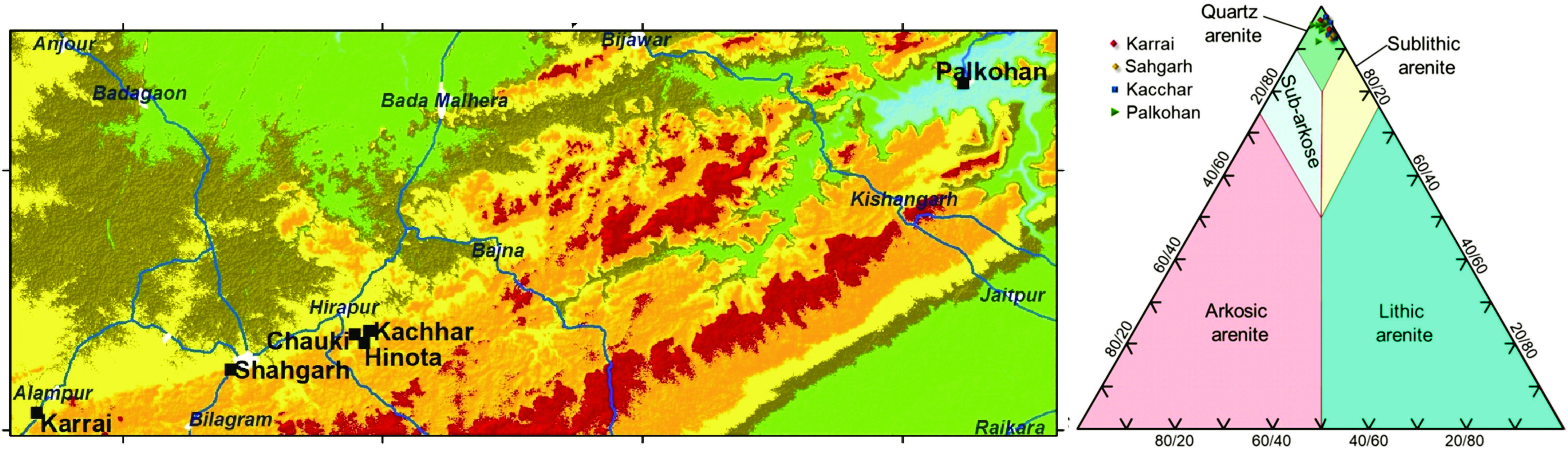
Condensation is considered as a function of a sharp decline in sedimentation rate and accumulation of highly thin succession embracing a broad stratigraphic interval. Condensed sections are fairly common in various sedimentary basins and their investigation is important as they are regionally reliable marker horizons for sequence stratigraphic correlation. Elevated concentration of glauconite is essentially found confined to condensed sections. Throughout the earth’s history, authigenesis driven glauconite genesis have been correlated with rising sea level and even interpreted as a manifestation of the ‘Greenhouse’ conditions. In ancient depositional systems as well, the occurrence of glauconite rich layers is often linked with marine flooding surfaces. Lower Vindhyan succession of Palaeoproterozoic age in central India constitutes one of the systems in which the presence of authigenic glauconite has been found associated with the stratigraphic condensation. These sediments often referred as Semri Group of rocks show glauconite rich layers in relatively thinner sections. The glauconite bearing condensed sections of Semri succession in central India has provided a regional correlation bench mark to trace basin wide unconformities for about 200 km. Here, we present the sequence stratigraphic framework of lower Vindhyan succession in Bundelkhand region around Hirapur for the first time.
Graphical Abstract
Keywords
Hirapur | glauconite | condensed section | Vindhyan | sequence stratigraphy
References
- 1.
Singh, A.K.; Chakraborty, P.P. Shales of Palaeo–Mesoproterozoic Vindhyan Basin, Central India: Insight into sedimentation dynamics of Proterozoic shelf. Geol. Mag. 2022, 159, 247–268.
- 2.
Catuneanu, O.; Martins-Neto, M.A.; Eriksson, P.G. Precambrian sequence stratigraphy. Sediment. Geol. 2005, 176, 67–95.
- 3.
Colleps, C.; McKenzie, N.; Sharma, M.; et al. Zircon and apatite U-Pb age constraints from the Bundelkhand craton and Proterozoic strata of central India: Insights into craton stabilization and subsequent basin evolution. Precambrian Res. 2021, 362, 106286.
- 4.
Singh, A.K.; Chakraborty, P.P. Geochemistry and hydrocarbon source rock potential of shales from the Palaeo–Mesoproterozoic Vindhyan Supergroup, Central India. Energy Geosci. 2021, 2, 100073.
- 5.
Singh, I.B.; Kumar, S. On the stratigraphy and sedimentation of the Vindhyan sediments in the Chitrakut area, Banda District (U.P.), Satna District (M.P.). J. Geol. Soc. India 1978, 19, 359–367.
- 6.
Singh, I.B. Precambrian sedimentation sequences of India: Their peculiarities and comparison with modern sediments. Precambrian Res. 1980, 12, 411–436.
- 7.
Bose, P.K.; Sarkar, S.; Chakrabarty, S.; et al. Overview of the mesoto neoproterozoic evolution of the Vindhyan Basin, central India. Sediment. Geol. 2001, 141, 395–419.
- 8.
Sarkar, S.; Banerjee, S.; Chakraborty, S.; et al. Shelf storm flow dynamics: Insight from the Mesoproterozoic Rampur Shale, central India. Sediment. Geol. 2002, 147, 89–104.
- 9.
Sarkar, S.; Banerjee, S.; Samanta, S.; et al. Microbial mat-induced sedimentary structures in siliciclastic sediments: Examples from the 1.6 Ga Chorhat Sandstone, Vindhyan Supergroup, M.P., India. J. Earth Syst. Sci. 2006, 115, 49–60.
- 10.
Mandal, S.; Choudhuri, A.; Mondal, I.; et al. Revisiting the boundary between the Lower and Upper Vindhyan, Son Valley, India. J. Earth Syst. Sci. 2019, 128, 222–227.
- 11.
Ahmad, F. Palaeogeography of central India. Rec. Geol. Surv. India 1958, 87, 530.
- 12.
Auden, J.B. Vindhyan sedimentation in the Son Valley, Mirzapur District. Rec. Geol. Surv. India 1933, 62, 141–250.
- 13.
Chanda, S.K.; Bhattacharya, A. Vindhyan sedimentation and paleogeography: Post-Auden developments. In Geology of Vindhyachal; Valdiya, K.S., Bhatia, S.B., Gaur, V.K., Eds.; Hindustan Publishing Corporation: Delhi, India, 1982; pp. 88–101.
- 14.
Kwafo, S.; Meert, J.G.; Pandit, M.K.; et al. Searching for the age of upper Vindhyan Basin, India: A view from paleomagnetism and geochronology. Geosci. Front. 2026, 17, 102168.
- 15.
McKenzie, N.R.; Hughes, N.C.; Myrow, P.M.; et al. New age constraints for the Proterozoic Aravalli–Delhi successions of India and their implications. Precambrian Res. 2013, 238, 120–128.
- 16.
Sastry, M.V.A.; Moitra, A.K. Vindhyan stratigraphy: A review. Mem. Geol. Surv. India 1984, 116, 108–148.
- 17.
Prasad, B.; Uniyal, S.N.; Asher, R. Organic-walled microfossils from the Proterozoic Vindhyan Supergroup of Son Valley, Madhya Pradesh, India. Palaeobotanist 2005, 54, 13–60.
- 18.
Voigt, E. Uber Hiatus-Konkretionen. Geol. Rundsch. 1968, 58, 281–296.
- 19.
F¨ ursich, F.T.; Oschmann, W.; Singh, I.B.; et al. Hardgrounds, reworked concretion levels and condensed horizons in the Jurassic of western India: Their significance for basin analysis. J. Geol. Soc. 1992, 149, 313–331.
- 20.
Raiswell, R. Chemical model for the origin of minor limestone-shale cycles by anaerobic methane oxidation. Geology 1988, 16, 64–144.
- 21.
Bathurst, R.G.C. Carbonate Sediments and their Diagenesis, 2nd ed.; Elsevier: Amsterdam, The Netherlands, 1975.
- 22.
Fursich, F.T. Genesis, environment and ecology of Jurassic hardgrounds. Neues Jahrb. Geol. Palaontol. Abh. 1979, 158, 1–63.
- 23.
Amorosi, A.; Sammartino, I.; Tateo, F. Evolution patterns of glauconite maturity: A mineralogical and geochemical approach. Deep-Sea Res. II: Top. Stud. Oceanogr. 2007, 54, 1364–1374.
- 24.
Baldermann, A.; Banerjee, S.; Czuppon, G.; et al. Impact of green clay authigenesis on element sequestration in marine settings. Nat. Commun. 2022, 13, 1527.
- 25.
Mandal, S.; Banerjee, S.; Sarkar, S.; et al. Origin and sequence stratigraphic implications of high-alumina glauconite within the Lower Quartzite, Vindhyan Supergroup. Mar. Pet. Geol. 2019, 112, 104040.
- 26.
Yuan, G.; Cao, Y.; Schulz, H.M.; et al. A review of feldspar alteration and its geological significance in sedimentary basins: From shallow aquifers to deep hydrocarbon reservoirs. Earth-Sci. Rev. 2019, 191, 114–140.
- 27.
Odin, G.S.; Matter, A. De glauconiarum origine. Sedimentology 1981, 28, 611–641.
- 28.
Odin, G.S. Green Marine Clays, Oolitic Ironstone Facies, Verdine Facies, Glauconite Facies, and Celadonite-Bearing Rock Facies: A Comparative Study; Elsevier: Amsterdam, The Netherlands, 1988; p. 445.
- 29.
Quir´os, A.L.; Escutia, C.; Navas, A.S.; et al. Glauconite authigenesis, maturity and alteration in the Weddell Sea: An indicator of paleoenvironmental conditions before the onset of Antarctic glaciations. Sci. Rep. 2019, 9, 13580.
- 30.
Pettijohn, F.J. Sedimentary Rocks, 3rd ed.; Harper & Row: New York, NY, USA, 1975; p. 628.
- 31.
Worden, R.H.; Burley, S.D. Sandstone Diagenesis: The Evolution of Sand to Stone; International Association of Sedimentologists (IAS): Oxford, UK, 2003; pp. 3–44.
- 32.
Singh, G.K.; Rai, A.K.; Singh, A.K. Diagenesis, facies and palaeocurrent analysis of Upper Rewa Sandstone around Sagar, central India. J. Palaeogeogr. 2023, 12, 546–563.
- 33.
Banerjee, I. Barrier coastline sedimentation model and the Vindhyan example. Q. J. Geol. Min. Metall. Soc. India 1974, 46, 101–127.
- 34.
Amorosi, A. Glauconite and sequence stratigraphy: A conceptual framework of distribution in siliciclastic sequences. J. Sediment. Res. 1995, 65, 419–425.
- 35.
Amorosi, A. Detecting compositional, spatial, and temporal attributes of glauconite: A tool for provenance research. Sediment. Geol. 1997, 109, 135–153.
- 36.
Berner, R.A. A new geochemical classification of sedimentary environments. J. Sediment. Res. 1981, 51, 339–365.
- 37.
Odin, G.S. Significance of green particles (glauconite, berthierine, chlorite) in arenites. In Provenance of Arenites; Zuffa, G.G., Ed.; D. Reidel: Dordrecht, The Netherlands, 1985; pp. 279–307.
- 38.
Banerjee, S.; Mondal, S.; Chakraborty, P.P.; et al. Distinctive compositional characteristics and evolutionary trend of Precambrian glauconite: Example from Bhalukona Formation, Chhattisgarh Basin, India. Precambrian Res. 2015, 271, 33–48.
- 39.
Giresse, P.; Lamboy, M.; Odin, G.S. Evolution geometrique des supports de glauconitisation: Application ´a la reconstitution du pal eoenvironnement. Oceanol. Acta 1980, 3, 251–260.
- 40.
Hughes, A.D.; Whitehead, D. Glauconitization of detrital silica substrates in the Barton Formation (Upper Eocene) of the Hampshire Basin, southern England. Sedimentology 1987, 34, 825–835.
- 41.
Dasgupta, S.; Chaudhuri, A.K.; Fukuoka, M. Compositional characteristics of glauconitic alterations of K-feldspar from India and their implications. J. Sediment. Petrol. 1990, 60, 277–281.
- 42.
Banerjee, S.; Jeevankumar, S.; Eriksson, P.G. Mg-rich ferric illite in marine transgressive and highstand system tracts: Examples from the Palaeoproterozoic Semri Group, central India. Precambrian Res. 2008, 162, 212–226.
- 43.
Banerjee, S.; Bansal, U.; Thorat, A.V. A review on palaeogeographic implications and temporal variation in glauconite composition. J. Palaeogeogr. 2016, 5, 43–71.
- 44.
Banerjee, S.; Bansal, U.; Pande, K.; et al. Compositional variability of glauconites within the upper cretaceous karai shale formation, Cauvery Basin, India: Implications for evaluation of stratigraphic condensation. Sediment. Geol. 2016, 331, 12–29.
- 45.
Tang, D.; Shi, X.; Ma, J.; et al. Formation of shallow-water glauconite in weakly oxygenated Precambrian ocean: An example from the Mesoproterozoic Tieling Formation in North China. Precambrian Res. 2017, 294, 214–229.
- 46.
Tang, D.; Shi, X.; Jiang, G.; et al. Ferruginous seawater facilitates the transformation of glauconite to chamosite: An example from the Mesoproterozoic Xiamaling Formation of North China. Am. Mineral. 2017, 102, 2317–2332.
- 47.
Khalifa, M.A. Origin and occurrence of glauconite in the green sandstone associated with unconformity, Bahariya Oases, Western Desert, Egypt. J. Afr. Earth Sci. 1983, 31, 321–325.
- 48.
Catuneanu, O. Principles of Sequence Stratigraphy; Elsevier: Amsterdam, The Netherlands, 2006; p. 375.
- 49.
Harder, H. Syntheses of glauconite at surface temperatures. Clays Clay Miner. 1980, 28, 217–222.
- 50.
Porrenga, D.H. Non-marine glauconitic illite in the Lower Oligocene of Aardebrug, Belgium. Clay Miner. 1968, 7, 421.
- 51.
El Albani, A.; Meunier, A.; F¨ ursich, F.T. Unusual occurrence of glauconite in a shallow marine lagoonal environment. Terra Nova 2005, 17, 537–544.
- 52.
Amorosi, A. The occurrence of glauconite in the stratigraphic record: Distribution patterns and sequence stratigraphic significance. In Linking Diagenesis to Sequence Stratigraphy; Morad, S., Ketzer, M., de Ros, L.F., Eds.; International Association of Sedimentologists Special Publication: Oxford, UK, 2013; Volume 45, pp. 37–53.
- 53.
Amorosi, A.; Centineo, M.C. Anatomy of a condensed section: The Lower Cenomanian glauconite-rich deposits of Cap Blanc-Nez (Boulonnais, northern France). In Marine Authigenesis: From Global to Microbial; Glenn, C.R., Lucas, J., Lucas, L., Eds.; SEPM Special Publication: Tulsa, OK, USA, 2000; Volume 66, pp. 405–413.
- 54.
Galloway, W.E. Paleogene depositional episodes, genetic stratigraphic sequences, and sediment accumulation rates, NW Gulf of Mexico Basin. In Sequence Stratigraphy as an Exploration Tool: Concepts and Practices in the Gulf Coast; SEPM Society for Sedimentary Geology: Claremore, OK, USA, 1991; pp. 165–176.
- 55.
Sangree, J.B.; Vail, P.R.; Mitchum, R.M., Jr. A summary of exploration applications of sequence stratigraphy. In Sequence Stratigraphy as an Exploration Tool: Concepts and Practices in the Gulf Coast; SEPM Society for Sedimentary Geology: Claremore, OK, USA, 1991; pp. 321–327.
- 56.
Sonnenfeld, M.D. Sequence evolution and hierarchy within the Lower Mississippian Madison Limestone of Wyoming. In Paleozoic Systems of the Rocky Mountain Region; Longman, M.W., Sonnenfeld, M.D., Eds.; SEPM Rocky Mountain Section: Tulsa, OK, USA, 1996; pp. 1–28.
- 57.
Giles, K.A.; Bocko, M.; Lowton, T.F. Stacked Late Devonian lowstand shorelines and their relation to tectonic subsidence at the Cordilleran hingeline, western Utah. J. Sediment. Res. 1999, 69, 1181–1190.
- 58.
Catuneanu, O.; Abreu, V.; Bhattacharya, J.P.; et al. Towards the standardization of sequence stratigraphy. Earth-Sci. Rev. 2009, 92, 1–33.
How to Cite
Singh, G. K.; Rai, A. K.; Ansari, A. H.; Singh, A. K. Lower Vindhyan Succession as a Condensed Horizon in Central India. Earth Systems, Resources, and Sustainability 2026, 1 (2), 183–201. https://doi.org/10.53941/esrs.2026.100012.
RIS
BibTex
Copyright & License

Copyright (c) 2026 by the authors.
This work is licensed under a Creative Commons Attribution 4.0 International License.
Contents
References
