
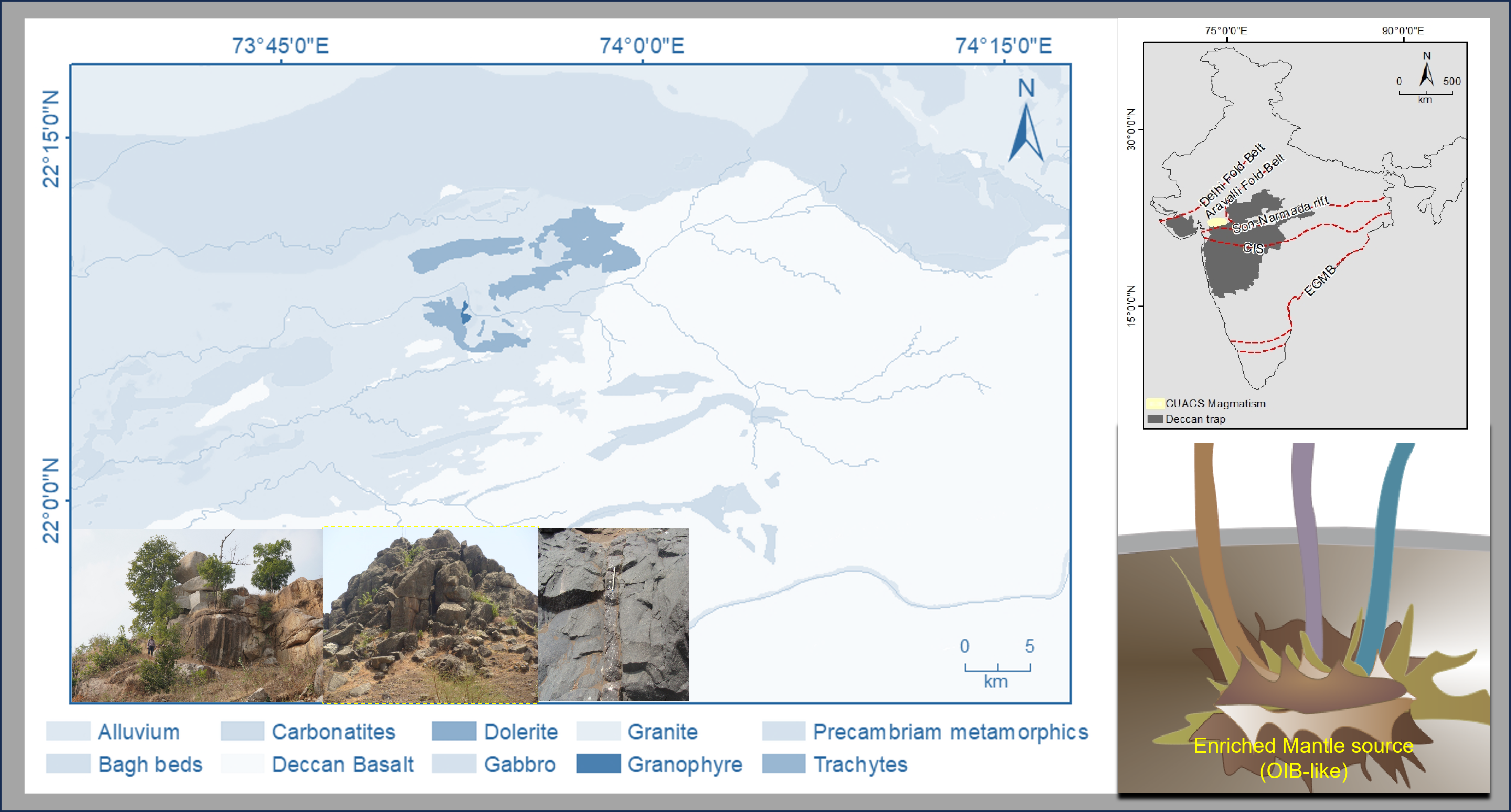
- CUACS magmatism is spatially and temporally linked to the main Deccan eruptive phase.
- Apparent radiometric age dispersion reflects analytical limitations rather than episodic magmatism.
- Field, structural, and geochronological data support short-duration magmatism within the DLIP.
- Open Access
- Article
On the Space-Time Context of Magmatism in the Chhota Udaipur Alkaline-Carbonatite Sub-Province within the Deccan Large Igneous Province, India
Author Information
Received: 08 November 2025 | Revised: 03 February 2026 | Accepted: 10 March 2026 | Published: 17 March 2026
Highlights
Abstract
The Deccan Large Igneous Province (DLIP) represents one of Earth’s most extensive continental flood basaltic events and is widely interpreted to have formed during a geologically short interval near the Cretaceous–Paleogene boundary. Within this framework, the Chhota Udaipur Alkaline-Carbonatite Sub-Province (CUACS), located in the lower Narmada rift zone, has yielded a wide range of radiometric ages, leading to suggestions of prolonged or episodic magmatism. This study integrates detailed field relationships, petrography, geochemistry, structural analysis, geophysical constraints, and critically evaluated geochronological data to reassess the spatial and temporal context of CUACS magmatism within the DLIP. The CUACS comprises diverse tholeiitic, transitional, and alkaline rock suites intruding Precambrian basement, Cretaceous sediments, and Deccan trap basaltic lava flows. Despite lithological diversity, geological relationships show no systematic cross-cutting or temporal separation among intrusive phases. Geochemical signatures indicate derivation from a common OIB-type enriched mantle source modified by crustal contamination. When evaluated in light of high-precision U–Pb and 40Ar/39Ar constraints on Deccan magmatism, the CUACS does not preserve evidence for distinct, long-lived magmatic pulses. Instead, the apparent age scatter largely reflects analytical and sampling errors. The results support a model in which CUACS magmatism is broadly coeval with the main Deccan eruptive phase, indicating short-duration magmatism for the DLIP.
Graphical Abstract
Keywords
Deccan traps | Chhota Udaipur | alkaline–carbonatite magmatism | Large Igneous Provinces | geochronology
References
- 1.
Subba Rao, S.S. Alkaline Rocks of the Deccan Traps. Bull. Volcanol. 1971, 35, 998–1011. https://doi.org/10.1007/BF02596861
- 2.
Bose, M.K. Alkaline Volcanism in the Deccan Volcanic Province. J. Geol. Soc. India 1980, 21, 317–329.
- 3.
Sethna, S.F. Petrology and geochemistry of the acid, intermediate and alkaline rocks associated with the Deccan basalt in Gujarat and Maharashtra. Mem. Geol. Soc. India 1989, 15, 47–61.
- 4.
Sethna, S.F.; Borges, S.M. Petrology of the Carbonatites and Associated Alkaline Rocks of Siriwasan, Cahota Udaipur J. Geol. Soc.
India 1981, 22, 417–425. - 5.
Randive, K.R. Intrusive dykes of Chhaktala, Jhabua district, Madhya Pradesh: Field relations, petrography and petrochemical characteristics with reference to their PGE concentration. J. Econ. Geol. Georesour. Manag. 2005, 2, 117–137.
- 6.
Lehmann, B.; Burgess, R.; Frei, D.; et al. Diamondiferous kimberlites in Central India synchronous with Deccan flood basalts. Earth Planet. Sci. Lett. 2010, 290, 142–149. https://doi.org/10.1016/j.epsl.2009.12.014
- 7.
Renne, P.R.; Sprain, C.J.; Richards, M.A.; et al. State shift in Deccan volcanism at the cretaceous–paleogene boundary, possibly induced by impact. Science 2015, 350, 76–78. https://doi.org/10.1126/science.aac7549
- 8.
Schoene, B.; Eddy, M.P.; Samperton, K.M.; et al. U-Pb constraints on pulsed eruption of the Deccan Traps across the end-Cretaceous mass extinction. Science 2019, 363, 862–866. https://doi.org/10.1126/science.aau2422
- 9.
Sprain, C.J.; Renne, P.R.; Vanderkluysen, L.; et al. The eruptive tempo of Deccan volcanism in relation to the Cretaceous-Paleogene boundary. Science 2019, 363, 866–870. https://doi.org/10.1126/science.aav1446
- 10.
Baksi, A.K. Geochemistry and geochronology of the Rajmahal flood basalt province, Northeastern India: Genetic links to Kerguelen hotspot activity. J. Earth Syst. Sci. 2022, 131, 1–10. https://doi.org/10.1007/s12040-022-01855-8
- 11.
Jiang, Y.; Ernst, R.E.; Peate, D.W.; et al. An appraisal of the ages of Phanerozoic large Igneous provinces. Earth Sci. Rev. 2023, 237, 104314. https://doi.org/10.1016/j.earscirev.2023.104314
- 12.
Ernst, R.E.; Bell, K. Large Igneous provinces (LIPs) and carbonatites. Miner. Petrol. 2010, 98, 55–76. https://doi.org/10.1007/s00710-009-0074-1
- 13.
Pande, K. Age and duration of the deccan traps, India: A review of radiometric and paleomagnetic constraints. Proc. Indian Acad. Sci. Earth Planet. Sci. 2002, 111, 115–123.
- 14.
Chenet, A.L.; Quidelleur, X.; Fluteau, F.; et al. 40Ar/39Ar Dating of the main Deccan large Igneous province: Further evidence of KTB age and short duration. Earth Planet. Sci. Lett. 2007, 263, 1–15. https://doi.org/10.1016/j.epsl.2007.07.011
- 15.
Hooper, P.R.; Widdowson, M.; Kelley, S.P.; et al. Tectonic setting and timing of the final Deccan flood basalt eruptions. Geology 2010, 38, 839–842. https://doi.org/10.1130/G31072.1
- 16.
Valdiya, K.S. The Making of India Geodynamic Evolution; Macmillan Publishers: New York, NY, USA, 2010; p. 816.
- 17.
Valdiya, K.S. Some burning questions remaining unanswered. J. Geol. Soc. India 2011, 78, 299–320. https://doi.org/10.1007/s12594-011-0097-1
- 18.
Baksi, A.K. Geochronological studies on the whole-rock basalts, Deccan traps, India: Evolution of the timing of volcanism relative to the K-T boundary. Earth Planet. Sci. Lett. 1994, 121, 43–56. https://doi.org/0012-821X(94)90030-2
- 19.
Baksi, A.K. The Deccan Trap – Cretaceous–Palaeogene Boundary connection: New 40Ar/39Ar Ages and critical assessment of existing argon data pertinent to this hypothesis. J. Asian Earth Sci. 2014, 84, 9–23. https://doi.org/10.1016/j.jseaes.2013.08.021
- 20.
Basu, A.R.; Renne, P.R.; DasGupta, D.K.; et al. Early and late alkali Igneous pulses and a high-3He Mantle source for the Deccan flood basalts, India. Science 1993, 261, 902–906. https://doi.org/10.1126/science.261.5123.902
- 21.
Sen G.; Hames, W.E.; Paul, D.K.; et al. Pre-Deccan and Deccan magmatism in Kutch, India: Implications of New 40Ar/39Ar ages of intrusions. J. Geol. Soc. India 2016, Special Publication No. 6, 211–222. https://doi.org/10.17491/cgsi/2016/105422
- 22.
Kumar, J.V.; Randive, K. Platinum group elements in lamprophyre, picrobasalt, gabbro and basalts of the Phenai Mata and nearby areas: Implications for Fe–Ni–Cu–PGE mineralization in the Deccan Large Igneous Province. In Lamprophyres, Lamproites and Related Rocks: Tracers to Supercontinent Cycles and Metallogenesis; Krmıcek, L., Chalapathi Rao, N.V., Eds.; Geological Society: London, UK, 2022. https://doi.org/10.1144/SP513-2020-265
- 23.
Coffin, M.F.; Eldholm, O. Large Igneous Provinces: Crustal structure, dimensions, and external consequences. Rev. Geophys. 1994, 32, 1–36. https://doi.org/10.1029/93RG02508
- 24.
Courtillot, V.E.; Renne, P.R. On the ages of flood basalt events. C. R. Geosci. 2003, 335, 113–140. https://doi.org/10.1016/S1631-0713(03)00006-3
- 25.
Neal, C.R.; Coffin, M.F.; Arndt, N.T.; et al. Investigating Large Igneous Province formation and associated Paleoenvironmental events: A white paper for scientific drilling. Sci. Drill. 2008, 6, 4–18. https://doi.org/10.04/iodp.sd.6.01.008
- 26.
Ernst, R.E. Large Igneous Provinces; Cambridge University Press: Cambridge, UK, 2014; p. 666. https://doi.org/10.1017/CBO9781139025300
- 27.
Mahoney, J.J. Deccan traps. In Continental Flood Basalts; Macdougall, J.D., Ed.; Kluwer Academic: Dordrecht, The Netherlands, 1988; pp. 151–194.
- 28.
Jay, A.E.; Widdowson, M. Stratigraphy, structure and volcanology of the SE Deccan continental flood Basalt Province: Implications for eruption mechanisms. J. Geol. Soc. Lond. 2008, 165, 177–188. https://doi.org/10.1144/0016-76492006-062
- 29.
Mahoney, J.J.; Duncan, R.A.; Khan, W.; et al. Cretaceous volcanic rocks of the South Tethyan Suture Zone, Pakistan: Implications for the reunion hotspot and the Deccan traps. Earth Planet. Sci. Lett. 2002, 203, 295–310. https://doi.org/10.1016/S0012-821X(02)00840-3
- 30.
Collier, J.S.; Sansom, V.; Ishizuka, O.; et al. Age of Seychelles–India break-up. Earth Planet. Sci. Lett. 2008, 272, 264–277. https://doi.org/10.1016/j.epsl.2008.04.045
- 31.
Mahoney, J.J.; Macdougall, J.D.; Lugmair, G.W. Kerguelen hotspot source for Rajmahal traps and Ninetyeast ridge? Nature 1983, 303, 385–389.
- 32.
Watts, A.B.; Cox, K.G. The Deccan traps: An interpretation in terms of progressive lithospheric thinning beneath the Indian Continent. Earth Planet. Sci. Lett. 1989, 93, 85–97. https://doi.org/10.1016/0012-821X(89)90186-6
- 33.
Sheth, H.C. From Deccan to R´eunion: No trace of a mantle plume. In Plates, Plumes and Paradigms; Foulger, G.R., Natland, J.H., Presnall, D.C., et al., Eds.; Geological Society of America: Boulder, CO, USA, 2005; Volume 388, pp. 477–501. https://doi.org/10.1130/0-8137-2388-4.477
- 34.
Hooper, P.R.; Widdowson, M.; Kelley, S. Tectonic setting and timing of the Deccan Traps. Geology 2010, 38, 839–842. https://doi.org/10.1130/g31072.1
- 35.
Baksi, A.K. Timing and duration of volcanism in the Columbia River Basalt Group: A review of existing radiometric data and new constraints on the age of the Steens through Wanapum Basalt extrusion. Geol. Soc. Am. Spec. Pap. 2013, 497, 67–85. https://doi.org/10.1130/2013.2497(03)
- 36.
Kasbohm, J.; Schoene, B. Rapid eruption of the Columbia River flood basalt and correlation with the mid-miocene climate optimum. Sci. Adv. 2018, 4, eaat8223. https://doi.org/10.1126/sciadv.aat8223
- 37.
Renne, P.; Ernesto, M.; Pacca, I.; et al. The age of Parana flood volcanism, rifting of Gondwanaland, and the Jurassic-cretaceous boundary. Science 1992, 258, 975–979. https://doi.org/10.1126/science.258.5084.975
- 38.
Baksi, A.K. Paran´a flood basalt volcanism primarily limited to ∼ 1 Myr beginning at 135 Ma: New 40Ar/39Ar ages for rocks from Rio Grande do Sul, and critical evaluation of published radiometric data. J. Volcanol. Geotherm. Res. 2018, 355, 66–77. https://doi.org/10.1016/j.jvolgeores.2017.02.016
- 39.
Renne, P.R.; Basu, A.R. Rapid eruption of the Siberian traps flood basalts at the permo-triassic boundary. Science 1991, 253, 176–179. https://doi.org/10.1126/science.253.5016.176
- 40.
Kale, V.; Achalla, G.; Shandilya, P.; et al. Stratigraphy and correlations in Deccan Volcanic Province, India: Quo vadis? GSA Bull. 2019, 132, 588–607. https://doi.org/10.1130/B35018.1
- 41.
Baksi, A.K. Corrigendum to “The Deccan Traps – Cretaceous– Paleogene boundary connection; new 40Ar/39Ar ages and critical assessment of existing argon data pertinent to this hypothesis”. [J. Asian Earth Sci. 84 (2014) 9–23]. J. Asian Earth Sci. 2016, 120, 193. https://doi.org/10.1016/j.jseaes.2016.01.020
- 42.
Schoene, B.; Eddy, M.P.; Samperton, K.M.; et al. U–Pb geochronology of the Deccan traps and relation to the endcretaceous mass extinction. Science 2015, 347, 182–184. https://doi.org/10.1126/science.aaa0118
- 43.
Schoene, B.; Eddy, M.; Samperton, K.; et al. U-Pb constraints on pulsed eruption of the Deccan Traps across the end-Cretaceous mass extinction. Science 2019, 363, 862–866. https://doi.org/10.1126/science.aau2422
- 44.
Sprain, C.J.; Renne, P.R.; Vanderkluysen, L.; et al. The eruptive tempo of Deccan volcanism in relation to the Cretaceous-Paleogene boundary. Science 2019, 363, 866–870. https://doi.org/10.1126/science.aav1446
- 45.
Eddy, M.P.; Schoene B.; Samperton K.M; et al. U-Pb zircon age constraints on the earliest eruptions of the Deccan Large Igneous Province, Malwa Plateau, India. Earth Planet. Sci. Lett. 2020, 540, 116249. https://doi.org/10.1016/j.epsl.2020.116249
- 46.
Chalapathi Rao, N.V.; Dharma Rao, C.V.; Das, S. Petrogenesis of lamprophyres from Chhota Udaipur area, Narmada rift zone, and its relation to Deccan magmatism. J. Asian Earth Sci. 2012, 45, 24–39. https://doi.org/10.1016/j.jseaes.2011.09.009
- 47.
Viladkar, S.G. Geology of the Carbonatite–Alkalic Diatreme of Amba Dongar, Gujarat; International Carbonatite Workshop: Gujarat, India, 1996; p. 74.
- 48.
Randive, K.R.; Jawadand, S.; Meshram, T.; et al. Lamprophyres from the Chhota Udaipur Alkaline – Carbonatite Sub-Province, Deccan Large Igneous Province, India: Implication for Petrogenesis and Crustal Structure; Geological Society, London, Special Publications: London, UK, 2024; Volume 551. https://doi.org/10.1144/SP551-2023-112
- 49.
Jawadand, S. Field evidences as a tool to determine space-time relationships of intrusive rocks of Chhota Udaipur Alkaline-Carbonatite Sub-Province, Lower Narmada Valley, Deccan Large Igneous Province, India. J. Emerg. Technol. Innov. Res. 2022, 9, e-436–e-443.
- 50.
Randive, K.R.; Hurai, V. Fluid inclusion study of quartz xenocrysts in mafic dykes from Kawant Tehsil, Chhota Udaipur District, Gujarat, India. Central Eur. J. Geosci. 2015, 7, 244–251.
- 51.
Sukheswala, R.N.; Borges, S.M. The carbonatite-injected sandstones of Siriwasan, Chhota Udaipur, Gujarat. Indian J. Earth Sci. 1975, 2, 1–10.
- 52.
Sethna, S.F.; Borges, S.M. Petrology of the carbonatites and associated alkaline rocks of Siriwasan, Chhota Udepur. J. Geol. Soc. India 1980, 22, 417-425. https://doi.org/10.17491/jgsi/1981/220902
- 53.
Gwalani, L.G. Petrology of Deccan Traps and Bagh Beds of Dugdha–Naswadi, Gujarat; Somaiya Publications: Bombay, India, 1981; p. 107.
- 54.
Gwalani, L.G.; Avasia, R.K. Petrography and geochemistry of carbonatites of Padvani and surrounding areas, Chhota Udaipur, Gujarat. Mem. Indian Geol. Assoc. 1984, 1, 165–174.
- 55.
Gwalani, L.G.; Avasia, R.K. Deccan basalts and carbonatitenephelinite volcanism. Chhota Udaipur, Gujarat state, India. Geochronique Special Washington Issue 30(53) and 28th Int. Geol. Congr. Abstract, Volume 1, 1989; pp. 602–603.
- 56.
Sukheswala, R.N.; Avasia, R.K. Carbonatite–alkalic complex of Panwad–Kawant, Gujarat and its bearing on the structural characteristics of the area. Bull. Volcanol. 1972, 35, 564–578.
- 57.
Gwalani, L. G.; Fernandez, S.; Karanth, R. V.; Demeny, A.; Chang, W.-J.; Avasia, R. K. Alkaline and tholeiitic dyke swarm associated with Amba Dongar and Phenai Mata complexes, Chhota Udaipur alkaline sub-province, Western India. Mem. Geol. Soc. India 1994, 33, 391–424.
- 58.
Sukheswala, R.N.; Sethna, S.F. Giant pseudoleucites of Ghori, Chhota Udaipur. Am. Miner. 1967, 52, 1904–1910.
- 59.
Sukheswala, R.N.; Avasia, R.K. Carbonatite-alkalic complex of Panwad-Kawant, Gujarat, and its bearing on the structural characteristics of the area. Bull Volcanol. 1971, 35, 564–578. https://doi.org/10.1007/BF02596828
- 60.
Sukheswala, R.N.; Srivastava, A.N.; Mahambre, S.J.; et al. Geology of Bakhatgarh-Phulmal and Dugdha-naswadi sectors in the Malva region of lower Narmada valley. In UGC Report on the Geology of the Deccan trap in Southern Part of Malva Region; University of Saugar, Sagar, MP, India, 1976; pp. 1–19.
- 61.
Viladkar, S.G. and Avasia, R.K. Carbonatites of Panwad-Kawant region, Chhota Udaipur province, Gujarat. In Proceedings of National Seminar on Recent Researches in Geology of Western India; Geology Department, Maharaja Sayajirao University of Baroda; Vadodara, India, 1995; pp. 61–71.
- 62.
Sukheswala, R.N.; Sethna, S.F. Layered gabbro of the Igneous complex of Phenai Mata, Gujarat State. J. Geol. Soc. India 1969, 10, 177–187.
- 63.
Randive, K.R. Occurrence of unusual quartz xenocryst-laden dykes in the Chhota Udaipur alkaline–carbonatite sub-province, Deccan Igneous Province, India. Curr. Sci. 2015, 108, 2261–2266.
- 64.
Jawadand, S.A.; Randive, K.R. Chlorite Geothermometry from a quartz Xenocryst-laden basaltic dyke at Rorda, Chhota Udaipur alkaline–carbonatite sub-province, Deccan large Igneous province, India. Nagpur Univ. Sci. J. 2022, XV, 79–92.
- 65.
Kumar, S. Pearce element ratios applied to model basic rock members of Phenai Mata Igneous Complex, Baroda district, Gujarat. J. Geol. Soc. India 2003, 61, 565–572.
- 66.
Hari, K.R.; Chalapathirao, N.V.; Swarnkar, V. Petrogenesis of gabbro and orthopyroxene gabbro from the Phenai Mata Igneous Complex, Deccan Province: Products of concurrent assimilation and fractional crystallisation. J. Geol. Soc. 2011, 78, 501–509. https://doi.org/10.1007/s12594-011-0126-0
- 67.
Kumar, S. Geochemical specialization of Phenai Mata Igneous Complex, Baroda district, Gujarat. J. Sci. Res. 1996, 46, 207–218.
- 68.
Sukheswala, R.N.; Sethna, S.F. Differentiated Gabbro of Deccan Trap age and its associates. Bull. Geol. Soc. India 1964, 1, 6–9.
- 69.
Sukheswala, R.N.; Sethna, S.F. Oversaturated and undersaturated differentiates in the tholeiitic Igneous complex of Phenai Mata, Baroda district, Gujarat State, India. Neu. Jb. Mineral., Abh. 1973, 118, 159–176.
- 70.
Sethna, S.F. Petrology and geochemistry of the acid, intermediate and alkaline rocks associated with the Deccan basalt in Gujarat and Maharashtra. Mem. Geol. Soc. India 1989, 15, 47–61.
- 71.
Kumar, S. Chemistry of clinopyroxenes from sub-alkaline and alkaline rocks of Phenai Mata Igneous complex, Baroda district, Gujarat, Western India. J. Geol. Soc. India 1996, 48, 547–558.
- 72.
Durgadmath, M.B. Lamprophyre dykes from Phenai Mata area, Baroda district. In Symposium on Three Decades of Developments in Petrology, Mineralogy and Petrochemistry in India; Geological Survey of India: Jaipur, India, 1984; pp. 3–6.
- 73.
Hari, K.R.; Randive, K. Mixing and mingling of dissimilar magmas as against extreme differentiation of tholeiitic magmas: A new insight on the petrogenesis of Phenai Mata Igneous Complex, Deccan Large Igneous Province, India. Indian J. Geosci. 2017, 71, 547–562.
- 74.
Randive, K; Kumar, J.; Korakoppa, M M. Platinum-group elements mineralization in the cumulate gabbro of Phenai Mata Complex, Deccan Large Igneous Province, India. Current Sci. 2015, 108, 1796–1798.
- 75.
Dwivedi, G.N.; Karkare, S.G. A study of granophyres at Phenai Mata hill, Baroda district, Gujarat. Hindustan Publ. Corp., Delhi. Rec. Res. Geol. 1978, 4, 374–379.
- 76.
Deshmukh, S.S.; Sehgal, M.N. Mafic Dyke Swarms in Deccan Volcanic Province of Madhya Pradesh and Maharashtra. In Deccan Flood Basalts, No. 10; Subbarao, K.V., Ed.: Geological Society of India: Bangalore, India, 1988; pp. 323–340.
- 77.
Randive, K.R. Intrusive dykes of Chhaktala, Jhabua district, Madhya Pradesh: Eield relations, petrography and petrochemical characteristics with reference to their PGE concentration. J. Econ. Geol. Georesour. Manage. 2005, 2, 117–137.
- 78.
Hari, K.R. Mineralogical and petrochemical studies of the lamprophyres around Chhaktalao area, Madhya Pradesh. J. Geol. Soc. India 1998, 51, 21–30.
- 79.
Randive, K.R. Compositional variation of micas from the lamprophyre dykes of Bakhatgarh–Phulmal area, Jhabua district, M.P., India. In Indian Dykes: Geochemistry, Geophysics and Geochronology; Srivastava, R. K., Sivaji, C., & Chalapathi Rao, N.V., Eds.; Narosa Publishing House: New Delhi, India, 2008; pp. 133–141.
- 80.
Randive, K.R. Occurrence of xenoliths in the lamprophyre and picrobasalt dykes of Bakhatgarh – Phulmal area, Jhabua district, Madhya Pradesh, India. In Dyke Swarms: Keys for Geodynamic Interpretations; Srivastava, R. K., Ed.; Springer-Verlag: Berlin and Heidelberg, Germany, 2011; pp. 301–303. https://doi.org/10.1007/978-3-642-12496-9 18
- 81.
Pandey, R.; Rao, N.V.C.; Singh, M.K.; et al. Alkaline rocks from the Deccan large Igneous province: Time–space distribution, petrology, geochemistry and economic aspects. J. Earth Syst. Sci. 2022, 131, 108. https://doi.org/10.1007/s12040-022-01852-x
- 82.
Hari, K.R.; Chalapathy Rao, N.V.; Swarnakar, V.; et al. Alkali feldspar syenites with shoshonitic affinities from Chhotaudepur area: Implication for mantle metasomatism in the Deccan large Igneous province. GeoSci. Front. 2014, 5, 261–276. https://dx.doi.org/10.1016/j.gsf.2013.06.007
- 83.
Le Maitre, R.W. A Classification of Igneous Rocks and Glossary of Terms; Blackwell: Oxford, UK, 1989; p. 193.
- 84.
West,W.D. The source of the Deccan trap flows. J. Geol. Soc. India 1959, 1, 44–52.
- 85.
Lino, L.M.; Vlach, S.R.F. Textural and geochemical evidence for multiple, sheet-like magma pulses in the limeira intrusion, Paran´a Magmatic Province, Brazil. J. Petrol. 2021, 62, egab011. https://doi.org/10.1093/petrology/egab011
- 86.
Singh, B.; Prabhakara Rao, M.R.K.; Prajapati, S.K.; et al. Combined gravity and magnetic modeling over Pavagadh and Phenaimata Igneous complexes, Gujarat, India: Inference on emplacement history of Deccan volcanism. J. Asian Earth Sci. 2014, 80, 119–133. https://doi.org/10.1016/j.jseaes.2013.11.005
- 87.
Poornachandra Rao, G.; Mallikharjun Rao, J.; Jaya Prasanna Lakshmi, K. Palaeomagnetic study of the alkaline rocks associated with the Deccan traps of north western India. Indian J. Geochem. 2004, 19, 19–32.
- 88.
Vandame, D.; Courtillot, V.; Besse, J.; et al. Paleomagnetism and age determination of the Deccan traps (India): Results of Nagpur–Bombay and review of earlier Work. Rev. Geophys. 1991, 29, 159–190. https://doi.org/10.1029/91RG00218
- 89.
Verma O.; Khosla A. Developments in the stratigraphy of the Deccan Volcanic Province, peninsular India. C. R. Geosci. 2019, 351, 461–476. https://doi.org/10.1016/j.crte.2019.10.002
- 90.
Baksi, A.K. Critical assessment of the geochronological data on the Deccan traps, India: Emphasis on the timing and duration of volcanism in sections of tholeiitic basalts J. Earth Syst. Sci. 2022, 131, 135. https://doi.org/10.1007/s12040-022-01842-z
- 91.
Baksi, A.K. “Data reporting norms for 40Ar/39Ar geochronology”– Comment. Quat. Geochronol. 2012, 12, 50–52. https://doi.org/10.1016/j.quageo.2012.07.004
- 92.
Melekhova, E.; Annen, C.; Blundy, J. Compositional gaps in Igneous rock suites controlled by magma system heat and water content. Nat. Geosci. 2013, 6, 385–390.
- 93.
Bowen, N.L. The Evolution of the Igneous Rocks; Princeton University Press, Princeton, NJ, USA, 1928.
- 94.
Fenner, C.N. The crystallization of Basalts. Am. J. Sci. 1929, 105, 225–253.
- 95.
Kennedy, W.Q. Trends of differentiation in basaltic magmas. Am. J. Sci. 1933, 25, 239–256.
- 96.
Tilley, C.E. Some aspects of magmatic evolution. Q. J. Geol. Soc. 1950, 106, 37–61.
- 97.
Irvine, T.N.; Baragar, W.R.A. A guide to the chemical classification of the common volcanic rocks. Can. J. Earth Sci. 1971, 8, 523–548. https://doi.org/10.1139/e71-055
- 98.
Randive, K.R. Project Report; Department of Science and Technology; New Delhi, India, 2012; p. 127. (Unpublished).
- 99.
Henderson, P. Rare Earth Element Geochemistry; Elsevier: Amsterdam, Netherlands, 1984; Volume xii, p. 510.
- 100.
Sun, S.; McDonough, W.F. Chemical and isotopic systematics of oceanic basalts: Implications for mantle composition and processes. In Magmatism in the Ocean Basins; Saunders, A.D.; Norry, M.J., Eds.; Geological Society, London, Special Publications, Volume 42; Geological Society, London: London, UK, 1989; pp. 313–345. https://doi.org/10.1144/GSL.SP.1989.042.01.19
- 101.
Pearce, J.A. Trace element characteristics of lavas from destructive plate boundaries. In Andesites: Orogenic Andesites and Related Rocks; Thorpe, R.S., Ed.; Wiley: Chichester, UK, 1982; pp. 528–548.
- 102.
Hofmann, A.W.; Jochum, K.P.; Seufert, M.; White, W.M. Nb and Pb in oceanic basalts: New constraints on mantle evolution. Earth Planet. Sci. Lett. 1986, 79, 33–45. https://doi.org/10.1016/0012-821X(86)90038-5
- 103.
Sims, K.W.W.; DePaolo, D.J. Inferences about mantle magma sources from incompatible element concentration ratios in oceanic basalts. Geochim. Cosmochim. Acta 1997, 61, 765–784. https://doi.org/10.1016/S0016-7037(96)00372-9
- 104.
Shervais, J.W. Ti–V plots and the petrogenesis of modern and ophiolitic lavas. Earth Planet. Sci. Lett. 1982, 59, 101–118. https://doi.org/10.1016/0012-821X(82)90120-0
- 105.
Taylor, S.R.; McLennan, S.M. The Continental crust: Its Composition and Evolution; Blackwell Scientific Publications: Oxford, UK, 1985; pp. 1–328
- 106.
Tappe, S.; Foley, S.F.; Stracke, A.; et al. Genesis of ultramafic lamprophyres and carbonatites at Aillik Bay, Labrador: A consequence of incipient lithospheric thinning beneath the North Atlantic Craton. J. Petrol. 2006, 47, 1261–1315. https://doi.org/10.1093/petrology/egl008
- 107.
Alexander, P.O. Age and duration of Deccan volcanism: K-Ar evidence. Mem. Geol. Soc. Ind. 1981, 3, 244–258.
- 108.
Deans, T.; Powell, J.L. Trace elements and strontium isotopes in carbonatites, fluorites and limestones from India and Pakistan. Nature 1968, 218, 750–751. https://doi.org/10.1038/218750a0
- 109.
Sahu, M.K.; Belyatski, B.; Lanjewar, S.; et al. Eocene (∼55 Ma) age for the lamprophyre dyke of Chhota Udaipur carbonatite-alkaline subprovince, Lower Narmada Valley, Gujarat and Madhya Pradesh states, India. In Petrology & Geochemistry of Metasomatised Lithospheric Mantle Magmas; 10th International Kimberlite Conference, 2012; Short Abstract no. 10IKC-365, p. 139.
- 110.
Pandey, R.; Pandey, A.; Chalapathi Rao, N.V.; et al. Petrogenesis of end-cretaceous/early eocene lamprophyres from the Deccan large Igneous province: Constraints on plume–lithosphere interaction and the post-Deccan LAB beneath NW India. Lithos 2019, 346–347, 105139. https://doi.org/10.1016/j.lithos.2019.07.006
- 111.
Baksi, A.K. (2007). A quantitative tool for detecting alteration in undisturbed rocks and minerals–I:Water, chemical weathering, and atmospheric argon. Geol. Soc. Am. Spec. Pap. 2007, 430, 1–15. https://doi.org/10.1130/2007.2430(15)
- 112.
Baksi, A.K. A quantitative tool for detecting alteration in undisturbed rocks and minerals—II: Application to argon ages related to hotspots. Geol. Soc. Am. Spec. Pap. 2007, 430, 305–333. https://doi.org/10.1130/2007.2430(16)
- 113.
Kaosbohm, J., Schoene, B., Burgess, S. Radiometric constraints on the timing, tempo, and effects of large Igneous province emplacement. In Large Igneous Provinces: A Driver of Global Environmental and Biotic Changes; Geophysical Monograph Series, Volume 255; American Geophysical Union/Wiley: Washington, DC, USA, 2021; pp. 39–64. https://doi.org/10.1002/9781119507444.ch2
- 114.
Deans, T.; Sukhesawala, R.N.; Sethna, S.F.; et al. Metasomatic feldspar rocks (potash fenites) associated with the fluorite deposits and carbonatites of Ambadongar, Gujarat, India. Trans. Inst. Min. Metall. Sect. B 1972, 81, 1–9.
- 115.
Veena, K.; Pandey, B.K.; Krishnamurthy, P.; et al. Sr and Nd Isotopic data and Rb-Sr age on the Ambadungar-Siriwasan carbonatite complex, and its relation to the Deccan Trap volcanism. In Proceedings of 6th National Symposium on Mass Spectrometry, IIP, Dehradun, India, 11–13 October 1993; pp. 515–517.
- 116.
Viladkar, S.G. Phlogopitization at Amba Dongar carbonatite alkalic complex, India. Neu. Jb. Miner. Abh. 1991, 162, 201–213.
- 117.
Petibon, C. E´ tude Ge´ochimique des Carbonates de Nevania, Amba Dongar et Siriwasan, Inde. M´emoire de DEA; Universit ´e de Rennes: Rennes, France, 1994.
- 118.
Ray, J.S.; Ramesh, R.; Pande, K.; et al. Isotope and rare earth element chemistry of carbonatite–alkaline complexes of Deccan volcanic province: Implications to magmatic and alteration processes. J. Asian Earth Sci. 2000, 18, 177–194. https://doi.org/S1367-9120(99)00030-9
- 119.
Ray, J.S.; Pande, K.K. Carbonatite alkaline magmatism associated with continental flood basalts at stratigraphic boundaries: Cause for mass extinctions. Geophys. Res. Lett. 1999, 26, 1917–1920. https://doi.org/10.1029/1999GL900390
- 120.
Ray, J.S.; Shukla, P.N. Trace element geochemistry of Amba Dongar carbonatite complex, India: Evidence for fractional crystallization and silicate-carbonate melt immiscibility. J. Earth Syst. Sci. 2004, 113, 519–531. https://doi.org/10.1007/BF02704020
- 121.
Parisio, L.; Jourdan F.; Marzoli A.; et al. 40Ar/39Ar ages of alkaline and tholeiitic rocks from the northern Deccan Traps: Implications for magmatic processes and the K–Pg boundary. J. Geol. Soc. 2016, 173, 679–688. https://doi.org/10.6084/m9.figshare.c.2674441.v1
- 122.
Viladkar, S.G.; Gittins, J. Trace elements and REE geochemistry of Siriwasan carbonatite, Chhota Udaipur, Gujarat. J. Geol. Soc. India 2016, 87, 709–715. https://doi.org/10.1007/s12594-016-0443-4
- 123.
Fosu, B.; Ghosh, P.; Chew, D.; et al. Composition and U–Pb ages of apatite in the Amba Dongar carbonatite–alkaline complex, India. Geol. J. 2018, 54. 3438–3454. https://doi.org/10.1002/gj.3350
- 124.
Chandra, J.; Paul, D.; Stracke, A.; et al. The origin of carbonatites from Amba Dongar within the Deccan large Igneous province. J. Petrol. 2019, 60, 1119–1134, https://doi.org/10.1093/petrology/egz026
- 125.
Basu, A.R.; Chakrabarty, P.; Szymanowski, D.; et al. Widespread silicic and alkaline magmatism synchronous with the Deccan Traps flood basalts, India. Earth Planet. Sci. Lett. 2020, 552, 116616. https://doi.org/10.1016/j.epsl.2020.116616
- 126.
Viladkar, S.G.; Ramesh, R.; Avasia, R.K; et al. Extrusive phase of Carbonatite-Alkalic activity in Amba Dongar complex, Chhota Udaipur, Gujarat. Geol. Soc. India 2005, 66, 273–276.
- 127.
Wellman, P.; McElhinny, M.W. K–Ar ages of the Deccan traps, India, and the opening of the Indian Ocean. Nature 1970, 227, 595–599. https://doi.org/10.1038/227595a0
- 128.
Paul, D.K.; Potts, P.J.; Rex, D.C.; et al. Geochemical and petrogenetic study of the Girnar Igneous complex, Deccan volcanic province, India. GSA Bull. 1977, 88, 227–234. https://doi.org/10.1130/0016-7606(1977)88%3C227:GAPSOT%3E2.0.CO;2
- 129.
Rathore, S.S; Venkatesan, T.R.; Srivastava, R.K. Mundwara Alkali Igneous complex, Rajasthan, India: Chronology and Sr isotope systematics. J. Geol. Soc. India 1996, 91, 517–528.
- 130.
Sahoo, S.; Chalapathi Rao, N.V.; Moni´ e, P.; et al. Petrogeochemistry, Sr-Nd isotopes and 40Ar/39Ar ages of fractionated alkaline lamprophyres from the Mount Girnar Igneous complex (NW India): Insights into the timing of magmatism and the lithospheric mantle beneath the Deccan Large Igneous Provinces. Lithos 2020, 374–375, 105712. https://doi.org/10.1016/j.lithos.2020.105712
- 131.
Krishnamurthy, P.; Gopalan, K.; MacDougall, J. D. Olivine composition in the picrite basalts and the Deccan Volcanic Cycle. J. Petrol. 2000, 41, 1057–1069.
- 132.
Kumar, S. Pearce element ratios applied to model basic rock members of Phenai Mata Igneous Complex, Baroda District, Gujarat. J. Geol. Soc. India 2003, 61, 565–572. https://doi.org/10.17491/jgsi/2003/610507
- 133.
Hari, K.R.; Prasanth, M.P.M.; Swarnkar, V.; et al. Evidence for the contrasting magmatic conditions in the petrogenesis of A-type granites of the Phenai Mata Igneous complex: Implications for felsic magmatism in the Deccan large Igneous Province. J. Indian Inst. Sci. 2018, 98, 379–399. https://doi.org/10.1007/s41745-018-0079-z
- 134.
Randive, K.R.; Vijaya Kumar, J.; Korakoppa, M.; et al. Occurrence of REE mineralization in the layered Gabbros of Phenai Mata Igneous Complex, Gujarat, India. Curr. Sci. 2017, 112, 231–235.
- 135.
NMBGMR. K/Ar and 40Ar/39Ar Methods. New Mexico Geochronology Research Laboratory; New Mexico Bureau of Geology & Mineral Resources (NMBGMR), New Mexico Institute of Mining and Technology: Socorro, New Mexico, USA, Available online: https://geoinfo.nmt.edu/labs/argon/methods/home.html (accessed on 18 April 2025).
- 136.
Patidar, R.; Agrawal, V. Emplacement of carbonatite and associate rocks of Siriwasan carbonatite complex, Gujarat: Evident by field relationship and petrology. J. Sci. Res. (BHU) 2022, 66, 1–10. https://doi.org/10.37398/JSR.2022.660301
- 137.
Rao, N.V.C; Giri, R.K.; Sharma, A.; et al. Lamprophyres from the Indian shield: A review of their occurrence, petrology, tectonomagmatic significance and relationship with the Kimberlites and related rocks. Episodes 2020, 43, 231–248.
How to Cite
Jawadand, S.; Randive, K. On the Space-Time Context of Magmatism in the Chhota Udaipur Alkaline-Carbonatite Sub-Province within the Deccan Large Igneous Province, India. Earth Systems, Resources, and Sustainability 2026, 1 (2), 221–248. https://doi.org/10.53941/esrs.2026.100014.
RIS
BibTex
Copyright & License

Copyright (c) 2026 by the authors.
This work is licensed under a Creative Commons Attribution 4.0 International License.
Contents
References
