
- Evidence across four domains to evaluate how climate change is fundamentally altering marine invasion dynamics.
- Proposal of a new climate-smart marine biosecurity framework aligned with Sustainable Development Goals and emerging global biodiversity targets.
- Operational pathway to shift biosecurity from post-invasion response toward anticipatory, climate-informed prevention.
- Open Access
- Article
Emerging Threats in a Warming Ocean: Climate-Driven Spread of Marine Invasive Species and Regional Biosecurity Gaps
- Paravanparambil Rajakumar Jayachandran 1,*,
- Mantodi Jima 2,
- Seerangan Manokaran 1,
- Jayanath Gopi 1,
- Karuppasamy Ponnambalam Manikandan 1 and
- Thadickal Viswanathan Joydas 1,*
Author Information
Received: 02 December 2025 | Revised: 14 January 2026 | Accepted: 04 February 2026 | Published: 10 February 2026
Highlights
Abstract
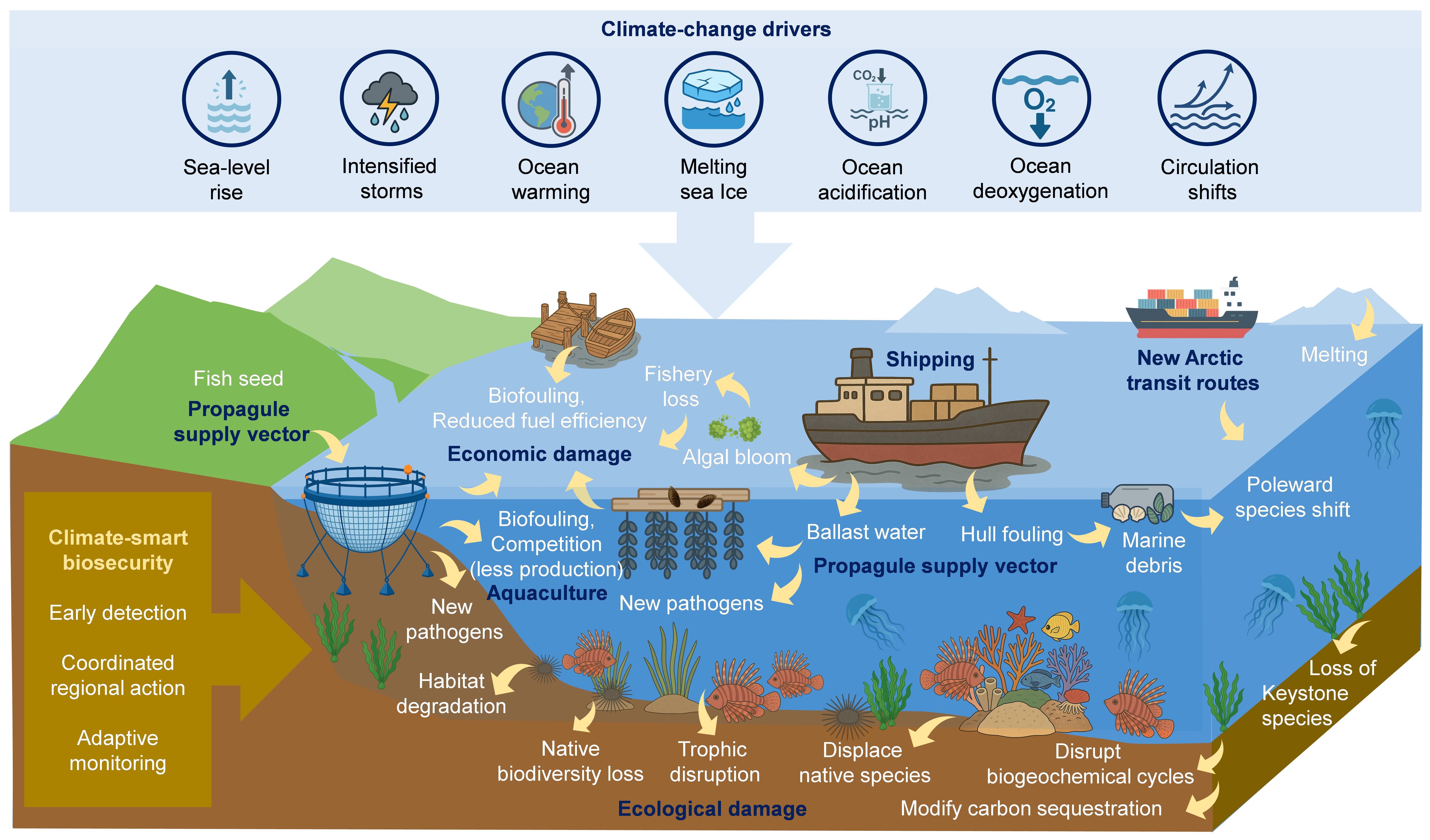
Climate change is rapidly reshaping oceanographic conditions, expanding ecological windows for marine invasive species (MIS) through warming, altered circulation, acidification, and deoxygenation. These shifts are amplifying invasion pressure across biogeographic boundaries, destabilizing native ecosystems and threatening fisheries, coastal protection, and blue carbon storage. Here, we synthesize evidence across four domains such as climate drivers, invasion pathways, ecological impacts, and governance responses to evaluate how climate change is fundamentally altering marine invasion dynamics. This review identifies three critical global gaps: (i) the absence of climate-integrated biosecurity metrics capable of anticipating future invasion risk, (ii) limited early-warning thresholds linking environmental change to invasion probability, and (iii) weak regional coordination across shared marine pathways, particularly in semi-enclosed seas and climate-sensitive regions. Despite growing policy attention, most existing biosecurity frameworks remain static and reactive, poorly aligned with accelerating climate variability. To address these gaps, we propose a climate-smart marine biosecurity framework that integrates molecular surveillance (e.g., eDNA), dynamic risk modeling, and predictive monitoring aligned with Sustainable Development Goals and emerging global biodiversity targets. By reframing MIS management as a core component of climate adaptation rather than a standalone conservation issue, this review provides an operational pathway to shift biosecurity from post-invasion response toward anticipatory, climate-informed prevention. The urgency of this transition is underscored by the rapid emergence of new invasion corridors and the narrowing window for effective intervention in a warming ocean.
Graphical Abstract
Keywords
climate change | marine invasions | biosecurity | ecosystem resilience | SDG 14 | risk assessment
References
- 1.
Katsanevakis, S.; Olenin, S.; Puntila-Dodd, R.; et al. Marine Invasive Alien Species in Europe: 9 Years after the IAS Regulation. Front. Mar. Sci. 2023, 10, 1271755. https://doi.org/10.3389/fmars.2023.1271755
- 2.
Wainright, C.A.; Muhlfeld, C.C.; Elser, J.J.; et al. Species invasion progressively disrupts the trophic structure of native food webs. Proc. Natl. Acad. Sci. USA 2021, 118, e2102179118. https://doi.org/10.1073/pnas.2102179118
- 3.
Costello, K.E.; Lynch, S.A.; McAllen, R.; et al. Assessing the potential for invasive species introductions and secondary spread using vessel movements in maritime ports. Mar. Pollut. Bull. 2022, 177, 113496. https://doi.org/10.1016/j.marpolbul.2022.113496
- 4.
Chan, F.T.; Stanislawczyk, K.; Sneekes, A.C.; et al. Climate change opens new frontiers for marine species in the arctic: Current trends and future invasion risks. Glob. Chang. Biol. 2019, 25, 25–38. https://doi.org/10.1111/gcb.14469
- 5.
Viljoen, J.J.; Sun, X.; Brewin, R.J.W. Climate variability shifts the vertical structure of phytoplankton in the Sargasso Sea. Nat. Clim. Change 2024, 14, 1292–1298. https://doi.org/10.1038/s41558-024-02136-6
- 6.
Von Schuckmann, K.; Moreira, L.; Cancet, M.; et al. The state of the Global Ocean. State Planet 2024, 4-osr8, 1–30. https://doi.org/10.5194/sp-4-osr8-1-2024
- 7.
Praved, P.H.; Oliveira, O.M.P.; Neethu, K.V.; et al. Unusual blooming of invasive ctenophore Beroe Ovata (Bruguiere, 1789) and Geographical Range Expansion Based on Morphology and Molecular Analysis. Reg. Stud. Mar. Sci. 2023, 60, 102837. https://doi.org/10.1016/j.rsma.2023.102837
- 8.
Yorifuji, M.; Hayashi, M.; Ono, T. Interactive effects of ocean deoxygenation and acidification on a coastal fish sillago japonica in early life stages. Mar. Pollut. Bull. 2024, 198, 115896. https://doi.org/10.1016/j.marpolbul.2023.115896
- 9.
Li, K.-Y.; Liu, W. Weakened atlantic meridional overturning circulation causes the historical North Atlantic warming hole. Commun. Earth Environ. 2025, 6, 416. https://doi.org/10.1038/s43247-025-02403-0
- 10.
Hamlington, B.D.; Bellas-Manley, A.; Willis, J.K.; et al. The rate of global sea level rise doubled during the past three decades. Commun. Earth Environ. 2024, 5, 601. https://doi.org/10.1038/s43247-024-01761-5
- 11.
Tregarot, E.; D’Olivo, J.P.; Botelho, A.Z.; et al. Effects of climate change on marine coastal ecosystems – A Review to guide research and management. Biol. Conserv. 2024, 289, 110394. https://doi.org/10.1016/j.biocon.2023.110394
- 12.
Cuthbert, R.N.; Pattison, Z.; Taylor, N.G.; et al. Global economic costs of aquatic invasive Alien Species. Sci. Total Environ. 2021, 775, 145238. https://doi.org/10.1016/j.scitotenv.2021.145238
- 13.
Davidson, I.C.; Cott, G.M.; Devaney, J.L.; et al. Differential effects of biological invasions on coastal blue carbon: A global review and meta-analysis. Glob. Chang. Biol. 2018, 24, 5218–5230. https://doi.org/10.1111/gcb.14426
- 14.
Weiskopf, S.R.; Rubenstein, M.A.; Crozier, L.G.; et al. Climate change effects on biodiversity, ecosystems, ecosystem services, and natural resource management in the United States. Sci. Total Environ. 2020, 733, 137782. https://doi.org/10.1016/j.scitotenv.2020.137782
- 15.
Diagne, C.; Leroy, B.; Vaissiere, A.-C.; et al. High and rising economic costs of biological invasions worldwide. Nature 2021, 592, 571–576. https://doi.org/10.1038/s41586-021-03405-6
- 16.
IPBES. IPBES Invasive Alien Species Assessment; IPBES Secretariat: Bonn, Germany, 2023.
- 17.
Brewington, L.; Rodgers, L.; Greenwood, L. Recommendations for incorporating invasive species into U.S. climate change adaptation planning and policy. Conserv. Sci. Pract. 2024, 6, e13210. https://doi.org/10.1111/csp2.13210
- 18.
Hughes, A.C.; Grumbine, R.E. The Kunming-montreal global biodiversity framework: What it does and does not do, and how to improve it. Front. Environ. Sci. 2023, 11, 1281536. https://doi.org/10.3389/fenvs.2023.1281536
- 19.
Hulme, P.E.; Lieurance, D.; Richardson, D.M.; et al. Multiple targets of the global biodiversity framework must be addressed to manage invasive alien species in protected areas. NB 2025, 99, 149–170. https://doi.org/10.3897/neobiota.99.152680
- 20.
Kraus, R. Ballast water management in ports: Monitoring, early warning and response measures to prevent biodiversity loss and risks to human health. JMSE 2023, 11, 2144. https://doi.org/10.3390/jmse11112144
- 21.
Liu, T.-K.; Wang, Y.-C.; Su, P.-H. Implementing the ballast water management convention: Taiwan’s experience and challenges in the early stage. Mar. Policy 2019, 109, 103706. https://doi.org/10.1016/j.marpol.2019.103706
- 22.
Gollasch, S.; David, M. Ballast water management convention implementation challenges. Ocean Yearb. Online 2018, 32, 456–476. https://doi.org/10.1163/22116001-03201018
- 23.
Lieurance, D.; Canavan, S.; Faulkner, K.T.; et al. Understanding and managing introduction pathways into protected areas in a changing climate. Biol. Invasions 2025, 27, 74. https://doi.org/10.1007/s10530-025-03534-3
- 24.
Zhang, Z.; Capinha, C.; Karger, D.N.; et al. Impacts of climate change on geographical distributions of invasive ascidians. Marine Environ. Res. 2020, 159, 104993. https://doi.org/10.1016/j.marenvres.2020.104993
- 25.
Thieltges, D.W.; Conn, D.B.; Cuthbert, R.N.; et al. Integrating climate change, biological invasions, and infectious wildlife diseases. Front. Ecol. Environ. 2025, 23, e2849. https://doi.org/10.1002/fee.2849
- 26.
Finch, D.M.; Butler, J.L.; Runyon, J.B.; et al. Effects of climate change on invasive species. In Invasive Species in Forests and Rangelands of the United States; Poland, T.M., Patel-Weynand, T., Finch, D.M., Miniat, C.F., Hayes, D.C., Lopez, V.M., Eds.; Springer International Publishing: Cham, Switzerland, 2021; pp. 57–83. ISBN 978-3-030-45366-4.
- 27.
Hassoun, A.E.R.; Mojtahid, M.; Merheb, M.; et al. Climate change risks on key open marine and coastal mediterranean ecosystems. Sci. Rep. 2025, 15, 24907. https://doi.org/10.1038/s41598-025-07858-x
- 28.
Garc´ıa Molinos, J.; Hunt, H.L.; Green, M.E.; et al. Climate, currents and species traits contribute to early stages of marine species redistribution. Commun. Biol. 2022, 5, 1329. https://doi.org/10.1038/s42003-022-04273-0
- 29.
Mayfield, A.E.; Seybold, S.J.; Haag, W.R.; et al. Impacts of invasive species in terrestrial and aquatic systems in the United States. In Invasive Species in Forests and Rangelands of the United States; Poland, T.M., Patel-Weynand, T., Finch, D.M., Miniat, C.F., Hayes, D.C., Lopez, V.M., Eds.; Springer International Publishing: Cham, Switzerland, 2021; pp. 5–39. ISBN 978-3-030-45366-4.
- 30.
Pecl, G.T.; Ara´ ujo, M.B.; Bell, J.D.; et al. Biodiversity redistribution under climate change: Impacts on ecosystems and human wellbeing. Science 2017, 355, eaai9214. https://doi.org/10.1126/science.aai9214
- 31.
Belkin, I.M. Rapid warming of large marine ecosystems. Prog. Oceanogr. 2009, 81, 207–213. https://doi.org/10.1016/j.pocean.2009.04.011
- 32.
Eladawy, A.; Nadaoka, K.; Negm, A.; et al. Characterization of the northern Red Sea’s oceanic features with remote sensing data and outputs from a global circulation model. Oceanology 2017, 59, 213–237. https://doi.org/10.1016/j.oceano.2017.01.002
- 33.
Humet, M.; Pereira, J.; Nunes, J.; et al. Proliferation of Undaria Pinnatifida along the Atlantic coast of the Iberian Peninsula. Bot. Mar. 2025, 68, 319–328. https://doi.org/10.1515/bot-2025-0013
- 34.
Kroeker, K.J.; Kordas, R.L.; Crim, R.N.; et al. Meta-analysis reveals negative yet variable effects of ocean acidification on marine organisms. Ecol. Lett. 2010, 13, 1419–1434. https://doi.org/10.1111/j.1461-0248.2010.01518.x
- 35.
Mollica, N.R.; Guo, W.; Cohen, A.L.; et al. Ocean acidification affects coral growth by reducing skeletal density. Proc. Natl. Acad. Sci. USA 2018, 115, 1754–1759. https://doi.org/10.1073/pnas.1712806115
- 36.
Wang, Z.; Pu, D.; Zheng, J.; et al. Hypoxia-induced physiological responses in fish: from organism to tissue to molecular levels. Ecotoxicol. Environ. Saf. 2023, 267, 115609. https://doi.org/10.1016/j.ecoenv.2023.115609
- 37.
Knowler, D. Reassessing the costs of biological invasion: Mnemiopsis leidyi in the Black Sea. Ecol. Econ. 2005, 52, 187–199. https://doi.org/10.1016/j.ecolecon.2004.06.013
- 38.
Oguz, T.; Fach, B.; Salihoglu, B. Invasion dynamics of the alien ctenophore Mnemiopsis Leidyi and its impact on anchovy collapse in the Black Sea. J. Plankton Res. 2008, 30, 1385–1397. https://doi.org/10.1093/plankt/fbn094
- 39.
Shiganova, T.A. Invasion of the Black Sea by the ctenophore Mnemiopsis Leidyi and recent changes in pelagic community structure. Fish. Oceanogr. 1998, 7, 305–310. https://doi.org/10.1046/j.1365-2419.1998.00080.x
- 40.
Wilson, L.J.; Fulton, C.J.; Hogg, A.M.; et al. Climate-driven changes to ocean circulation and their inferred impacts on marine dispersal patterns. Global Ecol. Biogeogr. 2016, 25, 923–939. https://doi.org/10.1111/geb.12456
- 41.
Doney, S.C. The growing human footprint on coastal and open-ocean biogeochemistry. Science 2010, 328, 1512–1516. https://doi.org/10.1126/science.1185198
- 42.
Li, G.; Cheng, L.; Zhu, J.; et al. Increasing ocean stratification over the past half-century. Nat. Clim. Chang. 2020, 10, 1116–1123. https://doi.org/10.1038/s41558-020-00918-2
- 43.
Garc´ıa Molinos, J.; Burrows, M.T.; Poloczanska, E.S. Ocean currents modify the coupling between climate change and biogeographical shifts. Sci. Rep. 2017, 7, 1332. https://doi.org/10.1038/s41598-017-01309-y
- 44.
Shapiro Goldberg, D.; Rilov, G.; Vill ´eger, S.; et al. Predation cues lead to reduced foraging of invasive siganus rivulatus in the Mediterranean. Front. Mar. Sci. 2021, 8, 678848. https://doi.org/10.3389/fmars.2021.678848
- 45.
Belmaker, J.; Brokovich, E.; China, V.; et al. Estimating the rate of biological introductions: Lessepsian fishes in the mediterranean. Ecology 2009, 90, 1134–1141. https://doi.org/10.1890/07-1904.1
- 46.
Castellanos-Galindo, G.A.; Robertson, D.R.; Sharpe, D.M.T.; et al. A new wave of marine fish invasions through the Panama and Suez Canals. Nat. Ecol. Evol. 2020, 4, 1444–1446. https://doi.org/10.1038/s41559-020-01301-2
- 47.
Chaikin, S.; De-Beer, G.; Yitzhak, N.; et al. The invasive silver-cheeked toadfish (Lagocephalus Sceleratus) predominantly impacts the behavior of other non-indigenous species in the Eastern Mediterranean. Biol. Invasions 2023, 25, 983–990. https://doi.org/10.1007/s10530-022-02972-7
- 48.
Aurelle, D.; Thomas, S.; Albert, C.; et al. Biodiversity, climate change, and adaptation in the Mediterranean. Ecosphere 2022, 13, e3915. https://doi.org/10.1002/ecs2.3915
- 49.
Beca-Carretero, P.; Winters, G.; Teichberg, M.; et al. Climate change and the presence of invasive species will threaten the persistence of the Mediterranean seagrass community. Sci. Total Environ. 2024, 910, 168675. https://doi.org/10.1016/j.scitotenv.2023.168675
- 50.
Jayachandran, P.R.; Joydas, T.V.; Manokaran, S.; et al. Ecological filtering and functional trait patterns in polychaete communities of the Arabian Gulf. Marine Environ. Res. 2025, 211, 107373. https://doi.org/10.1016/j.marenvres.2025.107373
- 51.
Manokaran, S.; Joydas, T.V.; Jayachandran, P.R.; et al. Ecosystem function: Trait diversity, bioturbation, and bio-irrigation potentials of macrobenthic invertebrate communities in the Red Sea. Cont. Shelf Res. 2026, 296, 105593. https://doi.org/10.1016/j.csr.2025.105593
- 52.
Marchessaux, G.; Ghanem, R.; Chaffai, A.; et al. The use of thermal performance analysis to improve conservation management: The case of the invasive red sea swimming blue crab Portunus Segnis. Glob. Ecol. Conserv. 2024, 54, e03071. https://doi.org/10.1016/j.gecco.2024.e03071
- 53.
Hari Praved, P.; Neethu, K.V.; Govindarajan, A.F.; et al. Introduction of the euryhaline epibenthic hydromedusa Vallentinia Gabriellae vannucci mendes, 1948 (Hydrozoa: Limnomedusae) to Indian waters. J. Mar. Biol. Ass. 2023, 103, e61. https://doi.org/10.1017/s002531542300053x
- 54.
Mart´ınez-Meg´ıas, C.; Rico, A. Biodiversity impacts by multiple anthropogenic stressors in Mediterranean coastal wetlands. Sci. Total Environ. 2022, 818, 151712. https://doi.org/10.1016/j.scitotenv.2021.151712
- 55.
Seebens, H.; Schwartz, N.; Schupp, P.J.; et al. Predicting the spread of marine species introduced by global shipping. Proc. Natl. Acad. Sci. USA 2016, 113, 5646–5651. https://doi.org/10.1073/pnas.1524427113
- 56.
Holman, L.E.; De Bruyn, M.; Creer, S.; et al. Detection of introduced and resident marine species using environmental DNA metabarcoding of sediment and water. Sci. Rep. 2019, 9, 11559. https://doi.org/10.1038/s41598-019-47899-7
- 57.
Joydas, T.V.; Manokaran, S.; Gopi, J.; et al. Advancing ecological assessment of the Arabian gulf through eDNA metabarcoding: Opportunities, prospects, and challenges. Front. Mar. Sci. 2024, 11, 1276956. https://doi.org/10.3389/fmars.2024.1276956
- 58.
Hulme, P.E. Trade, transport and trouble: Managing invasive species pathways in an era of globalization. J. Appl. Ecol. 2009, 46, 10–18. https://doi.org/10.1111/j.1365-2664.2008.01600.x
- 59.
Keller, A.G.; Counihan, T.D.; Grosholz, E.D.; et al. The transition from resistance to acceptance: Managing a marine invasive species in a changing world. Appl. Ecol. 2025, 62, 715–725. https://doi.org/10.1111/1365-2664.14881
- 60.
Fenn-Moltu, G.; Ollier, S.; Bates, O.K.; et al. Global flows of insect transport and establishment: The role of biogeography, trade and regulations. Divers. Distrib. 2023, 29, 1478–1491. https://doi.org/10.1111/ddi.13772
- 61.
Geburzi, J.C.; McCarthy, M.L. How do they do it? – Understanding the success of marine invasive species. In Youmares 8 – Oceans Across Boundaries: Learning from Each Other; Jungblut, S., Liebich, V., Bode, M., Eds.; Springer International Publishing: Cham, Switzerland, 2018; pp. 109–124. ISBN 978-3-319-93283-5.
- 62.
Costa-Areglado, F.M.P.; Ruiz, G.M.; Brandini, F.P. Biological invasions via ballast water: Evaluating the distribution and gaps in research effort by geography, taxonomic group, and habitat type. Front. Mar. Sci. 2025, 12, 1389559. https://doi.org/10.3389/fmars.2025.1389559
- 63.
DiBacco, C.; Humphrey, D.B.; Nasmith, L.E.; et al. Ballast water transport of non-indigenous zooplankton to canadian ports. ICES J. Mar. Sci. 2012, 69, 483–491. https://doi.org/10.1093/icesjms/fsr133
- 64.
Jayachandran, P.R.; Aneesh, B.P.; Oliver, P.G; et al. First record of the alien invasive biofouling mussel Mytella Strigata (Hanley, 1843) (Mollusca: Mytilidae) from Indian waters. Bioinvasions Rec. 2019, 8, 828–837. https://doi.org/10.3391/bir.2019.8.4.11
- 65.
Jayachandran, P.R.; Jima, M.; Joseph, P.; et al. Invasion of biofouling mussel Mytilopsis Conrad, 1857 (Bivalvia: Dreissenacea) in the Cochin Backwaters, Southwest coast of India. Curr. Sci. 2018, 115, 2198–2200.
- 66.
Lee, J.; Chown, S. Temporal development of hull-fouling assemblages associated with an Antarctic supply vessel. Mar. Ecol. Prog. Ser. 2009, 386, 97–105. https://doi.org/10.3354/meps08074
- 67.
Jayachandran, P.R.; Radhika, R.; Aneesh, B.P.; et al. Biological invasion of medically important bladder snail Physella acuta Draparnaud, 1805 (Gastropoda, Physidae) in the freshwater habitat of Kerala, India. Proc. Zool. Soc. 2022, 75, 200–207. https://doi.org/10.1007/s12595-021-00419-w
- 68.
Jayachandran, P.R.; Aneesh, B.P.; Hallan, A.; et al. Note on planorbid snail genus Amerianna Strand, 1928 (Gastropoda, Planorbidae) in India. Rec. Zool. Surv. India 2022, 121, 487–492. https://doi.org/10.26515/rzsi/v121/i4/2021/159888
- 69.
Tlusty, M. The benefits and risks of aquacultural production for the aquarium trade. Aquaculture 2002, 205, 203–219. https://doi.org/10.1016/S0044-8486(01)00683-4
- 70.
Audr´ezet, F.; Zaiko, A.; Lear, G.; et al. Biosecurity implications of drifting marine plastic debris: Current knowledge and future research. Mar. Pollut. Bull. 2021, 162, 111835. https://doi.org/10.1016/j.marpolbul.2020.111835
- 71.
Lincoln, S.; Andrews, B.; Birchenough, S.N.R.; et al. Marine litter and climate change: Inextricably connected threats to the world’s oceans. Sci. Total Environ. 2022, 837, 155709. https://doi.org/10.1016/j.scitotenv.2022.155709
- 72.
Rech, S.; Thiel, M.; Ruiz, G.M.; et al. Ocean rafting: Marine litter and benthic stopovers amplify species dispersal opportunities. Global Ecol. Biogeogr. 2025, 34, e70031. https://doi.org/10.1111/geb.70031
- 73.
Kling, M.M.; Auer, S.L.; Comer, P.J.; et al. Multiple axes of ecological vulnerability to climate change. Glob. Chang. Biol. 2020, 26, 2798–2813. https://doi.org/10.1111/gcb.15008
- 74.
Melia, N.; Haines, K.; Hawkins, E. Sea ice decline and 21st century trans-arctic shipping routes. Geophys. Res. Lett. 2016, 43, 9720–9728. https://doi.org/10.1002/2016GL069315
- 75.
Palmer, L. Melting arctic ice will make way for more ships and more species invasions. Nature 2013, 495, 12566. https://doi.org/10.1038/nature.2013.12566
- 76.
Holland, O.; Shaw, J.; Stark, J.S.; et al. Hull fouling marine invasive species pose a very low, but plausible, risk of introduction to East Antarctica in climate change scenarios. Divers. Distrib. 2021, 27,973–988. https://doi.org/10.1111/ddi.13246
- 77.
Occhipinti-Ambrogi, A. Global change and marine communities: Alien species and climate change. Mar. Pollut. Bull. 2007, 55, 342–352. https://doi.org/10.1016/j.marpolbul.2006.11.014
- 78.
Occhipinti-Ambrogi, A.; Galil, B. Marine alien species as an aspect of global change. Adv. Oceanogr. Limnol. 2010, 1, 199–218. https://doi.org/10.1080/19475721003743876
- 79.
Adams, T.P.; Miller, R.G.; Aleynik, D.; et al. Offshore marine renewable energy devices as stepping stones across biogeographical boundaries. J. Appl. Ecol. 2014, 51, 330–338. https://doi.org/10.1111/1365-2664.12207
- 80.
Poozesh, P.; Nieto, F.; Fern´andez, P.M.; et al. Biofouling on offshore wind energy structures: Characterization, impacts, mitigation strategies, and future trends. J. Mar. Sci. Eng. 2025, 13, 1363. https://doi.org/10.3390/jmse13071363
- 81.
Duggan, I.C.; Pullan, S.G. Do freshwater aquaculture facilities provide an invasion risk for zooplankton hitchhikers? Biol. Invasions 2017, 19, 307–314. https://doi.org/10.1007/s10530-016-1280-5
- 82.
Patoka, J.; Patokov´ a, B. Hitchhiking exotic clam: Dreissena polymorpha (Pallas, 1771) transported via the ornamental plant trade. Diversity 2021, 13, 410. https://doi.org/10.3390/d13090410
- 83.
Bishop, M.J.; Mayer-Pinto, M.; Airoldi, L.; et al. Effects of ocean sprawl on ecological connectivity: Impacts and solutions. J. Exp. Mar. Biol. Ecol. 2017, 492, 7–30. https://doi.org/10.1016/j.jembe.2017.01.021
- 84.
Muirhead, J.R.; Minton, M.S.; Miller, W.A.; et al. Projected effects of the Panama canal expansion on shipping traffic and biological invasions. Divers. Distrib. 2015, 21, 75–87. https://doi.org/10.1111/ddi.12260
- 85.
Carlton, J.T.; Chapman, J.W.; Geller, J.B.; et al. Tsunamidriven rafting: Transoceanic Species dispersal and implications for marine biogeography. Science 2017, 357, 1402–1406. https://doi.org/10.1126/science.aao1498
- 86.
UNCTADWorld Shipping Fleet and Services. In Review of Maritime Transport 2025: Staying the Course in TurbulentWaters; United Nations Conference on Trade and Development: Geneva, Switzerland, 2025; pp. 33–72.
- 87.
Wang, X.; Liu, H.; Zhang, J.; et al. Global shipping emissions from 1970 to 2021: Structural and spatial change driven by trade dynamics. One Earth 2025, 8, 101243. https://doi.org/10.1016/j.oneear.2025.101243
- 88.
Mellin, C.; Lurgi, M.; Matthews, S.; et al. Forecasting marine invasions under climate change: Biotic interactions and demographic processes matter. Biol. Conserv. 2016, 204, 459–467. https://doi.org/10.1016/j.biocon.2016.11.008
- 89.
Kurniawan, S.B.; Pambudi, D.S.A.; Ahmad, M.M.; et al. Ecological impacts of ballast water loading and discharge: Insight into the toxicity and accumulation of disinfection by-products. Heliyon 2022, 8, e09107. https://doi.org/10.1016/j.heliyon.2022.e09107
- 90.
Ward, N.L.; Masters, G.J. Linking climate change and species invasion: An illustration using insect herbivores. Glob. Chang. Biol. 2007, 13, 1605–1615. https://doi.org/10.1111/j.1365-2486.2007.01399.x
- 91.
Seebens, H.; Bacher, S.; Blackburn, T.M.; et al. Projecting the continental accumulation of alien species through to 2050. Glob. Chang. Biol. 2021, 27, 970–982. https://doi.org/10.1111/gcb.15333
- 92.
Giakoumi, S.; Katsanevakis, S.; Albano, P.G.; et al. Management priorities for marine invasive species. Sci. Total Environ. 2019, 688, 976–982. https://doi.org/10.1016/j.scitotenv.2019.06.282
- 93.
Katsanevakis, S.; Wallentinus, I.; Zenetos, A.; et al. Impacts of invasive alien marine species on ecosystem services and biodiversity: A Pan-European review. AI 2014, 9, 391–423. https://doi.org/10.3391/ai.2014.9.4.01
- 94.
Simberloff, D.; Martin, J.-L.; Genovesi, P.; et al. Impacts of biological invasions: What’s what and the way forward. Trends Ecol. Evol. 2013, 28, 58–66. https://doi.org/10.1016/j.tree.2012.07.013
- 95.
Breen, E.; Metaxas, A. Effects of juvenile non-indigenous Carcinus maenas on the growth and condition of juvenile Cancer Irroratus. J. Exp. Mar. Biol. Ecol. 2009, 377, 12–19. https://doi.org/10.1016/j.jembe.2009.06.007
- 96.
Thirukanthan, C.S.; Azra, M.N.; Seman, N.J.A.; et al. A scientometric review of climate change and research on crabs. J. Sea Res. 2023, 193, 102386. https://doi.org/10.1016/j.seares.2023.102386
- 97.
Chappell, B.F.; Smith, K.G. Patterns of predation of native reef fish by invasive Indo-Pacific lionfish in the Western Atlantic: Evidence of selectivity by a generalist predator. Glob. Ecol. Conserv. 2016, 8, 18–23. https://doi.org/10.1016/j.gecco.2016.08.002
- 98.
Green, S.J.; Akins, J.L.; Maljkovi´c, A.; et al. Invasive lionfish drive Atlantic coral reef fish declines. PLoS ONE 2012, 7, e32596. https://doi.org/10.1371/journal.pone.0032596
- 99.
Bierne, N.; Borsa, P.; Daguin, C.; et al. Introgression patterns in the mosaic hybrid zone between Mytilus Edulis and M. Galloprovincialis. Mol. Ecol. 2003, 12, 447–461. https://doi.org/10.1046/j.1365-294X.2003.01730.x
- 100.
Riginos, C.; Cunningham, C.W. Invited review: Local adaptation and species segregation in two mussel (Mytilus Edulis × Mytilus Trossulus) hybrid zones. Mol. Ecol. 2005, 14, 381–400. https://doi.org/10.1111/j.1365-294X.2004.02379.x
- 101.
Zbawicka, M.; Trucco, M.I.; Wenne, R. Single nucleotide polymorphisms in native south American Atlantic coast populations of smooth shelled mussels: Hybridization with invasive European Mytilus Galloprovincialis. Genet. Sel. Evol. 2018, 50, 5. https://doi.org/10.1186/s12711-018-0376-z
- 102.
Castro, K.L.; Battini, N.; Giachetti, C.B.; et al. Early detection of marine invasive species following the deployment of an artificial reef: Integrating tools to assist the decisionmaking process. J. Environ. Manage. 2021, 297, 113333. https://doi.org/10.1016/j.jenvman.2021.113333
- 103.
Gozlan, R.E.; Bommarito, C.; Caballero-Huertas, M.; et al. A one-health approach to non-native species, aquaculture, and food security. Water Biol. Secur. 2024, 3, 100250. https://doi.org/10.1016/j.watbs.2024.100250
- 104.
Lopes, M.L.; Crespo, D.; Costa, V.; et al. Effects of the nativeinvasive-alien substitution of ecosystem engineers on sediment reworking and nutrient cycling. Front. Mar. Sci. 2025, 12, 1641983. https://doi.org/10.3389/fmars.2025.1641983
- 105.
Gallardo, B.; Clavero, M.; S´anchez, M.I.; et al. Global ecological impacts of invasive species in aquatic ecosystems. Glob. Chang. Biol. 2016, 22, 151–163. https://doi.org/10.1111/gcb.13004
- 106.
Bax, N.; Williamson, A.; Aguero, M.; et al. Marine invasive alien species: A threat to global biodiversity. Mar. Policy 2003, 27, 313–323. https://doi.org/10.1016/S0308-597X(03)00041-1
- 107.
Jayachandran, P.R.; Bijoy Nandan, S.; Jima, M.; et al. Benthic organisms as an ecological tool for monitoring coastal and marine ecosystem health. In Ecology and Biodiversity of Benthos; Elsevier, Amsterdam, Netherlands, 2022; pp. 337–362. ISBN 978-0-12-821161-8.
- 108.
Joseph, P.; Nandan, S.B.; Sreelekshmi, S.; et al. Benthic biocoenosis: Influence of edaphic factors in the tropical mangroves of cochin, Southern India. Trop. Ecol. 2021, 62, 463–478. https://doi.org/10.1007/s42965-021-00162-5.
- 109.
Arasamuthu A.; Laju R.L.; Raj K., et al. Invasive red alga Kappaphycus Alvarezii on the reefs of the gulf of Mannar, India – A persistent threat to the corals. Bioinvasions Rec. 2023, 12, 151–166. https://doi.org/10.3391/bir.2023.12.1.13
- 110.
Bellisario, B.; Lattanzi, A.; Cimmaruta, R. The fingerprint of functional strategies in Mediterranean seagrass fish assemblages. Funct. Ecol. 2025, 39, 1665–1677. https://doi.org/10.1111/1365-2435.70070
- 111.
Nour, O.; Al Mabruk, S.; Adel, M.; et al. First occurrence of the needle-spined urchin Diadema setosum (Leske, 1778) (Echinodermata, Diadematidae) in the Southern Mediterranean Sea. BIR 2022, 11, 199–205. https://doi.org/10.3391/bir.2022.11.1.20
- 112.
Goudarzi, A.; Moslehi, M. Distribution of a devastating fungal pathogen in mangrove forests of Southern Iran. Crop Prot. 2020, 128, 104987. https://doi.org/10.1016/j.cropro.2019.104987
- 113.
Jayachandran, P.R.; Jima, M.; Philomina, J.; et al. Assessment of benthic macroinvertebrate response to anthropogenic and natural disturbances in the Kodungallur-Azhikode estuary, Southwest coast of India. Environ. Monit. Assess. 2020, 192, 626. https://doi.org/10.1007/s10661-020-08582-x
- 114.
Jayachandran, P.R.; Bijoy Nandan, S.; Jima, M.; et al. Bioecology of macrobenthic communities in the microtidal monsoonal Kodungallur-Azhikode estuary, Southwest coast of India. Lakes Reserv. 2019, 24, 372–390. https://doi.org/10.1111/lre.12292
- 115.
Flood, P.J.; Strickland, B.A.; Loftus, W.F.; et al. Trophic disruption by an invasive species linked to altered energy fluxes. Ecosphere 2025, 16, e70266, https://doi.org/10.1002/ecs2.70266
- 116.
Niermann, U. Mnemiopsis Leidyi: Distribution and effect on the black sea ecosystem during the first years of invasion in comparison with other Gelatinous Blooms. In Aquatic Invasions in the Black, Caspian, and Mediterranean Seas; Dumont, H., Shiganova, T.A., Niermann, U., Eds.; Nato Science Series: IV: Earth and Environmental Sciences; Kluwer Academic Publishers: Dordrecht, The Netherlands, 2004; Volume 35, pp. 3–31. ISBN 978-1-4020-1866-4.
- 117.
Gallardo, B.; Bacher, S.; Barbosa, A.M.; et al. Risks posed by invasive species to the provision of ecosystem services in Europe. Nat. Commun. 2024, 15, 2631. https://doi.org/10.1038/s41467-024-46818-3
- 118.
McClanahan, T.R.; Kosgei, J.K.; Humphries, A.T. Fisheries sustainability eroded by lost catch proportionality in a coral reef seascape. Sustainability 2025, 17, 2671. https://doi.org/10.3390/su17062671
- 119.
Guannel, G.; Arkema, K.; Ruggiero, P.; et al. The power of three: Coral reefs, seagrasses and mangroves protect coastal regions and increase their resilience. PLoS ONE 2016, 11, e0158094. https://doi.org/10.1371/journal.pone.0158094
- 120.
Choudhary, B.; Dhar, V.; Pawase, A.S. Blue carbon and the role of mangroves in carbon sequestration: Its mechanisms, estimation, human impacts and conservation strategies for economic incentives. J. Sea Res. 2024, 199, 102504. https://doi.org/10.1016/j.seares.2024.102504
- 121.
Rani, V.; Nandan, S.B.; Jayachandran, P.R.; et al. Carbon stock in biomass pool of fragmented mangrove habitats of Kochi, Southern India. Environ. Sci. Pollut. Res. 2023, 30, 96746–96762. https://doi.org/10.1007/s11356-023-29069-5
- 122.
Costa, P.R.; Martins, J.C.; Chainho, P. Impact of invasions on water quality in marine and freshwater environments. In Impact of Biological Invasions on Ecosystem Services; Vil ` a, M., Hulme, P.E., Eds.; Springer International Publishing: Cham, Switzerland, 2017; pp. 221–234. ISBN 978-3-319-45119-0.
- 123.
Kupriyanova, E.; Tovar-Hern´andez, M.; Mej´ıa-Gonz´ alez, G.; et al. Confirming the invasion by tubeworm Ficopomatus Cf. uschakovi (Pillai, 1960) (Annelida, Serpulidae) in Mexico. Bioinvasions Rec. 2024, 13, 979–991. https://doi.org/10.3391/bir.2024.13.4.11
- 124.
James, R.K.; Christianen, M.J.A.; Van Katwijk, M.M.; et al. Seagrass coastal protection services reduced by invasive species expansion and megaherbivore grazing. J. Ecol. 2020, 108, 2025–2037. https://doi.org/10.1111/1365-2745.13411
- 125.
Prabhakaran, M.P.; Jayachandran, P.R.; Bijoy Nandan, S. The occurrence of vulnerable seagrass species Halophila beccarii Ascherson, 1871 from restored mangrove of koduvally estuary, South-west coast of India. Lakes Reserv. 2021, 26, 70–75. https://doi.org/10.1111/lre.12339
- 126.
Prabhakaran, M.P.; Pillai, N.G.K.; Jayachandran, P.R.; et al. Species composition and distribution of sponges (Phylum: Porifera) in the seagrass ecosystem of minicoy atoll, Lakshadweep, India. In Ecology and Conservation of Tropical Marine Faunal Communities; Venkataraman, K., Sivaperuman, C., Raghunathan, C., Eds.; Springer: Berlin, Heidelberg, Germany, 2013; pp. 43–54. ISBN 978-3-642-38199-7.
- 127.
Latuconsina, H.; Purbiantoro,W.; Padang, A. Feeding preference of white spotted rabbitfish (Siganus canaliculatus) on different species of seagrass. AACL Bioflux 2021, 14, 3242–3251.
- 128.
C´ ot ´ e, I.M.; Bruno, J.F. Impacts of invasive species on coral reef fishes. In Ecology of Fishes on Coral Reefs; Mora, C., Ed.; Cambridge University Press: Cambridge, UK, 2015; pp. 154–165. ISBN 978-1-107-08918-1.
- 129.
Miranda, R.J.; Nunes, J.D.A.C.C.; Mariano-Neto, E.; et al. Do invasive corals alter coral reef processes? An empirical approach evaluating reef fish trophic interactions. Mar. Environ. Res. 2018, 138, 19–27. https://doi.org/10.1016/j.marenvres.2018.03.013
- 130.
South, P.M.; Lilley, S.A.; Tait, L.W.; et al. Transient effects of an invasive kelp on the community structure and primary productivity of an intertidal assemblage. Mar. Freshw. Res. 2015, 67, 103–112. https://doi.org/10.1071/MF14211
- 131.
Walton, W.C.; MacKinnon, C.; Rodriguez, L.F.; et al. Effect of an invasive crab upon a marine fishery: Green crab, Carcinus maenas, predation upon a venerid clam, Katelysia scalarina, in Tasmania (Australia). J. Exp. Mar. Bio. Ecol. 2002, 272, 171–189. https://doi.org/10.1016/S0022-0981(02)00127-2
- 132.
Fisher, M.C.; Grason, E.W.; Stote, A.; et al. Invasive European green crab (Carcinus Maenas) predation in a Washington State estuary revealed with DNA metabarcoding. PLoS One 2024, 19, e0302518. https://doi.org/10.1371/journal.pone.0302518
- 133.
Rubal, M.; Fern´andez-Guti´ errez, J.; Carreira-Flores, D.; et al. Current distribution of the invasive kelp Undaria pinnatifida (Harvey) Suringar, 1873 along artificial and natural habitats in North Portugal—impacts and mitigation initiatives. Plants 2025, 14, 658. https://doi.org/10.3390/plants14050658
- 134.
Ottersen, G.; Constable, A.J.; Hollowed, A.B.; et al. Climate change impacts on polar marine ecosystems: Toward robust approaches for managing risks and uncertainties. Front. Clim. 2022, 3, 733755. https://doi.org/10.3389/fclim.2021.733755
- 135.
Husson, B.; Bluhm, B.A.; Cyr, F.; et al. Borealization impacts shelf ecosystems across the arctic. Front. Environ. Sci. 2024, 12, 1481420. https://doi.org/10.3389/fenvs.2024.1481420
- 136.
Laing, I.; Gollasch, S. Coscinodiscus wailesii — A nuisance diatom in European waters. In Invasive Aquatic Species of Europe. Distribution, Impacts and Management; Lepp¨akoski, E., Gollasch, S., Olenin, S., Eds.; Springer: Dordrecht, The Netherlands, 2002; pp. 53–55. ISBN 978-90-481-6111-9.
- 137.
Arismendi, I.; Penaluna, B.E.; Dunham, J.B.; et al. Differential invasion success of salmonids in Southern Chile: Patterns and hypotheses. Rev. Fish Biol. Fish. 2014, 24, 919–941. https://doi.org/10.1007/s11160-014-9351-0
- 138.
Olenin, S.; Elliott, M.; Bysveen, I.; et al. Recommendations on methods for the detection and control of biological pollution in marine coastal waters. Mar. Pollut. Bull. 2011, 62, 2598–2604. https://doi.org/10.1016/j.marpolbul.2011.08.011
- 139.
Convention on Biological Diversity (CBD). CBD 2030 Targets of the Kunming–Montreal Global Biodiversity Framework, Convention on Biological Diversity; Secretariat of the Convention on Biological Diversity (SCBD): Montreal, Quebec, Canada, 2022.
- 140.
Maney, C.; Guaras, D.; Harrison, J.; et al. National commitments to aichi targets and their implications for monitoring the Kunming-Montreal global biodiversity framework. npj biodivers. 2024, 3, 6. https://doi.org/10.1038/s44185-024-00039-5
- 141.
UNEP. Agreement on Marine Biological Diversity of Areas beyond National Jurisdiction (BBNJ Agreement); United Nations Environment Programme: New York, NY, USA, 2025.
- 142.
David, M.; Gollasch, S., Eds. Global Maritime Transport and Ballast Water Management: Issues and Solutions; Springer: Dordrecht, The Netherlands, 2015. ISBN 978-94-017-9366-7.
- 143.
Marın-Guirao, L.; Bernardeau-Esteller, J.; Garcıa-Munoz, R.; et al. Carbon economy of mediterranean seagrasses in response to thermal stress. Mar. Pollut. Bull. 2018, 135, 617–629. https://doi.org/10.1016/j.marpolbul.2018.07.050
- 144.
GIS Posidonie. Commission Control of the Caulerpa taxifolia Extention in the Mediterranean Sea (LIFE95 ENV/F/000782); European Commission LIFE Programme: Marseille, France, 1996.
- 145.
Glasby, T.M.; Creese, R.G.; Gibson, P.T. Experimental use of salt to control the invasive marine alga Caulerpa taxifolia in New South Wales, Australia. Biol. Conserv. 2005, 122, 573–580. https://doi.org/10.1016/j.biocon.2004.09.012
- 146.
Zaiko, A.; Pochon, X.; Garcia-Vazquez, E.; et al. Advantages and limitations of environmental DNA/RNA tools for marine biosecurity: Management and surveillance of non-indigenous species. Front. Mar. Sci. 2018, 5, 322. https://doi.org/10.3389/fmars.2018.00322
- 147.
Early, R.; Bradley, B.A.; Dukes, J.S.; et al. Global threats from invasive alien species in the twenty-first century and national response capacities. Nat. Commun. 2016, 7, 12485. https://doi.org/10.1038/ncomms12485
- 148.
Black, R.; Bartlett, D.M.F. Biosecurity frameworks for cross-border movement of invasive alien species. Environ. Sci. Policy 2020, 105, 113–119. https://doi.org/10.1016/j.envsci.2019.12.011
- 149.
Gucu, A.C. Can overfishing be responsible for the successful establishment of in the black sea? Estuar. Coast. Shelf Sci. 2002, 54, 439–451. https://doi.org/10.1006/ecss.2000.0657
- 150.
Newton, A.; Icely, J.; Cristina, S.; et al. An overview of ecological status, vulnerability and future perspectives of European large shallow, semi-enclosed coastal systems, lagoons and transitional waters. Estuar. Coast. Shelf Sci. 2014, 140, 95–122. https://doi.org/10.1016/j.ecss.2013.05.023
- 151.
Ferrario, J.; Marchini, A.; Gazzola, F.; et al. The influence of recreational boat traffic in the introduction of nonindigenous fouling species in three ligurian marinas (Mediterranean Sea, Italy). Estuar. Coast. Shelf Sci. 2024, 303, 108810. https://doi.org/10.1016/j.ecss.2024.108810
- 152.
Tiralongo, F.; Hall-Spencer, J.M.; Giovos, I.; et al. Editorial: Biological invasions in the Mediterranean Sea. Front. Mar. Sci. 2022, 9, 1016168. https://doi.org/10.3389/fmars.2022.1016168
- 153.
Clarke, S.A.; Vilizzi, L.; Lee, L.; et al. Identifying potentially invasive non-native marine and brackish water species for the Arabian gulf and sea of Oman. Glob. Chang. Biol. 2020, 26, 2081–2092. https://doi.org/10.1111/gcb.14964
- 154.
Zitoun, R.; Sander, S.G.; Masque, P.; et al. Review of the scientific and institutional capacity of small island developing states in support of a bottom-up approach to achieve sustainable development goal 14 targets. Oceans 2020, 1, 109–132. https://doi.org/10.3390/oceans1030009
- 155.
Reisinger, R.R.; Brooks, C.M.; Raymond, B.; et al. Predator-derived bioregions in the Southern Ocean: Characteristics, drivers and representation in marine protected areas. Biol. Conserv. 2022, 272, 109630. https://doi.org/10.1016/j.biocon.2022.109630
- 156.
David, M.; Gollasch, S.; Leppakoski, E.; et al. Risk assessment in ballast water management. In Global Maritime Transport and Ballast Water Management; David, M., Gollasch, S., Eds.; Springer: Dordrecht, The Netherlands, 2015; pp. 133–169. ISBN 978-94-017-9366-7.
- 157.
King, D.M.; Tamburri, M.N. Verifying compliance with ballast water discharge regulations. Ocean Dev. & Int’l L. 2010, 41, 152–165. https://doi.org/10.1080/00908321003733139
- 158.
Cuthbert, R.N.; Diagne, C.; Hudgins, E.J.; et al. Biological invasion costs reveal insufficient proactive management worldwide. Sci. Total Environ. 2022, 819, 153404. https://doi.org/10.1016/j.scitotenv.2022.153404
- 159.
Lodge, D.M.; Williams, S.; MacIsaac, H.J.; et al. Biological invasions: Recommendations for U.S. policy and management. Ecol. Appl. 2006, 16, 2035–2054. https://doi.org/10.1890/1051-0761(2006)016%5B2035:BIRFUP%5D2.0.CO;2
- 160.
Halder, S.; Sen, P.; Mukherji, S. Techniques and process development for quick response and sustainable recovery. In Technology Innovation for Sustainable Development of Healthcare and Disaster Management; Ray, P.K., Shaw, R., Soshino, Y., Dutta, A., Geumpana, T.A., Eds.; Disaster Risk Reduction; Springer Nature: Singapore, 2024; pp. 127–143. ISBN 978-981-97-2048-4.
- 161.
Essl, F.; Lenzner, B.; Bacher, S.; et al. Drivers of future alien species impacts: an expert-based assessment. Glob. Chang. Biol. 2020, 26, 4880–4893. https://doi.org/10.1111/gcb.15199
- 162.
Hoveka, L.N.; Bezeng, B.S.; Yessoufou, K.; et al. Effects of climate change on the future distributions of the top five freshwater invasive plants in South Africa. S. Afr. J. Bot. 2016, 102, 33–38. https://doi.org/10.1016/j.sajb.2015.07.017
- 163.
Boudouresque, C.F.; Verlaque, M. Biological pollution in the Mediterranean Sea: Invasive versus introduced macrophytes. Mar. Pollut. Bull. 2002, 44, 32–38. https://doi.org/10.1016/S0025-326X(01)00150-3
- 164.
Carlton, J.T.; Schwindt, E. The assessment of marine bioinvasion diversity and history. BioI. Invasions 2024, 26, 237–298. https://doi.org/10.1007/s10530-023-03172-7
- 165.
Galil, B.S.; Marchini, A.; Occhipinti-Ambrogi, A.; et al. International arrivals: Widespread bioinvasions in European Seas. Ethol. Ecol. Evol. 2014, 26, 152–171. https://doi.org/10.1080/03949370.2014.897651
- 166.
Brante, A.; Camus, P.; Pinochet, J.; et al. Marine biosecurity: A study of the ballast water of ships arriving at Chilean ports. Manag. Biol. Invasions 2025, 16, 341–354. https://doi.org/10.3391/mbi.2025.16.2.02
- 167.
Carvalho, S.; Shchepanik, H.; Aylagas, E.; et al. Hurdles and opportunities in implementing marine biosecurity systems in data-poor regions. Bioscience 2023, 73, 494–512. https://doi.org/10.1093/biosci/biad056
- 168.
Kim, P.; Kim, D.; Yoon, T.J.; et al. Early detection of marine invasive species, Bugula Neritina (Bryozoa: Cheilostomatida), using species-specific primers and environmental DNA analysis in Korea. Mar. Environ. Res. 2018, 139, 1–10. https://doi.org/10.1016/j.marenvres.2018.04.015
- 169.
Sahu, A.; Singh, M.; Amin, A.; et al. A systematic review on environmental DNA (eDNA) science: An eco-friendly survey method for conservation and restoration of fragile ecosystems. Ecol. Indic. 2025, 173, 113441. https://doi.org/10.1016/j.ecolind.2025.113441
- 170.
Acharya-Patel, N.; Cram, K.; Groenwold, E.T.; et al. Monitoring marine pollution effects through targeted environmental DNA (eDNA) testing in the pacific northwest. Mar. Pollut. Bull. 2025, 216, 118036. https://doi.org/10.1016/j.marpolbul.2025.118036
- 171.
Kozhoridze, G.; Ben-Dor, E.; Moudr´y, V.; et al. Remote sensing assessment of invasive plant species impacts on microclimate and water stress in Mediterranean coastal ecosystems. Agric. For. Meteorol. 2025, 371, 110606. https://doi.org/10.1016/j.agrformet.2025.110606
- 172.
Hari Praved, P.; Morandini, A.C.; Maronna, M.M.; et al. Report of mauve stinger pelagia Cf. Noctiluca (Cnidaria: Scyphozoa) bloom from Northeastern Arabian Sea (NEAS). Thalassas 2021, 37, 569–576. https://doi.org/10.1007/s41208-021-00304-5
- 173.
Rakgoale, P.B.; Ngetar, S.N. Detecting invasive alien plant species using remote sensing, machine learning and deep learning: A systematic review. J. Sens. 2024, 2024, 8854675. https://doi.org/10.1155/2024/8854675
- 174.
Rani, V.; Schwing, P.T.; Jayachandran, P.R.; et al. Carbon stocks and sequestration rate in mangroves and its major influencing factors from highly urbanised port city, Southern India. J. Environ. Manage. 2023, 335, 117542. https://doi.org/10.1016/j.jenvman.2023.117542
- 175.
Sreelekshmi, S.; Aneesh, B.; Nandan, S.B.; et al. Distribution, drivers, and community perceptions of recent mass mangrove dieback in Maldives. Reg. Environ. Change 2025, 25, 48. https://doi.org/10.1007/s10113-025-02386-w
- 176.
Liu, X.; Ho, L.; Bruneel, S.; et al. Applications of unmanned vehicle systems for multi-spatial scale monitoring and management of aquatic ecosystems: A review. Ecol. Inform. 2025, 85, 102926. https://doi.org/10.1016/j.ecoinf.2024.102926
- 177.
Gesami, B.K.; Nunoo, J. Artificial intelligence in marine ecosystem management: Addressing climate threats to Kenya’s blue economy. Front. Mar. Sci. 2024, 11, 1404104. https://doi.org/10.3389/fmars.2024.1404104
- 178.
Oficialdegui, F.J.; Zamora-Mar´ın, J.M.; Guareschi, S.; et al. A horizon scan exercise for aquatic invasive alien species in Iberian Inland waters. Sci. Total Environ. 2023, 869, 161798. https://doi.org/10.1016/j.scitotenv.2023.161798
- 179.
Miller, T.; Micho´ nski, G.; Durlik, I.; et al. Artificial intelligence in aquatic biodiversity research: A PRISMA-based systematic review. Biology 2025, 14, 520. https://doi.org/10.3390/biology14050520
- 180.
Mannix, E.J.; Wei, S.; A. Woodham, B.; et al. Automating the assessment of biofouling in images using expert agreement as a gold standard. Sci. Rep. 2021, 11, 2739. https://doi.org/10.1038/s41598-021-81011-2
- 181.
Wu, Q.; Sakata, M.K.; Wu, D.; et al. Application of environmental DNA metabarcoding in a lake with extensive algal blooms. Limnology 2021, 22, 363–370. https://doi.org/10.1007/s10201-021-00663-1
- 182.
Deiner, K.; Bik, H.M.; M¨achler, E.; et al. Environmental DNA metabarcoding: Transforming how we survey animal and plant communities. Mol. Ecol. 2017, 26, 5872–5895. https://doi.org/10.1111/mec.14350
- 183.
Darling, J.A.; Galil, B.S.; Carvalho, G.R.; et al. Recommendations for developing and applying genetic tools to assess and manage biological invasions in marine ecosystems. Mar. Policy 2017, 85, 54–64. https://doi.org/10.1016/j.marpol.2017.08.014
- 184.
Tait, L.W.; Bulleid, J.; Rodgers, L.P.; et al. Towards remote surveillance of marine pests: A comparison between remote operated vehicles and diver surveys. Front. Mar. Sci. 2023, 10, 1102506. https://doi.org/10.3389/fmars.2023.1102506
- 185.
Queiros, A.M.; Ten Brink, T.; Bas, M.; et al. The opportunity for climate action through climate-smart marine spatial planning. npj Ocean Sustain. 2025, 4, 26. https://doi.org/10.1038/s44183-025-00129-2
- 186.
Thinesh, T.; De, K.; Sobanaa, M.; et al. History of recurrent shortand long-term coral bleaching events in Indian coral reefs: A systematic review of contrasting bleaching patterns, lessons learned, and future directions. Estuar. Coast. Shelf Sci. 2025, 313, 109112. https://doi.org/10.1016/j.ecss.2024.109112
- 187.
Nunes, M.; Adams, J.B.; Van Niekerk, L. Changes in invasive alien aquatic plants in a small closed estuary. S. Afr. J. Bot. 2020, 135, 317–329. https://doi.org/10.1016/j.sajb.2020.09.016
- 188.
Fasola, E.; Santolini, C.; Villa, B.; et al. Integrating traditional and innovative monitoring approaches to monitor the marine biodiversity in the Tyrrhenian Sea (Mediterranean Sea). Mar. Environ. Res. 2025, 208, 107160. https://doi.org/10.1016/j.marenvres.2025.107160
- 189.
Jahangiri, L.; Shum, S.; Pfeiffer, D.U.; et al. An economic model to assess biosecurity management strategies for marine fish farms in Hong Kong SAR. Aquaculture 2023, 567, 739294. https://doi.org/10.1016/j.aquaculture.2023.739294
- 190.
Srebaliene, G.; Lehtiniemi, M.; Ojaveer, H.; et al. Early warning system on harmful aquatic organisms at a regional sea scale: Components and mechanisms. Mar. Policy 2024, 169, 106334. https://doi.org/10.1016/j.marpol.2024.106334
- 191.
Hewitt, C.L.; Campbell, M.L. Mechanisms for the prevention of marine bioinvasions for better biosecurity. Mar. Pollut. Bull. 2007, 55, 395–401. https://doi.org/10.1016/j.marpolbul.2007.01.005
- 192.
Santos-Simon, M.; Ferrario, J.; Benaduce-Ortiz, B.; et al. Assessment of the effectiveness of antifouling solutions for recreational boats in the context of marine bioinvasions. Mar. Pollut. Bull. 2024, 200, 116108. https://doi.org/10.1016/j.marpolbul.2024.116108
- 193.
Noman, Md.A.; Adyel, T.M.; Macreadie, P.I.; et al. Prioritising plastic pollution research in blue carbon ecosystems: A scientometric overview. Sci. Total Environ. 2024, 914, 169868. https://doi.org/10.1016/j.scitotenv.2024.169868
- 194.
Chan, F.T.; Briski, E. An overview of recent research in marine biological invasions. Mar. Biol. 2017, 164, 121. https://doi.org/10.1007/s00227-017-3155-4
- 195.
Tureyen, O.E. Environmental risk assessment of marine invasive species carried by Ballast Water. GiDB Dergi 2016, 1–12.

How to Cite
Jayachandran, P. R.; Jima, M.; Manokaran, S.; Gopi, J.; Manikandan, K. P.; Joydas, T. V. Emerging Threats in a Warming Ocean: Climate-Driven Spread of Marine Invasive Species and Regional Biosecurity Gaps. Earth Systems, Resources, and Sustainability 2026, 1 (2), 143–165. https://doi.org/10.53941/esrs.2026.100010.
RIS
BibTex
Copyright & License

Copyright (c) 2026 by the authors.
This work is licensed under a Creative Commons Attribution 4.0 International License.
Contents
References
