
- PGE distribution in Torappadi Ultramafic–Mafic Complex is controlled by both the structure as well as lithology.
- The total PGE (ΣPGE) in the Ultramafic–Mafic rocks of Torappadi Complex varies from 14.1 to 380.5 ppb.
- The PGE and trace element geochemistry indicates that the TUC evolved through episodic magmatic pulses.
- Open Access
- Article
Geochemical Signature of PGE Mineralization in the Torappadi Ultramafic–Mafic Complex, Southern India
- S. Velladurai 1,2,*,
- V. Kumaravel 2,*,
- J. Prabhakar 3,
- S.S. Chinnasamy 4,
- P. Devarajan 1 and
- Yogendra Bhogta 5
Author Information
Received: 19 November 2025 | Revised: 04 March 2026 | Accepted: 11 March 2026 | Published: 17 March 2026
Highlights
Abstract
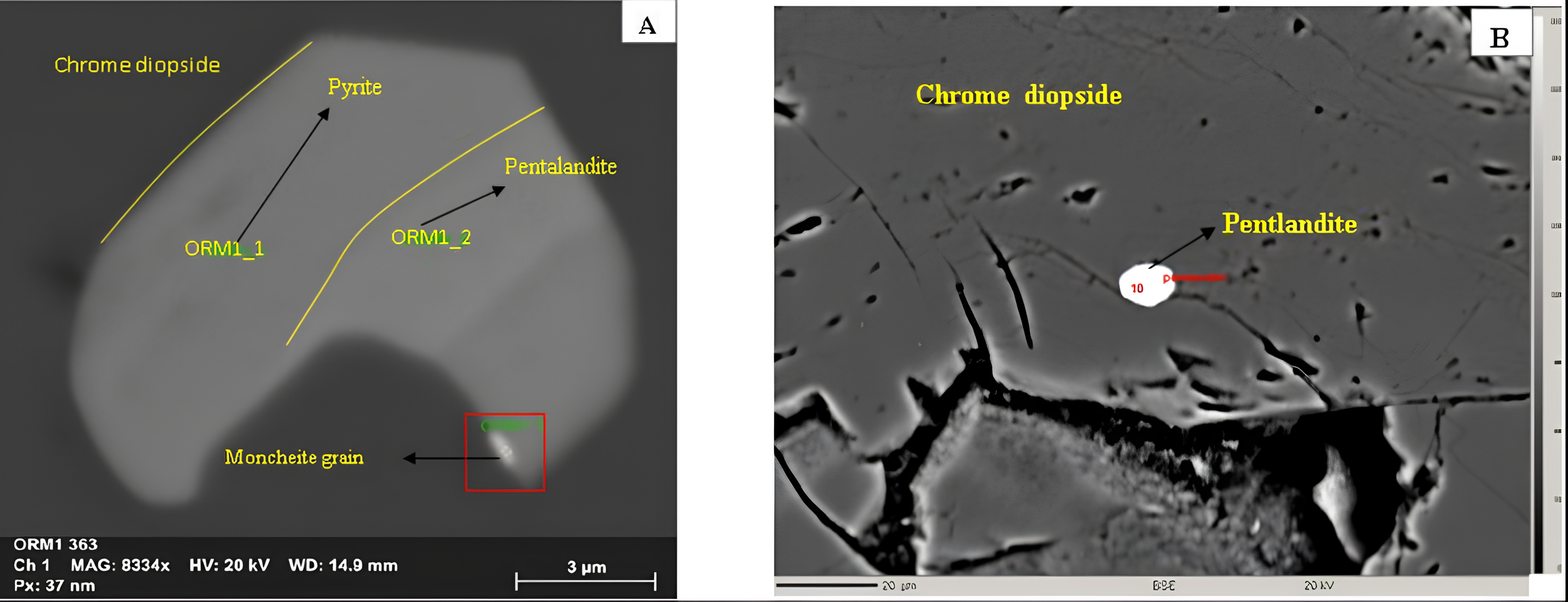
The Torappadi Ultramafic–Mafic Complex (TUC) in the Southern Granulite Terrain (SGT) is mainly composed of pyroxenite (websterite) and gabbro along with their variants—orthopyroxenite, diopsidite, gabbroic anorthosite and anorthositic gabbro was investigated for PGE mineralization. Orthopyroxene (enstatite), clinopyroxene (chrome diopside), plagioclase feldspar (An57–73%) and primary hornblende (magnesio-hornblende) are the major minerals largely present in TUC in the order of decreasing abundance. The MgO values in enstatite rich pyroxenite ranges between 17.15–30.78 wt%, it varies from 25.21 to 32.19 wt% for chrome diopside rich pyroxenite while the MgO wt% in gabbro ranges between 10.5 and 25.5. A total of 145 rock samples from pyroxenite (81), ortho-pyroxenite (13), diopsidite (7) and gabbro (44) were analysed for Platinum Group Elements (PGE). The total PGE (ΣPGE) in the pyroxenite (N = 94) varies from 16.2 to 380.5 ppb, it ranges between 14.1 ppb and 117.4 ppb in gabbro (N = 44) while the diopsidite (N = 7) analyzed from 54.7 to 272.7 ppb. The PGE mineralization in TUC appears to be lithologically controlled. However, the elevated ΣPGE content around fold hinges (F1 and F2) provides evidence limited re-distribution of PGE during deformational event. Wide range of ΣREE (8–1021 ppm), LaN/SmN (0.58–6.10), and GdN/YbN (0.08–6.69) ratios, indicate significant post magmatic deformation assisted fluid–rock interaction. The primitive mantle-normalized Ni–Cu–PGE patterns of the pyroxenites and gabbro of TUC indicate that these rocks were formed from an evolved mafic magma that experienced early silicate fractionation and sulfide saturation. The ratios of Pd vs. Cu/Pd, and Cu vs. Pd, suggest that the TUC sequence might have been evolved through mantle derived, episodic magmatic pulses with early-stage sulphur fractionation.
Graphical Abstract
References
- 1.
Cameron, D.S. Fuel cell energy generators. Platin. Met. Rev. 1978, 22, 38–46.
- 2.
Naldrett, A.J.; Duke, J.M. Platinum metals in magmatic sulfide ores. Science 1980, 208, 1417–1424.
- 3.
Cabri, L.J. The platinum-group minerals. In Platinum-Group Elements: Mineralogy, Geology, Recovery; Cabri, L.J., Ed.; Canadian Institute of Mining and Metallurgy: Montreal, QC, Canada, 1981; Special Volume 23, pp. 83–150.
- 4.
Cabri, L.J. The platinum-group minerals. In The Geology Geochemistry, Mineralogy and Mineral Beneficiation of Platinum-Group Elements; Cabri, L.J., Ed.; Canadian Institute of Mining and Metallurgy: Montreal, QC, Canada, 2003; Special Volume 41, pp. 544–546. https://doi.org/10.2113/gscanmin.41.2.544
- 5.
Buchanan, D.L. Platinum-group Element Exploration, Developments in Economic Geology; Elsevier Science Publishers: New York, NY, USA, 1988; p. 184.
- 6.
Barnes, S.J.; Naldrett, A.J.; Gorton, M.P. The origin of the fractionation of the platinum-group elements in terrestrial magmas. Chem. Geol. 1985, 53, 303–323. https://doi.org/10.1016/0009-2541(85)90076-2
- 7.
Qing, L.; Quanlin, H.; Liewen, X.; et al. Different origins of the fractionation of platinum-group elements in Raobazhai and Bixi Ling mafic rocks from Dabie Orogen, Central China. J. Geol. Res. 2012, 2012, 631426. https://doi.org/10.1155/2012/631426
- 8.
Maier, W.D. Platinum-group element (PGE) deposits and occurrences: Mineralization styles, genetic concepts, and exploration criteria. J. Afr. Earth Sci. 2005, 41, 165–191. https://doi.org/10.1016/j.jafrearsci.2005.03.004
- 9.
Mondal, S.K.; Zhou, M.F. Enrichment of PGE through interaction of evolved boninitic magmas with early formed cumulates in a gabbrobreccia zone of the Mesoarchean Nuasahi massif (Eastern India). Miner. Depos. 2010, 45, 69–91. https://dx.doi.org/10.1007/s00126-009-0264-0
- 10.
Barnes, S.J.; Lightfoot, P.C. Formation of magmatic Ni–Cu–PGE sulphide deposits and processes affecting their Cu and PGE contents. In Economic Geology 100th Anniversary Volume; Economic Geology Publishing Company: Littleton, CO, USA, 2005; pp. 179–213. https://doi.org/10.5382/AV100
- 11.
Hudson, D.R.; Robinson, B.W.; Vigers, R.B.W.; et al. Zoned michenerite testibiopalladite from Kambalda, Western Australia. Can. Mineral. 1978, 16, 121–126.
- 12.
Naldrett, A.J.; Wilson, A.; Kinnaird, J.; et al. PGE tenor and metal ratios within and below the Merensky Reef, Bushveld Complex: Implications for its genesis. J. Petrol. 2009, 50, 625–659.
- 13.
Crocket, J.H.; Paul, D.K. Platinum-group elements in Deccan mafic rocks: A comparison of suites differentiated by Ir content. Chem. Geol. 2004, 208, 273–291.
- 14.
Chen, G.; Xia, B. Platinum-group elemental geochemistry of mafic and ultramafic rocks from the Xigaze ophiolite, Southern Tibet. J. Asian Earth Sci. 2008, 32, 406–422. https://doi.org/10.1016/j.jseaes.2007.11.009
- 15.
Brain, D.G. Igneous Petrology of the Ni–Cu–PGE Mineralised Tamrack Intrusion, Aitkin and Carlton Counties, Minnesota, Master’s Thesis, University of Minnesota, Minnesota, 2011. https://hdl.handle.net/11299/104139
- 16.
Randine, K.; Kumar, J.V.; Korakoppa, M. Platinum-group elements mineralization in the cumulate gabrro of Phenai Mata complex, Deccan Large Igneous Province, India. Curr. Sci. 2015, 108, 1796–1798.
- 17.
Barnes, S.J. The use of metal ratios in prospecting for platinum group elements deposits in mafic and ultramafics intrusions. J. Geochem. Explor. 1990, 37, 91–99. https://doi.org/10.1016/0375-6742(90)90084-N
- 18.
Dare, S.A.A.; Barnes, S.J.; Prichard, H.M. The distribution of platinum group elements (PGE) and chalcophile elements among sulfides from the Creighton Ni–Cu–PGE sulfide deposit, Sudbury, Canada, and the origin of palladium in pentlandite. Miner. Depos. 2010, 45, 765–793. https://doi.org/10.1007/s00126-010-0295-6
- 19.
Maier, W.D.; Barnes, S.J.; Chinyepi, G.; et al. The composition of magmatic Ni-Cu-(PGE) sulfide deposits in the Tati and Selebi-Phikwe belts of eastern Botswana. Miner. Depos. 2008, 43, 37–60. https://doi.org/10.1007/s00126-007-0143-5
- 20.
Maier, W.D.; Barnes, S.J.; Sarkar, A.; et al. The Kabanga Ni Sulfide deposit, Tanzania: 1. Geology, petrography, silicate rock geochemistry, and sulfur and oxygen isotopes. Miner. Depos. 2010, 45, 419–441. https://doi.org/10.1007/s00126-010-0280-0
- 21.
Godel, B.; Barnes, S.J.; Maier, W.D. Platinum-group-elements in sulphide minerals, platinum-group minerals, and whole-rocks of the Merensky Reef (Bushveld Complex, South Africa): Implications for the formation of the reef. J. Petrol. 2007, 48, 1569–1604. https://doi.org/10.1093/petrology/egm030
- 22.
Naldrett, A.J. Magmatic Sulfide Deposits: Geology, Geochemistry and Exploration; Springer-Verlag: Berlin and Heidelberg, Germany, 2004; p. 727. https://doi.org/10.1007/978-3-662-08444-1
- 23.
Pina, R.; Gervilla, F.; Ortega, L.; et al. Mineralogy and geochemistry of platinum-group elements in the Aguablanca Ni–Cu deposit (SW Spain). Miner. Petrol. 2008, 92, 259–282. https://doi.org/10.1007/s00710-007-0195-3
- 24.
Gorbunov, G.I. Geology and Genesis of the Pechenga Ni–Cu Sulfide Deposits; Nedra: Moscow, Russia, 1968; p. 352. (In Russian).
- 25.
Ross, J.R.; Hopkins, G.M.F. Kambalda nickel sulphide deposits. In Economic Geology of Australia and Papua-New Guinea, Metals; Knight, C.L., Ed.; Australasian Institute of Mining and Metallurgy Monograph Series; Australasian Institute of Mining and Metallurgy: Parkville, VIC, Australia, 1975; Volume 5, pp. 100–121.
- 26.
Boudreau, A.E.; Mathez, E.A.; McCallum, I.S. Halogen geochemistry of the Stillwater and Bushveld complexes: Evidence from hydrous silicates and fluid inclusions. J. Petrol. 1986, 27, 967–986.
- 27.
Auge, T.; Cocherie, A.; Genna, A.; et al. Age of Baula PGE mineralization (Orissa, India) and its implications concerning the Singhbhum Archean Nucleus. Precambrian Res. 2003, 121, 85–101. https://doi.org/10.1016/S0301-9268(02)00202-4
- 28.
Mondal, S.K.; Khatun, S.; Prichard, H.M.; et al. Platinum Group Elements geochemistry of boninite derived Mesoarchaean chromitite and ultramafic-mafic cumulate rocks from the Sukinda Massif (Orissa, India). O. Geol. Rev. 2019, 104, 722–744. https://doi.org/10.1016/j.oregeorev.2018.11.027
- 29.
Dora, M.L.; Meshram, T.; Baswani, S.R.; et al. The Paleo-Mesoarchaean Gondpipri mafic-ultramafic intrusions, western Bastar Archaean Craton, Central India: Insights from bulk-rock geochemistry and Sm–Nd and S isotope studies on the formation of Ni–Cu–PGE mineralization. Econ. Geol. 2022, 117, 1845–1866.
- 30.
Farooqui, S.A.; Singh, A.K. Platinum mineralization in Ikauna area, Lalitpur district, Uttar Pradesh. J. Geol. Soc. India 2006, 68, 582–584. https://doi.org/10.17491/jgsi/2006/680403
- 31.
Allapieti, T.T.; Devaraju, T.C.; Kaukonen, R.J. PGE mineralisation in the Late Archean iron rich mafic-ultramafic Hanumalapur complex, Karnataka, India. Miner. Petrol. 2008, 92, 99–128. https://doi.org/10.1007/s00710-007-0211-7
- 32.
Sesha Sai, V.; Nathan, N.P.; Kumar, R.; et al. Occurrence of PGE minerals in Archaean Sittampundi layered anorthosite complex, Tamil Nadu, south India. Indian Miner. 2009, 63, 305–310.
- 33.
Nathan, N.P.; Vijay Kumar, R.; Prabhakar, J.; et al. Exploration for Platinum Group of Elements in India, Special Publication No. 122; Geological Survey of India: Kolkata, India, 2022; p. 170.
- 34.
Indian Bureau of Mines. Indian Minerals Yearbook; Indian Bureau of Mines: Nagpur and Delhi, India, 2007.
- 35.
Dora, M.L.; Singh, H.; Kundu, A.; et al. Tsumoite (BiTe) and associated Ni-PGE mineralization from Gondpipri mafic-ultramafic complex, Bastar craton, Central India: Mineralogy and genetic significance. Central Eur. J. Geosci. 2014, 6, 506–517.
- 36.
Singh, S.; Balaram, V.; Satyanarayanan, M.V.; et al. Platinum group elements in basic and ultrabasic rocks around Madawara, Bundelkhand Massif, Central India. Curr. Sci. 2010, 99, 375–383.
- 37.
Dora, M.L.; Nair, K.K.K.; Shasidharan, K. Occurrence of platinum group minerals in the Western Bastar Craton, Chandrapur District, Maharashtra. Curr. Sci. 2011, 100, 399–404.
- 38.
Mondal, R.; Baidya, T. Titaniferous magnetite deposits associated with Archean Greenstone belt in the East Indian shield. Earth Sci. 2015, 4, 15–30. https://doi.org/10.11648/j.earth.s.2015040401.12
- 39.
Majumdar, D.; Gogoi, A. First report on platinum occurrence in ultramafic-mafic complex, East-Central Karbi Hills of Assam, North East India. J. Geol. Soc. India 2019, 94, 245–248. https://doi.org/10.1007/s12594-019-1303-9
- 40.
Subramaniam, A.P. Mineralogy and petrology of the Sittampundi Complex, Salem district, Madras State, India. Bull. Geol. Soc. Am. 1956, 67, 317–390. http://dx.doi.org/10.1130/0016-7606(1956)67[317:MAPOTS]2.0.CO;2
- 41.
Gopalakrishnan, R. Reconnaissance Survey for Platinum Group of Elements in Torappadi-Ponakkadu area, Tiruvannamalai–Sambuvarayar District, Tamil Nadu; Geological Survey of India: Tamil Nadu, India, 1999. (Unpublished Report)
- 42.
Ray, J. Mineral Chemistry of mafic chain silicate minerals in the Torappadi layered complex of the Southern Granulite Terrain. J. Geol. Soc. India 1995, 45, 531–537.
- 43.
Ray, J.S.; Bose, M.K. Occurrence of ultramafic rocks in Torappadi layered complex, North Arcot district, Tamil Nadu. Indian Miner. 1993, 47, 195–206.
- 44.
Ray, J. Structure and Petrology of Torappadi Igneous Complex and Surrounding Area, Arcot District, Tamil Nadu. Ph.D. Thesis, University of Calcutta, Calcutta, India, 1988.
- 45.
Sugavanam, E.B. Geology of Parts of Chengam and Thiruvannamalai Taluks, North Arcot District, Tamil Nadu; Geological Survey of India: Tamil Nadu, India, 1973. (Unpublished Report)
- 46.
Venkata Rao, V. Report on the Geological and Structural and Petrological Studies of Parts of Ultramafic Complex Near Torappadi, North Arcot District, Tamil Nadu; Geological Survey of India: Tamil Nadu, India, 1975. (Unpublished Report)
- 47.
Velladurai, S.; Bhogta, Y. Reconnaissance Survey for Platinum Group of Elements (PGE) in Torappadi Ultramafic Complex, Tiruvanamalai District, Tamil Nadu; Geological Survey of India: Tamil Nadu, India, 2017. (Unpublished Report)
- 48.
Sowminarayanan, V.R.; Srinivasan, B.V.; Maharaja Singh, H.J. Geochemical and Second Generation Geological Mapping of the Alkaline – Carbonatite Complex Around Bommikuppam – Kambugudi–Kavalur – Kallatur Areas, Tiruppattur and Chengam Taluks, North Arcot District, Tamil Nadu; Geological Survey of India: Tamil Nadu, India, 1994. (Unpublished Report)
- 49.
Jensen, L.S. A New Cation Plot for Classifying Subalkalic Volcanic Rocks; Ontario Division Mines, Miscellaneous Paper 66; Ontario Department of Mines: Toronto, ON, Canada, 1976; p. 22.
- 50.
Maier, W.D.; Barnes, S.J.; Sarkar, A.; et al. The kabanga Ni sulfide deposit, Tanzania: I. Geology, petrography, silicate rock geochemistry, and sulfur and oxygen isotopes. Miner. Depos. 2010, 45, 419–441.
- 51.
Oskarsson, N.; Sigvaldson G.E.; Steinthorsson S. A dynamic model of rift zone petrogenesis and the regional petrology of Iceland. J. Petrol. 1982, 23, 28–74.
- 52.
Wilkinson, J.F.G. The genesis of mid-ocean ridge basalt. Earth Sci. Rev. 1982, 18, 1–57. https://doi.org/10.1016/0012-8252(82)90002-2
- 53.
Morimoto, N. Nomenclatures of pyroxenes. Can. Mineral. 1989, 27, 143–156.
- 54.
Poldervaart, A.; Hess, H.H. Pyroxenes in the crystallization of basaltic magmas. J. Geol. 1951, 59, 472–489. https://doi.org/10.1086/625891
- 55.
Deer, W.A.; Howie, R.A.; Zussman, J. Rock Forming Minerals; Geological Society of London: London, UK, 1978; p. 668.
- 56.
Leake, B.E. Nomenclature of amphiboles. Min. Mag. 1978, 42, 533–556.
- 57.
Kamineni D.C. Distribution of uranium, thorium, and rare earth elements in the Eye Dashwa Lakes pluton. A study of some analogue elements. Chem. Geol. 1986, 55, 361–373. https://doi.org/10.1016/0009-2541(86)90036-7
- 58.
Leake, B.E. The relationship between composition of calciferous amphibole and grade of metamorphism. In Controls of Metamorphism; Pitcher, W.S., Flynn, G.W., Eds.; Oliver and Boyd: Edinburgh, London, UK, 1965; pp. 299–318.
- 59.
Stevens, R.E. Composition of some chromites of the western Hemisphere. Am. Mineral. 1944, 29, 1–34.
- 60.
Rollinson, H.R. Using Geochemical Data: Evaluation, Presentation, Interpretation; Longman Scientific & Technical: Harlow, Essex, UK, 1993; p. 352.
- 61.
Bau, M. Controls on the fractionation of isovalent trace elements in magmatic and aqueous systems: Evidence from Y/Ho, Zr/Hf, and lanthanide tetrad effect. Contrib. Mineral. Petrol. 1996, 123, 323–333. https://doi.org/10.1007/s004100050159
- 62.
McDonough, W.F.; Sun, S. The composition of the Earth. Chem. Geol. 1995, 120, 223–253. https://doi.org/10.1016/0009-2541(94)00140-4
- 63.
Ionov, D.; Savoyant, L.; Dupuy, C. Application of the ICP-MS Technique to trace element analysis of peridotites and their minerals. Geostand. Newsl. 1992, 16, 311–315. https://doi.org/10.1111/j.1751-908x.1992.tb00494.x
- 64.
Bodinier, J.L.; Godard, M. Orogenic, ophiolitic, and abyssal peridotites. In Treatise on Geochemistry; Holland, H.D., Turekian, K. K., Ed.; Elsevier: Oxford, UK, 2003; Volume 2, pp. 103–170. https://doi.org/10.1016/B0-08-043751-6/02004-1
- 65.
Barnes, S.; Lightfoot P. Formation of magmatic nickel sulfide deposits and processes affecting their copper and Platinum Group Element. In Economic Geology 100th Anniversary Volume; Economic Geology Publishing Company: Littleton, CO, USA, 2005; pp. 179–213. https://doi.org/10.5382/AV100.08
- 66.
Winter, J.D. Principles of Igneous and Metamorphic Petrology, 2nd ed.; Prentice Hall: Upper Saddle River, NJ, USA, 2010.
- 67.
Barnes, S.J.; Cox, R.A.; Zientek, M.L. Platinum-group element, Gold, Silver and Base Metal distribution in compositionally zoned sulfide droplets from the Medvezky Creek Mine, Noril’sk, Russia. Contrib. Mineral. Petrol. 2006, 152, 187–200. https://doi.org/10.1007/S00410-006-0100-9
- 68.
Barnes, S.J; Maier, W.D. The fractionation of Ni, Cu and the noble metals in silicate and sulfide liquids. In Dynamic Processes in Magmatic Ore Deposits and their Application in Mineral Exploration; Geological Association of Canada: St. John’s, Newfoundland and Labrador, Canada, 1999, Short Course Volume 13, pp. 69–106.
- 69.
Lorand J.P.; Alard, O. Determination of selenium and tellurium concentrations in Pyrenean peridotites (Ariege, France), new insight into S/Se/Te systematics of the upper mantle. Chem. Geol. 2010, 278, 120–130. https://doi.org/10.1016/j.chemgeo.2010.09.007.
- 70.
Mungall. J.E.; Hanley J.J.; Arndt N.T.; et al. Evidence from meimechites and other low-degree mantle melts for redox controls on mantle-crust fractionation of platinum-group elements. Proc. Natl. Acad. Sci. USA 2006, 103, 12695–12700. https://doi.org/10.1073/pnas.0600878103
- 71.
Park, JW.; Campbell, I.H.; Malaviarachchi, S.P.K.; et al. Chalcophile element fertility and the formation of porphyry Cu ± Au deposits. Miner. Depos. 2019, 54, 657–670. https://doi.org/10.1007/s00126-018-0834-0
- 72.
Smythe Duane, J.; Wood Bernard, J.; Kiseeva Ekaterina, S. The S content of silicate melts at sulfide saturation: New experiments and a model incorporating the effects of sulfide composition. Am. Mineral. 2017, 102, 795–803. https://doi.org/10.2138/am-2017-5800CCBY
- 73.
Cooke, D.R.; Hollings. P.; Wilkinson, J.J.; et al. Geochemistry of Porphyry Deposits. Treatise on Geochemistry, 2nd ed.; Elsevier: Oxford, UK, 2014. https://doi.org/10.1016/B978-0-08-095975-7.01116-5
- 74.
Maier, W.D.; Barnes, S.J.; de Waal, A. Exploration for magmatic Ni-Cu-PGE sulphide deposits; a review of recent advances in the use of geochemical tools, and their application to some South African ores. S. Afr. J. Geol. 1998, 101, 237–253.
- 75.
Li, C.; Ripley, E.M. Empirical equations to predict the sulfur content of mafic magmas at sulfide saturation and applications to magmatic sulfide deposit. Miner. Depos. 2005, 40, 218–230. https://doi.org/10.1007/s00126-005-0478-8
- 76.
Hoatson Dean, M.; Keays Reid, R. Formation of platiniferous sulfide horizons by crystal fractionation and magma mixing in the Munni Munni layered intrusion, West Pilbara Block, Western Australia. Econ. Geol. 1989, 84, 1775–1804. https://doi.org/10.2113/gsecongeo.84.7.1775
- 77.
Keays.; Reid R. The role of komatiitic and picritic magmatism and S-saturation in the formation of ore deposits. Lithos 1995, 34, 1–18. https://doi.org/10.1016/0024-4937(95)90003-9
- 78.
Barnes, S.J.; Maier,W.D. Platinum-group element distributions in the Rustenberg Layered Suite of the Bushveld Complex, South Africa. In The Geology, Geochemistry, Mineralogy and Mineral Beneficiation of Platinum-Group Elements; Cabri, L.J., Ed.; Canadian Institute of Mining, Metallurgy and Petroleum: Montreal, QC, Canada, 2002; Special Volume 54.
How to Cite
Velladurai, S.; Kumaravel, V.; Prabhakar, J.; Chinnasamy, S. S.; Devarajan, P.; Bhogta, Y. Geochemical Signature of PGE Mineralization in the Torappadi Ultramafic–Mafic Complex, Southern India. Earth Systems, Resources, and Sustainability 2026, 1 (3), 249–264. https://doi.org/10.53941/esrs.2026.100015.
RIS
BibTex
Copyright & License

Copyright (c) 2026 by the authors.
This work is licensed under a Creative Commons Attribution 4.0 International License.
Contents
References
