
- Integrated Multiproxy approach to improve interpretations for high-resolution sequence stratigraphy.
- Clay mineral ratios as a proxy to delineate continental systems tracts.
- TSF trends distinguish HAST and LAST.
- Elemental ratios track continental versus marine processes.
- Redox proxies utilized for identification of spatial and temporal depositional shifts.
- Open Access
- Article
Multiproxy Approach for Identification of Sequence Stratigraphic Elements: Implications on Continental Sequence Stratigraphy
Author Information
Received: 04 December 2025 | Revised: 29 April 2026 | Accepted: 06 May 2026 | Published: 12 May 2026
Highlights
Abstract
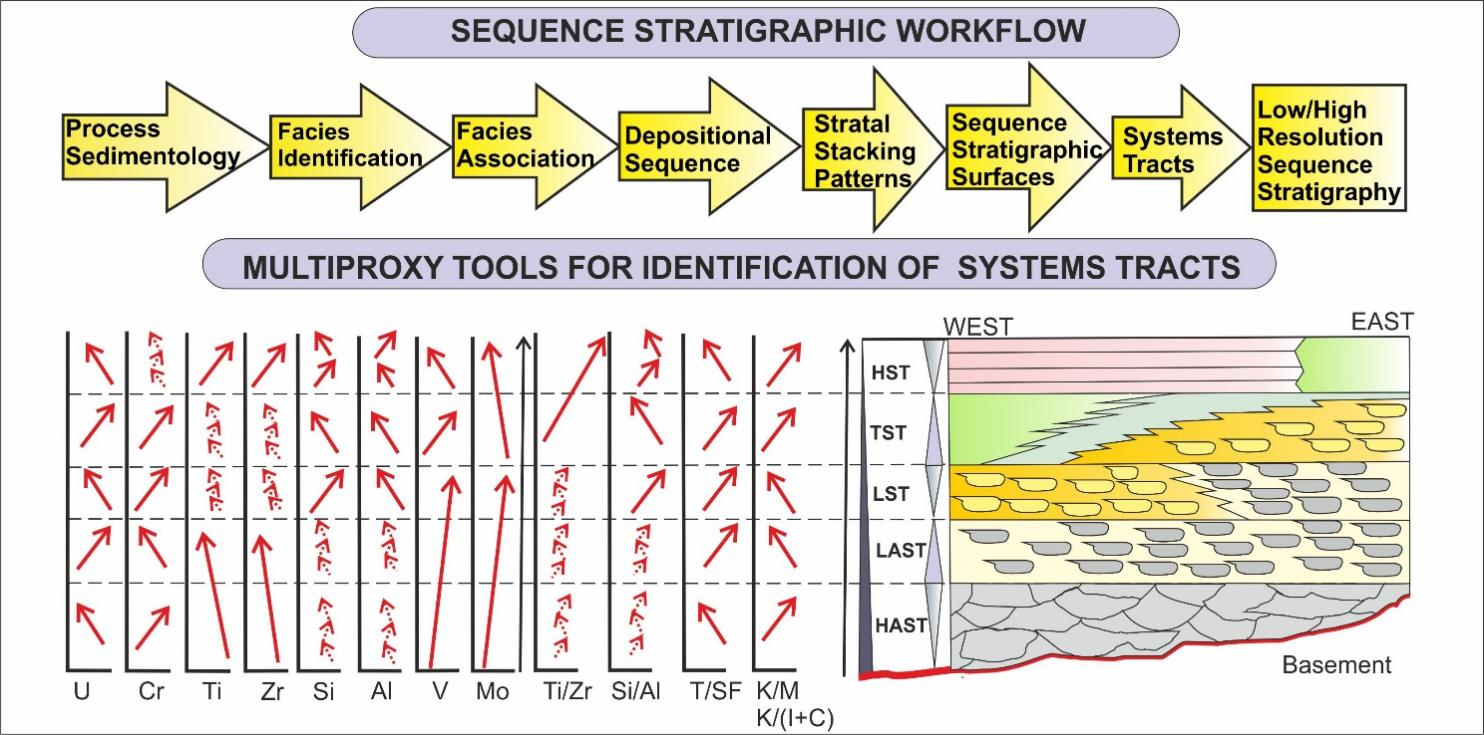
The applications of sequence stratigraphy are mostly limited to areas in the vicinity of the shoreline. However, due to lack of distinct geological markers, its application to fine-grained continental and deep-marine sediments remains restricted. Hence a multi-proxy approach that integrates sedimentological, mineralogical, and chemostratigraphic proxies from both marine and continental successions is used with a focus on continental domains. The shifting trends of accommodation to sediment supply are comparable to the shifting trends of several proxies, which indicates the utility of such proxies in constraining the sequence stratigraphic architecture. Clay mineral assemblages indicate weathering and paleoclimatic conditions, while paleosols reflect subaerial exposure and landscape stability. Decreasing Ti/Al, Zr/Al and Si/Al ratios marks shift from continental to marine influence. In case of the lacustrine settings or glacial lakes, periodic paleoredox fluctuations and glacial-cycles can be constrained using Ti/Zr ratios. Upstream, high sediment supply leads to depleted Mo and V, while downstream, anoxic conditions promote organic matter preservation. T/SF trends distinguish upstream from downstream river segments. Similarly varying trends of the T/SF are utilized to interpret the upstream and downstream portions of a river system. However, several limitations are often associated with using these proxies, which have to be accounted for. The present review work documents the utility, applicability and limitations of such proxies using several case studies from marine and transitional settings and proposes their applicability in continental domain. By documenting changes in sediment supply, accommodation space, and water chemistry, this multi-proxy technique enables the reconstruction of transgressive–regressive cycles and systems tracts in fine-grained deposits, as observed in several case studies. The work demonstrates that the combination of all these proxies significantly enhances the reliability of sequence stratigraphic interpretations, despite intrinsic limitations.
Graphical Abstract
Keywords
sequence stratigraphy | chemostratigraphy | sediment supply dynamics | accommodation space | basin evolution
References
- 1.
Berger, H.; Vincent, E. Chemostratigraphy and biostratigraphic correlation: Exercises in systematic stratigraphy. Oceanol. Acta 1981, 4, 115–127. https://archimer.ifremer.fr/doc/ 00246/35689/
- 2.
Mitchell, S.F.; Paul, C.R.C.; Gale, A.S. Carbon isotopes and sequence stratigraphy. Geol. Soc. Lond. Spec. Publ. 1996, 104, 11–24. https://doi.org/10.1144/GSL.SP.1996.104.01.02
- 3.
Pelechaty, S.M.; Grotzinger, J.P.; Kashirtsev, V.A.; et al. Chemostratigraphic and sequence stratigraphic constraints on Vendian–Cambrian basin dynamics, northeast Siberian craton. J. Geol. 1996, 104, 543–563.
- 4.
Rodrigues, R. Chemostratigraphy. In Applied Stratigraphy; Springer: Dordrecht, The Netherlands, 2005; pp. 165–178. https://doi.org/10.1007/1-4020-2763-X 8
- 5.
Bergstrom, S.M.; Young, S.; Schmitz, B. Katian (Upper Ordovician) δ13C chemostratigraphy and sequence stratigraphy in the United States and Baltoscandia: A regional comparison. Palaeogeogr. Palaeoclimatol. Palaeoecol. 2010, 296, 217–234. https://doi.org/10.1016/j.palaeo.2010.02.035
- 6.
Ramkumar, M. Toward standardization of terminologies and recognition of chemostratigraphy as a formal stratigraphic method. In Chemostratigraphy; Elsevier: Amsterdam, The Netherlands, 2015; pp. 1–21. https://doi.org/10.1016/B978-0-12-419968-2.00001-7
- 7.
Mehrabi, H.; Navidtalab, A.; Enayati, A.; et al. Age, duration, and geochemical signatures of paleo-exposure events in Cenomanian–Santonian sequences (Sarvak and Ilam formations) in SW Iran: Insights from carbon and strontium isotope chemostratigraphy. Sediment. Geol. 2022, 434, 106136. https://doi.org/10.1016/j.sedgeo.2022.106136
- 8.
Reboulet, S.; Jaillard, E.; Shmeit, M.; et al. Biostratigraphy, carbon isotope and sequence stratigraphy of South Tethyan Valanginian successions in the Essaouira–Agadir Basin (Morocco). Cretac. Res. 2022, 140, 105341. https://doi.org/10.1016/j.cretres.2022.105341
- 9.
Kang, J.; Tang, Q.; Gill, B.C.; et al. Carbonate δ13C chemostratigraphy of the Hunjiang Group in North China and a tentative stratigraphic framework for the Meso–Neoproterozoic transition. Palaeogeogr. Palaeoclimatol. Palaeoecol. 2024, 655, 112505. https://doi.org/10.1016/j.palaeo.2024.112505
- 10.
Chirakal, T.; Messaoud, J.H.; Alibrahim, A.; et al. Integrated carbon isotope stratigraphy and biostratigraphy of Cenomanian to Turonian carbonates from Jordan: An updated age model and sequence stratigraphic correlations with Oman. Cretac. Res. 2025, 106207. https://doi.org/10.1016/j.cretres.2025.106207
- 11.
Turner, B.W.; Molinares-Blanco, C.E.; Slatt, R.M. Chemostratigraphic, palynostratigraphic, and sequence stratigraphic analysis of the Woodford Shale, Wyche Farm Quarry, Pontotoc County, Oklahoma. Interpretation 2015, 3, SH1–SH9. https://doi.org/10.1190/INT-2014-0089.1
- 12.
Turner, B.W.; Tr ´eanton, J.A.; Slatt, R.M. The use of chemostratigraphy to refine ambiguous sequence stratigraphic correlations in marine mudrocks: An example from the Woodford Shale, Oklahoma, USA. J. Geol. Soc. 2016, 173, 854–868. https://doi.org/10.1144/jgs2015-125
- 13.
LaGrange, M.T.; Konhauser, K.O.; Catuneanu, O.; et al. Sequence stratigraphy in organic-rich marine mudstone successions using chemostratigraphic datasets. Earth-Sci. Rev. 2020, 203, 103137. https://doi.org/10.1016/j.earscirev.2020.103137
- 14.
Morante, R.; Veevers, J.J.; Andrew, A.S.; et al. Determination of the Permian–Triassic boundary in Australia from carbon isotope stratigraphy. APPEA J. 1994, 34, 330–336.
- 15.
Van Wagoner, J.C.; Posamentier, H.W.; Mitchum, R.M.; et al. An overview of the fundamentals of sequence stratigraphy and key definitions. In Sea-Level Changes: An Integrated Approach; Wilgus, C.K., Hastings, B.S., Posamentier, H., et al., Eds.; SEPM Special Publication 42; SEPM: Tulsa, OK, USA, 1988; pp. 39–45. https://doi.org/10.2110/pec.88.01.0039
- 16.
Catuneanu, O.; Abreu, V.; Bhattacharya, J.P.; et al. Towards the standardization of sequence stratigraphy. Earth-Sci. Rev. 2009, 92, 1–33. https://doi.org/10.1016/j.earscirev.2008.10.003
- 17.
Catuneanu, O.; Galloway, W.E.; Kendall, C.G.S.C.; et al. Sequence stratigraphy: Methodology and nomenclature. Newsl. Stratigr. 2011, 44, 173–245.
- 18.
Catuneanu, O. Sequence stratigraphy: Guidelines for a standard methodology. In Stratigraphy & Timescales; Academic Press: Cambridge, MA, USA, 2017; Volume 2, pp. 1–57. https://doi.org/10.1016/bs.sats.2017.07.003
- 19.
Catuneanu, O. Sequence stratigraphy of deepwater systems. In Deepwater Sedimentary Systems; Elsevier: Amsterdam, The Netherlands, 2022; pp. 443–470. https://doi.org/10.1016/B978-0-323-91918-0.00010-4
- 20.
Zhao, L.; Ji, J.; Chen, J.; et al. Variations of illite/chlorite ratio in Chinese loess sections during the last glacial and interglacial cycle: Implications for monsoon reconstruction. Geophys. Res. Lett. 2005, 32, L20718. https://doi.org/10.1029/2005GL024145
- 21.
Yilmaz, K.; Celik, I.; Kapur, S.; et al. Clay minerals, Ca/Mg ratio and Fe–Al oxides in relation to structural stability, hydraulic conductivity and soil erosion in southeastern Turkey. Turk. J. Agric. For. 2005, 29, 29–37.
- 22.
Changdok, W.; Hong, H.; Cheng, F.; et al. Clay mineralogy and its palaeoclimatic significance in the Luochuan loess–palaeosols over ∼1.3 Ma, Shaanxi, northwestern China. Front. Earth Sci. 2017, 12, 134–147.
- 23.
Ainsworth, R.B.; McArthur, J.B.; Lang, S.C.; et al. Quantitative sequence stratigraphy. AAPG Bull. 2018, 102, 1913–1939. https://doi.org/10.1306/02201817271
- 24.
Song, Y.; Wang, Q.; An, Z.; et al. Mid-Miocene climatic optimum: Clay mineral evidence from the red clay succession, Longzhong Basin, Northern China. Palaeogeogr. Palaeoclimatol. Palaeoecol. 2018, 512, 46–55. https://doi.org/10.1016/j.palaeo.2017.10.001
- 25.
DeReuil, A.A.; Birgenheier, L.P. Sediment dispersal and organic carbon preservation in a dynamic mudstone-dominated system, Juana Lopez Member, Mancos Shale. Sedimentology 2019, 66, 1002–1041. https://doi.org/10.1111/sed.12532
- 26.
Van Wagoner, J.C. Siliciclastic sequence stratigraphy in well logs, cores, and outcrops. Am. Assoc. Petrol. Geol. Methods Explor. Ser. 1990, 7, 1–55.
- 27.
Eriksson, K.A.; Simpson, E.L. Siliciclastic braided-alluvial sediments intercalated within continental flood basalts in the early to middle Proterozoic Mount Isa Inlier, Australia. Allu. Sedimentation 1993, 30, 473–488. https://doi.org/10.1002/9781444303995.ch30
- 28.
Quinton P.; Rygel M. “Sequence Stratigraphic Nomenclature,” digital image, Wikimedia Commons. 2023. Available online: https://commons.wikimedia.org/wiki/User:Page Quinton#/media/File:Sequence Stratigraphic Nomenclature.jpg (accessed on 9 May 2026)
- 29.
Ramkumar, M. Role of chemostratigraphic technique in reservoir characterisation and global stratigraphic correlation. Indian J. Geochem. 1999, 14, 33–45.
- 30.
Them, T.R.; Gill, B.C.; Caruthers, A.H.; et al. Thallium isotopes reveal protracted anoxia during the Toarcian (Early Jurassic) associated with volcanism, carbon burial and mass extinction. Proc. Natl. Acad. Sci. USA 2018, 115, 6596–6601. https://doi.org/10.1073/pnas.1803478115
- 31.
Ramkumar, M.; Sial, A.N.; Gaucher, C.; et al. Glossary of chemostratigraphy. In Chemostratigraphy of Major Chronological Boundaries; AGU Geophysical Monograph Series; Wiley: Hoboken, NJ, USA, 2019; pp. 27–34.
- 32.
Sial, A.N.; Gaucher, C.; Ramkumar, M.; et al. Chemostratigraphy as a formal stratigraphic method. In Chemostratigraphy Across Major Chronological Boundaries; Wiley: Hoboken, NJ, USA, 2018; pp. 1–25. https://doi.org/10.1002/9781119382508.ch1
- 33.
Scott, R.W.; Brett, C.E.; Fluegeman, R.H.; et al. North American Commission on Stratigraphic Nomenclature. Note 71—Application for addition of chemostratigraphic units to the North American Stratigraphic Code: A case for formalizing chemostratigraphic units. Stratigraphy 2020, 17, 135–139.
- 34.
Ratcliffe, K.; Wright, M.; Spain, D. Unconventional methods for unconventional plays: Using elemental data to understand shale resource plays. In Pesa New Resources, AAPG Database Archives; AAPG: Tulsa, OK, USA, 2012; pp. 89–93.
- 35.
Borcovsky, D.; Egenhoff, S.; Fishman, N.; et al. Sedimentology, facies architecture, and sequence stratigraphy of a Mississippian black mudstone succession—The upper member of the Bakken Formation, North Dakota, United States. AAPG Bull. 2017, 101, 1625–1673. https://doi.org/10.1306/01111715183
- 36.
LaGrange, M.T.; Harris, B.S.; Biddle, S.K.; et al. Integrating chemostratigraphy and sedimentology for sequence stratigraphy in an enigmatic Middle to Late Devonian mudstone. Sedimentologika 2025, 3, e31. https://doi.org/10.57035/journals/sdk.2025.e31.1695
- 37.
Sano, J.L.; Ratcliffe, K.T.; Spain, D.R. Chemostratigraphy of the Haynesville shale. In Petroleum Systems of the Haynesville-Bossier Shale Gas Play of the Ark-La-Tex Area; Hammes, U., Gale, J.F.W., Eds.; American Association of Petroleum Geologists Memoir No. 105; AAPG: Tulsa, OK, USA, 2014; pp. 73–96. https://doi.org/10.1306/13441847M1053602
- 38.
Hammes, U.; Fr ´ebourg, G. Haynesville and Bossier mudrocks: A facies and sequence stratigraphic investigation, East Texas and Louisiana, USA. Mar. Pet. Geol. 2012, 31, 8–26. https://doi.org/10.1016/j.marpetgeo.2011.10.001
- 39.
Pearce, T.J.; Martin, J.H.; Cooper, D.; et al. Chemostratigraphy of upper Carboniferous (Pennsylvanian) sequences from the Southern North Sea (United Kingdom). SEPM Spec. Pub. 2010, 94, 109–127. https://doi.org/10.2110/sepmsp.094.109
- 40.
Klappa, C.F. Rhizoliths in terrestrial carbonates: Classification, recognition, genesis and significance. Sedimentology 1980, 27, 613–629. https://doi.org/10.1111/j.1365-3091.1980.tb01651.x
- 41.
Abdel-Fattah, Z.A. Fluvial architecture of the Upper Cretaceous Nubia Sandstones: An ancient example of sandy braided rivers in central Eastern Desert, Egypt. Sediment. Geol. 2021, 420, 105923. https://doi.org/10.1016/j.sedgeo.2021.105923
- 42.
Saha, A.; Chakrabarty, S.; Bhattacharya, B. Evidence of the Permian marginal marine sedimentation recorded in sub-surface drill cores, Lower Gondwana successions, southern India. J. Earth Syst. Sci. 2022, 131, 134.
- 43.
Mack, G.H.; James, W.C.; Monger, H.C. Classification of paleosols. Geol. Soc. Am. Bull. 1993, 105, 129–136.
- 44.
Nettleton, W.D.; Olson, C.G.; Wysocki, D.A. Paleosol classification: Problems and solutions. Catena 2000, 41, 61–92. https://doi.org/10.1016/S0341-8162(00)00109-0
- 45.
Krasilnikov, P.; Calder´on, N.E.G. A WRB-based buried paleosol classification. Quat. Int. 2006, 156, 176–188. https://doi.org/10.1016/j.quaint.2006.05.009
- 46.
Nordt, L.; Stinchcomb, G.; McCarthy, P.; et al. Soil taxonomy adapted to buried paleosols: First approximation. Earth-Sci. Rev. 2025, 105, 105141. https://doi.org/10.1016/j.earscirev.2025.105141
- 47.
Kraus, M.J. Mesozoic and Tertiary paleosols. In Developments in Earth Surface Processes; Elsevier: Amsterdam, The Netherlands, 1992; pp. 525–542. https://doi.org/10.1016/B978-0-444-89198-3.50025-8
- 48.
Kraus, M.J. Lower Eocene alluvial paleosols: Pedogenic development, stratigraphic relationships, and paleosol/landscape associations. Palaeogeogr. Palaeoclimatol. Palaeoecol. 1997, 129, 387–406. https://doi.org/10.1016/S0031-0182(96)00056-9
- 49.
Khalaf, E.I.; El-Sayed, M.I. Fossil cyclic calcrete in the Kuwait group clastic deposits (Mio-Pleistocene) of Kuwait, Arabian Gulf. Geol. Rundsch. 1989, 78, 525–536.
- 50.
Tandon, S.K.; Friend, P.F. Near-surface shrinkage and carbonate replacement processes, Arran Cornstone Formation, Scotland. Sedimentology 1989, 36, 1113–1126.
- 51.
Klappa, C.F. Lichen stromatolites; criterion for subaerial exposure and a mechanism for the formation of laminar calcretes (caliche). J. Sediment. Res. 1979, 49, 387–400. https://doi.org/10.1306/212F7752-2B24-11D7-8648000102C1865D
- 52.
Srivastava, P.; Parkash, B.; Pal, D.K. Clay minerals in soils as evidence of Holocene climatic change, central Indo-Gangetic Plains, north-central India. Quat. Res. 1998, 50, 230–239. https://doi.org/10.1006/qres.1998.1994
- 53.
Wang, W.M.; Yeh, H.W.; Chen, P.Y.; et al. Kaolin mineralogy of clays in paleosol profiles on the late-Miocene sediments in Penghu Islands (Pescadores), Taiwan. Clays Clay Miner. 1998, 46, 1–9.
- 54.
Sedov, S.; Solleiro-Rebolledo, E.; Morales-Puente, P.; et al. Mineral and organic components of the buried paleosols of the Nevado de Toluca, Central Mexico, as indicators of paleoenvironments and soil evolution. Quat. Int. 2003, 106, 169–184. https://doi.org/10.1016/S1040-6182(02)00171-4
- 55.
Do Campo, M.; Bauluz, B.; Del Papa, C.; et al. Evidence of cyclic climatic changes recorded in clay mineral assemblages from continental Paleocene–Eocene sequence, northwestern Argentina. Sediment. Geol. 2018, 368, 44–57. https://doi.org/10.1016/j.sedgeo.2018.03.007
- 56.
Schmitz, B.; Pujalte, V. Abrupt increase in seasonal extreme precipitation at the Paleocene–Eocene boundary. Geology 2007, 35, 215–218. https://doi.org/10.1130/G23261A.1
- 57.
Domingo, L.; L´opez-Mart´ınez, N.; Leng, M.J.; et al. The Paleocene–Eocene Thermal Maximum record in the organic matter of the Claret and Tendruy continental sections (South-central Pyrenees, Lleida, Spain). Earth Planet. Sci. Lett. 2009, 281, 226–237. https://doi.org/10.1016/j.epsl.2009.02.025
- 58.
Baczynski, A.A.; McInerney, F.A.; Wing, S.L.; et al. Constraining paleohydrologic change during the Paleocene–Eocene Thermal Maximum in the continental interior of North America. Palaeogeogr. Palaeoclimatol. Palaeoecol. 2017, 465, 237–246. https://doi.org/10.1016/j.palaeo.2016.10.030
- 59.
Kraus, M.J.; Riggins, S. Transient drying during the Paleocene–Eocene Thermal Maximum (PETM): Analysis of paleosols in the Bighorn Basin, Wyoming. Palaeogeogr. Palaeoclimatol. Palaeoecol. 2007, 245, 444–461. https://doi.org/10.1016/j.palaeo.2006.09.011
- 60.
Chamley, H. Clay minerals. In Clay Sedimentology; Springer: Berlin, Heidelberg, Germany, 1989; pp. 3–20.
- 61.
Biscaye, P.E. Mineralogy and sedimentation of recent deep-sea clay in the Atlantic Ocean and adjacent seas and oceans. Geol. Soc. Am. Bull. 1965, 76, 803–832. https://doi.org/10.1130/0016-7606(1965)76[803:MASORD]2.0.CO;2
- 62.
Liu, Z.; Colin, C.; Huang, W.; et al. Climatic and tectonic controls on weathering in South China and Indochina Peninsula: Clay mineralogical and geochemical investigations from the Pearl, Red, and Mekong drainage basins. Geochem. Geophys. Geosyst. 2007, 8, Q05005. https://doi.org/10.1029/2006GC001490
- 63.
Mei, H.; Jian, X.; Zhang, W.; et al. Behavioral differences between weathering and pedogenesis in a subtropical humid granitic terrain: Implications for chemical weathering intensity evaluation. Catena 2021, 203, 105368. https://doi.org/10.1016/j.catena.2021.105368
- 64.
Fu, H.; Jian, X.; Pan, H. Bias in sediment chemical weathering intensity evaluation: A numerical simulation study. Earth-Sci. Rev. 2023, 246, 104574. https://doi.org/10.1016/j.earscirev.2023.104574
- 65.
Ehrmann, W.; Schmiedl, G.; Hamann, Y.; et al. Clay minerals in late glacial and Holocene sediments of the northern and southern Aegean Sea. Palaeogeogr. Palaeoclimatol. Palaeoecol. 2007, 249, 36–57. https://doi.org/10.1016/j.palaeo.2007.01.004
- 66.
Fagel, N.; Mackay, A.W. Weathering in the Lake Baikal watershed during the Kazantsevo (Eemian) interglacial: Evidence from the lacustrine clay record. Palaeogeogr. Palaeoclimatol. Palaeoecol. 2008, 259, 244–257. https://doi.org/10.1016/j.palaeo.2007.10.011
- 67.
Xu, F.; Hu, B.; Zhao, J.; et al. Topographic and climatic control on chemical weathering of mountainous riverine sediments of Hainan Island, South China Sea. Front. Earth Sci. 2022, 9, 770236.
- 68.
Oni, S.; Olatunji, A. Depositional environments signatures, maturity and source weathering of Niger Delta sediments from an oil well in southeastern Delta State, Nigeria. Eur. J. Soil Sci. 2017, 6, 259–274. https://doi.org/10.18393/ejss.297245
- 69.
Yu, X.; Wang, G.; Zhang, T.; et al. Chemical weathering intensity as a reliable indicator for southwest summer monsoon reconstruction: Evidence from clay minerals of Qionghai Lake sediments since the Last Glacial Maximum. Geochem. Geophys. Geosyst. 2023, 24, e2023GC010900. https://doi.org/10.1029/2023GC010900
- 70.
Sionneau, T.; Bout-Roumazeilles, V.; Biscaye, P.E.; et al. Clay mineral distributions in and around the Mississippi River watershed and northern Gulf of Mexico: Sources and transport patterns. Quat. Sci. Rev. 2008, 27, 1740–1751. https://doi.org/10.1016/j.quascirev.2008.07.001
- 71.
Bhattacharya, B.; Jha, S.; Mondal, P. Palaeogeographic reconstruction of a fluvio-marine transitional system in Narmada rift basin, India—Implications on Late Cretaceous global sea-level rise. J. Palaeogr. 2020, 9, 30. https://doi.org/10.1186/s42501-020-00078-6
- 72.
Warr, L.N.; Grathoff, G.H.; Haberzettl, T. The Clay Mineral Alteration Index (CMAI) as an improved indicator of climate change. Appl. Clay Sci. 2024, 256, 107419. https://doi.org/10.1016/j.clay.2024.107419
- 73.
Ver Straeten, C.A.; Brett, C.E.; Sageman, B.B. Mudrock sequence stratigraphy: A multi-proxy (sedimentological, paleobiological and geochemical) approach, Devonian Appalachian Basin. Palaeogeogr. Palaeoclimatol. Palaeoecol. 2011, 304, 125–145. https://doi.org/10.1016/j.palaeo.2010.10.010
- 74.
Algeo, T.J.; Maynard, J.B. Trace-element behavior and redox facies in core shales of Upper Pennsylvanian Kansastype cyclothems. Chem. Geol. 2004, 206, 289–318. https://doi.org/10.1016/j.chemgeo.2003.12.009
- 75.
Ratcliffe, K.T.; Wright, A.M.; Hallsworth, C.; et al. An example of alternative correlation techniques in a low-accommodation setting, nonmarine hydrocarbon system: The Lower Cretaceous Mannville Ba. AAPG Bull. 2004. 88, 1419–1432. https://doi.org/10.1306/05100402035
- 76.
Brumsack, H.J. The trace metal content of recent organic carbonrich sediments: Implications for Cretaceous black shale formation. Palaeogeogr. Palaeoclimatol. Palaeoecol. 2006, 232, 344–361.
- 77.
Tribovillard, N.; Algeo, T.J.; Lyons, T.; et al. Trace metals as paleoredox and paleoproductivity proxies: An update. Chem. Geol. 2006, 232, 12–32. https://doi.org/10.1016/j.chemgeo.2006.02.012
- 78.
Piper, D.Z.; Calvert, S.E. A marine biogeochemical perspective on black shale deposition. Earth-Sci. Rev. 2009, 95, 63–96. https://doi.org/10.1016/j.earscirev.2009.03.001
- 79.
Pearce, T.J.; Wray, D.S.; Ratcliffe, K.T.; et al. Chemostratigraphy of the upper carboniferous Schooner formation, southern North Sea. In Carboniferous Hydrocarbon Geology: The Southern North Sea; Collinson, D., Evans, D.J., Holliday, D.W., et al., Eds.; Occasional Publications Series of the Yorkshire Geological Society 7; Yorkshire Geological Society: Yorkshire, UK, 2005; pp. 147–164.
- 80.
El Attar, A.; Pranter, M.J. Regional stratigraphy, elemental chemostratigraphy, and organic richness of the Niobrara Member of the Mancos Shale, Piceance Basin, Colorado. AAPG Bull. 2016, 100, 345–377. https://doi.org/10.1306/12071514127
- 81.
Bonjour, J.L.; Dabard, M.P. Ti/Nb ratios of clastic terrigenous sediments used as an indicator of provenance. Chem. Geol. 1991, 91, 257–267. https://doi.org/10.1016/0009-2541(91)90003-A
- 82.
Dinelli, E.; Tateo, F.; Summa, V. Geochemical and mineralogical proxies for grain size in mudstones and siltstones from the Pleistocene and Holocene of the Po River alluvial plain, Italy. GSA Spec. Pap. 2007, 420, 25–36.
- 83.
Myers, K.J.; Wignall, P.B. Understanding Jurassic organic-rich mudrocks—New concepts using gamma-ray spectrometry and palaeoecology: Examples from the Kimmeridge Clay of Dorset and the Jet Rock of Yorkshire. In Marine Clastic Sedimentology; Springer: Dordrecht, Netherlands, 1987; pp. 172–189. https://doi.org/10.1007/978-94-009-3241-8 9
- 84.
Wignall, P.B.; Twitchett, R.J. Oceanic anoxia and the end Permian mass extinction. Science 1996, 272, 1155–1158. https://doi.org/10.1126/science.272.5265.1155
- 85.
Patchett, P.J.; White, W.M.; Feldmann, H.; et al. Hafnium/rare earth element fractionation in the sedimentary system and crustal recycling into the Earth’s mantle. Earth Planet. Sci. Lett. 1984, 69, 365–378. https://doi.org/10.1016/0012-821X(84)90195-X
- 86.
Mongelli, G.; Critelli, S.; Perri, F.; et al. Sedimentary recycling, provenance and paleoweathering from chemistry and mineralogy of Mesozoic continental redbed mudrocks, Peloritani Mountains, southern Italy. Geochem. J. 2006, 40, 197–209.
- 87.
Morrison, J.M.; Codispoti, L.A.; Smith, S.L.; et al. The oxygen minimum zone in the Arabian Sea during 1995. Deep Sea Res. Part II 1999, 46, 1903–1931.
- 88.
Revsbech, N.P.; Larsen, L.H.; Gundersen, J.; et al. Determination of ultra-low oxygen concentrations in oxygen minimum zones by the STOX sensor. Limnol. Oceanogr. Methods 2009, 7, 371–381.
- 89.
Pearson, D.G.; Davies, G.R.; Nixon, P.H.; et al. Oxygen isotope evidence for the origin of pyroxenites in the Beni Bousera peridotite massif, North Morocco: Derivation from subducted oceanic lithosphere. Earth Planet. Sci. Lett. 1991, 102, 289–301. https://doi.org/10.1016/0012-821X(91)90024-C
- 90.
Ratcliffe, K.T.; Martin, J.; Pearce, T.J.; et al. A regional chemostratigraphically-defined correlation framework for the Late Triassic TAG-I Formation in Blocks 402 and 405a, Algeria. Pet. Geosci. 2006, 12, 3–12.
- 91.
Chen, H.F.; Yeh, P.Y.; Song, S.R.; et al. The Ti/Al molar ratio as a new proxy for tracing sediment transportation processes and its application in aeolian events and sea level change in East Asia. J. Asian Earth Sci. 2013, 73, 116–127. https://doi.org/10.1016/j.jseaes.2013.04.017
- 92.
Schieber, J. Early diagenetic silica deposition in algal cysts and spores: A source of sand in black shales? J. Sediment. Res. 1996, 66, 175–183. https://doi.org/10.1306/D42682ED-2B26-11D7-8648000102C1865D
- 93.
Taylor, K.G.; Macquaker, J.H. Diagenetic alterations in a silt- and clay-rich mudstone succession: An example from the Upper Cretaceous Mancos Shale of Utah, USA. Clays Miner. 2014, 49, 213–227.
- 94.
Calvert, S.E.; Pedersen, T.F. Geochemistry of recent oxic and anoxic marine sediments: Implications for the geological record. Mar. Geol. 1993, 113, 67–88. https://doi.org/10.1016/0025-3227(93)90150-T
- 95.
Colodner, D.; Sachs, J.; Ravizza, G.; et al. The geochemical cycle of rhenium: A reconnaissance. Earth Planet. Sci. Lett. 1993, 117, 205–221. https://doi.org/10.1016/0012-821X(93)90127-U
- 96.
Crusius, J.; Calvert, S.; Pedersen, T.; et al. Rhenium and molybdenum enrichments in sediments as indicators of oxic, suboxic and sulfidic conditions of deposition. Earth Planet. Sci. Lett. 1996, 145, 65–78. https://doi.org/10.1016/S0012-821X(96)00204-X
- 97.
Erickson, B.E.; Helz, G.R. Molybdenum(VI) speciation in sulfidic waters: Stability and lability of thiomolybdates. Geochim. Cosmochim. Acta 2000, 64, 1149–1158.
- 98.
McManus, J.; Berelson, W.M.; Klinkhammer, G.P.; et al. Authigenic uranium: Relationship to oxygen penetration depth and organic carbon rain. Geochim. Cosmochim. Acta 2005, 69, 95–108. https://doi.org/10.1016/j.gca.2004.06.023
- 99.
Yamashita, Y.; Takahashi, Y.; Haba, H.; et al. Comparison of reductive accumulation of Re and Os in seawater–sediment systems. Geochim. Cosmochim. Acta 2007, 71, 3458–3475. https://doi.org/10.1016/j.gca.2007.05.003
- 100.
Taylor, S.R.; McLennan, S.M. In The Continental Crust: Its Composition and Evolution; Blackwell: Oxford, UK, 1985.
- 101.
Weltje, G.J.; von Eynatten, H. Quantitative provenance analysis of sediments: Review and outlook. Sediment. Geol. 2004, 171, 1–11. https://doi.org/10.1016/j.sedgeo.2004.05.007
- 102.
DeMaster, D.J. The supply and accumulation of silica in the marine environment. Geochim. Cosmochim. Acta 1981, 45, 1715–1732. https://doi.org/10.1016/0016-7037(81)90006-5
- 103.
Nelson, D.M.; Tr ´eguer, P.; Brzezinski, M.A.; et al. Production and dissolution of biogenic silica in the ocean: Revised global estimates, comparison with regional data and relationship to biogenic sedimentation. Glob. Biogeochem. Cycles 1995, 9, 359–372. https://doi.org/10.1029/95GB01070
- 104.
Rickert, D.; Schl¨ uter, M.; Wallmann, K. Dissolution kinetics of biogenic silica from the water column to the sediments. Geochim. Cosmochim. Acta 2002, 66, 439–455. https://doi.org/10.1016/S0016-7037(01)00757-8
- 105.
Harris, N.B.; McMillan, J.M.; Knapp, L.J.; et al. Organic matter accumulation in the Upper Devonian Duvernay Formation, Western Canada Sedimentary Basin, from sequence stratigraphic analysis and geochemical proxies. Sediment. Geol. 2018, 371, 114–132. https://doi.org/10.1016/j.sedgeo.2018.09.004
- 106.
McLennan, S.M. Relationships between the trace element composition of sedimentary rocks and upper continental crust. Geochem. Geophys. Geosyst. 2001, 2, 2000GC000109. https://doi.org/10.1029/2000GC000109
- 107.
Miall, A.D. The Geology of Fluvial Deposits: Sedimentary Facies, Basin Analysis, and Petroleum Geology; Springer: Berlin, Germany, 2013.
- 108.
Nichols, G. Sedimentology and Stratigraphy, 2nd ed.; Wiley-Blackwell: Oxford, UK, 2009.
- 109.
Reading, H.G. Sedimentary Environments: Processes, Facies and Stratigraphy; Wiley-Blackwell: Oxford, UK, 2009.
- 110.
Bhatia, M.R.; Crook, K.A. Trace element characteristics of graywackes and tectonic setting discrimination of sedimentary basins. Contrib. Mineral. Petrol. 1986, 92, 181–193.
- 111.
Sageman, B.B.; Lyons, T.W. Geochemistry of fine-grained sediments. In Readings from the Treatise on Geochemistry, 2nd ed.; Holland, H.D., Turekian, K.K., Eds.; Elsevier: Amsterdam, The Netherlands, 2010; Volume 11, p. 637–670.
- 112.
Plank, T.; Langmuir, C.H. The chemical composition of subducting sediment and its consequences for the crust and mantle. Chem. Geol. 1998, 145, 325–394.
- 113.
Garzanti, E.; And´ o, S.; Vezzoli, G. Grain-size dependence of sediment composition and environmental bias in provenance studies. Earth Planet. Sci. Lett. 2009, 277, 422–432. https://doi.org/10.1016/j.epsl.2008.11.007
- 114.
Goldstein, S.J.; Jacobsen, S.B. Nd and Sr isotopic systematics of river water suspended material: Implications for crustal evolution. Earth Planet. Sci. Lett. 1988, 87, 249–265. https://doi.org/10.1016/0012-821X(88)90013-1
- 115.
McLennan, S.M.; Hemming, S.; McDaniel, D.K.; et al. Geochemical approaches to sedimentation, provenance, and tectonics. Geol. Soc. Am. Spec. Pap. 1993, 284, 21–40. https://doi.org/10.1130/SPE284-p21
- 116.
Fedo, C.M.; Sircombe, K.N.; Rainbird, R.H. Detrital zircon analysis of the sedimentary record. Rev. Mineral. Geochem. 2003, 53, 277–303. https://doi.org/10.2113/0530277
- 117.
Gehrels, G. Detrital zircon U–Pb geochronology: Current methods and new opportunities. In Tectonics of Sedimentary Basins: Recent Advances; John Wiley & Sons: Hoboken, NJ, USA, 2011; pp. 45–66. https://doi.org/10.1002/9781444347166.ch2
- 118.
Garzanti, E.; And´ o, S.; Vezzoli, G.; et al. Petrology of the Namib Sand Sea: Long-distance transport and compositional variability in the wind-displaced Orange Delta. Earth-Sci. Rev. 2012, 112, 173–189. https://doi.org/10.1016/j.earscirev.2012.02.008
- 119.
von Eynatten, H.; Dunkl, I. Assessing the sediment factory: The role of single grain analysis. Earth-Sci. Rev. 2012, 115, 97–120. https://doi.org/10.1016/j.earscirev.2012.08.001
- 120.
Helz, G.R.; Miller, C.V.; Charnock, J.M.; et al. Mechanism of molybdenum removal from the sea and its concentration in black shales: EXAFS evidence. Geochim. Cosmochim. Acta 1996, 60, 3631–3642. https://doi.org/10.1016/0016-7037(96)00195-0
- 121.
Algeo, T.J.; Lyons, T.W. Mo–total organic carbon covariation in modern anoxic marine environments: Implications for analysis of paleoredox and paleohydrographic conditions. Paleoceanography 2006, 21, PA1016. https://doi.org/10.1029/2004PA001112
- 122.
Catuneanu, O. Sequence stratigraphy of clastic systems: Concepts, merits, and pitfalls. J. Afr. Earth Sci. 2002, 35, 1–43. https://doi.org/10.1016/S0899-5362(02)00004-0
- 123.
Catuneanu, O.; Khalifa, M.A.; Wanas, H.A. Sequence stratigraphy of the Lower Cenomanian Bahariya Formation, Bahariya Oasis, Western Desert, Egypt. Sediment. Geol. 2006, 190, 121–137. https://doi.org/10.1016/j.sedgeo.2006.05.010
- 124.
Catuneanu, O. Model-independent sequence stratigraphy. Earth-Sci. Rev. 2019, 188, 312–388. https://doi.org/10.1016/j.earscirev.2018.09.017
- 125.
Wilde, P.; Quinby-Hunt, M.S.; Erdtmann, B.D. The whole-rock cerium anomaly: A potential indicator of eustatic sea-level changes in shales of the anoxic facies. Sediment. Geol. 1996, 101, 43–53. https://doi.org/10.1016/0037-0738(95)00020-8
- 126.
Embry, J.C.; Vennin, E.; Van Buchem, F.S.P.; et al. Sequence stratigraphy and carbon isotope stratigraphy of an Aptian mixed carbonate-siliciclastic platform to basin transition (Galve subbasin, NE Spain). Geol. Soc. Spec. Publ. 2010, 329, 105–136. https://doi.org/10.1144/SP329.6
- 127.
Scott, C.; Lyons, T.W. Contrasting molybdenum cycling and isotopic properties in euxinic versus non-euxinic sediments and sedimentary rocks: Refining the paleoproxies. Chem. Geol. 2012, 324, 19–27. https://doi.org/10.1016/j.chemgeo.2012.05.012
- 128.
Algeo, T.J.; Tribovillard, N. Environmental analysis of paleoceanographic systems based on molybdenum–uranium covariation. Chem. Geol. 2009, 268, 211–225. https://doi.org/10.1016/j.chemgeo.2009.09.001
- 129.
Scott, C.; Lyons, T.W.; Bekker, A.; et al. Tracing the stepwise oxygenation of the Proterozoic ocean. Nature 2008, 452, 456–459. https://doi.org/10.1038/nature06811
- 130.
Calvert, S.E.; Pedersen, T.F. Chapter fourteen: Elemental proxies for palaeoclimatic and palaeoceanographic variability in marine sediments: Interpretation and application. In Developments in Marine Geology; Elsevier: Amsterdam, The Netherlands, 2007; Volume 1, pp. 567–644. https://doi.org/10.1016/S1572-5480(07)01019-6
- 131.
Duan, L.; Song, J.; Li, X.; et al. Dynamic mobilization of redox sensitive elements Mo, U and V in seasonal hypoxic sediments off the Changjiang Estuary. Contin. Shelf Res. 2023, 252, 104902. https://doi.org/10.1016/j.csr.2022.104902
- 132.
Ariztegui, D.; Chondrogianni, C.; Lami, A.; et al. Lacustrine organic matter and the Holocene paleoenvironmental record of Lake Albano (central Italy). J. Paleolimnol. 2001, 26, 283–292.
- 133.
Martinius, A.W.; Elfenbein, C.; Keogh, K.J. Applying accommodation versus sediment supply ratio concepts to stratigraphic analysis and zonation of a fluvial reservoir. In From Depositional Systems to Sedimentary Successions on the Norwegian Continental Margin; 1st ed.; Martinius, A.W., Ravn˚as, R., Howell, J.A., et al., Eds.; John Wiley & Sons Ltd.: Chichester, UK, 2014; Volume 46, pp. 101–125. https://doi.org/10.1002/9781118920435.ch4
- 134.
Saha, A.; Bhattacharya, B. Controls of allogenic factors on the development of fluvial sequence stratigraphic architecture: A case study. J. Earth Syst. Sci. 2023, 132, 25. https://doi.org/10.1007/s12040-022-02038-1
How to Cite
Saha, A.; Gogoi, A.; Chetia, R.; Bhuyan, D.; Kalita, P. Multiproxy Approach for Identification of Sequence Stratigraphic Elements: Implications on Continental Sequence Stratigraphy. Earth Systems, Resources, and Sustainability 2026, 1 (3), 298–319. https://doi.org/10.53941/esrs.2026.100018.
RIS
BibTex
Copyright & License

Copyright (c) 2026 by the authors.
This work is licensed under a Creative Commons Attribution 4.0 International License.
Contents
References
