
- Using non-target analysis, 11 PFAS were identified with confidence level 2.
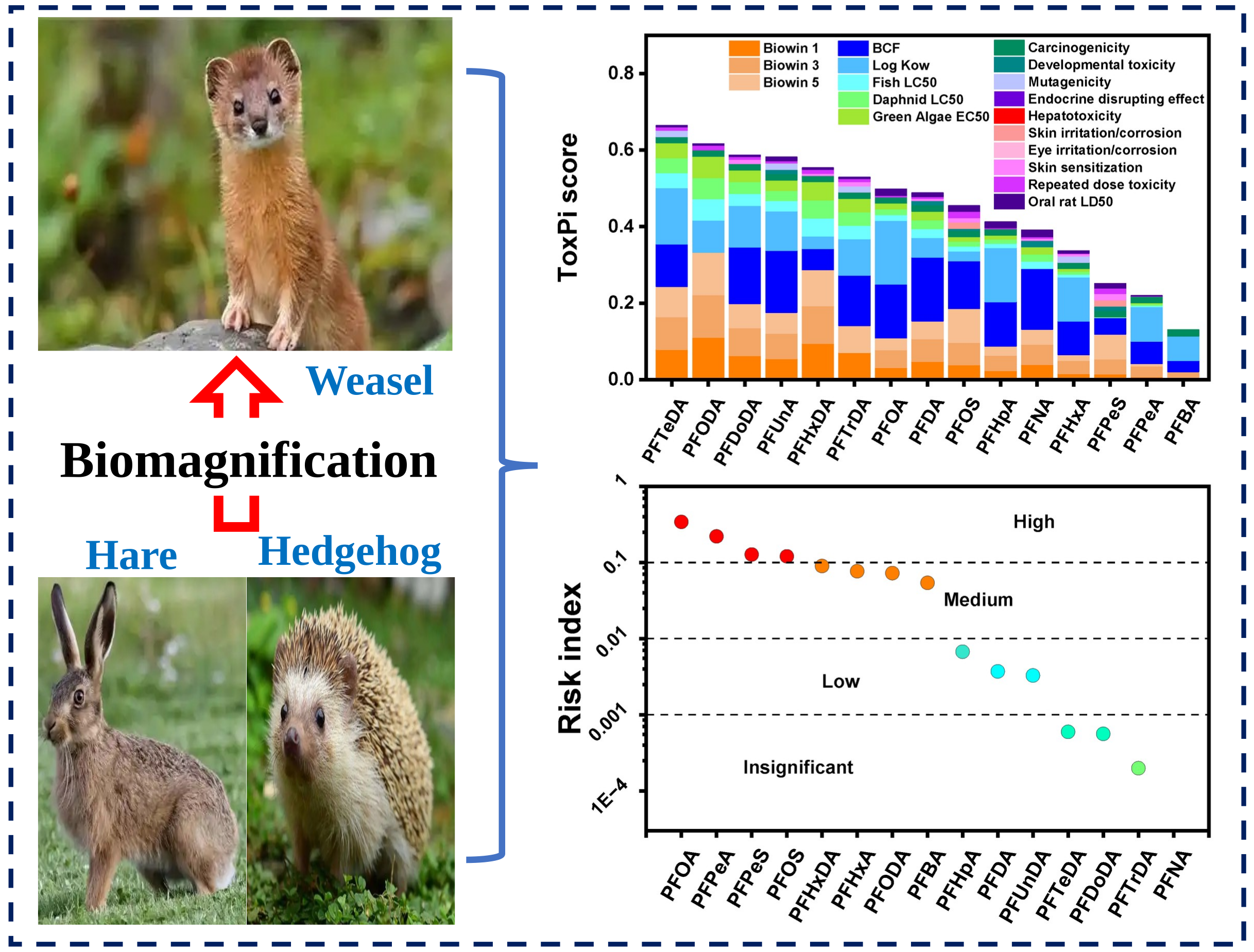
- Weasels obviously exhibited significant higher PFAS concentrations among the three terrestrial mammals.
- For 15 PFAS examined except PFHxDA and PFODA, biomagnification factors were found to be greater than 1 in the food chains.
- Four PFAS, including PFOA, PFPeA, PFPeS, and PFOS were flagged with high priority (risk index > 0.1).
- Open Access
- Article
Per- and Polyfluoroalkyl Substances (PFAS) in Terrestrial Mammals from a Typical Chinese Agricultural Region: Non-Target Screening, Biomagnification, and Risk Assessment
- Chunyou Zhu 1,
- Zenghua Qi 2,
- Beibei Hu 3,
- Yu Liu 1,4,
- Xiang He 1,5,
- Yuejie Li 1,2,
- Jiawen Zhang 1,
- Chenyu Yang 1,
- Yine Liu 6,
- Liangzhong Li 1,*,
- Haoran Yuan 1
Author Information
Received: 30 Dec 2025 | Revised: 09 Feb 2026 | Accepted: 09 Mar 2026 | Published: 03 Sep 2026
Highlights
Abstract
With perfluoroalkyl and polyfluoroalkyl substances (PFAS) widely distributed across environmental media and prone to bioaccumulation, terrestrial mammals face ecological health risks, yet related research remains limited. This study addresses the gap by investigating the occurrence and biomagnification of PFAS in terrestrial mammals in a typical agricultural region in China. Using non-target analysis, fifteen PFAS from twelve classes were identified with confidence level 2. Total PFAS concentrations ranged from 0.121 to 0.386 ng/g wet weight (ww) in hares, 0.086 to 0.434 ng/g ww in hedgehogs, and 0.306 to 0.973 ng/g ww in weasels. For 15 PFAS examined except PFHxDA and PFODA, biomagnification factors were found to be greater than 1 in both the hare-weasel and hedgehog-weasel food chains, indicating significant biomagnification of PFAS in hare-weasel and hedgehog-weasel food chains. A risk-based prioritization approach was developed to rank the identified PFAS, flagging four as high priority (risk index > 0.1). These findings enhance understanding of PFAS behavior in terrestrial ecosystems and provide valuable insights to mitigate their environmental and ecological impacts.
Graphical Abstract
Keywords
per- and polyfluoroalkyl substances | non-target screening | terrestrial mammal | biomagnification | risk prioritization
References
- 1.
Dimitrakopoulou, M.-E.; Karvounis, M.; Marinos, G.; et al. Comprehensive analysis of PFAS presence from environment to plate. npj Sci. Food 2024, 8, 80.
- 2.
Evich, M.G.; Davis, M.J.B.; McCord, J.P.; et al. Per- and polyfluoroalkyl substances in the environment. Science 2022, 375, eabg9065.
- 3.
Gaines, L.G.T. Historical and current usage of per- and polyfluoroalkyl substances (PFAS): A literature review. Am. J. Ind. Med. 2023, 66, 353–378.
- 4.
Chen, X.Y.; Li, J.; Han, L.; et al. Human health risk-based soil generic assessment criteria of representative perfluoroalkyl acids (PFAAs) under the agricultural land use in typical Chinese regions. Environ. Pollut. 2023, 335, 122368.
- 5.
Costello, M.C.S.; Lee, L.S. Sources, Fate, and Plant Uptake in Agricultural Systems of Per- and Polyfluoroalkyl Substances. Curr. Pollut. Rep. 2024, 10, 799–819.
- 6.
Stahl, T.; Heyn, J.; Thiele, H.; et al. Carryover of Perfluorooctanoic Acid (PFOA) and Perfluorooctane Sulfonate (PFOS) from Soil to Plants. Arch. Environ. Contam. Toxicol. 2009, 57, 289–298.
- 7.
Haug, L.S.; Salihovic, S.; Jogsten, I.E.; et al. Levels in food and beverages and daily intake of perfluorinated compounds in Norway. Chemosphere 2010, 80, 1137–1143.
- 8.
Herzke, D.; Nikiforov, V.; Yeung, L.W.Y.; et al. Targeted PFAS analyses and extractable organofluorine—Enhancing our understanding of the presence of unknown PFAS in Norwegian wildlife. Environ. Int. 2023, 171, 107640.
- 9.
Mueller, C.E.; De Silva, A.O.; Small, J.; et al. Biomagnification of Perfluorinated Compounds in a Remote Terrestrial Food Chain: Lichen-Caribou-Wolf. Environ. Sci. Technol. 2011, 45, 8665–8673.
- 10.
Ye, M.X.; Luo, X.J.; Liu, Y.; et al. Sex-Specific Bioaccumulation, Maternal Transfer, and Tissue Distribution of Legacy and Emerging Per- and Polyfluoroalkyl Substances in Snakes (Enhydris chinensis) and the Impact of Pregnancy. Environ. Sci. Technol. 2023, 57, 4481–4491.
- 11.
Falk, S.; Brunn, H.; Schröter-Kermani, C.; et al. Temporal and spatial trends of perfluoroalkyl substances in liver of roe deer (Capreolus capreolus). Environ. Pollut. 2012, 171, 1–8.
- 12.
Li, Z.; Shi, X.; Lu, J.; et al. Assessing mammal population densities in response to urbanization using camera trap distance sampling. Ecol. Evol. 2023, 13, e10634.
- 13.
Fang, S.; Chen, X.; Zhao, S.; et al. Trophic magnification and isomer fractionation of perfluoroalkyl substances in the food web of Taihu Lake, China. Environ. Sci. Technol. 2014, 48, 2173–2182.
- 14.
Kelly, B.C.; Ikonomou, M.G.; Blair, J.D.; et al. Perfluoroalkyl Contaminants in an Arctic Marine Food Web: Trophic Magnification and Wildlife Exposure. Environ. Sci. Technol. 2009, 43, 4037–4043.
- 15.
Martin, J.W.; Whittle, D.M.; Muir, D.C.G.; et al. Perfluoroalkyl contaminants in a food web from Lake Ontario. Environ. Sci. Technol. 2004, 38, 5379–5385.
- 16.
Bline, A.P.; Dewitt, J.C.; Kwiatkowski, C.F.; et al. Public Health Risks of PFAS-Related Immunotoxicity Are Real. Curr. Environ. Health Rep. 2024, 11, 118–127.
- 17.
Rickard, B.P.; Rizvi, I.; Fenton, S.E. Per- and poly-fluoroalkyl substances (PFAS) and female reproductive outcomes: PFAS elimination, endocrine-mediated effects, and disease. Toxicology 2022, 465, 153031.
- 18.
Alijagic, A.; Sinisalu, L.; Duberg, D.; et al. Metabolic and phenotypic changes induced by PFAS exposure in two human hepatocyte cell models. Environ. Int. 2024, 190, 108820.
- 19.
Peritore, A.F.; Gugliandolo, E.; Cuzzocrea, S.; et al. Current Review of Increasing Animal Health Threat of Per- and Polyfluoroalkyl Substances (PFAS): Harms, Limitations, and Alternatives to Manage Their Toxicity. Int. J. Mol. Sci. 2023, 24, 11707.
- 20.
Yang, L.; Jin, F.; Zhang, P.; et al. Simultaneous Determination of Perfluorinated Compounds in Edible Oil by Gel-Permeation Chromatography Combined with Dispersive Solid-Phase Extraction and Liquid Chromatography-Tandem Mass Spectrometry. J. Agric. Food Chem. 2015, 63, 8364–8371.
- 21.
Hu, J.; Lyu, Y.; Chen, H.; et al. Integration of target, suspect, and nontarget screening with risk modeling for per- and polyfluoroalkyl substances prioritization in surface waters. Water Res. 2023, 233, 119735.
- 22.
Loos, M.; Singer, H. Nontargeted homologue series extraction from hyphenated high resolution mass spectrometry data. J. Cheminform. 2017, 9, 12.
- 23.
Charbonnet, J.A.; McDonough, C.A.; Xiao, F.; et al. Communicating Confidence of Per- and Polyfluoroalkyl Substance Identification via High-Resolution Mass Spectrometry. Environ. Sci. Technol. Lett. 2022, 9, 473–481.
- 24.
Zheng, X.B.; Wu, X.D.; Lu, R.F.; et al. Identification of Species-Specific Prey Uptake and Biotransformation of Chiral Polychlorinated Biphenyls (PCBs) in Riparian and Aquatic Food Webs. Environ. Sci. Technol. 2023, 57, 20282–20291.
- 25.
Marvel, S.W.; To, K.; Grimm, F.A.; et al. ToxPi Graphical User Interface 2.0: Dynamic exploration, visualization, and sharing of integrated data models. BMC Bioinform. 2018, 19, 80.
- 26.
Zhao, F.; Li, L.; Chen, Y.; et al. Risk-Based Chemical Ranking and Generating a Prioritized Human Exposome Database. Environ. Health Perspect. 2021, 129, 047014.
- 27.
Gaston, L.; Lapworth, D.J.; Stuart, M.; et al. Prioritization Approaches for Substances of Emerging Concern in Groundwater: A Critical Review. Environ. Sci. Technol. 2019, 53, 6107–6122.
- 28.
Pedersen, A.F.; Bayen, S.; Liu, L.; et al. Nontarget and suspect screening reveals the presence of multiple plastic-related compounds in polar bear, killer whale, narwhal and long-finned pilot whale blubber from East Greenland. Environ. Pollut. 2024, 357, 124417.
- 29.
Liu, T.; Hu, L.-X.; Han, Y.; et al. Non-target discovery and risk prediction of per- and polyfluoroalkyl substances (PFAS) and transformation products in wastewater treatment systems. J. Hazard. Mater. 2024, 476, 135081.
- 30.
Qi, Z.; Cao, Y.; Li, D.; et al. Nontarget Analysis of Legacy and Emerging PFAS in a Lithium-Ion Power Battery Recycling Park and Their Possible Toxicity Measured Using High-Throughput Phenotype Screening. Environ. Sci. Technol. 2024, 58, 14530–14540.
- 31.
Wang, Y.-Q.; Hu, L.-X.; Liu, T.; et al. Per- and polyfluoroalkyl substances (PFAS) in drinking water system: Target and non-target screening and removal assessment. Environ. Int. 2022, 163, 107219.
- 32.
Wang, Q.; Ruan, Y.; Jin, L.; et al. Target, Nontarget, and Suspect Screening and Temporal Trends of Per- and Polyfluoroalkyl Substances in Marine Mammals from the South China Sea. Environ. Sci. Technol. 2021, 55, 1045–1056.
- 33.
Guckert, M.; Rupp, J.; Nürenberg, G.; et al. Differences in the internal PFAS patterns of herbivores, omnivores and carnivores—lessons learned from target screening and the total oxidizable precursor assay. Sci. Total Environ. 2023, 875, 162361.
- 34.
Witt, C.C.; Gadek, C.R.; Cartron, J.-L.E.; et al. Extraordinary levels of per- and polyfluoroalkyl substances (PFAS) in vertebrate animals at a New Mexico desert oasis: Multiple pathways for wildlife and human exposure. Environ. Res. 2024, 249, 118229.
- 35.
Eriksson, U.; Roos, A.; Lind, Y.; et al. Comparison of PFASs contamination in the freshwater and terrestrial environments by analysis of eggs from osprey (Pandion haliaetus), tawny owl (Strix aluco), and common kestrel (Falco tinnunculus). Environ. Res. 2016, 149, 40–47.
- 36.
Huang, K.; Li, Y.; Bu, D.; et al. Trophic Magnification of Short-Chain Per- and Polyfluoroalkyl Substances in a Terrestrial Food Chain from the Tibetan Plateau. Environ. Sci. Technol. Lett. 2022, 9, 147–152.
- 37.
Carey, M. Fatal fertilizer: PFAS contamination of farmland from biosolids and potential federal solutions. Pace Env't L. Rev. 2022, 40, 29.
- 38.
Bangma, J.; Guillette, T.C.; Bommarito, P.A.; et al. Understanding the dynamics of physiological changes, protein expression, and PFAS in wildlife. Environ. Int. 2022, 159, 107037.
- 39.
Dai, Y.; Guo, X.; Wang, S.; et al. Photochemical transformation of perfluoroalkyl acid precursors in water using engineered nanomaterials. Water Res. 2020, 181, 115964.
- 40.
Thapa, B.S.; Pandit, S.; Mishra, R.K.; et al. Emergence of per- and poly-fluoroalkyl substances (PFAS) and advances in the remediation strategies. Sci. Total Environ. 2024, 916, 170142.
- 41.
Du, X.; Yuan, B.; Zhou, Y.; et al. Chlorinated Paraffins in Two Snake Species from the Yangtze River Delta: Tissue Distribution and Biomagnification. Environ. Sci. Technol. 2020, 54, 2753–2762.
- 42.
Gobas, F.A.; de Wolf, W.; Burkhard, L.P.; et al. Revisiting Bioaccumulation Criteria for POPs and PBT Assessments. Integr. Environ. Assess. Manag. 2009, 5, 624–637.
- 43.
Ecke, F.; Golovko, O.; Hörnfeldt, B.; et al. Trophic fate and biomagnification of organic micropollutants from staple food to a specialized predator. Environ. Res. 2024, 261, 119686.
- 44.
Ren, J.; Point, A.D.; Baygi, S.F.; et al. Bioaccumulation of perfluoroalkyl substances in the Lake Erie food web. Environ. Pollut. 2023, 317, 120677.
- 45.
Gronnestad, R.; Vazquez, B.P.; Arukwe, A.; et al. Levels, Patterns, and Biomagnification Potential of Perfluoroalkyl Substances in a Terrestrial Food Chain in a Nordic Skiing Area. Environ. Sci. Technol. 2019, 53, 13390–13397.
- 46.
Chen, Z.W.; Zhan, X.Y.; Zhang, J.R.; et al. Bioaccumulation and risk mitigation of legacy and novel perfluoroalkyl substances in seafood: Insights from trophic transfer and cooking method. Environ. Int. 2023, 177, 108023.
- 47.
Cao, X.; Yu, S.; Luo, Z.; et al. Bioaccumulation and Transfer of Legacy and Emerging Per- and Polyfluoroalkyl Substances throughout the Lifecycle of a Tropical Amphibian Species Fejervarya limnocharis. Environ. Sci. Technol. 2025, 59, 6214–6223.
- 48.
Brown, J.B.; Conder, J.M.; Arblaster, J.A.; et al. Assessing Human Health Risks from Per- and Polyfluoroalkyl Substance (PFAS)-Impacted Vegetable Consumption: A Tiered Modeling Approach. Environ. Sci. Technol. 2020, 54, 15202–15214.
- 49.
Ojo, A.F.; Peng, C.; Ng, J.C. Assessing the human health risks of per- and polyfluoroalkyl substances: A need for greater focus on their interactions as mixtures. J. Hazard. Mater. 2021, 407, 124863.
- 50.
Burkhard, L.P. Evaluation of Published Bioconcentration Factor (BCF) and Bioaccumulation Factor (BAF) Data for Per- and Polyfluoroalkyl Substances Across Aquatic Species. Environ. Toxicol. Chem. 2021, 40, 1530–1543.
- 51.
Cai, Y.; Chen, H.; Yuan, R.; et al. Toxicity of perfluorinated compounds to soil microbial activity: Effect of carbon chain length, functional group and soil properties. Sci. Total Environ. 2019, 690, 1162–1169.
- 52.
Gaballah, S.; Swank, A.; Sobus, J.R.; et al. Evaluation of Developmental Toxicity, Developmental Neurotoxicity, and Tissue Dose in Zebrafish Exposed to GenX and Other PFAS. Environ. Health Perspect. 2020, 128, 047005.
- 53.
ChemSafetyPRO. When to Use QSAR for Chemical Substance Registration and Common QSAR Models. 2017. Available online: http://www.chemsafetypro.com/Topics/CRA/When_to_Use_QSAR_for_Chemical_Substance_Registration_and_Common_QSAR_Models.html (accessed on 21 March 2025).
- 54.
European Chemicals Agency. How to Use and Report (Q)SARs. Practical Guide 5. 2016. Available online: https://op.europa.eu/en/publication-detail/-/publication/0bfe7b84-3386-11e6-969e-01aa75ed71a1 (accessed on 21 March 2025).
- 55.
Reach Online. Annex XIII: Criteria for the Identification of Persistent, Bioaccumulative and Toxic Substances, and Very Persistent and Very Bioaccumulative Substances. Available online: https://reachonline.eu/reach/en/annex-xiii.html?kw=substance (accessed on 30 July 2026)
- 56.
Strempel, S.; Scheringer, M.; Ng, C.A.; et al. Screening for PBT Chemicals among the “Existing” and “New” Chemicals of the EU. Environ. Sci. Technol. 2012, 46, 5680–5687.
- 57.
Zheng, Z.; Peters, G.M.; Arp, H.P.H.; et al. Combining in Silico Tools with Multicriteria Analysis for Alternatives Assessment of Hazardous Chemicals: A Case Study of Decabromodiphenyl Ether Alternatives. Environ. Sci. Technol. 2019, 53, 6341–6351.
- 58.
Su, H.; Shi, S.; Zhu, M.; et al. Persistent, bioaccumulative, and toxic properties of liquid crystal monomers and their detection in indoor residential dust. Proc. Natl. Acad. Sci. USA 2019, 116, 26450–26458.
How to Cite
Zhu, C.; Qi, Z.; Hu, B.; Liu, Y.; He, X.; Li, Y.; Zhang, J.; Yang, C.; Liu, Y.; Li, L.; Yuan, H. Per- and Polyfluoroalkyl Substances (PFAS) in Terrestrial Mammals from a Typical Chinese Agricultural Region: Non-Target Screening, Biomagnification, and Risk Assessment. Global Environmental Science 2026, 2 (3), 346–358. https://doi.org/10.53941/ges.2026.100022.
RIS
BibTex
Copyright & License

Copyright (c) 2026 by the authors.
This work is licensed under a Creative Commons Attribution 4.0 International License.
Article Metrics
66
Article Views
0
Citations
Contents
References

 Suite 4002 Level 4, 447 Collins Street, Melbourne, Victoria 3000, Australia
 General Inquiries: info@sciltp.com