
- Design principles of single-atom catalysts for low-temperature VOC oxidation are summarized.
- Single-atom catalyst oxygen activation and intermediate transformation mechanisms over single-atom catalysts are discussed.
- Structure–activity relationships of single-atom catalysts in VOC oxidation are reviewed.
- Prospects and challenges for practical application of single-atom catalysts are proposed.
- Open Access
- Review
Design Principles and Structure-Activity Relationships of Single-Atom Catalysts for Low-Temperature VOCs Oxidation and Related Probe Reactions
- Chang Sun,
- Zhiwei Huang,
- Haoran Liu,
- Jia Chen,
- Huazhen Shen,
- Xiaomin Wu,
- Huawang Zhao,
- Bihong Lv,
- Guohua Jing *
Author Information
Received: 10 Mar 2026 | Revised: 19 Apr 2026 | Accepted: 15 Jun 2026 | Published: 13 Aug 2026
Highlights
Abstract
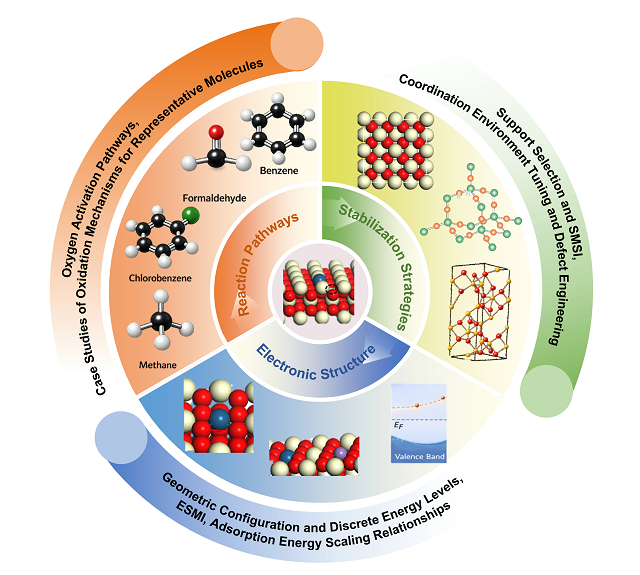
Volatile organic compounds (VOCs) are key precursors of ozone and secondary organic aerosols and pose serious risks to human health. Consequently, stringent emission abatement is urgently required under realistic operating conditions such as low inlet concentrations, high gas hourly space velocities, and high humidity. Catalytic oxidation is widely regarded as one of the most competitive end-of-pipe technologies. However, low-temperature operation remains kinetically challenging. Oxygen activation is sluggish, reaction intermediates can bind strongly, and catalysts are prone to deactivation by water, chlorine/sulfur-containing species, and carbonaceous deposits. Single-atom catalysts (SACs) provide an atomic-level platform in which isolated metal centers exhibit unique electronic structures and metal–support interfacial chemistry. These features can fundamentally reshape oxygen activation and VOC oxidation pathways. This review summarizes recent advances in SACs for low-temperature VOC oxidation and discusses how anchoring motifs (M–Ox, M–Nx, and defect-localized sites), support redox properties, and microenvironmental factors (hydroxyls and hydrophilicity) synergistically regulate oxygen delivery (adsorbed oxygen vs lattice oxygen), intermediate evolution (formate/benzoate/carbonate species), and conversion stability. Finally, perspectives are provided on future design and application of single-atom catalysts.
Graphical Abstract
Keywords
single-atom catalyst | VOC oxidation | low-temperature catalysis | oxygen vacancy | defect-localized site
References
- 1.
Huang, R.-J.; Zhang, Y.; Bozzetti, C.; et al. High secondary aerosol contribution to particulate pollution during haze events in China. Nature 2014, 514, 218–222.
- 2.
Kamal, M.S.; Razzak, S.A.; Hossain, M.M. Catalytic oxidation of volatile organic compounds (VOCs)—A review. Atmos. Environ. 2016, 140, 117–134.
- 3.
He, C.; Cheng, J.; Zhang, X.; et al. Recent advances in the catalytic oxidation of volatile organic compounds: A review based on pollutant sorts and sources. Chem. Rev. 2019, 119, 4471–4568.
- 4.
Li, J.; Lei, X.; Zhao, R.; et al. Catalytic oxidation removal of typical sinter flue gas volatile organic compounds by CoMn binary spinel via peroxymonosulfate wet scrubbing. Sep. Purif. Technol. 2025, 363, 132071.
- 5.
Liu, J.; Burciaga, R.; Tang, S.; et al. Heterogeneous catalysis for the environment. Innov. Mater. 2024, 2, 100090.
- 6.
Wang, P.; Ma, X.; Hao, X.; et al. Oxygen vacancy defect engineering to promote catalytic activity toward the oxidation of VOCs: A critical review. Catal. Rev. 2024, 66, 586–639.
- 7.
Cheng, N.; Stambula, S.; Wang, D.; et al. Platinum single-atom and cluster catalysis of the hydrogen evolution reaction. Nat. Commun. 2016, 7, 13638.
- 8.
Galushko, A.S.; Ananikov, V.P. Deactivation of single-atom catalysts by nanoparticles. Angew. Chem. Int. Ed. 2026, 65, e20712.
- 9.
Lang, R.; Du, X.; Huang, Y.; et al. Single-atom catalysts based on the metal-oxide interaction. Chem. Rev. 2020, 120, 11986–12043.
- 10.
Zhao, J.; Wang, Y.; Chen, Z.; et al. Recent advances in catalytic removal volatile organic compounds: Structure activity correlation, mechanism and application insights. Sep. Purif. Technol. 2025, 378, 134598.
- 11.
Bond, G.C. The origins of particle size effects in heterogeneous catalysis. Surf. Sci. 1985, 156, 966–981.
- 12.
Wang, A.; Li, J.; Zhang, T. Heterogeneous single-atom catalysis. Nat. Rev. Chem. 2018, 2, 65–81.
- 13.
Taylor, H.S. A theory of the catalytic surface. Proc. R. Soc. Lond. A 1925, 108, 105–111.
- 14.
Qiao, B.; Wang, A.; Yang, X.; et al. Single-atom catalysis of CO oxidation using Pt1/FeOx. Nat. Chem. 2011, 3, 634–641.
- 15.
Yang, X.-F.; Wang, A.; Qiao, B.; et al. Single-atom catalysts: A new frontier in heterogeneous catalysis. Acc. Chem. Res. 2013, 46, 1740–1748.
- 16.
Jones, J.; Xiong, H.; DeLaRiva, A.T.; et al. Thermally stable single-atom platinum-on-ceria catalysts via atom trapping. Science 2016, 353, 150–154.
- 17.
Goodman, E.D.; Schwalbe, J.A.; Cargnello, M. Mechanistic understanding and the rational design of sinter-resistant heterogeneous catalysts. ACS Catal. 2017, 7, 7156–7173.
- 18.
Chen, Y.; Ji, S.; Wang, Y.; et al. Isolated single iron atoms anchored on N-doped porous carbon as an efficient electrocatalyst for the oxygen reduction reaction. Angew. Chem. Int. Ed. 2017, 56, 6937–6941.
- 19.
Wang, L.; Chen, M.-X.; Yan, Q.-Q.; et al. A sulfur-tethering synthesis strategy toward high-loading atomically dispersed noble metal catalysts. Sci. Adv. 2019, 5, eaax6322.
- 20.
Shang, H.; Zhou, X.; Dong, J.; et al. Engineering unsymmetrically coordinated Cu-S1N3 single atom sites with enhanced oxygen reduction activity. Nat. Commun. 2020, 11, 3049.
- 21.
Babucci, M.; Sarac Oztuna, F.E.; Debefve, L.M.; et al. Atomically dispersed reduced graphene aerogel-supported iridium catalyst with an iridium loading of 14.8 wt%. ACS Catal. 2019, 9, 9905–9913.
- 22.
Wan, J.; Chen, W.; Jia, C.; et al. Defect effects on TiO2 nanosheets: Stabilizing single atomic site Au and promoting catalytic properties. Adv. Mater. 2018, 30, 1705369.
- 23.
Liu, J.-C.; Wang, Y.-G.; Li, J. Toward rational design of oxide-supported single-atom catalysts: Atomic dispersion of gold on ceria. J. Am. Chem. Soc. 2017, 139, 6190–6199.
- 24.
Bruix, A.; Lykhach, Y.; Matolínová, I.; et al. Maximum noble-metal efficiency in catalytic materials: Atomically dispersed surface platinum. Angew. Chem. Int. Ed. 2014, 53, 10525–10530.
- 25.
Duan, X.; Niu, B.; Wang, Y.; et al. Regulating the electronic metal–support interaction of single-atom ruthenium catalysts for boosting chlorobenzene oxidation. Environ. Sci. Technol. 2025, 59, 7408–7418.
- 26.
Jeong, H.; Shin, D.; Kim, B.-S.; et al. Controlling the oxidation state of Pt single atoms for maximizing catalytic activity. Angew. Chem. Int. Ed. 2020, 59, 20691–20696.
- 27.
Yuan, L.; Hung, S.-F.; Tang, Z.-R.; et al. Dynamic evolution of atomically dispersed Cu species for CO2 photoreduction to solar fuels. ACS Catal. 2019, 9, 4824–4833.
- 28.
Campbell, C.T. Electronic perturbations. Nat. Chem. 2012, 4, 597–598.
- 29.
Pérez-Ramírez, J.; López, N. Strategies to break linear scaling relationships. Nat. Catal. 2019, 2, 971–976.
- 30.
Li, H.; Wang, L.; Dai, Y.; et al. Synergetic interaction between neighbouring platinum monomers in CO2 hydrogenation. Nat. Nanotechnol. 2018, 13, 411–417.
- 31.
Wang, Y.-G.; Mei, D.; Glezakou, V.-A.; et al. Dynamic formation of single-atom catalytic active sites on ceria-supported gold nanoparticles. Nat. Commun. 2015, 6, 6511.
- 32.
Zhang, L.; Bao, Q.; Zhang, B.; et al. Distinct role of surface hydroxyls in single-atom Pt1/CeO2 catalyst for room-temperature formaldehyde oxidation: Acid–base versus redox. JACS Au 2022, 2, 1651–1660.
- 33.
Perilli, D.; Breglia, R.; Valentin, C.D. Using coordination chemistry concepts to unravel electronic properties of SACs in bidimensional materials. J. Phys. Chem. C 2022, 126, 9615–9622.
- 34.
Chowdhury, C.; Lovato, M.; Di Liberto, G.; et al. Predicting the HER activity of SACs on MXenes with simple features and interpretable machine learning models. J. Mater. Chem. A 2026, 14, 5349–5365.
- 35.
Rasool, A.; Anis, I.; Bhat, S.A.; et al. Optimizing the NRR activity of single and double boron atom catalysts using a suitable support: A first principles investigation. Phys. Chem. Chem. Phys. 2023, 25, 22275–22285.
- 36.
Hassan, A.; Dar, M.; Dar, M.A. Driving CO2 conversion to C1 and C2 products on single-atom catalysts: Recent experimental and theoretical insights. ACS Appl. Mater. Interfaces 2025, 17, 53056–53080.
- 37.
Amin, S.; Krishnamurty, S.; Dar, M.A. Boosting the CO2 reduction activity of Cu double-atom catalysts through coordination environment engineering. Sustain. Energy Fuels 2025, 9, 5589–5600.
- 38.
Guan, X.; Han, R.; Asakura, H.; et al. Subsurface single-atom catalyst enabled by mechanochemical synthesis for oxidation chemistry. Angew. Chem. Int. Ed. 2024, 63, e202410457.
- 39.
O’Connor, N.J.; Jonayat, A.S.M.; Janik, M.J.; et al. Interaction trends between single metal atoms and oxide supports identified with density functional theory and statistical learning. Nat. Catal. 2018, 1, 531–539.
- 40.
Shi, H.; Yang, P.; Huang, L.; et al. Single-atom Pt-CeO2/Co3O4 catalyst with ultra-low Pt loading and high performance for toluene removal. J. Colloid Interface Sci. 2023, 641, 972–980.
- 41.
Ma, S.; Feng, C.; Dong, F.; et al. A Pt1Co1/CeO2 bimetallic single-atom catalyst with a strong Pt-Co synergistic effect for efficient oxidation of benzene. Appl. Catal. B 2025, 374, 125369.
- 42.
Liu, L.; Jing, G.; Xu, C.; et al. Exceptional formaldehyde oxidation at room temperature on Co single-atom functionalized TiO2 nanowires via highly effective O2 activation. Appl. Catal. B 2024, 344, 123634.
- 43.
Hao, X.; Dai, L.; Deng, J.; et al. Nanotubular OMS-2 supported single-atom platinum catalysts highly active for benzene oxidation. J. Phys. Chem. C 2021, 125, 17696–17708.
- 44.
Nie, L.; Mei, D.; Xiong, H.; et al. Activation of surface lattice oxygen in single-atom Pt/CeO2 for low-temperature CO oxidation. Science 2017, 358, 1419–1423.
- 45.
Zhao, S.; Wen, Y.; Liu, X.; et al. Formation of active oxygen species on single-atom Pt catalyst and promoted catalytic oxidation of toluene. Nano Res. 2020, 13, 1544–1551.
- 46.
Su, H.; Chai, J.; Guan, Z.; et al. Tuning the f band for enhanced surface redox in strained rare earth oxides. J. Am. Chem. Soc. 2025, 147, 40196–40204.
- 47.
Capdevila-Cortada, M.; Vilé, G.; Teschner, D.; et al. Reactivity descriptors for ceria in catalysis. Appl. Catal. B 2016, 197, 299–312.
- 48.
Wang, X.; Hu, J.; Lu, T.; et al. Importing atomic rare-earth sites to activate lattice oxygen of spinel oxides for electrocatalytic oxygen evolution. Angew. Chem. Int. Ed. 2025, 64, e202415306.
- 49.
Tan, W.; Xie, S.; Le, D.; et al. Fine-tuned local coordination environment of Pt single atoms on ceria controls catalytic reactivity. Nat. Commun. 2022, 13, 7070.
- 50.
Jiang, D.; Yao, Y.; Li, T.; et al. Tailoring the local environment of platinum in single-atom Pt1/CeO2 catalysts for robust low-temperature CO oxidation. Angew. Chem. Int. Ed. 2021, 60, 26054–26062.
- 51.
Jiang, D.; Wan, G.; García-Vargas, C.E.; et al. Elucidation of the active sites in single-atom Pd1/CeO2 catalysts for low-temperature CO oxidation. ACS Catal. 2020, 10, 11356–11364.
- 52.
Schilling, C.; Ganduglia-Pirovano, M.V.; Hess, C. Experimental and theoretical study on the nature of adsorbed oxygen species on shaped ceria nanoparticles. J. Phys. Chem. Lett. 2018, 9, 6593–6598.
- 53.
Chakarova, K.; Drenchev, N.; Mihaylov, M.; et al. Interaction of O2 with reduced ceria nanoparticles at 100–400 K: Fast oxidation of Ce3+ ions and dissolved H2. Catalysts 2024, 14, 45.
- 54.
Xing, Y.; Wang, C.; Li, D.; et al. Solution plasma processing single-atom Au1 on CeO2 nanosheet for low temperature photo-enhanced mars–van krevelen CO oxidation. Adv. Funct. Mater. 2022, 32, 2207694.
- 55.
Han, W.; Ling, W.; Gao, P.; et al. Engineering Pt single atom catalyst with abundant lattice oxygen by dual nanospace confinement strategy for the efficient catalytic elimination of VOCs. Appl. Catal. B 2024, 345, 123687.
- 56.
Wang, T.; Qiu, S.; Dai, Z.; et al. Exploration of TiO2 as substrates for single metal catalysts: A DFT study. Appl. Surf. Sci. 2020, 533, 147362.
- 57.
Lazzeri, M.; Vittadini, A.; Selloni, A. Structure and energetics of stoichiometric TiO2 anatase surfaces. Phys. Rev. B 2001, 63, 155409.
- 58.
Sun, S.; Liu, S.; Cao, J.; et al. Metastable Pt1/TiO2 catalyst for activating H2O to enhanced C6H6 oxidation under humid condition. Appl. Catal. B 2025, 367, 125125.
- 59.
Wang, Q.; Gu, Q.; Wang, A.; et al. Crystal facet enhanced dynamic stability and reactivity of undercoordinated Pt1-TiO2 single atom species for methane oxidation. J. Phys. Chem. Lett. 2025, 16, 5887–5896.
- 60.
Jia, J.; Zhang, P.; Chen, L. Catalytic decomposition of gaseous ozone over manganese dioxides with different crystal structures. Appl. Catal. B 2016, 189, 210–218.
- 61.
Yang, W.; Su, Z. a.; Xu, Z.; et al. Comparative study of α-, β-, γ- And δ-MnO2 on toluene oxidation: Oxygen vacancies and reaction intermediates. Appl. Catal. B 2020, 260, 118150.
- 62.
Chen, Y.; Huang, Z.; Zhou, M.; et al. Single silver adatoms on nanostructured manganese oxide surfaces: Boosting oxygen activation for benzene abatement. Environ. Sci. Technol. 2017, 51, 2304–2311.
- 63.
Chen, Y.; Gao, J.; Huang, Z.; et al. Sodium rivals silver as single-atom active centers for catalyzing abatement of formaldehyde. Environ. Sci. Technol. 2017, 51, 7084–7090.
- 64.
Wang, Y.; Zhang, J.; Zhang, Y.; et al. Single Fe atom-anchored manganese dioxide for efficient removal of volatile organic compounds in refrigerator. Nano Res. 2024, 17, 3927–3933.
- 65.
Wang, Y.; Wang, M.; Jin, X.; et al. Cyclable CuⅠ-Ov-Mn sites accelerate O2 activation to enhance photo-driven catalytic oxidation performance. Appl. Catal. B 2024, 353, 124110.
- 66.
Zhang, Q.; Zhang, S.; Wu, Y. Research advances in volatile organic compounds catalytic removal using CeO2-based catalysts. J. Environ. Chem. Eng. 2025, 13, 119033.
- 67.
Meng, F.; Tang, X.; Kadja, G.T.M.; et al. A systematic review with improving activity and stability in VOCs elimination by oxidation of noble metals: Starting from active sites. Sep. Purif. Technol. 2025, 354, 129222.
- 68.
Wang, D.; Yuan, C.; Yang, C.; et al. Recent advances in catalytic removal volatile organic compounds over metal–organic framework–derived catalysts: A review. Sep. Purif. Technol. 2023, 326, 124765.
- 69.
Pan, H.; Chen, Z.; Feng, X.; et al. Sulfur-resistant mechanism of MnOx@CeO2@MgO core-shell catalyst in simultaneous removal of NOx and chlorobenzene. Appl. Catal. B 2025, 362, 124761.
- 70.
Yang, D.; Dong, F.; Han, W.; et al. Significant enhanced SO2 resistance of Pt/SiO2 catalysts by building the ultrathin metal oxide shell for benzene catalytic combustion. ACS Appl. Mater. Interfaces 2023, 15, 42541–42556.
- 71.
Zhang, X.; Zhang, X.; Liang, C.; et al. Flowerlike structured Cu promoted MnOx catalysts for VOC oxidation: Enhanced water vapor resistance in simulated coal-fired flue gas. Fuel 2025, 399, 135668.
- 72.
Li, J.; Chen, J.; Zeng, J.; et al. Tuning the crystallinity of the MnOx catalysts to promote toluene catalytic oxidation. Environ. Technol. 2025, 46, 98–110.
- 73.
Weng, X.; Shi, B.; Liu, A.; et al. Highly dispersed pd/modified-Al2O3 catalyst on complete oxidation of toluene: Role of basic sites and mechanism insight. Appl. Surf. Sci. 2019, 497, 143747.
- 74.
Wang, J.; Wang, C.; Chen, X.; et al. The performance and mechanism of HCHO oxidation on Pt/Al2O3 catalysts: The effect of alumina crystalline phase and surface hydroxyls. Appl. Catal. B 2024, 357, 124342.
- 75.
Yang, D.; Dong, F.; Wang, J.; et al. Constructing a core–shell Pt@MnOx/SiO2 catalyst for benzene catalytic combustion with excellent SO2 resistance: New insights into active sites. Environ. Sci. Nano 2024, 11, 1926–1947.
- 76.
Li, J.; Feng, J.; Liu, F.; et al. Enhanced antichlorine poisoning of CaCO3-modified MnO2 catalyst for catalytic combustion of chlorobenzene. J. Environ. Chem. Eng. 2025, 13, 115038.
- 77.
Tauster, S.J.; Fung, S.C.; Garten, R.L. Strong metal–support interactions. Group 8 noble metals supported on titanium dioxide. J. Am. Chem. Soc. 1978, 100, 170–175.
- 78.
Monai, M.; Jenkinson, K.; Melcherts, A.E.M.; et al. Restructuring of titanium oxide overlayers over nickel nanoparticles during catalysis. Science 2023, 380, 644–651.
- 79.
Tang, H.; Su, Y.; Zhang, B.; et al. Classical strong metal–support interactions between gold nanoparticles and titanium dioxide. Sci. Adv. 2017, 3, e1700231.
- 80.
Liu, S.; Qi, H.; Zhou, J.; et al. Encapsulation of platinum by titania under an oxidative atmosphere: Contrary to classical strong metal–support interactions. ACS Catal. 2021, 11, 6081–6090.
- 81.
Du, E.; Yang, J.; Huai, L.; et al. Quantifying interface-dependent active sites induced by strong metal–support interactions on Au/TiO2 in 2,5-bis(hydroxymethyl)furan oxidation. ACS Catal. 2025, 15, 54–62.
- 82.
Xie, S.; Liu, L.; Lu, Y.; et al. Pt atomic single-layer catalyst embedded in defect-enriched ceria for efficient CO oxidation. J. Am. Chem. Soc. 2022, 144, 21255–21266.
- 83.
Liu, K.; Zhao, X.; Ren, G.; et al. Strong metal–support interaction promoted scalable production of thermally stable single-atom catalysts. Nat. Commun. 2020, 11, 1263.
- 84.
Yang, J.; Huang, Y.; Qi, H.; et al. Modulating the strong metal–support interaction of single-atom catalysts via vicinal structure decoration. Nat. Commun. 2022, 13, 4244.
- 85.
Li, Y.; Qin, T.; Wei, Y.; et al. A single site ruthenium catalyst for robust soot oxidation without platinum or palladium. Nat. Commun. 2023, 14, 7149.
- 86.
Tang, M.; Li, S.; Chen, S.; et al. Facet-dependent oxidative strong metal–support interactions of palladium–TiO2 determined by in situ transmission electron microscopy. Angew. Chem. Int. Ed. 2021, 60, 22339–22344.
- 87.
Tang, H.; Su, Y.; Guo, Y.; et al. Oxidative strong metal–support interactions (OMSI) of supported platinum-group metal catalysts. Chem. Sci. 2018, 9, 6679–6684.
- 88.
Ingale, P.; Knemeyer, K.; Preikschas, P.; et al. Design of PtZn nanoalloy catalysts for propane dehydrogenation through interface tailoring via atomic layer deposition. Catal. Sci. Technol. 2021, 11, 484–493.
- 89.
Wei, P.; Chen, S.; Luo, R.; et al. Stable and homogeneous intermetallic alloys by atomic gas-migration for propane dehydrogenation. Nat. Commun. 2024, 15, 8157.
- 90.
Arroyo-Ramírez, L.; Chen, C.; Cargnello, M.; et al. Supported platinum–zinc oxide core–shell nanoparticle catalysts for methanol steam reforming. J. Mater. Chem. A 2014, 2, 19509–19514.
- 91.
Ran, L.; Li, Z.; Ran, B.; et al. Engineering single-atom active sites on covalent organic frameworks for boosting CO2 photoreduction. J. Am. Chem. Soc. 2022, 144, 17097–17109.
- 92.
Jiang, R.; Li, L.; Sheng, T.; et al. Edge-site engineering of atomically dispersed Fe–N4 by selective C–N bond cleavage for enhanced oxygen reduction reaction activities. J. Am. Chem. Soc. 2018, 140, 11594–11598.
- 93.
Zhang, J.; Zhao, Y.; Chen, C.; et al. Tuning the coordination environment in single-atom catalysts to achieve highly efficient oxygen reduction reactions. J. Am. Chem. Soc. 2019, 141, 20118–20126.
- 94.
Dong, F.; Meng, Y.; Ling, W.; et al. Single atomic Pt confined into lattice defect sites for low-temperature catalytic oxidation of VOCs. Appl. Catal. B 2024, 346, 123779.
- 95.
Tao, Q.; Song, J.; Sun, N.; et al. Boosting the activity of single-atom Pt1/CeO2 via Co doping for low-temperature catalytic oxidation of CO. Inorg. Chem. 2022, 61, 11932–11938.
- 96.
Maurer, F.; Jelic, J.; Wang, J.; et al. Tracking the formation, fate and consequence for catalytic activity of Pt single sites on CeO2. Nat. Catal. 2020, 3, 824–833.
- 97.
DeRita, L.; Resasco, J.; Dai, S.; et al. Structural evolution of atomically dispersed Pt catalysts dictates reactivity. Nat. Mater. 2019, 18, 746–751.
- 98.
Tan, W.; Xie, S.; Cai, Y.; et al. Transformation of highly stable Pt single sites on defect engineered ceria into robust Pt clusters for vehicle emission control. Environ. Sci. Technol. 2021, 55, 12607–12618.
- 99.
Wang, Z.; Zhou, X.; Wang, G.; et al. High-performance Ir1/CeO2 single-atom catalyst for the oxidation of toluene. Inorg. Chem. 2024, 63, 7241–7254.
- 100.
Zhang, H.; Sui, S.; Zheng, X.; et al. One-pot synthesis of atomically dispersed Pt on MnO2 for efficient catalytic decomposition of toluene at low temperatures. Appl. Catal. B 2019, 257, 117878.
- 101.
Wang, Y.; Dai, J.; Wang, M.; et al. Enhanced toluene oxidation by photothermal synergetic catalysis on manganese oxide embedded with Pt single-atoms. J. Colloid Interface Sci. 2023, 636, 577–587.
- 102.
Yang, W.; Zhao, X.; Wang, Y.; et al. Atomically dispersed Ag on δ-MnO2 via cation vacancy trapping for toluene catalytic oxidation. Catal. Sci. Technol. 2022, 12, 5932–5941.
- 103.
Zheng, Y.; Fu, K.; Yu, Z.; et al. Oxygen vacancies in a catalyst for VOCs oxidation: Synthesis, characterization, and catalytic effects. J. Mater. Chem. A 2022, 10, 14171–14186.
- 104.
Zhang, H.; Wang, Z.; Lin, H.; et al. Catalytic oxidation of volatile organic compounds over supported noble metal and single atom catalysts: A review. J. Environ. Sci. 2025, 155, 858–888.
- 105.
Tang, T.; Zhao, S.; Liu, Y.; et al. Metal-support interaction in supported Pt single-atom catalyst promotes lattice oxygen activation to achieve complete oxidation of acetone at low concentrations. J. Hazard. Mater. 2024, 480, 135839.
- 106.
Cheng, H.; Wang, Y.; Jin, Y.; et al. Oxygen vacancy engineering through equivalent and aliovalent doping on LaCoO3. Sep. Purif. Technol. 2024, 351, 128078.
- 107.
Jiang, M.; Yan, D.; Lv, X.; et al. Recognition of water-dissociation effect toward lattice oxygen activation on single-atom Co catalyst in toluene oxidation. Appl. Catal. B 2022, 319, 121962.
- 108.
Chu, P.; Zhang, L.; Wang, Z.; et al. Regulation lattice oxygen mobility via dual single atoms for simultaneously enhancing VOC oxidation and NOx reduction. Environ. Sci. Technol. 2024, 58, 17475–17484.
- 109.
Barman, N.; Majumder, C.; Thapa, R. Electronic and energy descriptors for SACs as tri-functional catalysts towards urea formation and unveiling the C–N coupling mechanism. Chem. Sci. 2026, 17, 2169–2182.
- 110.
Bhat, S.S.; Rasool, A.; Dar, M.A. Single-atom-functionalized covalent organic frameworks for efficient CO2 conversion: Electronic structure insights from first-principles simulations. J. Phys. Chem. C 2025, 129, 17512–17518.
- 111.
Belew, A.A.; Meshesha, D.S.; Assege, M.A.; et al. Recent progress of single-atom catalysts (SACs) for the advanced oxidation of organic compounds: A comprehensive review on metal-specific performance and mechanisms. Mater. Today Sustain. 2026, 34, 101335.
- 112.
Khanam, R.; Rasool, A.; Dar, M.A. Unraveling the mechanism of oxygen electrocatalysis on transition metal-free single-atom-doped holey graphyne. ChemPhysChem 2025, 26, e202500167.
- 113.
Wang, Y.; Liang, Y.; Bo, T.; et al. Orbital dependence in single-atom electrocatalytic reactions. J. Phys. Chem. Lett. 2022, 13, 5969–5976.
- 114.
Greiner, M.T.; Jones, T.E.; Beeg, S.; et al. Free-atom-like d states in single-atom alloy catalysts. Nat. Chem. 2018, 10, 1008–1015.
- 115.
Shi, Y.; Ma, Z.-R.; Xiao, Y.-Y.; et al. Electronic metal–support interaction modulates single-atom platinum catalysis for hydrogen evolution reaction. Nat. Commun. 2021, 12, 3021.
- 116.
Wang, L.; Wang, H.; Lu, J. Local chemical environment effect in single-atom catalysis. Chem Catal. 2023, 3, 100492.
- 117.
Liu, L.; Corma, A. Metal catalysts for heterogeneous catalysis: From single atoms to nanoclusters and nanoparticles. Chem. Rev. 2018, 118, 4981–5079.
- 118.
Kraushofer, F.; Parkinson, G.S. Single-atom catalysis: Insights from model systems. Chem. Rev. 2022, 122, 14911–14939.
- 119.
Giulimondi, V.; Mitchell, S.; Pérez-Ramírez, J. Challenges and opportunities in engineering the electronic structure of single-atom catalysts. ACS Catal. 2023, 13, 2981–2997.
- 120.
Di Liberto, G.; Pacchioni, G. Key ingredients for the modeling of single-atom electrocatalysts. ChemElectroChem 2024, 11, e202400476.
- 121.
Lu, Y.; Wang, J.; Yu, L.; et al. Identification of the active complex for CO oxidation over single-atom Ir-on-MgAl2O4 catalysts. Nat. Catal. 2019, 2, 149–156.
- 122.
Liu, S.; Huang, S. Theoretical insights into the activation of O2 by Pt single atom and Pt4 nanocluster on functionalized graphene support: Critical role of Pt positive polarized charges. Carbon 2017, 115, 11–17.
- 123.
Tsounis, C.; Subhash, B.; Kumar, P.V.; et al. Pt single atom electrocatalysts at graphene edges for efficient alkaline hydrogen evolution. Adv. Funct. Mater. 2022, 32, 2203067.
- 124.
Li, J.; Chen, C.; Xu, L.; et al. Challenges and perspectives of single-atom-based catalysts for electrochemical reactions. JACS Au 2023, 3, 736–755.
- 125.
Wang, J.; Li, Z.; Wu, Y.; et al. Fabrication of single-atom catalysts with precise structure and high metal loading. Adv. Mater. 2018, 30, 1801649.
- 126.
Bethe, H. Termaufspaltung in kristallen. Ann. Phys. 1929, 395, 133–208.
- 127.
Wu, B.; Chen, Z.; Ye, Y.; et al. Symmetry breaking of single-atom catalysts in heterogeneous electrocatalysis: Reactivity and configuration. Chem. Soc. Rev. 2026, 55, 114–143.
- 128.
Hammer, B.; Nørskov, J.K. Theoretical surface science and catalysis—Calculations and concepts. Adv. Catal. 2000, 45, 71–129.
- 129.
Nørskov, J.K.; Abild-Pedersen, F.; Studt, F.; et al. Density functional theory in surface chemistry and catalysis. Proc. Natl. Acad. Sci. USA 2011, 108, 937–943.
- 130.
Chen, W.; Qian, G.; Wang, H.; et al. Rationalizing the d-band model from theory to practice in catalyst design. J. Am. Chem. Soc. 2025, 147, 46729–46744.
- 131.
Blyholder, G. Molecular orbital view of chemisorbed carbon monoxide. J. Phys. Chem. 1964, 68, 2772–2777.
- 132.
Patra, A.; Peng, H.; Sun, J.; et al. Rethinking CO adsorption on transition-metal surfaces: Effect of density-driven self-interaction errors. Phys. Rev. B 2019, 100, 035442.
- 133.
Liu, J.; Liang, K.; Yao, D.; et al. Modulating the coordination of single Co atoms to trigger the catalytic oxidation of formaldehyde at room temperature. Inorg. Chem. 2023, 62, 4003–4010.
- 134.
Wang, X.; Chen, Z.; Zhao, X.; et al. Regulation of coordination number over single Co sites: Triggering the efficient electroreduction of CO2. Angew. Chem. 2018, 57, 1944–1948.
- 135.
Rafsanjani-Abbasi, A.; Buchner, F.; Lewis, F.J.; et al. Digging its own site: Linear coordination stabilizes a Pt1/Fe2O3 single-atom catalyst. ACS Nano 2024, 18, 26920–26927.
- 136.
Zhao, T.; Wang, J.; Wei, Y.; et al. From lab-scale to industrialization: Atomically M–N–C catalysts for the oxygen reduction reaction. Energy Environ. Sci. 2025, 18, 3462–3501.
- 137.
Zhong, X.; Huang, Y.; Cai, J.; et al. Axial fluorine coordination boosts the activity and durability of Fe single-atom catalysts in room-temperature Na–S batteries. Chem. Sci. 2025, 16, 18821–18831.
- 138.
Zhang, T.; Han, X.; Liu, H.; et al. Site-specific axial oxygen coordinated FeN4 active sites for highly selective electroreduction of carbon dioxide. Adv. Funct. Mater. 2022, 32, 2111446.
- 139.
Chen, S.; Luo, T.; Li, X.; et al. Identification of the highly active Co–N4 coordination motif for selective oxygen reduction to hydrogen peroxide. J. Am. Chem. Soc. 2022, 144, 14505–14516.
- 140.
Liu, K.; Fu, J.; Lin, Y.; et al. Insights into the activity of single-atom Fe-N-C catalysts for oxygen reduction reaction. Nat. Commun. 2022, 13, 2075.
- 141.
Chi, K.; Wu, Y.; Wang, X.; et al. Single atom catalysts with out-of-plane coordination structure on conjugated covalent organic frameworks. Small 2022, 18, e2203966.
- 142.
Mitchell, S.; Pérez-Ramírez, J. Single atom catalysis: A decade of stunning progress and the promise for a bright future. Nat. Commun. 2020, 11, 4302.
- 143.
Daelman, N.; Capdevila-Cortada, M.; López, N. Dynamic charge and oxidation state of Pt/CeO2 single-atom catalysts. Nat. Mater. 2019, 18, 1215–1221.
- 144.
Sang, K.; Zuo, J.; Zhang, X.; et al. Towards a molecular understanding of the electronic metal-support interaction (EMSI) in heterogeneous catalysis. Green Energy Environ. 2023, 8, 619–625.
- 145.
Han, Z.-K.; Liu, W.; Gao, Y. Advancing the understanding of oxygen vacancies in ceria: Insights into their formation, behavior, and catalytic roles. JACS Au 2025, 5, 1549–1569.
- 146.
Wang, Q.; Yeung, K.L.; Bañares, M.A. Ceria and its related materials for VOC catalytic combustion: A review. Catal. Today 2020, 356, 141–154.
- 147.
Zhao, Y.; Teng, B.; Wen, X.-D.; et al. Superoxide and peroxide species on CeO2(111), and their oxidation roles. J. Phys. Chem. C 2012, 116, 15986–15991.
- 148.
Hoang, S.; Guo, Y.; Binder, A.J.; et al. Activating low-temperature diesel oxidation by single-atom Pt on TiO2 nanowire array. Nat. Commun. 2020, 11, 1062.
- 149.
Kang, L.; Wang, B.; Bing, Q.; et al. Adsorption and activation of molecular oxygen over atomic copper(I/II) site on ceria. Nat. Commun. 2020, 11, 4008.
- 150.
Binninger, T. Electronic metal-support interactions in vacuum vs. Electrolyte. Nat. Commun. 2020, 11, 1471.
- 151.
Jackson, C.; Smith, G.T.; Inwood, D.W.; et al. Electronic metal-support interaction enhanced oxygen reduction activity and stability of boron carbide supported platinum. Nat. Commun. 2017, 8, 15802.
- 152.
Binninger, T.; Schmidt, T.J.; Kramer, D. Capacitive electronic metal-support interactions: Outer surface charging of supported catalyst particles. Phys. Rev. B 2017, 96, 165405.
- 153.
Leybo, D.; Etim, U.J.; Monai, M.; et al. Metal–support interactions in metal oxide-supported atomic, cluster, and nanoparticle catalysis. Chem. Soc. Rev. 2024, 53, 10450–10490.
- 154.
Beck, A.; Huang, X.; Artiglia, L.; et al. The dynamics of overlayer formation on catalyst nanoparticles and strong metal-support interaction. Nat. Commun. 2020, 11, 3220.
- 155.
Delley, M.F.; Nichols, E.M.; Mayer, J.M. Interfacial acid–base equilibria and electric fields concurrently probed by in situ surface-enhanced infrared spectroscopy. J. Am. Chem. Soc. 2021, 143, 10778–10792.
- 156.
Chen, Z.; Liu, Z.; Xu, X. Dynamic evolution of the active center driven by hemilabile coordination in Cu/CeO2 single-atom catalyst. Nat. Commun. 2023, 14, 2512.
- 157.
Newns, D.M. Self-consistent model of hydrogen chemisorption. Phys. Rev. 1969, 178, 1123–1135.
- 158.
Wang, S.; Pillai, H.S.; Xin, H. Bayesian learning of chemisorption for bridging the complexity of electronic descriptors. Nat. Commun. 2020, 11, 6132.
- 159.
Liu, P.; Zheng, N. Coordination chemistry of atomically dispersed catalysts. Natl. Sci. Rev. 2018, 5, 636–638.
- 160.
Qin, R.; Liu, K.; Wu, Q.; et al. Surface coordination chemistry of atomically dispersed metal catalysts. Chem. Rev. 2020, 120, 11810–11899.
- 161.
Rosen, A.S.; Vijay, S.; Persson, K.A. Free-atom-like d states beyond the dilute limit of single-atom alloysorg. Chem. Sci. 2023, 14, 1503–1511.
- 162.
Franchini, C.; Reticcioli, M.; Setvin, M.; et al. Polarons in materials. Nat. Rev. Mater. 2021, 6, 560–586.
- 163.
Reticcioli, M.; Setvin, M.; Hao, X.; et al. Polaron-driven surface reconstructions. Phys. Rev. X 2017, 7, 031053.
- 164.
Liu, K.; Li, Y.; Guo, L.; et al. Heralding the electrification era of catalysts: A highly practical current-assisted catalytic strategy. Innovation 2025, 6, 100804.
- 165.
Ciampi, S.; Darwish, N.; Aitken, H.M.; et al. Harnessing electrostatic catalysis in single molecule, electrochemical and chemical systems: A rapidly growing experimental tool box. Chem. Soc. Rev. 2018, 47, 5146–5164.
- 166.
Shaik, S.; Mandal, D.; Ramanan, R. Oriented electric fields as future smart reagents in chemistry. Nat. Chem. 2016, 8, 1091–1098.
- 167.
Léonard, N.G.; Dhaoui, R.; Chantarojsiri, T.; et al. Electric fields in catalysis: From enzymes to molecular catalysts. ACS Catal. 2021, 11, 10923–10932.
- 168.
Zhang, L.; Wan, S.; Du, C.; et al. Generating active metal/oxide reverse interfaces through coordinated migration of single atoms. Nat. Commun. 2024, 15, 1234.
- 169.
Ooka, H.; Huang, J.; Exner, K.S. The Sabatier principle in electrocatalysis: Basics, limitations, and extensions. Front. Energy Res. 2021, 9, 654460.
- 170.
Mao, Y.; Chen, J.; Wang, H.; et al. Catalyst screening: Refinement of the origin of the volcano curve and its implication in heterogeneous catalysis. Chin. J. Catal. 2015, 36, 1596–1605.
- 171.
Quaino, P.; Juarez, F.; Santos, E.; et al. Volcano plots in hydrogen electrocatalysis—Uses and abuses. Beilstein J. Nanotechnol. 2014, 5, 846–854.
- 172.
Guo, Y.; Wen, M.; Li, G.; et al. Recent advances in VOC elimination by catalytic oxidation technology onto various nanoparticles catalysts: A critical review. Appl. Catal. B 2021, 281, 119447.
- 173.
Ding, J.; Liu, J.; Yang, Y.; et al. Understanding a-site tuning effect on formaldehyde catalytic oxidation over La-Mn perovskite catalysts. J. Hazard. Mater. 2022, 422, 126931.
- 174.
Liu, Z.; Wei, J.; Zhang, G.; et al. Excellent room temperature catalytic activity for formaldehyde oxidation on a single-atom iron catalyst in a moist atmosphere. J. Mater. Chem. A 2023, 11, 1978–1990.
- 175.
Zhao, Z.-J.; Liu, S.; Zha, S.; et al. Theory-guided design of catalytic materials using scaling relationships and reactivity descriptors. Nat. Rev. Mater. 2019, 4, 792–804.
- 176.
Anderson, P.W. Localized magnetic states in metals. Phys. Rev. 1961, 124, 41–53.
- 177.
Abild-Pedersen, F.; Greeley, J.; Studt, F.; et al. Scaling properties of adsorption energies for hydrogen-containing molecules on transition-metal surfaces. Phys. Rev. Lett. 2007, 99, 016105.
- 178.
Hammer, B.; Nørskov, J.K. Electronic factors determining the reactivity of metal surfaces. Surf. Sci. 1995, 343, 211–220.
- 179.
Khorshidi, A.; Violet, J.; Hashemi, J.; et al. How strain can break the scaling relations of catalysis. Nat. Catal. 2018, 1, 263–268.
- 180.
Nørskov, J.K.; Rossmeisl, J.; Logadottir, A.; et al. Origin of the overpotential for oxygen reduction at a fuel-cell cathode. J. Phys. Chem. B 2004, 108, 17886–17892.
- 181.
Ivanistsev, V.; Cepitis, R.; Rossmeisl, J.; et al. Twenty years after: Scaling relations in oxygen electrocatalysis and beyond. Chem. Soc. Rev. 2025, 54, 10956–10976.
- 182.
Xu, S.; Feng, S.; Yu, Y.; et al. Dual-site segmentally synergistic catalysis mechanism: Boosting CoFeSx nanocluster for sustainable water oxidation. Nat. Commun. 2024, 15, 1720.
- 183.
Du, K.; Zhang, L.; Shan, J.; et al. Interface engineering breaks both stability and activity limits of RuO2 for sustainable water oxidation. Nat. Commun. 2022, 13, 5448.
- 184.
Gao, S.; Wang, L.; Kang, X.; et al. Interface engineering towards overall water electrolysis over NiCo2O4/NiMo hybrid catalysts. Catal. Sci. Technol. 2024, 14, 1349–1358.
- 185.
Cepitis, R.; Ivaništšev, V.; Rossmeisl, J.; et al. Bypassing the scaling relations in oxygen electrocatalysis with geometry-adaptive catalysts. Catal. Sci. Technol. 2024, 14, 2105–2113.
- 186.
Liu, S.; Chen, Y.; Chen, C.; et al. From single-atom catalysis to dual-atom catalysis: A comprehensive review of their application in advanced oxidation processes. Sep. Purif. Technol. 2024, 351, 127989.
- 187.
Fang, C.; Zhou, J.; Zhang, L.; et al. Synergy of dual-atom catalysts deviated from the scaling relationship for oxygen evolution reaction. Nat. Commun. 2023, 14, 4449.
- 188.
Shen, Q.; Lu, Z.; Bi, F.; et al. Effect of actual working conditions on catalyst structure and activity for oxidation of volatile organic compounds: A review. Fuel 2023, 343, 128012.
- 189.
Zhang, N.; Zhang, X.; Kang, Y.; et al. A supported Pd2 dual-atom site catalyst for efficient electrochemical CO2 reduction. Angew. Chem. Int. Ed. 2021, 60, 13388–13393.
- 190.
Zhou, X.; Han, K.; Li, K.; et al. Dual-site single-atom catalysts with high performance for three-way catalysis. Adv. Mater. 2022, 34, e2201859.
- 191.
Sun, H.; Li, L.; Li, X.; et al. Dual-atom catalysts for the hydrogen evolution reaction. ACS Appl. Energy Mater. 2025, 8, 3276–3293.
- 192.
Jiang, X.; Chen, C.; Chen, J.; et al. Atomically dispersed dual-atom catalysts: A new rising star in environmental remediation. Sci. of Total Environ. 2024, 912, 169142.
- 193.
Zhang, C.; Dai, Y.; Sun, Q.; et al. Strategy to weaken the oxygen adsorption on single-atom catalysts towards oxygen-involved reactions. Mater. Today Adv. 2022, 16, 100280.
- 194.
Sun, Q.; Yue, X.; Yu, L.; et al. Well-defined Co2 dual-atom catalyst breaks scaling relations of oxygen reduction reaction. J. Am. Chem. Soc. 2024, 146, 35295–35304.
- 195.
Ouyang, Y.; Shi, L.; Bai, X.; et al. Breaking scaling relations for efficient CO2 electrochemical reduction through dual-atom catalysts. Chem. Sci. 2020, 11, 1807–1813.
- 196.
Zheng, X.; Yang, J.; Wang, D. Advanced dual-atom catalysts for efficient oxygen evolution reaction. EES Catal. 2023, 1, 665–676.
- 197.
Rasool, A.; Dar, M.A. Multistep screening of transition-metal-based homonuclear double-atom catalysts to unravel the electronic origin of their activity and selectivity challenges for nitrogen reduction. Catal. Sci. Technol. 2024, 14, 5687–5698.
- 198.
Jafarzadeh, M.; Daasbjerg, K. Rational design of heterogeneous dual-atom catalysts for CO2 electroreduction reactions. ACS Appl. Energy Mater. 2023, 6, 6851–6882.
- 199.
Rasool, A.; Khanam, R.; Masood, K.; et al. Atomically dispersed Fe–TM pairs on g-C6N6: A comparative theoretical insight into heteronuclear dual-atom catalysts for N2 reduction to form ammonia and urea. J. Mater. Chem. A 2026, 14, 10988–10999.
- 200.
Xu, C.; Liu, L.; Zhang, X.; et al. Enhanced catalytic oxidation of benzene though the synergistic Pt-Ni bimetallic single-atom catalyst. Chem. Eng. J. 2024, 480, 148361.
- 201.
Zhang, Y.; Song, X.; Chen, Z.; et al. Pt-Cu dual-atom pairs-triggering intermediate activation on single-atom catalysts for enhanced photothermal catalytic VOCs oxidation in cooking oil fumes. J. Hazard. Mater. 2026, 501, 140740.
- 202.
Mars, P.; van Krevelen, D.W. Oxidations carried out by means of vanadium oxide catalysts. Chem. Eng. Sci. 1954, 3, 41–59.
- 203.
An, Y.; Chen, S.-Y.; Zhou, L.; et al. Sintering resistance of Pd single atoms on steam-modified ceria: Deciphering the role of hydroxyl groups. J. Mater. Chem. A 2023, 11, 21285–21292.
- 204.
Zhou, H.; Su, W.; Xing, Y.; et al. Progress of catalytic oxidation of VOCs by manganese-based catalysts. Fuel 2024, 366, 131305.
- 205.
Luo, S.; Zhao, X.; Qu, Y.; et al. Insights into the full cycling of oxygen in VOCs oxidation on α-MnO2: A NAP-XPS study. Appl. Surf. Sci. 2023, 634, 157506.
- 206.
Zhang, J.; Zhang, L.; Cheng, Y.; et al. Construction of oxygen vacancies in δ-MnO2 for promoting low-temperature toluene oxidation. Fuel 2023, 332, 126104.
- 207.
Zhang, Z.; Tian, J.; Lu, Y.; et al. Memory-dictated dynamics of single-atom Pt on CeO2 for CO oxidation. Nat. Commun. 2023, 14, 2664.
- 208.
Gan, L.; Ye, P.; Wu, Q.; et al. Surface lattice oxygen activation and oxygen vacancies formation in Cu-doped CeO2 for boosting catalytic oxidation of toluene. Appl. Surf. Sci. 2025, 710, 163999.
- 209.
Wen, Y.; Wang, F.; Zhu, J.; et al. Revealing the structure-activity relationship of Pt1/CeO2 with 17O solid-state NMR spectroscopy and DFT calculations. Nat. Commun. 2025, 16, 3537.
- 210.
Langmuir, I. The mechanism of the catalytic action of platinum in the reactions 2Co + O2 = 2Co2 and 2H2 + O2 = 2H2O. Trans. Faraday Soc. 1922, 17, 621–654.
- 211.
Kiani, D.; Wachs, I.E. Practical considerations for understanding surface reaction mechanisms involved in heterogeneous catalysis. ACS Catal. 2024, 14, 16770–16784.
- 212.
Xu, T.; Shen, M.; Shen, G.; et al. On the deactivation and regeneration mechanisms of Pd/θ-Al2O3 catalysts for propane oxidation. J. Catal. 2025, 451, 116380.
- 213.
Wang, Z.; Zhong, W.; Jiang, J.; et al. Decoupling analysis of O2 adsorption on Metal–N–C single-atom catalysts via data-driven descriptors. J. Phys. Chem. Lett. 2023, 14, 4760–4765.
- 214.
Liu, L.; Yung, K.-F.; Yang, H.; et al. Emerging single-atom catalysts in the detection and purification of contaminated gases. Chem. Sci. 2024, 15, 6285–6313.
- 215.
Jiang, Z.; Wang, Y.; Chen, C.; et al. Progress and challenge of functional single-atom catalysts for the catalytic oxidation of volatile organic compounds. Chin. Chem. Lett. 2024, 35, 109400.
- 216.
Wang, L.; Huang, C.; Gao, Z.; et al. Recent research on the anti-poisoning catalysts in the catalytic oxidation of VOCs: A review. Catalysts 2025, 15, 234.
- 217.
Wang, L.; Liu, W.; Song, S.; et al. Promotional effects of atomically dispersed Pt on titanium-doped SBA-15 for efficient low-temperature oxidation of benzene derivatives. J. Environ. Chem. Eng. 2025, 13, 116378.
- 218.
Zhang, Q.; Li, G.; Liu, W.; et al. Constructing highly active zeolite encapsulated PdAg alloy catalysts for typical VOCs deep oxidation: The role of electron-structure interaction. Appl. Catal. B 2024, 352, 124051.
- 219.
Zhang, H.; Guo, G.; Wang, Z.; et al. Superior performance of formaldehyde complete oxidation at ambient temperature over Co single-atom catalysts. Appl. Catal. B 2023, 333, 122774.
- 220.
Chen, Y.; Zhang, S.; Yang, X. Interfacial adsorption and catalysis of single-atom Pt-loaded ZrO2 surfaces for enhancing formaldehyde oxidation. Surf. Interfaces 2024, 52, 104871.
- 221.
Ma, S.; Dong, F.; Wu, S.; et al. Silica-assisted Pt1/CeO2 single-atom catalyst for enhancing the catalytic combustion performance of VOCs by inducing H2O activation. Appl. Catal. B 2024, 354, 124152.
- 222.
Wu, L.; Deng, J.; Liu, Y.; et al. Enhanced removal efficiency of multicomponent VOCs over the Sn-doped Silicalite-1-supported Ru single-atom catalysts by constructing tightly coupled redox and acidic sites. Appl. Catal. B 2024, 351, 123910.
- 223.
Fang, Y.; Han, X.; Liu, K.; et al. Current-assisted dual-atom catalyst sequentially boosts low-temperature propane combustion through atomic relay. Nat. Chem. 2026, 18, 445–456.
- 224.
Tao, S.; Rao, C.; He, F.; et al. Single-atom Pd1O4Ce2/CeO2 catalyst with unique local fields for methane-catalyzed combustion. J. Colloid Interface Sci. 2025, 685, 1184–1194.
- 225.
Wang, Y.; Liu, Z.; Wei, Y.; et al. Significant inhibition of secondary pollution in the catalytic oxidation of chloroaromatics over a bifunctional Ru1/CeO2 single-atom catalyst. J. Mater. Chem. A 2024, 12, 2949–2958.
- 226.
Wang, M.; Jia, Z.; Ji, X.; et al. Highly levels of atomically dispersed Ru atom on CeO2 from defects designing for promoted catalytic oxidation of chlorobenzene. Sep. Purif. Technol. 2025, 362, 131936.
- 227.
Sun, T.; Zhou, X.; Li, X.; et al. Chlorine poisoning-resistant atomically dispersed Ru for low-temperature o-dichlorobenzene oxidation. Appl. Catal. B 2025, 366, 125035.
- 228.
Zhong, Z.; Chen, M.; Huang, X.; et al. Design and synthesis of Pt/TiO2 catalyst with abundant surface hydroxyl for formaldehyde oxidation. J. Hazard. Mater. 2025, 487, 137302.
- 229.
Chen, L.; Li, K.; Xue, T.; et al. Efficient and durable oxidation removal of formaldehyde over layered double hydroxide catalysts at room temperature. Environ. Sci. Technol. 2024, 58, 10378–10387.
- 230.
Zhang, Z.; He, G.; Li, Y.; et al. Effect of hydroxyl groups on metal anchoring and formaldehyde oxidation performance of Pt/Al2O3. Environ. Sci. Technol. 2022, 56, 10916–10924.
- 231.
Liu, S.; Li, C.; Zachman, M.J.; et al. Atomically dispersed iron sites with a nitrogen–carbon coating as highly active and durable oxygen reduction catalysts for fuel cells. Nat. Energy 2022, 7, 652–663.
- 232.
Chen, X.; Qin, Q.; Wang, J.; et al. Strong interaction between promoter and metal in Pd-Ba/TiO2 catalysts for formaldehyde oxidation. J. Colloid Interface Sci. 2025, 678, 520–531.
- 233.
Ge, S.; Wang, A.; Guo, Y.; et al. Supported noble metal catalysts for complete propane oxidation: Structure-activity relationships and reaction mechanisms. Chem. Synth. 2026, 6, 8.
- 234.
Zhang, F.; Han, D.; Mantzaras, J.; et al. Surface kinetics and pressure dependence of propane oxidation over platinum. Proc. Combust. Inst. 2024, 40, 105228.
- 235.
Zhao, H.; Liu, L.; Hao, Y.-D.; et al. Mediating the competitive adsorption of propane and oxygen via Pt-Sulfate synergy for enhanced propane combustion. ACS Catal. 2025, 15, 21054–21065.
- 236.
Karatok, M. Activation of propane on Ag–PdO (101) model surfaces. Turk. J. Chem. 2025, 49, 609–615.
- 237.
Ge, S.; Chen, Y.; Tang, X.; et al. Preformed Pt nanoparticles supported on nanoshaped CeO2 for total propane oxidation. ACS Appl. Nano Mater. 2023, 6, 15073–15084.
- 238.
Wang, S.-W.; He, Z.-H.; Tian, Y.; et al. Metal nitride-terminated metal oxides efficiently catalyzing CO2 oxidative dehydrogenation of propane. ACS Catal. 2026, 16, 2375–2385.
- 239.
Yang, X.; Li, X.; Huang, Y. Single-atom catalysis: A promising avenue for precisely controlling reaction pathways. Front. Chem. Sci. Eng. 2024, 18, 79.
- 240.
Jing, Y.; Wang, Y. Heterolytic dissociation of H2 and bond activation: Spotting new opportunities from a unified view. Chem Catal. 2023, 3, 100515.
- 241.
Wang, Y.; Hu, P.; Yang, J.; et al. C–H bond activation in light alkanes: A theoretical perspective. Chem. Soc. Rev. 2021, 50, 4299–4358.
- 242.
Li, J.; Li, G.; Tsang, S.C.E. Heterogeneous frustrated Lewis pair catalysts: Rational structure design and mechanistic elucidation based on intrinsic properties of supports. Acc. Chem. Res. 2025, 58, 555–569.
- 243.
Fang, Y.; He, Y.; Liu, K.; et al. Synergistic ceria facets and Mo-engineered acidity in Pt/CeO2 catalysts driving superior low-temperature propane combustion. J. Rare Earths 2025. https://doi.org/10.1016/j.jre.2025.12.017.
- 244.
Zhang, Z.; Kang, R.; Yi, X.; et al. Migration roles of different oxygen species over Cu/CeO2 for propane and soot combustion. Sep. Purif. Technol. 2024, 349, 127820.
- 245.
Tabakova, T. State of the art and challenges in complete benzene oxidation: A review. Molecules 2024, 29, 5484.
- 246.
Song, S.; Zhang, S.; Zhang, X.; et al. Advances in catalytic oxidation of volatile organic compounds over Pd-Supported catalysts: Recent trends and challenges. Front. Mater. 2020, 7, 595667.
- 247.
Zhang, L.; Xue, L.; Lin, B.; et al. Noble metal single-atom catalysts for the catalytic oxidation of volatile organic compounds. ChemSusChem 2022, 15, e202200356.
- 248.
Ullah, L.; Munsif, S.; Cao, L.; et al. Hydrogen Co-Combustion of aromatic volatile organic compounds over Pd/Al2O3 catalyst. Catalysts 2024, 14, 563.
- 249.
Gunton, A.L.; Jenkins, S.J. Chemical softness in aromatic adsorption: Benzene, nitrobenzene and anisole on Pt{111}. J. Phys. Chem. A 2024, 128, 6296–6304.
- 250.
Morin, C.; Simon, D.; Sautet, P. Chemisorption of benzene on Pt(111), Pd(111), and Rh(111) metal surfaces: A structural and vibrational comparison from first principles. J. Phys. Chem. B 2004, 108, 5653–5665.
- 251.
Sarma, B.B.; Maurer, F.; Doronkin, D.E.; et al. Design of single-atom catalysts and tracking their fate using operando and advanced X-ray spectroscopic tools. Chem. Rev. 2023, 123, 379–444.
- 252.
Wang, S.; Wang, L.; Zhou, X.; et al. Design principles of single-atom catalysts anchored over porous materials for green catalysis and conversion. Nano Res. 2025, 18, 94907137.
- 253.
Yu, X.; Deng, J.; Liu, Y.; et al. Single-atom catalysts: Preparation and applications in environmental catalysis. Catalysts 2022, 12, 1239.
- 254.
Song, Y.; Liu, T.; Feng, W.; et al. Atomically dispersed Ru species induced by strong metal–support interaction for electrochemical methane reforming. J. Am. Chem. Soc. 2024, 146, 31825–31835.
- 255.
Vu, G.H.T.; Phan, T.T.; Nguyen, T.H.; et al. A theoretical study of the oxidation of benzene by manganese oxide clusters: Formation of quinone intermediates. Phys. Chem. Chem. Phys. 2024, 26, 18629–18648.
- 256.
Wu, Y.; Wang, A.; Zhang, Q.; et al. Regulation of oxygen vacancies in MnCO3-based catalysts by thermally inducing for efficiently catalytic benzene combustion. Sep. Purif. Technol. 2025, 354, 128897.
- 257.
Guo, H.; Guo, T.; Zhao, M.; et al. Improving benzene catalytic oxidation on Ag/Co3O4 by regulating the chemical states of Co and Ag. J. Environ. Sci. 2024, 143, 201–212.
- 258.
Hou, Z.; Dai, L.; Liu, Y.; et al. Highly efficient and enhanced sulfur resistance supported bimetallic single-atom palladium-cobalt catalysts for benzene oxidation. Appl. Catal. B 2021, 285, 119844.
- 259.
Jia, H.; Xing, Y.; Zhang, L.; et al. Progress of catalytic oxidation of typical chlorined volatile organic compounds (CVOCs): A review. Sci. of Total Environ. 2023, 865, 161063.
- 260.
Hevia, M.A.G.; Amrute, A.P.; Schmidt, T.; et al. Transient mechanistic study of the gas-phase HCl oxidation to Cl2 on bulk and supported RuO2 catalysts. J. Catal. 2010, 276, 141–151.
- 261.
Bi, F.; Zhao, Z.; Yang, Y.; et al. Chlorine-coordinated Pd single atom enhanced the chlorine resistance for volatile organic compound degradation: Mechanism study. Environ. Sci. Technol. 2022, 56, 17321–17330.

How to Cite
Sun, C.; Huang, Z.; Liu, H.; Chen, J.; Shen, H.; Wu, X.; Zhao, H.; Lv, B.; Jing, G. Design Principles and Structure-Activity Relationships of Single-Atom Catalysts for Low-Temperature VOCs Oxidation and Related Probe Reactions. Global Environmental Science 2026, 2 (3), 312–345. https://doi.org/10.53941/ges.2026.100021.
RIS
BibTex
Copyright & License

Copyright (c) 2026 by the authors.
This work is licensed under a Creative Commons Attribution 4.0 International License.
Article Metrics
145
Article Views
0
Citations
Contents
References

 Suite 4002 Level 4, 447 Collins Street, Melbourne, Victoria 3000, Australia
 General Inquiries: info@sciltp.com