
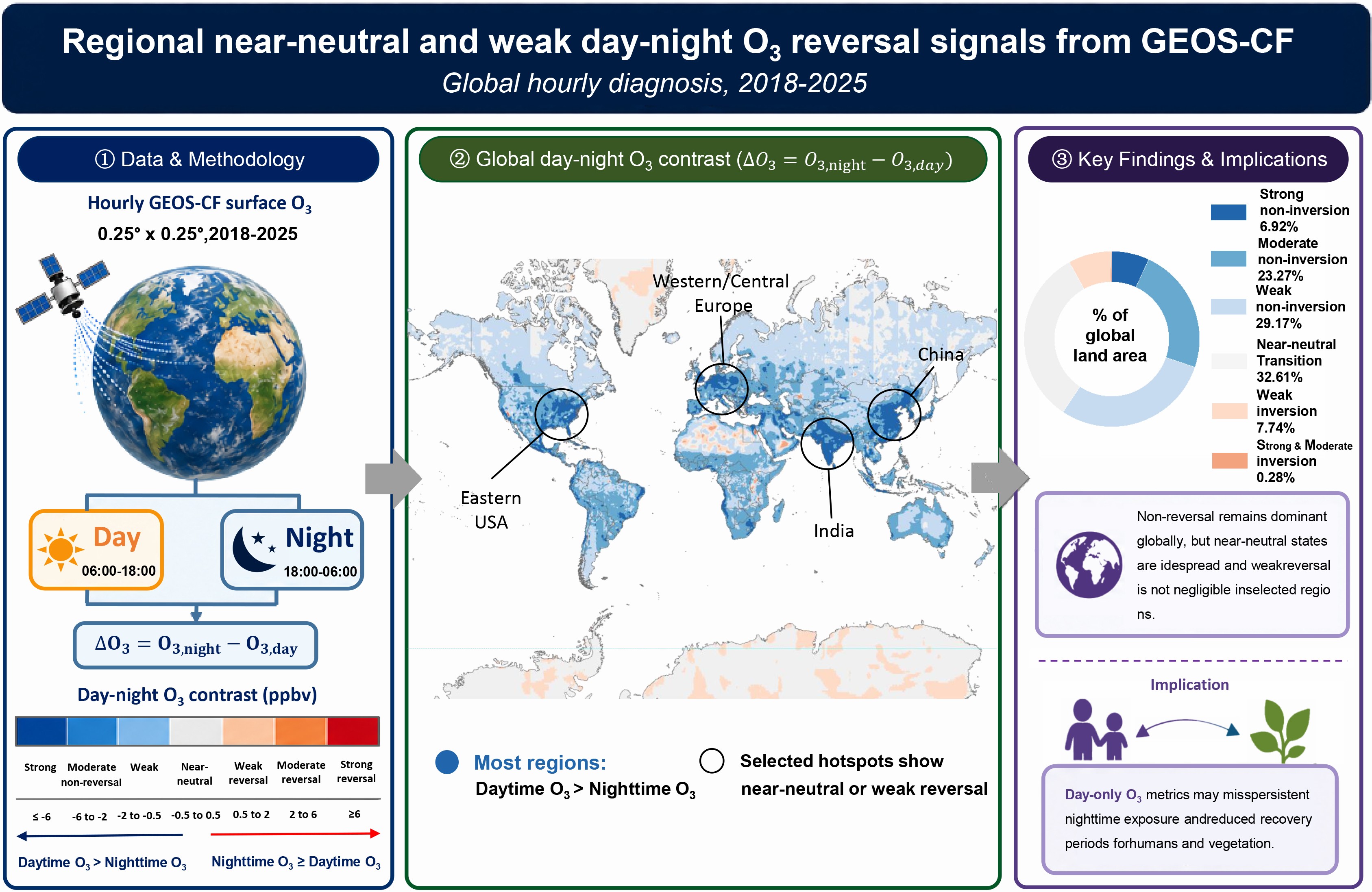
- GEOS-CF reveals regional near-neutral and weak day–night O3 reversal signals.
- Non-reversal dominates globally, but reversal covers ~8% of monthly land area.
- Day-only O3 metrics may underestimate exposure in regions with nocturnal persistence.
- Open Access
- Short Communication
GEOS-CF Evidence for Regional Near-Neutral and Weak Day–Night Reversal Signals in Surface Ozone
- Chao He 1,
- Qian Wu 2,
- Yanwen Wang 3,4,
- Peiyue Tu 2,4,
- Chaoqing Huang 5,*
Author Information
Received: 24 Feb 2026 | Revised: 30 May 2026 | Accepted: 23 Jun 2026 | Published: 17 Jul 2026
Highlights
Abstract
Traditionally, near-surface ozone (O3) concentrations are higher during the day than at night. However, analysis of global hourly O3 reanalysis data from 2018–2025 reveals that a day–night reversal (higher nighttime than daytime concentrations) is emerging in many regions. Globally, the day–night O3 difference is diminishing, with a notable reversal already evident in parts of India, China, and selected cities in Western Europe. This shift challenges long-held assumptions about O3 diurnal patterns and has important implications for understanding regional chemistry, air quality assessment, and policy development.
Graphical Abstract
Keywords
References
- 1.
He, C.; Liu, J.; Zhou, Y.; Zhou, J.; et al. Synergistic PM2.5 and O3 Control to Address the Emerging Global PM2.5-O3 Compound Pollution Challenges. Eco Environ. Health 2024, 3, 325–337. https://doi.org/10.1016/j.eehl.2024.04.004.
- 2.
Wang, Y.; Yang, Y.; Yuan, Q.; et al. Substantially underestimated global health risks of current ozone pollution. Nat. Commun. 2025, 16, 102. https://doi.org/10.1038/s41467-024-55450-0.
- 3.
Wang, W.; Li, X.; Cheng, Y.; et al. Ozone pollution mitigation strategy informed by long-term trends of atmospheric oxidation capacity. Nat. Geosci. 2023, 17, 20–25. https://doi.org/10.1038/s41561-023-01334-9.
- 4.
Gao, J.; Zhu, B.; Xiao, H.; et al. Diurnal variations and source apportionment of ozone at the summit of Mount Huang, a rural site in Eastern China. Environ. Pollut. 2017, 222, 513–522. https://doi.org/10.1016/j.envpol.2016.11.031.
- 5.
Li, S.; Song, G.; Xing, J.; et al. Unraveling overestimated exposure risks through hourly ozone retrievals from next-generation geostationary satellites. Nat. Commun. 2025, 16, 3364. https://doi.org/10.1038/s41467-025-58652-2.
- 6.
Keller, C.; Knowland, K.; Duncan, B.; et al. Description of the NASA GEOS Composition Forecast Modeling System GEOS-CF v1.0. J. Adv. Model. Earth Syst. 2021, 13, e2020MS002413. https://doi.org/10.1029/2020ms002413.
- 7.
Shan, Y.; Zhu, Y.; Qi, Y.; et al. Insights into atmospheric trace gases, aerosols, and transport processes at a high-altitude station (2623 m a.s.l.) in Northeast Asia. Atmos. Environ. 2024, 326, 120482. https://doi.org/10.1016/j.atmosenv.2024.120482.
- 8.
Sen, P.K. Estimates of the regression coefficient based on Kendall’s tau. J. Am. Stat. Assoc. 1968, 63, 1379–1389. https://doi.org/10.1080/01621459.1968.10480934.
- 9.
Gopikrishnan, G.S.; Kuttippurath, J. Global tropical and extra-tropical tropospheric ozone trends and radiative forcing deduced from satellite and ozonesonde measurements for the period 2005–2020. Environ. Pollut. 2024, 361, 124869. https://doi.org/10.1016/j.envpol.2024.124869.
- 10.
Knowland, K.E.; Keller, C.A.; Lucchesi, R. File Specification for GEOS-CF Products; GMAO Office Note No. 17, Version 1.3, 54p; NASA Goddard Space Flight Center, Global Modeling and Assimilation Office: Greenbelt, MD, USA, 2022.

How to Cite
He, C.; Wu, Q.; Wang, Y.; Tu, P.; Huang, C. GEOS-CF Evidence for Regional Near-Neutral and Weak Day–Night Reversal Signals in Surface Ozone. Global Environmental Science 2026, 2 (3), 273–277. https://doi.org/10.53941/ges.2026.100018.
RIS
BibTex
Copyright & License

Copyright (c) 2026 by the authors.
This work is licensed under a Creative Commons Attribution 4.0 International License.
Article Metrics
163
Article Views
0
Citations
Contents
References

 Suite 4002 Level 4, 447 Collins Street, Melbourne, Victoria 3000, Australia
 General Inquiries: info@sciltp.com