
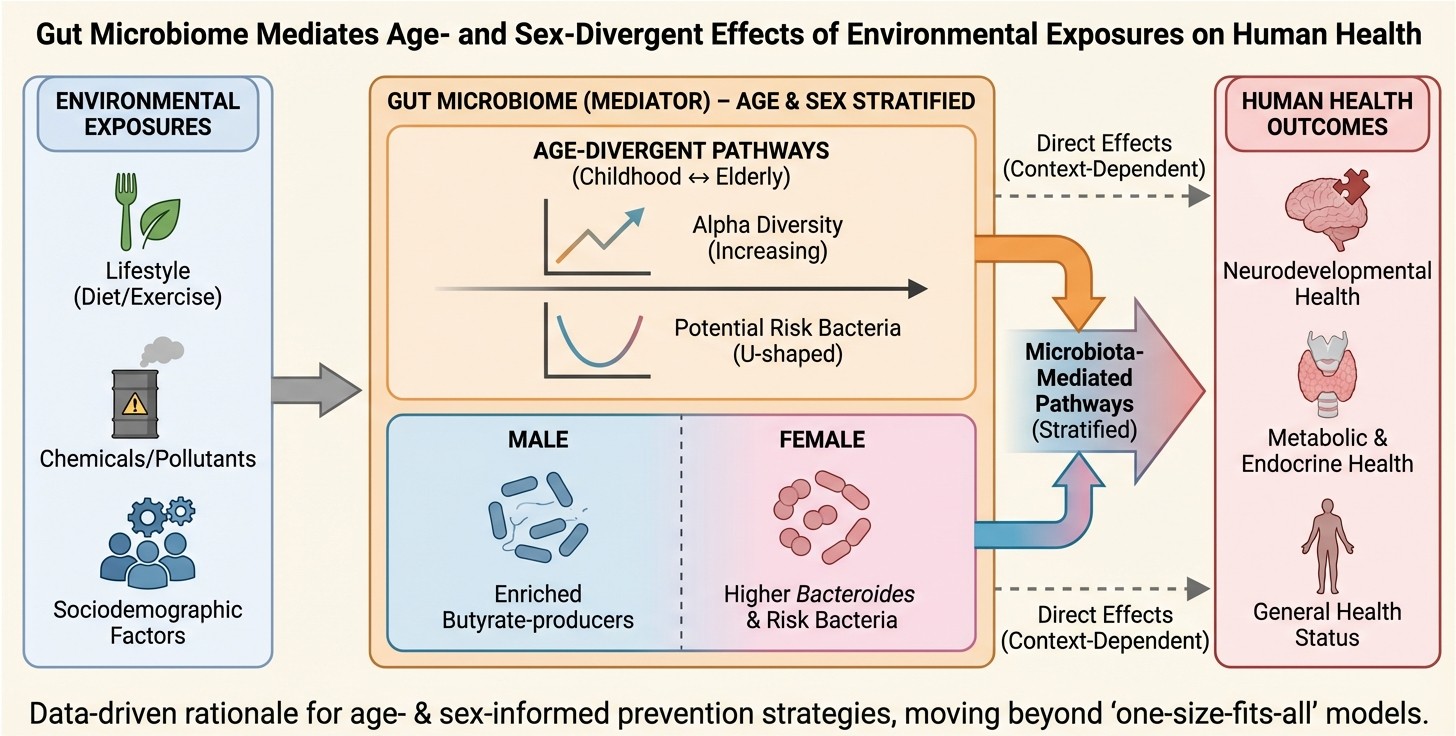
- Age and sex stratify gut microbiome responses to environmental exposures.
- Mediation analysis reveals distinct pollution-microbiome-health pathways.
- ASD risk from Endosulfan is microbiota-mediated in females, direct in males.
- Diversity rises with age while risk bacteria exhibit a U-shaped trajectory.
- Open Access
- Article
Gut Microbiome Mediates Age- and Sex-Divergent Effects of Environmental Exposures on Human Health
- Jieying Ou 1,
- Yuwei Tang 1,
- Xinghan Wang 1,
- Yiwen Yuan 1,
- Xi Fu 2,*,
- Yu Sun 1,*
Author Information
Received: 06 Jan 2026 | Revised: 07 Feb 2026 | Accepted: 23 Jul 2026 | Published: 06 Aug 2026
Highlights
Abstract
The gut microbiome acts as a critical interface between environmental exposures and human health, yet the influence of intrinsic host factors on this interaction remains poorly understood. We hypothesized that the microbiome’s role as a mediator of environmental risks is fundamentally stratified by host age and sex. Integrating 16S rRNA gene sequencing from 13,991 American Gut Project participants with extensive geospatial environmental datasets, we performed stratified regression and formal mediation analyses on 86 environmental/personal factors and 24 self-reported health outcomes. We identified distinct, age- and sex- dependent microbial trajectories; alpha diversity increased with age, while the abundance of potential risk bacteria exhibited a U-shaped distribution, peaking in children and the elderly (p < 0.001). Females had a higher abundance of Bacteroides and potential risk bacteria, whereas males were enriched in butyrate-producing bacteria (p < 0.001). The influence of environmental factors was highly stratified; for example, the impact of diet and exercise on alpha diversity was strongest in children, while travel’s impact was greatest in the elderly (q < 0.05). Mediation analysis identified potential stratified risk pathways. The microbiome-mediated risk of thyroid dysfunction from POPs was significant only in older adults (p < 0.05). Furthermore, the risk pathway for ASD linked to Endosulfan exposure was sex-dependent: a direct toxicological effect was significant in males, whereas the primary pathway in females was microbiota-mediated. These stratified pathways provide potential mechanistic insights into well-known demographic disparities in human diseases. Our findings provide a data-driven rationale for moving beyond “one-size-fits-all” models toward age- and sex-informed strategies for disease prevention and public health.
Graphical Abstract
Keywords
gut microbiome | host-microbe interactions | mediation analysis | sex differences | environmental exposures
References
- 1.
Yuan, Y.; Fu, X.; Deng, Y.; et al. Exploring the role of genetics, gut microbiota and blood metabolites in IBD. Gut 2025, 74, 690–691.
- 2.
Gacesa, R.; Kurilshikov, A.; Vich Vila, A.; et al. Environmental factors shaping the gut microbiome in a Dutch population. Nature 2022, 604, 732–739.
- 3.
Schupack, D.A.; Mars, R.A.T.; Voelker, D.H.; et al. The promise of the gut microbiome as part of individualized treatment strategies. Nat. Rev. Gastroenterol. Hepatol. 2022, 19, 7–25.
- 4.
de Vos, W.M.; Tilg, H.; Van Hul, M.; et al. Gut microbiome and health: Mechanistic insights. Gut 2022, 71, 1020–1032.
- 5.
Stewart, C.J.; Ajami, N.J.; O’Brien, J.L.; et al. Temporal development of the gut microbiome in early childhood from the TEDDY study. Nature 2018, 562, 583–588.
- 6.
Yatsunenko, T.; Rey, F.E.; Manary, M.J.; et al. Human gut microbiome viewed across age and geography. Nature 2012, 486, 222–227.
- 7.
Hassan, S.; Kaakinen, M.A.; Draisma, H.; et al. Bifidobacterium Is Enriched in Gut Microbiome of Kashmiri Women with Polycystic Ovary Syndrome. Genes 2022, 13, 379.
- 8.
Hatayama, K.; Kono, K.; Okuma, K.; et al. Sex Differences in Intestinal Microbiota and Their Association with Some Diseases in a Japanese Population Observed by Analysis Using a Large Dataset. Biomedicines 2023, 11, 376.
- 9.
Sisk-Hackworth, L.; Kelley, S.T.; Thackray, V.G. Sex, puberty, and the gut microbiome. Reproduction 2023, 165, R61–R74.
- 10.
Sun, Y.; Meng, Y.; Ou, Z.; et al. Indoor microbiome, air pollutants and asthma, rhinitis and eczema in preschool children—A repeated cross-sectional study. Environ. Int. 2022, 161, 107137.
- 11.
Shen, J.; Zhang, D.; Liang, B. Prediction of host age and sex classification through gut microbes based on machine learning. Biochem. Eng. J. 2022, 178, 108280.
- 12.
McDonald, D.; Hyde, E.; Debelius, J.W.; et al. American Gut: An Open Platform for Citizen Science Microbiome Research. mSystems 2018, 3, e00031-18.
- 13.
Bolyen, E.; Rideout, J.R.; Dillon, M.R.; et al. Reproducible, interactive, scalable and extensible microbiome data science using QIIME 2. Nat. Biotechnol. 2019, 37, 852–857.
- 14.
Zhang, X.; Wang, X.; Hu, H.; et al. Prevalence and Trends of Thyroid Disease Among Adults, 1999–2018. Endocr. Pract. 2023, 29, 875–880.
- 15.
Yap, C.X.; Henders, A.K.; Alvares, G.A.; et al. Autism-related dietary preferences mediate autism-gut microbiome associations. Cell 2021, 184, 5916–5931.e5917.
- 16.
Brugha, T.S.; McManus, S.; Bankart, J.; et al. Epidemiology of autism spectrum disorders in adults in the community in England. Arch. Gen. Psychiatry 2011, 68, 459–465.
- 17.
Maffei, V.J.; Kim, S.; Blanchard, E.T.; et al. Biological Aging and the Human Gut Microbiota. J. Gerontol. A Biol. Sci. Med. Sci. 2017, 72, 1474–1482.
- 18.
Salazar, N.; Valdes-Varela, L.; Gonzalez, S.; et al. Nutrition and the gut microbiome in the elderly. Gut Microbes 2017, 8, 82–97.
- 19.
Wu, L.; Zeng, T.; Zinellu, A.; et al. A Cross-Sectional Study of Compositional and Functional Profiles of Gut Microbiota in Sardinian Centenarians. mSystems 2019, 4, e00325-19.
- 20.
Ruiz-Ruiz, S.; Sanchez-Carrillo, S.; Ciordia, S.; et al. Functional microbiome deficits associated with ageing: Chronological age threshold. Aging Cell 2020, 19, e13063.
- 21.
Fryar, C.D.; Carroll, M.D.; Gu, Q.; et al. Anthropometric Reference Data for Children and Adults: United States, 2015–2018; Vital & Health Statistics Series 3, Analytical and Epidemiological Studies; U.S. Government Publishing Office: Washington, DC, USA, 2021.
- 22.
Koenig, J.E.; Spor, A.; Scalfone, N.; et al. Succession of microbial consortia in the developing infant gut microbiome. Proc. Natl. Acad. Sci. USA 2011, 108, 4578–4585.
- 23.
van Nimwegen, F.A.; Penders, J.; Stobberingh, E.E.; et al. Mode and place of delivery, gastrointestinal microbiota, and their influence on asthma and atopy. J. Allergy Clin. Immunol. 2011, 128, 948–955.e1–3.
- 24.
Song, C.-H.; Kim, N.; Nam, R.H.; et al. The Possible Preventative Role of Lactate- and Butyrate-Producing Bacteria in Colorectal Carcinogenesis. Gut Liver 2024, 18, 654–666.
- 25.
So, D.; Whelan, K.; Rossi, M.; et al. Dietary fiber intervention on gut microbiota composition in healthy adults: A systematic review and meta-analysis. Am. J. Clin. Nutr. 2018, 107, 965–983.
- 26.
Miranda, P.M.; De Palma, G.; Serkis, V.; et al. High salt diet exacerbates colitis in mice by decreasing Lactobacillus levels and butyrate production. Microbiome 2018, 6, 57.
- 27.
Gensollen, T.; Iyer, S.S.; Kasper, D.L.; et al. How colonization by microbiota in early life shapes the immune system. Science 2016, 352, 539–544.
- 28.
Laforest-Lapointe, I.; Arrieta, M.-C. Patterns of Early-Life Gut Microbial Colonization during Human Immune Development: An Ecological Perspective. Front. Immunol. 2017, 8, 788.
- 29.
Rodriguez, J.M.; Murphy, K.; Stanton, C.; et al. The composition of the gut microbiota throughout life, with an emphasis on early life. Microb. Ecol. Health Dis. 2015, 26, 26050.
- 30.
Du, B.; Shama, A.; Zhang, Y.; et al. Gut microbiota and plasma metabolites in pregnant mothers and infant atopic dermatitis: A multi-omics study. World Allergy Organ. J. 2025, 18, 101017.
- 31.
Mann, E.R.; Lam, Y.K.; Uhlig, H.H. Short-chain fatty acids: Linking diet, the microbiome and immunity. Nat. Rev. Immunol. 2024, 24, 577–595.
- 32.
Zhang, L.; Liu, C.; Jiang, Q.; et al. Butyrate in Energy Metabolism: There Is Still More to Learn. Trends Endocrinol. Metab. 2021, 32, 159–169.
- 33.
Kriss, M.; Hazleton, K.Z.; Nusbacher, N.M.; et al. Low diversity gut microbiota dysbiosis: Drivers, functional implications and recovery. Curr. Opin. Microbiol. 2018, 44, 34–40.
- 34.
Bjorvang, R.D.; Mamsen, L.S. Sexually Dimorphic Accumulation of Persistent Organic Pollutants in Fetuses. Front. Toxicol. 2022, 4, 909307.
- 35.
Kim, M.J.; Choi, S.; Kim, S.; et al. Sex, menopause, and age differences in the associations of persistent organic pollutants with thyroid hormones, thyroxine-binding globulin, and peripheral deiodinase activity: A cross-sectional study of the general Korean adult population. Environ. Res. 2022, 212, 113143.
- 36.
Han, X.; Meng, L.; Li, Y.; et al. Associations between Exposure to Persistent Organic Pollutants and Thyroid Function in a Case-Control Study of East China. Environ. Sci. Technol. 2019, 53, 9866–9875.
- 37.
Knezevic, J.; Starchl, C.; Tmava Berisha, A.; et al. Thyroid-Gut-Axis: How Does the Microbiota Influence Thyroid Function? Nutrients 2020, 12, 1769.
- 38.
Frohlich, E.; Wahl, R. Microbiota and Thyroid Interaction in Health and Disease. Trends Endocrinol. Metab. 2019, 30, 479–490.
- 39.
Silva, I.B.; Puig-Domingo, M. The impact of thyroid disorders on the gut microbiome: Emerging mechanisms and clinical relevance. Arch. Endocrinol. Metab. 2025, 70, e250075.
- 40.
Pace, F.; Watnick, P.I. The Interplay of Sex Steroids, the Immune Response, and the Intestinal Microbiota. Trends Microbiol. 2021, 29, 849–859.
- 41.
Vemuri, R.; Sylvia, K.E.; Klein, S.L.; et al. The microsexome revealed: Sex differences in bidirectional interactions between the microbiota, hormones, immunity and disease susceptibility. Semin. Immunopathol. 2019, 41, 265–275.
- 42.
Wastyk, H.C.; Fragiadakis, G.K.; Perelman, D.; et al. Gut-microbiota-targeted diets modulate human immune status. Cell 2021, 184, 4137–4153.e4114.
- 43.
Voreades, N.; Kozil, A.; Weir, T.L. Diet and the development of the human intestinal microbiome. Front. Microbiol. 2014, 5, 494.
- 44.
Lu, C.; Deng, W.; Qiao, Z.; et al. Childhood Helicobacter pylori infection: Impacts of environmental exposures and parental stress. J. Hazard. Mater. 2024, 478, 135584.
- 45.
Lu, C.; Jiang, Y.; Deng, W.; et al. Early-life nutritional additives, household environment, and air pollution in relation to childhood food allergies: A multi-city mother–child study in China. Environ. Int. 2025, 203, 109774.
- 46.
Claesson, M.J.; Cusack, S.; O’Sullivan, O.; et al. Composition, variability, and temporal stability of the intestinal microbiota of the elderly. Proc. Natl. Acad. Sci. USA 2011, 108, 4586–4591.
- 47.
Kampmann, C.; Dicksved, J.; Engstrand, L.; et al. Changes to human faecal microbiota after international travel. Travel Med. Infect. Dis. 2021, 44, 102199.
- 48.
O’Donovan, C.M.; Connor, B.; Madigan, S.M.; et al. Instances of altered gut microbiomes among Irish cricketers over periods of travel in the lead up to the 2016 World Cup: A sequencing analysis. Travel Med. Infect. Dis. 2020, 35, 101553.
- 49.
Pandics, T.; Major, D.; Fazekas-Pongor, V.; et al. Exposome and unhealthy aging: Environmental drivers from air pollution to occupational exposures. GeroScience 2023, 45, 3381–3408.
- 50.
Odamaki, T.; Kato, K.; Sugahara, H.; et al. Age-related changes in gut microbiota composition from newborn to centenarian: A cross-sectional study. BMC Microbiol. 2016, 16, 90.
- 51.
Biagi, E.; Franceschi, C.; Rampelli, S.; et al. Gut Microbiota and Extreme Longevity. Curr. Biol. 2016, 26, 1480–1485.
- 52.
Cui, J.; Lian, Y.; Zhao, C.; et al. Dietary Fibers from Fruits and Vegetables and Their Health Benefits via Modulation of Gut Microbiota. Compr. Rev. Food Sci. Food Saf. 2019, 18, 1514–1532.
- 53.
Sun, Z.; Wang, Y.; Su, X.; et al. Proteomic Characterization of Human Gut Habitual Bacteroides intestinalis against Common Intestinal Bile Acid Stress. Adv. Gut Microbiome Res. 2023, 2023, 1–10.
- 54.
Acharya, K.D.; Friedline, R.H.; Ward, D.V.; et al. Differential effects of Akkermansia-enriched fecal microbiota transplant on energy balance in female mice on high-fat diet. Front. Endocrinol. 2022, 13, 1010806.
- 55.
Santos-Marcos, J.A.; Haro, C.; Vega-Rojas, A.; et al. Sex Differences in the Gut Microbiota as Potential Determinants of Gender Predisposition to Disease. Mol. Nutr. Food Res. 2019, 63, e1800870.
- 56.
De Filippis, F.; Pellegrini, N.; Vannini, L.; et al. High-level adherence to a Mediterranean diet beneficially impacts the gut microbiota and associated metabolome. Gut 2016, 65, 1812–1821.
- 57.
Kovatcheva-Datchary, P.; Nilsson, A.; Akrami, R.; et al. Dietary Fiber-Induced Improvement in Glucose Metabolism Is Associated with Increased Abundance of Prevotella. Cell Metab. 2015, 22, 971–982.
How to Cite
Ou, J.; Tang, Y.; Wang, X.; Yuan, Y.; Fu, X.; Sun, Y. Gut Microbiome Mediates Age- and Sex-Divergent Effects of Environmental Exposures on Human Health. Global Environmental Science 2026, 2 (3), 295–311. https://doi.org/10.53941/ges.2026.100020.
RIS
BibTex
Copyright & License

Copyright (c) 2026 by the authors.
This work is licensed under a Creative Commons Attribution 4.0 International License.
Article Metrics
118
Article Views
1
Citations
Contents
References

 Suite 4002 Level 4, 447 Collins Street, Melbourne, Victoria 3000, Australia
 General Inquiries: info@sciltp.com