
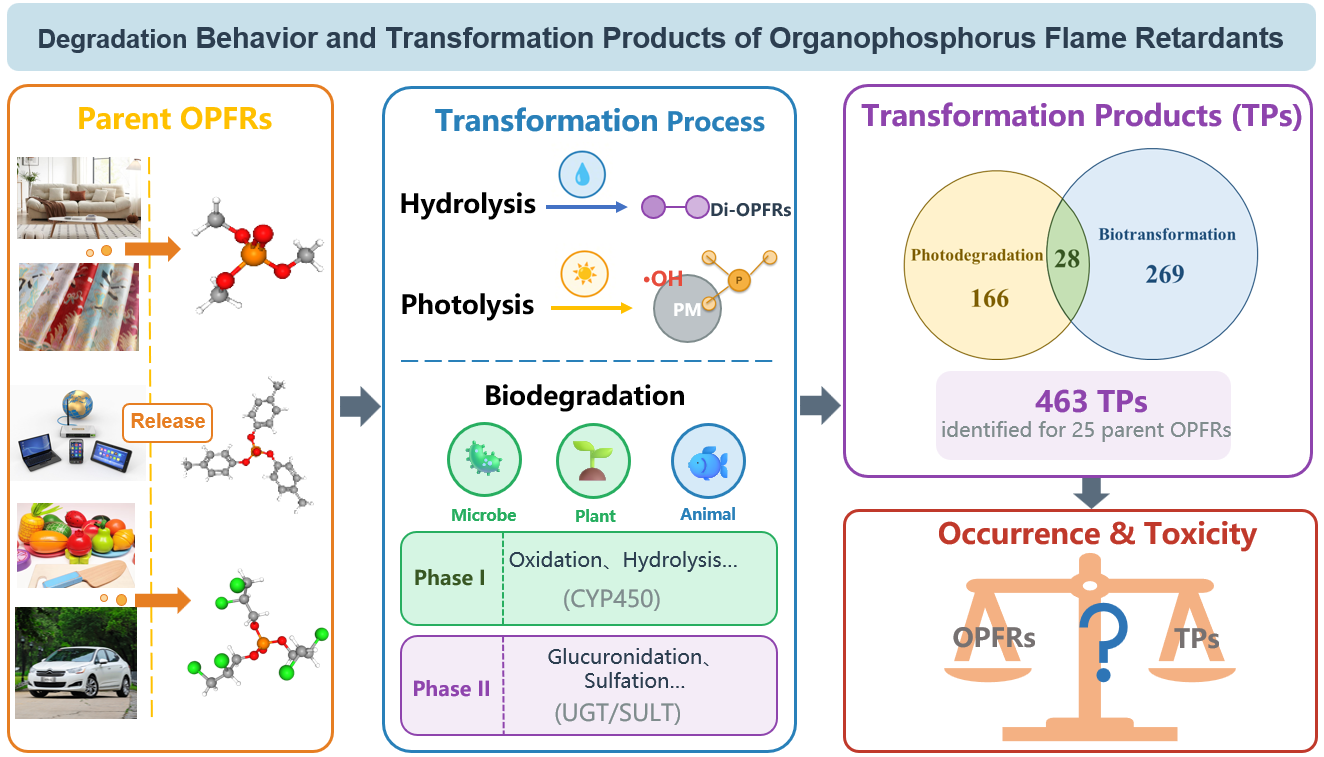
- 463 transformation products from 25 parent OPFRs were compiled
- Hydrolysis and hydroxylation dominate OPFR biotransformation pathways
- 19 TPs were confirmed in multiple environmental matrices
- Some diester and hydroxylated TPs show stronger toxicity than parent OPFRs
- Open Access
- Review
Review on Degradation Behavior and Transformation Products of Organophosphorus Flame Retardants
- Lan Jiang,
- Yue Shi,
- Yuyao Zhou,
- Yonghao Huangfu,
- Siyang Xu,
- Qingwei Bu *
Author Information
Received: 06 Mar 2026 | Revised: 22 Aug 2026 | Accepted: 01 Sep 2026 | Published: 28 Sep 2026
Highlights
Abstract
Organophosphorus flame retardants (OPFRs), as widespread alternatives to brominated flame retardants, are now ubiquitous in the environment and generate a large number of uncharacterized transformation products (TPs) through abiotic and biotic transformation. However, a comprehensive description of OPFR TPs is still lacking. This review systematically integrates current knowledge on the environmental fate of OPFRs, focusing on the formation, occurrence, and toxicity of TPs. We compiled 463 TPs derived from 25 parent OPFRs identified in laboratory studies, involving 1338 reaction pathways, among which hydrolysis (>29%) and hydroxylation (>30%) were the dominant reaction pathways in microbial, plant, and animal metabolism. To date, 19 TPs have been confirmed in multiple environmental matrices, among which diester metabolites (e.g., diphenyl phosphate (DPHP) and bis(1,3-dichloro-2-propyl) phosphate (BDCIPP)) are most frequently detected in human urine, blood, and breast milk. Importantly, accumulating toxicological data indicate that TPs such as hydroxylated triphenyl phosphate (OH-TPHP), BDCIPP, and di-n-butyl phosphate (DnBP) exhibit greater endocrine-disrupting, developmental, and metabolic toxicity than their parent compounds. Given the evidence presented, heightened emphasis should be placed on incorporating TPs into environmental risk assessment.
Graphical Abstract
Keywords
organophosphorus flame retardants | transformation pathways | transformation products | toxicological effects
References
- 1.
Keimowitz, A.R.; Strunsky, N.; Wovkulich, K. Organophosphate flame retardants in household dust before and after introduction of new furniture. Chemosphere 2016, 148, 467–472. https://doi.org/10.1016/j.chemosphere.2016.01.048.
- 2.
van der Veen, I.; de Boer, J. Phosphorus flame retardants: Properties, production, environmental occurrence, toxicity and analysis. Chemosphere 2012, 88, 1119–1153. https://doi.org/10.1016/j.chemosphere.2012.03.067.
- 3.
Ma, H.; Wang, C.; Suo, H.; et al. Global gridded emission inventory of organophosphate flame retardants from 2010 to 2020. Environ. Sci. Technol. 2024, 58, 17070–17080. https://doi.org/10.1021/acs.est.4c06504.
- 4.
Huang, J.; Ye, L.; Fang, M.; et al. Industrial production of organophosphate flame retardants (OPFRs): Big knowledge gaps need to be filled? Bull. Environ. Contam. Toxicol. 2022, 108, 809–818. https://doi.org/10.1007/s00128-021-03454-7.
- 5.
Greaves, A.K.; Letcher, R.J. A review of organophosphate esters in the environment from biological effects to distribution and fate. Bull. Environ. Contam. Toxicol. 2017, 98, 2–7. https://doi.org/10.1007/s00128-016-1898-0.
- 6.
Alghamdi, M.; Abdallah, M.A.-E.; Harrad, S. The utility of X-Ray fluorescence spectrometry as a tool for monitoring compliance with limits on concentrations of halogenated flame retardants in waste polymers: A critical review. Emerg. Contam. 2022, 8, 9–20. https://doi.org/10.1016/j.emcon.2021.12.002.
- 7.
Yao, C.; Yang, H.; Li, Y. A review on organophosphate flame retardants in the environment: Occurrence, accumulation, metabolism and toxicity. Sci. Total Environ. 2021, 795, 148837. https://doi.org/10.1016/j.scitotenv.2021.148837.
- 8.
Wang, Z.; Qi, A.; Lv, J.; et al. Occurrence and seasonal variations of organophosphate flame retardants in air and dust from college microenvironments at Qingdao, China: Implications for student’s exposure and risk assessment. Sci. Total Environ. 2024, 937, 173182. https://doi.org/10.1016/j.scitotenv.2024.173182.
- 9.
Chen, M.; Jiang, J.; Gan, Z.; et al. Grain size distribution and exposure evaluation of organophosphorus and brominated flame retardants in indoor and outdoor dust and PM10 from Chengdu, China. J. Hazard. Mater. 2019, 365, 280–288. https://doi.org/10.1016/j.jhazmat.2018.10.082.
- 10.
Kim, U.J.; Kannan, K. Occurrence and distribution of organophosphate flame retardants/plasticizers in surface waters, tap water, and rainwater: Implications for human exposure. Environ. Sci. Technol. 2018, 52, 5625–5633. https://doi.org/10.1021/acs.est.8b00727.
- 11.
Han, F.; Chen, G.; Tao, G.; et al. Thyroid-disrupting effects caused by exposure to alternative flame retardants from groundwater contamination in rural central China. Sci. Total Environ. 2022, 839, 156300. https://doi.org/10.1016/j.scitotenv.2022.156300.
- 12.
Casas, G.; Martinez-Varela, A.; Vila-Costa, M.; et al. Rain amplification of persistent organic pollutants. Environ. Sci. Technol. 2021, 55, 12961–12972. https://doi.org/10.1021/acs.est.1c03295.
- 13.
Hu, Y.X.; Sun, Y.X.; Li, X.; et al. Organophosphorus flame retardants in mangrove sediments from the pearl river estuary, south China. Chemosphere 2017, 181, 433–439. https://doi.org/10.1016/j.chemosphere.2017.04.117.
- 14.
Wang, Y.; Sun, H.; Zhu, H.; et al. Occurrence and distribution of organophosphate flame retardants (OPFRs) in soil and outdoor settled dust from a multi-waste recycling area in China. Sci. Total Environ. 2018, 625, 1056–1064. https://doi.org/10.1016/j.scitotenv.2018.01.013.
- 15.
Zhang, X.; Zou, W.; Mu, L.; et al. Rice ingestion is a major pathway for human exposure to organophosphate flame retardants (OPFRs) in China. J. Hazard. Mater. 2016, 318, 686–693. https://doi.org/10.1016/j.jhazmat.2016.07.055.
- 16.
Bekele, T.G.; Zhao, H.; Wang, Q.; et al. Bioaccumulation and trophic transfer of emerging organophosphate flame retardants in the marine food webs of Laizhou Bay, North China. Environ. Sci. Technol. 2019, 53, 13417–13426. https://doi.org/10.1021/acs.est.9b03687.
- 17.
Guo, Y.; Chen, M.; Liao, M.; et al. Organophosphorus flame retardants and their metabolites in paired human blood and urine. Ecotoxicol. Environ. Saf. 2023, 268, 115696. https://doi.org/10.1016/j.ecoenv.2023.115696.
- 18.
Qiao, L.; Zheng, X.B.; Zheng, J.; et al. Legacy and currently used organic contaminants in human hair and hand wipes of female e-waste dismantling workers and workplace dust in South China. Environ. Sci. Technol. 2019, 53, 2820–2829. https://doi.org/10.1021/acs.est.8b05503.
- 19.
Chen, Y.; Cao, Z.; Covaci, A.; et al. Novel and legacy flame retardants in paired human fingernails and indoor dust samples. Environ. Int. 2019, 133, 105227. https://doi.org/10.1016/j.envint.2019.105227.
- 20.
Brommer, S.; Jantunen, L.M.; Bidleman, T.F.; et al. Determination of vapor pressures for organophosphate esters. J. Chem. Eng. Data 2014, 59, 1441–1447. https://doi.org/10.1021/je401026a.
- 21.
Hong, X.; Yuan, L.; Zhao, X.; et al. Embryonic exposure to organophosphate flame retardants (OPFRs) differentially induces cardiotoxicity in rare minnow (Gobiocypris rarus). Environ. Sci. Technol. 2024, 58, 13648–13657. https://doi.org/10.1021/acs.est.4c01927.
- 22.
Sun, L.; Xu, W.; Peng, T.; et al. Developmental exposure of zebrafish larvae to organophosphate flame retardants causes neurotoxicity. Neurotoxicol. Teratol. 2016, 55, 16–22. https://doi.org/10.1016/j.ntt.2016.03.003.
- 23.
Hao, Z.; Zhang, Z.; Lu, D.; et al. Organophosphorus flame retardants impair intracellular lipid metabolic function in human hepatocellular cells. Chem. Res. Toxicol. 2019, 32, 1250–1258. https://doi.org/10.1021/acs.chemrestox.9b00058.
- 24.
Wang, J.; Cui, Y.; Wang, Y.; et al. Tributyl phosphate induced male reproductive toxicity in mice. Environ. Sci. Technol. 2025, 59, 3000–3012. https://doi.org/10.1021/acs.est.4c10280.
- 25.
Song, Y.; Xu, T.; Zhang, H.; et al. Opposing visual impairments induced by structurally similar organophosphate flame retardants TPHP and CDP in zebrafish larvae. Environ. Sci. Technol. 2025, 59, 8428–8438. https://doi.org/10.1021/acs.est.5c00663.
- 26.
Hong, Z.; Li, Y.; Deng, X.; et al. Comprehensive analysis of triphenyl phosphate: An environmental explanation of colorectal cancer progression. Ecotoxicol. Environ. Saf. 2022, 241, 113778. https://doi.org/10.1016/j.ecoenv.2022.113778. Correction in Ecotoxicol. Environ. Saf. 2022, 242, 113911.
- 27.
Zhang, X.; Lu, Z.; Ren, X.; et al. Genetic comprehension of organophosphate flame retardants, an emerging threat to prostate cancer. Ecotoxicol. Environ. Saf. 2021, 223, 112589. https://doi.org/10.1016/j.ecoenv.2021.112589.
- 28.
Blum, A.; Behl, M.; Birnbaum, L.S.; et al. Organophosphate ester flame retardants: Are they a regrettable substitution for polybrominated diphenyl ethers? Environ. Sci. Technol. Lett. 2019, 6, 638–649. https://doi.org/10.1021/acs.estlett.9b00582.
- 29.
Zhang, L.; Luo, X.; Fu, J.; et al. Emerging aryl-organophosphate esters in coastal sediments: Comprehensive screening and transformation insights from the Beibu Gulf, China. Environ. Sci. Technol. 2025, 59, 18294–18305. https://doi.org/10.1021/acs.est.5c05790.
- 30.
Tran-Lam, T.T.; Pham, P.T.; Bui, M.Q.; et al. Organophosphate esters and their metabolites in marine fish from Vietnam: Analytical method development and validation. J. Food Compos. Anal. 2024, 131, 106266. https://doi.org/10.1016/j.jfca.2024.106266.
- 31.
Cao, J.; Wang, X.; Lei, Y.; et al. Health risks of low-dose dietary exposure to triphenyl phosphate and diphenyl phosphate in mice: Insights from the gut-liver axis. Environ. Sci. Technol. 2025, 59, 8960–8971. https://doi.org/10.1021/acs.est.4c08270.
- 32.
Tian, Y.X.; Chen, H.Y.; Ma, J.; et al. A critical review on sources and environmental behavior of organophosphorus flame retardants in the soil: Current knowledge and future perspectives. J. Hazard. Mater. 2023, 452, 131161. https://doi.org/10.1016/j.jhazmat.2023.131161.
- 33.
Zhang, Q.; Wang, Y.; Zhang, C.; et al. A review of organophosphate esters in soil: Implications for the potential source, transfer, and transformation mechanism. Environ. Res. 2022, 204, 112122. https://doi.org/10.1016/j.envres.2021.112122.
- 34.
Zhou, X.; Wang, C.; Huang, M.; et al. A review of the present methods used to remediate soil and water contaminated with organophosphate esters and developmental directions. J. Hazard. Mater. 2024, 475, 134834. https://doi.org/10.1016/j.jhazmat.2024.134834.
- 35.
Yang, L.; Yin, Z.; Tian, Y.; et al. A new and systematic review on the efficiency and mechanism of different techniques for OPFRs removal from aqueous environments. J. Hazard. Mater. 2022, 431, 128517. https://doi.org/10.1016/j.jhazmat.2022.128517.
- 36.
Blumenthal, E.; Herbert, J.B.M. The mechanism of the hydrolysis of trimethyl orthophosphate. Trans. Faraday Soc. 1945, 41, 611–617. https://doi.org/10.1039/tf9454100611.
- 37.
Tarrat, N. Alkaline hydrolysis of phosphate triesters in solution: Stepwise or concerted? A theoretical study. J. Mol. Struct. THEOCHEM. 2010, 941, 56–60. https://doi.org/10.1016/j.theochem.2009.11.001.
- 38.
Su, G.; Letcher, R.J.; Yu, H. Organophosphate flame retardants and plasticizers in aqueous solution: pH-dependent hydrolysis, kinetics, and pathways. Environ. Sci. Technol. 2016, 50, 8103–8111. https://doi.org/10.1021/acs.est.6b02187.
- 39.
Howard, P.H.; Deo, P.G. Degradation of aryl phosphates in aquatic environments. Bull. Environ. Contam. Toxicol. 1979, 22, 337–344. https://doi.org/10.1007/bf02026952.
- 40.
David, M.D.; Seiber, J.N. Accelerated hydrolysis of industrial organophosphates in water and soil using sodium perborate. Environ. Pollut. 1999, 105, 121–128. https://doi.org/10.1016/s0269-7491(98)00173-0.
- 41.
Fang, Y.; Kim, E.; Strathmann, T.J. Mineral - and base-catalyzed hydrolysis of organophosphate flame retardants: Potential major fate-controlling sink in soil and aquatic environments. Environ. Sci. Technol. 2018, 52, 1997–2006. https://doi.org/10.1021/acs.est.7b05911.
- 42.
Li, Y.; Liu, K.; Guo, Y.; et al. Mechanistic insights into facet-dependent catalytic hydrolysis of organophosphate ester by α-MnO2 nanorods. Sep. Purif. Technol. 2025, 360, 130940. https://doi.org/10.1016/j.seppur.2024.130940.
- 43.
Saint-Hilaire, D.; Jans, U. Reactions of three halogenated organophosphorus flame retardants with reduced sulfur species. Chemosphere 2013, 93, 2033–2039. https://doi.org/10.1016/j.chemosphere.2013.07.028.
- 44.
Saint-Hilaire, D.; Ismail, K.Z.; Jans, U. Reaction of tris(2-chloroethyl) phosphate with reduced sulfur species. Chemosphere 2011, 83, 941–947. https://doi.org/10.1016/j.chemosphere.2011.02.040.
- 45.
Gong, X.; Zhang, W.; Zhang, S.; et al. Organophosphite antioxidants in mulch films are important sources of organophosphate pollutants in farmlands. Environ. Sci. Technol. 2021, 55, 7398–7406. https://doi.org/10.1021/acs.est.0c08741.
- 46.
Liu, Q.; Li, L.; Zhang, X.; et al. Uncovering global-scale risks from commercial chemicals in air. Nature 2021, 600, 456–461. https://doi.org/10.1038/s41586-021-04134-6.
- 47.
Yu, Q.; Xie, H.B.; Chen, J. Atmospheric chemical reactions of alternatives of polybrominated diphenyl ethers initiated by ·OH: A case study on triphenyl phosphate. Sci. Total Environ. 2016, 571, 1105–1114. https://doi.org/10.1016/j.scitotenv.2016.07.105.
- 48.
Li, C.; Chen, J.; Xie, H.B.; et al. Effects of atmospheric water on ·OH-initiated oxidation of organophosphate flame retardants: A DFT investigation on TCPP. Environ. Sci. Technol. 2017, 51, 5043–5051. https://doi.org/10.1021/acs.est.7b00347.
- 49.
Li, C.; Zheng, S.; Chen, J.; et al. Kinetics and mechanism of OH-initiated atmospheric oxidation of organophosphorus plasticizers: A computational study on tri-p-cresyl phosphate. Chemosphere 2018, 201, 557–563. https://doi.org/10.1016/j.chemosphere.2018.03.034.
- 50.
Liu, Y.; Huang, L.; Li, S.M.; et al. OH-initiated heterogeneous oxidation of tris-2-butoxyethyl phosphate: Implications for its fate in the atmosphere. Atmos. Chem. Phys. 2014, 14, 12195–12207. https://doi.org/10.5194/acp-14-12195-2014.
- 51.
Lao, J.Y.; Lin, H.; Qin, X.; et al. Insights into the atmospheric persistence, transformation, and health implications of organophosphate esters in urban ambient air. Environ. Sci. Technol. 2022, 56, 12003–12013. https://doi.org/10.1021/acs.est.2c01161.
- 52.
Liu, Q.; Liggio, J.; Li, K.; et al. Understanding the impact of relative humidity and coexisting soluble iron on the OH-initiated heterogeneous oxidation of organophosphate flame retardants. Environ. Sci. Technol. 2019, 53, 6794–6803. https://doi.org/10.1021/acs.est.9b01758.
- 53.
Fan, W.; Zhu, Z.; Zhang, H.; et al. Degradation, transformation and cytotoxicity of triphenyl phosphate on surface of different transition metal salts in atmospheric environment. Sci. Total Environ. 2024, 937, 173462. https://doi.org/10.1016/j.scitotenv.2024.173462.
- 54.
Huo, Y.; Li, M.; Jiang, J.; et al. The homogeneous and heterogeneous oxidation of organophosphate esters (OPEs) in the atmosphere: Take diphenyl phosphate (DPhP) as an example. Environ. Pollut. 2023, 324, 121395. https://doi.org/10.1016/j.envpol.2023.121395.
- 55.
Wu, Y.; Wu, F.; Brigante, M.; et al. Reactive species-mediated phototransformation of triphenyl phosphate in cloud water: Kinetics, pathways and implications. Environ. Pollut. 2025, 383, 126717. https://doi.org/10.1016/j.envpol.2025.126717.
- 56.
Cristale, J.; Dantas, R.F.; De Luca, A.; et al. Role of oxygen and DOM in sunlight induced photodegradation of organophosphorous flame retardants in river water. J. Hazard. Mater. 2017, 323, 242–249. https://doi.org/10.1016/j.jhazmat.2016.05.019.
- 57.
Li, C.; Wei, G.; Chen, J.; et al. Aqueous OH radical reaction rate constants for organophosphorus flame retardants and plasticizers: Experimental and modeling studies. Environ. Sci. Technol. 2018, 52, 2790–2799. https://doi.org/10.1021/acs.est.7b05429.
- 58.
Sun, S.; Jiang, J.; Zhao, H.; et al. Photochemical reaction of tricresyl phosphate (TCP) in aqueous solution: Influencing factors and photolysis products. Chemosphere 2020, 241, 124971. https://doi.org/10.1016/j.chemosphere.2019.124971.
- 59.
Wu, N.; Yu, H.; Liu, Z.; et al. The underestimated environmental risk of tris(2-chloroethyl) phosphate photodegradation in aqueous environment induced by polystyrene microplastics. Water Res. 2025, 273, 123048. https://doi.org/10.1016/j.watres.2024.123048.
- 60.
Long, Y.; Wang, J.; Nwe, M.T.; et al. Biodegradation of aryl-organophosphate flame retardants by Rhodococcus pyridinivorans YC-MTN: Performance, pathway and potential in environmental remediation. Int. Biodeterior. Biodegrad. 2024, 190, 105772. https://doi.org/10.1016/j.ibiod.2024.105772.
- 61.
Ren, L.; Luo, X.; Zhou, J.L.; et al. Biodegradation of triphenyl phosphate by a novel marine bacterial strain: Performance, mechanism, bioremediation and toxicity alleviation. J. Hazard. Mater. 2025, 494, 138664. https://doi.org/10.1016/j.jhazmat.2025.138664.
- 62.
Hou, R.; Wang, Y.; Zhou, S.; et al. Aerobic degradation of nonhalogenated organophosphate flame esters (OPEs) by enriched cultures from sludge: Kinetics, pathways, bacterial community evolution, and toxicity evaluation. Sci. Total Environ. 2021, 760, 143385. https://doi.org/10.1016/j.scitotenv.2020.143385.
- 63.
Yu, Y.; Huang, W.; Yu, W.; et al. Metagenomic insights into the mechanisms of triphenyl phosphate degradation by bioaugmentation with Sphingopyxis sp. GY. Ecotoxicol. Environ. Saf. 2023, 263, 115261. https://doi.org/10.1016/j.ecoenv.2023.115261.
- 64.
Qin, P.; Lu, S.; Liu, X.; et al. Removal of tri-(2-chloroisopropyl) phosphate (TCPP) by three types of constructed wetlands. Sci. Total Environ. 2020, 749, 141668. https://doi.org/10.1016/j.scitotenv.2020.141668.
- 65.
Kawagoshi, Y.; Nakamura, S.; Fukunaga, I. Degradation of organophosphoric esters in leachate from a sea-based solid waste disposal site. Chemosphere 2002, 48, 219–225. https://doi.org/10.1016/s0045-6535(02)00051-6.
- 66.
Pang, L.; Ge, L.; Yang, P.; et al. Degradation of organophosphate esters in sewage sludge: Effects of aerobic/anaerobic treatments and bacterial community compositions. Bioresour. Technol. 2018, 255, 16–21. https://doi.org/10.1016/j.biortech.2018.01.104.
- 67.
Liu, J.; Lin, H.; Dong, Y.; et al. Elucidating the biodegradation mechanism of tributyl phosphate (TBP) by Sphingomonas sp. isolated from TBP-contaminated mine tailings. Environ. Pollut. 2019, 250, 284–291. https://doi.org/10.1016/j.envpol.2019.03.127.
- 68.
Wang, G.; Li, M.; Ji, Y.; et al. Insight into natural attenuation of tributyl phosphate by indigenous anaerobic microbes in soils: Implication by stable carbon isotope fractionation and microbial community structures. Environ. Pollut. 2025, 366, 125482. https://doi.org/10.1016/j.envpol.2024.125482.
- 69.
Vila-Costa, M.; Sebastián, M.; Pizarro, M.; et al. Microbial consumption of organophosphate esters in seawater under phosphorus limited conditions. Sci. Rep. 2019, 9, 233. https://doi.org/10.1038/s41598-018-36635-2.
- 70.
Lin, Z.; Yan, Z.; Kong, W.; et al. Unveiling the simultaneous organophosphate esters degradation mechanisms in biological wastewater nitrogen removal systems under varying phosphorus source conditions: Microbial insights and ecological interactions. J. Hazard. Mater. 2026, 501, 140835. https://doi.org/10.1016/j.jhazmat.2025.140835.
- 71.
Castro-Jiménez, J.; Cuny, P.; Militon, C.; et al. Effective degradation of organophosphate ester flame retardants and plasticizers in coastal sediments under high urban pressure. Sci. Rep. 2022, 12, 20228. https://doi.org/10.1038/s41598-022-24685-6.
- 72.
Takahashi, S.; Satake, I.; Konuma, I.; et al. Isolation and identification of persistent chlorinated organophosphorus flame retardant-degrading bacteria. Appl. Environ. Microbiol. 2010, 76, 5292–5296. https://doi.org/10.1128/aem.00506-10.
- 73.
Zhou, X.; Liang, Y.; Ren, G.; et al. Biotransformation of tris(2-chloroethyl) phosphate (TCEP) in sediment microcosms and the adaptation of microbial communities to TCEP. Environ. Sci. Technol. 2020, 54, 5489–5497. https://doi.org/10.1021/acs.est.9b07042.
- 74.
Liu, Q.; Wang, X.; Zhou, J.; et al. Phosphorus deficiency promoted hydrolysis of organophosphate esters in plants: Mechanisms and transformation pathways. Environ. Sci. Technol. 2021, 55, 9895–9904. https://doi.org/10.1021/acs.est.1c02396.
- 75.
Wan, W.; Huang, H.; Lv, J.; et al. Uptake, translocation, and biotransformation of organophosphorus esters in wheat (Triticum aestivum L.). Environ. Sci. Technol. 2017, 51, 13649–13658. https://doi.org/10.1021/acs.est.7b01758.
- 76.
Wang, Y.; Li, X.; Chen, S.; et al. Structure-dependent distribution, metabolism, and toxicity effects of alkyl organophosphate esters in lettuce (Lactuca sativa L.). Environ. Sci. Technol. 2024, 58, 17441–17453. https://doi.org/10.1021/acs.est.4c05523.
- 77.
Gong, X.; Wang, Y.; Pu, J.; et al. The environment behavior of organophosphate esters (OPEs) and di-esters in wheat (Triticum aestivum L.): Uptake mechanism, in vivo hydrolysis and subcellular distribution. Environ. Int. 2020, 135, 105405. https://doi.org/10.1016/j.envint.2019.105405.
- 78.
Dekant, W. The role of biotransformation and bioactivation in toxicity. In Molecular, Clinical and Environmental Toxicology; Birkhäuser Basel: Basel, Switzerland, 2009; Volume 99, pp. 57–86. https://doi.org/10.1007/978-3-7643-8336-7_3.
- 79.
Zhang, Q.; Yao, Y.; Wang, Y.; et al. Plant accumulation and transformation of brominated and organophosphate flame retardants: A review. Environ. Pollut. 2021, 288, 117742. https://doi.org/10.1016/j.envpol.2021.117742.
- 80.
Li, X.; Yao, Y.; Chen, H.; et al. Identification of novel organophosphate esters in hydroponic lettuces (Lactuca sativa L.): Biotransformation and acropetal translocation. Environ. Sci. Technol. 2022, 56, 10699–10709. https://doi.org/10.1021/acs.est.2c01610.
- 81.
Fu, Z.; Chen, J.; Wang, Y.; et al. Quantum chemical simulations revealed the toxicokinetic mechanisms of organic phosphorus flame retardants catalyzed by P450 enzymes. J. Environ. Sci. Health Part C. 2018, 36, 272–291. https://doi.org/10.1080/10590501.2018.1537564.
- 82.
Wang, X.; Zhong, W.; Xiao, B.; et al. Bioavailability and biomagnification of organophosphate esters in the food web of Taihu Lake, China: Impacts of chemical properties and metabolism. Environ. Int. 2019, 125, 25–32. https://doi.org/10.1016/j.envint.2019.01.018.
- 83.
Cao, J.; Lei, Y.; Jiang, X.; et al. Biotransformation, bioaccumulation, and bioelimination of triphenyl phosphate and its dominant metabolite diphenyl phosphate in vivo. Environ. Sci. Technol. 2024, 58, 15486–15496. https://doi.org/10.1021/acs.est.4c04782.
- 84.
Wang, G.; Du, Z.; Chen, H.; et al. Tissue-specific accumulation, depuration, and transformation of triphenyl phosphate (TPHP) in adult zebrafish (Danio rerio). Environ. Sci. Technol. 2016, 50, 13555–13564. https://doi.org/10.1021/acs.est.6b04697.
- 85.
Yang, R.; Ye, Y.; Chen, Y.; et al. First insight into the formation of in vivo transformation products of 2-ethylhexyl diphenyl phosphate in zebrafish and prediction of their potential toxicities. Environ. Sci. Technol. 2023, 57, 451–462. https://doi.org/10.1021/acs.est.2c05506.
- 86.
Bonnot, K.; Benoit, P.; Mamy, L.; et al. Transformation of PPCPs in the environment: Review of knowledge and classification of pathways according to parent molecule structures. Crit. Rev. Environ. Sci. Technol. 2023, 53, 47–69. https://doi.org/10.1080/10643389.2022.2045159.
- 87.
Hou, M.; Fang, J.; Shi, Y.; et al. Exposure to organophosphate esters in elderly people: Relationships of OPE body burdens with indoor air and dust concentrations and food consumption. Environ. Int. 2021, 157, 106803. https://doi.org/10.1016/j.envint.2021.106803. Correction in Environ. Int. 2022, 164, 107270.
- 88.
Ashley-Martin, J.; MacPherson, S.; Zhao, Z.; et al. Descriptive analysis of organophosphate ester metabolites in a Pan-Canadian pregnancy cohort. Sci. Total Environ. 2023, 883, 163327. https://doi.org/10.1016/j.scitotenv.2023.163327.
- 89.
Li, M.; Yao, Y.; Wang, Y.; et al. Organophosphate ester flame retardants and plasticizers in a Chinese population: Significance of hydroxylated metabolites and implication for human exposure. Environ. Pollut. 2020, 257, 113633. https://doi.org/10.1016/j.envpol.2019.113633.
- 90.
Yu, M.; Xie, C.; Chen, D.; et al. Development of MOF-808 based dispersive solid-phase extraction and ultra-high performance liquid chromatography tandem mass spectrometry for monitoring organophosphate diesters in urine. Talanta 2026, 298, 128950. https://doi.org/10.1016/j.talanta.2025.128950.
- 91.
Ya, M.; Yu, N.; Zhang, Y.; et al. Biomonitoring of organophosphate triesters and diesters in human blood in Jiangsu Province, eastern China: Occurrences, associations, and suspect screening of novel metabolites. Environ. Int. 2019, 131, 105056. https://doi.org/10.1016/j.envint.2019.105056.
- 92.
Cui, J.; Ge, Y.; Guo, M.; et al. Occupational exposure to traditional and emerging organophosphate esters: A comparison of levels across different sources and blood distribution. Environ. Int. 2024, 194, 109165. https://doi.org/10.1016/j.envint.2024.109165.
- 93.
Zheng, G.; Schreder, E.; Dempsey, J.C.; et al. Organophosphate esters and their metabolites in breast milk from the United States: Breastfeeding is an important exposure pathway for infants. Environ. Sci. Technol. Lett. 2021, 8, 224–230. https://doi.org/10.1021/acs.estlett.0c00916.
- 94.
Yao, S.; Zhang, L.; Lyu, B.; et al. Organophosphate esters and their metabolites in paired maternal serum and human milk: Occurrence, transfer efficiency, and metabolic conversion. J. Environ. Sci. 2026, 162, 42–50. https://doi.org/10.1016/j.jes.2025.05.064.
- 95.
Wang, S.; Qian, J.; Zhang, B.; et al. Unveiling the occurrence and potential ecological risks of organophosphate esters in municipal wastewater treatment plants across China. Environ. Sci. Technol. 2023, 57, 1907–1918. https://doi.org/10.1021/acs.est.2c06077.
- 96.
Li, X.; Yao, Y.; Zhao, M.; et al. Nontarget identification of novel organophosphorus flame retardants and plasticizers in rainfall runoffs and agricultural soils around a plastic recycling industrial park. Environ. Sci. Technol. 2023, 57, 12794–12805. https://doi.org/10.1021/acs.est.3c02156.
- 97.
Chen, Y.; Wang, K.; Ge, X.; et al. Bacterial transformation products from organophosphate esters and their elevated environmental risks in soil and groundwater surrounding a chemical industrial park. Environ. Sci. Technol. 2026, 60, 9496–9507. https://doi.org/10.1021/acs.est.5c13940.
- 98.
He, C.; Wang, X.; Tang, S.; et al. Concentrations of organophosphate esters and their specific metabolites in food in southeast Queensland, Australia: Is dietary exposure an important pathway of organophosphate esters and their metabolites? Environ. Sci. Technol. 2018, 52, 12765–12773. https://doi.org/10.1021/acs.est.8b03043.
- 99.
Chen, X.; Zhang, N.; Li, L.; et al. A simple method for simultaneous determination of organophosphate esters and their diester metabolites in dairy products and human milk by using solid-phase extraction coupled to liquid chromatography-tandem mass spectrometry. Anal. Bioanal. Chem. 2022, 414, 4255–4265. https://doi.org/10.1007/s00216-022-04079-3.
- 100.
Zhang, Q.; Liu, Y.; Li, S.; et al. Traditional and novel organophosphate esters in plastic greenhouse: Occurrence, multimedia migration, and exposure risk via vegetable consumption. Environ. Sci. Technol. 2024, 58, 13929–13939. https://doi.org/10.1021/acs.est.4c02705.
- 101.
Su, G.; Crump, D.; Letcher, R.J.; et al. Rapid in vitro metabolism of the flame retardant triphenyl phosphate and effects on cytotoxicity and mRNA expression in chicken embryonic hepatocytes. Environ. Sci. Technol. 2014, 48, 13511–13519. https://doi.org/10.1021/es5039547.
- 102.
Wang, Z.; Zhang, W.; Hu, X.; et al. Organophosphate esters inhibit enzymatic proteolysis through non-covalent interactions. Environ. Int. 2025, 195, 109256. https://doi.org/10.1016/j.envint.2025.109256.
- 103.
Peng, Y.; Zheng, Y.; Shi, C.; et al. Disruption of the reproductive-metabolic-aging signaling cascade by organophosphate esters: Comparative toxicity of tris(1,3-dichloro-2-propyl) phosphate and bis(1,3-dichloro-2-propyl) phosphate in Caenorhabditis elegans. Environ. Sci. Technol. 2026, 60, 2930–2942. https://doi.org/10.1021/acs.est.5c09180.
- 104.
Selmi-Ruby, S.; Marín-Sáez, J.; Fildier, A.; et al. In Vivo characterization of the toxicological properties of DPhP, one of the main degradation products of aryl phosphate esters. Environ. Health Perspect. 2020, 128, 127006. https://doi.org/10.1289/ehp6826.
- 105.
Mitchell, C.A.; Reddam, A.; Dasgupta, S.; et al. Diphenyl phosphate-induced toxicity during embryonic development. Environ. Sci. Technol. 2019, 53, 3908–3916. https://doi.org/10.1021/acs.est.8b07238.
- 106.
Zhang, Q.; Yu, C.; Fu, L.; et al. New insights in the endocrine disrupting effects of three primary metabolites of organophosphate flame retardants. Environ. Sci. Technol. 2020, 54, 4465–4474. https://doi.org/10.1021/acs.est.9b07874.
- 107.
Noyes, P.D.; Haggard, D.E.; Gonnerman, G.D.; et al. Advanced morphological-behavioral test platform reveals neurodevelopmental defects in embryonic zebrafish exposed to comprehensive suite of halogenated and organophosphate flame retardants. Toxicol. Sci. 2015, 145, 177–195. https://doi.org/10.1093/toxsci/kfv044.
- 108.
Kojima, H.; Takeuchi, S.; Van den Eede, N.; et al. Effects of primary metabolites of organophosphate flame retardants on transcriptional activity via human nuclear receptors. Toxicol. Lett. 2016, 245, 31–39. https://doi.org/10.1016/j.toxlet.2016.01.004.
- 109.
Chen, R.; He, J.; Li, Y.; et al. Tricresyl phosphate inhibits fertilization in Japanese medaka (Oryzias latipes): Emphasizing metabolic toxicity. Environ. Pollut. 2022, 297, 118809. https://doi.org/10.1016/j.envpol.2022.118809.
- 110.
Tariq, S.S.; Sardar, M.; Shafiq, M.; et al. Molecular insights into the binding of organophosphate flame retardant key metabolites with mineralocorticoid and estrogen receptors. ACS Omega 2025, 10, 20015–20025. https://doi.org/10.1021/acsomega.5c02044.
- 111.
Deng, Y.; Yi, S.; Zheng, Y.; et al. Gestational exposure to tri-n-butyl phosphate induces maternal insulin resistance and glucose intolerance by antagonizing estrogen receptor alpha. Environ. Sci. Technol. 2026, 60, 8983–8996. https://doi.org/10.1021/acs.est.5c14462.
- 112.
Luo, K.; Aimuzi, R.; Wang, Y.; et al. Urinary organophosphate esters metabolites, glucose homeostasis and prediabetes in adolescents. Environ. Pollut. 2020, 267, 115607. https://doi.org/10.1016/j.envpol.2020.115607.
- 113.
Hu, P.; Ke, S.; Vinturache, A.; et al. Organophosphate esters, airway inflammation, and lung function among US participants: A nationally representative cross-sectional study from NHANES, 2011–2012. Sci. Total Environ. 2023, 892, 164755. https://doi.org/10.1016/j.scitotenv.2023.164755.
- 114.
Nan, W.; Peng, Z.; Yi, T.; et al. Association between exposure to organophosphate esters metabolites and sarcopenia prevalence: A cross-sectional study using NHANES data. Ecotoxicol. Environ. Saf. 2024, 285, 117041. https://doi.org/10.1016/j.ecoenv.2024.117041.
- 115.
Luo, D.; Liu, W.; Wu, W.; et al. Trimester-specific effects of maternal exposure to organophosphate flame retardants on offspring size at birth: A prospective cohort study in China. J. Hazard. Mater. 2021, 406, 124754. https://doi.org/10.1016/j.jhazmat.2020.124754.
- 116.
Choi, Y.; Jeon, J.; Kim, S.D. Identification of biotransformation products of organophosphate ester from various aquatic species by suspect and non-target screening approach. Water Res. 2021, 200, 117201. https://doi.org/10.1016/j.watres.2021.117201.
- 117.
Lao, J.Y.; Xu, S.; Zhang, K.; et al. New perspective to understand and prioritize the ecological impacts of organophosphate esters and transformation products in urban stormwater and sewage effluents. Environ. Sci. Technol. 2023, 57, 11656–11665. https://doi.org/10.1021/acs.est.3c04159.
- 118.
Mabey, W.; Mill, T. Critical review of hydrolysis of organic compounds in water under environmental conditions. J. Phys. Chem. Ref. Data 1978, 7, 383–415. https://doi.org/10.1063/1.555572.
- 119.
Lyznicki, E.P., Jr.; Oyama, K.; Tidwell, T.T. Reactivity of organophosphates. IV. acid-catalyzed hydrolysis of triethyl phosphate: A comparison with ethyl acetate. Can. J. Chem. 1974, 52, 1066–1071. https://doi.org/10.1139/v74-170.
- 120.
Tang, C.X.; Tang, M.Q.; Wu, C.C.; et al. Organophosphate esters and their transformation products in megacity atmospheres: Size-dependent gas-particle partitioning and transformation potential. J. Hazard. Mater. 2025, 494, 138708. https://doi.org/10.1016/j.jhazmat.2025.138708.
- 121.
Liu, Y.; Liggio, J.; Harner, T.; et al. Heterogeneous OH initiated oxidation: A possible explanation for the persistence of organophosphate flame retardants in air. Environ. Sci. Technol. 2014, 48, 1041–1048. https://doi.org/10.1021/es404515k.
- 122.
Liu, Q.; Liggio, J.; Wu, D.; et al. Experimental study of OH-initiated heterogeneous oxidation of organophosphate flame retardants: Kinetics, mechanism, and toxicity. Environ. Sci. Technol. 2019, 53, 14398–14408. https://doi.org/10.1021/acs.est.9b05327.
- 123.
Zhang, Q.; Wang, Y.; Gao, M.; et al. Organophosphite antioxidants and novel organophosphate esters in dust from China: Large-scale distribution and heterogeneous phototransformation. Environ. Sci. Technol. 2023, 57, 4187–4198. https://doi.org/10.1021/acs.est.2c08239.
- 124.
Laversin, H.; El Masri, A.; Al Rashidi, M.; et al. Kinetic of the gas-phase reactions of OH radicals and Cl atoms with diethyl ethylphosphonate and triethyl phosphate. Atmos. Environ. 2016, 126, 250–257. https://doi.org/10.1016/j.atmosenv.2015.11.057.
- 125.
Aschmann, S.M.; Long, W.D.; Atkinson, R. Rate constants for the gas-phase reactions of OH radicals with dimethyl phosphonate over the temperature range of 278−351 K and for a series of other organophosphorus compounds at ∼280 K. J. Phys. Chem. A 2008, 112, 4793–4799. https://doi.org/10.1021/jp800899y.
- 126.
Aschmann, S.M.; Long, W.D.; Atkinson, R. Temperature-dependent rate constants for the gas-phase reactions of OH radicals with 1,3,5-trimethylbenzene, triethyl phosphate, and a series of alkylphosphonates. J. Phys. Chem. A 2006, 110, 7393–7400. https://doi.org/10.1021/jp061542r.
- 127.
Wu, L.; Chládková, B.; Lechtenfeld, O.J.; et al. Characterizing chemical transformation of organophosphorus compounds by 13C and 2H stable isotope analysis. Sci. Total Environ. 2018, 615, 20–28. https://doi.org/10.1016/j.scitotenv.2017.09.233.
- 128.
Eysseric, E.; Gagnon, C.; Segura, P.A. Uncovering transformation products of four organic contaminants of concern by photodegradation experiments and analysis of real samples from a local river. Chemosphere 2022, 293, 133408. https://doi.org/10.1016/j.chemosphere.2021.133408.
- 129.
Liang, Y.; Zhou, X.; Wu, Y.; et al. Meta-omics elucidates key degraders in a bacterial tris(2-butoxyethyl) phosphate (TBOEP)-degrading enrichment culture. Water Res. 2023, 233, 119774. https://doi.org/10.1016/j.watres.2023.119774.
- 130.
Liang, Y.; Zhou, X.; Wu, Y.; et al. Rhizobiales as the key member in the synergistic tris(2-chloroethyl) phosphate (TCEP) degradation by two bacterial consortia. Water Res. 2022, 218, 118464. https://doi.org/10.1016/j.watres.2022.118464.
- 131.
Yu, Y.; Huang, W.; Tang, S.; et al. Metagenomic and enzymatic mechanisms underpinning efficient water treatment of 2-ethylhexyl diphenyl phosphate (EHDPP) by the microbial consortium 8-ZY. Water Res. 2025, 275, 123178. https://doi.org/10.1016/j.watres.2025.123178.
- 132.
Losantos, D.; Fernández-Arribas, J.; Pérez-Trujillo, M.; et al. Degradation of organophosphate flame retardants by white-rot fungi: Degradation pathways and associated toxicity. Sci. Total Environ. 2025, 959, 178260. https://doi.org/10.1016/j.scitotenv.2024.178260.
- 133.
Cheng, Y.; Zheng, X.; Jiang, Y.; et al. Key genes and microbial ecological clusters involved in organophosphate ester degradation in agricultural fields of a typical watershed in southwest China. J. Hazard. Mater. 2025, 492, 138076. https://doi.org/10.1016/j.jhazmat.2025.138076.
- 134.
Feng, M.; Zhou, J.; Yu, X.; et al. Insights into biodegradation mechanisms of triphenyl phosphate by a novel fungal isolate and its potential in bioremediation of contaminated river sediment. J. Hazard. Mater. 2022, 424, 127545. https://doi.org/10.1016/j.jhazmat.2021.127545.
- 135.
Yao, C.; Li, Y.; Li, J.; et al. Aerobic degradation of parent triisobutyl phosphate and its metabolite diisobutyl phosphate in activated sludge: Degradation pathways and degrading bacteria. J. Hazard. Mater. 2023, 460, 132380. https://doi.org/10.1016/j.jhazmat.2023.132380.
- 136.
Yu, Y.; Huang, W.; Tang, S.; et al. Degradation mechanisms of isodecyl diphenyl phosphate (IDDP) and bis-(2-ethylhexyl)-phenyl phosphate (BEHPP) using a novel microbially-enriched culture. J. Hazard. Mater. 2025, 494, 138453. https://doi.org/10.1016/j.jhazmat.2025.138453.
- 137.
Ye, J.; Tang, S.; Qiu, R.; et al. Biodegradation pathway and mechanism of tri(2-chloropropyl) phosphate by Providencia rettgeri. J. Environ. Sci. 2024, 144, 26–34. https://doi.org/10.1016/j.jes.2023.07.023.
- 138.
Guan, Q.; Jiang, C.; Li, Y.; et al. Biodegradation of cresyl diphenyl phosphate using microbial consortium enriched from anaerobic activated sludge. J. Environ. Chem. Eng. 2025, 13, 119610. https://doi.org/10.1016/j.jece.2025.119610.
- 139.
Zhu, X.; Deng, S.; Fang, Y.; et al. Dehalococcoides-containing enrichment cultures transform two chlorinated organophosphate esters. Environ. Sci. Technol. 2022, 56, 1951–1962. https://doi.org/10.1021/acs.est.1c06686.
- 140.
Yang, S.; Wu, J.; Wang, H.; et al. New dechlorination products and mechanisms of tris (2-chloroethyl) phosphate by an anaerobic enrichment culture from a vehicle dismantling site. Environ. Pollut. 2023, 338, 122704. https://doi.org/10.1016/j.envpol.2023.122704.
- 141.
Yang, T.; Zhou, X.; Wu, Y.; et al. Metagenomic analyses of aerobic bacterial enrichment cultures that degraded tris(2-chloroethyl) phosphate (TCEP) and its transformation products. Environ. Pollut. 2024, 361, 124825. https://doi.org/10.1016/j.envpol.2024.124825.
- 142.
Yang, S.; Wu, J.; Yang, Q.; et al. Dechlorination of mixed chlorinated organophosphate esters (V6 and TCEP) and associated reductive dehalogenase gene expression by Dehalococcoides mccartyi. Appl. Environ. Microbiol. 2026, 92, e01990-25. https://doi.org/10.1128/aem.01990-25.
- 143.
Losantos, D.; Palacios, O.; Berge, M.J.; et al. Novel method for rapid monitoring of OPFRs by LLE and GC-MS as a tool for assessing biodegradation: Validation and applicability. Anal. Bioanal. Chem. 2024, 416, 1493–1504. https://doi.org/10.1007/s00216-024-05154-7.
- 144.
Wang, Q.; Zhao, H.; Bekele, T.G.; et al. Citric acid can enhance the uptake and accumulation of organophosphate esters (OPEs) in Suaeda salsa rhizosphere: Potential for phytoremediation. J. Hazard. Mater. 2023, 443, 130169. https://doi.org/10.1016/j.jhazmat.2022.130169.
- 145.
Yu, X.; Yao, R.; Xiao, M.; et al. Revealing novel phytotoxicity pathways in rice under two organophosphate esters exposure: From biotransformation processes to toxic intermediates and systemic metabolic perturbations. J. Environ. Manage. 2025, 395, 128011. https://doi.org/10.1016/j.jenvman.2025.128011.
- 146.
Liu, S.; Wang, G.; Xing, Z.; et al. Stable isotope and multiomics reveal uptake, translocation, and transformation mechanisms of tris(2-chloroethyl) phosphate in wheat (Triticum aestivum L.). J. Agric. Food Chem. 2024, 72, 27797–27807. https://doi.org/10.1021/acs.jafc.4c08393.
- 147.
Yu, Y.; Yu, X.; Zhang, D.; et al. Biotransformation of organophosphate esters by rice and rhizosphere microbiome: Multiple metabolic pathways, mechanism, and toxicity assessment. Environ. Sci. Technol. 2023, 57, 1776–1787. https://doi.org/10.1021/acs.est.2c07796.
- 148.
Yu, Y.; Ai, T.; Huang, J.; et al. Metabolism of isodecyl diphenyl phosphate in rice and microbiome system: Differential metabolic pathways and underlying mechanisms. Environ. Pollut. 2024, 361, 124803. https://doi.org/10.1016/j.envpol.2024.124803.
- 149.
Yu, Y.; Huang, J.; Jin, L.; et al. Translocation and metabolism of tricresyl phosphate in rice and microbiome system: Isomer-specific processes and overlooked metabolites. Environ. Int. 2023, 172, 107793. https://doi.org/10.1016/j.envint.2023.107793.
- 150.
Deng, Y.; Zhao, H.; Zhang, X.; et al. The dissipation of organophosphate esters mediated by ryegrass root exudate oxalic acid in soil: Analysis of enzymes activities, microorganism. Chemosphere 2024, 356, 141896. https://doi.org/10.1016/j.chemosphere.2024.141896.
- 151.
Li, J.; Zhang, Y.; Meng, W.; et al. First insight on in vitro metabolism of three newly identified aryl organophosphate esters via a suspect coupled with nontarget screening approach. Toxicol. Lett. 2021, 348, 73–84. https://doi.org/10.1016/j.toxlet.2021.05.009.
- 152.
Wang, L.; Huang, X.; Laserna, A.K.C.; et al. Untargeted metabolomics reveals transformation pathways and metabolic response of the earthworm Perionyx excavatus after exposure to triphenyl phosphate. Sci. Rep. 2018, 8, 16440. https://doi.org/10.1038/s41598-018-34814-9.
- 153.
Choi, Y.; Jeon, J.; Choi, Y.; et al. Characterizing biotransformation products and pathways of the flame retardant triphenyl phosphate in Daphnia magna using non-target screening. Sci. Total Environ. 2020, 708, 135106. https://doi.org/10.1016/j.scitotenv.2019.135106.
- 154.
Wang, G.; Chen, H.; Du, Z.; et al. In Vivo metabolism of organophosphate flame retardants and distribution of their main metabolites in adult zebrafish. Sci. Total Environ. 2017, 590–591, 50–59. https://doi.org/10.1016/j.scitotenv.2017.03.038.
- 155.
Wu, X.; Zhu, Y.; Yang, M.; et al. Earthworms enhance the bioremediation of tris(2-butoxyethyl) phosphate-contaminated soil by releasing degrading microbes. J. Hazard. Mater. 2023, 452, 131303. https://doi.org/10.1016/j.jhazmat.2023.131303.
- 156.
Li, J.; Liu, Y.; Meng, W.; et al. Biotransformation of organophosphate diesters characterized via in vitro metabolism and in vivo screening. Environ. Sci. Technol. 2024, 58, 4381–4391. https://doi.org/10.1021/acs.est.3c09803.
- 157.
Shen, J.; Zhang, Y.; Yu, N.; et al. Organophosphate ester, 2-ethylhexyl diphenyl phosphate (EHDPP), elicits cytotoxic and transcriptomic effects in chicken embryonic hepatocytes and its biotransformation profile compared to humans. Environ. Sci. Technol. 2019, 53, 2151–2160. https://doi.org/10.1021/acs.est.8b06246.
- 158.
Xu, W.; Zhang, W.; Yu, Z.; et al. A comparative study for organophosphate triesters and diesters in mice via oral gavage exposure: Tissue distribution, excreta elimination, metabolites and toxicity. Environ. Int. 2024, 193, 109114. https://doi.org/10.1016/j.envint.2024.109114.
- 159.
Alves, A.; Erratico, C.; Lucattini, L.; et al. Mass spectrometric identification of in vitro-generated metabolites of two emerging organophosphate flame retardants: V6 and BDP. Chemosphere 2018, 212, 1047–1057. https://doi.org/10.1016/j.chemosphere.2018.08.142.
- 160.
Kang, P.; Chen, Q.; Wu, J.; et al. Novel organophosphate ester tris(2,4-di-tert-butylphenyl) phosphate alters lipid metabolism: Insights from lipidomic analysis and mRNA expression. Chem. Res. Toxicol. 2025, 38, 448–457. https://doi.org/10.1021/acs.chemrestox.4c00460.
- 161.
Yin, Y.; Zhao, N.; Li, Y.; et al. Deposition, bioaccumulation and depletion of organophosphate triesters (tri-OPEs) and their organophosphate diester metabolites (di-OPEs) from feed to laying hens' eggs. J. Hazard. Mater. 2022, 440, 129858. https://doi.org/10.1016/j.jhazmat.2022.129858.
- 162.
Yin, Y.; Zhao, N.; Pan, W.; et al. Unravelling bioaccumulation, depletion and metabolism of organophosphate triesters in laying hens: Insight of in vivo biotransformation assisted by diester metabolites. J. Hazard. Mater. 2024, 466, 133598. https://doi.org/10.1016/j.jhazmat.2024.133598.
- 163.
Yue, C.; Ma, S.; Liu, R.; et al. Pollution profiles and human health risk assessment of atmospheric organophosphorus esters in an e-waste dismantling park and its surrounding area. Sci. Total Environ. 2022, 806, 151206. https://doi.org/10.1016/j.scitotenv.2021.151206.
- 164.
Wang, S.Q.; Hu, Z.C.; Li, J.C.; et al. Microbial interactions and health risks of organophosphate esters and their transformation products in indoor dust. Environ. Int. 2026, 210, 109333.
- 165.
Du, B.; Shen, M.; Chen, H.; et al. Beyond traditional organophosphate triesters: Prevalence of emerging organophosphate triesters and organophosphate diesters in indoor dust from a mega e-waste recycling industrial park in South China. Environ. Sci. Technol. 2020, 54, 12001–12012.
- 166.
Tan, H.; Yang, L.; Yu, Y.; et al. Co-existence of organophosphate di- and tri-esters in house dust from South China and Midwestern United States: Implications for human exposure. Environ. Sci. Technol. 2019, 53, 4784–4793.
- 167.
Zhao, L.; Zhu, H.; Cheng, Z.; et al. Co-occurrence and distribution of organophosphate tri- and di-esters in dust and hand wipes from an e-waste dismantling plant in central China. Sci. Total Environ. 2023, 878, 162989.
- 168.
Gao, M.; Wang, Y.; Wei, L.; et al. Novel organophosphate esters and their transformation products in offshore sediment from eastern China: Occurrence, temporal trend, and risk assessment. Environ. Int. 2025, 195, 109205. https://doi.org/10.1016/j.envint.2024.109205.
- 169.
Zhang, X.; Bi, Y.; Fu, M.; et al. Organophosphate tri- and diesters in source water supply and drinking water treatment systems of a metropolitan city in China. Environ. Geochem. Health 2023, 45, 2401–2414.
- 170.
Liang, C.; Mo, X.J.; Xie, J.F.; et al. Organophosphate tri-esters and di-esters in drinking water and surface water from the Pearl River Delta, South China: Implications for human exposure. Environ. Pollut. 2022, 313, 120150.
- 171.
An, R.; Wang, J.; Cao, L.; et al. Environmental risks of thermal insulation manufacturing under global decarbonization: A case study of organophosphate esters using targeted and nontargeted analyses. Environ. Sci. Technol. 2025, 59, 26157–26170. https://doi.org/10.1021/acs.est.5c11507.
- 172.
Castro-Jiménez, J.; Aminot, Y.; Bely, N.; et al. Organophosphate ester additives and microplastics in benthic compartments from the Loire estuary (French Atlantic coast). Mar. Pollut. Bull. 2024, 201, 116256. https://doi.org/10.1016/j.marpolbul.2024.116256.
- 173.
Zapata-Corella, P.; Velázquez-Gómez, M.; Pollono, C.; et al. Evaluating factors affecting the sample processing for trace analysis of organophosphate tri- and di-esters in seawater: Application in the Loire estuary (France). Mar. Pollut. Bull. 2026, 222, 118804. https://doi.org/10.1016/j.marpolbul.2025.118804.
- 174.
Zhang, L.; Xing, Y.; Zhang, P.; et al. Organophosphate triesters and their transformation products in sediments of mangrove wetlands in the Beibu Gulf, South China sea. Molecules 2024, 29, 736. https://doi.org/10.3390/molecules29030736.
- 175.
Chen, P.; Ma, S.; Yang, Y.; et al. Organophosphate flame retardants, tetrabromobisphenol a, and their transformation products in sediment of e-waste dismantling areas and the flame-retardant production base. Ecotoxicol. Environ. Saf. 2021, 225, 112717. https://doi.org/10.1016/j.ecoenv.2021.112717.
- 176.
Gao, M.; Zhang, Q.; Wu, S.; et al. Contamination status of novel organophosphate esters derived from organophosphite antioxidants in soil and the effects on soil bacterial communities. Environ. Sci. Technol. 2024, 58, 10740–10751. https://doi.org/10.1021/acs.est.3c10611.
- 177.
Tian, Y.X.; Wang, Y.; Chen, H.Y.; et al. Organophosphate esters in soils of Beijing urban parks: Occurrence, potential sources, and probabilistic health risks. Sci. Total Environ. 2023, 879, 162855. https://doi.org/10.1016/j.scitotenv.2023.162855.
- 178.
Meng, J.; Long, C.; Fang, L.; et al. National urinary metabolites of organophosphate flame retardants in urban Chinese residents. Environ. Pollut. 2025, 370, 125886. https://doi.org/10.1016/j.envpol.2025.125886.
- 179.
Wang, H.; Bian, R.; Stubbings, W.A.; et al. Human exposure to organophosphate esters (OPEs): A comparison between home and school microenvironments and inter-individual variations. Environ. Pollut. 2025, 383, 126839. https://doi.org/10.1016/j.envpol.2025.126839.
- 180.
Huang, Q.; Hou, R.; Lin, L.; et al. Bioaccumulation and trophic transfer of organophosphate flame retardants and their metabolites in the estuarine food web of the pearl river, China. Environ. Sci. Technol. 2023, 57, 3549–3561. https://doi.org/10.1021/acs.est.2c05619.
- 181.
Fu, D.; Lu, W.; Peng, C.; et al. Organophosphorus esters in edible seaweeds: Higher levels and different bioaccumulation patterns relative to terrestrial vegetables. Food Chem. 2026, 501, 147565. https://doi.org/10.1016/j.foodchem.2025.147565.
- 182.
Wang, H.; Qin, Z.; Bian, R.; et al. Single injection by LC-ESI-MS/MS for simultaneous determination of organophosphate tri- and di-esters in plant tissue based on ultrasonic-assisted sequential extraction and single-step purification. Food Chem. 2024, 437, 137917. https://doi.org/10.1016/j.foodchem.2023.137917.
- 183.
Chen, N.; Fan, S.; Zhang, N.; et al. Organophosphate esters and their diester metabolites in infant formulas and baby supplementary foods collected in Beijing, China: Occurrence and the implications for infant exposure. Sci. Total Environ. 2022, 827, 154272. https://doi.org/10.1016/j.scitotenv.2022.154272.
- 184.
Cui, X.; Yao, S.; Jia, H.; et al. Organophosphate esters and their metabolites in Beijing total diets: Occurrence, time trend, and dietary exposure assessment. Food Chem. Toxicol. 2024, 194, 115103. https://doi.org/10.1016/j.fct.2024.115103.
- 185.
Hou, M.; Wang, Y.; Ding, H.; et al. Nationwide investigation on organophosphate esters and di-esters in raw grains from China: Distribution, sources, and implications for risk assessment. Environ. Int. 2025, 198, 109437. https://doi.org/10.1016/j.envint.2025.109437.
- 186.
Li, X.; Zhao, N.; Fu, J.; et al. Organophosphate diesters (di-OPEs) play a critical role in understanding global organophosphate esters (OPEs) in fishmeal. Environ. Sci. Technol. 2020, 54, 12130–12141. https://doi.org/10.1021/acs.est.0c03274.
- 187.
Tran-Lam, T.T.; Pham, P.T.; Dao, Y.H.; et al. Organophosphate esters and their metabolites in eggs from Vietnam. Food Addit. Contam. Part B Surveill. 2025, 18, 65–77. https://doi.org/10.1080/19393210.2024.2419588.
- 188.
Yao, S.; Shi, Z.; Cao, P.; et al. A global survey of organophosphate esters and their metabolites in milk: Occurrence and dietary intake via milk consumption. J. Hazard. Mater. 2023, 442, 130080. https://doi.org/10.1016/j.jhazmat.2022.130080.
- 189.
Chakraborty, G.; Joshi, B.; Ahire, K.; et al. Tributyl phosphate inhibits neurogenesis and motor functions during embryonic development in zebrafish. Aquat. Toxicol. 2025, 279, 107203. https://doi.org/10.1016/j.aquatox.2024.107203.
- 190.
Li, Y.; Zhao, M.; Shen, X.; et al. Adverse effects of aryl organophosphate esters on reproduction. Environ. Sci. Technol. 2025, 59, 10122–10135. https://doi.org/10.1021/acs.est.5c01992.
- 191.
Fan, T.; Yan, Z.; Huang, W.; et al. A comprehensive review of contents, toxic effects, metabolisms, and environmental behaviors of brominated and organophosphorus flame retardants. J. Hazard. Mater. 2025, 496, 139428. https://doi.org/10.1016/j.jhazmat.2025.139428.

How to Cite
Jiang, L.; Shi, Y.; Zhou, Y.; Huangfu, Y.; Xu, S.; Bu, Q. Review on Degradation Behavior and Transformation Products of Organophosphorus Flame Retardants. Global Environmental Science 2026, 2 (3), 404–425. https://doi.org/10.53941/ges.2026.100026.
RIS
BibTex
Copyright & License

Copyright (c) 2026 by the authors.
This work is licensed under a Creative Commons Attribution 4.0 International License.
Article Metrics
78
Article Views
0
Citations
Contents
References

 Suite 4002 Level 4, 447 Collins Street, Melbourne, Victoria 3000, Australia
 General Inquiries: info@sciltp.com