
- Emerging contaminants can drive antimicrobial resistance evolution in environmental systems
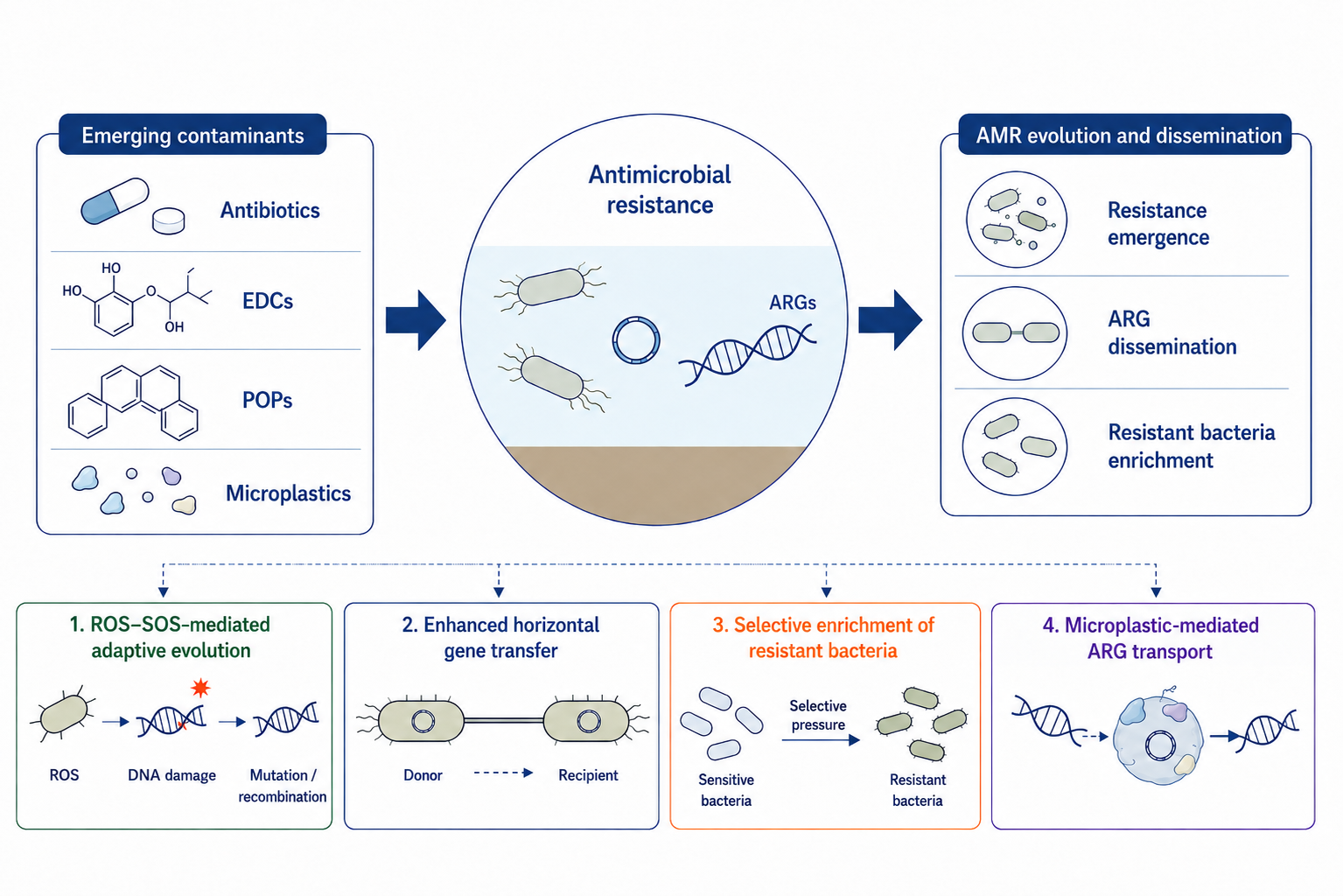
- Antibiotics, EDCs, POPs, and microplastics exhibit distinct AMR-driving potentials
- Four mechanisms link emerging contaminants to AMR evolution and dissemination
- Multi-omics, modeling, and AI will advance contaminant-driven AMR risk assessment and management
- Open Access
- Review
Environmental Emerging Contaminants Drive Bacterial Antimicrobial Resistance Evolution: Evidence, Mechanisms, and Challenges
- Xinrui Yang,
- Qingbin Yuan *,
- Yaru Dai,
- Xiaolong Wang,
- Zhigang Yu,
- Mengxiong Wu,
- Yi Luo *
Author Information
Received: 12 Jul 2026 | Revised: 28 Sep 2026 | Accepted: 12 Oct 2026 | Published: 23 Oct 2026
Highlights
Abstract
Antimicrobial resistance in the environment has become a major challenge to global public health. In addition to antibiotics themselves, emerging contaminants such as endocrine-disrupting chemicals (EDCs), persistent organic pollutants (POPs), and microplastics also significantly influence the emergence, evolution, and dissemination of bacterial antimicrobial resistance. This systematic review, based on a structured literature search, first summarizes current evidence linking emerging contaminants to bacterial antimicrobial resistance across diverse environmental matrices. It also provides a mechanistic analysis of four major pathways by which emerging contaminants promote antimicrobial resistance evolution: ROS–SOS-mediated adaptive evolution, enhanced horizontal gene transfer (HGT), selective enrichment of resistant bacteria, and microplastic-mediated migration and dissemination of antimicrobial resistance genes (ARGs). Finally, we highlight current knowledge gaps and propose future research directions, including long-term field investigations, multi-omics approaches, experiment–model integration, and artificial intelligence-assisted analyses, to establish a cross-scale framework for understanding emerging contaminant-driven antimicrobial resistance evolution. This review provides new mechanistic insights into the environmental evolution of bacterial antimicrobial resistance and offers a theoretical foundation for environmental risk assessment and pollution control of emerging contaminants.
Graphical Abstract
Keywords
antibiotics | endocrine-disrupting chemicals (EDCs) | persistent organic pollutants (POPs) | microplastics | antimicrobial resistance
References
- 1.
Naghavi, M.; Vollset, S.E.; Ikuta, K.S.; et al. Global Burden of Bacterial Antimicrobial Resistance 1990–2021: A Systematic Analysis with Forecasts to 2050. Lancet 2024, 404, 1199–1226. https://doi.org/10.1016/s0140-6736(24)01867-1.
- 2.
Sun, S.; Wang, Q.; Wang, N.; et al. High-risk antibiotics positively correlated with antibiotic resistance genes in five typical urban wastewater. J. Environ. Manag. 2023, 342, 118296. https://doi.org/10.1016/j.jenvman.2023.118296.
- 3.
Xu, Z.; Xing, J.; Zeng, X.; et al. Citywide metagenomics reveals microbial community and resistome dynamics in urban wastewater. Nat. Commun. 2026, 17, 8833. https://doi.org/10.1038/s41467-026-75771-6.
- 4.
Hutinel, M.; Larsson, D.G.J.; Flach, C.F. Antibiotic resistance genes of emerging concern in municipal and hospital wastewater from a major Swedish city. Sci. Total Environ. 2022, 812, 151433. https://doi.org/10.1016/j.scitotenv.2021.151433.
- 5.
Yang, W.; Wang, X. Transmission mechanisms and risk tracing of antibiotic resistance genes in rivers driven by wastewater inputs. J. Hazard. Mater. 2025, 500, 140523. https://doi.org/10.1016/j.jhazmat.2025.140523.
- 6.
Yang, T.; Wang, X.; Jiang, L.; et al. Antibiotic resistance genes associated with size-segregated bioaerosols from wastewater treatment plants: A review. Environ. Pollut. 2024, 343, 123169. https://doi.org/10.1016/j.envpol.2023.123169.
- 7.
Xin, H.; Gao, M.; Wang, X.; et al. Animal farms are hot spots for airborne antimicrobial resistance. Sci. Total Environ. 2022, 851, 158050. https://doi.org/10.1016/j.scitotenv.2022.158050.
- 8.
Forsberg, K.J.; Reyes, A.; Wang, B.; et al. The Shared Antibiotic Resistome of Soil Bacteria and Human Pathogens. Science 2012, 337, 1107–1111. https://doi.org/10.1126/science.1220761.
- 9.
Chng, K.R.; Li, C.; Bertrand, D.; et al. Cartography of opportunistic pathogens and antibiotic resistance genes in a tertiary hospital environment. Nat. Med. 2020, 26, 941–951. https://doi.org/10.1038/s41591-020-0894-4.
- 10.
Gillieatt, B.F.; Coleman, N.V. Unravelling the mechanisms of antibiotic and heavy metal resistance co-selection in environmental bacteria. FEMS Microbiol. Rev. 2024, 48, fuae017. https://doi.org/10.1093/femsre/fuae017.
- 11.
Yan, Q.; Zhong, Z.; Li, X.; et al. Characterization of heavy metal, antibiotic pollution, and their resistance genes in paddy with secondary municipal-treated wastewater irrigation. Water Res. 2024, 252, 121208. https://doi.org/10.1016/j.watres.2024.121208.
- 12.
Jin, L.; Xie, J.; He, T.; et al. Airborne transmission as an integral environmental dimension of antimicrobial resistance through the “One Health” lens. Crit. Rev. Environ. Sci. Technol. 2022, 52, 4172–4193. https://doi.org/10.1080/10643389.2021.2006537.
- 13.
Caporale, N.; Leemans, M.; Birgersson, L.; et al. From cohorts to molecules: Adverse impacts of endocrine disrupting mixtures. Science 2022, 375, eabe8244. https://doi.org/10.1126/science.abe8244.
- 14.
Ahn, C.; Jeung, E.B. Endocrine-Disrupting Chemicals and Disease Endpoints. Int. J. Mol. Sci. 2023, 24, 5342. https://doi.org/10.3390/ijms24065342.
- 15.
Marlatt, V.L.; Bayen, S.; Castaneda-Cortès, D.; et al. Impacts of endocrine disrupting chemicals on reproduction in wildlife and humans. Environ. Res. 2022, 208, 112584. https://doi.org/10.1016/j.envres.2021.112584.
- 16.
Wang, C.; Zhao, J.; Xing, B. Environmental source, fate, and toxicity of microplastics. J. Hazard. Mater. 2021, 407, 124357. https://doi.org/10.1016/j.jhazmat.2020.124357.
- 17.
Severe, E.; Sinha Ray, S.; Li, W.; et al. Rainfall-induced lateral and vertical microplastic transport of varying sizes in agricultural fields. Environ. Sci. Processes Impacts 2025, 27, 2968–2981. https://doi.org/10.1039/d5em00304k.
- 18.
Aydin, S.; Mucevher, O.; Ulvi, A.; et al. Effects of long-term wastewater irrigation on microplastics pollution in agricultural soil. Environ. Sci. Pollut. Res. 2025, 32, 12340–12359. https://doi.org/10.1007/s11356-025-36452-x.
- 19.
Mishra, A.; Kumari, M.; Swati; et al. Persistent organic pollutants in the environment: Risk assessment, hazards, and mitigation strategies. Bioresour. Technol. Rep. 2022, 19, 101143. https://doi.org/10.1016/j.biteb.2022.101143.
- 20.
Maghsodian, Z.; Sanati, A.M.; Mashifana, T.; et al. Occurrence and Distribution of Antibiotics in the Water, Sediment, and Biota of Freshwater and Marine Environments: A Review. Antibiotics 2022, 11, 1461. https://doi.org/10.3390/antibiotics11111461.
- 21.
Yuan, Q.; Wang, N.; Guo, X.; et al. Antibiotics and antibiotic resistance genes in aquatic environments in China: Occurrences and risks. Chin. Sci. Bull. 2024, 69, 759–773. https://doi.org/10.1360/tb-2023-0321.
- 22.
Shi, J.; Dong, Y.; Shi, Y.; et al. Groundwater antibiotics and microplastics in a drinking-water source area, northern China: Occurrence, spatial distribution, risk assessment, and correlation. Environ. Res. 2022, 210, 112855. https://doi.org/10.1016/j.envres.2022.112855.
- 23.
Zainab, S.M.; Junaid, M.; Xu, N.; et al. Antibiotics and antibiotic resistant genes (ARGs) in groundwater: A global review on dissemination, sources, interactions, environmental and human health risks. Water Res. 2020, 187, 116455. https://doi.org/10.1016/j.watres.2020.116455.
- 24.
Lyu, J.; Yang, L.; Zhang, L.; et al. Antibiotics in soil and water in China–a systematic review and source analysis. Environ. Pollut. 2020, 266, 115147. https://doi.org/10.1016/j.envpol.2020.115147.
- 25.
Chaturvedi, P.; Shukla, P.; Giri, B.S.; et al. Prevalence and hazardous impact of pharmaceutical and personal care products and antibiotics in environment: A review on emerging contaminants. Environ. Res. 2021, 194, 110664. https://doi.org/10.1016/j.envres.2020.110664.
- 26.
He, Y.; Yuan, Q.; Mathieu, J.; et al. Antibiotic resistance genes from livestock waste: Occurrence, dissemination, and treatment. npj Clean Water 2020, 3, 4. https://doi.org/10.1038/s41545-020-0051-0.
- 27.
Hong, B.; Li, Q.; Li, J.; et al. Spectrum of pharmaceutical residues in commercial manure-based organic fertilizers from multi-provinces of Chinese mainland in relation to animal farming and possible environmental risks of fertilization. Sci. Total Environ. 2023, 894, 165029. https://doi.org/10.1016/j.scitotenv.2023.165029.
- 28.
Beltrán de Heredia, I.; Garbisu, C.; Alkorta, I.; et al. Spatio-seasonal patterns of the impact of wastewater treatment plant effluents on antibiotic resistance in river sediments. Environ. Pollut. 2023, 319, 120883. https://doi.org/10.1016/j.envpol.2022.120883.
- 29.
Rodriguez-Mozaz, S.; Chamorro, S.; Marti, E.; et al. Occurrence of antibiotics and antibiotic resistance genes in hospital and urban wastewaters and their impact on the receiving river. Water Res. 2015, 69, 234–242. https://doi.org/10.1016/j.watres.2014.11.021.
- 30.
Voigt, A.M.; Zacharias, N.; Timm, C.; et al. Association between antibiotic residues, antibiotic resistant bacteria and antibiotic resistance genes in anthropogenic wastewater—An evaluation of clinical influences. Chemosphere 2020, 241, 125032. https://doi.org/10.1016/j.chemosphere.2019.125032.
- 31.
Zhang, P.; Mao, D.; Gao, H.; et al. Colonization of gut microbiota by plasmid-carrying bacteria is facilitated by evolutionary adaptation to antibiotic treatment. ISME J. 2022, 16, 1284–1293. https://doi.org/10.1038/s41396-021-01171-x.
- 32.
Zhu, Y.G.; Johnson, T.A.; Su, J.Q.; et al. Diverse and abundant antibiotic resistance genes in Chinese swine farms. Proc. Natl. Acad. Sci. USA 2013, 110, 3435–3440. https://doi.org/10.1073/pnas.1222743110.
- 33.
Laconi, A.; Mughini-Gras, L.; Tolosi, R.; et al. Microbial community composition and antimicrobial resistance in agricultural soils fertilized with livestock manure from conventional farming in Northern Italy. Sci. Total Environ. 2021, 760, 143404. https://doi.org/10.1016/j.scitotenv.2020.143404.
- 34.
McKinney, C.W.; Dungan, R.S.; Moore, A.; et al. Occurrence and abundance of antibiotic resistance genes in agricultural soil receiving dairy manure. FEMS Microbiol. Ecol. 2018, 94, fiy010. https://doi.org/10.1093/femsec/fiy010.
- 35.
Huang, J.; Yong, H.; Huang, J.; et al. Microbial risks triggered by oral administration of antibiotics in fish aquaculture persist long after the legally mandated antibiotic withdrawal time. Nat. Water 2025, 3, 1057–1069. https://doi.org/10.1038/s44221-025-00502-y.
- 36.
Mao, D.; Yu, S.; Rysz, M.; et al. Prevalence and proliferation of antibiotic resistance genes in two municipal wastewater treatment plants. Water Res. 2015, 85, 458–466. https://doi.org/10.1016/j.watres.2015.09.010.
- 37.
Zhang, Y.; Niu, Z.; Zhang, Y.; et al. Occurrence of intracellular and extracellular antibiotic resistance genes in coastal areas of Bohai Bay (China) and the factors affecting them. Environ. Pollut. 2018, 236, 126–136. https://doi.org/10.1016/j.envpol.2018.01.033.
- 38.
Chen, C.Q.; Zheng, L.; Zhou, J.L.; et al. Persistence and risk of antibiotic residues and antibiotic resistance genes in major mariculture sites in Southeast China. Sci. Total Environ. 2017, 580, 1175–1184. https://doi.org/10.1016/j.scitotenv.2016.12.075.
- 39.
Hernández, F.; Calısto-Ulloa, N.; Gómez-Fuentes, C.; et al. Occurrence of antibiotics and bacterial resistance in wastewater and sea water from the Antarctic. J. Hazard. Mater. 2019, 363, 447–456. https://doi.org/10.1016/j.jhazmat.2018.07.027.
- 40.
Kampouris, I.D.; Alygizakis, N.; Klümper, U.; et al. Elevated levels of antibiotic resistance in groundwater during treated wastewater irrigation associated with infiltration and accumulation of antibiotic residues. J. Hazard. Mater. 2022, 423, 127155. https://doi.org/10.1016/j.jhazmat.2021.127155.
- 41.
Zhang, C.; Li, Y.; Wang, C.; et al. Occurrence of endocrine disrupting compounds in aqueous environment and their bacterial degradation: A review. Crit. Rev. Environ. Sci. Technol. 2016, 46, 1–59. https://doi.org/10.1080/10643389.2015.1061881.
- 42.
Xiao, Y.; Han, D.; Currell, M.; et al. Review of Endocrine Disrupting Compounds (EDCs) in China's water environments: Implications for environmental fate, transport and health risks. Water Res. 2023, 245, 120645. https://doi.org/10.1016/j.watres.2023.120645.
- 43.
Young, W.F.; Calhoun, D.A.; Lenders, J.W.M.; et al. Screening for Endocrine Hypertension: An Endocrine Society Scientific Statement. Endocr. Rev. 2017, 38, 103–122. https://doi.org/10.1210/er.2017-00054.
- 44.
Azizi, D.; Arif, A.; Blair, D.; et al. A comprehensive review on current technologies for removal of endocrine disrupting chemicals from wastewaters. Environ. Res. 2022, 207, 112196. https://doi.org/10.1016/j.envres.2021.112196.
- 45.
Sharma, P.; Pal, N.; Kumawat, M.; et al. Investigating the antibiotic resistance genes and mobile genetic elements in water systems impacted with anthropogenic pollutants. Environ. Res. 2025, 269, 120814. https://doi.org/10.1016/j.envres.2025.120814.
- 46.
Yang, B.; Sun, J.; Zhu, S.; et al. Exposure to bisphenol compounds accelerates the conjugative transfer of antibiotic resistance plasmid. Environ. Res. 2024, 263, 120002. https://doi.org/10.1016/j.envres.2024.120002.
- 47.
Lu, J.; Wang, Y.; Li, J.; et al. Triclosan at environmentally relevant concentrations promotes horizontal transfer of multidrug resistance genes within and across bacterial genera. Environ. Int. 2018, 121, 1217–1226. https://doi.org/10.1016/j.envint.2018.10.040.
- 48.
Lu, J.; Yu, Z.; Ding, P.; et al. Triclosan Promotes Conjugative Transfer of Antibiotic Resistance Genes to Opportunistic Pathogens in Environmental Microbiome. Environ. Sci. Technol. 2022, 56, 15108–15119. https://doi.org/10.1021/acs.est.2c05537.
- 49.
Wang, C.; Liu, S.; Feng, H.; et al. Effects of Triclosan on the Development of Antimicrobial Resistance in the Environment: A Review. Curr. Pollut. Rep. 2023, 9, 454–467. https://doi.org/10.1007/s40726-023-00270-x.
- 50.
Carey, D.E.; Zitomer, D.H.; Hristova, K.R.; et al. Triclocarban Influences Antibiotic Resistance and Alters Anaerobic Digester Microbial Community Structure. Environ. Sci. Technol. 2016, 50, 126–134. https://doi.org/10.1021/acs.est.5b03080.
- 51.
Wang, Z.; Gao, J.; Wang, S.; et al. Triclocarban shifted the microbial communities and promoted the spread of antibiotic resistance genes in nitrifying granular sludge system. Bioresour. Technol. 2022, 347, 126429. https://doi.org/10.1016/j.biortech.2021.126429.
- 52.
Tang, X.; Zhou, M.; Zeng, G.; et al. The effects of dimethyl phthalate on sludge anaerobic digestion unveiling the potential contribution of plastic chemical additive to spread of antibiotic resistance genes. Chem. Eng. J. 2022, 435, 134734. https://doi.org/10.1016/j.cej.2022.134734.
- 53.
Wu, J.; Zhou, J.H.; Liu, D.F.; et al. Phthalates Promote Dissemination of Antibiotic Resistance Genes: An Overlooked Environmental Risk. Environ. Sci. Technol. 2023, 57, 6876–6887. https://doi.org/10.1021/acs.est.2c09491.
- 54.
Noyes, P.D.; Miranda, D.; Oliveira de Carvalho, G.; et al. Climate change drives persistent organic pollutant dynamics in marine environments. Commun. Earth Environ. 2025, 6, 363. https://doi.org/10.1038/s43247-025-02348-4.
- 55.
Wang, Y.; Chang, W.; Wang, L.; et al. A review of sources, multimedia distribution and health risks of novel fluorinated alternatives. Ecotoxicol. Environ. Saf. 2019, 182, 109402. https://doi.org/10.1016/j.ecoenv.2019.109402.
- 56.
Choo, G.; Wang, W.; Cho, H.S.; et al. Legacy and emerging persistent organic pollutants in the freshwater system: Relative distribution, contamination trends, and bioaccumulation. Environ. Int. 2020, 135, 105377. https://doi.org/10.1016/j.envint.2019.105377.
- 57.
Han, J.; Liang, Y.; Zhao, B.; et al. Polycyclic aromatic hydrocarbons (PAHs) geographical distribution in China and their source, risk assessment analysis. Environ. Pollut. 2019, 251, 312–327. https://doi.org/10.1016/j.envpol.2019.05.022.
- 58.
Ukalska-Jaruga, A.; Lewińska, K.; Mammadov, E.; et al. Residues of Persistent Organic Pollutants (POPs) in Agricultural Soils Adjacent to Historical Sources of Their Storage and Distribution—The Case Study of Azerbaijan. Molecules 2020, 25, 1815. https://doi.org/10.3390/molecules25081815.
- 59.
Chen, B.; He, R.; Yuan, K.; et al. Polycyclic aromatic hydrocarbons (PAHs) enriching antibiotic resistance genes (ARGs) in the soils. Environ. Pollut. 2017, 220, 1005–1013. https://doi.org/10.1016/j.envpol.2016.11.047.
- 60.
Yi, G.; Jin, M.K.; Cai, T.G.; et al. Antibiotics and Pesticides Enhancing the Transfer of Resistomes among Soil-Bayberry-Fruit Fly Food Chain in the Orchard Ecosystem. Environ. Sci. Technol. 2024, 58, 18167–18176. https://doi.org/10.1021/acs.est.4c05829.
- 61.
Gorovtsov, A.V.; Sazykin, I.S.; Sazykina, M.A. The influence of heavy metals, polyaromatic hydrocarbons, and polychlorinated biphenyls pollution on the development of antibiotic resistance in soils. Environ. Sci. Pollut. Res. 2018, 25, 9283–9292. https://doi.org/10.1007/s11356-018-1465-9.
- 62.
Ben Said, O.; Goñi-Urriza, M.S.; El Bour, M.; et al. Characterization of aerobic polycyclic aromatic hydrocarbon-degrading bacteria from Bizerte lagoon sediments, Tunisia. J. Appl. Microbiol. 2008, 104, 987–997. https://doi.org/10.1111/j.1365-2672.2007.03621.x.
- 63.
Yasemi, M.; Jalali, A.; Asadzadeh, M.; et al. Organophosphate pesticides and their potential in the change of microbial population and frequency of antibiotic resistance genes in aquatic environments. Chemosphere 2025, 376, 144296. https://doi.org/10.1016/j.chemosphere.2025.144296.
- 64.
Lu, N.; Du, Z.; Chu, F.; et al. Tracking the impact of perfluoroalkyl acid emissions on antibiotic resistance gene profiles in receiving water by metagenomic analysis. Water Res. 2024, 261, 121931. https://doi.org/10.1016/j.watres.2024.121931.
- 65.
Wang, J.; Wang, J.; Zhao, Z.; et al. PAHs accelerate the propagation of antibiotic resistance genes in coastal water microbial community. Environ. Pollut. 2017, 231, 1145–1152. https://doi.org/10.1016/j.envpol.2017.07.067.
- 66.
Li, Y.; Zhang, Y.; Liu, X.; et al. Per- and polyfluoroalkyl substances exacerbate the prevalence of plasmid-borne antibiotic resistance genes by enhancing natural transformation, in vivo stability, and expression in bacteria. Water Res. 2025, 272, 122972. https://doi.org/10.1016/j.watres.2024.122972.
- 67.
Li, Y.; Wang, H.; Wang, M.; et al. The perfluoroalkyl substances influenced the distribution of bacterial communities and their functions from source water to tap water. Water Res. 2023, 247, 120831. https://doi.org/10.1016/j.watres.2023.120831.
- 68.
Zhu, S.; Yang, B.; Yu, F.; et al. Investigation of the impact of widely used pesticides on conjugative transfer of multidrug resistance plasmids. J. Hazard. Mater. 2024, 478, 135436. https://doi.org/10.1016/j.jhazmat.2024.135436.
- 69.
Stedtfeld, R.D.; Stedtfeld, T.M.; Fader, K.A.; et al. TCDD influences reservoir of antibiotic resistance genes in murine gut microbiome. FEMS Microbiol. Ecol. 2017, 93, fix058. https://doi.org/10.1093/femsec/fix058.
- 70.
Mohasin, M.; Habib, K.; Rao, P.S.; et al. Microplastics in agricultural soils: Sources, impacts, and mitigation strategies. Environ. Monit. Assess. 2025, 197, 684. https://doi.org/10.1007/s10661-025-14114-2.
- 71.
Yang, H.; Yan, Y.; You, Y.; et al. Distribution, sources, migration, influence and analytical methods of microplastics in soil ecosystems. Ecotoxicol. Environ. Saf. 2022, 243, 114009. https://doi.org/10.1016/j.ecoenv.2022.114009.
- 72.
Hu, J.; Zhang, L.; Zhang, W.; et al. Significant influence of land use types and anthropogenic activities on the distribution of microplastics in soil: A case from a typical mining-agricultural city. J. Hazard. Mater. 2024, 477, 135253. https://doi.org/10.1016/j.jhazmat.2024.135253.
- 73.
Wang, Y.; Yang, Y.; Liu, X.; et al. Interaction of Microplastics with Antibiotics in Aquatic Environment: Distribution, Adsorption, and Toxicity. Environ. Sci. Technol. 2021, 55, 15579–15595. https://doi.org/10.1021/acs.est.1c04509.
- 74.
Shim, W.J.; Hong, S.H.; Eo, S. Marine Microplastics: Abundance, Distribution, and Composition. In Microplastic Contamination in Aquatic Environments; Elsevier: Amsterdam, The Netherlands, 2018; pp. 1–26. https://doi.org/10.1016/b978-0-12-813747-5.00001-1.
- 75.
Frère, L.; Paul-Pont, I.; Rinnert, E.; et al. Influence of environmental and anthropogenic factors on the composition, concentration and spatial distribution of microplastics: A case study of the Bay of Brest (Brittany, France). Environ. Pollut. 2017, 225, 211–222. https://doi.org/10.1016/j.envpol.2017.03.023.
- 76.
Malli, A.; Corella-Puertas, E.; Hajjar, C.; et al. Transport mechanisms and fate of microplastics in estuarine compartments: A review. Mar. Pollut. Bull. 2022, 177, 113553. https://doi.org/10.1016/j.marpolbul.2022.113553.
- 77.
Ouyang, X.; Duarte, C.M.; Cheung, S.G.; et al. Fate and Effects of Macro- and Microplastics in Coastal Wetlands. Environ. Sci. Technol. 2022, 56, 2386–2397. https://doi.org/10.1021/acs.est.1c06732.
- 78.
Zhu, D.; Ma, J.; Li, G.; et al. Soil plastispheres as hotspots of antibiotic resistance genes and potential pathogens. ISME J. 2022, 16, 521–532. https://doi.org/10.1038/s41396-021-01103-9. Correction in: ISME J. 2022, 16, 615. https://doi.org/10.1038/s41396-021-01137-z.
- 79.
Peng, R.; Xu, Y.; Li, R.; et al. Marine microplastics enrich antibiotic resistance genes (ARGs), especially extracellular ARGs: An investigation in the East China Sea. Mar. Pollut. Bull. 2024, 209, 117260. https://doi.org/10.1016/j.marpolbul.2024.117260.
- 80.
Wang, J.; Qin, X.; Guo, J.; et al. Evidence of selective enrichment of bacterial assemblages and antibiotic resistant genes by microplastics in urban rivers. Water Res. 2020, 183, 116113. https://doi.org/10.1016/j.watres.2020.116113.
- 81.
Luo, G.; Fan, L.; Liang, B.; et al. Determining Antimicrobial Resistance in the Plastisphere: Lower Risks of Nonbiodegradable vs Higher Risks of Biodegradable Microplastics. Environ. Sci. Technol. 2025, 59, 7722–7735. https://doi.org/10.1021/acs.est.5c00246.
- 82.
Zhang, D.; Sun, J.; Peng, S.; et al. Biodegradable microplastics exacerbate the risk of antibiotic resistance genes pollution in agricultural soils. J. Hazard. Mater. 2025, 496, 139490. https://doi.org/10.1016/j.jhazmat.2025.139490.
- 83.
Li, R.; Zhu, L.; Yang, K.; et al. Impact of Urbanization on Antibiotic Resistome in Different Microplastics: Evidence from a Large-Scale Whole River Analysis. Environ. Sci. Technol. 2021, 55, 8760–8770. https://doi.org/10.1021/acs.est.1c01395.
- 84.
Wang, Y.F.; Liu, Y.J.; Fu, Y.M.; et al. Microplastic diversity increases the abundance of antibiotic resistance genes in soil. Nat. Commun. 2024, 15, 9788. https://doi.org/10.1038/s41467-024-54237-7.
- 85.
Wang, S.; Xue, N.; Li, W.; et al. Selectively enrichment of antibiotics and ARGs by microplastics in river, estuary and marine waters. Sci. Total Environ. 2020, 708, 134594. https://doi.org/10.1016/j.scitotenv.2019.134594.
- 86.
Liu, F.; Zhang, Y.; Wang, F. Environmental relevant concentrations of triclosan affected developmental toxicity, oxidative stress, and apoptosis in zebrafish embryos. Environ. Toxicol. 2022, 37, 848–857. https://doi.org/10.1002/tox.23448.
- 87.
Wang, Q.; Chen, G.; Tian, L.; et al. Neuro- and hepato-toxicity of polystyrene nanoplastics and polybrominated diphenyl ethers on early life stages of zebrafish. Sci. Total Environ. 2023, 857, 159567. https://doi.org/10.1016/j.scitotenv.2022.159567.
- 88.
Guerin, É.; Cambray, G.; Sanchez-Alberola, N.; et al. The SOS Response Controls Integron Recombination. Science 2009, 324, 1034. https://doi.org/10.1126/science.1172914.
- 89.
Chinemerem Nwobodo, D.; Ugwu, M.C.; Oliseloke Anie, C.; et al. Antibiotic resistance: The challenges and some emerging strategies for tackling a global menace. J. Clin. Lab. Anal. 2022, 36, e24655. https://doi.org/10.1002/jcla.24655.
- 90.
Babosan, A.; Gaschet, M.; Muggeo, A.; et al. A qnrD-Plasmid Promotes Biofilm Formation and Class 1 Integron Gene Cassette Rearrangements in Escherichia coli. Antibiotics 2022, 11, 715. https://doi.org/10.3390/antibiotics11060715.
- 91.
Drevinek, P.; Baldwin, A.; Lindenburg, L.; et al. Oxidative Stress of Burkholderia cenocepacia Induces Insertion Sequence-Mediated Genomic Rearrangements That Interfere with Macrorestriction-Based Genotyping. J. Clin. Microbiol. 2010, 48, 34–40. https://doi.org/10.1128/jcm.01433-09.
- 92.
Sazykin, I.S.; Sazykina, M.A. The role of oxidative stress in genome destabilization and adaptive evolution of bacteria. Gene 2023, 857, 147170. https://doi.org/10.1016/j.gene.2023.147170.
- 93.
Telke, A.A.; Olaitan, A.O.; Morand, S.; et al. soxRS induces colistin hetero-resistance in Enterobacter asburiae and Enterobacter cloacae by regulating the acrAB-tolC efflux pump. J. Antimicrob. Chemother. 2017, 72, 2715–2721. https://doi.org/10.1093/jac/dkx215.
- 94.
Dodd, M.C. Potential impacts of disinfection processes on elimination and deactivation of antibiotic resistance genes during water and wastewater treatment. J. Environ. Monit. 2012, 14, 1754–1771. https://doi.org/10.1039/c2em00006g.
- 95.
Zhu, S.; Yang, B.; Wang, Z.; et al. Augmented dissemination of antibiotic resistance elicited by non-antibiotic factors. Ecotoxicol. Environ. Saf. 2023, 262, 115124. https://doi.org/10.1016/j.ecoenv.2023.115124.
- 96.
Yang, Y.; Pan, X.; Yu, Y.; et al. Tire microplastics amplify the risk of antibiotic resistance genes in the environment. Biocontaminant 2026, 2, e010. https://doi.org/10.48130/biocontam-0026-0007.
- 97.
Das, A. The emerging role of microplastics in systemic toxicity: Involvement of reactive oxygen species (ROS). Sci. Total Environ. 2023, 895, 165076. https://doi.org/10.1016/j.scitotenv.2023.165076.
- 98.
Ma, Y.; Chang, X.; Zhang, J.; et al. Microplastics promote conjugative transfer of antibiotic resistance genes via membrane protein interactions: Highlighting oxidative stress and energy supply. Bioresour. Technol. 2026, 443, 133793. https://doi.org/10.1016/j.biortech.2025.133793.
- 99.
Feng, C.; Liang, Z.; Liao, X.; et al. Microbial Dynamics on Different Microplastics in Coastal Urban Aquatic Ecosystems: The Critical Roles of Extracellular Polymeric Substances. Environ. Sci. Technol. 2025, 59, 10554–10566. https://doi.org/10.1021/acs.est.5c03796.
- 100.
Yan, M.; Yang, C.; Huang, J.; et al. Reactor performance and microbial responses of sulfate-reducing bacteria sludge under stepwise polyvinyl chloride microplastic exposure. Bioresour. Technol. 2026, 460, 135334. https://doi.org/10.1016/j.biortech.2026.135334.
- 101.
Zou, H.; Li, J.; Li, J.; et al. Bilateral transmission of plasmid-mediated antibiotic resistance genes under polycyclic aromatic hydrocarbons pressure. J. Hazard. Mater. 2025, 496, 139401. https://doi.org/10.1016/j.jhazmat.2025.139401.
- 102.
Baran, A.; Kwiatkowska, A.; Potocki, L. Antibiotics and Bacterial Resistance—A Short Story of an Endless Arms Race. Int. J. Mol. Sci. 2023, 24, 5777. https://doi.org/10.3390/ijms24065777.
- 103.
Gullberg, E.; Cao, S.; Berg, O.G.; et al. Selection of Resistant Bacteria at Very Low Antibiotic Concentrations. PLoS Pathog. 2011, 7, e1002158. https://doi.org/10.1371/journal.ppat.1002158.
- 104.
Gao, J.F.; Liu, X.H.; Fan, X.Y.; et al. Effects of triclosan on performance, microbial community and antibiotic resistance genes during partial denitrification in a sequencing moving bed biofilm reactor. Bioresour. Technol. 2019, 281, 326–334. https://doi.org/10.1016/j.biortech.2019.02.112.
- 105.
Britti, D. Molecular mimicry in the agroecosystem: A new paradigm for understanding how pesticide residues drive the emergence of antimicrobial resistance. Environ. Toxicol. Pharmacol. 2026, 123, 104974. https://doi.org/10.1016/j.etap.2026.104974.
- 106.
Zheng, Z.; Huang, Y.; Liu, L.; et al. Interaction between microplastic biofilm formation and antibiotics: Effect of microplastic biofilm and its driving mechanisms on antibiotic resistance gene. J. Hazard. Mater. 2023, 459, 132099. https://doi.org/10.1016/j.jhazmat.2023.132099.
- 107.
Müller, N.D.; Kirtane, A.; Schefer, R.B.; et al. eDNA Adsorption onto Microplastics: Impacts of Water Chemistry and Polymer Physiochemical Properties. Environ. Sci. Technol. 2024, 58, 7588–7599. https://doi.org/10.1021/acs.est.3c10825.
- 108.
Liu, Y.; Liu, L.; Wang, X.; et al. Microplastics enhance the prevalence of antibiotic resistance genes in mariculture sediments by enriching host bacteria and promoting horizontal gene transfer. Eco-Environ. Health 2025, 4, 100136. https://doi.org/10.1016/j.eehl.2025.100136.
- 109.
Xia, R.; Yin, X.; Balcazar, J.L.; et al. Bacterium-Phage Symbiosis Facilitates the Enrichment of Bacterial Pathogens and Antibiotic-Resistant Bacteria in the Plastisphere. Environ. Sci. Technol. 2025, 59, 2948–2960. https://doi.org/10.1021/acs.est.4c08265.
- 110.
Li, F.; Shen, H.; Pang, R.; et al. Biodegradable and non-biodegradable plastics foster unique regimes of antibiotic resistance and virulence factors in aquatic plastispheres. Biocontaminant 2026, 2, e001. https://doi.org/10.48130/biocontam-0025-0026.
- 111.
Jia, J.; Liu, Q.; Zhao, E.; et al. Biofilm formation on microplastics and interactions with antibiotics, antibiotic resistance genes and pathogens in aquatic environment. Eco-Environ. Health 2024, 3, 516–528. https://doi.org/10.1016/j.eehl.2024.05.003.
- 112.
Su, H.; Xu, W.; Hu, X.; et al. The impact of microplastics on antibiotic resistance genes, metal resistance genes, and bacterial community in aquaculture environment. J. Hazard. Mater. 2025, 489, 137704. https://doi.org/10.1016/j.jhazmat.2025.137704.
- 113.
Arias-Andres, M.; Klümper, U.; Rojas-Jimenez, K.; et al. Microplastic pollution increases gene exchange in aquatic ecosystems. Environ. Pollut. 2018, 237, 253–261. https://doi.org/10.1016/j.envpol.2018.02.058.
- 114.
Chen, Y.; Yan, Z.; Zhou, Y.; et al. Dynamic evolution of antibiotic resistance genes in plastisphere in the vertical profile of urban rivers. Water Res. 2024, 249, 120946. https://doi.org/10.1016/j.watres.2023.120946.
- 115.
Mosca Angelucci, D.; Piergiacomo, F.; Donati, E.; et al. Combined effects of ciprofloxacin and microplastics on alpine spring water microbiota: Evidence from glacier-fed microcosm experiments. Front. Microbiol. 2025, 16, 1654589. https://doi.org/10.3389/fmicb.2025.1654589.
- 116.
Zhao, H.; Zhao, H.M.; Wu, F.; et al. Perfluorooctane sulfonate (PFOS) promotes transformational transfer of antibiotic resistance genes and cross-resistance between antibiotics and PFOS. Water Res. 2025, 284, 123868. https://doi.org/10.1016/j.watres.2025.123868.
- 117.
Balta, I.; Lemon, J.; Gadaj, A.; et al. The interplay between antimicrobial resistance, heavy metal pollution, and the role of microplastics. Front. Microbiol. 2025, 16, 1550587. https://doi.org/10.3389/fmicb.2025.1550587.
How to Cite
Yang, X.; Yuan, Q.; Dai, Y.; Wang, X.; Yu, Z.; Wu, M.; Luo, Y. Environmental Emerging Contaminants Drive Bacterial Antimicrobial Resistance Evolution: Evidence, Mechanisms, and Challenges. Global Environmental Science 2026, 2 (4), 471–494. https://doi.org/10.53941/ges.2026.100028.
RIS
BibTex
Copyright & License

Copyright (c) 2026 by the authors.
This work is licensed under a Creative Commons Attribution 4.0 International License.
Article Metrics
22
Article Views
0
Citations
Contents
References
