
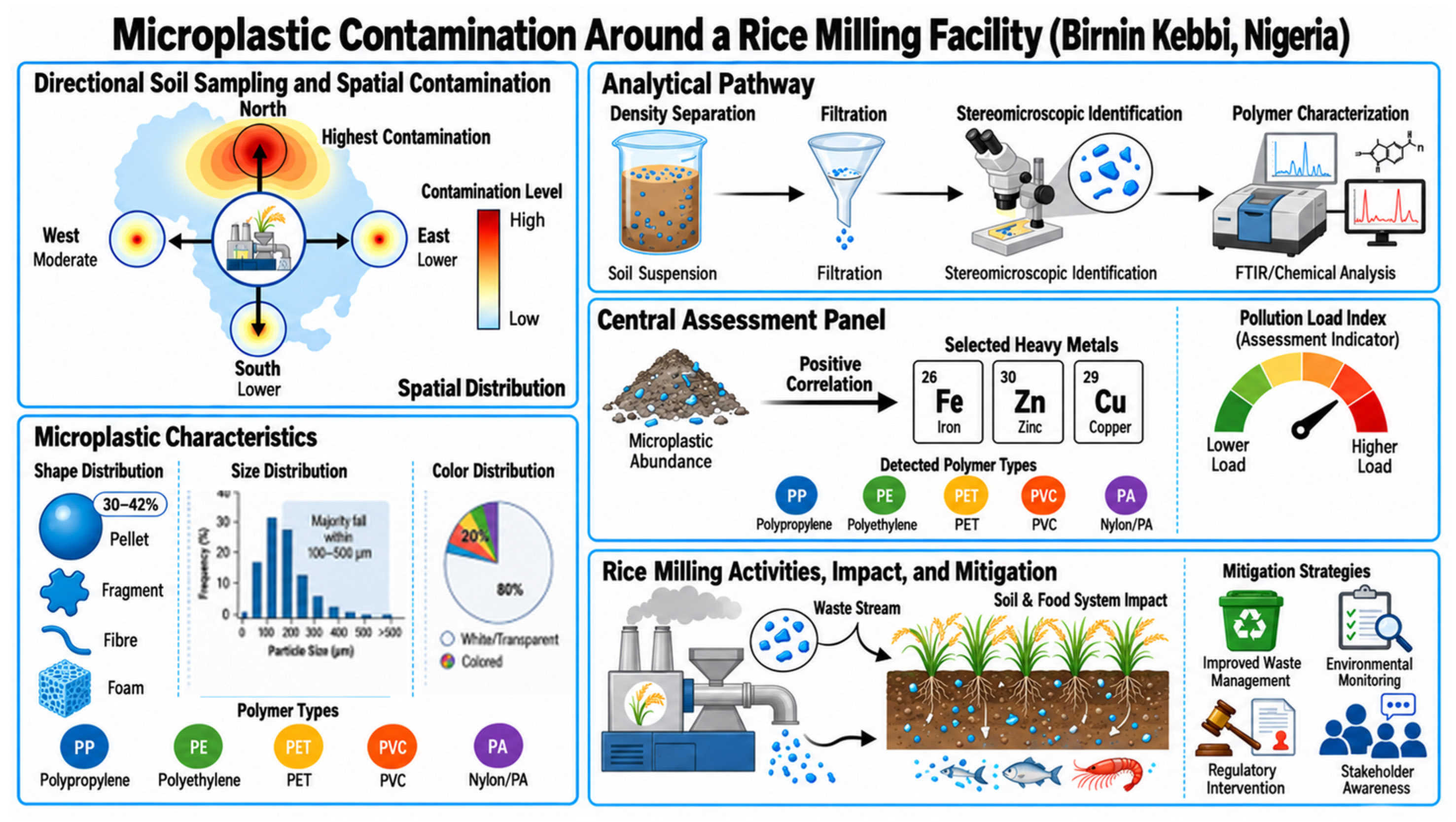
- Microplastic concentrations in soils around Labana Rice Mills ranged from 626 to 1112 particles kg−1
- Pellets dominated particle morphology, with most microplastics in the 100–500 µm size range
- Polypropylene, polyethylene, PET, PVC, and nylon were the major polymers identified
- Positive correlations were observed between microplastics and heavy metals (Fe, Zn, Cu)
- Microplastic abundance showed clear spatial variation, with the northern axis having the highest concentration
- Open Access
- Article
Agro-Industrial Contributions to Soil Microplastic Pollution: Evidence from a Rice Milling Facility in Birnin Kebbi, Nigeria
- Tajudeen Olanrewaju Yahaya 1,*,
- Asmau Muhammed Sfulani 1,
- Haliru Abdullahi 1,
- Jamilu Danjuma Bala 2,
- Abdulrazaq Izuafa 1,3,
- Zaharadeen Muhammad Yusuf 4,
- Mutiyat Kehinde Adewale 1
Author Information
Received: 09 Jun 2026 | Revised: 04 Sep 2026 | Accepted: 12 Oct 2026 | Published: 23 Oct 2026
Highlights
Abstract
Microplastic contamination in terrestrial environments is an emerging concern, yet its association with agro-industrial activities and heavy metal contamination remains poorly understood. This study characterized microplastics in soils surrounding Labana Rice Mills, Birnin Kebbi, Nigeria, and assessed their co-occurrence with selected heavy metals. Soil samples were collected along four cardinal directions of the facility and analyzed using density separation, stereomicroscopy, and attenuated total reflection–Fourier transform infrared (ATR-FTIR) spectroscopy. Microplastic concentrations ranged from 626 ± 11 to 1112 ± 41 particles kg−1, with the northern axis having the highest. These concentrations were comparable to values reported for agro-environments in Bangladesh (660–1309 particles kg−1) and India (400–1370 particles kg−1). Pellets and fragments were the dominant shapes, while particle size 100–500 µm and transparent/white coloration predominated. Identified polymer types included polypropylene, polyethylene, polyethylene terephthalate, polyvinyl chloride, and polyamide. Iron, copper, and zinc were detected in all samples and showed positive correlations with microplastic abundance (R2 = 0.72, 0.52, and 0.46, respectively; p < 0.01). Contamination factor indicated very high contamination across all axes, while pollution load index (PLI = 8.95) confirmed significant microplastic pollution. Polymer risk assessment classified polypropylene as low risk, polyethylene, polyethylene terephthalate, and polyvinyl chloride as moderate risk, and polyamide as high risk. The predominance of pellets suggests potential contributions from rice milling activities. The co-occurrence of microplastics and heavy metals highlights potential ecological risks and underscores the need for improved waste management practices, routine environmental monitoring, and targeted regulatory interventions in agro-industrial systems.
Graphical Abstract
Keywords
microplastics | pellets | polyethylene | polymers | rice mill
References
- 1.
Islam, A.; Hossain, B.; Hossain, M.E.; et al. Microplastics in agricultural soils: Evidence from an industrial suburb of Bangladesh. J. Hazard. Mater. Adv. 2025, 20, 100928. https://doi.org/10.1016/j.hazadv.2025.100928.
- 2.
Auta, H.S.; Emenike, C.U.; Fauziah, S.H. Distribution and importance of microplastics in the marine environment: A review of the sources, fate, effects, and potential solutions. Environ. Int. 2017, 102, 165–176. https://doi.org/10.1016/j.envint.2017.02.013.
- 3.
Sharma, S.; Chatterjee, S. Microplastic pollution, a threat to marine ecosystem and human health: A short review. Environ. Sci. Pollut. Res. 2017, 24, 21530–21547. https://doi.org/10.1007/s11356-017-9910-8.
- 4.
Marrone, A.; La Russa, M.F.; Randazzo, L.; et al. Microplastics in the Center of Mediterranean: Comparison of the Two Calabrian Coasts and Distribution from Coastal Areas to the Open Sea. Int. J. Environ. Res. Public Health 2021, 18, 10712. https://doi.org/10.3390/ijerph182010712.
- 5.
Yahaya, T.O.; Salisu, T.F.; Musa, K.; et al. Microplastic Exposure Impairs Weight Gain, Reproduction, Blood Glucose Levels, and Organ Health in Rats (Rattus norvegicus). J. Exp. Lab. Med. 2025, 2, 44–55. https://doi.org/10.5455/jelm.20241203024659.
- 6.
Ho, K.T.; Bjorkland, R.; Burgess, R.M. Comparing the definitions of microplastics based on size range: Scientific and policy implications. Mar. Pollut. Bull. 2024, 207, 116907. https://doi.org/10.1016/j.marpolbul.2024.116907.
- 7.
Belmaker, I.; Anca, E.D.; Rubin, L.P.; et al. Adverse health effects of exposure to plastic, microplastics and their additives: Environmental, legal and policy implications for Israel. Isr. J. Health Policy Res. 2024, 13, 44. https://doi.org/10.1186/s13584-024-00628-6.
- 8.
Ebong, B. Review on microplastic-polymer composite interactions: Assessing contaminant adsorption, structural integrity, and environmental impacts. Commun. Phys. Sci. 2025, 12, 770–777. https://doi.org/10.4314/cps.v12i3.8.
- 9.
Govind, A.; Nishitha, K. Plastic and its Side Effects on Humans—A Review Article. Asian Pac. J. Environ. Cancer 2023, 6, 81–85. https://doi.org/10.31557/apjec.2023.6.1.81-85.
- 10.
Zurub, R.E.; Cariaco, Y.; Wade, M.G.; et al. Microplastics exposure: Implications for human fertility, pregnancy and child health. Front. Endocrinol. 2024, 14, 1330396. https://doi.org/10.3389/fendo.2023.1330396.
- 11.
Jeong, E.; Lee, J.Y.; Redwan, M. Animal exposure to microplastics and health effects: A review. Emerg. Contam. 2024, 10, 100369. https://doi.org/10.1016/j.emcon.2024.100369.
- 12.
Mohidem, N.A.; Hashim, N.; Shamsudin, R.; et al. Rice for Food Security: Revisiting Its Production, Diversity, Rice Milling Process and Nutrient Content. Agriculture 2022, 12, 741. https://doi.org/10.3390/agriculture12060741.
- 13.
Erhuen, E.; Okonkwo, H.N.; Nwaezeapu, A.O.; et al. The Impact of Rice Milling Activities on the Quality of Soil. Int. J. Innov. Sci. Res. Technol. 2024, 9, 2619–2626. https://doi.org/10.38124/ijisrt/ijisrt24jun1730.
- 14.
Muñoz Yustres, J.L.; Zapata-Restrepo, L.M.; Garcia-Chaves, M.C.; et al. Microplastics in rice-based farming systems and their connection to plastic waste management in the Chicoral district of Espinal-Tolima. Chemosphere 2025, 378, 144423. https://doi.org/10.1016/j.chemosphere.2025.144423.
- 15.
Amelba, B.T.; Daud, A.; Amqam, H.; et al. Microplastics found in rice consumed by humans. J. Posit. Sch. Psychol. 2022, 6, 7809–7818.
- 16.
Yahaya, T.; Anyebe, D.A.; Adebayo, A.O.; et al. Characterization and toxicological evaluation of Labana Rice Mill wastewater in Kebbi State Nigeria. Uniport J. Eng. Sci. Res. 2019, 4, 34–42.
- 17.
Yahaya, T.O.; Aliero, A.A.; Oladele, E.O.; et al. Concentration and Cytogenotoxicity of Heavy Metals and Microorganisms in Labana Rice Mills Wastewater Birnin Kebbi, Northwestern Nigeria. Niger. Res. J. Eng. Environ. Sci. 2021, 6, 216–225. https://doi.org/10.5281/zenodo.5048285.
- 18.
Challa, M.; Dash, R.R.; Behera, M. A review on treatment of rice mill wastewater with emphasis on biological technologies. Int. Biodeterior. Biodegrad. 2024, 195, 105895. https://doi.org/10.1016/j.ibiod.2024.105895.
- 19.
Seo, Y.; Chevali, V.; Lai, Y.; et al. Microplastics in soils: A comparative review on extraction, identification and quantification methods. J. Environ. Manag. 2025, 377, 124556. https://doi.org/10.1016/j.jenvman.2025.124556.
- 20.
Tkachenko, Y.; Niedzielski, P. FTIR as a Method for Qualitative Assessment of Solid Samples in Geochemical Research: A Review. Molecules 2022, 27, 8846. https://doi.org/10.3390/molecules27248846.
- 21.
Mohammed, S.A.; Agada, J.; Abdulazeez, A.M.; et al. Comparative study of inorganic pollutants in soils obtained from selected farmlands in Millennium City and Unguwan Kudu, Kaduna State, Nigeria. IRASS J. Multidiscip. Stud. 2024, 1, 65–71.
- 22.
Yahaya, T.; Adewale, M.K.; Fagbayi, T.; et al. Concentration, characterization, and risk assessment of microplastics in two main rivers in Birnin Kebbi, Nigeria. Environ. Health Eng. Manag. 2024, 11, 315–325. https://doi.org/10.34172/ehem.2024.31.
- 23.
Yahaya, T.; Umar, A.; Abubakar, M.; et al. Heavy Metals in the Soil Around a Cement Company in Sokoto, Northwestern Nigeria Pose Health Risks. Ind. Domest. Waste Manag. 2023, 3, 17–26. https://doi.org/10.53623/idwm.v3i1.183.
- 24.
Wang, Y.; Zhu, Y.; Guo, G.; et al. A comprehensive risk assessment of microplastics in soil, water, and atmosphere: Implications for human health and environmental safety. Ecotoxicol. Environ. Saf. 2024, 285, 117154. https://doi.org/10.1016/j.ecoenv.2024.117154.
- 25.
Lithner, D.; Larsson, Å.; Dave, G. Environmental and health hazard ranking and assessment of plastic polymers based on chemical composition. Sci. Total Environ. 2011, 409, 3309–3324. https://doi.org/10.1016/j.scitotenv.2011.04.038.
- 26.
Xu, P.; Peng, G.; Su, L.; et al. Microplastic risk assessment in surface waters: A case study in the Changjiang Estuary, China. Mar. Pollut. Bull. 2018, 133, 647–654. https://doi.org/10.1016/j.marpolbul.2018.06.020.
- 27.
Amirhosseini, K.; Haghani, Z.; Alikhani, H.A. Microplastics pollution in rice fields: A case study of Pir Bazar rural district of Gilan, Iran. Environ. Monit. Assess. 2023, 195, 1473. https://doi.org/10.1007/s10661-023-12111-x.
- 28.
Amaneesh, C.; Kim, H.S.; Ramanan, R. Plastics aplenty in paddy lands: Incidence of microplastics in Indian rice fields and ecotoxicity on paddy field phytoplankton. Environ. Monit. Assess. 2025, 197, 308. https://doi.org/10.1007/s10661-025-13737-9.
- 29.
Ye, C.; Lin, J.; Li, Z.; et al. Characteristics of Microplastic Pollution in Agricultural Soils in Xiangtan, China. Sustainability 2024, 16, 7254. https://doi.org/10.3390/su16177254.
- 30.
Katsumi, N.; Kusube, T.; Nagao, S.; et al. Accumulation of microcapsules derived from coated fertilizer in paddy fields. Chemosphere 2021, 267, 129185. https://doi.org/10.1016/j.chemosphere.2020.129185.
- 31.
Khamboonruang, P.; Prommi, T.O. Using aquatic insects as indicators of microplastic pollution in rice field ecosystems. Ecol. Montenegrina 2024, 80, 106–127. https://doi.org/10.37828/em.2024.80.10.
- 32.
Yarahmadi, A.; Heidari, S.; Sepahvand, P.; et al. Microplastics and environmental effects: Investigating the effects of microplastics on aquatic habitats and their impact on human health. Front. Public Health 2024, 12, 1411389. https://doi.org/10.3389/fpubh.2024.1411389.
- 33.
Karakurt, O.; Altuntaş, O.; Şimşek, İ.; et al. Microplastics from industrial sources: A known but overlooked problem. J. Water Process Eng. 2025, 72, 107487. https://doi.org/10.1016/j.jwpe.2025.107487.
- 34.
Yahaya, T.O.; Adamu, J.W.; Sifau, M.; et al. Microplastic pollution from cement production: Health risks in tomato fruits (Solanum lycopersicum) cultivated around the Sokoto cement plant. J. Hazard. Mater. Plast. 2026, 3, 100046. https://doi.org/10.1016/j.hazmp.2026.100046.
- 35.
Kochanek, A.; Grąz, K.; Potok, H.; et al. Micro- and Nanoplastics in the Environment: Current State of Research, Sources of Origin, Health Risks, and Regulations—A Comprehensive Review. Toxics 2025, 13, 564. https://doi.org/10.3390/toxics13070564.
- 36.
de Souza Machado, A.A.; Lau, C.W.; Kloas, W.; et al. Microplastics Can Change Soil Properties and Affect Plant Performance. Environ. Sci. Technol. 2019, 53, 6044–6052. https://doi.org/10.1021/acs.est.9b01339.
- 37.
Huang, Y.; Shang, P.; Li, Y.; et al. Lung hazards of microplastics and their toxicological mechanisms. Environ. Pollut. 2025, 385, 127149. https://doi.org/10.1016/j.envpol.2025.127149.
- 38.
Lee, Y.; Cho, J.; Sohn, J.; et al. Health Effects of Microplastic Exposures: Current Issues and Perspectives in South Korea. Yonsei Med. J. 2023, 64, 301–308. https://doi.org/10.3349/ymj.2023.0048.
- 39.
Corradini, F.; Meza, P.; Eguiluz, R.; et al. Evidence of microplastic accumulation in agricultural soils from sewage sludge disposal. Sci. Total Environ. 2019, 671, 411–420. https://doi.org/10.1016/j.scitotenv.2019.03.368.
- 40.
Yu, H.; Zhang, Z.; Zhang, Y.; et al. Metal type and aggregate microenvironment govern the response sequence of speciation transformation of different heavy metals to microplastics in soil. Sci. Total Environ. 2021, 752, 141956. https://doi.org/10.1016/j.scitotenv.2020.141956.
- 41.
Jolaosho, T.L.; Rasaq, M.F.; Omotoye, E.V.; et al. Microplastics in freshwater and marine ecosystems: Occurrence, characterization, sources, distribution dynamics, fate, transport processes, potential mitigation strategies, and policy interventions. Ecotoxicol. Environ. Saf. 2025, 294, 118036. https://doi.org/10.1016/j.ecoenv.2025.118036.
- 42.
Laftah, W.A.; Wan Abdul Rahman, W.A. Rice waste–based polymer composites for packaging applications: A review. Polym. Polym. Compos. 2021, 29, S1621–S1629. https://doi.org/10.1177/09673911211046775.
- 43.
Boucher, C.; Morin, M.; Bendell, L.I. The influence of cosmetic microbeads on the sorptive behavior of cadmium and lead within intertidal sediments: A laboratory study. Reg. Stud. Mar. Sci. 2016, 3, 1–7. https://doi.org/10.1016/j.rsma.2015.11.009.
- 44.
Boucher, J.; Friot, D. Primary Microplastics in the Oceans: A Global Evaluation of Sources; International Union for Conservation of Nature (IUCN): Gland, Switzerland, 2017. https://doi.org/10.2305/iucn.ch.2017.01.en.
- 45.
Sarfraz, U.; Qian, Y.; Yu, Q.; et al. Microplastic effects on soil nitrogen storage, nitrogen emissions, and ammonia volatilization in relation to soil health and crop productivity: Mechanism and future consideration. Front. Plant Sci. 2025, 16, 1621542. https://doi.org/10.3389/fpls.2025.1621542.
- 46.
Abbas, G.; Ahmed, U.; Ahmad, M.A. Impact of Microplastics on Human Health: Risks, Diseases, and Affected Body Systems. Microplastics 2025, 4, 23. https://doi.org/10.3390/microplastics4020023.
- 47.
Bajt, O. From plastics to microplastics and organisms. FEBS Open Bio 2021, 11, 954–966. https://doi.org/10.1002/2211-5463.13120.
- 48.
De Falco, F.; Di Pace, E.; Cocca, M.; et al. The contribution of washing processes of synthetic clothes to microplastic pollution. Sci. Rep. 2019, 9, 6633. https://doi.org/10.1038/s41598-019-43023-x.
- 49.
Lozano, Y.M.; Lehnert, T.; Linck, L.T.; et al. Microplastic Shape, Polymer Type, and Concentration Affect Soil Properties and Plant Biomass. Front. Plant Sci. 2021, 12, 616645. https://doi.org/10.3389/fpls.2021.616645. Erratum in: Front. Plant Sci. 2021, 12, 714541. https://doi.org/10.3389/fpls.2021.714541.
- 50.
Trestrail, C.; Walpitagama, M.; Hedges, C.; et al. Foaming at the mouth: Ingestion of floral foam microplastics by aquatic animals. Sci. Total Environ. 2020, 705, 135826. https://doi.org/10.1016/j.scitotenv.2019.135826.
- 51.
Kumar Das, S.; Adediran, A.; Rodrigue Kaze, C.; et al. Production, characteristics, and utilization of rice husk ash in alkali activated materials: An overview of fresh and hardened state properties. Constr. Build. Mater. 2022, 345, 128341. https://doi.org/10.1016/j.conbuildmat.2022.128341.
- 52.
Ferreira-Marques, I.; Silva, A.M.; Prata, J.C. Microplastics in rice: A systematic review. RevSALUS 2025, 7, 32. https://doi.org/10.51126/revsalus.v7isup.1027.
- 53.
Bhavsar, P.S.; Solanki, M.B.; Shimada, Y.; et al. Microplastic contamination in Indian rice: A comprehensive characterization and health risk assessment. J. Hazard. Mater. 2024, 480, 136208. https://doi.org/10.1016/j.jhazmat.2024.136208.
- 54.
Yao, Z.; Seong, H.J.; Jang, Y.S. Environmental toxicity and decomposition of polyethylene. Ecotoxicol. Environ. Saf. 2022, 242, 113933. https://doi.org/10.1016/j.ecoenv.2022.113933.
- 55.
Dhaka, V.; Singh, S.; Anil, A.G.; et al. Occurrence, toxicity and remediation of polyethylene terephthalate plastics. A review. Environ. Chem. Lett. 2022, 20, 1777–1800. https://doi.org/10.1007/s10311-021-01384-8.
- 56.
Liu, B.; Zhao, S.; Qiu, T.; et al. Interaction of microplastics with heavy metals in soil: Mechanisms, influencing factors and biological effects. Sci. Total Environ. 2024, 918, 170281. https://doi.org/10.1016/j.scitotenv.2024.170281.
- 57.
Shi, Y.; Shi, L.; Huang, H.; et al. Analysis of aged microplastics: A review. Environ. Chem. Lett. 2024, 22, 1861–1888. https://doi.org/10.1007/s10311-024-01731-5.
How to Cite
Yahaya, T. O.; Sfulani, A. M.; Abdullahi, H.; Bala, J. D.; Izuafa, A.; Yusuf, Z. M.; Adewale, M. K. Agro-Industrial Contributions to Soil Microplastic Pollution: Evidence from a Rice Milling Facility in Birnin Kebbi, Nigeria. Global Environmental Science 2026, 2 (4), 495–512. https://doi.org/10.53941/ges.2026.100029.
RIS
BibTex
Copyright & License

Copyright (c) 2026 by the authors.
This work is licensed under a Creative Commons Attribution 4.0 International License.
Article Metrics
22
Article Views
0
Citations
Contents
References
