
- A descriptor framework enables cross-study comparison and mechanistic insight.
- E2/E3 links MP-DOM formation with photoreactivity and contaminant transformation.
- Transferable descriptors provide a foundation for future predictive and AI-driven advances in MP-DOM science
- Open Access
- Perspective
Toward Transferable Descriptors Linking Formation and Environmental Effects of Microplastic-Derived Dissolved Organic Matter
- Yunyi Zeng 1,
- Yangjian Zhou 1,
- Japhet Cheuk-Fung Law 1,
- Yanran Huang 1 and
- Kelvin Sze-Yin Leung 1,2,*
Author Information
Received: 07 August 2026 | Revised: 23 October 2026 | Accepted: 10 November 2026 | Published: 18 November 2026
Highlights
Abstract
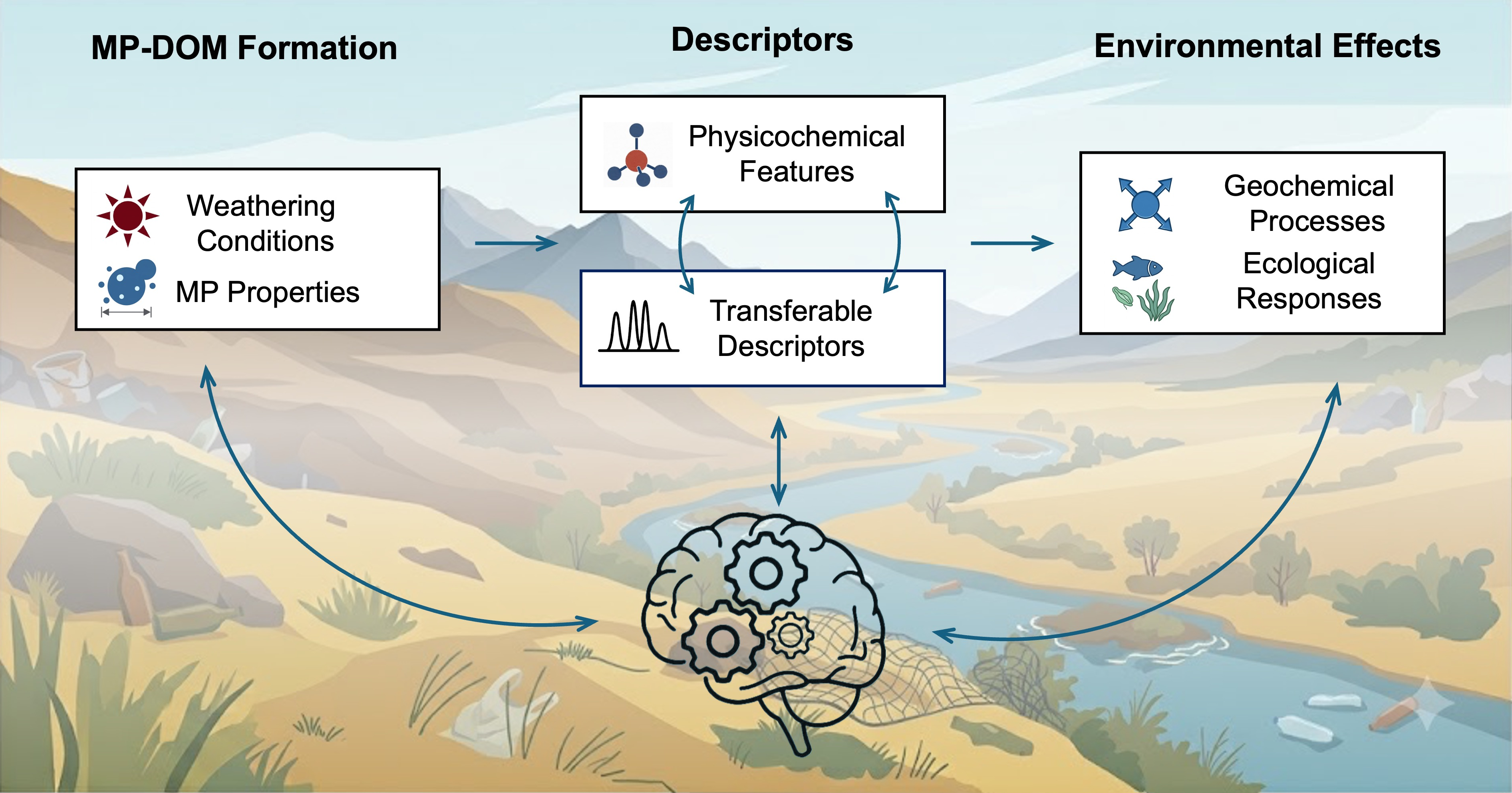
Microplastic-derived dissolved organic matter (MP-DOM) is increasingly recognized as an active product of plastic weathering; however, its environmental effects remain difficult to compare or predict. A major problem is the absence of variables that can maintain comparable mechanistic meaning across formation and effect studies. To address this gap, we propose a descriptor-based conceptual framework that uses measurable MP-DOM properties as transferable intermediates. Within this framework, using descriptors as a transferable and standardized language, spanning quantity, optical properties, molecular composition, and reactivity, can bridge diverse weathering conditions with downstream environmental effects. Using E2/E3, defined as the absorbance ratio at 250 and 365 nm, as a representative example, we demonstrate how an optical descriptor can connect MP-DOM formation processes with photochemical reactivity and contaminant photodegradation through its relationship with singlet oxygen generation. This framework highlights the need for transferable descriptors as a standardized framework for MP-DOM, providing a foundation for cross-study comparison, mechanistic integration, and predictive assessment of MP-DOM fate and environmental effects.
Graphical Abstract
Keywords
microplastic-derived dissolved organic matter | transferable descriptors | environmental effect | descriptor-based framework
References
- 1.
Liu, X.; Fang, L.; Gardea-Torresdey, J.L.; et al. Microplastic-derived dissolved organic matter: Generation, characterization, and environmental behaviors. Sci. Total Environ. 2024, 948, 174811.
- 2.
Romera-Castillo, C.; Pinto, M.; Langer, T.M.; et al. Dissolved organic carbon leaching from plastics stimulates microbial activity in the ocean. Nat. Commun. 2018, 9, 1430.
- 3.
Thompson, R.C.; Courtene-Jones, W.; Boucher, J.; et al. Twenty years of microplastic pollution research—What have we learned? Science 2024, 386, eadl2746.
- 4.
Zhou, Y.; Zeng, Y.; Law, J.C.F.; et al. Long-Lived Organic Radicals Drive the Photodegradation of Plastic Additives in Microplastic-Derived Dissolved Organic Matter. Environ. Sci. Technol. 2026, 60, 18835–18843.
- 5.
Lee, Y.K.; Romera-Castillo, C.; Hong, S.; et al. Characteristics of microplastic polymer-derived dissolved organic matter and its potential as a disinfection byproduct precursor. Water Res. 2020, 175, 115678.
- 6.
Ateia, M.; Kanan, A.; Karanfil, T. Microplastics release precursors of chlorinated and brominated disinfection byproducts in water. Chemosphere 2020, 251, 126452.
- 7.
Tang, X.; Yuan, X.; Lu, W.; et al. Microplastics in livestock manure and compost: Environmental distribution, degradation behavior, and their impact on antibiotic resistance gene dissemination. Chem. Eng. J. 2025, 513, 162881.
- 8.
Song, F.; Li, T.; Hur, J.; et al. Molecular-level insights into the heterogeneous variations and dynamic formation mechanism of leached dissolved organic matter during the photoaging of polystyrene microplastics. Water Res. 2023, 242, 120114.
- 9.
Wang, K.; Ma, S.; Li, Z.; et al. New Insights into the Long-Term Leaching Process of Dissolved Organic Matter from Microplastics: Dynamic Formation and Transformation Mechanism. Environ. Sci. Technol. 2025, 59, 22180–22191.
- 10.
Lee, Y.K.; Hong, S.; Hur, J. A fluorescence indicator for source discrimination between microplastic-derived dissolved organic matter and aquatic natural organic matter. Water Res. 2021, 207, 117833.
- 11.
Huang, D.; Ding, L.; Qiu, X.; et al. Molecular-Scale Insights into the Surface Structural Transformation and Light-Driven Production of Reactive Oxygen Species of Goethite Induced by Microplastic-Derived Dissolved Organic Matter. Environ. Sci. Technol. 2025, 59, 17349–17360.
- 12.
Chen, M.; Xu, J.; Tang, R.; et al. Roles of microplastic-derived dissolved organic matter on the photodegradation of organic micropollutants. J. Hazard. Mater. 2022, 440, 129784.
- 13.
Zhang, X.; Zhang, T.; Zhang, J.; et al. Review of decisive factors for controlling generation and environmental effect of dissolved organic matter from (micro)plastics. J. Hazard. Mater. 2025, 500, 140511.
- 14.
Shi, C.; Guo, A.; Pang, S.; et al. Precise characterization of the presence and fate of plastic oligomers in water. Nat. Water 2025, 3, 461–472.
- 15.
Wang, M.; Zhang, J.; Yang, Y.; et al. Photoreactivity of microplastic-derived dissolved organic matter governed by its oxygen-containing functional groups in hydrophobic/hydrophilic fractions rather than molecular weights. Water Res. 2026, 291, 125187.
- 16.
Xiao, J.; Zhang, Z.; Liu, P.; et al. Microplastic-Derived Carbon Emissions: From Granular Carbon to Dissolved Organic Carbon and Carbon Dioxide under Ultraviolet Radiation. Environ. Sci. Technol. 2025, 59, 17310–17321.
- 17.
Yin, Y.; Li, Z.; Li, R.; et al. Effect of pH and salinity on the release of polystyrene microplastics derived dissolved organic matter as revealed by experimental studies and molecular dynamic simulations. Sci. Total Environ. 2025, 975, 179307.
- 18.
Fan, Z.; Yang, Y.; Wang, P.; et al. Microplastics-driven reconfiguration of organic carbon fractions in lake sediments: Mineralization and stabilization dynamics of biodegradable polymers. Water Res. 2026, 289, 124852.
- 19.
Helms, J.R.; Stubbins, A.; Ritchie, J.D.; et al. Absorption spectral slopes and slope ratios as indicators of molecular weight, source, and photobleaching of chromophoric dissolved organic matter. Limnol. Oceanogr. 2008, 53, 955–969.
- 20.
Petersen-Sonn, E.A.; Brigante, M.; Deguillaume, L.; et al. Tropospheric Multiphase Chemistry: Excited Triplet States Compete with OH Radicals and Singlet Molecular Oxygen. ACS Earth Space Chem. 2025, 9, 533–544.
- 21.
Ossola, R.; Jönsson, O.M.; Moor, K.; et al. Singlet Oxygen Quantum Yields in Environmental Waters. Chem. Rev. 2021, 121, 4100–4146.
- 22.
McNeill, K.; Canonica, S. Triplet state dissolved organic matter in aquatic photochemistry: Reaction mechanisms, substrate scope, and photophysical properties. Environ. Sci. Process. Impacts 2016, 18, 1381–1399.
- 23.
Lee, J.; von Gunten, U.; Kim, J.H. Persulfate-Based Advanced Oxidation: Critical Assessment of Opportunities and Roadblocks. Environ. Sci. Technol. 2020, 54, 3064–3081.
- 24.
Ding, L.; Zhang, H.; Chen, H.; et al. Photochemical transformation of microplastics-derived dissolved organic matter altered the photoaging of microplastics. J. Hazard. Mater. 2025, 500, 140477.
- 25.
Yang, H.; Gao, B.; Wang, Z.; et al. Phototransformation of microplastic derived dissolved organic matter reduces its adsorption capacity on ferrihydrite: Effects of additive types. J. Hazard. Mater. 2026, 503, 141147.
- 26.
Ouyang, Z.; Li, S.; Xue, J.; et al. Dissolved organic matter derived from biodegradable microplastic promotes photo-aging of coexisting microplastics and alters microbial metabolism. J. Hazard. Mater. 2023, 445, 130564.
- 27.
Wang, K.; Xu, S.; Wang, J.; et al. Insights into the photosensitivity and photobleaching of dissolved organic matter from microplastics: Structure-activity relationship and transformation mechanism. J. Hazard. Mater. 2024, 480, 135931.
- 28.
Huang, D.; Dong, H.; Li, X.; et al. Transformation of dissolved organic matter leached from biodegradable and conventional microplastics under UV/chlorine treatment and the subsequent effect on contaminant removal. J. Hazard. Mater. 2024, 480, 135994.
- 29.
Wang, Q.; Chen, M.; Min, Y.; et al. Aging of polystyrene microplastics by UV/Sodium percarbonate oxidation: Organic release, mechanism, and disinfection by-product formation. J. Hazard. Mater. 2024, 464, 132934.
- 30.
Huang, D.; Ding, L.; Qiu, X.; et al. Molecular transformation and photochemical reactivity of microplastic-derived dissolved organic matter on goethite: Implications for persistence and reactive oxygen species dynamics. Water Res. 2026, 288, 124568.
- 31.
Zhang, J.; Hou, X.; Zhang, K.; et al. Photochemistry of microplastics-derived dissolved organic matter: Reactive species generation and organic pollutant degradation. Water Res. 2025, 269, 122802.
- 32.
Gu, J.; Chen, K.; Cai, T.; et al. The intermolecular differences in dissolved organic matter derived from microplastics during photo-aging and photo-bio-aging processes. Environ. Pollut. 2025, 381, 126599.
- 33.
Xu, Y.; Huang, D.; Liu, P.; et al. The characteristics of dissolved organic matter release from UV-aged microplastics and its cytotoxicity on human colonic adenocarcinoma cells. Sci. Total Environ. 2022, 826, 154177.
- 34.
Zeng, L.; Zhou, Z.; Zhang, J.; et al. Selective degradation of organic pollutants in the aquatic environment by microplastic-derived dissolved organic matter through molecular photoresponse sequence transformation. Chem. Eng. J. 2024, 499, 156676.
- 35.
Ding, R.; Shan, X.; Ding, L.; et al. Coupled Reactive Regulation by Microplastic-Derived Dissolved Organic Matter Sustains Reactive Oxygen Species Cycling in Laccase-Metal Synergy for Continuous Microplastic Degradation. Environ. Sci. Technol. 2026, 60, 2101–2111.
- 36.
Yang, Z.; Liu, P.; Wang, J.; et al. Microplastics-derived dissolved organic matters accelerate photodegradation of sulfamethazine in wastewater ultraviolet disinfection process. Chem. Eng. J. 2023, 454, 140301.
- 37.
Chen, H.; Shan, X.; Qiu, X.; et al. High-Resolution Mass Spectrometry Combined with Reactive Oxygen Species Reveals Differences in Photoreactivity of Dissolved Organic Matter from Microplastic Sources in Aqueous Environments. Environ. Sci. Technol. 2024, 58, 10334–10346.
- 38.
Wan, D.; Wang, J.; Chen, T.; et al. Effect of disinfection on the photoreactivity of effluent organic matter and photodegradation of organic contaminants. Water Res. 2022, 219, 118552.
- 39.
Guo, S.; Liu, L.; Wang, L.; et al. Phototransformation and photoreactivity of MPs-DOM in aqueous environment: Key role of MPs structure decoded by optical and molecular signatures. J. Hazard. Mater. 2024, 480, 136331.
- 40.
Dalrymple, R.M.; Carfagno, A.K.; Sharpless, C.M. Correlations between Dissolved Organic Matter Optical Properties and Quantum Yields of Singlet Oxygen and Hydrogen Peroxide. Environ. Sci. Technol. 2010, 44, 5824–5829.
- 41.
Li, S.; Harir, M.; Bastviken, D.; et al. Dearomatization drives complexity generation in freshwater organic matter. Nature 2024, 628, 776–781.
- 42.
Li, Y.; Poisson, K.; McMinn, M.H.; et al. Small Molecules as Markers for Decoding Plastic-Related Information: A Focus on Polymer Composition. Environ. Sci. Technol. Lett. 2025, 12, 1019–1025.
- 43.
Yang, R.; Duan, J.; Song, J.; et al. Microplastics identification framework: Integration of microplastic-derived dissolved organic matter fingerprints and machine learning. Water Res. 2026, 303, 126251.

How to Cite
Zeng , Y.; Zhou, Y.; Law, J. C.-F.; Huang, Y.; Leung, K. S.-Y. Toward Transferable Descriptors Linking Formation and Environmental Effects of Microplastic-Derived Dissolved Organic Matter. Global Environmental Science 2026, 2 (4), 526–532. https://doi.org/10.53941/ges.2026.100031.
RIS
BibTex
Copyright & License

Copyright (c) 2026 by the authors.
This work is licensed under a Creative Commons Attribution 4.0 International License.
Article Metrics
29
Article Views
0
Citations
Contents
References
