
- An MC-GNN model integrating multiple factors is proposed for urban toxic gas diffusion prediction.
- MC-GNN accurately predicts urban toxic gas diffusion while substantially reducing computational time.
- Lateral distance analysis of high-risk regions.
- Open Access
- Article
Multi-Factor Coupled Deep Learning Framework for Predicting Toxic Gas Diffusion Patterns in Urban Areas
- Mingtao Ding 1,†,
- Xuqiang Shao 2,3,†,
- Xinhang Jing 2,4,
- Xiaofan Liu 2,
- Sixuan Chen 2,
- Zijia Zhao 2,
- Jiancai Huang 2,4 and
- Zhijian Liu 1,*
Author Information
Received: 30 December 2025 | Revised: 16 June 2026 | Accepted: 16 November 2026 | Published: 25 November 2026
Highlights
Abstract
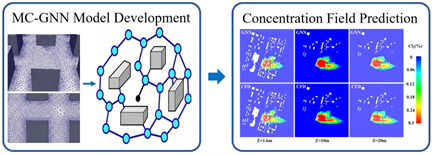
Toxic gas leakage accidents in urban environments pose serious threats to public health, environmental safety, economic activity, and social stability, underscoring the urgent need for effective monitoring and prevention strategies. At present, the diffusion of toxic gases is typically analyzed using computational fluid dynamics (CFD) simulations. However, toxic gas diffusion in urban settings is jointly influenced by multiple factors, including building layouts, meteorological conditions, leakage concentrations, and leakage rates, thereby making it difficult for traditional numerical approaches to comprehensively account for these influences. Moreover, CFD simulations inherently suffer from high computational cost and long simulation time. To address these limitations, this study proposes a multi-factor coupled graph neural network model. The graph architecture effectively represents the unstructured flow field data produced by CFD simulations, and the incorporation of meteorological data, leakage-source parameters, and inlet boundary conditions enables comprehensive prediction of toxic gas diffusion under multi-factor coupling. Furthermore, a dose–response model is introduced to assess exposure risks, and dimensional analysis is employed to evaluate the lateral distance of high-risk regions. The π theorem is used to derive an analytical formula for lateral distance prediction, and its validity is verified using 40 simulation cases. The results demonstrate that the proposed predictive framework improves computational speed by nearly one order of magnitude compared with traditional CFD simulations, achieving an average R2 of up to 0.84 for concentration field prediction. Through dimensional analysis, the π theorem–based lateral-distance prediction formula achieves an R2 of 0.96, with absolute errors ranging from 0.1% to 5.03%.
Graphical Abstract
Keywords
toxic gas diffusion | multiple factors | deep learning | graph neural network | exposure risk
References
- 1.
Gant, S.E.; Weil, J.C.; Monache, L.D.; et al. Dense gas dispersion model development and testing for the Jack Rabbit II phase 1 chlorine release experiments. Atmos. Environ. 2018, 192, 218–240. Correction in Atmos. Environ. 2019, 196, 179.
- 2.
Zheng, D.; Zhang, J.; Liu, Z.; et al. Effects of Pipeline Pressure on Diffusion Characteristics of Leaked Natural Gas in Tunnel Space. ACS Omega 2023, 8, 10235–10241.
- 3.
Zhou, Z.Q.; Zhao, W.W.; Zhang, Y.L.; et al. Study on the Diffusion Law of Heavy Gas Leakage in Complex Scenarios Based on Scaled-Down Experiments. ACS Omega 2024, 9, 31533–31545.
- 4.
Wu, B.; Zhao, R.; Meng, G.; et al. A numerical study on CO migration after blasting in high-altitude tunnel by inclined shaft. Sci. Rep. 2022, 12, 14696.
- 5.
Feng, X.; Jiang, Z.; Zhang, G.; et al. Study on CO diffusion law and concentration distribution function under ventilation after blasting in high-altitude tunnel. J. Wind. Eng. Ind. Aerodyn. 2022, 220, 104871.
- 6.
Hirst, W.J.S.; Eyre, J.A. Maplin Sands Experiments 1980: Combustion of Large LNG and Refrigerated Liquid Propane Spills on the Sea. In Heavy Gas and Risk Assessment—II; Springer: Dordrecht, The Netherlands, 1983; pp. 211–224.
- 7.
Puttock, J.S.; Colenbrander, G.W.; Blackmore, D.R. Maplin Sands Experiments 1980: Dispersion Results from Continuous Releases of Refrigerated Liquid Propane. In Heavy Gas and Risk Assessment—II; Springer: Dordrecht, The Netherlands, 1983; pp. 147–161.
- 8.
Colenbrander, G.W.; Puttock, J.S. Maplin Sands Experiments 1980: Interpretation and Modelling of Liquefied Gas Spills onto the Sea. In Atmospheric Dispersion of Heavy Gases and Small Particles; Springer: Berlin/Heidelberg, Germany, 1984; pp. 277–295.
- 9.
Hanna, S.R.; Steinberg, K.W. Overview of Petroleum Environmental Research Forum (PERF) dense gas dispersion modeling project. Atmos. Environ. 2001, 35, 2223–2229.
- 10.
Hanna, S.; Britter, R.; Argenta, E.; et al. The Jack Rabbit chlorine release experiments: Implications of dense gas removal from a depression and downwind concentrations. J. Hazard. Mater. 2012, 213–214, 406–412.
- 11.
Thompson, R.S. Building amplification factors for sources near buildings: A wind-tunnel study. Atmos. Environ. Part A. Gen. Top. 1993, 27, 2313–2325.
- 12.
Chen, B.; Liu, S.; Miao, Y.; et al. Construction and validation of an urban area flow and dispersion model on building scales. Acta Meteorol. Sin. 2013, 27, 923–941.
- 13.
Janour, Z.; Jurcakova, K.; Brych, K.; et al. Potential risks at an industrial site: A wind tunnel study. Process Saf. Environ. Prot. 2010, 88, 185–190.
- 14.
Salim, S.M.; Buccolieri, R.; Chan, A.; et al. Numerical simulation of atmospheric pollutant dispersion in an urban street canyon: Comparison between RANS and LES. J. Wind. Eng. Ind. Aerodyn. 2011, 99, 103–113.
- 15.
Tominaga, Y.; Akabayashi, S.I.; Kitahara, T.; et al. Air flow around isolated gable-roof buildings with different roof pitches: Wind tunnel experiments and CFD simulations. Build. Environ. 2015, 84, 204–213.
- 16.
Tan, W.; Wang, K.; Li, C.; et al. Experimental and numerical study on the dispersion of heavy gases in urban environments. Process Saf. Environ. Prot. 2018, 116, 640–653.
- 17.
Dai, Y.; Mak, C.M.; Ai, Z.; et al. Evaluation of computational and physical parameters influencing CFD simulations of pollutant dispersion in building arrays. Build. Environ. 2018, 137, 90–107.
- 18.
Hang, J.; Chen, L.; Lin, Y.; et al. The impact of semi-open settings on ventilation in idealized building arrays. Urban Clim. 2018, 25, 196–217.
- 19.
Pontiggia, M.; Derudi, M.; Alba, M.; et al. Hazardous gas releases in urban areas: Assessment of consequences through CFD modelling. J. Hazard. Mater. 2010, 176, 589–596.
- 20.
Foroutan, H.; Tang, W.; Heist, D.K.; et al. Numerical analysis of pollutant dispersion around elongated buildings: An embedded large eddy simulation approach. Atmos. Environ. 2018, 187, 117–130.
- 21.
Tominaga, Y.; Stathopoulos, T. Steady and unsteady RANS simulations of pollutant dispersion around isolated cubical buildings: Effect of large-scale fluctuations on the concentration field. J. Wind. Eng. Ind. Aerodyn. 2017, 165, 23–33.
- 22.
Shao, X.; Zhao, Z.; Liu, Z.; et al. Exposure risk and emergency evacuation modeling of toxic gas leakage in urban areas under the influence of multiple meteorological factors. Environ. Pollut. 2023, 333, 122044.
- 23.
Wang, B.; Chen, B.; Zhao, J. The real-time estimation of hazardous gas dispersion by the integration of gas detectors, neural network and gas dispersion models. J. Hazard. Mater. 2015, 300, 433–442.
- 24.
Jiao, Z.; Ji, C.; Sun, Y.; et al. Deep learning based quantitative property-consequence relationship (QPCR) models for toxic dispersion prediction. Process Saf. Environ. Prot. 2021, 152, 352–360.
- 25.
Wang, Y.; Luo, Z.; Luo, J. Research on predicting the diffusion of toxic heavy gas sulfur dioxide by applying a hybrid deep learning model to real case data. Sci. Total Environ. 2023, 901, 166506.
- 26.
Li, Z.; Liu, F.; Yang, W.; et al. A Survey of Convolutional Neural Networks: Analysis, Applications, and Prospects. IEEE Trans. Neural Netw. Learn. Syst. 2022, 33, 6999–7019.
- 27.
Guo, X.; Li, W.; Iorio, F. Convolutional Neural Networks for Steady Flow Approximation. In Proceedings of the KDD’16: The 22nd ACM SIGKDD International Conference on Knowledge Discovery and Data Mining, San Francisco, CA, USA, 13–17 August 2016; pp. 481–490.
- 28.
Sekar, V.; Jiang, Q.; Shu, C.; et al. Fast flow field prediction over airfoils using deep learning approach. Phys. Fluids 2019, 31, 057103.
- 29.
Kochkov, D.; Smith, J.A.; Alieva, A.; et al. Machine learning–accelerated computational fluid dynamics. Proc. Natl. Acad. Sci. USA 2021, 118, e2101784118.
- 30.
Miyanawala, T.P.; Jaiman, R.K. An Efficient Deep Learning Technique for the Navier-Stokes Equations: Application to Unsteady Wake Flow Dynamics. arXiv 2017, arXiv:1710.09099.
- 31.
Xiang, S.; Fu, X.; Zhou, J.; et al. Non-intrusive reduced order model of urban airflow with dynamic boundary conditions. Build. Environ. 2021, 187, 107397.
- 32.
Alet, F.; Jeewajee, A.K.; Bauzá, M.; et al. Graph Element Networks: Adaptive, structured computation and memory. In Proceedings of the International Conference on Machine Learning, Long Beach, CA, USA, 10–15 June 2019; pp. 212–222.
- 33.
Zhao, R.; Liu, S.; Liu, J.; et al. A two-stage CFD-GNN approach for efficient steady-state prediction of urban airflow and airborne contaminant dispersion. Sustain. Cities Soc. 2024, 112, 105607.
- 34.
Shao, X.; Zhang, S.; Liu, X.; et al. Rapid prediction for the transient dispersion of leaked airborne pollutant in urban environment based on graph neural networks. J. Hazard. Mater. 2024, 478, 135517.
- 35.
Wang, F.; Zhang, T.T.; You, R.; et al. Evaluation of infection probability of Covid-19 in different types of airliner cabins. Build. Environ. 2023, 234, 110159.
- 36.
Zhang, X.; Wang, J. Dose-response Relation Deduced for Coronaviruses from Coronavirus Disease 2019, Severe Acute Respiratory Syndrome, and Middle East Respiratory Syndrome: Meta-analysis Results and its Application for Infection Risk Assessment of Aerosol Transmission. Clin. Infect. Dis. 2021, 73, e241–e245.
- 37.
Liu, M.; Liu, J.; Cao, Q.; et al. Evaluation of different air distribution systems in a commercial airliner cabin in terms of comfort and COVID-19 infection risk. Build. Environ. 2022, 208, 108590. Correction in Build. Environ. 2022, 214, 108939.
- 38.
Liu, Z.; Cao, H.; Hu, C.; et al. Modeling the infection risk and emergency evacuation from bioaerosol leakage around an urban vaccine factory. npj Clim. Atmos. Sci. 2023, 6, 6.
- 39.
Schubach, S. A measure of human sensitivity in acute inhalation toxicity. J. Loss Prev. Process Ind. 1997, 10, 309–315.
- 40.
Yang, D.; Chen, G.; Shi, J.; et al. A novel approach for hazardous area identification of toxic gas leakage accidents on offshore facilities. Ocean. Eng. 2020, 217, 107926.
- 41.
Leitl, B.; Schatzmann, M. Compilation of Experimental Data for Validation Purposes; Meteorology Institute, Hamburg University: Hamburg, Germany, 1998.
- 42.
Franke, J.; Hellsten, A.; Schlunzen, K.H.; et al. The COST 732 Best Practice Guideline for CFD simulation of flows in the urban environment: A summary. Int. J. Environ. Pollut. 2011, 44, 419–427.
- 43.
Ai, Z.T.; Mak, C.M. CFD simulation of flow in a long street canyon under a perpendicular wind direction: Evaluation of three computational settings. Build. Environ. 2017, 114, 293–306.
- 44.
Pfaff, T.; Fortunato, M.; Sanchez Gonzalez, A.; et al. Learning Mesh-Based Simulation with Graph Networks. In Proceedings of the International Conference on Learning Representations, Virtual, 3–7 May 2021.
- 45.
Sánchez-González, Á.; Heess, N.; Springenberg, J.T.; et al. Graph networks as learnable physics engines for inference and control. In Proceedings of the International Conference on Machine Learning, Stockholm, Sweden, 10–15 July 2018; Volume 80, pp. 4470–4479.

How to Cite
Ding, M.; Shao, X.; Jing, X.; Liu, X.; Chen, S.; Zhao, Z.; Huang, J.; Liu, Z. Multi-Factor Coupled Deep Learning Framework for Predicting Toxic Gas Diffusion Patterns in Urban Areas. Global Environmental Science 2026, 2 (4), 553–576. https://doi.org/10.53941/ges.2026.100034.
RIS
BibTex
Copyright & License

Copyright (c) 2026 by the authors.
This work is licensed under a Creative Commons Attribution 4.0 International License.
Article Metrics
43
Article Views
0
Citations
Contents
References
