
- Photo-assisted AOPs: From activity optimization to sustainability optimization.
- A five-perspective framework reframes how photo-assisted AOPs are judged.
- No weighted index: From maximizing one metric to meeting every requirement.
- Open Access
- Perspective
Rethinking Photo-Assisted Advanced Oxidation Processes toward Sustainable Water Treatment
- Zixiao Wu 1,2,
- Alain R. Puente-Santiago 3,* and
- Bo Weng 1,2,*
Author Information
Received: 18 August 2026 | Revised: 25 October 2026 | Accepted: 16 November 2026 | Published: 19 November 2026
Highlights
Abstract
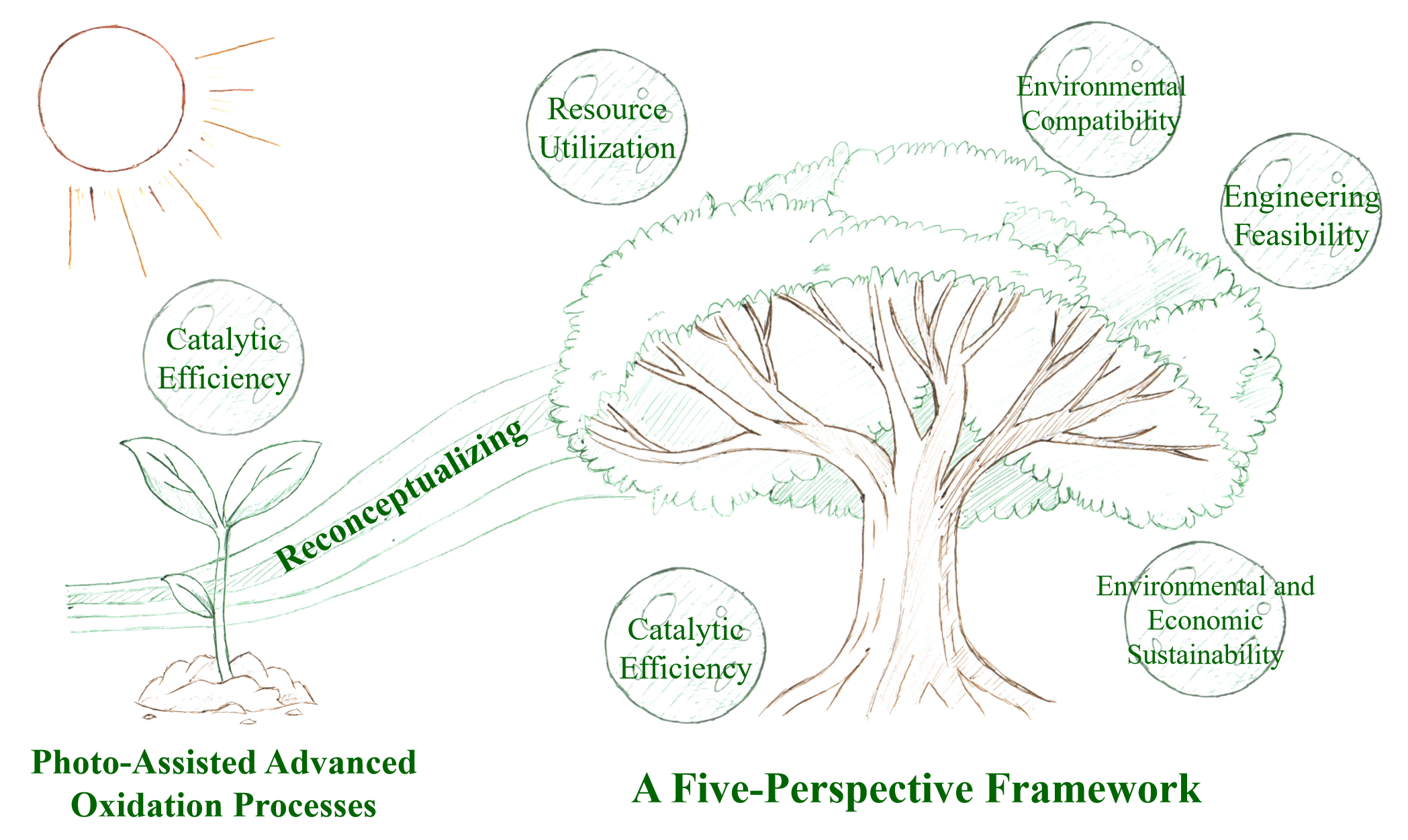
Photo-assisted advanced oxidation processes (AOPs) have emerged as promising strategies for sustainable water treatment, yet their development remains largely driven by catalytic activity, with degradation efficiency and reactive oxygen species generation often serving as the primary performance metrics. Here, we argue that this activity-centered paradigm is insufficient for translating laboratory advances into practical and sustainable water treatment. We propose a shift from activity optimization toward sustainability optimization, in which photo-assisted AOPs are examined from five complementary perspectives: catalytic efficiency, resource utilization, environmental compatibility, engineering feasibility, and environmental and economic sustainability. Particular emphasis is placed on improving the utilization efficiency of sunlight, oxidants, and reactive oxygen species rather than simply maximizing their generation. We further highlight the need to examine realistic water matrices, scalable catalyst design, and to weigh environmental and economic sustainability alongside them. Moving beyond activity, we argue, can provide a more meaningful framework for guiding the next generation of photo-assisted AOPs toward practical, efficient, and sustainable water treatment.
Graphical Abstract
Keywords
photo-assisted advanced oxidation processes | sustainability optimization | resource utilization | environmental and economic sustainability | wastewater treatment
References
- 1.
Wilkinson, J.L.; Boxall, A.B.A.; Kolpin, D.W.; et al. Pharmaceutical pollution of the world’s rivers. Proc. Natl. Acad. Sci. USA 2022, 119, e2113947119. https://doi.org/10.1073/pnas.2113947119.
- 2.
aus der Beek, T.; Weber, F.A.; Bergmann, A.; et al. Pharmaceuticals in the environment—Global occurrences and perspectives. Environ. Toxicol. Chem. 2015, 35, 823–835. https://doi.org/10.1002/etc.3339.
- 3.
Larsson, D.G.J.; Flach, C.F. Antibiotic resistance in the environment. Nat. Rev. Microbiol. 2022, 20, 257–269. https://doi.org/10.1038/s41579-021-00649-x.
- 4.
Petrie, B.; Barden, R.; Kasprzyk-Hordern, B. A review on emerging contaminants in wastewaters and the environment: Current knowledge, understudied areas and recommendations for future monitoring. Water Res. 2015, 72, 3–27. https://doi.org/10.1016/j.watres.2014.08.053.
- 5.
Li, S.; Mu, S.; Chang, Z.; et al. Quartz sand-supported polydopamine/Co–Ni ZIF catalyst for efficient degradation of tetracycline antibiotics in water. J. Phys. Chem. Solids 2026, 211, 113487. https://doi.org/10.1016/j.jpcs.2025.113487.
- 6.
Miklos, D.B.; Remy, C.; Jekel, M.; et al. Evaluation of advanced oxidation processes for water and wastewater treatment—A critical review. Water Res. 2018, 139, 118–131. https://doi.org/10.1016/j.watres.2018.03.042.
- 7.
Nosaka, Y.; Nosaka, A.Y. Generation and Detection of Reactive Oxygen Species in Photocatalysis. Chem. Rev. 2017, 117, 11302–11336. https://doi.org/10.1021/acs.chemrev.7b00161.
- 8.
Oturan, M.A.; Aaron, J.J. Advanced Oxidation Processes in Water/Wastewater Treatment: Principles and Applications. A Review. Crit. Rev. Environ. Sci. Technol. 2014, 44, 2577–2641. https://doi.org/10.1080/10643389.2013.829765.
- 9.
Kanakaraju, D.; Glass, B.D.; Oelgemöller, M. Advanced oxidation process-mediated removal of pharmaceuticals from water: A review. J. Environ. Manag. 2018, 219, 189–207. https://doi.org/10.1016/j.jenvman.2018.04.103.
- 10.
Brillas, E. A review on the photoelectro-Fenton process as efficient electrochemical advanced oxidation for wastewater remediation. Treatment with UV light, sunlight, and coupling with conventional and other photo-assisted advanced technologies. Chemosphere 2020, 250, 126198. https://doi.org/10.1016/j.chemosphere.2020.126198.
- 11.
Loeb, S.K.; Alvarez, P.J.J.; Brame, J.A.; et al. The Technology Horizon for Photocatalytic Water Treatment: Sunrise or Sunset? Environ. Sci. Technol. 2019, 53, 2937–2947. https://doi.org/10.1021/acs.est.8b05041.
- 12.
Weng, B.; Zhang, M.; Lin, Y.; et al. Photo-assisted technologies for environmental remediation. Nat. Rev. Clean Technol. 2025, 1, 201–215. https://doi.org/10.1038/s44359-025-00037-1.
- 13.
Tripathy, H.; Balakrishnan, A.; Chinthala, M.; et al. Peroxymonosulfate-activated photocatalytic reclamation of sulfamethoxazole using In2S3/CuSe infused carboxymethyl cellulose photocatalytic heterojunction hydrogels: Insights into operations and mechanisms. Chem. Eng. J. 2025, 518, 164360. https://doi.org/10.1016/j.cej.2025.164360.
- 14.
Ai, Y.; Carabineiro, S.A.C.; Xiong, X.; et al. Systematic assessment of emerging contaminants elimination using an S-scheme Mn0.5Cd0.5S/In2S3 photocatalyst: Degradation pathways, toxicity evaluation and mechanistic analysis. Chin. J. Catal. 2025, 75, 147–163. https://doi.org/10.1016/s1872-2067(25)64723-1.
- 15.
Luo, Z.; She, X.; Wu, Y.; et al. Regulating ·OH generation via an S-scheme TiO2/CdZnS heterojunction for selective photocatalytic PET upcycling to glycolate. Chem. Eng. J. 2026, 545, 179801. https://doi.org/10.1016/j.cej.2026.179801.
- 16.
Wang, A.; Li, J.; Zhang, T. Heterogeneous single-atom catalysis. Nat. Rev. Chem. 2018, 2, 65–81. https://doi.org/10.1038/s41570-018-0010-1.
- 17.
Shang, Y.; Xu, X.; Gao, B.; et al. Single-atom catalysis in advanced oxidation processes for environmental remediation. Chem. Soc. Rev. 2021, 50, 5281–5322. https://doi.org/10.1039/d0cs01032d.
- 18.
Wang, S.; Zhang, X.; Wang, L.; et al. Single-Atom Catalysts for Photo-Related Advanced Oxidation Processes Towards Environmental Remediation. Adv. Funct. Mater. 2026, 36, e26761. https://doi.org/10.1002/adfm.202526761.
- 19.
Lin, Y.; Zhou, Z.; Wang, S.; et al. High-Entropy Metal Nanomaterials for Energy Conversion and Environmental Remediation: Fundamentals, Design Strategies, and Future Directions. ACS Catal. 2026, 16, 13939–13980. https://doi.org/10.1021/acscatal.6c01442.
- 20.
Ma, Y.; Ma, Y.; Wang, Q.; et al. High-entropy energy materials: Challenges and new opportunities. Energy Environ. Sci. 2021, 14, 2883–2905. https://doi.org/10.1039/d1ee00505g.
- 21.
Linic, S.; Christopher, P.; Ingram, D.B. Plasmonic-metal nanostructures for efficient conversion of solar to chemical energy. Nat. Mater. 2011, 10, 911–921. https://doi.org/10.1038/nmat3151.
- 22.
Hübner, U.; Spahr, S.; Lutze, H.; et al. Advanced oxidation processes for water and wastewater treatment—Guidance for systematic future research. Heliyon 2024, 10, e30402. https://doi.org/10.1016/j.heliyon.2024.e30402.
- 23.
Wang, Y.; Jiao, G.; Yang, Y.; et al. 3D structure of LaFe1−δCoδO3@carbon cloth composite catalyst for promoting peroxymonosulfate activation: Identification of catalytic mechanism towards multiple antibiotics. Desalination 2025, 602, 118643. https://doi.org/10.1016/j.desal.2025.118643.
- 24.
Braham, R.J.; Harris, A.T. Review of Major Design and Scale-up Considerations for Solar Photocatalytic Reactors. Ind. Eng. Chem. Res. 2009, 48, 8890–8905. https://doi.org/10.1021/ie900859z.
- 25.
Hodges, B.C.; Cates, E.L.; Kim, J.H. Challenges and prospects of advanced oxidation water treatment processes using catalytic nanomaterials. Nat. Nanotechnol. 2018, 13, 642–650. https://doi.org/10.1038/s41565-018-0216-x.
- 26.
Li, K.; Du, Y.; Lv, H.; et al. Donor-dimensionality-modulated excited state in conjugated microporous polymers for enhanced photocatalysis. Cell Press Blue 2026, 1, 100032. https://doi.org/10.1016/j.cpblue.2026.100032.
- 27.
Lee, J.; von Gunten, U.; Kim, J.H. Persulfate-Based Advanced Oxidation: Critical Assessment of Opportunities and Roadblocks. Environ. Sci. Technol. 2020, 54, 3064–3081. https://doi.org/10.1021/acs.est.9b07082.
- 28.
Wang, J.; Wang, S. Activation of persulfate (PS) and peroxymonosulfate (PMS) and application for the degradation of emerging contaminants. Chem. Eng. J. 2018, 334, 1502–1517. https://doi.org/10.1016/j.cej.2017.11.059.
- 29.
Katsoyiannis, I.A.; Canonica, S.; von Gunten, U. Efficiency and energy requirements for the transformation of organic micropollutants by ozone, O3/H2O2 and UV/H2O2. Water Res. 2011, 45, 3811–3822. https://doi.org/10.1016/j.watres.2011.04.038.
- 30.
Lado Ribeiro, A.R.; Moreira, N.F.F.; Li Puma, G.; et al. Impact of water matrix on the removal of micropollutants by advanced oxidation technologies. Chem. Eng. J. 2019, 363, 155–173. https://doi.org/10.1016/j.cej.2019.01.080.
- 31.
Brame, J.; Long, M.; Li, Q.; et al. Inhibitory effect of natural organic matter or other background constituents on photocatalytic advanced oxidation processes: Mechanistic model development and validation. Water Res. 2015, 84, 362–371. https://doi.org/10.1016/j.watres.2015.07.044.
- 32.
Grebel, J.E.; Pignatello, J.J.; Mitch, W.A. Effect of Halide Ions and Carbonates on Organic Contaminant Degradation by Hydroxyl Radical-Based Advanced Oxidation Processes in Saline Waters. Environ. Sci. Technol. 2010, 44, 6822–6828. https://doi.org/10.1021/es1010225.
- 33.
von Gunten, U. Oxidation Processes in Water Treatment: Are We on Track? Environ. Sci. Technol. 2018, 52, 5062–5075. https://doi.org/10.1021/acs.est.8b00586.
- 34.
Corominas, L.; Foley, J.; Guest, J.S.; et al. Life cycle assessment applied to wastewater treatment: State of the art. Water Res. 2013, 47, 5480–5492. https://doi.org/10.1016/j.watres.2013.06.049.
- 35.
Rizzo, L.; Malato, S.; Antakyali, D.; et al. Consolidated vs new advanced treatment methods for the removal of contaminants of emerging concern from urban wastewater. Sci. Total Environ. 2019, 655, 986–1008. https://doi.org/10.1016/j.scitotenv.2018.11.265.
- 36.
Sun, T.; Wang, R.; Guan, R.; et al. Design strategies and application progress of covalent organic frameworks in photocatalytic oxidation reactions. Chem. Sci. 2026, 17, 1964–2000. https://doi.org/10.1039/d5sc08410e.
- 37.
Samarasinghe, L.V.; Muthukumaran, S.; Baskaran, K. Heterojunction photocatalysts for solar-driven wastewater treatment: Interfacial design, charge carrier dynamics, and advanced characterization techniques. J. Water Process Eng. 2025, 79, 108960. https://doi.org/10.1016/j.jwpe.2025.108960.
- 38.
Rodríguez-Chueca, J.; Carbajo, J.; García-Muñoz, P. Intensification of Photo-Assisted Advanced Oxidation Processes for Water Treatment: A Critical Review. Catalysts 2023, 13, 401. https://doi.org/10.3390/catal13020401.
- 39.
Lawan, M.S.; Balkhyour, M.A.; Kumar, R.; et al. Hybrid photocatalytic-ozonation for wastewater remediation: Mechanisms and synergistic effects. RSC Adv. 2026, 16, 23818–23847. https://doi.org/10.1039/d6ra01948j.
- 40.
Serik, A.; Idrissov, N.; Kuspanov, Z.; et al. Impact of water matrix type on the efficiency of photocatalytic degradation of organic pollutants. Catal. Today 2026, 477, 115934. https://doi.org/10.1016/j.cattod.2026.115934.
- 41.
Qudsieh, I.Y.; Ali, M.A.; Maafa, I.M. Effect of water matrix on photocatalytic degradation of organic pollutants in water: A literature review. Rev. Chem. Eng. 2025, 41, 539–573. https://doi.org/10.1515/revce-2024-0093.
- 42.
Wang, L.; Zhang, Q.; Chen, B.; et al. Some issues limiting photo(cata)lysis application in water pollutant control: A critical review from chemistry perspectives. Water Res. 2020, 174, 115605. https://doi.org/10.1016/j.watres.2020.115605.
- 43.
Bagchi, D.; Hausmann, J.N.; Sontheimer, T.; et al. Linking Synthetic Materials Chemistry to Electrocatalytic Performance. Angew. Chem. Int. Ed. 2026, 65, e4318027. https://doi.org/10.1002/anie.4318027.
- 44.
Chen, H.; Huang, Z.; Wang, J.; et al. Single-Atom Catalysts at the Crossroads: Navigating the Path from Laboratory Synthesis to Real-World Devices. ACS Catal. 2026, 16, 2976–2997. https://doi.org/10.1021/acscatal.5c08694.
- 45.
Hashemi, S.A.; Ghaffarkhah, A.; Isari, A.A.; et al. Advancing from MOFs and COFs to Functional Macroscopic Porous Constructs. Adv. Mater. 2025, 37, 2411617. https://doi.org/10.1002/adma.202411617.
- 46.
Lu, J.; Wu, Z.; Zhu, S.H.; et al. Scalable TiO2/high-entropy oxide heterojunctions for synergistic photo-PMS activation toward ciprofloxacin degradation. Appl. Catal. B Environ. Energy 2027, 404, 127653. https://doi.org/10.1016/j.apcatb.2026.127653.
- 47.
Esania, Z.; Nowrouzi, M.; Abyar, H.; et al. Integrating life cycle assessment and cost analysis for a MOF-based ZnO–Fe3O4/TiO2 photocatalyst: Toward sustainable degradation of Reactive Blue 21 in textile wastewater. Integr. Environ. Assess. Manag. 2026, 22, 2080–2095. https://doi.org/10.1093/inteam/vjag100.
- 48.
Rezaie, A.; Khaki, E.; Boleydei, H.; et al. Environmental, energy and economic assessment of four recyclable nano-sized semiconductor photocatalysts to remove 2,4-dichlorophenol. J. Water Process Eng. 2025, 77, 108351. https://doi.org/10.1016/j.jwpe.2025.108351.
- 49.
Cunha, I.L.C.; Assis, G.C.D.; Metolina, P.; et al. Is Photocatalysis Ready for Scale Yet? Processes 2025, 14, 102. https://doi.org/10.3390/pr14010102.

How to Cite
Wu, Z.; Puente-Santiago, A. R.; Weng, B. Rethinking Photo-Assisted Advanced Oxidation Processes toward Sustainable Water Treatment. Global Environmental Science 2026, 2 (4), 533–540. https://doi.org/10.53941/ges.2026.100032.
RIS
BibTex
Copyright & License

Copyright (c) 2026 by the authors.
This work is licensed under a Creative Commons Attribution 4.0 International License.
Article Metrics
20
Article Views
0
Citations
Contents
References
