
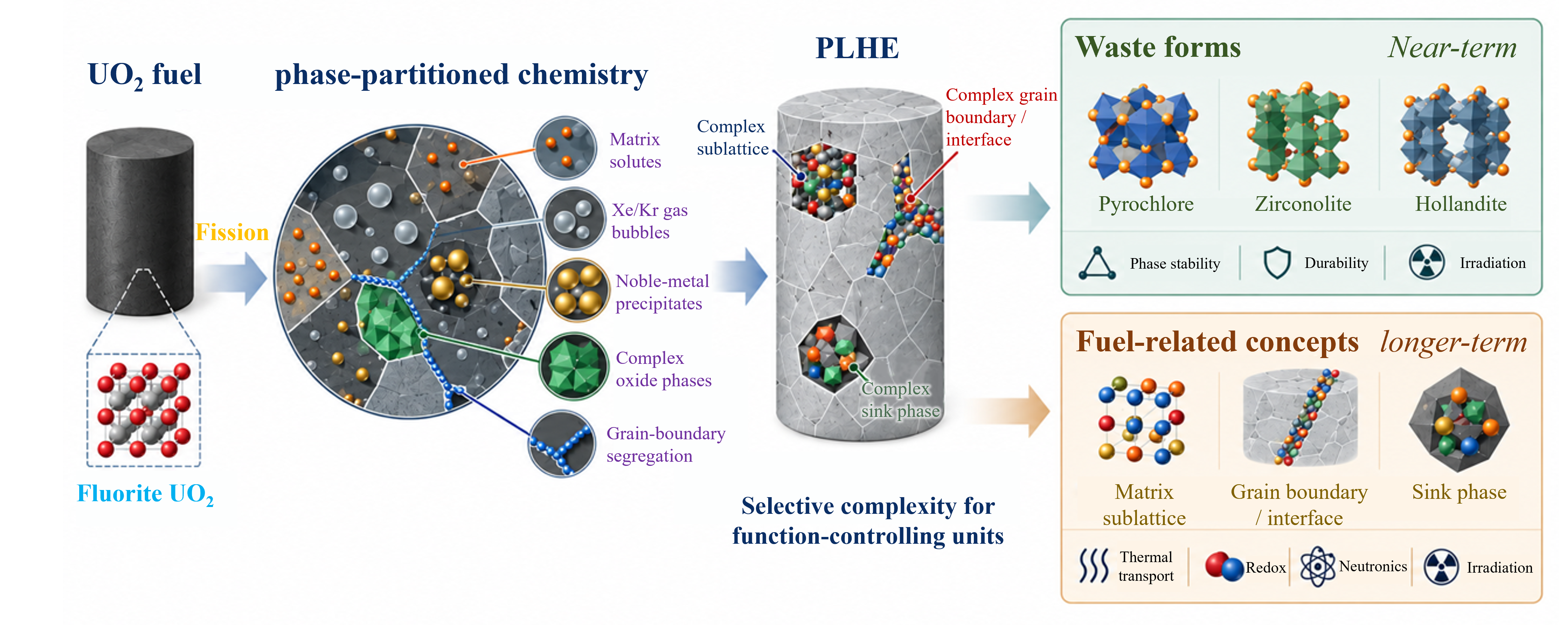
High-entropy ceramics are generally designed by distributing several principal cations over one or more crystallographic sublattices. Nuclear fuel ceramics develop a different form of chemical complexity: fission, neutron capture, radioactive decay, redox changes, temperature gradients, and diffusion produce a phase-partitioned UO2 microstructure containing dissolved fission products, gas bubbles, noble-metal precipitates, complex oxides, and chemically modified interfaces. Here we use this irradiation-driven partitioning to motivate partial/local high-entropy (PLHE) design, in which deliberately introduced compositional complexity is confined to a function-controlling sublattice, grain-boundary region, interface, or secondary phase while the primary matrix is retained. Irradiated UO2 is treated as a non-equilibrium heterogeneous state rather than a high-entropy phase. PLHE is defined by resolved spatial or crystallographic confinement, local compositional/site evidence, a specified performance bottleneck, and comparison with a matched lower-complexity reference. The resulting framework treats configurational entropy as one screening metric within broader thermodynamic and kinetic constraints. Waste-form ceramics provide the most direct near-term test bed, whereas fuel-matrix and in-fuel concepts require additional thermal, neutronic, redox, and irradiation screening.
- Open Access
- Review
- Jiasheng Wang 1,2,
- Yong Zhang 1,2,*
Author Information
Received: 01 Aug 2026 | Revised: 04 Sep 2026 | Accepted: 23 Sep 2026 | Published: 09 Oct 2026
Abstract
Graphical Abstract
Keywords
nuclear ceramics | UO2 fuel | fission products | compositionally complex ceramics | partial/local high entropy | radiation tolerance
References
- 1.
Rost, C.M.; Sachet, E.; Borman, T.; et al. Entropy-Stabilized Oxides. Nat. Commun. 2015, 6, 8485. https://doi.org/10.1038/ncomms9485.
- 2.
Jiao, Y.; Dai, J.; Fan, Z.; et al. Overview of High-Entropy Oxide Ceramics. Mater. Today 2024, 77, 92–117. https://doi.org/10.1016/j.mattod.2024.06.005.
- 3.
Dube, T.C.; Zhang, J. Underpinning the Relationship between Synthesis and Properties of High Entropy Ceramics: A Comprehensive Review on Borides, Carbides and Oxides. J. Eur. Ceram. Soc. 2024, 44, 1335–1350. https://doi.org/10.1016/j.jeurceramsoc.2023.10.023.
- 4.
Luo, J. From High-Entropy Ceramics to Compositionally Complex Ceramics and Beyond. J. Materiomics. 2026, 12, 101173. https://doi.org/10.1016/j.jmat.2026.101173.
- 5.
Musicó, B.L.; Gilbert, D.; Ward, T.Z.; et al. The Emergent Field of High Entropy Oxides: Design, Prospects, Challenges, and Opportunities for Tailoring Material Properties. APL Mater. 2020, 8, 040912. https://doi.org/10.1063/5.0003149.
- 6.
Brahlek, M.; Gazda, M.; Keppens, V.; et al. What Is in a Name: Defining “High Entropy” Oxides. APL Mater. 2022, 10, 110902. https://doi.org/10.1063/5.0122727.
- 7.
Gild, J.; Samiee, M.; Braun, J.L.; et al. High-Entropy Fluorite Oxides. J. Eur. Ceram. Soc. 2018, 38, 3578–3584. https://doi.org/10.1016/j.jeurceramsoc.2018.04.010.
- 8.
Wright, A.J.; Luo, J. A Step Forward from High-Entropy Ceramics to Compositionally Complex Ceramics: A New Perspective. J. Mater. Sci. 2020, 55, 9812–9827. https://doi.org/10.1007/s10853-020-04583-w.
- 9.
Wright, A.J.; Wang, Q.; Huang, C.; et al. From High-Entropy Ceramics to Compositionally-Complex Ceramics: A Case Study of Fluorite Oxides. J. Eur. Ceram. Soc. 2020, 40, 2120–2129. https://doi.org/10.1016/j.jeurceramsoc.2020.01.015.
- 10.
Olander, D.R. Fundamental Aspects of Nuclear Reactor Fuel Elements; Technical Information Center, Office of Public Affairs, Energy Research and Development Administration: Oak Ridge, TN, USA, 1976. https://doi.org/10.2172/7343826.
- 11.
Weber, W.J.; Ewing, R.C.; Catlow, C.R.A.; et al. Radiation Effects in Crystalline Ceramics for the Immobilization of High-Level Nuclear Waste and Plutonium. J. Mater. Res. 1998, 13, 1434–1484. https://doi.org/10.1557/jmr.1998.0205.
- 12.
Ewing, R.C. Long-Term Storage of Spent Nuclear Fuel. Nat. Mater. 2015, 14, 252–257. https://doi.org/10.1038/nmat4226.
- 13.
Kleykamp, H. The Chemical State of the Fission Products in Oxide Fuels. J. Nucl. Mater. 1985, 131, 221–246. https://doi.org/10.1016/0022-3115(85)90460-x.
- 14.
Ge, Z.; Yan, D.; Lei, P.; et al. A Comprehensive Review of High Burn-up Structure Formation in UO2: Mechanisms, Interactions, and Future Directions. Nanomaterials 2025, 15, 325. https://doi.org/10.3390/nano15050325.
- 15.
Lucuta, P.G.; Verrall, R.A.; Matzke, H.; et al. Microstructural Features of SIMFUEL—Simulated High-Burnup UO2-Based Nuclear Fuel. J. Nucl. Mater. 1991, 178, 48–60. https://doi.org/10.1016/0022-3115(91)90455-g.
- 16.
Matzke, H. On the Rim Effect in High Burnup UO2LWR Fuels. J. Nucl. Mater. 1992, 189, 141–148. https://doi.org/10.1016/0022-3115(92)90428-n.
- 17.
Barker, M.A.; Adam, M.S.; Little, P.; et al. Observations of High Burnup Structure in AGR Fuel. Prog. Nucl. Energy 2022, 153, 104433. https://doi.org/10.1016/j.pnucene.2022.104433.
- 18.
Kim, D.J.; Yang, J.H.; Kim, J.H.; et al. Effects of Solid Fission Products Forming Dissolved Oxide (Nd) and Metallic Precipitate (Ru) on the Thermal Conductivity of Uranium Base Oxide Fuel. Thermochim. Acta 2007, 455, 123–128. https://doi.org/10.1016/j.tca.2006.12.005.
- 19.
Pilania, R.K.; Dube, C.L. Matrices for Radioactive Waste Immobilization: A Review. Front. Mater. 2023, 10, 1236470. https://doi.org/10.3389/fmats.2023.1236470.
- 20.
Chen, K.; Pei, X.; Tang, L.; et al. A Five-Component Entropy-Stabilized Fluorite Oxide. J. Eur. Ceram. Soc. 2018, 38, 4161–4164. https://doi.org/10.1016/j.jeurceramsoc.2018.04.063.
- 21.
Huang, S.; Zhang, J.; Fu, H.; et al. Irradiation Performance of High Entropy Ceramics: A Comprehensive Comparison with Conventional Ceramics and High Entropy Alloys. Prog. Mater. Sci. 2024, 143, 101250. https://doi.org/10.1016/j.pmatsci.2024.101250.
- 22.
Xu, L.; Su, L.; Niu, M.; et al. Irradiation Induced Structural Damage and Evolution of Mechanical Properties in High Entropy Fluorite Oxide. J. Eur. Ceram. Soc. 2023, 43, 3507–3515. https://doi.org/10.1016/j.jeurceramsoc.2023.02.003.
- 23.
Daghbouj, N.; AlMotasem, A.T.; Li, B.; et al. Defect Landscape Engineering Suppresses Helium Damage in Ceramics. Commun. Mater. 2026, 7, 97. https://doi.org/10.1038/s43246-026-01083-3.
- 24.
Bae, I.T.; Weber, W.J.; Ishimaru, M.; et al. Effect of Ionization Rates on Dynamic Recovery Processes during Electron-Beam Irradiation of 6H-SiC. Appl. Phys. Lett. 2007, 90, 121910. https://doi.org/10.1063/1.2715135.
- 25.
Xu, X.; Ning, X.; Dong, F.; et al. Low Temperature Fabrication of Ba0.9Cs0.3Cr2.1Ti5.9O16 Ceramic Waste Form for Cesium Immobilization Using Bi2O3 as Sintering Aid. Chem. Eng. J. 2024, 492, 152166. https://doi.org/10.1016/j.cej.2024.152166.
- 26.
Daghbouj, N.; AlMotasem, A.T.; Duchoň, J.; et al. Nanoscale Strain Evolution and Grain Boundary-Mediated Defect Sink Behavior in Irradiated SiC: Insights from N-PED and DFT. Acta Mater. 2026, 303, 121739. https://doi.org/10.1016/j.actamat.2025.121739.
- 27.
Sickafus, K.E.; Minervini, L.; Grimes, R.W.; et al. Radiation Tolerance of Complex Oxides. Science 2000, 289, 748–751. https://doi.org/10.1126/science.289.5480.748.
- 28.
Wang, Y.; Jing, C.; Ding, Z.Y.; et al. The Structure, Property, and Ion Irradiation Effects of Pyrochlores: A Comprehensive Review. Crystals 2023, 13, 143. https://doi.org/10.3390/cryst13010143.
- 29.
Blackburn, L.R.; Corkhill, C.L.; Hyatt, N.C. A Review of Zirconolite Solid Solution Regimes for Plutonium and Candidate Neutron Absorbing Additives. Ceramics 2023, 6, 1330–1347. https://doi.org/10.3390/ceramics6030082.
- 30.
Braun, J.L.; Rost, C.M.; Lim, M.; et al. Charge-Induced Disorder Controls the Thermal Conductivity of Entropy-Stabilized Oxides. Adv. Mater. 2018, 30, 1805004. https://doi.org/10.1002/adma.201805004.
- 31.
Terricabras, A.J.; Galvin, C.O.T.; Kosmidou, M.; et al. Chromium Doping Effects on UO2 Grain Boundary Chemistry: A Combined Experimental and Modeling Approach. J. Nucl. Mater. 2025, 617, 156114. https://doi.org/10.1016/j.jnucmat.2025.156114.
- 32.
Alshannaq, M.; Owen, C.; Ferrigno, J.; et al. Implications of Point Defect Accumulation on UO2 Thermal Conductivity and Fission Gas Release under Accelerated Fuel Irradiation. J. Nucl. Mater. 2025, 616, 156057. https://doi.org/10.1016/j.jnucmat.2025.156057.
- 33.
NIST Center for Neutron Research. Neutron Scattering Lengths and Cross Sections. Available online: https://www.nist.gov/ncnr/planning-your-experiment/scattering-length-periodic-table (accessed on 2 September 2026).
- 34.
Ko, S.T.; Lee, T.; Qi, J.; et al. Compositionally Complex Perovskite Oxides: Discovering a New Class of Solid Electrolytes with Interface-Enabled Conductivity Improvements. Matter 2023, 6, 2395–2418. https://doi.org/10.1016/j.matt.2023.05.035.
- 35.
Wang, Z.; Zhou, L.; Liu, C.; et al. The Irradiation Resistance and Mechanical Properties of the High-Entropy Zirconate Pyrochlore (La0.2Nd0.2Sm0.2Eu0.2Gd0.2)2Zr2O7. Nucl. Instrum. Methods Phys. Res. Sect. B Beam Interact. Mater. Atoms 2024, 549, 165285. https://doi.org/10.1016/j.nimb.2024.165285.

This work is licensed under a Creative Commons Attribution 4.0 International License.

 Suite 4002 Level 4, 447 Collins Street, Melbourne, Victoria 3000, Australia
 General Inquiries: info@sciltp.com