
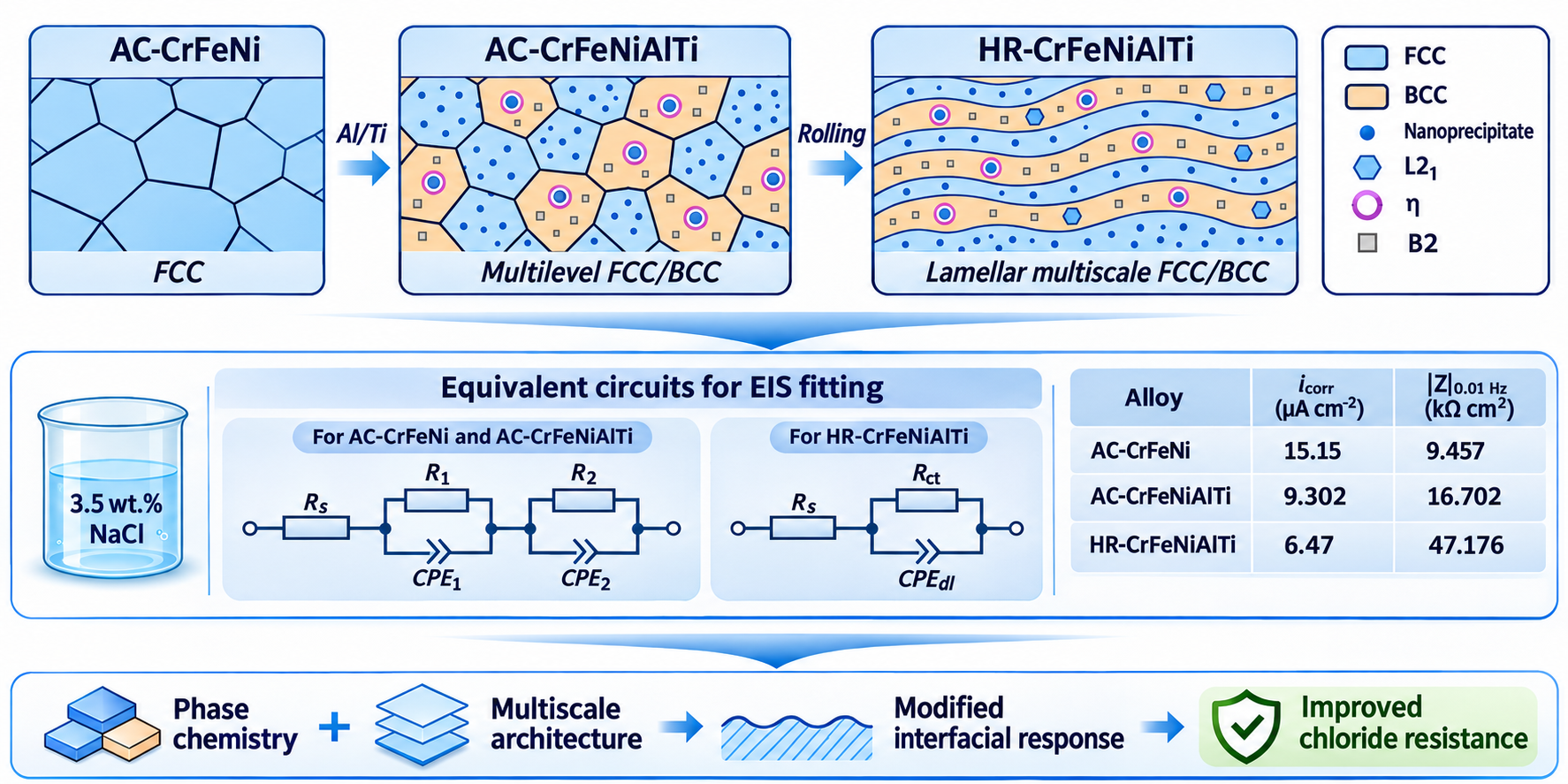
Phase heterogeneity provides an effective strategy for designing multi-principal element alloys (MPEAs), yet how phase constitution and spatial organization regulate chloride corrosion remains insufficiently understood. Here, the electrochemical corrosion behavior of as-cast equiatomic CrFeNi (AC-CrFeNi), as-cast Cr30Fe30Ni30Al5Ti5 (AC-CrFeNiAlTi), and hot-rolled Cr30Fe30Ni30Al5Ti5 (HR-CrFeNiAlTi) was comparatively investigated in 3.5 wt.% NaCl solution. The Al/Ti-induced transition from a single-phase FCC structure to a face-centered cubic (FCC) and body-centered cubic (BCC) heterogeneous architecture containing hierarchical ordered precipitates reduced the corrosion current density from 15.15 to 9.302 μA cm−2 and increased the low-frequency impedance modulus from 9.457 to 16.702 kΩ cm2. Further reorganization of the FCC/BCC regions into a directional lamellar morphology at unchanged nominal composition enhanced the corrosion resistance, yielding an icorr of 6.47 μA cm−2 and |Z|0.01 Hz of 47.176 kΩ cm2. Electrochemical impedance analysis revealed that the improved corrosion response of the hot-rolled alloy was accompanied by a more capacitive interfacial response and prolonged relaxation behavior. Post-electrochemical characterization revealed localized oxygen-enriched corrosion products, while XRD confirmed the retention of the primary FCC structure in AC-CrFeNi and the FCC/BCC structures in both CrFeNiAlTi conditions, indicating that corrosion remained controlled by microstructurally dependent local attack rather than extensive phase degradation. The results reveal that chloride corrosion in CrFeNi-based MPEAs is governed by the coupling between phase chemistry, local electrochemical heterogeneity, and phase morphology. This work highlights that reorganizing heterogeneous phase architectures provides a viable pathway for simultaneously tailoring mechanical and corrosion performance in advanced MPEAs.
- Open Access
- Article
Phase Chemistry and Spatial Organization Govern Chloride Corrosion Behavior of CrFeNi-Based Multi-Principal Element Alloys
- Qingwei Gao *,
- Changzi Chen,
- Jianfei Wang,
- Huiqiang Huang and
- Xiaoming Yang
Author Information
Received: 01 October 2026 | Revised: 23 October 2026 | Accepted: 04 November 2026 | Published: 16 November 2026
Abstract
Graphical Abstract
Keywords
multi-principal element alloy | phase heterogeneity | microstructural morphology | electrochemical corrosion | localized corrosion
References
- 1.
Ghorbani, M.; Li, Z.; Qiu, Y.; et al. Current Progress in Aqueous Corrosion of Multi-Principal Element Alloys. Metall. Mater. Trans. A 2024, 55, 2571–2588. https://doi.org/10.1007/s11661-024-07473-x.
- 2.
Qin, Y.; Fu, J.; Lu, Z.; et al. Research Progress on Corrosion Mechanism of High-Entropy Alloys. Trans. Nonferrous Met. Soc. China 2026, 36, 1365–1387. https://doi.org/10.1016/s1003-6326(25)67036-1.
- 3.
Ghorbani, M.; Laleh, M.; Gharbi, O.; et al. Aqueous Corrosion of Additively Manufactured Multi Principal Element Alloys: A Critical Review. npj Mater. Degrad. 2025, 9, 159. https://doi.org/10.1038/s41529-025-00701-8.
- 4.
Zhang, J.Y.; Xiao, B.; Chou, T.H.; et al. High-Entropy Alloys: A Critical Review of Aqueous Corrosion Behavior and Mechanisms. High Entropy Alloys Mater. 2023, 1, 195–259. https://doi.org/10.1007/s44210-023-00021-z.
- 5.
Blades, W.H.; Redemann, B.W.Y.; Smith, N.; et al. Tuning Chemical Short-Range Order for Stainless Behavior at Reduced Chromium Concentrations in Multi-Principal Element Alloys. Acta Mater. 2024, 277, 120209. https://doi.org/10.1016/j.actamat.2024.120209.
- 6.
Sur, D.; Smith, N.C.; Connors, P.F.; et al. Investigating the Synergistic Benefits of Al on Cr(III) in the Passive Films of FeCoNi-Cr-Al CCAs in Sulfuric Acid. Electrochim. Acta 2025, 513, 145523. https://doi.org/10.1016/j.electacta.2024.145523.
- 7.
Kang, K.W.; Li, A.X.; Zhang, B.R.; et al. Corrosion Resistance of Ultra-High Yield Strength CoCrNi-Based Medium Entropy Alloy. J. Alloys Compd. 2025, 1036, 181770. https://doi.org/10.1016/j.jallcom.2025.181770.
- 8.
Liu, L.; Lu, K.; Jing, Z.; et al. Simultaneously Improving Strength and Corrosion Resistance of CoCrNi-Based Multi-Principal Element Alloys via Alloying with Mo Content. J. Alloys Compd. 2025, 1010, 177119. https://doi.org/10.1016/j.jallcom.2024.177119.
- 9.
Yu, K.P.; Feng, S.H.; Ding, C.; et al. Improving Anti-Corrosion Properties of CoCrFeMnNi High Entropy Alloy by Introducing Si into Nonmetallic Inclusions. Corros. Sci. 2022, 208, 110616. https://doi.org/10.1016/j.corsci.2022.110616.
- 10.
Yen, C.C.; Lin, S.Y.; Ting, C.L.; et al. Passivation Mechanisms of CoCrFeNiMox (X = 0, 0.1, 0.2, 0.3) High Entropy Alloys and MP35N in 3.5 wt% NaCl Aerated Aqueous Solutions. Corros. Sci. 2024, 228, 111812. https://doi.org/10.1016/j.corsci.2023.111812.
- 11.
Zhang, M.; Shi, X.; Li, Z.; et al. Corrosion Behaviors and Mechanism of CrFeNi2 Based High-Entropy Alloys. Corros. Sci. 2022, 207, 110562. https://doi.org/10.1016/j.corsci.2022.110562.
- 12.
Zhao, Q.; Pan, Z.; Wang, X.; et al. Corrosion and Passive Behavior of AlxCrFeNi3−X (X = 0.6, 0.8, 1.0) Eutectic High Entropy Alloys in Chloride Environment. Corros. Sci. 2022, 208, 110666. https://doi.org/10.1016/j.corsci.2022.110666.
- 13.
Wang, Y.; Li, G.; Li, H.; et al. Effect of Aging on Corrosion Resistance of (FeCoNi)86Al7Ti7 High Entropy Alloys. Corros. Sci. 2024, 227, 111717. https://doi.org/10.1016/j.corsci.2023.111717.
- 14.
Cheng, H.; Luo, H.; Wang, X.; et al. Microstructure and Corrosion Resistance Properties of (FeCoNi)86Al7Ti7 High-Entropy Alloy via Different Aging Time. Corros. Sci. 2024, 226, 111670. https://doi.org/10.1016/j.corsci.2023.111670.
- 15.
Qi, W.; Wang, W.; Yang, X.; et al. Effects of Al and Ti Co-Doping on the Strength-Ductility- Corrosion Resistance of CoCrFeNi-AlTi High-Entropy Alloys. J. Alloys Compd. 2022, 925, 166751. https://doi.org/10.1016/j.jallcom.2022.166751.
- 16.
Liu, S.; Duan, J.; Zhang, M.; et al. Correlation of Microstructure, Mechanical Properties and Corrosion Behavior in a Ni34Co28Cr28Al10 Multi-Principal Element Alloy with Outstanding Corrosion Resistance. Corros. Sci. 2024, 228, 111835. https://doi.org/10.1016/j.corsci.2024.111835.
- 17.
Inman, S.B.; Han, J.; Wischhusen, M.A.; et al. Passivation and Localized Corrosion Resistance of Al0.3Cr0.5Fe2MoxNi1.5Ti0.3 Compositionally Complex Alloys: Effect of Mo Content. Corros. Sci. 2024, 227, 111692. https://doi.org/10.1016/j.corsci.2023.111692.
- 18.
Duan, J.M.; Jiang, Z.N.; Zeng, X.Q.; et al. Unveiling the Underlying Corrosion/Corrosion-Resistance Mechanism of a Novel Corrosion-Resistant High Entropy Alloy by Experimental Means and AIMD Simulations. Corros. Sci. 2024, 227, 111782. https://doi.org/10.1016/j.corsci.2023.111782.
- 19.
Li, X.; Zhang, G.; Lei, N.; et al. Corrosion Behaviors of CrFeNiNbx Medium Entropy Alloys with Hypereutectic and Hypoeutectic Structures. Mater. Today Commun. 2023, 35, 106153. https://doi.org/10.1016/j.mtcomm.2023.106153.
- 20.
Shi, X.; Li, G.; Zhang, M.; et al. Laves Phase Assisted the Passive Behaviors of Co-Free Non-Equiatomic Cr-Fe-Ni-Nb Eutectic High-Entropy Alloys. J. Alloys Compd. 2023, 960, 170905. https://doi.org/10.1016/j.jallcom.2023.170905.
- 21.
Ao, P.; Liu, L.; Xi, Z.; et al. Coupled Effects of FCC/BCC Phase Morphology and Passive-Film Defects on the Corrosion Behavior of AlₓFeNiCrCo High-Entropy Alloys. J. Alloys Compd. 2026, 1080, 190428. https://doi.org/10.1016/j.jallcom.2026.190428.
- 22.
Wu, H.; Xie, J.; Yang, H.; et al. Corrosion Behavior and Corrosion Resistance Mechanism of a Multi-Level Heterogeneous Lamellar Structure Eutectic High Entropy Alloy. Corros. Sci. 2025, 256, 113172. https://doi.org/10.1016/j.corsci.2025.113172.
- 23.
Xu, M.K.; Li, A.X.; Kang, K.W.; et al. Influence of Thermomechanical Processing on Microstructure, Mechanical Response and Corrosion Behavior of a Precipitation-Strengthened CoCrNi Base Alloy. J. Alloys Compd. 2025, 1039, 183290. https://doi.org/10.1016/j.jallcom.2025.183290.
- 24.
Hong, L.; Li, H.; Huang, M.; et al. Enhancing Mechanical Property and Corrosion Resistance of Al0.3CoCrFeNi1.5 High Entropy Alloy via Grain Boundary Engineering. Mater. Charact. 2024, 217, 114420. https://doi.org/10.1016/j.matchar.2024.114420.
- 25.
Gao, Q.; Kou, Z.; Zhou, C.; et al. Exceptional Strength-Ductility Synergy in a Casting Multi-Principal Element Alloy with a Hierarchically Heterogeneous Structure. Mater. Today 2024, 81, 70–83. https://doi.org/10.1016/j.mattod.2024.10.009.
- 26.
Stern, M.; Geary, A.L. Electrochemical Polarization: I. A Theoretical Analysis of the Shape of Polarization Curves. J. Electrochem. Soc. 1957, 104, 56. https://doi.org/10.1149/1.2428496.
- 27.
Brug, G.J.; van den Eeden, A.L.G.; Sluyters-Rehbach, M.; et al. The Analysis of Electrode Impedances Complicated by the Presence of a Constant Phase Element. J. Electroanal. Chem. Interfacial Electrochem. 1984, 176, 275–295. https://doi.org/10.1016/s0022-0728(84)80324-1.
- 28.
Hirschorn, B.; Orazem, M.E.; Tribollet, B.; et al. Determination of Effective Capacitance and Film Thickness from Constant-Phase-Element Parameters. Electrochim. Acta 2010, 55, 6218–6227. https://doi.org/10.1016/j.electacta.2009.10.065.
- 29.
Wang, X.Z.; Hu, Q.; Zhang, L.; et al. The Influence of Nb Addition on the Passivity of CoCrNiNbx Multi-Principal Element Alloys. J. Electroanal. Chem. 2022, 908, 116107. https://doi.org/10.1016/j.jelechem.2022.116107.
- 30.
Sun, Y.; Lv, Y.; Di, J.; et al. Correlating Microstructure, Corrosion Behavior and Wear Resistance in an Additively Manufactured Heterogeneous CoCrNi-Based Medium Entropy Alloy with Outstanding Mechanical Properties. Mater. Charact. 2026, 231, 115941. https://doi.org/10.1016/j.matchar.2025.115941.
- 31.
Wang, D.; Lei, X.; Bai, Y.; et al. Effect of La Addition on the Corrosion Behaviors of CrCoNi Medium Entropy Alloy in Chloride Solution. Appl. Surf. Sci. 2025, 699, 163164. https://doi.org/10.1016/j.apsusc.2025.163164.
- 32.
Xie, R.; Wei, Y.; Luo, K.; et al. Effect of Environmental Factors on the Corrosion Behavior of CoCrNi and CoCrFeMnNi Alloys in 3.5 wt% NaCl Solution. J. Mater. Res. Technol. 2025, 35, 2994–3007. https://doi.org/10.1016/j.jmrt.2025.01.227.
- 33.
Wu, Y.; Yue, Y.; Yan, X.; et al. Mechanical and Corrosion Behavior of CoCrFeNiAl0.3 High Entropy Alloy Seamless Tubes. J. Alloys Compd. 2025, 1010, 177143. https://doi.org/10.1016/j.jallcom.2024.177143.
- 34.
Che, C.; Jiang, M.; Li, A.; et al. Effect of Ni Content on the Corrosion Resistance of CoCr0.8FeTi0.4Nix High Entropy Alloys in 3.5 wt% NaCl Solution. J. Alloys Compd. 2025, 1016, 178900. https://doi.org/10.1016/j.jallcom.2025.178900.
- 35.
Chahlaoui, Y.; Saeidlou, S.; Al-Harbi, L.M.; et al. Bayesian-Optimized Surface Energy Microstructure-Informed Model of Active Dissolution in CrMnFeCoNi High-Entropy Alloys. Mater. Today Commun. 2025, 49, 113741. https://doi.org/10.1016/j.mtcomm.2025.113741.
- 36.
Wang, Z.; Fu, J.; Feng, Y.; et al. Corrosion Behavior and Antifouling Performance of CoCrFeNiCux High-Entropy Alloys in 3.5 Wt% NaCl Solution. Electrochim. Acta 2026, 553, 148303. https://doi.org/10.1016/j.electacta.2026.148303.
- 37.
Xie, C.; Han, J.; Sun, F.; et al. The Spontaneous Passivation of Multi Principal Element Alloys II: The Effect of Mn in the CoCrFeNiMn Family. Corros. Sci. 2025, 244, 112642. https://doi.org/10.1016/j.corsci.2024.112642.
- 38.
Hou, Y.; Dou, B.; Xie, C.; et al. On the Corrosion Resistance of the CoCrFeMnNi High Entropy Alloys in Chloride-Containing Sulfuric Acid Solutions. Appl. Surf. Sci. 2025, 681, 161487. https://doi.org/10.1016/j.apsusc.2024.161487.
- 39.
Sur, D.; Inman, S.B.; Anderson, K.L.; et al. Factors Governing Passivation Behavior of Fe-Cr-Al-Ti Alloys in Sulfate Containing Acidified Solutions: Uncovering the Many Roles of Ti. Materialia 2025, 39, 102370. https://doi.org/10.1016/j.mtla.2025.102370.
- 40.
Wei, L.; Qin, W.M.; Chen, J.Y.; et al. L21-Strengthened Face-Centered Cubic High-Entropy Alloy with Well Pitting Resistance. Corros. Sci. 2023, 215, 111043. https://doi.org/10.1016/j.corsci.2023.111043.
- 41.
Wang, J.; Jiang, H.; Chang, X.; et al. Effect of Cu Content on the Microstructure and Corrosion Resistance of AlCrFeNi3Cux High Entropy Alloys. Corros. Sci. 2023, 221, 111313. https://doi.org/10.1016/j.corsci.2023.111313.
- 42.
Song, L.; Hu, W.; Liao, B.; et al. Corrosion Behavior of AlCoCrFeNi2.1 Eutectic High-Entropy Alloy in Cl− Containing Solution. J. Alloys Compd. 2023, 938, 168609. https://doi.org/10.1016/j.jallcom.2022.168609.
- 43.
Tsai, F.Y.; Pandaleon, A.; O’Brien, S.; et al. Effects of Annealing on Phase Transformation and Corrosion Mechanism of Severely Deformed Al0.3CoCrFeNi High-Entropy Alloy. npj Mater. Degrad. 2026, 10, 109. https://doi.org/10.1038/s41529-026-00818-4.
- 44.
Qiu, X.; Liu, X.; Pan, X.; et al. Corrosion and Tensile Performance of a Co40Cr20Ni30Al4.5Ti5Mo0.5 High-Entropy Alloy under High Temperature and Pressure CO2 Environment. J. Alloys Compd. 2025, 1036, 181905. https://doi.org/10.1016/j.jallcom.2025.181905.
- 45.
Fu, Y.; Wen, M.; Cao, Y.; et al. Enhanced Pitting Resistance of Al0.4Cr0.9FeNi2.2V0.2 High-Entropy Alloy via Coherent Nanoprecipitates Design. Corros. Sci. 2026, 259, 113491. https://doi.org/10.1016/j.corsci.2025.113491.

This work is licensed under a Creative Commons Attribution 4.0 International License.
