
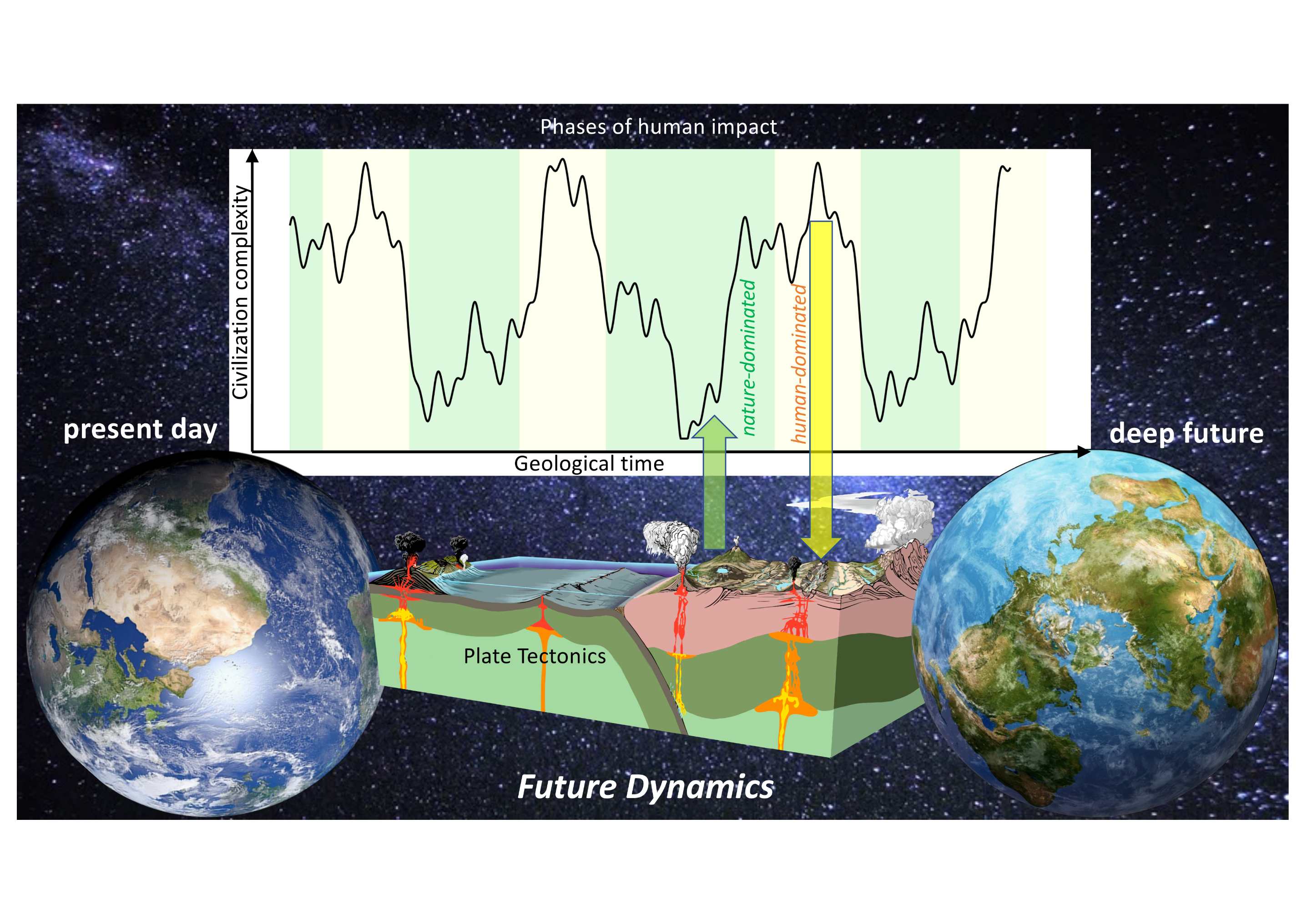
Recent studies of the likelihood of intelligent life in our galaxy suggest that we may be the only technological civilization. This imposes a profound responsibility on us to safeguard the resilient future of intelligence and technology in the galaxy. Therefore, ensuring that our civilization endures for millions of years is a prime scientific and moral priority. Our current influence on Earth’s systems is undeniable, yet it remains superficial compared to the planet’s long-term biogeodynamical evolution processes. By studying Earth’s deep past and thinking on geological timescales, we can learn how to better navigate the deep future. At present, a guiding science-based paradigm for long-term survival of human civilization is missing and the research of the Earth-Life-Human system future focuses on relatively short-term timescales (decades, centuries). Here, we formulate the missing paradigm by presenting four core theses and studying their cultural, scientific and societal consequences. We begin with our motivation---that ours may be the only technologically advanced civilization in the galaxy and thus is precious. Next, we explore the greatest implication of our uniqueness---that we have a duty to ensure the long-term survival of our civilization, for the sake of the galaxy as well as our descendants. We then explore ways to do this, by consciously aligning civilization with solid Earth tempos and cycles. Finally, we propose “Future Dynamics”---a new interdisciplinary field focused on ensuring civilization’s long-term survival by defining, modeling and quantifying potential future trajectories of the coupled Earth-Life-Human system over geological timescales.
- Open Access
- Article
The Long-Term Survival of Human Civilization: A Science-Based Paradigm
Author Information
Received: 28 Sep 2025 | Revised: 09 Oct 2025 | Accepted: 14 Oct 2025 | Published: 21 Oct 2025
Abstract
Graphical Abstract
References
- 1.
Moynihan, T. Existential risk and human extinction: An intellectual history. Futures 2020, 116, 102495.
- 2.
Bostrom, N. Existential risk prevention as global priority. Glob. Policy 2013, 4, 15–31.
- 3.
Roman, S. Theories and models: Understanding and predicting societal collapse. In The Era of Global Risk; Open Book Publishers: Cambridge, UK, 2023; pp. 27–54.
- 4.
Vinn, O. Potential incompatibility of inherited behavior patterns with civilization: Implications for Fermi paradox. Sci. Prog. 2024, 107, 1–6.
- 5.
Maccone, C. Thestatistical Drake equation. In Mathematical SETI: Statistics, Signal Processing, Space Missions; Springer: Berlin/Heidelberg, Germany, 2012; pp. 3–72.
- 6.
Prantzos, N. Fermi Paradox. In Encyclopedia of Astrobiology; Springer: Berlin/Heidelberg, Germany, 2023; pp. 1036–1037.
- 7.
Ward, P.; Brownlee, D. Rare Earth: Why Complex Life Is Uncommon in the Universe; Springer: New York, NY, USA, 2000; p. 333.
- 8.
Stern, R.J.; Gerya, T.V. The importance of continents, oceans and plate tectonics for the evolution of complex life: implications for finding extraterrestrial civilizations. Sci. Rep. 2024, 14, 8552.
- 9.
Lammer, H.; Scherf, M.; Sproß, L. Eta-Earth revisited I: A formula for estimating the maximum number of Earthlike habitats. Astrobiology 2024, 24, 897–915.
- 10.
Holland, H.D. The Chemical Evolution of the Atmosphere and Oceans; Princeton University Press: Princeton, NJ, USA, 1984; p. 598.
- 11.
Kellermann, K.I.; Bouton, E.N.; Brandt, S.S. Is anyone out there? In Open Skies: The National Radio Astronomy Observatory and Its Impact on US Radio Astronomy; Kellermann, K.I., Bouton, E.N., Brandt, S.S., Eds.; Springer: Cham, Switzerland, 2020; pp. 229–262.
- 12.
Wright, J.T.; Kanodia, S.; Luber, E. How much SETI has been done? Finding needles in the n-dimensional cosmic haystack. Astr. J. 2018, 156, 260.
- 13.
Tremblay, C.D.; Tingay, J.J. A SETI survey of the Vela region using the Murchison Widefield array: Orders of magnitude expansion in search space. Proc. Astr. Soc. Aust. 2020, 37, e035.
- 14.
Oliver, B.M. Rationale for the water hole. Acta Astronaut. 1979, 6, 71–79.
- 15.
Ball, J.A. The zoo hypothesis. Icarus 1973, 19, 347–349.
- 16.
Crossley, R. Percival Lowell and the history of Mars.Mass. Rev. 2000, 41, 297–318.
- 17.
Wells, H.G. The War of the Worlds; William Heinemann: London, UK, 1898.
- 18.
Hunziker, S.; Schmid, H.M.; Mouillet, D.; et al. RefPlanets: Search for reflected light from extrasolar planets with SPHERE/ZIMPOL. Astron. Astrophys. 2020, 634, A69.
- 19.
Schwieterman, E.W.; Leung, M. An overview of exoplanet biosignatures available. Rev. Mineral. Geochem. 2024, 90, 465–514.
- 20.
Catling, D.C.; Zahnle, K.J. The Archean atmosphere. Sci. Adv. 2020, 6, eaax1420.
- 21.
Zerkle, A.L. Biogeodynamics: bridging the gap between surface and deep Earth processes. Phil. Trans. R. Soc. A 2018, 376, 20170401.
- 22.
Spencer, C.J. Biogeodynamics: Coupled evolution of the biosphere, atmosphere, and lithosphere. Geology 2022, 50, 867–868.
- 23.
Stern, R.J.; Gerya, T.V. Co-evolution of life and plate tectonics: The biogeodynamic perspective on the Mesoproterozoic-Neoproterozoic transitions. In Dynamics of Plate Tectonics and Mantle Convection; Duarte, J., Ed.; Elsevier: Amsterdam, The Netherlands, 2023; pp. 295–319.
- 24.
Rogger, J.; Mills, B.; Gerya, T.V.; Pellissier, L. Speed of thermal adaptation of the terrestrial vegetation alters Earth’s long-term climate. Sci. Adv. 2024, 10, eadj4408.
- 25.
Wilkinson, B.H. Humans as geologic agents: A deeptime perspective. Geology 2005, 33, 161–164.
- 26.
Cooper, A.H.; Brown, T.J.; Price, S.J.; et al. Humans are the most significant global geomorphological driving force of the 21st century. Anthr. Rev. 2018, 5, 222–229.
- 27.
Gott, J.R., III. Implications of the Copernican principle for our future prospects. Nature 1993, 363, 315–319.
- 28.
Wilson, E.O. Biodiversity; National Academy Press: Washington, DC, USA, 1988; p. 521.
- 29.
Raup, D.M. Biological extinction in earth history. Science 1986, 231, 1528–1533.
- 30.
Alroy, J. Dynamics of origination and extinction in the marine fossil record. Proc. Natl. Acad. Sci. U. S. A. 2008, 105, 11536–11542.
- 31.
Stanley, S.M. A theory of evolution above the species level. Proc. Natl. Acad. Sci. USA 1975, 72, 646–650.
- 32.
Donahoe, J.W. Reflections on behavior analysis and evolutionary biology: A selective review of evolution since Darwin—The first 150 years. J. Exp. Anim. Behav. 2012, 97, 249–260.
- 33.
Donahoe, J.W. Biological Behaviorism. In Contemporary Behaviorisms in Debate; Zilio, D.D.; Carrara, K., Eds.; Springer International Publishing: Cham, Switzerland, 2021; pp. 113–135.
- 34.
Georgiev, A.V.; Klimczuk, A.C.; Traficonte, D.M.; et al. When violence pays: a cost-benefit analysis of aggressive behavior in animals and humans. Evol. Psychol. 2013, 11, 678–699.
- 35.
Ceballos, G.; Ehrlich, P.R.; Barnosky, A.D.; et al. Accelerated modern human—Induced species losses: Entering the sixth mass extinction. Sci. Adv. 2015, 1, e1400253.
- 36.
Zalasiewicz, J.; Adeney Thomas, J.; Waters, C.N.; et al. The meaning of the Anthropocene: why it matters even without a formal geological definition. Nature 2024, 632, 980–984.
- 37.
Wignall, P.B.; Bond, D.P. The great catastrophe: causes of the Permo-Triassic marine mass extinction. Natl. Sci. Rev. 2024, 11, nwad273.
- 38.
Jablonski, D.; Edie, S.M. Mass extinctions and their rebounds: A macroevolutionary framework. Paleobiology 2025, 51, 83–96.
- 39.
Rogger, J.; Judd, E.J.; Mills, B.J.W.; et al. Biogeographic climate sensitivity controls Earth system response to large igneous province carbon degassing. Science 2024, 385, 661–666.
- 40.
Neubauer, T.A.; Hauffe, T.; Silvestro, D.; et al. Current extinction rate in European freshwater gastropods greatly exceeds that of the late Cretaceous mass extinction. Commun. Earth Environ. 2021, 2, 97.
- 41.
Brunetti, M.; Ragon, C.N. Attractors and bifurcation diagrams in complex climate models. Phys. Rev. E 2023, 107, 054214.
- 42.
Ragon, C.; V´erard, C.; Kasparian, J.; et al. Alternative climatic steady states for the Permian-Triassic paleogeography. EGUsphere 2023, 1–31. https://doi.org/10.5194/egusphere-2023-1808.
- 43.
Stocker, T.F.; Jones, R.G.; Hegglin, M.I.; et al. Reflecting on the science of climate tipping points to inform and assist policy making and address the risks they pose to society. Surv. Geophys. 2025, 46, 421–442.
- 44.
Ellis, E.C.; Malhi, Y.; Ritchie, H.; et al. An aspirational approach to planetary futures. Nature 2025, 642, 889–899.
- 45.
Tainter, J. The Collapse of Complex Societies; Cambridge University Press: Cambridge, UK, 1988.
- 46.
Turchin, P.; Nefedov, S.A. Secular Cycles; Princeton University Press: Princeton, NJ, USA, 2009.
- 47.
Cumming, G.S.; Peterson, G.D. Unifying research on social–ecological resilience and collapse. Trends Ecol. Evol. 2017, 32, 695–713.
- 48.
Roman,S.Historical dynamics of the Chinese dynasties. Heliyon 2021, 7, e07253.
- 49.
Bardi, U. The Seneca Effect: Why Growth Is Slow but Collapse Is Rapid; Springer: Cham, Switzerland, 2017.
- 50.
Roman, S.; Palmer, E. The growth and decline of the Western Roman Empire: Quantifying the dynamics of army size, territory, and coinage. Cliodynamics 2019, 10, 76–98.
- 51.
Diamond, J. Collapse: How Societies Choose to Fail or Succeed; Penguin: New York, NY, USA, 2005.
- 52.
Roman, S.; Bullock, S.; Brede, M. Coupled societies are more robust against collapse: A hypothetical look at Easter Island. Ecol. Econ. 2017, 132, 264–278.
- 53.
Roman, S.; Palmer, E.; Brede, M. The dynamics of human–environment interactions in the collapse of the Classic Maya. Ecol. Econ. 2018, 146, 312–324.
- 54.
Turchin, P. Historical Dynamics: Why States Rise and Fall; Princeton University Press: Princeton, NJ, USA, 2003.
- 55.
Roman, S.; Bertolotti, F. Global history, the emergence of chaos and inducing sustainability in networks of socioecological systems. PLoS ONE 2023, 18, e0293391.
- 56.
Meadows, D.H.; Randers, J.; Meadows, D.L. Limits to Growth: The 30-Year Update; Chelsea Green: Post Mills, VT, USA, 2004.
- 57.
Bardi, U. The Limits to Growth Revisited; Springer: Berlin, Germany, 2011.
- 58.
Currie, A.M.; ´ O h´ Eigeartaigh, S. Working together to face humanity’s greatest threats: Introduction to the Future of Research on Catastrophic and Existential Risk. Futures 2018, 102, 1–5.
- 59.
Janssen, M.A.; Kohler, T.A.; Scheffer, M. Sunk cost effects and vulnerability to collapse in ancient societies. Curr. Anthropol. 2003, 44, 722–728.
- 60.
Pierson, P. Increasing returns, path dependence, and the study of politics. Am. Political Sci. Rev. 2000, 94, 251–267.
- 61.
Janssen, M.A.; Anderies, J.M.; Ostrom, E. Robustness of social-ecological systems to spatial and temporal variability. Soc. Nat. Resour. 2003, 16, 99–112.
- 62.
Ostrom, E. Understanding Institutional Diversity; Princeton University Press: Princeton, NJ, USA, 2005.
- 63.
Lyon, C.; Saupe, E.E.; Smith, C.J.; et al. Climate change research and action must look beyond 2100. Glob. Chang. Biol. 2022, 28, 349–361.
- 64.
Rubin, D.C. Memory in Oral Traditions: The Cognitive Psychology of Epic, Ballads, and Counting-Out Rhymes; Oxford University Press: Oxford, UK, 1995.
- 65.
Nunn, P.D.; Reid, N.J. Aboriginal memories of inundation of the Australian coast dating from more than 7000 years ago. Aust. Geogr. 2016, 47, 11–47.
- 66.
Dalley, S. Myths from Mesopotamia: Creation, the Flood, Gilgamesh, and Others; Oxford University Press: Oxford, UK, 2000.
- 67.
Duranti, L. Long-term preservation of digital records. Proc. IEEE 2010, 98, 299–305.
- 68.
Tonn, B.E. Designing futures for multiple timescales. Technol. Forecast. Soc. Chang. 1999, 62, 45–73.
- 69.
Krznaric, R. The GoodAncestor: HowtoThinkLongTerm in a Short-Term World; WH Allen: London, UK, 2020.
- 70.
Lenton, T.M.; Watson, A.J. Revolutions that Made the Earth; Oxford University Press: Oxford, UK, 2011.
- 71.
Rockstr¨om, J.; Steffen, W.; Noone, K.; et al. A safe operating space for humanity. Nature 2009, 461, 472–475.
- 72.
Mason, A.; Lee, R.; members of the NTA Network. Six ways population change will affect the global economy. Popul. Dev. Rev. 2022, 48, 1–268.
- 73.
Pellissier, L.; Heine, C.; Rosauer, D.F.; et al. Are global hotspots of endemic richness shaped by plate tectonics? Biol. J. Linn. Soc. 2017, 123, 247–261.
- 74.
Mallard, C.; Coltice, N.; Seton, M.; et al. Subduction controls the distribution and fragmentation of Earth’s tectonic plates. Nature 2016, 535, 140–143.
- 75.
Salles, T.; Husson, L.; Rey, P.; et al. Hundred million years of landscape dynamics from catchment to global scale. Science 2023, 379, 918–923.
- 76.
Salles, T.; Husson, L.; Lorcery, M.; et al. Landscape dynamics and the Phanerozoic diversification of the biosphere. Nature 2023, 624, 115–121.
- 77.
Way, M.J.; Davies, H.S.; Duarte, J.C.; et al. The climates of Earth’s next supercontinent: Effects of tectonics, rotation rate, and insolation. Geochem. Geophys. Geosyst. 2021, 22, e2021GC009983.
- 78.
Davies, H.S.; Green, J.A.M.; Duarte, J.C. Back to the future II: tidal evolution of four supercontinent scenarios. Earth Syst. Dynam. 2020, 11, 291–299.
- 79.
Mitchell, R. The Next Supercontinent: Solving the Puzzle of a Future Pangea; University of Chicago Press: Chicago, IL, USA, 2023; p. 304.
- 80.
Chaverot, G.; Bolmont, E.; Turbet, M. First exploration of the runaway greenhouse transition with a 3D General Circulation Model. Astron. Astrophys. 2023, 680, A103.
- 81.
Kvashnina, K.; Claret, F.; Clavier, N.; et al. Long-term, sustainable solutions to radioactive waste management. Sci. Rep. 2024, 14, 5907.
- 82.
Brunner, C.; Hausfather, Z.; Knutti, R. Durability of carbon dioxide removal is critical for Paris climate goals. Commun. Earth Environ. 2024, 5, 645.
- 83.
Zabel, F.; Delzeit, R.; Schneider, J.M.; et al. Global impacts of future cropland expansion and intensification on agricultural markets and biodiversity. Nat. Commun. 2019, 10, 2844.
- 84.
Beyer, R.M.; Hua, F.; Martin, P.A.; et al. Relocating croplands could drastically reduce the environmental impacts of global food production. Commun. Earth Environ. 2022, 3, 49.
- 85.
Callahan, C.W.; Mankin, J.S. Carbon majors and the scientific case for climate liability. Nature 2025, 640, 893–901.

How to Cite
Gerya, T. V., Stern, R. J., Turner, F., & Roman, S. (2026). The Long-Term Survival of Human Civilization: A Science-Based Paradigm. Habitable Planet, 2(1), 1–13. https://doi.org/10.63335/j.hp.2025.0022
RIS
BibTex
Copyright & License

Copyright (c) 2025 by the authors.
This work is licensed under a Creative Commons Attribution 4.0 International License.
Article Metrics
2,246
Article Views
1
Citations
Contents
References

 Suite 4002 Level 4, 447 Collins Street, Melbourne, Victoria 3000, Australia
 General Inquiries: info@sciltp.com